

The Best B2B Prospecting Tools for Enterprise Teams in 2026
It's Q4. Finance flags a ZoomInfo renewal, and only 4 of your 12 reps actually log in. The East Coast team uses ZoomInfo, EMEA bought Cognism seats six months ago, and three SDRs quietly signed up for Apollo on a corporate card. You've got three databases, three billing cycles, and a RevOps lead drowning in deduplication.
This is the reality nobody talks about in generic listicles - and it's why choosing the right stack requires a completely different evaluation framework than "which tool has the most contacts."
Enterprise deals involve 8+ stakeholders on average, 86% of B2B purchases stall, and your reps spend 40% of their working hours just looking for the right people to contact. With average B2B cost per lead at $200 and the sales tech market projected to hit $104.5B by 2030, the problem isn't a lack of options. It's picking the right ones and not overpaying.
Our Picks (TL;DR)
| Pick | Best For | Price Anchor | Rationale |
|---|---|---|---|
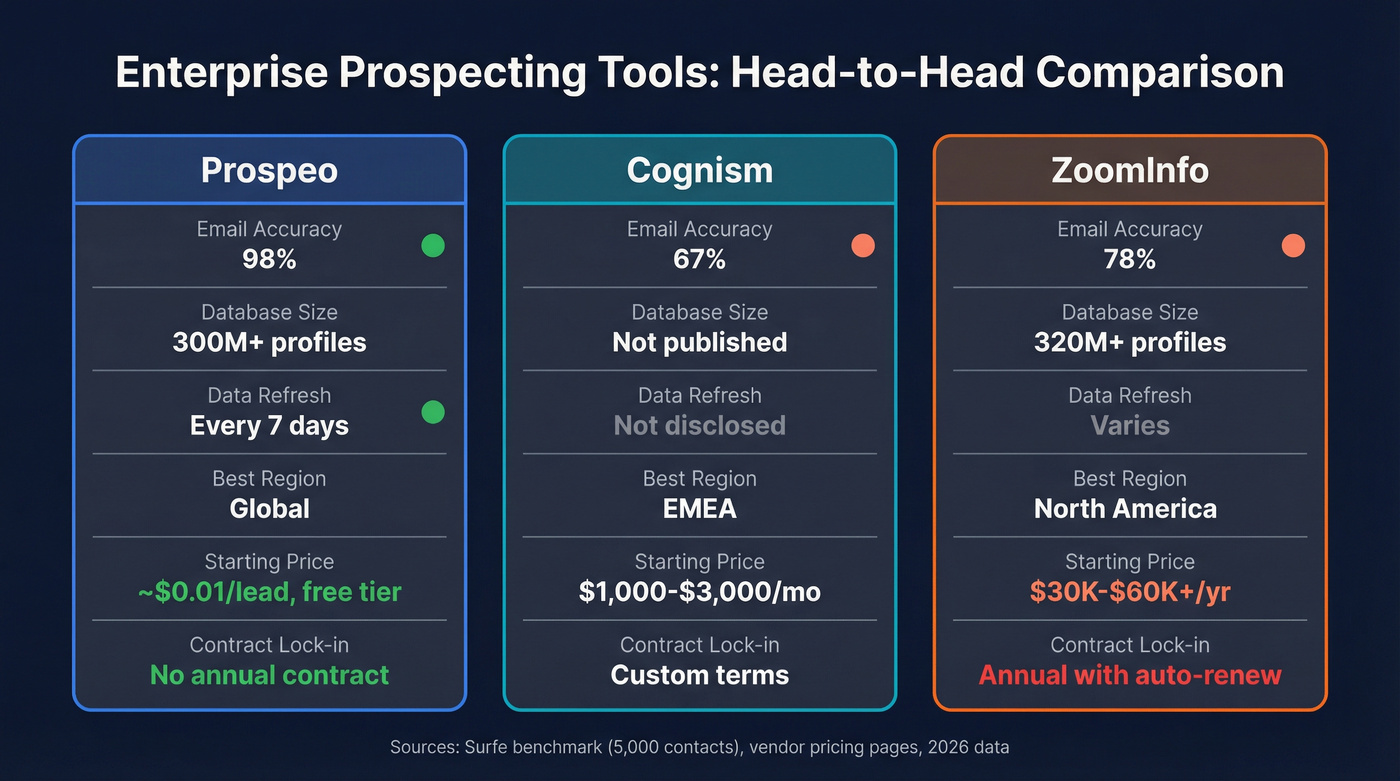
| Prospeo | Data accuracy + self-serve | ~$0.01/lead, free tier | 98% email accuracy, 7-day refresh, Bombora-powered intent across 15,000 topics |
| Cognism | EMEA coverage + compliance | ~$1,000-$3,000/mo | 22% call connect rate, strong EMEA mobile data |
| ZoomInfo | North American depth + ABM | $30K-$60K+/yr | 320M+ profiles - if you can stomach the contract |
What Makes a Tool Enterprise-Ready
Here's the thing: if a prospecting platform doesn't offer these capabilities in its enterprise tier, it's not enterprise-ready. It's just expensive.
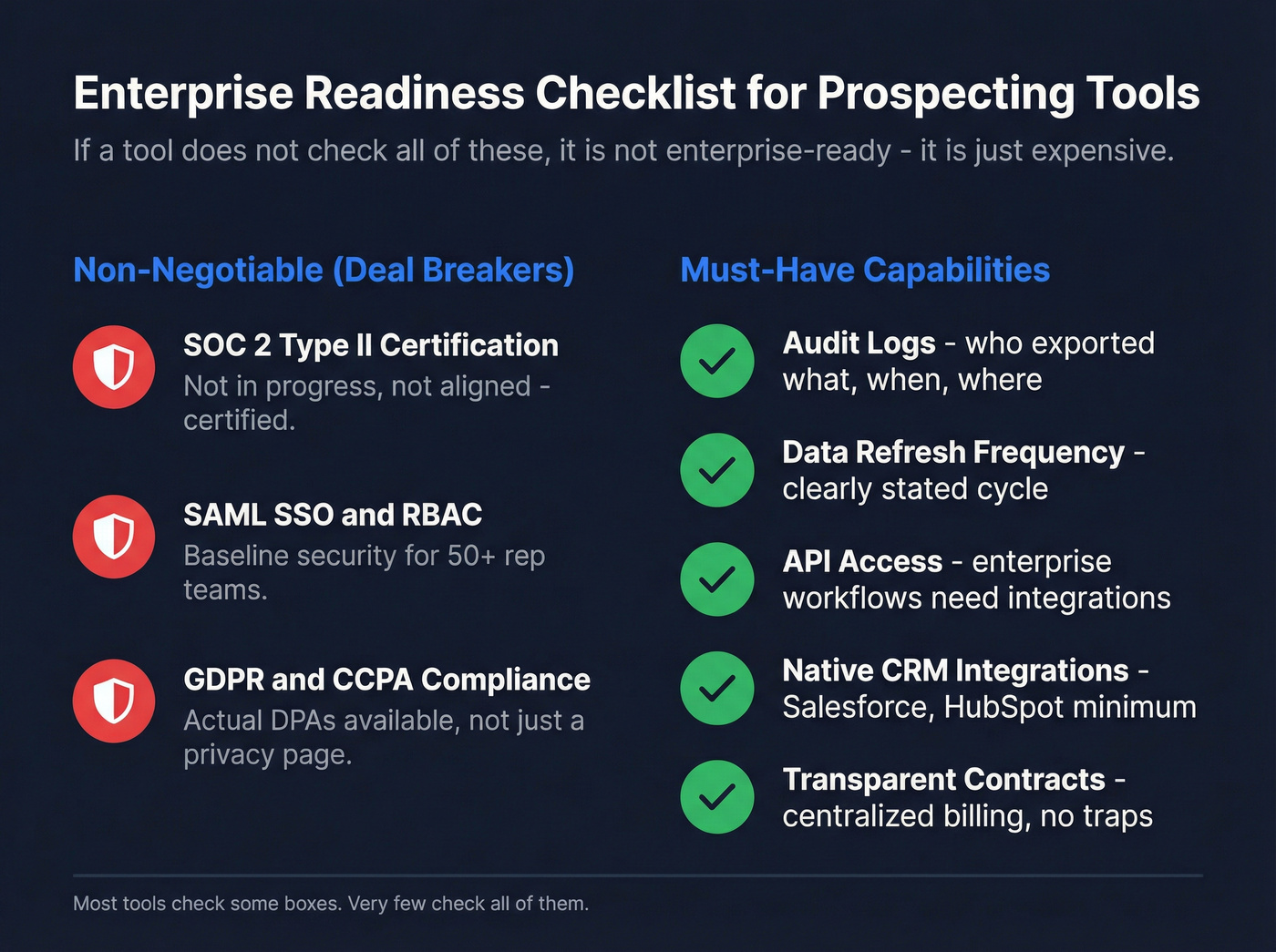
Your compliance team will block the deal without SOC 2 Type II certification - not "in progress," not "aligned." Certified. SAML SSO and RBAC aren't nice-to-haves when you've got 50+ reps across regions; they're baseline security requirements. GDPR and CCPA compliance means actual DPAs available, not just a privacy policy page. These three items are non-starters for any enterprise procurement process.
Beyond security, evaluate these capabilities:
- Audit logs - who exported what, when, and where it went
- Data refresh frequency - how often does the database update? If the vendor can't answer clearly, that's a red flag.
- API access - enterprise workflows run on integrations, not manual exports
- CRM integrations - native Salesforce and HubSpot connections at minimum, plus sequencer support
- Transparent contract terms, centralized user management, and consolidated invoicing
Most tools check some of these boxes. Very few check all of them.
Data Quality Benchmarks That Matter
Database size is a vanity metric. What matters is whether the email you pull actually reaches a human inbox and whether the phone number connects to the right person.
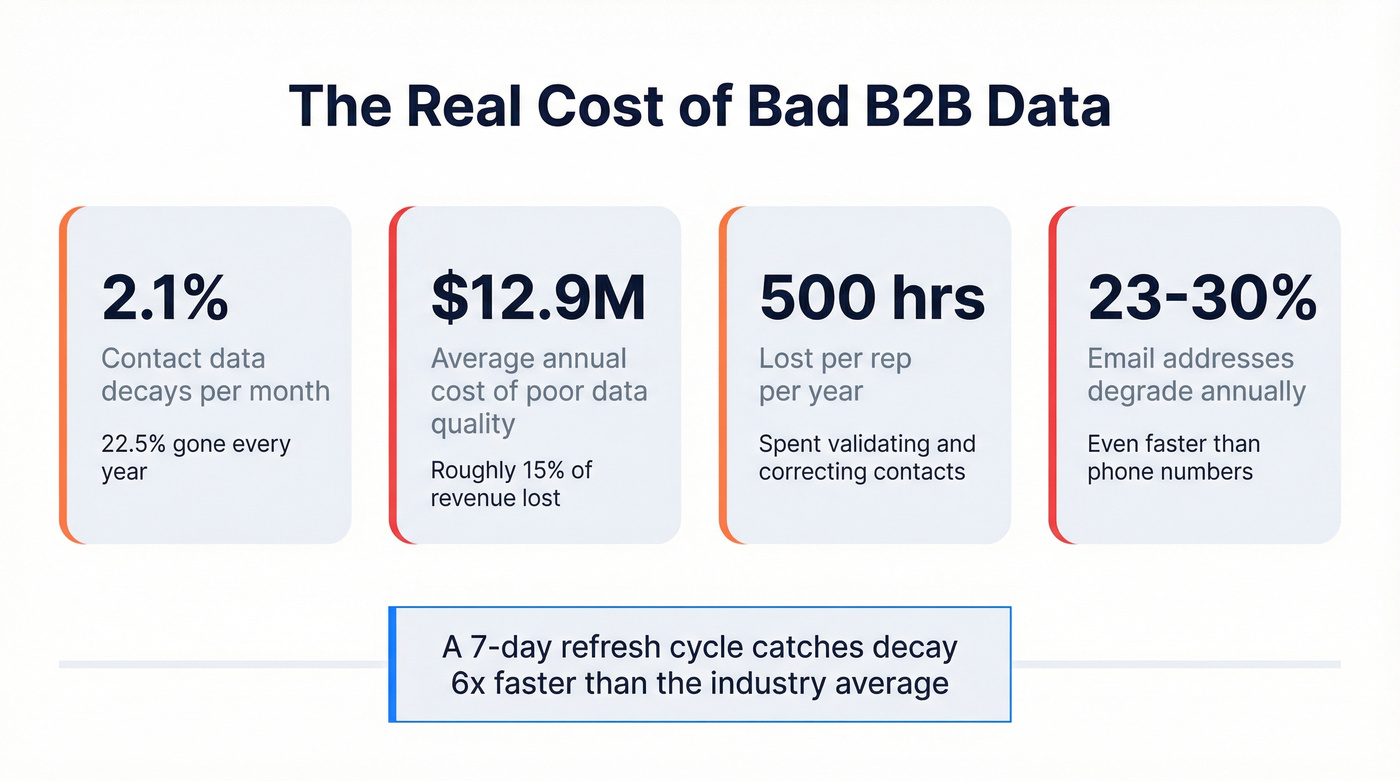
B2B contact data decays at 2.1% per month - that's 22.5% annually. Emails degrade even faster, at 23-30% per year. Poor data quality costs organizations an average of $12.9M per year and roughly 15% of revenue. Your reps lose an estimated 500 hours per year just validating and correcting contact information, which is time they should be spending on actual selling.
A Surfe benchmark test of 5,000 contacts across regions and industries tells the story:
| Provider | Email Find (US / Global) | Email Quality | Mobile Find | Mobile Quality |
|---|---|---|---|---|
| ZoomInfo | 65% / 35% | 78% | 39% | <50% |
| Cognism | 68% / 68% | 67% | 46% | 67% |
Neither delivers consistent global accuracy at scale. ZoomInfo dominates the US; Cognism wins on mobile quality in EMEA. But look at those global email find rates - 35% from ZoomInfo means two-thirds of your international prospects come back empty.
Prospeo's 98% email accuracy outperforms ZoomInfo (87%) and Apollo (79%), and teams using Prospeo book 26% more meetings than ZoomInfo users and 35% more than Apollo users. The 7-day refresh cycle means data gets refreshed 6x more frequently than the industry average.

Top Enterprise Prospecting Platforms
Data and Contact Intelligence
Prospeo
Use this if: You need the highest email accuracy in the market, want self-serve access without a sales cycle, or you're tired of paying $40K+ for data that bounces 20% of the time.
Prospeo's database covers 300M+ professional profiles, drawn from 800M+ collected records that go through a proprietary 5-step verification process - catch-all handling, spam-trap removal, and honeypot filtering included. Unlike most competitors that aggregate from third-party email providers, Prospeo runs its own email-finding infrastructure. That yields 143M+ verified emails at 98% accuracy and 125M+ verified mobile numbers with a 30% pickup rate, all refreshed every 7 days. Over 15,000 companies use it.
Search filters span 30+ criteria: Bombora intent data across 15,000 topics, technographics, job changes, headcount growth, and funding rounds. Native integrations cover Salesforce, HubSpot, Outreach, Salesloft, Clay, Smartlead, Instantly, and Lemlist.
Two proof points worth calling out. Snyk deployed Prospeo across 50 AEs prospecting 4-6 hours per week. Within the first quarter, bounce rates dropped from 35-40% to under 5%, AE-sourced pipeline increased 180%, generating 200+ new opportunities per month. Meritt tripled weekly pipeline from $100K to $300K after switching, with bounce rates dropping from 35% to under 4%.
Pricing runs ~$0.01 per email with a free tier (75 emails + 100 Chrome extension credits/month). No annual contracts. No sales calls required.

ZoomInfo
Let's start with the money, because that's what will dominate your procurement conversations.
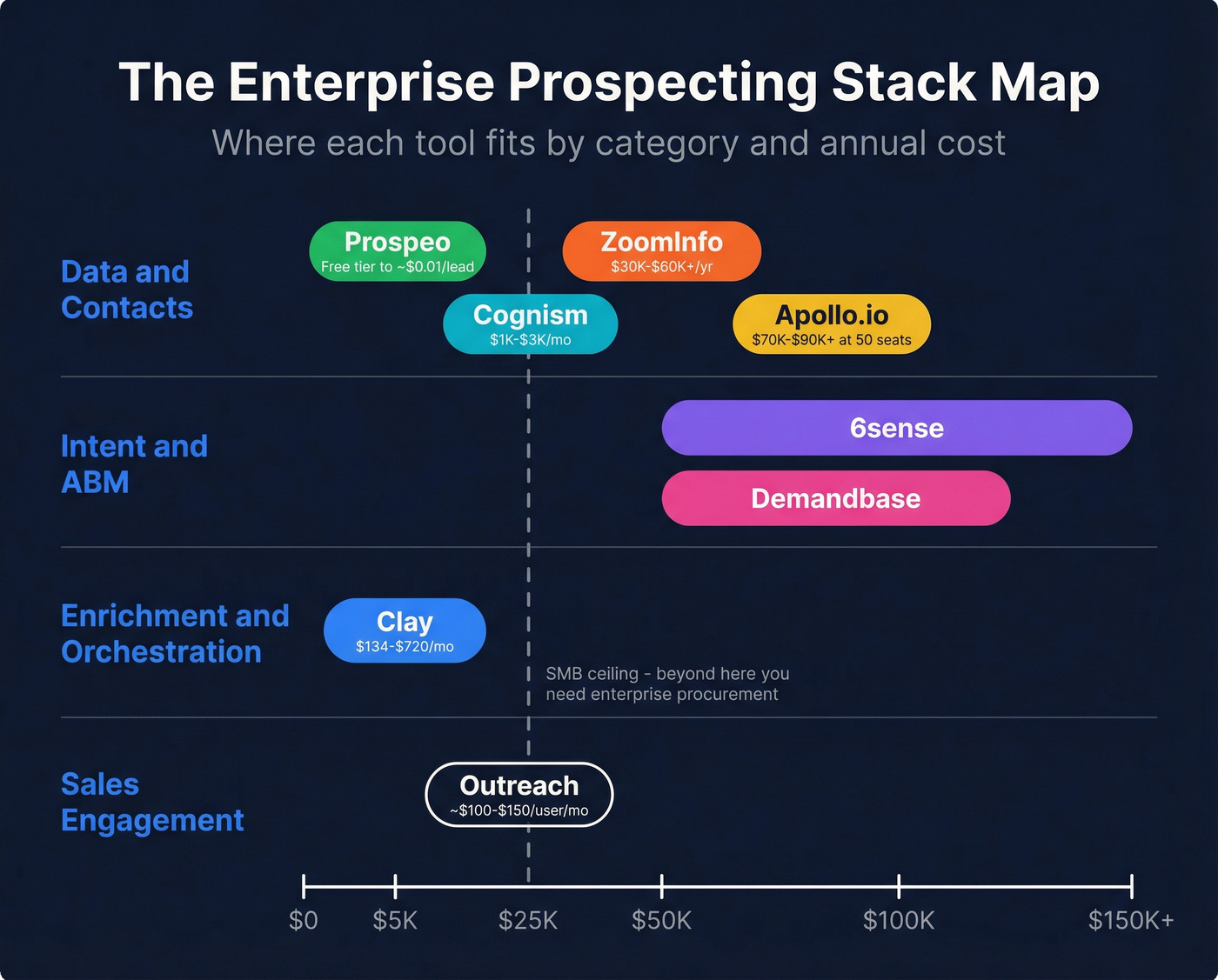
Professional tier starts at $15K-$18K/year for 3 seats with ~5,000 bulk credits. Advanced runs $25K-$30K. Elite hits $40K-$45K+. But real-world totals land $30K-$60K+ once you add seats ($2K-$5K each), credit overages ($0.25-$0.50 per credit), and add-ons like Enrich Data ($10K-$15K/year) or Global Data Passport ($10K+/year). Unused credits don't roll over.
The contract structure is the real issue. Annual-only terms with auto-renewal requiring 60-90 day cancellation notice. Renewal increases of 10-20% are standard. And there's a data-destroy clause - if you cancel, you may need to delete ZoomInfo-sourced data from your CRM. That's a switching cost nobody mentions in the sales demo. The consensus on r/sales threads is that auto-renewal and strict notice windows are among the most common ZoomInfo frustrations.
Best for: North American pipeline with deep firmographic and org-chart needs, and the budget (and legal bandwidth) for a complex contract. Skip this if: You sell globally, have fewer than 10 reps, or your finance team hates auto-renewal traps. The 320M+ profile database is the strongest in the US, but 35% global email find rates make it a poor choice for international teams.
Cognism
The numbers make the case: a 22% call connect rate versus ZoomInfo's 14% and a 90%+ match rate compared to ZoomInfo's 75%+. For teams selling into Europe, Cognism is consistently one of the strongest options for EMEA mobile data and GDPR-compliant workflows.
Intent data comes via Bombora, same as several competitors. Cognism positions itself as having no hidden platform fees or credit ceilings - a refreshing contrast to credit-overage pricing models. Custom pricing typically falls around the $1,000-$3,000/month range for small teams, with no published per-seat rates.
Best for: Teams selling into EMEA where GDPR compliance is mandatory and mobile connect rates matter more than database size. Skip this if: You're US-only and don't need European coverage, or you want published per-seat pricing.
Apollo.io
Apollo is the obvious starting point for SMB and mid-market teams. A generous free tier, published pricing (Basic $49/user/month, Professional $79, Organization $119), and a built-in sequencer make it the fastest path from "we need a prospecting tool" to "we're sending emails."
The enterprise concern is real, though. SSO, permission profiles, and advanced security sit behind the Organization tier. You shouldn't have to pay $119/user/month just to get single sign-on. Credit consumption is a frequent frustration point, and you can't reduce seats mid-term.
For a 50-person sales org, Apollo's list price is about $71K/year at the Organization tier (50 x $119 x 12) before overages; with typical credit overages, total cost often lands $70K-$90K+. At that point, you're in ZoomInfo territory without ZoomInfo's North America depth.
Our take: If your ACV is under $15K and your team is under 20 reps, Apollo is genuinely great. The moment you cross either threshold, the economics and security gating start working against you.
Intent and ABM Platforms
6sense
6sense is an enterprise intent platform for teams that want AI-driven predictive analytics and in-market account identification. It scores accounts based on buying signals, maps anonymous website visitors to companies, and orchestrates outreach timing based on predicted purchase windows. Implementation is significant and usually requires a dedicated ABM team. Expect $50K-$150K+ per year. Best for large organizations with mature ABM programs and the budget to match.
Demandbase
Demandbase takes a different angle as an ABX platform unifying marketing, sales, and customer success. Its strongest differentiator versus 6sense is the advertising component - targeted display ads to specific accounts with cross-channel engagement measurement. Pricing sits in the $50K-$120K+ per year range. Data accuracy concerns and implementation complexity are common tradeoffs. Best for marketing-led ABM programs where ad spend is a core component of account engagement.
Enrichment and Orchestration
Clay
Clay has become the darling of RevOps teams who've given up on finding one perfect data provider. Its waterfall enrichment approach queries 150+ data sources sequentially - if Provider A misses a contact, Provider B tries, then C. The result is 85-95% find rates versus 50-60% from any single source. Over 300,000 GTM teams use it.
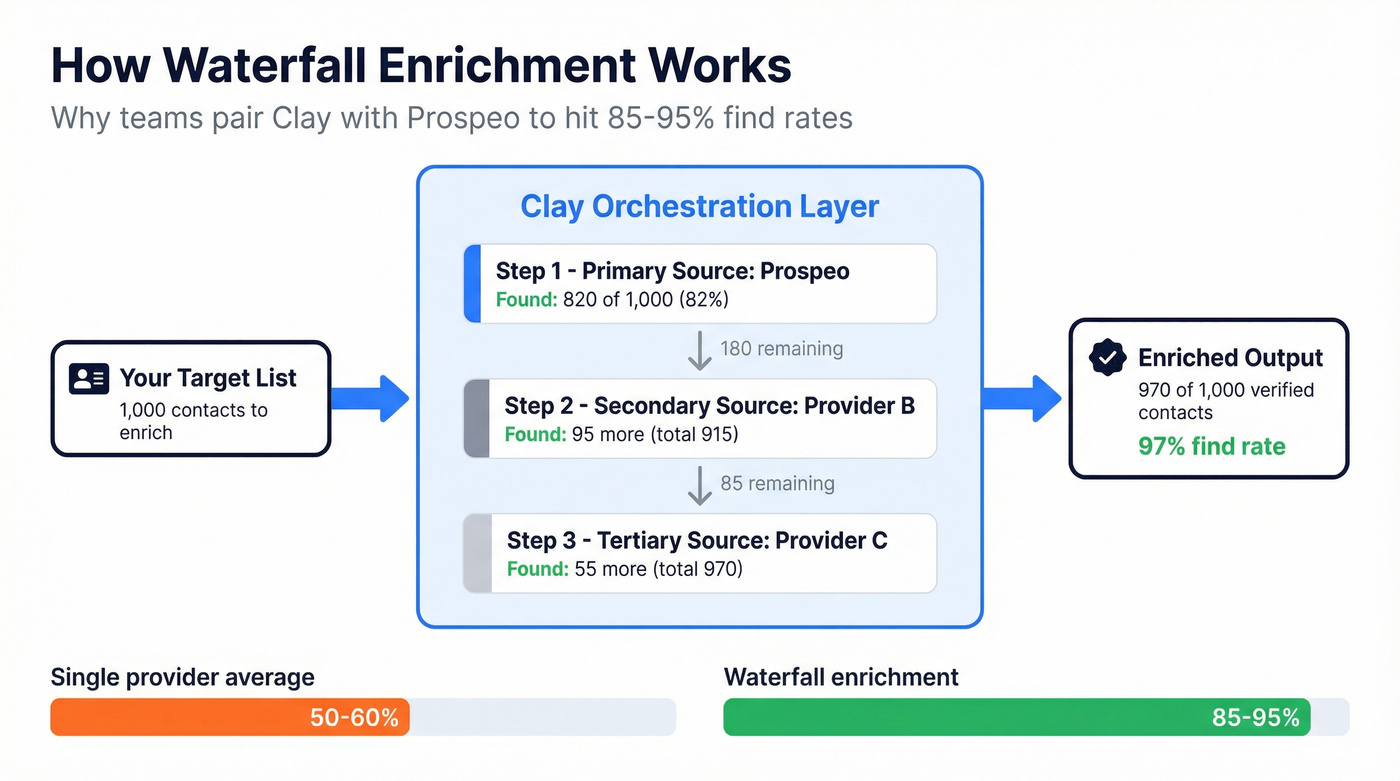
Pricing runs on credits: free tier gives you 1,200 credits/year, Starter $134/month, Explorer $314, Pro $720, and Enterprise is custom. It's not a standalone prospecting tool - think of it as the orchestration layer that makes your other tools work better together. We've seen teams pair Clay with Prospeo as a primary data source and fill gaps with secondary providers, which consistently outperforms relying on any single database.
Sales Engagement
Outreach
Outreach is the enterprise sales engagement platform many large teams default to. It handles multi-channel sequences (email, phone, social), call recording, and meeting scheduling across Engage, Call, and Meet modules - each priced separately. Expect ~$100-$150/user/month, quote-only. SOC 2, GDPR, and ISO-aligned. In our experience, teams take 2-3 months to fully adopt it. But once it's running, the structured workflow enforcement is hard to beat at scale.
Quick Mentions
| Tool | Best For | Starting Price | Enterprise Ready? |
|---|---|---|---|
| Salesloft | Structured sequences | ~$100-$150/user/mo | Yes (SOC 2, GDPR, SSO) |
| LinkedIn Sales Nav | Relationship-based prospecting | $119.99/user/mo (Core) | Partial (no intent, limited enrichment) |
| Lusha | Quick lookups | Free (70 credits/mo) | Limited |
| HubSpot Sales Hub | CRM-native prospecting | Free; Enterprise $150/seat/mo | Yes (onboarding $1.5-$3.5K) |
| Dealfront (Leadfeeder) | European web visitor ID | Free-$99+/mo | Partial |
| Reply.io | AI-assisted outreach | $59-$99/user/mo | Partial |
Lusha's free tier gives you 70 credits per month - fine for individual contributors, not for enterprise-scale outbound.

Snyk deployed Prospeo across 50 AEs and cut bounce rates from 35-40% to under 5% - generating 200+ new opportunities per month. With 300M+ profiles, 98% email accuracy, and a 7-day refresh cycle, enterprise teams get data that actually connects to real buyers. No annual contracts. No sales calls.
Stop paying enterprise prices for data that decays before your reps use it.
Enterprise Pricing Comparison
If your data provider won't publish pricing, that tells you something about their sales process.
| Tool | Starting Price | Enterprise Range | Contract | Watch For |
|---|---|---|---|---|
| Prospeo | Free tier | Scales at ~$0.01/lead | No contract | Nothing |
| ZoomInfo | ~$15K/yr (3 seats) | $30K-$60K+/yr | Annual, auto-renew | Credits, add-ons, seats, data-destroy clause |
| Cognism | Custom | ~$1,000-$3,000/mo | Custom | No hidden platform fees |
| Apollo.io | Free tier | $70K-$90K+/yr (50 seats) | Annual | Credit overages, security gating |
| 6sense | ~$50K/yr | $50K-$150K+/yr | Annual | Implementation timeline |
| Demandbase | ~$50K/yr | $50K-$120K+/yr | Annual | Ad spend, implementation |
| Clay | Free (1,200 credits) | Custom | Monthly available | Credit consumption |
| Outreach | Quote-only | ~$100-$150/user/mo | Annual | Module add-ons |
With email marketing returning $36-$40 per dollar spent, the ROI math favors investing in data accuracy over database size. A transparent, self-serve model means you can test with a free tier and scale without ever talking to a sales rep. ZoomInfo's real cost is 3-4x its published starting price once you factor in the add-ons and seat expansion that enterprise teams inevitably need.
Security and Compliance Checklist
This is table stakes - but it's surprising how many tools gate security features behind their most expensive tiers.
| Tool | SOC 2 | GDPR | SSO/SAML | RBAC | Audit Logs |
|---|---|---|---|---|---|
| Prospeo | ✓ | ✓ (DPAs available) | ✓ | ✓ | ✓ |
| Apollo.io | ✓ | ✓ | Org tier only | Org tier only | Org tier only |
| Outreach | ✓ | ✓ | ✓ | ✓ | ✓ |
| Salesloft | ✓ | ✓ | ✓ | ✓ | ✓ |
| HubSpot Sales Hub | ✓ | ✓ | ✓ | ✓ | ✓ |
| Reply.io | ✓ (enterprise) | ✓ | ✓ (enterprise) | ✓ (enterprise) | ✓ (enterprise) |
Apollo's gating of SSO and RBAC to the Organization tier is the biggest red flag on this chart. Single sign-on is a baseline security requirement, not a premium feature.
Building Your Enterprise Prospecting Stack
The all-in-one prospecting platform is a myth at enterprise scale. We've seen it play out dozens of times - one region has ZoomInfo, another bought Cognism, three SDRs found Apollo, and RevOps is spending 20 hours a week on deduplication. Sound familiar?
The smarter approach is a deliberate, layered stack:
- Intent signals - identify accounts showing buying behavior before you prospect them. Bombora data or dedicated platforms like 6sense.
- Enrichment and verification - turn account signals into verified contact data. This is where 98% email accuracy and 7-day refresh matter most, because your outbound starts clean or it doesn't start at all. (If you want a deeper dive, see data quality scorecards and KPIs.)
- Engagement - structured multi-channel sequences via Outreach or Salesloft. (Use a sales cadence that matches deal complexity.)
- CRM sync - everything flows back to Salesforce or HubSpot as the system of record. (Keep your CRM hygiene tight to avoid duplicates.)
Our recommended stack for most enterprise teams: a high-accuracy data provider like Prospeo for verified contacts and intent signals, Cognism for supplemental EMEA mobile coverage, and Outreach or Salesloft for engagement. For teams that need multi-provider enrichment, add Clay as the orchestration layer. That's a total cost of roughly $3K-$6K/month for a 20-person team - compared to $30K-$60K+/year for ZoomInfo alone.
Contract Gotchas Procurement Should Know
Before your team signs anything, make sure procurement asks these questions:
Auto-renewal windows. ZoomInfo requires 60-90 day cancellation notice. Miss the window and you're locked in for another year at a 10-20% price increase.
Credit rollover. Do unused credits carry over? At ZoomInfo, they don't. You're paying for credits whether you use them or not.
Seat flexibility. Apollo won't let you reduce seats mid-term. ZoomInfo's mid-contract seat additions can trigger a re-quote.
Data portability. ZoomInfo's data-destroy clause means you may need to delete all ZoomInfo-sourced contacts from your CRM upon cancellation. Get your renewal rate in writing before you sign - "we'll discuss at renewal" usually means "we'll raise it 10-20%." (More on procurement math in our guide to the cost of sales tech stack.)
Ask about every one of these before you sign. Better yet, choose providers with transparent, no-contract pricing where none of this applies.
At ~$0.01 per email, Prospeo is 90% cheaper than ZoomInfo with higher accuracy - 98% vs 87%. No auto-renewal traps, no data-destroy clauses, no 60-day cancellation windows. Just 30+ search filters, Bombora intent across 15,000 topics, and native CRM integrations your RevOps team will actually use.
Replace your $40K contract with enterprise-grade data at a fraction of the cost.
FAQ
What's the difference between a prospecting tool and a sales intelligence platform?
A prospecting tool finds contact data - emails and phone numbers - while a sales intelligence platform layers on firmographics, intent signals, technographics, and org charts. Enterprise teams typically need both capabilities, or a single platform that combines verified contact data with intent signals and 30+ search filters.
How much should an enterprise spend on prospecting tools?
Budget $20K-$100K per year for a full stack covering data, intent, and engagement. ZoomInfo alone runs $30K-$60K+/year; intent platforms like 6sense cost $50K-$150K+. Self-serve providers with transparent pricing make it possible to build an enterprise-grade stack at a fraction of legacy cost.
Is ZoomInfo worth it for large sales teams?
For North American coverage, ZoomInfo's 320M+ profile database is strong. But at $30K-$60K+/year with ~35% global email find rates, auto-renewal traps, and data-destroy clauses, many enterprise teams find better ROI combining a high-accuracy provider with regional specialists like Cognism for EMEA coverage.
What's waterfall enrichment and why does it matter?
Waterfall enrichment queries multiple data providers sequentially - if Provider A misses, Provider B tries, then C. Tools like Clay orchestrate this across 150+ sources, achieving 85-95% find rates versus 50-60% from any single provider. It's the enterprise answer to the fact that no single database is complete.
How often should B2B contact data be refreshed?
At minimum monthly, since B2B data decays 2.1% per month - 22.5% annually. The best providers refresh every 7 days; the industry average is 6 weeks. For enterprise outbound at scale, weekly refresh prevents bounce-rate damage to your domain reputation and keeps sequences hitting real inboxes.