

Email Introductions That Actually Get Replies
You've deleted "I hope this email finds you well" for the third time. The cursor blinks after "Hi Sarah," and you've got nothing. Every professional has been stuck on that blank line - knowing the first sentence determines whether someone reads the rest or archives it.
The right introductions for emails aren't clever or creative. They're specific, short, and structured around the recipient. Here's how to write them, backed by data from 16.5 million cold emails and frameworks that work across every scenario.
Three Rules for 90% of Situations
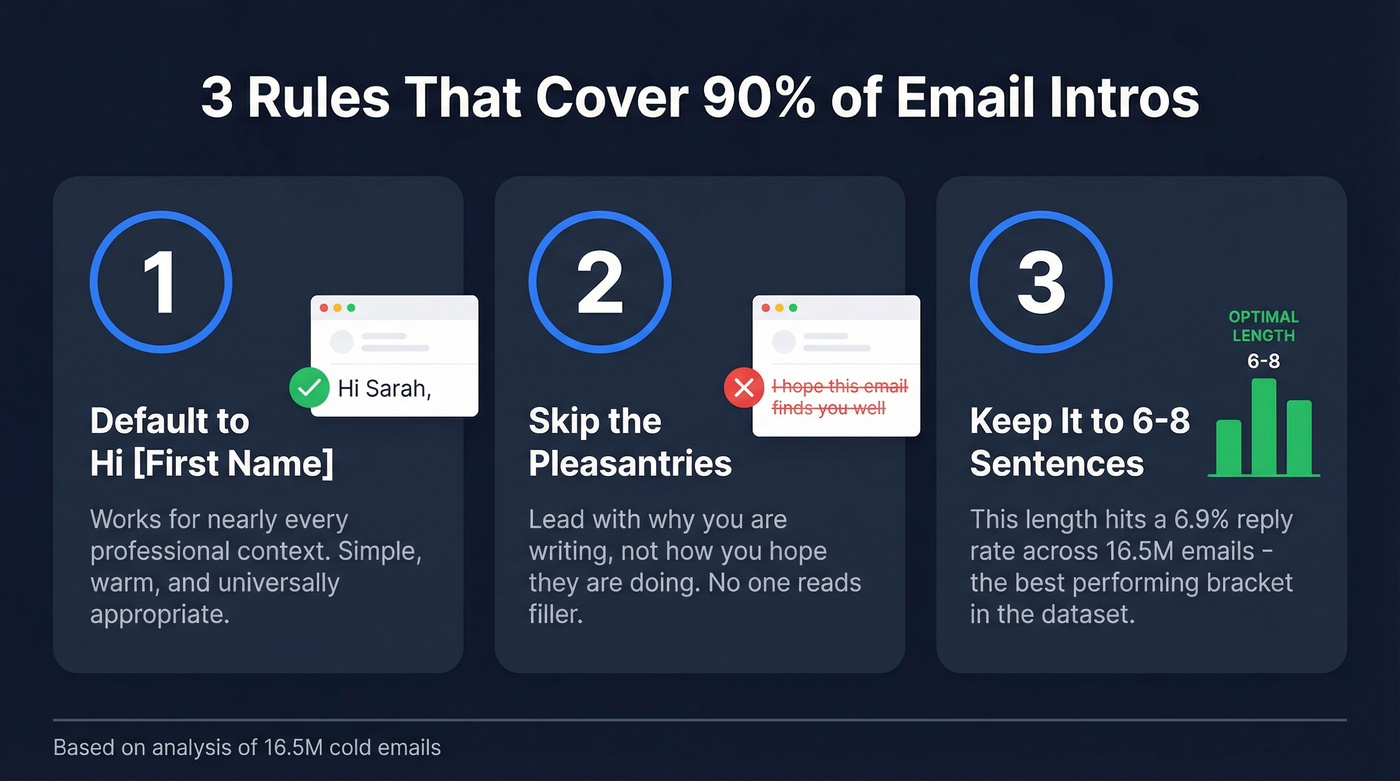
- Default greeting: "Hi [First Name]," - it works for nearly every professional context.
- Skip pleasantries in your opening line. Lead with why you're writing, not how you hope they're doing.
- Keep the whole email to 6-8 sentences. That length hits a 6.9% reply rate across 16.5M emails - the best-performing length bracket in the dataset.
Email Greetings: Quick Reference
Your greeting sets the tone for everything that follows.
| Context | Greeting | When to Use | Avoid Instead |
|---|---|---|---|
| Standard professional | Hi [First Name], | 90% of business emails | Hey / Yo |
| Formal (first contact) | Dear [Full Name], | Legal, academic, exec | Dear Sir or Madam |
| Warm/familiar | Hey [First Name], | Colleagues you know well | Hey there (to strangers) |
| Group (inclusive) | Hi everyone, / Hi team, | Team-wide messages | Hi guys |
| Unknown name | Hello, / Hi there, | When name isn't available | To whom it may concern |
Grammarly's style guide flags honorifics like Mr./Mrs. as risky - they can misgender recipients or assume marital status. When in doubt, use the person's first name. "Dear Sam" is always safer than "Dear Mr. Thompson."
Etiquette expert Jacqueline Whitmore recommends matching the recipient's tone in replies. If they wrote "Dear," respond with "Dear." If they wrote "Hi," mirror that. It's a small signal that you're paying attention.
For group emails, "Hi everyone" or "Hi [department] team" reads as inclusive. "Hi guys" still shows up constantly, but it carries gender connotation that's easy to avoid. And if you're using merge tags, double-check them - nothing kills credibility faster than "Dear [Enter Name Here]" landing in someone's inbox.
What to skip entirely: "To whom it may concern" is overused and impersonal. "Dear Sir or Madam" is dated and non-inclusive.
Professional Opening Lines That Work
You don't need 100 opening lines. You need 3-4 you rotate and test. GMass breaks strong openers into four functions, and that framework holds up well in practice.
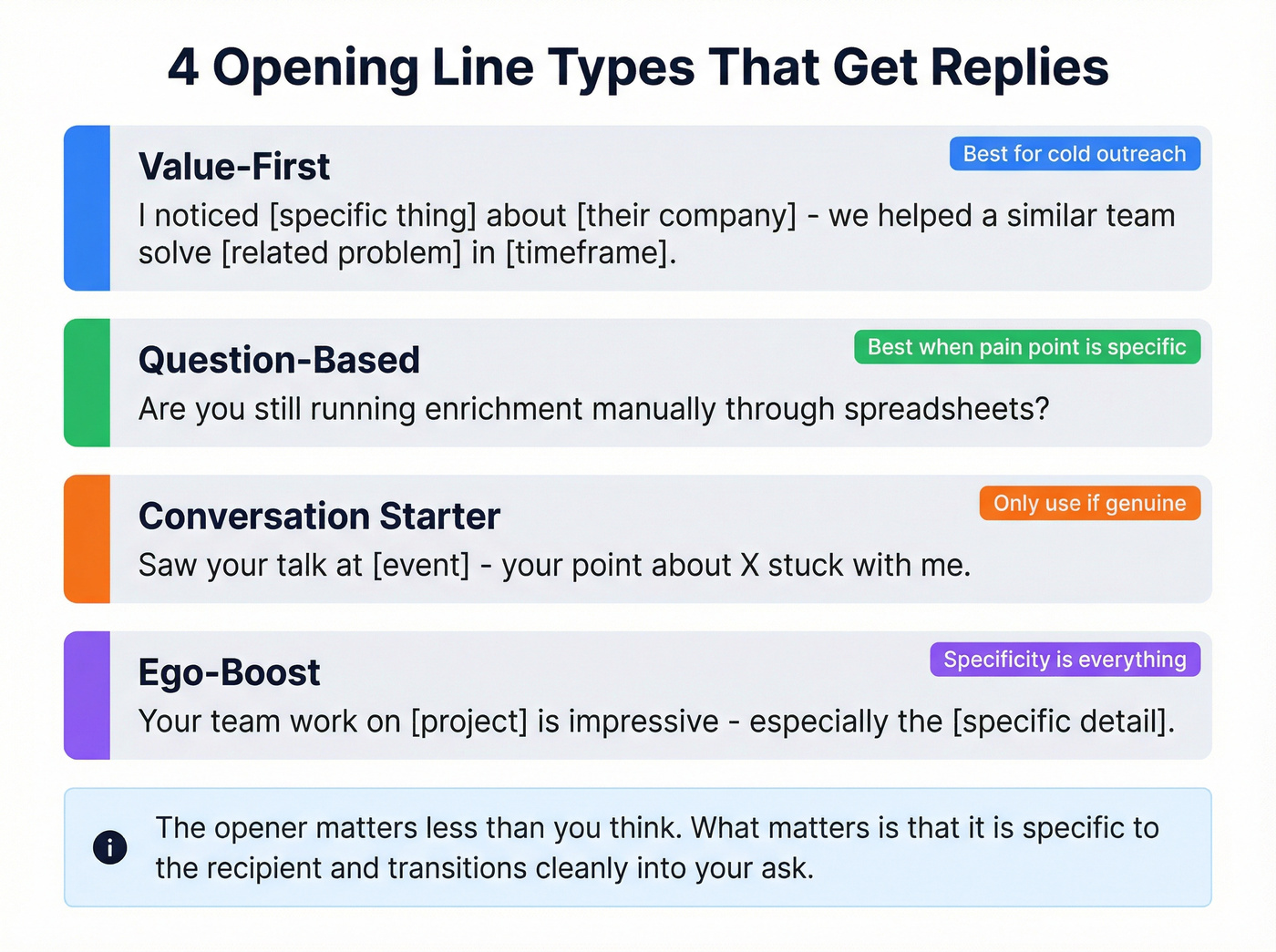
Value-first: Lead with something useful. "I noticed [specific thing] about [their company] - we helped a similar team solve [related problem] in [timeframe]." This works because it's about them, not you.
Question-based: Pose something they actually want to answer. "Are you still handling [pain point] with [current approach]?" The best questions reference a real situation, not a generic challenge. "Are you happy with your current CRM?" is lazy. "Are you still running enrichment manually through spreadsheets?" is specific enough to earn a reply. In our experience, the question-based opener consistently outperforms generic value props when the pain point is nailed down tight.
Conversation-starter: Reference something real. "Saw your talk at [event] - your point about X stuck with me." This only works if you actually watched the talk. Faking it is worse than skipping it.
Ego-boost: Genuine compliments open doors. "Your team's work on [project] is impressive - especially the [specific detail]." The key word is specific. Generic flattery ("I love what you're doing!") reads as a template.
Here's the thing: the opening line matters less than most people think. What matters more is that it's specific to the recipient and transitions cleanly into your ask. A mediocre opener with a clear purpose beats a brilliant opener that leads nowhere.
What 16.5M Emails Reveal
Belkins analyzed 16.5 million cold emails across 93 business domains from Jan-Dec 2024. These benchmarks are worth internalizing.
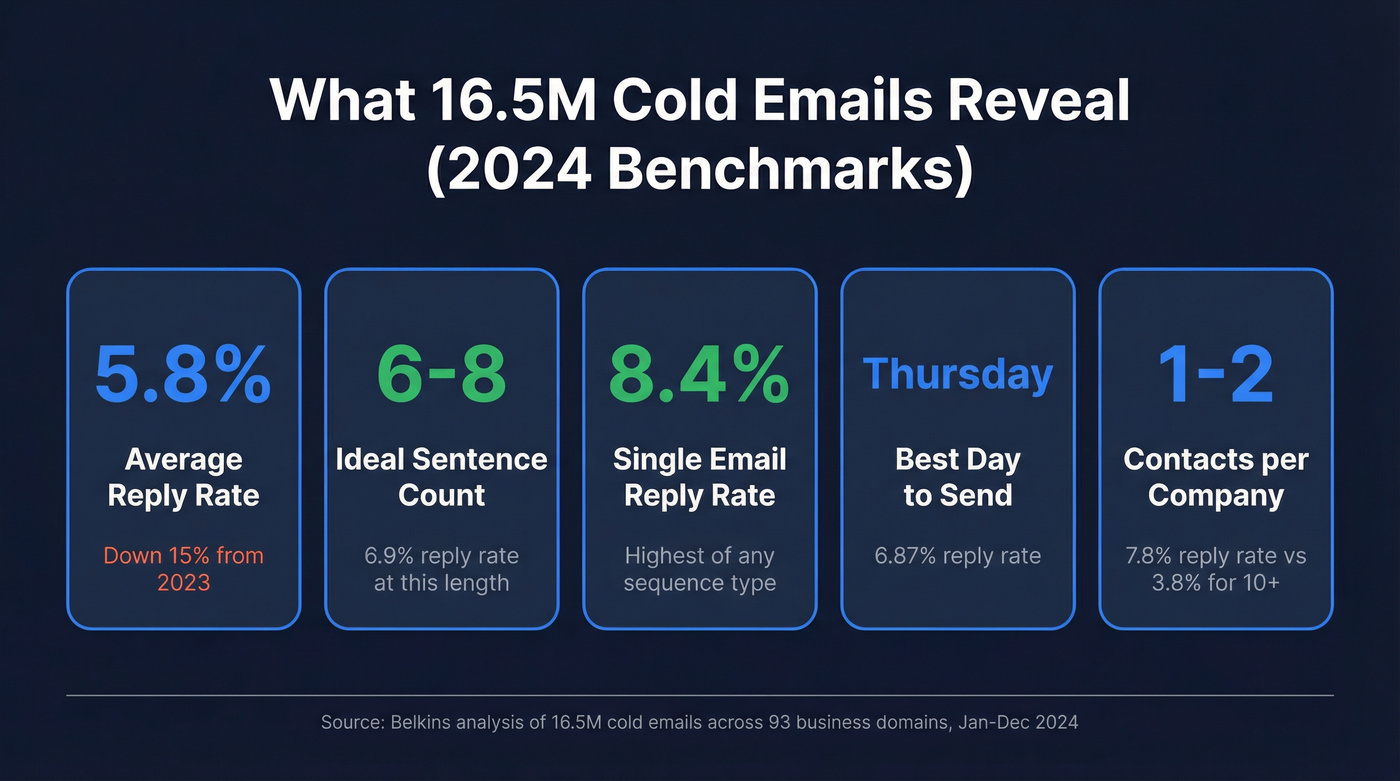
The average reply rate landed at 5.8% - down from 6.8% in 2023, a 15% year-over-year drop. Inboxes are more crowded, filters are tighter, and buyers are pickier. That makes your email introduction even more critical.
The length sweet spot is clear: emails with 6-8 sentences hit a 6.9% reply rate and 42.67% open rate. Under 200 words beats longer emails consistently. Thursday was the best-performing day at 6.87% reply rate, while Monday lagged at 5.29%. Evening sends between 8-11 PM peaked at 6.52%.
Now here's the most counterintuitive finding in the entire dataset: campaigns with just one email - no follow-ups at all - got the highest reply rate of 8.4%. That's not a typo. The single-touch campaign outperformed every multi-step sequence. It suggests that when your first email is strong enough, you don't need to chase.
Turning off open-tracking pixels improved deliverability enough to produce roughly 3% higher response rates. The tracking pixel that tells you someone opened your email might be the thing preventing them from seeing it. Open rates themselves swung from 46% early in 2024 to 31-32% before the study stopped tracking opens mid-year - another reason to focus on replies, not opens.
Targeting volume matters too. Reaching out to 1-2 contacts per company yields a 7.8% reply rate. Blast 10+ people at the same company and that drops to 3.8%.
Our take: Most teams over-invest in follow-up sequences and under-invest in making their first email worth replying to. If your first email needs four follow-ups to work, the problem isn't persistence - it's the email.

The data is clear: your first email has to land and it has to be good. Prospeo verifies emails with 98% accuracy so your carefully crafted introduction actually reaches the inbox. One team dropped bounce rates from 35% to under 4% - meaning every opener they wrote had a chance to convert.
Stop perfecting intros that bounce. Verify first, send second.
Email Introduction Templates
Use a fallback variable in your merge tags - something like {FirstName|there} - so a missing name produces "Hi there," instead of "Hi ," with an awkward space. Whitmore's advice to fill the "To" field last is genuinely useful too. Write the email, review it, then add the recipient. It prevents accidental sends of half-finished drafts.
Cold Outreach
Subject: [Specific result] for [their company]
Hi {FirstName|there},
I noticed [specific observation about their company or role]. We helped [similar company] [achieve specific result] in [timeframe].
Would it make sense to spend 15 minutes exploring whether we could do the same for [their company]?
Best, [Your name]
That's six sentences including the sign-off. It leads with relevance, provides proof, and makes a clear ask. Per the 16.5M-email dataset, this length hits the sweet spot for reply rates.

Your email intro doesn't matter if the email bounces. Before launching any cold campaign, verify your list. Prospeo checks email addresses in real time with 98% accuracy - upload a CSV and verify at scale before you send. One sales team we work with saw bounce rates drop from 35% to under 4% after switching to verified data. A high bounce rate doesn't just waste your outreach; it damages your domain reputation for every future send.
Introducing Yourself to a New Team
Not every email introduction is external. When you join a new company or team, a short intro email sets the tone for working relationships. Keep it to three elements: who you are, what you'll be working on, and one human detail.
Hi team,
I'm [Name], joining as [role] starting [date]. I'll be focused on [primary responsibility]. Previously I was at [company] working on [relevant experience]. Outside work, I'm into [one personal detail]. Looking forward to meeting everyone.
Skip the life story. People want to know what you do and that you're a real person.
Introducing Two People
The double opt-in protocol from The Muse is the gold standard here. Before connecting two people, ask both of them if they're interested. Nobody wants to be voluntold into a meeting.
Once both parties agree:
Subject: Intro: Rob (Abc, Inc.) <> Marie (Xyz, Inc.)
Hi Rob and Marie,
Thanks for being open to connecting. Rob, Marie leads [role/team] at Xyz and has deep experience in [relevant area]. Marie, Rob runs [role/team] at Abc and is working on [relevant project].
I think you'd have a great conversation about [specific topic]. I'll let you two take it from here.
Then exit the thread. Don't hover.
Following Up
The data is clear: a first follow-up can lift reply rates up to 49% in high-performing campaigns. But returns diminish fast - by follow-up #4, response rates drop 55% compared to earlier touches, and spam complaints triple from 0.5% to 1.6%.
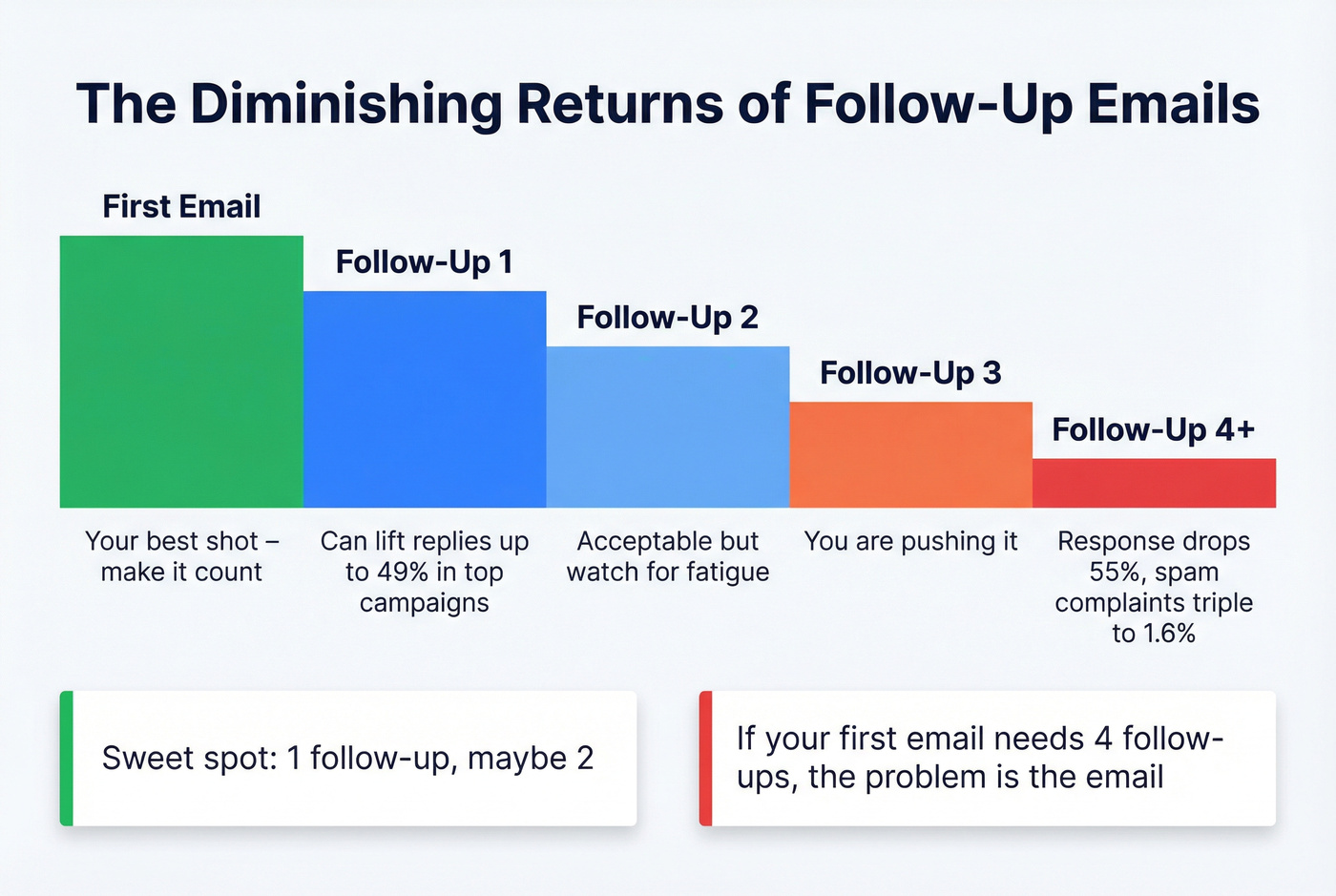
One follow-up is fine. Two is acceptable. Three means you're pushing it. A good follow-up is short: "Hi [Name], wanted to bump this in case it got buried. [One-sentence restatement of your ask]. No worries if the timing isn't right."
Email Openers Across Cultures
If you're emailing internationally, your "normal" might be someone else's red flag. In English, starting an email with "My name is Alex" can read like a phishing attempt. English emails typically open with the reason for writing, not the sender's identity. But in Korean business culture, opening with "This is Alex" mirrors phone-call conventions and is perfectly polite.
"I hope this email finds you well" is one of the most common openers - and it often reads like filler in English business email. That's an English-speaking bias, though. In many cultures, skipping the pleasantry feels abrupt and rude.
Formality expectations vary dramatically. English speakers often shift quickly from "Dear Mr. Smith" to "Hi John" within a few exchanges, and sticking with the formal version after the other person has relaxed can feel standoffish. German and Japanese business emails, by contrast, often use family names even with long-term colleagues. Small formatting details trip people up too - American English uses periods in titles (Mr., Ms., Dr.) while British English drops them (Mr, Ms, Dr).
One common mistake: using "Re:" in a subject line for a first email. It means "Regarding," not "Reply" - but recipients assume it's a reply to something they never sent. Use "About" or "Regarding" instead.
Mistakes That Kill Your Intro
- Misspelling the recipient's name. Nothing says "I didn't care enough to check" faster. Copy-paste from their signature or profile.
- Using "Dear Sir or Madam" in 2026. It's dated, non-inclusive, and signals you didn't bother finding the person's name.
- Leaving merge-tag placeholders visible. "Dear [Enter Name Here]" is an instant delete. Test every template before it goes live.
- Writing a 400-word first email. The data says 6-8 sentences. Respect people's time.
- Sending to an unverified email address. A bounced email doesn't just waste your effort - it hurts your sender reputation. Verify before you send, every time.
- Guessing pronouns or honorifics. If you're not sure, use their first name. "Hi Jordan" is always safe.
Whitmore's best advice: read your email out loud before sending. If it sounds awkward spoken, it reads awkward too.
How to Test Your Introductions
You won't find a universal "best opening line" because it depends on your audience, your offer, and your industry. But you can test systematically.
Change one variable at a time - greeting, opening line, or CTA. Changing multiple elements makes it impossible to isolate what worked. Split your audience equally and randomly into groups of 100-200 recipients per variant, run the test for 1-2 weeks to account for day-of-week variation, and track reply rate, not open rate. Opens are unreliable, especially since disabling tracking pixels actually improves deliverability. Reply rate tells you whether your intro compelled someone to act.
For more sophisticated testing, try multivariate: two subject lines x two opening lines = four variants. You'll need roughly 400 leads to get about 100 per cell, which is the minimum for meaningful results.
We've seen teams obsess over subject lines while ignoring their opening sentence. Test both, but if you're only going to optimize one thing, make it the first line after the greeting. That's what the recipient sees in their preview pane - and it's the sentence that determines whether they keep reading.
If you want to go deeper on outreach structure, start with a proven outreach email template and then iterate with split testing to find what your audience responds to.
Targeting 1-2 contacts per company gets a 7.8% reply rate - but only if you reach the right person with a verified email. Prospeo's database gives you 300M+ profiles with 30+ filters so you can find the exact decision-maker, nail the personalized opener, and send to an address that actually works.
Find the right contact, write the right intro, and never bounce again.
FAQ
How long should an email introduction be?
Six to eight sentences, or under 200 words. Analysis of 16.5M emails found this length hits a 6.9% reply rate - the highest-performing bracket in the dataset. Longer emails see diminishing returns as recipients lose interest before reaching your ask.
What's the best greeting for a professional email?
"Hi [First Name]," works for 90% of professional situations. Reserve "Dear [Full Name]" for highly formal contexts like legal correspondence, academic outreach, or first contact with senior executives in traditional industries.
When should I follow up after an intro email?
Wait 3-5 business days. A first follow-up can lift reply rates up to 49%, but each additional follow-up increases spam complaints. By follow-up #4, spam complaint rates hit 1.6% - more than triple the first email's rate - and response rates drop 55%.
Is "I hope this email finds you well" still acceptable?
It's not wrong, but it wastes your most valuable real estate - the opening line. Replace it with something specific: "I noticed your team just expanded into EMEA" beats a generic pleasantry every time in reply-rate testing.
How do I make sure my cold emails actually reach the inbox?
Verify every email address before sending. Beyond verification: avoid tracking pixels (they hurt deliverability), keep links minimal, warm your sending domain gradually, and target 1-2 contacts per company rather than blasting entire org charts.