

Technographic Data: The Complete Guide for 2026
The average company now runs 100+ software applications, and 86% plan to add more. That's not just IT complexity - it's a targeting goldmine. Every tool a prospect installs tells you something about their budget, their priorities, and the gaps in their stack you could fill.
The technographic data market grew from $367M in 2020 to over $1B by 2026, riding a 26.1% CAGR, because B2B teams figured out that knowing what software a company uses is often more valuable than knowing their revenue or headcount. Over 80% of B2B companies now incorporate technographics into their targeting workflows.
Here's the thing: over 60% of B2B software purchases are replacements. Your prospects aren't buying their first CRM - they're replacing the one that's failing them. Tech stack intelligence tells you who's ripe for that switch, what they're switching from, and when the contract might be up. That's the difference between cold outreach and warm timing.
If your average deal size sits below $10K, you probably don't need a $40K/year technographic platform. A $59/mo job-posting tool paired with a good contact database will get you 80% of the value at 2% of the cost.
What Is Technographic Data?
Technographic data is structured intelligence about the technology stack a company uses - the software, hardware, cloud infrastructure, and digital tools that power their operations. Think of it as firmographic data's technical cousin: where firmographics tell you a company's size, industry, and revenue, technographics tell you they run Salesforce for CRM, AWS for cloud, and Marketo for marketing automation.
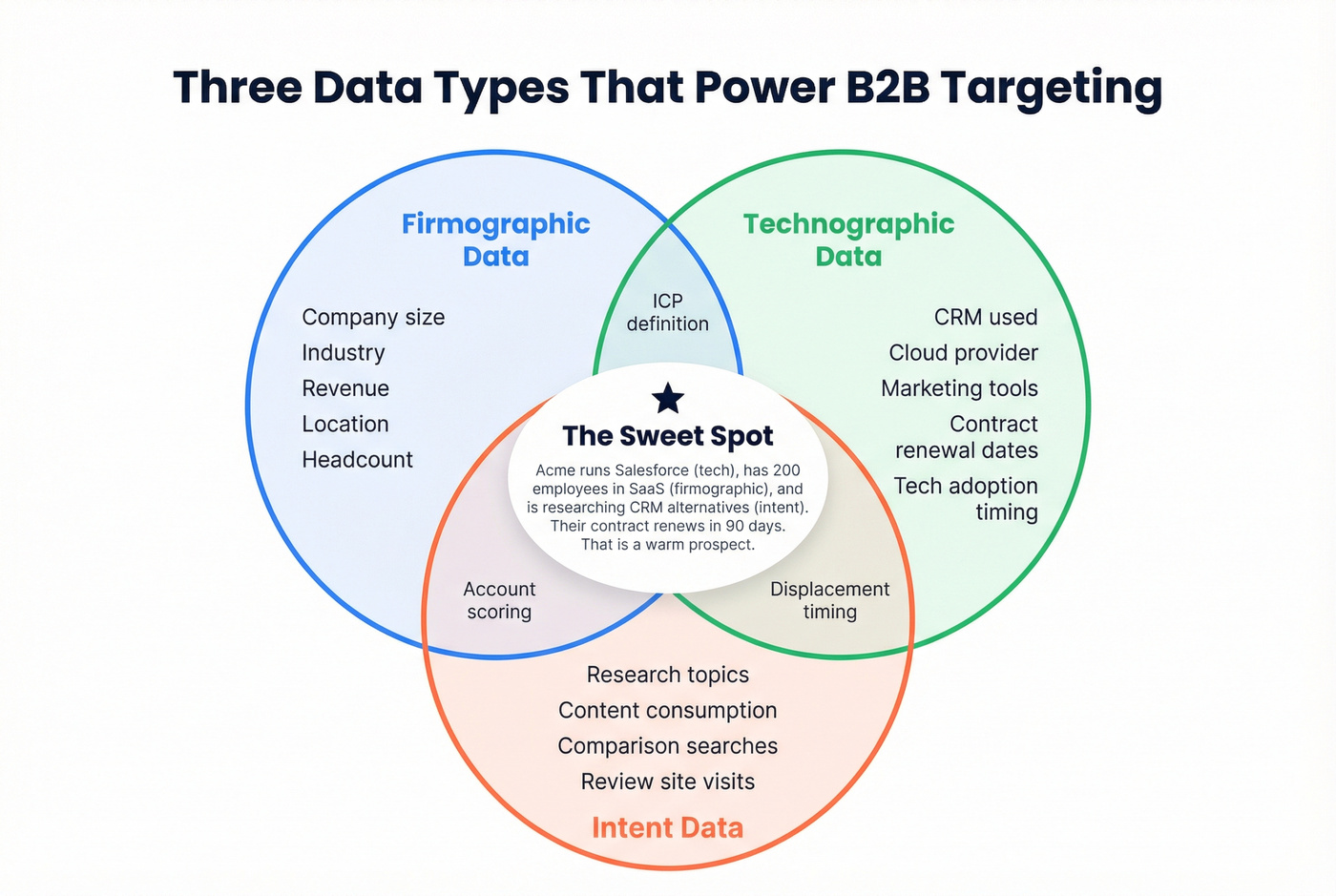
A mature technographic record goes well beyond a simple list of installed tools. The most valuable data points include adoption timing, usage intensity, version information, integrations between tools, and sometimes contract renewal windows - that last one is gold for competitive displacement campaigns.
Here's what a sample record looks like:
| Field | Example Value |
|---|---|
| Company | Acme Corp |
| CRM | Salesforce (Enterprise) |
| Marketing Platform | HubSpot |
| Cloud Provider | AWS |
| Security Tool | CrowdStrike |
| Adoption Date | Q1 2026 |
| Contract Status | Renewal in 90 days |
Intent data tells you someone at Acme is researching CRM alternatives. Technographics tell you Acme currently runs Salesforce Enterprise and their contract is up in 90 days. Combine the two and you've got a prospect who's actively shopping and whose timing is right. Not stack intelligence alone, but technographics layered with intent and firmographic filters - that's where the real power sits.
How Tech Stack Data Is Collected
Not all technographic data is created equal. The collection method determines what you can and can't see, and most guides only cover web-scraping methods. Job posting NLP is an underrated approach that catches backend tools invisible to crawlers.
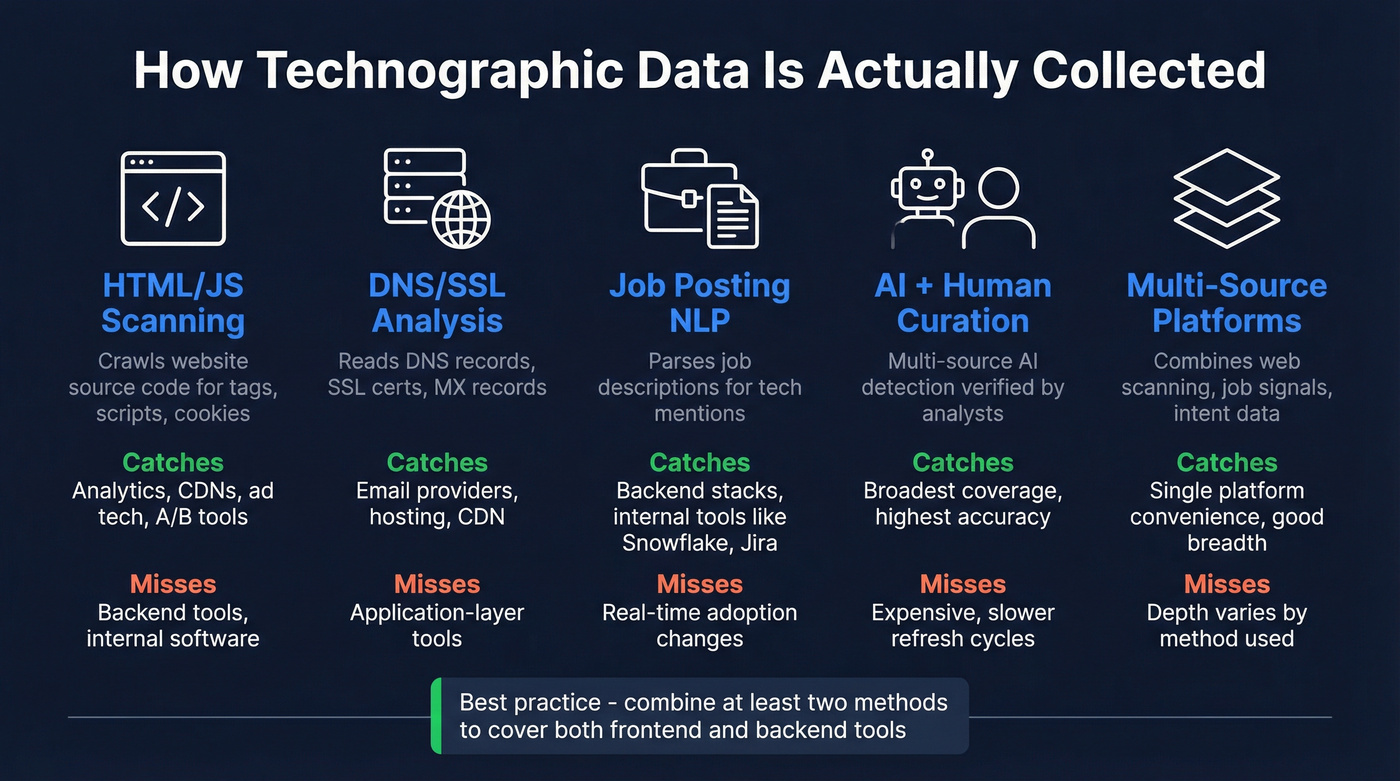
| Method | How It Works | Strengths | Blind Spots |
|---|---|---|---|
| HTML/JS/Header Scan | Crawls websites for code snippets, tags, cookies | Deep frontend coverage | Misses backend/internal tools |
| DNS/SSL Analysis | Analyzes DNS records, SSL certs, MX records | Catches email/hosting/CDN | Limited to infrastructure |
| Job Posting NLP | Parses job descriptions for tech mentions | Reveals internal/backend tools | Lags behind real-time adoption |
| AI + Human Curation | Multi-source AI with human verification | Broadest coverage, higher accuracy | Expensive, slower updates |
| Multi-Source Platforms | Combines web scanning, job signals, intent | Single-platform convenience | Depth varies by method |
Frontend scanning is the most common approach. BuiltWith crawls 670M+ websites and tracks 58K+ technologies by analyzing HTML source code, JavaScript libraries, HTTP headers, DNS records, and SSL certificates. Wappalyzer takes a similar approach across 7,400 technologies in 106 categories and offers a free browser extension for one-off lookups.
The limitation? Anything behind the firewall is invisible. If a company uses Snowflake for their data warehouse or Gong for call recording, a website crawler won't see it.
That's where job posting analysis fills the gap. TheirStack scans 172M+ job postings across 318K+ sources, using NLP to extract technology mentions from job descriptions. When a company posts a "Senior Snowflake Engineer" role, that's a strong signal about their data stack - even though Snowflake never appears in their HTML. Their data refreshes every minute and supports webhooks, making it one of the most real-time sources available.
HG Insights sits at the enterprise end, covering 13.2M+ companies across 236 countries with AI-led detection plus human curation. They claim 90% accuracy, and the price tag reflects the methodology.
Key Uses in B2B Sales and Marketing
Six workflows where technographic data actually moves revenue.
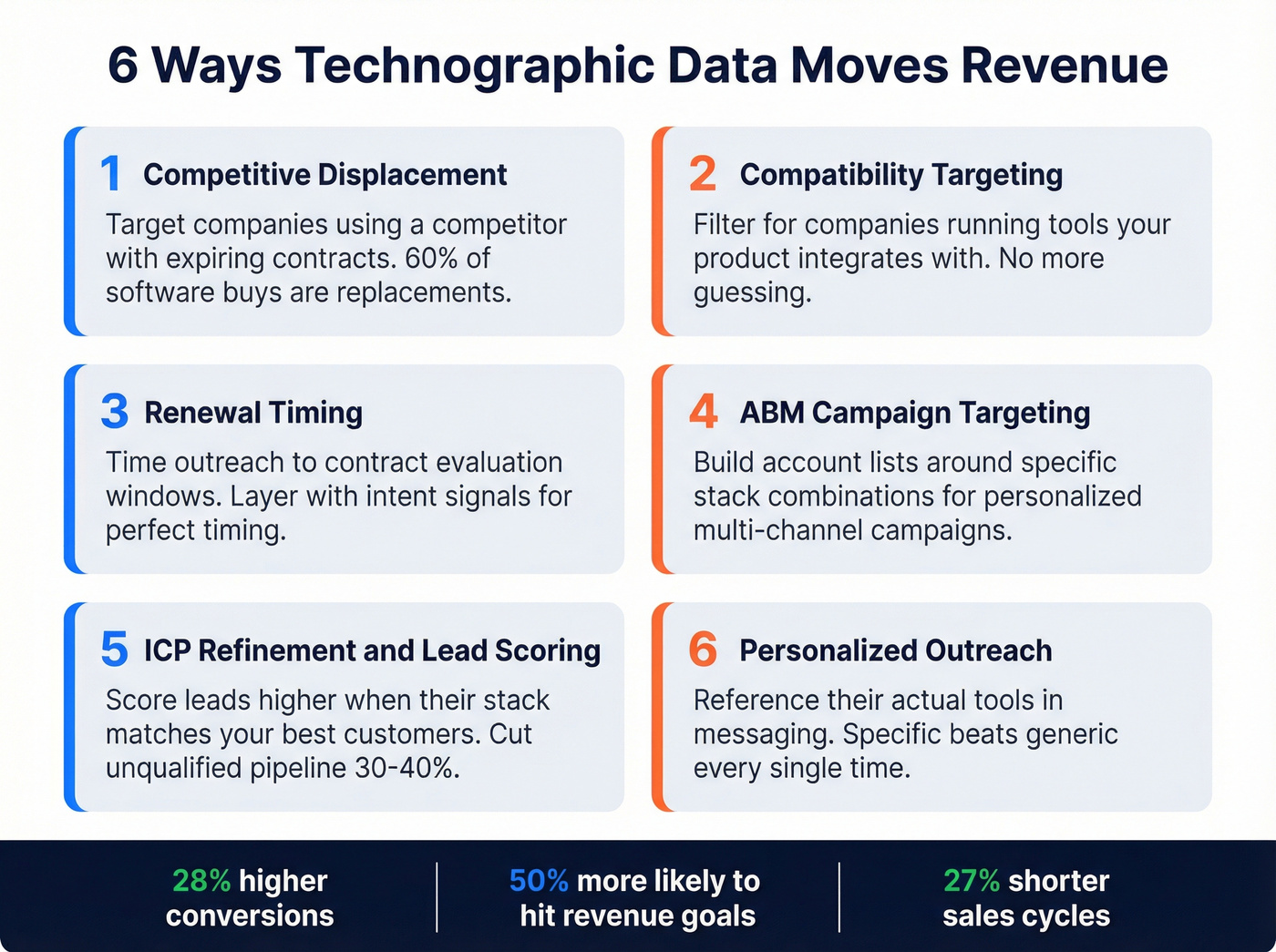
Competitive displacement targeting. You sell a CRM. You know companies using your competitor's product - and you know which ones have contracts expiring soon. That's not cold outreach; that's precision timing. With 60% of software purchases being replacements, this is the highest-ROI use case by far.
Compatibility and integration targeting. Your product integrates with Salesforce. Filter for companies running Salesforce, layer in a firmographic fit like 50-500 employees in SaaS, and you've got a list of prospects who can actually use what you sell. No guessing.
Renewal timing and buying signals. When stack intelligence includes contract status or adoption dates, you can time outreach to the evaluation window. Combine that with intent signals showing the prospect is researching alternatives, and your SDR's email lands at exactly the right moment.
ABM campaign targeting. Account-based marketing lives and dies on signal quality. Technology filters let you build account lists around specific stack combinations - say, companies running HubSpot for marketing but no dedicated ABM platform - then serve personalized ads and content to those accounts across channels.
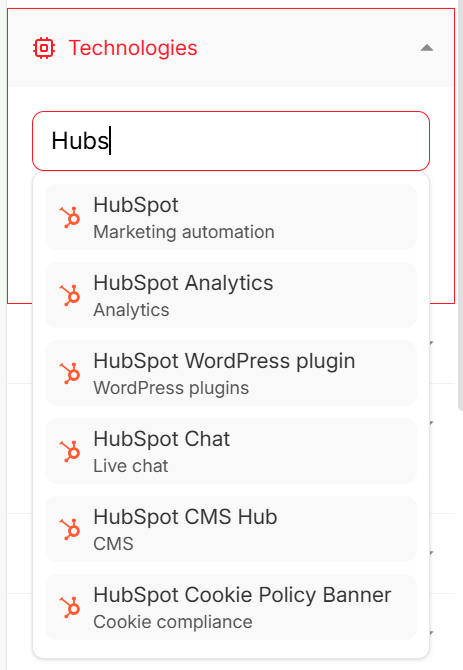
ICP refinement and lead scoring. Stack data sharpens your ideal customer profile. If your best customers all run HubSpot + Snowflake + Gong, you can score inbound leads higher when they match that stack fingerprint. We've seen teams cut unqualified pipeline by 30-40% just by adding two or three technographic filters to their scoring model. (If you want the scoring mechanics, see lead scoring.)
Personalized outreach. "I noticed you're running Marketo - here's how our integration saves your ops team 3 hours/week" beats "Hi, I'd love to show you our platform" every time. If you're building sequences around stack triggers, use a personalization framework so it scales.
The ROI case in three numbers: Teams using technographic targeting see 28% higher conversion rates, are 50% more likely to exceed revenue goals, and cut sales cycles by 27%.
A Real Workflow
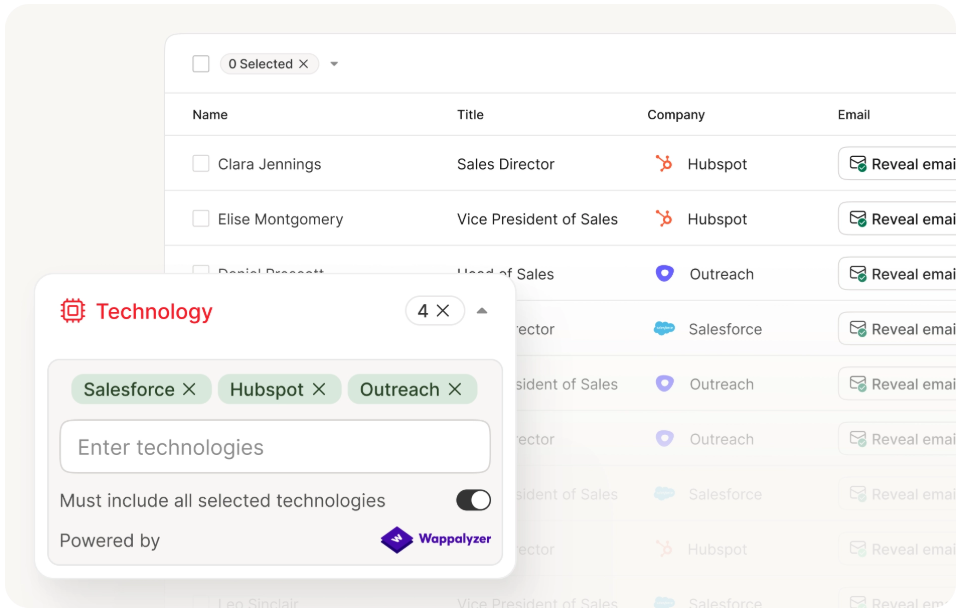
Your VP of Sales wants a list of companies using Salesforce but not a sales engagement tool - by Friday. In Prospeo's B2B database, you'd filter by technology stack (Salesforce = installed, sales engagement tool = not detected), layer in firmographic criteria and a buyer intent signal from Bombora's 15,000 topics, and export verified emails in minutes. The platform combines Wappalyzer-based detection with live job posting signals, refreshes data every 7 days, and delivers 98% email accuracy - no dataset stitching, no waiting on a data vendor.
If you're standardizing this into a repeatable motion, map it into a prospecting workflow so reps run the same play every week.

Prospeo's B2B database lets you filter 300M+ profiles by technology installed - powered by Wappalyzer and live job posting signals. Layer in buyer intent from 15,000 Bombora topics, firmographic fit, and headcount growth to build lists that match exact stack combinations. 98% email accuracy means your displacement campaigns actually land.
Stop guessing who runs Salesforce. Filter by tech stack and reach them today.
Top Providers Compared
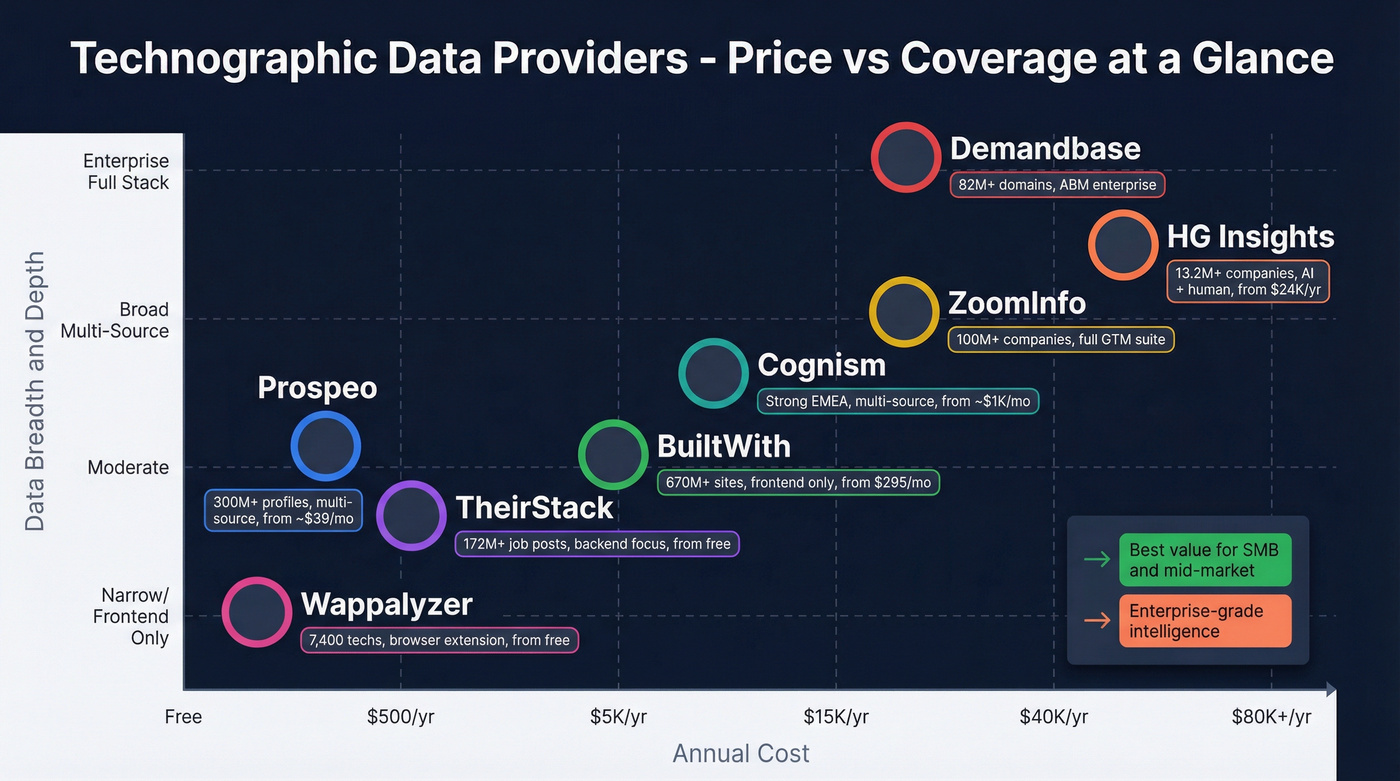
| Provider | Scale | Method | Price | Best For |
|---|---|---|---|---|
| Prospeo | 300M+ profiles, Wappalyzer + live job posting signals | Multi-source | Free-~$39/mo+ | Tech filter + verified contacts |
| HG Insights | 13.2M+ cos, 20K+ products | AI + human | ~$24K-$80K+/yr | Enterprise intelligence |
| BuiltWith | 670M+ sites, 58K+ techs | HTML/JS/DNS | $295-$995/mo | Frontend web tech |
| ZoomInfo | 100M+ cos, 30K+ techs | Multi-source | ~$15K-$40K+/yr | Full GTM suite |
| TheirStack | 172M+ job posts, 32K+ techs | Job posting NLP | Free-$400/mo | Budget/backend tech |
| Cognism | Strong EMEA coverage | Multi-source | ~$1K-$3K/mo | EMEA compliance |
| Wappalyzer | 7,400 techs, 106 categories | Browser/API | Free-$250/mo+ | Quick lookups |
| Demandbase | 82M+ domains, 18K+ techs | Multi-source | ~$30K-$100K+/yr | ABM enterprise |
HG Insights
HG Insights is the deep pure-play technographic intelligence platform - and it's priced accordingly. Their coverage spans 13.2M+ companies across 236 countries with 20K+ tracked products. The methodology combines AI-led detection with human curation, and they claim a 90% accuracy rate. The "Cloud Dynamics" module monitors 10M+ cloud companies specifically, making it particularly useful for infrastructure sellers.
The tradeoff is brutal on budget. Entry-level contracts start at $24K-$40K/year, mid-market runs $40K-$80K/year, and enterprise deals push past $80K with add-ons for global coverage, advanced analytics, and intent data. Annual contracts only - no monthly option. If you're a startup or mid-market team, skip this one. HG Insights is built for strategic TAM analysis at scale, not for an SDR pulling a list for Tuesday's outreach.
BuiltWith
BuiltWith only sees what's publicly visible on a website - but for web-visible tech, nothing goes deeper. Their scanner covers 670M+ websites and tracks 58K+ technologies, the largest taxonomy in the space. Detection covers HTML, JavaScript libraries, HTTP headers, DNS records, and SSL certificates. For analytics tools, CDNs, A/B testing platforms, and ad tech, it's the gold standard.
Pricing is straightforward: $295/mo Basic, $495/mo Pro, $995/mo Team. No annual contract required at the lower tiers. The gap is equally straightforward: backend tools like Snowflake, internal tools like Jira, and security products like CrowdStrike are invisible to HTML scanning. If your ICP targeting depends on internal stack data, pair BuiltWith with a job-posting provider like TheirStack.
Other Notable Providers
ZoomInfo tracks 30K+ technologies across 100M+ companies, bundled into their broader GTM platform with intent data, contact database, and workflow tools. Expect $15K-$40K+/year depending on seats and modules. If you're already paying for ZoomInfo, the technographics are solid. If you're buying just for technographics, it's overkill.
TheirStack takes a unique approach: NLP analysis of 172M+ job postings across 318K+ sources to infer technology usage. This catches backend and internal tools that web crawlers miss entirely, with near-real-time refresh via webhooks. Free tier gives you 50 company credits/month; paid plans run $59-$400/mo. Best budget option for teams that care about internal stack visibility.
Cognism offers technographics with strong EMEA coverage and compliance posture, typically ~$1K-$3K/mo for small teams. Worth evaluating if you're selling into European markets where GDPR compliance is non-negotiable.
Wappalyzer is the go-to free option - their browser extension identifies technologies on any website you visit. Paid API plans start at $250/mo for bulk lookups. Demandbase tracks 18K+ technologies across 82M+ domains as part of their ABM platform at $30K-$100K+/year. SalesIntel monitors technographic and buying-signal data alongside a large contact database, positioning its data as human-verified on a 90-day cycle. Coresignal offers technographic records across 87M entries starting around $49/mo - a budget-friendly API option. And Datarade operates as a marketplace with technographic datasets starting around $1,000/purchase or $5,000/mo.
If you're comparing vendors in this category, it helps to start with a shortlist of sales prospecting platforms and then narrow by technographic depth.
You just read that combining technographics with intent data is where the real power sits. Prospeo does exactly that - 30+ filters including technology installed, buyer intent across 15,000 topics, and contract-timing signals, all refreshed every 7 days. At $0.01 per verified email, you get enterprise-grade stack targeting without the $40K platform.
Layer tech stack filters with intent signals for $0.01 per lead.
How to Evaluate a Provider
Single-method tools often show 15-25% coverage gaps. Here's the checklist we use when running evaluations:
Coverage breadth. How many technologies do they track? Does their coverage extend to your target geographies? US-centric databases often have significant EMEA gaps - a recurring complaint across B2B data communities, and one we've seen echoed repeatedly on r/sales and r/salesoperations.
Detection methodology. Frontend-only scanning misses half the stack. Multi-source approaches catch more but cost more. Match the method to what you need to see.
Data freshness. This is where most providers quietly fail. Ask about refresh cycles. The industry average is 6 weeks. When you're targeting companies based on current tech stack, stale data means wasted outreach - and we've watched teams burn weeks of SDR time on lists built from three-month-old scans.
Accuracy validation. Pick 20 accounts you know well - companies where you already know the tech stack - and compare the provider's data to reality. This 20-account spot-check catches most accuracy issues before you commit budget.
CRM/MAP integration. Can you push enriched data directly into Salesforce or HubSpot? API access? Native integrations save hours of manual work every week. If you're cleaning up fields before enrichment, follow a CRM hygiene process so you don't pollute your system.
Pricing model. Self-serve with monthly billing vs. annual contracts with sales calls. Know which one your procurement process can handle. For teams under 10 reps, I'd strongly recommend starting with a self-serve tool and upgrading only when you've proven the ROI.
Compliance posture. GDPR, CCPA, SOC 2, available DPAs. Enterprise buyers will require these.
Data Freshness and Accuracy
28% of email addresses in B2B databases become outdated every year. Poor data quality costs organizations an average of $12.9M/year. Those aren't abstract numbers - they translate directly into bounced emails, burned sender reputation, and wasted SDR hours.

For technographic data specifically, freshness matters even more than for contact records. A company can switch from HubSpot to Marketo in a quarter. If your provider's last scan was six weeks ago, you're personalizing outreach around a tool they've already replaced. That's worse than no personalization at all - it signals you don't actually know their business.
The two most common complaints in B2B data communities: stale detections from infrequent crawling, and pricing that jumps dramatically at higher tiers. Web-scraped technographics also have inherent blind spots - frontend scanning catches analytics tags, chat widgets, and CDN providers, but backend systems, internal tools, and security products stay invisible without additional signals like job postings or human verification.
The practical fix: spot-check before you commit. Take 20 accounts where you already know the tech stack (your own customers work great for this), run them through the provider, and compare. If accuracy falls below 80% on accounts you can verify, the provider's broader database is likely worse. (Related: prospect data accuracy benchmarks and how to validate.)
Compliance and Privacy
Technographic data about a company - "Acme Corp uses Salesforce" - is company-level information. But the moment you link that technographic record to an identifiable contact, a name, email, or job title, you're in personal data territory, and GDPR, CCPA/CPRA, and other privacy frameworks apply.
Let's break this down practically: run a Data Protection Impact Assessment before deploying technographic-enriched contact lists. Require Data Processing Agreements from every vendor. Implement opt-out handling - if a contact requests removal, that needs to propagate across your enrichment pipeline. And apply purpose limitation: technographic data collected for sales targeting shouldn't end up in unrelated marketing campaigns without a separate lawful basis. For the outbound-specific version of this, use our GDPR for sales and marketing playbook.
In the US, there's still no single national privacy law, but CCPA/CPRA applies to California residents and has become the de facto standard. Enterprise buyers increasingly require SOC 2 certification and signed DPAs from any data vendor before procurement will approve the contract.
FAQ
What's the difference between firmographics and technographics?
Firmographic data describes company attributes - size, industry, revenue, location. Technographic data describes the technology stack - software, hardware, and cloud infrastructure a company uses. Firmographics tell you who to sell to; technographics tell you why they'd buy and what to say when you reach out.
How much does technographic data cost?
The range spans free to $80K+/year. Wappalyzer's browser extension and TheirStack's free tier cost nothing. Prospeo starts with a free plan and scales to ~$39/mo with technographic filters included. BuiltWith starts at $295/mo. Enterprise providers like HG Insights run $24K-$80K+/year on annual contracts.
Can I collect technographic data myself?
Yes - browser extensions like Wappalyzer detect frontend technologies for free on any website you visit. For a handful of target accounts, that's sufficient. But for backend tools, renewal timing signals, and scale across thousands of accounts, you need a dedicated provider. The manual approach breaks down fast once you're targeting more than 50 companies.
Is technographic data GDPR compliant?
Company-level tech stack information carries no personal data obligation. The compliance requirement kicks in when you attach that data to an identifiable individual. At that point, you need a lawful basis for processing, a signed DPA with your data vendor, and an opt-out mechanism. Choose providers with clear GDPR postures and available DPAs.
What are the most common data points tracked?
The most frequently tracked fields include CRM platform, marketing automation tool, cloud provider, analytics suite, CMS, email service provider, and security stack. Advanced providers also capture adoption dates, version numbers, integration relationships, and contract renewal windows - all of which feed into more precise targeting and outreach timing.