

Crayon vs Klue: Which CI Platform Is Worth $30K/Year?
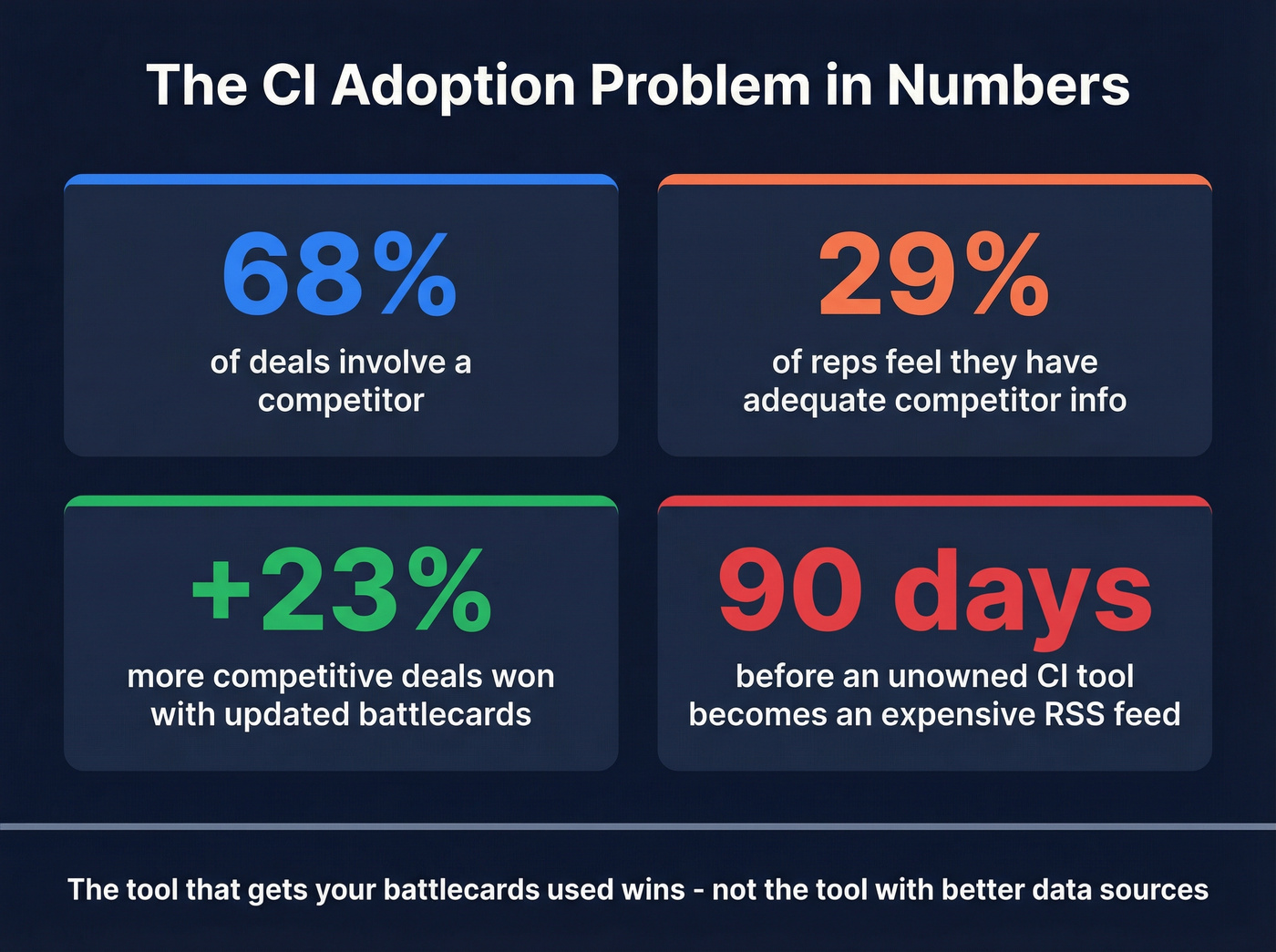
Your VP of Product Marketing just told you to pick a CI tool. You've got a Crayon demo on Tuesday and a Klue demo on Thursday, and every comparison you can find was written by Crayon, Klue, or a vendor selling against both. Sales teams face competitors in 68% of deals, yet competitive preparedness averages a dismal 3.8 out of 10.
Here's the honest breakdown - and the demo questions nobody else will give you.
The 30-Second Verdict
Pick Crayon if you have a dedicated CI analyst, want the deepest AI features (Sparks, Answers, Call Clips), and care about Salesforce-linked win/loss reporting.
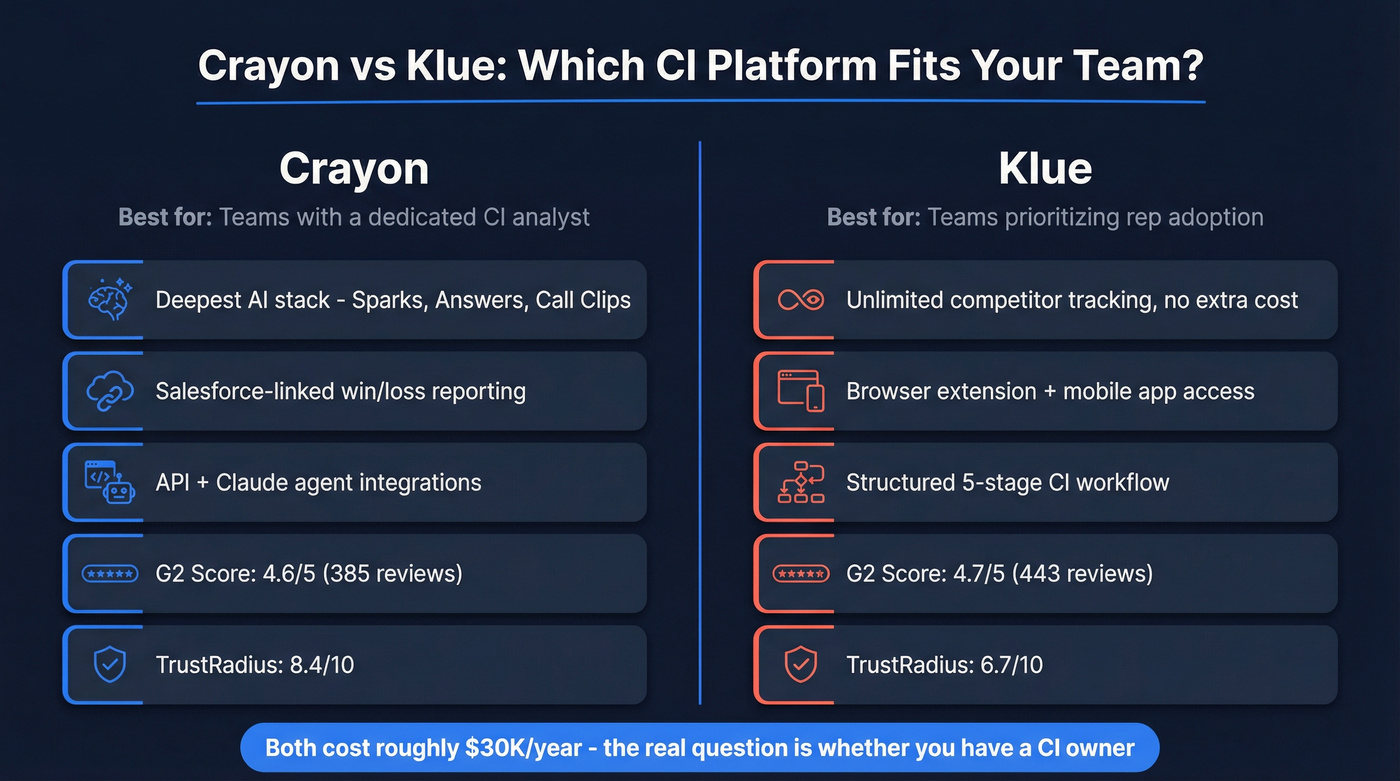
Pick Klue if rep adoption is your top concern, you want unlimited competitor tracking without cost surprises, and you value responsive support.
Here's the thing: both tools are good, and the differences are marginal for 80% of teams. The real question is whether your org has the bandwidth to run a CI program at all. A CI platform without a dedicated owner becomes an expensive RSS feed within 90 days.
What It Actually Costs
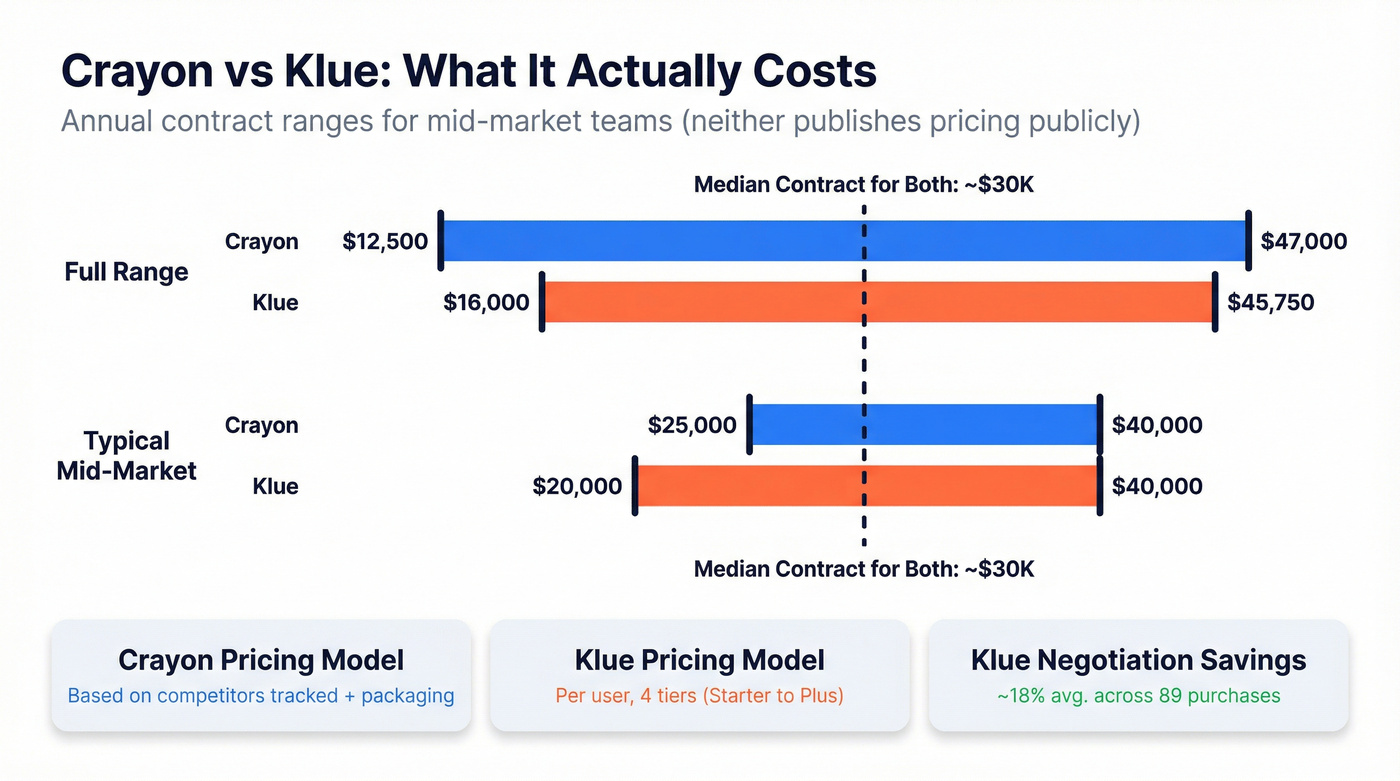
Neither Crayon nor Klue publishes pricing. That's frustrating when both run $20K-$40K/year for most mid-market teams (and it’s worth sanity-checking against your overall cost of sales tech stack).
| Crayon | Klue | |
|---|---|---|
| Annual range | $12,500-$47,000 | $16,000-$45,750 |
| Typical mid-market | $25,000-$40,000 | $20,000-$40,000 |
| Median contract | ~$30,000 | ~$30,000 |
| Pricing model | Shaped by competitors tracked + packaging | Per user, tiered |
| Free trial | Not public | Not public |
| Negotiation savings | Not reported | ~18% avg. |
Crayon's packaging is commonly shaped by the number of competitors you track and how many Answers seats are included, so costs can creep as your competitor list expands. Klue uses a four-tier model (Starter, Essentials, Pro, Plus) priced per user, which makes scaling more predictable.
A widely cited Vendr benchmark pegs Klue negotiation savings around 18% across 89 purchases. Klue also charges separately for setup and certain integrations - ask during your demo. And because neither tool lists a self-serve free trial publicly, you're committing based on demos alone.
Features Compared Head-to-Head
| Capability | Crayon | Klue |
|---|---|---|
| AI assistant | Answers (GPT, in-workflow) | Compete Agent |
| Signal synthesis | Sparks (auto-digests) | AI triage + newsletters |
| Call intelligence | Call Clips (Gong, Chorus) | Not a core platform feature |
| Competitor tracking | Tied to pricing tier | Unlimited, no extra cost |
| Battlecards | Auto-updated | Dynamic + distributed via integrations |
| Win/loss analytics | Strong Salesforce-linked reporting | Built-in module |
| Search access | Primarily in-platform | Universal (integrations, mobile, extension) |
| Distribution | Slack, Teams, Salesforce, Gong | Slack, Teams, mobile, extension |
| API / agent support | Yes (Claude use cases) | Not emphasized |
Crayon's AI stack is deeper. Sparks synthesizes thousands of signals across sources like G2 reviews, news, and Gong calls into digestible summaries, while Answers puts a GPT-powered assistant directly inside sales tools so reps can ask competitive questions mid-deal. Call Clips scans Gong and Chorus recordings to surface competitive mentions automatically. We've seen teams build competitive deal agents using Crayon's API connected to Anthropic Claude, pulling from CRM data and call transcripts alongside Crayon intel - it's genuinely impressive when you have the engineering resources to wire it up.
Klue takes a different approach with its 5-stage CI workflow: Collect, Analyze, Create, Distribute, Measure. It's more structured and easier for PMMs to manage without a CI analyst on staff. Universal Search lets reps find intel across integrations, a mobile app, and a browser extension - not just inside the platform. Klue also offers AI-powered review analysis that synthesizes G2 and Capterra reviews into competitive insights automatically. The unlimited competitor tracking at no extra cost is a genuine advantage if you're in a crowded market with 15+ competitors.
What Real Users Say
| Platform | Crayon | Klue |
|---|---|---|
| G2 | 4.6/5 (385 reviews) | 4.7/5 (443 reviews) |
| TrustRadius | 8.4/10 | 6.7/10 |
| Gartner Peer Insights | 4.5 (10 ratings) | 4.7 (20 ratings) |
| Ease of setup (G2) | 9.1 | 8.9 |
| Ease of admin (G2) | 9.2 | 8.9 |
| Quality of support (G2) | 9.6 | 9.8 |
| Product direction (G2) | 8.8 | 9.4 |
Crayon users consistently praise auto-updated battlecards and Salesforce-linked win/loss analytics. One TrustRadius reviewer put it bluntly: "Proving ROI is simple" with revenue influence reporting baked in. The top G2 complaint? Price. Crayon's "Expensive" tag surfaces prominently.
Klue scores higher on support and product direction, which matters if you're betting on a platform for two to three years. Complaints center on difficult setup, overwhelming information volume, and UX that needs polish. Across review sites, the decision keeps coming back to the same question: does your team have the bandwidth to curate the intel either tool collects?
The stat that matters for both: teams with regularly updated battlecards win 23% more competitive deals. The tool that gets your battlecards used wins.

Battlecards help reps win deals - but only if reps can reach decision-makers in the first place. Prospeo gives your team 300M+ verified contacts with 98% email accuracy and 125M+ direct dials, so the competitive intel you're paying $30K/year for actually converts into pipeline.
Win the deal before the battlecard even opens. Start with better data.
Adoption: The Real Deciding Factor
Klue says over 80 former Crayon clients have switched, citing UiPath's experience of a 2x adoption lift after moving away from what they described as "noisy, duplicate data." That's vendor marketing, but the underlying point is real: only 29% of reps feel they have adequate competitor info. If reps stop checking battlecards, it doesn't matter which tool has better data sources.
Klue's browser extension and mobile app lower the friction to access intel. Crayon's Answers puts a chatbot inside the tools reps already use. Both approaches work - the question is which matches your team's habits. In our experience, the teams that succeed with either platform are the ones that assign a named CI owner in the first week, not the ones that pick the "better" tool.
What to Ask in Your Demos
No vendor will volunteer their weaknesses. These five questions will surface the information that actually matters:
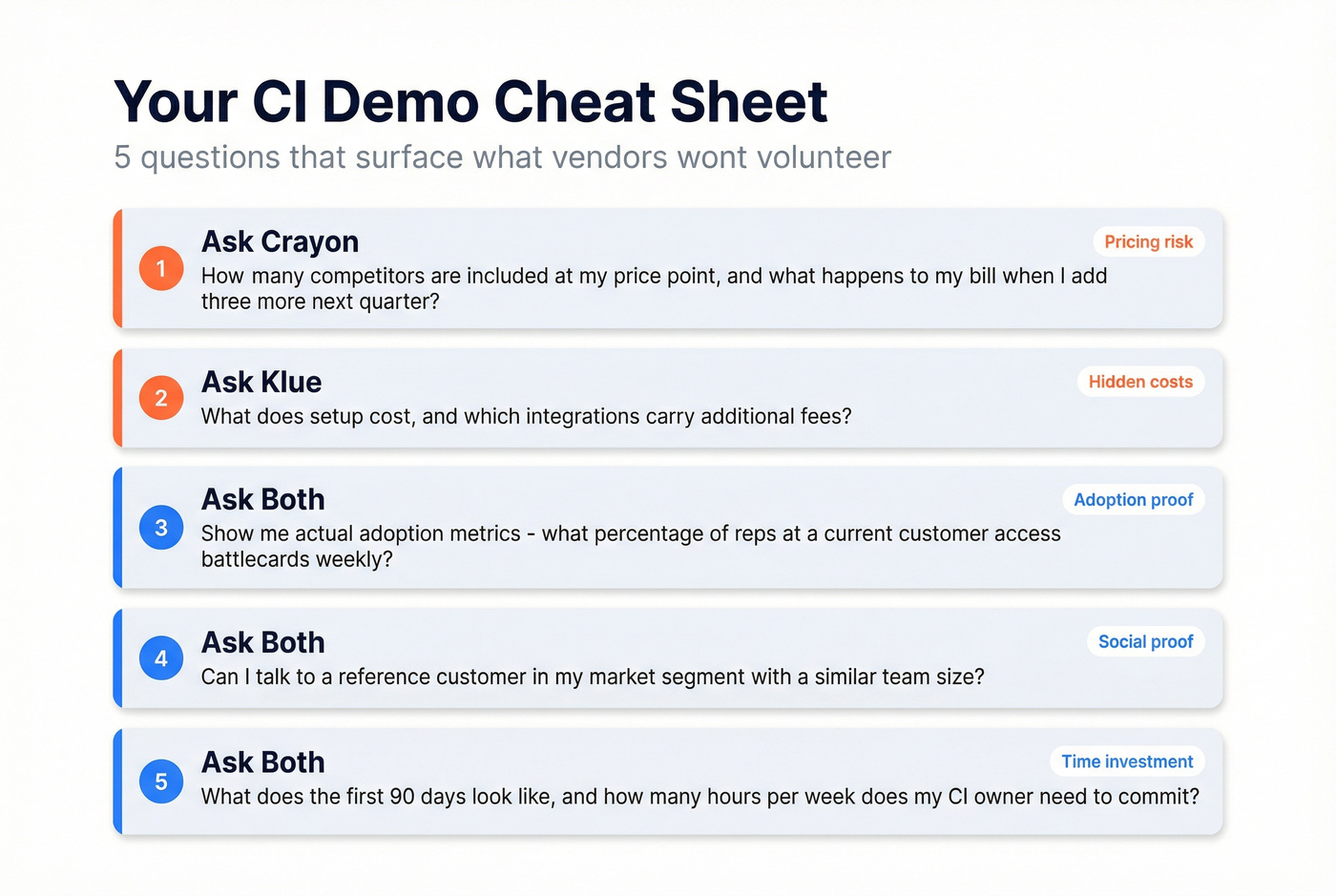
- Ask Crayon: "How many competitors are included at my price point, and what happens to my bill when I add three more next quarter?"
- Ask Klue: "What does setup cost, and which integrations carry additional fees?"
- Ask both: "Show me actual adoption metrics - what percentage of reps at a current customer access battlecards weekly?"
- Ask both: "Can I talk to a reference customer in my market segment with a similar team size?"
- Ask both: "What does the first 90 days look like, and how many hours per week does my CI owner need to commit?"
Other Tools Worth Knowing
Kompyte is often positioned as a more affordable alternative that covers automated competitor tracking and battlecard basics. It lacks the AI depth of Crayon or the adoption polish of Klue, but for teams that just need battlecards without the bigger commitment, it's worth a demo.
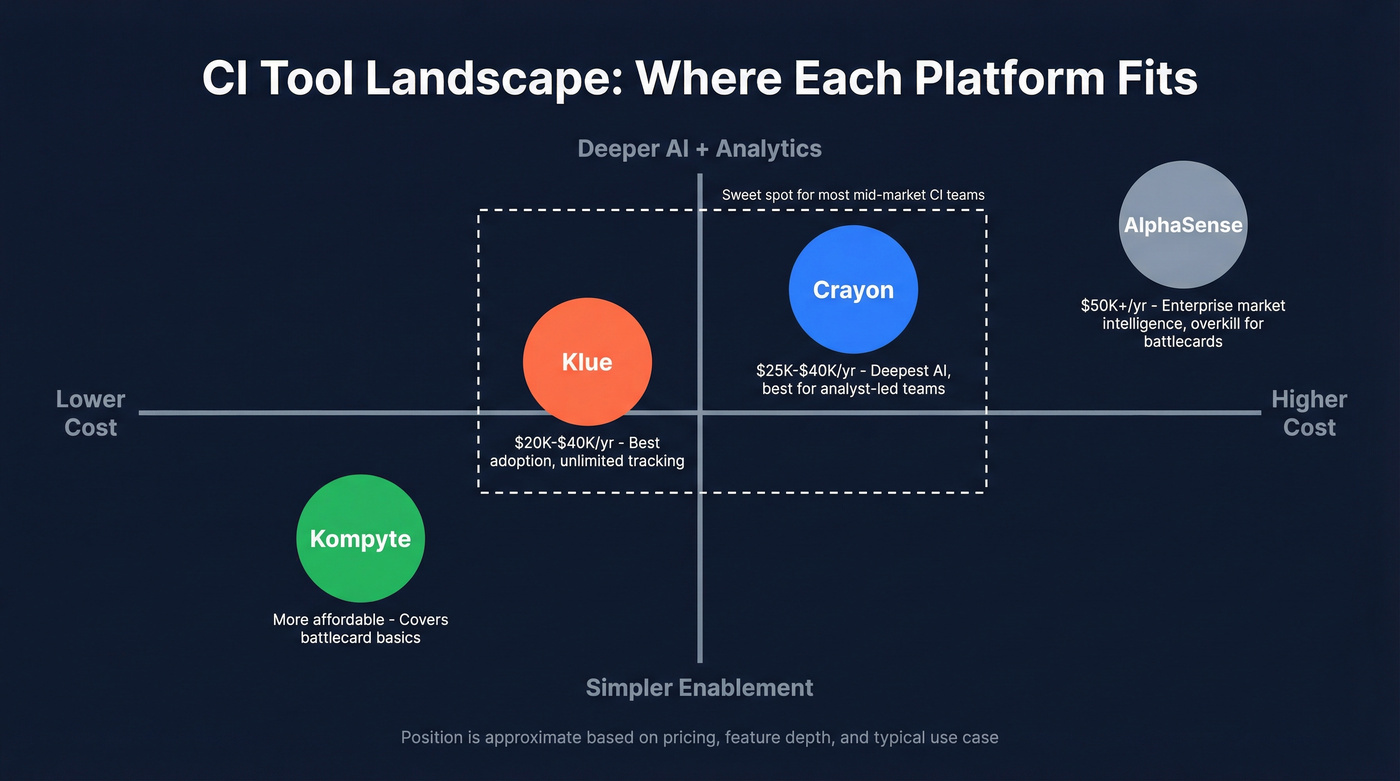
AlphaSense plays in a different league entirely - enterprise pricing (typically $50K+/year) for a platform built around broader market intelligence, not just competitive enablement. If your CI needs extend into financial research, regulatory monitoring, and industry analysis, AlphaSense is the tool. For head-to-head competitive battlecards, it's overkill.
What Neither Tool Solves
CI platforms tell you what competitors are doing. They don't give you verified contact data to act on that intelligence.
When your battlecard says "target accounts using Competitor X," you still need accurate emails and direct dials to reach those accounts. That's the gap we kept running into when we tested both platforms - brilliant intel, no way to execute on it without switching to a completely separate prospecting workflow (see a modern prospecting workflow).
Prospeo fills that gap with 143M+ verified emails at 98% accuracy and 125M+ verified mobile numbers, all on a 7-day refresh cycle (which matters because of B2B contact data decay). The cost contrast is stark - roughly $0.01 per email versus $30K/year for CI software. For teams not ready for a full competitive enablement platform, pairing Prospeo with a manual competitive tracking process delivers more pipeline per dollar than any tool you'll never fully adopt.
You're about to spend $30K on a CI platform. Before you do, make sure your reps can actually reach the 68% of deals where competitors show up. Prospeo delivers verified emails at $0.01 each - refreshed every 7 days, not 6 weeks - so your battlecards land in front of real buyers.
Competitive intel is useless if your emails bounce. Fix that first.
FAQ
Is Klue or Crayon better for small teams?
Neither is ideal under 50 employees - both cost $20K-$40K/year and require dedicated CI bandwidth to maintain. Smaller teams get more ROI from accurate contact data paired with manual competitive tracking in a shared doc. Save the CI platform budget until you have someone to own it full-time.
Can you use Crayon and Klue together?
Nobody does - they solve the same problem. Pick one based on whether you prioritize AI depth and analytics (Crayon) or adoption and unlimited tracking (Klue). Running both is ~$60K/year in redundancy.
What's the biggest complaint about both platforms?
Cost and noise. Both collect massive amounts of competitive data, and users consistently report that curation workload - turning raw signals into actionable intel - is higher than expected. Budget 8-15 analyst hours per week on top of the software spend.