

10 ABM Campaign Examples With Budgets, Metrics, and Execution Detail
A marketer on r/b2bmarketing recently described their "ABM program": 500 companies lumped into three campaigns, same ads with minimal messaging changes, about 50 form submissions a month, and sales getting crickets when they followed up. That's not ABM. That's rebranded display advertising with a target account list stapled to it.
Most ABM campaign examples you'll find are sanitized vendor case studies stripped of budgets, team sizes, and honest timelines. The campaigns that actually produce pipeline look nothing like those - they're smaller, weirder, more manual, and far more effective than the "ABM platform" pitch would have you believe.
Quick Navigation by Stage
- Starting ABM? Run direct mail + phone follow-up on 20-30 accounts. Budget $5-10K. Example #1 turned $6K into $300K.
- Scaling ABM? Tier your accounts (1:1, 1:few, 1:many) and measure pipeline influence, not MQLs.
- ABM "not working"? Your attribution is probably broken before your strategy is. Read the failure modes section before you kill the program.
ABM Tiers Explained
Not every account deserves the same investment.
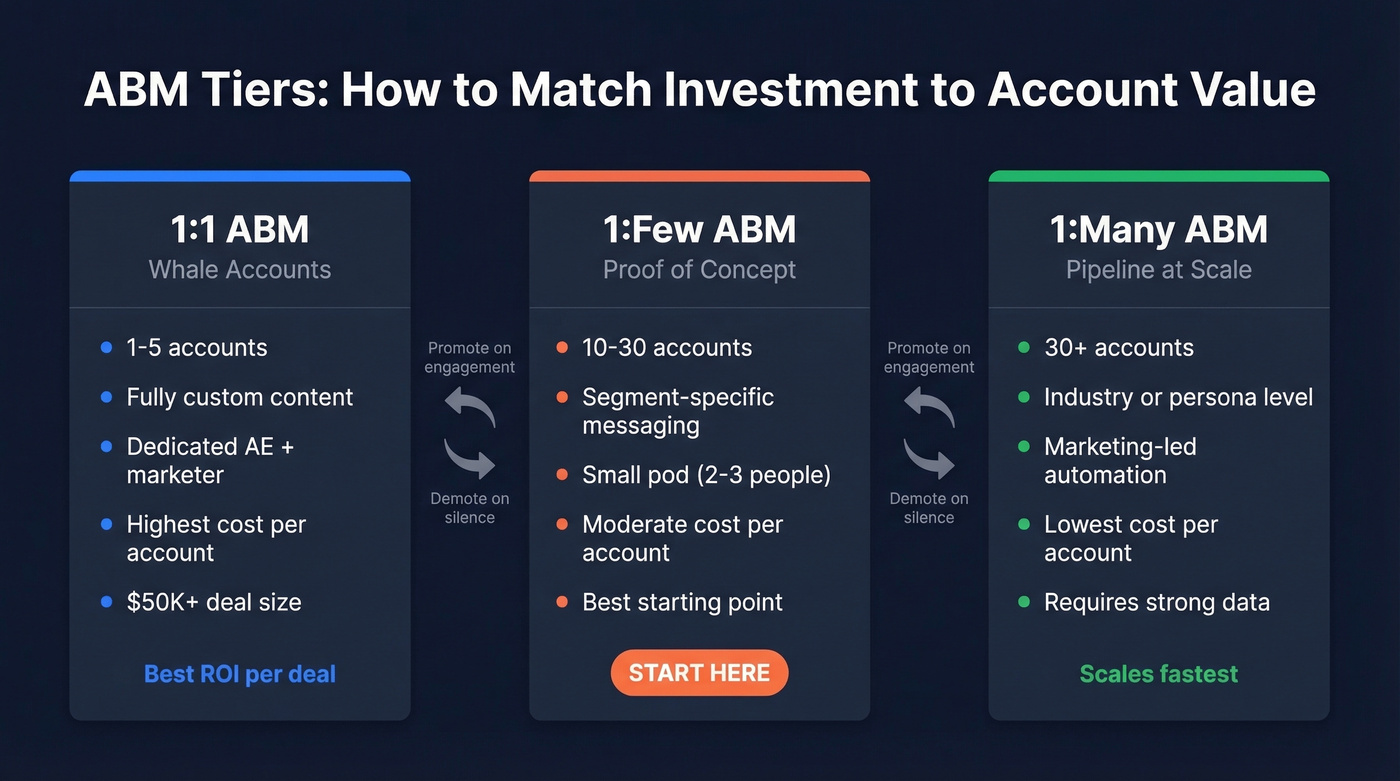
| 1:1 | 1:Few | 1:Many | |
|---|---|---|---|
| Accounts | 1-5 | 10-30 | 30+ |
| Personalization | Fully custom | Segment-specific | Industry/persona |
| Team required | Dedicated AE + marketer | Small pod | Marketing-led |
| Best for | Whale accounts | Proof of concept | Pipeline at scale |
Here's the thing most teams miss: accounts should move between tiers based on engagement signals. A 1:many account showing strong intent gets promoted to 1:few. A 1:few account going dark drops back down. Static lists are the enemy of good ABM, and we've watched teams burn six figures treating their tier assignments like permanent labels instead of dynamic categories that shift as buying signals change.
Marnie Giuranna Zaccaria at Fortinet put it bluntly: ABM strategy takes about three years to get up to speed. That's why starting with 1:few makes sense - you get proof of concept without the resource drain of fully custom 1:1 campaigns.
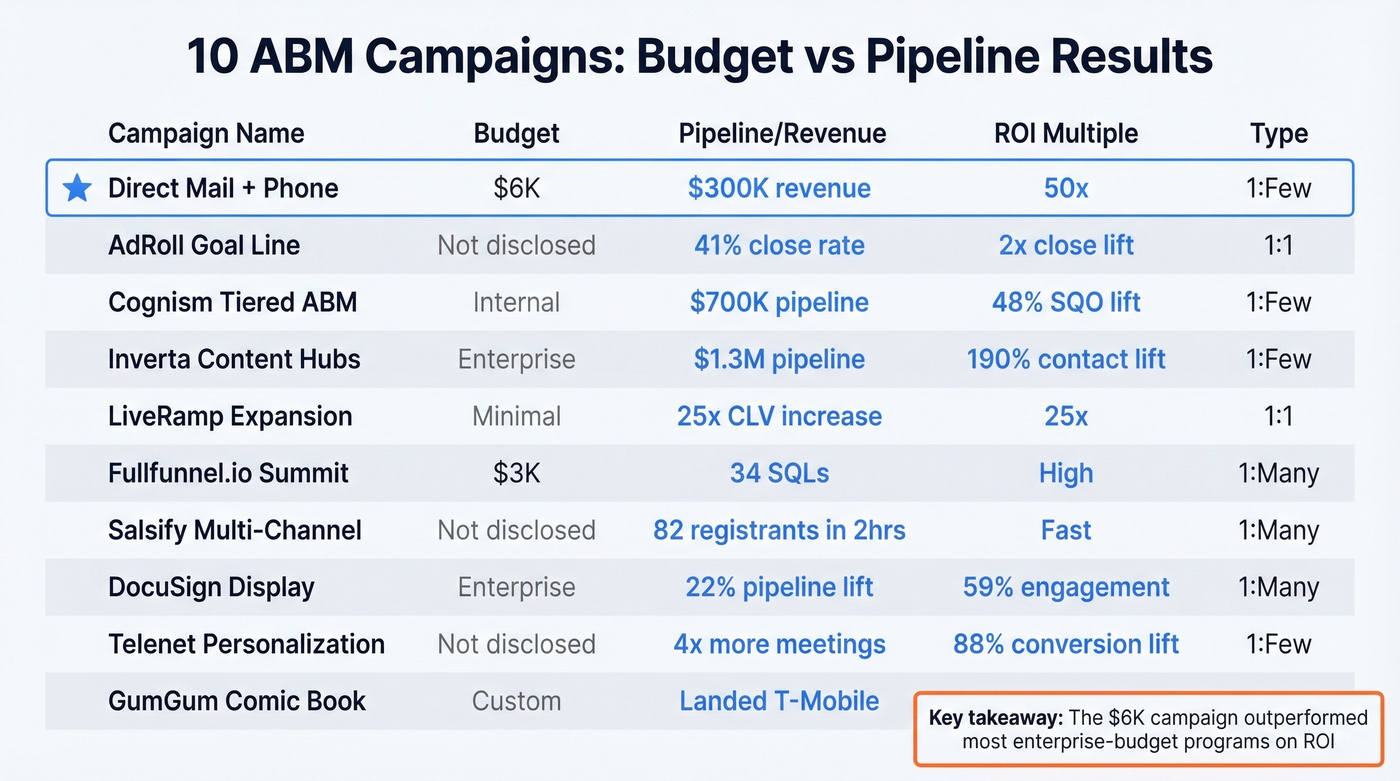
10 Campaigns That Drove Real Pipeline
1. $6K Direct Mail to $300K Revenue
This is the ABM example worth studying because it's the most replicable. A founder on r/Entrepreneur documented the full campaign: a team of three - one SDR, one junior marketer, and a campaign lead - targeted 30 Tier 2 accounts with direct mail and phone follow-up. Total budget: $6K.
The personalization was clever without being expensive. They matched swag to the recipient's role: CTOs got a Darth Vader toy, CEOs got Scrooge McDuck, HR leaders got Superwoman. Every package included Tylenol - a tongue-in-cheek nod to the pain points in their pitch - plus a personalized note with niche case studies relevant to the prospect's industry.
Shipping went through FedEx, not USPS, because FedEx packages get opened. The next morning after delivery, the SDR called. Then email. Then social follow-up.
Results: 37% reply rate, 20% success rate, $300K in revenue. That's a 50x return. No 6sense. No Demandbase. No programmatic display. Just good targeting, creative personalization, and relentless follow-up. We point people to this campaign every time someone says they can't afford ABM.
2. AdRoll "Project Goal Line" - 41% Close Rate
Use this if: You've got a sales team that already closes but marketing isn't getting credit for pipeline influence.
Skip this if: You don't have Salesforce + a marketing automation platform mapped to lifecycle stages.
AdRoll's internal ABM campaign hit a 41% close rate by orchestrating direct mail triggers around sales stages. They mapped Salesforce stages to Marketo lifecycle stages then triggered three distinct mail pieces at key moments: a "Door Opener Kit" early on (a note from the SDR plus a book of customer use cases), a post-meeting kit shipped within days of a quality appointment, and an "Over-the-Line Kit" if a prospect stalled for 35 days.
Company-name personalized ads decreased CPA by 42% compared to generic ads. The headline stat: outbound opportunities with a marketing touch closed at 7% versus 3% without one. That's a 2x close rate lift from marketing involvement alone.
3. Cognism's Tiered ABM - $700K Pipeline
Cognism ran their own tiered ABM playbook internally and generated $700K in pipeline in the first half of 2025. The conversion deltas tell the real story.
MQL-to-pipeline conversion hit 47.9% - 24% higher than their enterprise average. MQL-to-SQO conversion reached 30.9%, a 48% lift. Average contract value on ABM accounts ran 46% higher than their enterprise average. The lesson isn't that Cognism has special tools. It's that disciplined tiering and measurement produce dramatically better conversion rates than treating every account the same.
4. Inverta Content Hubs - $1.3M Pipeline
Inverta worked with a large cloud services company targeting 50 enterprise manufacturing accounts. The challenge was complexity - buying committees of 12+ people, each with different concerns.
Their approach: personalized content hubs with content mapped to each stakeholder's role and stage. Not one landing page. Not a generic whitepaper. A curated experience for each account cluster. Results: $1.3M in pipeline, 70% engagement rate, and a 190% increase in successful contacts. That 70% engagement rate is the number worth paying attention to - it means the content was actually relevant, not just served. For teams selling into complex enterprise accounts, this is the model.
5. LiveRamp - 15 Accounts, 25x CLV
LiveRamp went ultra-narrow: just 15 top-tier client accounts. The campaign focused on deepening existing relationships rather than net-new acquisition. Within four weeks, they hit a 33% conversion rate on expansion opportunities. Over two years, customer lifetime value increased 25x.
Most teams skip this example because it isn't about new logos. That's a mistake. For companies where expansion revenue matters - and it should - targeting your best existing accounts with dedicated ABM motions produces outsized returns with minimal spend.
6. Fullfunnel.io Virtual Summit - $3K, 34 SQLs
Fullfunnel.io ran a virtual summit as an ABM play on a $3K budget, pulling 2,320 signups and converting 34 into SQLs. Events create a natural reason for sales follow-up - "Did you catch the session on X?" is a warmer opener than any cold email.
For teams without budget for direct mail or display ads, event-based ABM is the move. Keep the event tightly themed around your ICP's pain points, not a generic webinar rebranded as ABM.
7. Salsify - 82 Registrants in 2 Hours
Salsify coordinated a multi-channel push from a curated target account list with a goal of 60 event attendees. They hit 82 registrants in roughly two hours - proof of what happens when the account list is already built and channels are ready to activate.
8. DocuSign Programmatic Display
DocuSign ran targeted display ads for over 450 enterprise accounts across six industries with messaging and content customized by industry and buying stage. Results: 22% increase in sales pipeline, 59% engagement rate, 300% increase in page views, and a 26% decrease in bounce rate. Classic 1:many play. Not flashy, but the pipeline numbers justify it for teams with established ad operations.
9. Telenet Personalized Content
Telenet teamed up with Turtl on reader-led personalization and booked 4x more meetings with an 88% lift in conversion rates. Even modest personalization - industry-specific landing pages, role-based messaging - compounds when applied consistently across your target list.
10. GumGum's T-Mobile Comic Book
GumGum created a custom comic book for T-Mobile's CEO in 2016. It's in every ABM listicle ever written. It worked - they landed the account. But it's a stunt, not a strategy. The boring examples above - direct mail kits, tiered campaigns, content hubs - are the ones worth copying because they're repeatable. One-off creative stunts make great conference talks and terrible playbooks.
Patterns Across Winning Campaigns
Every campaign above that produced outsized returns shares three traits:
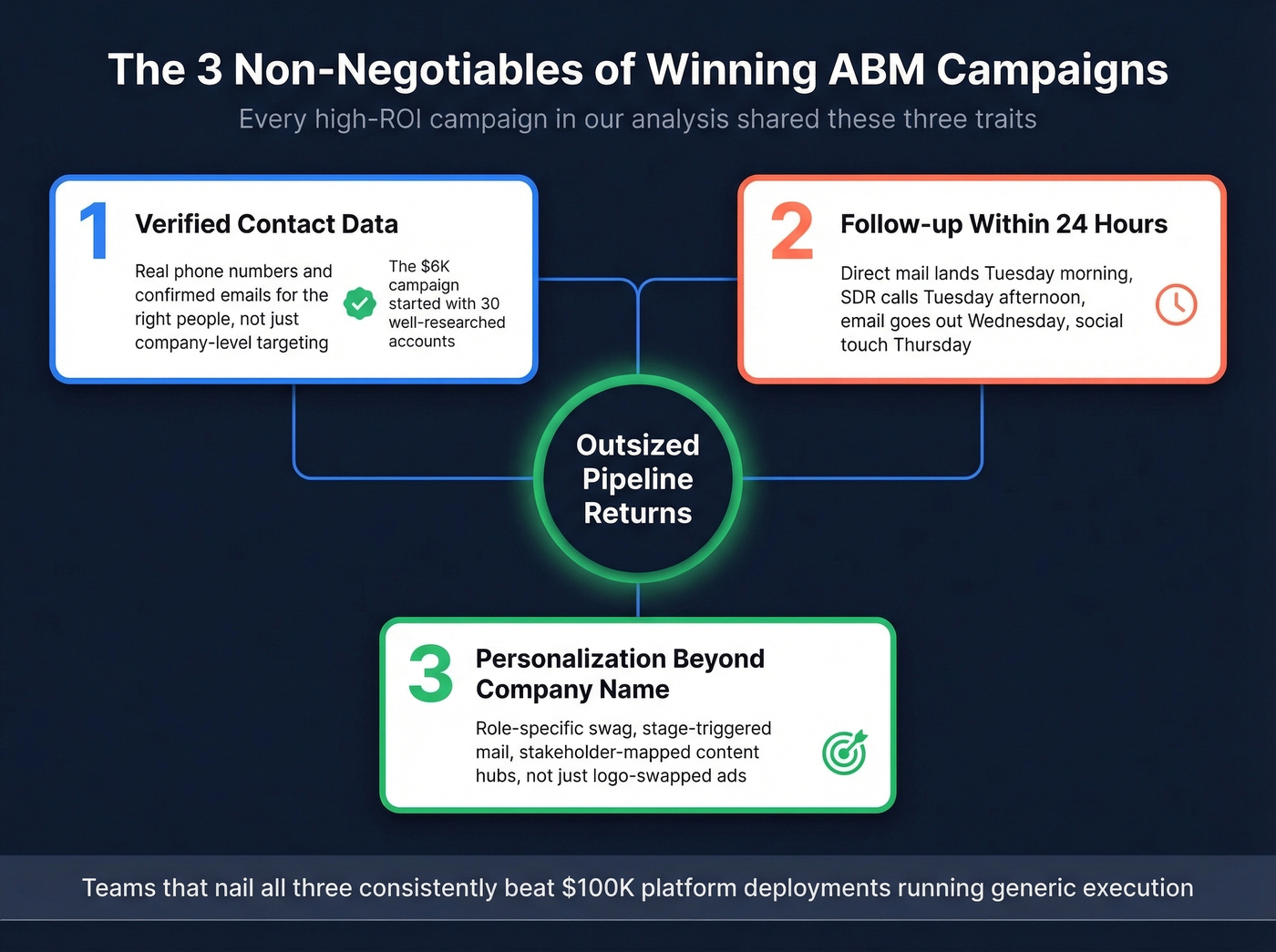
- Verified contact data. The $6K campaign started with 30 well-researched accounts and confirmed contact details for the right people at each one.
- Fast follow-up within 24 hours of the first touch.
- Personalization beyond the company name - role-specific swag, stage-triggered mail, stakeholder-mapped content hubs.
Teams that nail all three consistently outperform teams running expensive platforms with generic execution. Let's be honest: we've seen $100K ABM platform deployments produce worse results than a $6K direct mail campaign because the fundamentals were missing.

That $6K direct mail campaign worked because the SDR had real phone numbers and verified emails for every target. Prospeo gives you 98% accurate emails and 125M+ verified mobile numbers with a 30% pickup rate - so your follow-up actually connects.
Stop mailing packages to prospects you can't reach by phone the next morning.
How to Budget Your ABM Campaign
Most teams either overspend on platforms or underspend on execution. Here's a formula that works backward from revenue, adapted from ZenABM's budgeting model based on 2026 campaign data from 211 companies across 29 countries.
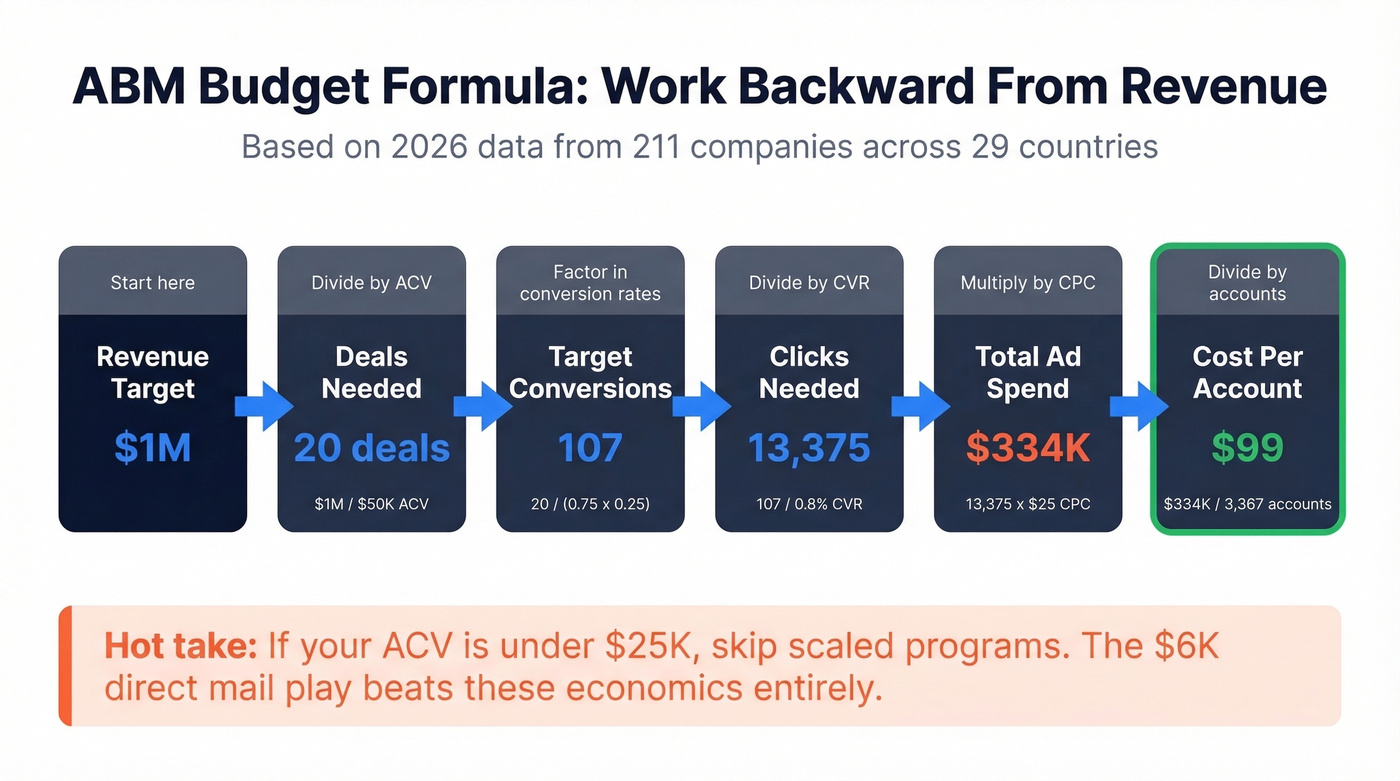
| Step | Calculation | Result |
|---|---|---|
| Revenue target | - | $1M |
| Deals needed | $1M / $50K ACV | 20 |
| Target conversions | 20 / (0.75 x 0.25) | 107 |
| Clicks needed | 107 / 0.8% CVR | 13,375 |
| Total spend | 13,375 x $25 CPC | ~$334K |
| Cost per account | $334K / 3,367 accts | ~$99 |
The $25 CPC assumption reflects typical B2B ad costs. Work backward from revenue, not forward from budget.
Here's the hot take: if your average deal size sits below $25K, you probably don't need a scaled 1:many program at all. The $6K direct mail campaign blew past these economics because it skipped paid media entirely. For 1:few ABM on 20-30 accounts, you need $5-10K for direct mail, a CRM, verified contact data, and a phone.
Why Most ABM Campaigns Fail
Operational Breakdowns
UserGems documented eight reasons ABM campaigns fail. The top five we see repeatedly:
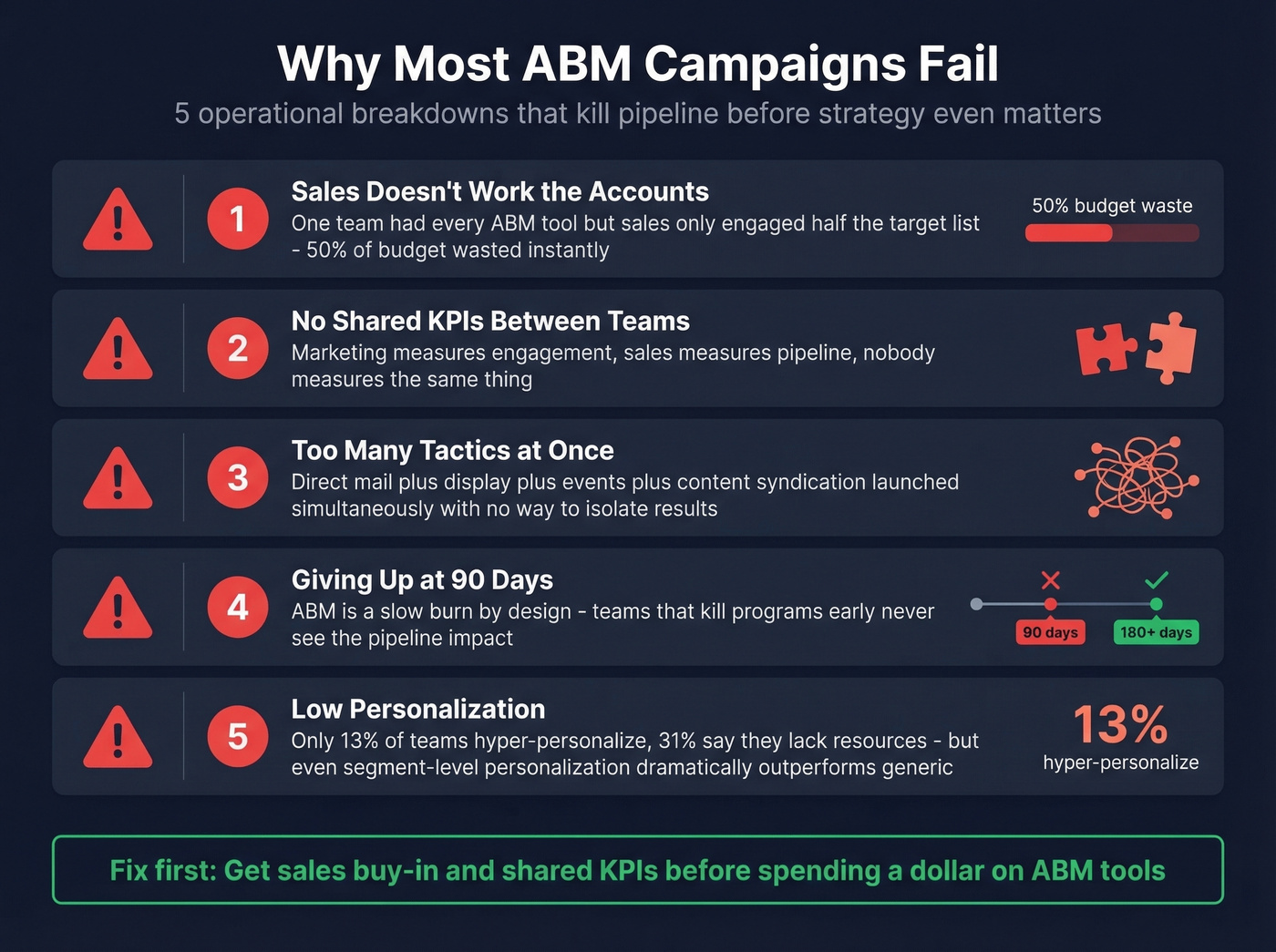
Sales doesn't work the accounts. One team had every ABM tool in the stack, but sales only engaged half the target accounts. That's 50% of the ABM budget wasted before a single deal closed. If sales isn't bought in, don't launch.
No shared KPIs. Marketing measures engagement. Sales measures pipeline. Nobody measures the same thing. Fix this with weekly alignment meetings and shared pipeline targets.
Too many tactics at once. Direct mail plus display plus events plus content syndication plus gifting - launched simultaneously with no way to isolate what's working. Start with one or two channels, prove them, then layer.
Giving up too early. Teams that kill programs at 90 days never see the pipeline impact. ABM is a slow burn by design.
Low personalization. Sending the same ad to 500 companies isn't ABM. Only 13% of teams hyper-personalize, and 31% say they lack the resources. But even segment-level personalization dramatically outperforms generic campaigns.
Bad data is the silent ABM killer. If 15% of your emails bounce, your sender reputation tanks and attribution breaks. Verify every email before you hit send so your sequences actually reach the buying committee instead of disappearing into spam folders.
Attribution That Lies to You
Before you conclude ABM isn't working, check whether your measurement is broken.
HubSpot's contact-level attribution creates false negatives for ABM because it tracks the individual who filled out the form, not the account that was influenced. If your champion saw three ads, attended a webinar, and forwarded the content to the VP who eventually booked a demo - HubSpot credits the VP's direct visit, not your ABM campaign. The technical breakdowns compound from there: UTM parameters get stripped by redirects, ad blockers, and Safari's Intelligent Tracking Prevention; the LinkedIn attribution window only extends 90 days, so longer sales cycles lose those touches entirely; and contacts not set as Marketing Contacts in HubSpot won't show up in campaign reporting at all.
We've seen teams kill ABM programs that were actually working because their attribution setup couldn't capture account-level influence. Before you pull the plug, audit your tracking stack.
Building Your ABM Target List
The gap between "we have a strategy" and "we're executing" is almost always the target list. Contact-level ABM drives up to 74% more booked meetings and up to 118% higher pipeline conversion than account-level-only approaches. But you can't run contact-level plays on bad data.
Your campaign is only as good as your contact data. Before you ship a single direct mail kit or launch a single ad, verify every email and phone number on your list. Prospeo covers 300M+ professional profiles with 98% email accuracy and refreshes data every 7 days, so you're not burning $150 direct mail kits on contacts who left the company last quarter.

The workflow: define your ICP, pull accounts showing buying signals, build contact-level lists with verified data, then push those contacts into your sequencer or direct mail platform. The $6K campaign that generated $300K started with exactly this approach - 30 well-researched accounts and verified contact details for the right people at each one.
Tiered ABM only works when your account data is fresh. Prospeo refreshes every 7 days - not the 6-week industry average - so your intent signals and contact info stay current as accounts move between tiers. Layer in buyer intent across 15,000 topics to know which accounts to promote.
Build dynamic ABM lists with intent data and contacts that don't bounce.
ABM Tools - What You Actually Need
You don't need an expensive ABM platform to start. The $6K case study used a CRM, direct mail, and a phone. But when you're scaling beyond 50 accounts or running multi-channel programs, here's how the major platforms compare:
| Platform | Primary Strength | Best For | Est. Annual Cost |
|---|---|---|---|
| 6sense | AI-powered intent + prediction | Enterprise, large TAMs | $30-100K+ |
| Demandbase | Buying-group-first ABM | Multi-stakeholder deals | $30-100K+ |
| RollWorks | Account-targeted ads | Ad-led mid-market | $12-36K |
| Terminus | Multi-channel orchestration | Display + mail + events | $24-60K |
6sense processes 1 trillion+ buying signals daily. Demandbase is built around buying groups inside complex accounts. RollWorks is the most accessible entry point for ad-driven ABM. Terminus orchestrates across channels.
The opinion nobody wants to hear: most teams under 50 employees don't need any of these. A CRM, a data provider with verified contacts, a direct mail vendor, and disciplined follow-up will outperform a $50K platform that nobody fully implements. Buy the platform when your ABM motion is proven and you need to scale - not before.
FAQ
How much does an ABM campaign cost?
Expect $5K for direct mail to 30 accounts up to $300K+ for full-stack enterprise programs. Cost per account typically lands between $50-$200 for mid-market. Use the reverse-from-revenue formula in the budgeting section to calculate your specific number.
How long before ABM shows results?
Engagement signals appear in 4-8 weeks, pipeline impact in 3-6 months, and full program maturity takes 2-3 years. Start with a 1:few motion on 20-30 accounts for the fastest proof of concept.
Can I run ABM without 6sense or Demandbase?
Yes - the $300K-on-$6K case study used only a CRM, direct mail, and phone calls. Platforms help at scale, but the fundamentals are targeting, personalization, and follow-up. Pair a verified data provider with a direct mail vendor and you've got a functional ABM stack for under $500/month.
How do I build an ABM target account list?
Define your ICP, identify accounts showing buying signals (intent data, job postings, funding rounds), build contact-level lists with verified emails and direct dials, then validate every record before launch. Start with 20-30 accounts, not 500.
What's the difference between ABM and demand gen?
Demand gen casts a wide net and measures leads. ABM targets specific accounts and measures pipeline influence. Most B2B teams need both - ABM for high-value accounts worth $50K+ ACV, demand gen for volume and brand awareness.
The best ABM campaign examples in this article aren't the most creative or the most expensive. They're the most disciplined - small target lists, verified data, fast follow-up, and the patience to let pipeline build over months instead of days. Start with 20 accounts and a phone. Scale from there.