

Account Manager Tips That Go Beyond "Build Relationships"
It's your first Monday. You've got a spreadsheet with 40 accounts, a CRM that hasn't been updated since your predecessor left, and a manager who says "just focus on building relationships." That's not a playbook - that's a wish.
The account manager tips you actually need aren't about active listening or empathy exercises. They're operational: written plans, regular reviews, clean data, and a system that doesn't depend on your memory.
What You Need (Quick Version)
If you implement nothing else, do these three things:
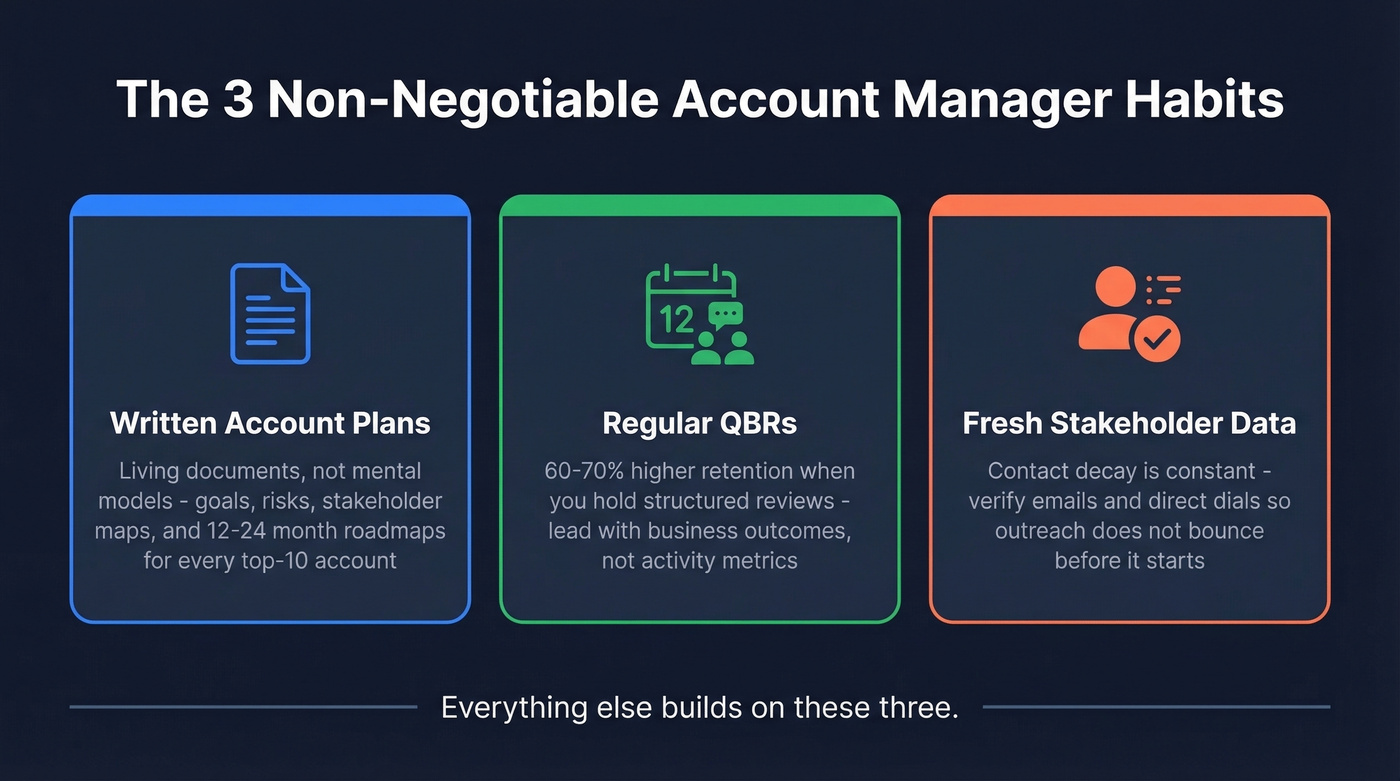
- Write an account plan for every top-10 account. Not a mental model - a document.
- Run QBRs. Companies that hold regular customer reviews see 60-70% higher retention. That's not a nice-to-have.
- Keep your stakeholder contact data fresh so outreach doesn't bounce. Stale data kills proactive outreach before it starts.
Everything else below builds on those three.
Build a Written Account Plan
The single biggest difference between AMs who retain and grow accounts and AMs who churn them? A written plan. Not a slide deck you made for a QBR once. A living document that covers goals, growth opportunities, risks, and a 12-24-month roadmap.
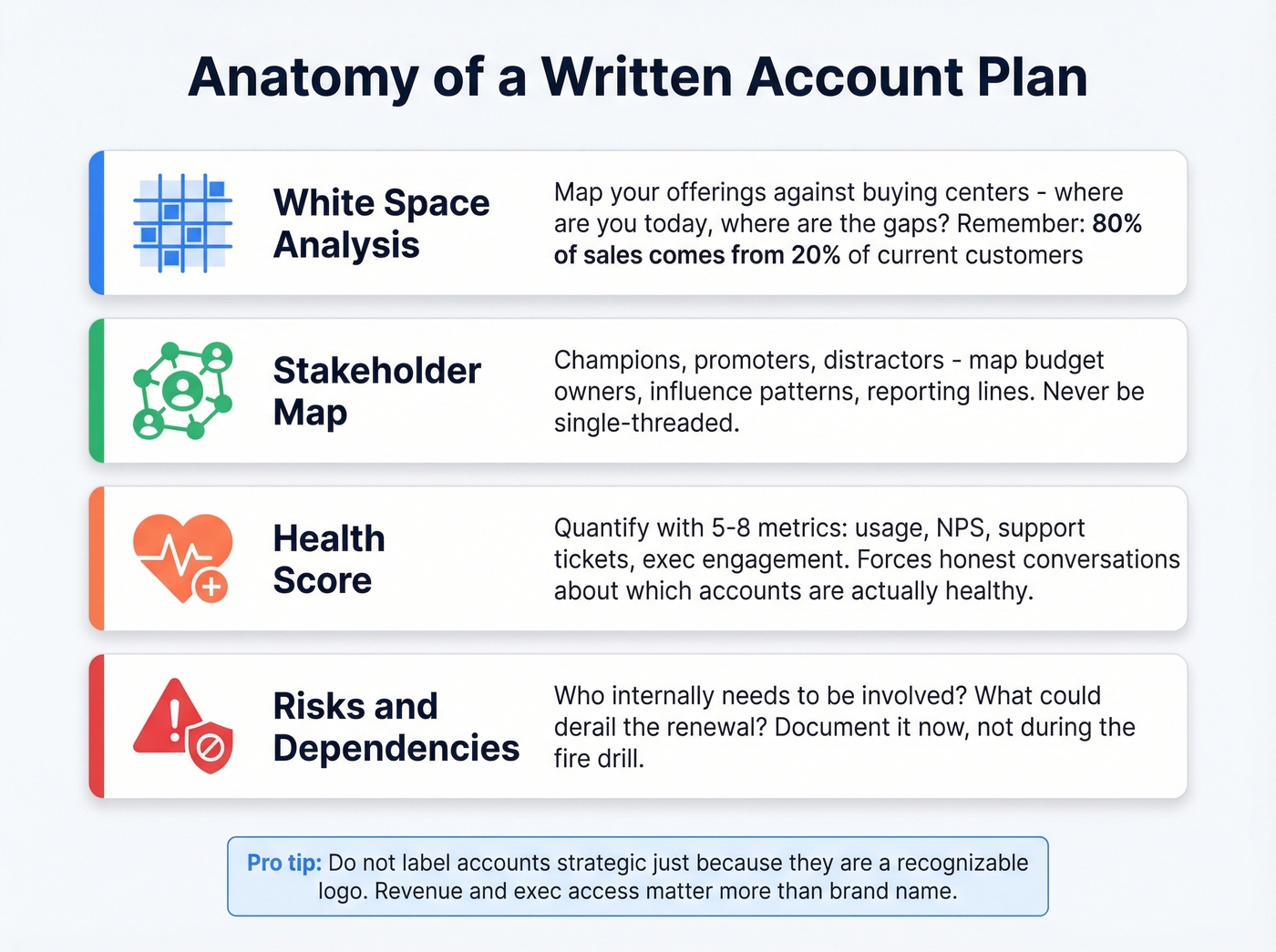
Here's what goes in it:
- White space analysis - map your offerings against the customer's buying centers. Where are you engaged today? Where are the gaps? Apply the 80/20 rule: 80% of sales comes from 20% of current customers, so invest your planning time accordingly.
- Stakeholder map - identify champions, promoters, and distractors. Map budget owners, influence patterns, and reporting lines. Avoid being single-threaded at all costs. If your one champion leaves, you're starting from zero.
- Health score - quantify relationship health with 5-8 core metrics like usage, NPS, support ticket trends, and executive engagement. This forces honest conversations about which accounts are actually healthy versus which ones are coasting.
- Risks and dependencies - who internally needs to be involved? What could derail the renewal?
One thing that kills stakeholder maps: stale data. People change roles, leave companies, get promoted. If you're managing 30+ accounts, contact decay is constant. We've found that verifying contacts through Prospeo's Chrome extension - which pulls verified emails and direct dials from web sources - catches dead addresses before they torpedo your outreach. The free tier covers 75 emails and 100 Chrome extension credits per month, enough to audit your top accounts regularly.
Don't label accounts "strategic" just because they're a recognizable logo. A Fortune 500 account that generates minimal revenue and has no executive relationship isn't strategic - it's a distraction.
Run QBRs That Drive Revenue
QBRs are one of the highest-ROI activities an account manager can do. If you're skipping them because "clients are too busy," you're leaving money on the table.
B2B customers with strong executive participation are 2.5x more likely to renew. One CS leader at UpKeep called QBRs a "money activity" because of the direct correlation between reviews held per rep and expansion opportunities identified. Let's be honest - if you aren't sitting across from your client at least twice a year, someone else will.
To run them well: prepare 1-2 weeks in advance and send the agenda beforehand so the client shows up ready to engage, not ambushed. Lead with business outcomes, not activity metrics. Nobody cares that you logged 47 support tickets - they care whether the product moved their KPIs. Send notes with action items, owners, and deadlines within 24 hours. No exceptions.
Not every account needs a quarterly QBR. Segment your book:
| Tier | QBR Cadence | Format |
|---|---|---|
| Strategic | Quarterly | In-person or video, exec-level |
| Mid-tier | 2x/year | Video, manager-level |
| Low-touch | Async | Email summary + optional call |
Your First 90 Days on the Job
A 30-60-90 plan converts the overwhelming "learn everything" mandate into concrete milestones. We've seen new AMs flounder for months without one, then wonder why their first renewal cycle is a disaster.
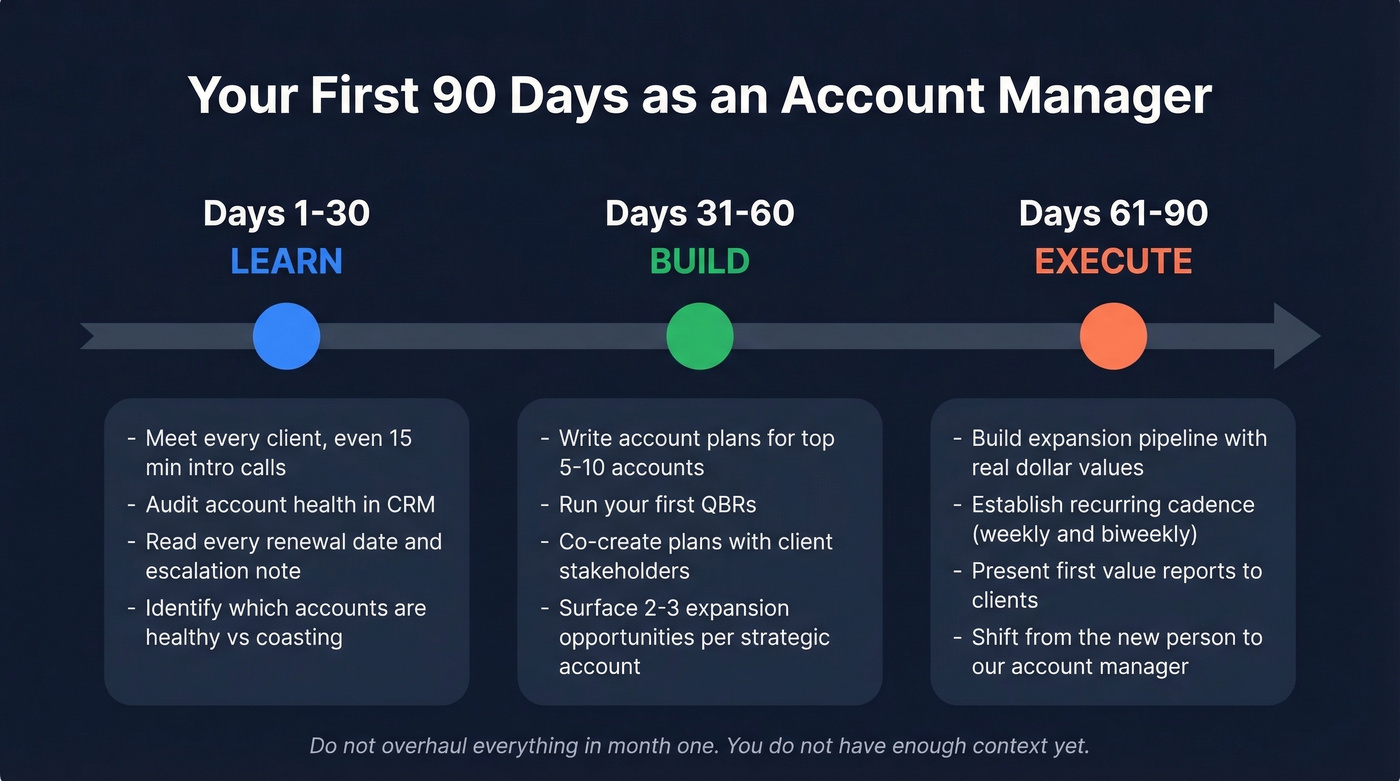
Days 1-30: Learn. Meet every client - even a 15-minute intro call. Audit account health in the CRM. Read every renewal date, support escalation, and expansion note your predecessor left behind. Identify which accounts are actually healthy versus which ones are coasting on inertia.
Days 31-60: Build. Write account plans for your top 5-10 accounts. Run your first QBRs. Co-create plans with client stakeholders rather than building them in a silo - this single habit separates AMs who get buy-in from AMs who get ghosted. White space analysis should surface at least 2-3 expansion opportunities per strategic account.
Days 61-90: Execute. Build an expansion pipeline with real dollar values. Establish your recurring cadence: weekly check-ins for strategic accounts, biweekly for mid-tier. Present your first value reports to clients. This is where you shift from "the new person" to "our account manager."
Skip the temptation to overhaul everything in month one. You don't have enough context yet, and your clients don't trust you enough to accept big changes. Earn the right first.

Stale stakeholder data is the silent killer of account plans. People change roles, leave companies, and your outreach bounces. Prospeo's 7-day data refresh cycle keeps your contact maps current - 98% email accuracy, 125M+ verified mobile numbers, and 50+ data points per contact.
Stop building account plans on dead email addresses.
A Real AM's Daily Routine
Edward Wehr, an account manager at Cisco managing roughly 60 accounts, described his daily split as about 50% meetings and conversations, 50% organizing and working through systems. That's a useful default if you want a day that doesn't get swallowed by inbox triage.
His best tactical rule: do proactive outreach - calls, not emails - before you open your inbox. Email is easier and more tempting, which is exactly why it eats your morning if you let it. The real work happens in conversations.
For in-person meetings, Wehr targets three customer meetings per day to balance travel time with follow-ups. Even if you're fully remote, the principle holds: block mornings for proactive client outreach, afternoons for internal work and prep. I've tried flipping that schedule and it doesn't work - by afternoon, your energy for cold conversations is gone.
Track the Right KPIs
New AMs get handed a book of business with zero context and told to "figure it out." Here's what "good" looks like.
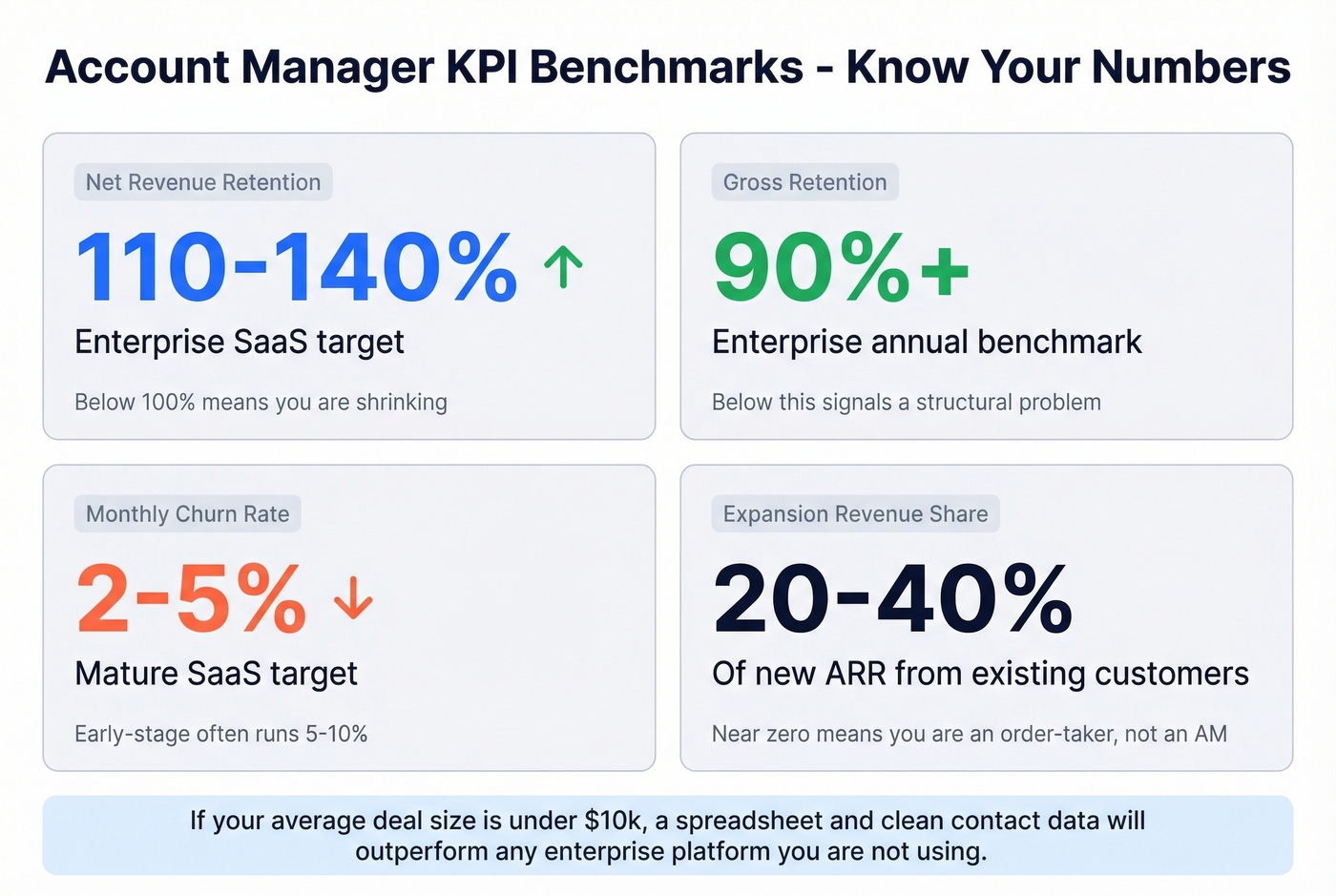
Net Revenue Retention is the north star - enterprise SaaS often runs around 110-140%. If you're below 100%, you're shrinking. Gross retention in enterprise typically sits at 90%+ annually; anything below signals a structural problem, not just a few bad accounts.
Monthly churn in early-stage SaaS runs 5-10%. Mature companies aim for 2-5%. And expansion revenue contribution tells you whether you're actually growing accounts - in expansion-led models, 20-40% of new ARR comes from existing customers. If your expansion number is near zero, you're an order-taker, not an account manager.
Here's the thing: if your average deal size is under $10k, you probably don't need complex account management tooling. A spreadsheet, a calendar, and clean contact data will outperform any enterprise platform you're not actually using.
Mistakes That Kill Accounts
Being tactical instead of strategic. You become an order-taker. The client asks, you deliver, nobody talks about outcomes. Every renewal becomes a procurement exercise instead of a partnership conversation.
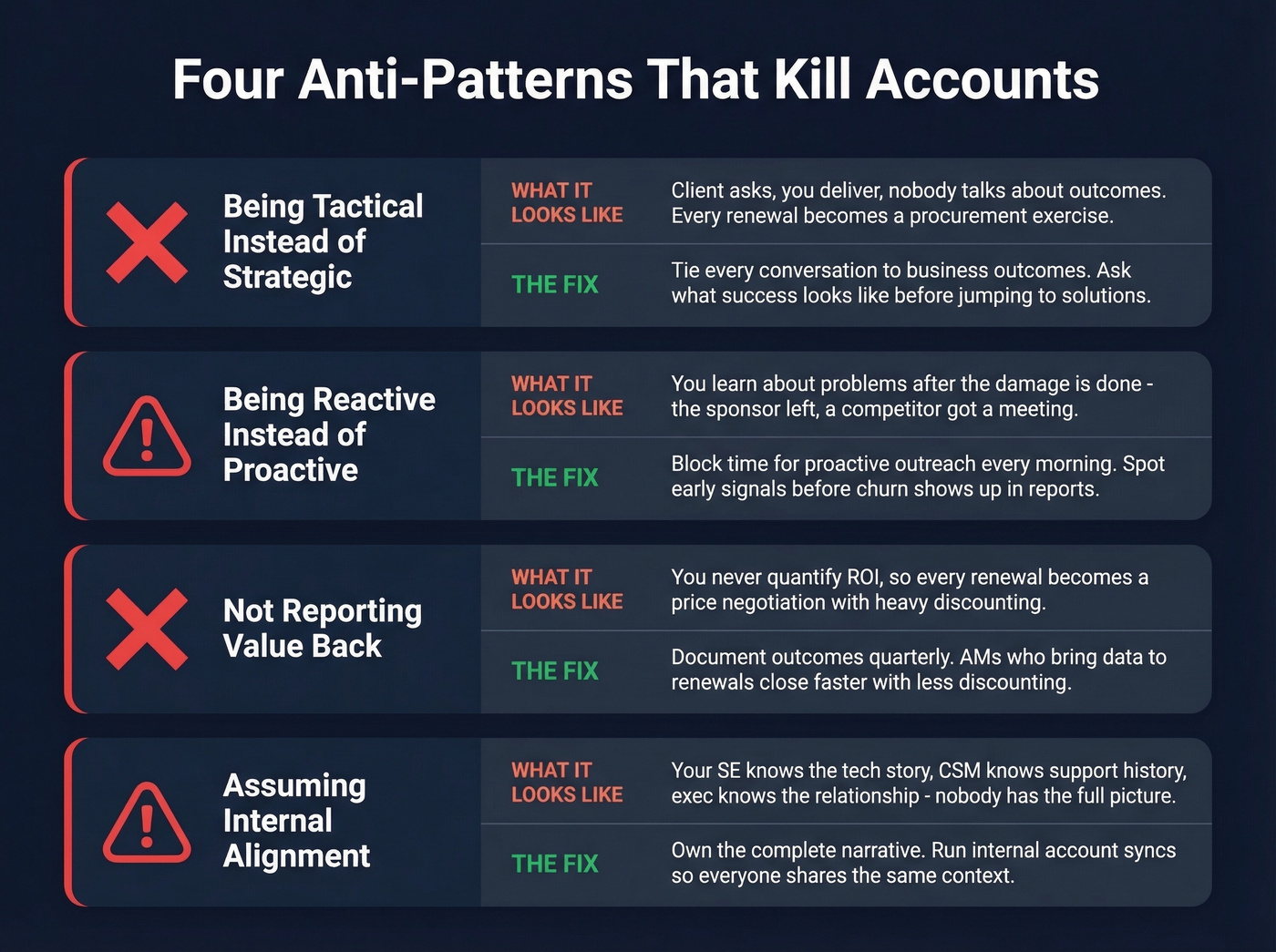
Being reactive instead of proactive. You learn about problems after the damage is done - the sponsor left, priorities shifted, a competitor got a meeting. The real work is spotting early signals before churn shows up in reports. Developing strong selling skills, like identifying expansion signals and positioning upsells around business outcomes, is what separates retention-focused AMs from growth-focused ones.
Not reporting value back. If you never quantify ROI, every renewal becomes a price negotiation. Document outcomes quarterly. The consensus on r/sales is that AMs who bring data to renewal conversations close faster and with less discounting than those who rely on the relationship alone.
Assuming everyone internally understands the client. Your SE knows the technical story, your CSM knows the support history, your exec sponsor knows the relationship - but nobody has the full picture. That's your job. Own it.
Managing 30-60 accounts means hundreds of contacts decaying every quarter. Prospeo's Chrome extension lets you verify emails and pull direct dials in one click - right from your CRM or any company page. 40,000+ users already rely on it. Free tier includes 75 emails and 100 extension credits monthly.
Keep every stakeholder map alive without the manual legwork.
The Operational Mindset
Stop treating account management as a soft-skills job. The best AMs are operators who run processes, track metrics, and treat every account like a mini-business. Relationship skills matter - but they're table stakes, not a strategy.
These account manager tips boil down to one principle: build systems, not habits that live in your head. Write the plans. Run the reviews. Keep your data clean. The rest is execution.