

How to Build an Account Plan That Doesn't End Up in a Drawer
It's QBR week. Your VP just pinged the team Slack channel asking for updated account plans by Friday. Half the reps scramble to screenshot their CRM dashboards, slap a logo on a slide deck, and call it strategy. The other half dig up last quarter's plan, change the date, and hope nobody notices.
That's not an account plan. That's theater.
The plans that actually drive revenue share three things: disciplined account selection, a repeatable structure, and accurate stakeholder data. We've watched teams build gorgeous plans on top of rotten contact data, and the result is always the same - wasted cycles chasing people who left the company months ago. This guide gives you all three pieces, plus a filled-out template you can steal.
What You Need (Quick Version)
- Right accounts. Not every account deserves a plan. Tier your book - 5-10 get full plans, 15-25 get abbreviated versions, the rest get monitored for buying signals.
- Right structure. Use the 9-section template below. It covers everything from business challenges to stakeholder maps to SMART goals.
- Right data. Verify your stakeholder contacts before you build anything. A beautiful org chart with wrong emails and departed contacts is worse than no chart at all.
- Five full plans per rep, max. Beyond five, quality collapses. This isn't a suggestion.
- Quarterly reviews minimum. Annual plans are dead. The market moves too fast.
What Is an Account Plan?
An account plan is a strategic document that maps how you'll grow revenue and deepen relationships within a specific account. It's not a CRM record. It's not a slide deck for your manager. It's a working playbook that connects your solution to the customer's business priorities, stakeholders, and timeline.
Let's clear up the terminology. An account plan can apply to any account in your book. A key account plan targets your highest-value customers - the ones you genuinely can't afford to lose. A strategic account plan is the enterprise version, covering multi-year engagement with C-suite alignment. The structure is similar; the depth and investment scale up.
Why does this matter? Bain & Company's research shows that a 5% increase in customer retention can boost profits by 25-95%. Yet fewer than 20% of companies have fully embedded account planning into their operations, according to Momentum ITSMA. That gap between knowing it works and actually doing it well is where most revenue gets left on the table.
Why Account Planning Matters
The data is overwhelming. A Book of Evidence study surveyed 1,034 people across 62 countries on the impact of structured planning:
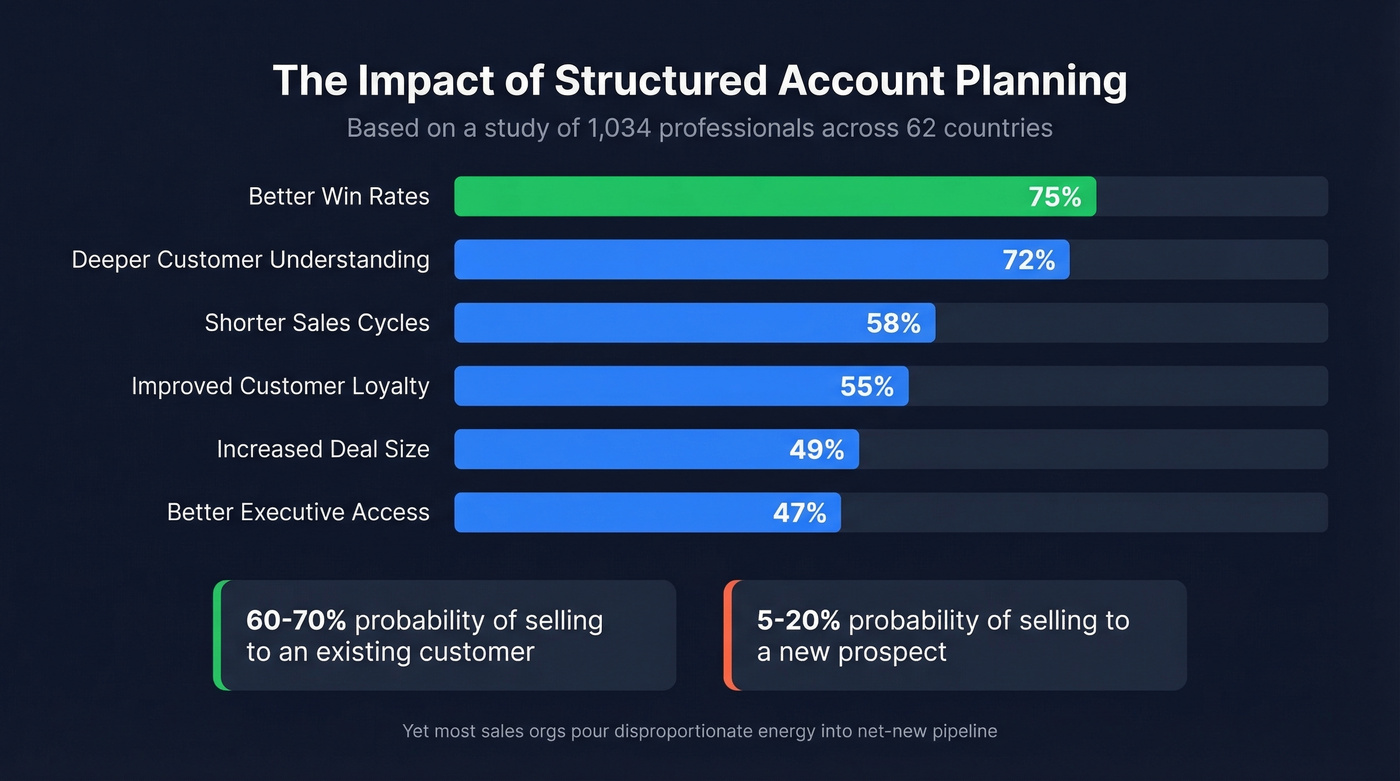
- 75% reported better win rates
- 58% saw shorter sales cycles
- 49% increased deal size
- 72% gained deeper understanding of their customers' business
- 55% improved customer loyalty
- 47% achieved better executive access
A 58% improvement in sales cycle length alone justifies the time investment for most enterprise teams.
There's also the basic math of where revenue comes from. The probability of selling to an existing customer runs 60-70%, compared to 5-20% for a new prospect. Yet most sales orgs pour disproportionate energy into net-new pipeline while treating existing accounts as renewal paperwork. Structured planning reverses that ratio - it turns customer relationships into pipeline by treating your installed base as your highest-yield revenue source.
Here's the uncomfortable truth: only 5% of B2B accounts are actively looking to buy at any given time. A strong account plan is how you stay positioned with the other 95% so you're the first call when budget opens up or a competitor stumbles.
How to Choose Which Accounts Get Plans
Not every account deserves a full plan. The Pareto principle applies ruthlessly - roughly 80% of your revenue growth will come from 20% of your accounts. The goal is to identify that 20% and invest accordingly.
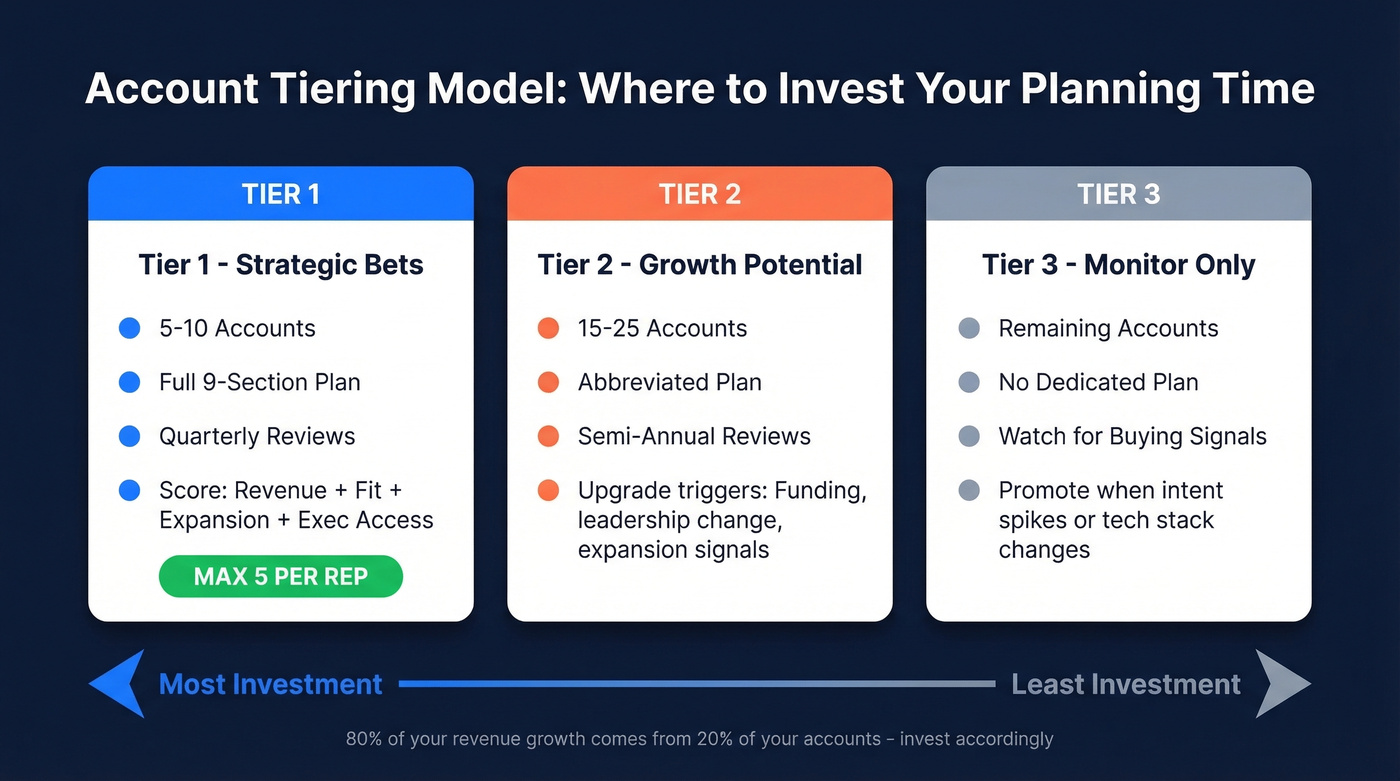
Use a three-tier model:
| Tier | # of Accounts | Plan Depth | Review Cadence |
|---|---|---|---|
| Tier 1 | 5-10 | Full 9-section plan | Quarterly |
| Tier 2 | 15-25 | Abbreviated plan | Semi-annual |
| Tier 3 | Remaining | No dedicated plan | Monitor signals |
Tier 1 accounts are your strategic bets - high revenue potential, strong ICP fit, executive relationships worth cultivating. Score them on four criteria: revenue potential, product fit, expansion opportunity, and executive access. Accounts that score high on at least three get the full treatment.
Tier 2 accounts show promise but don't warrant the same depth. An abbreviated plan covering business challenges, key contacts, and next steps is enough. Review semi-annually unless something triggers an upgrade - a new funding round, leadership change, or expansion signal.
Tier 3 accounts sit in monitoring mode. No dedicated plan. Just watch for buying signals like job postings, tech stack changes, or intent spikes that would justify promoting them to a higher tier.
The hard rule: no more than five full plans per rep. We've seen teams assign 15-20 accounts per rep for "strategic planning." The result is always the same - 15-20 mediocre plans instead of 5 excellent ones.
Account Plan Template
The 9 Sections Every Plan Needs
This structure draws from the Intellisell template framework and what we've seen work across enterprise sales teams.
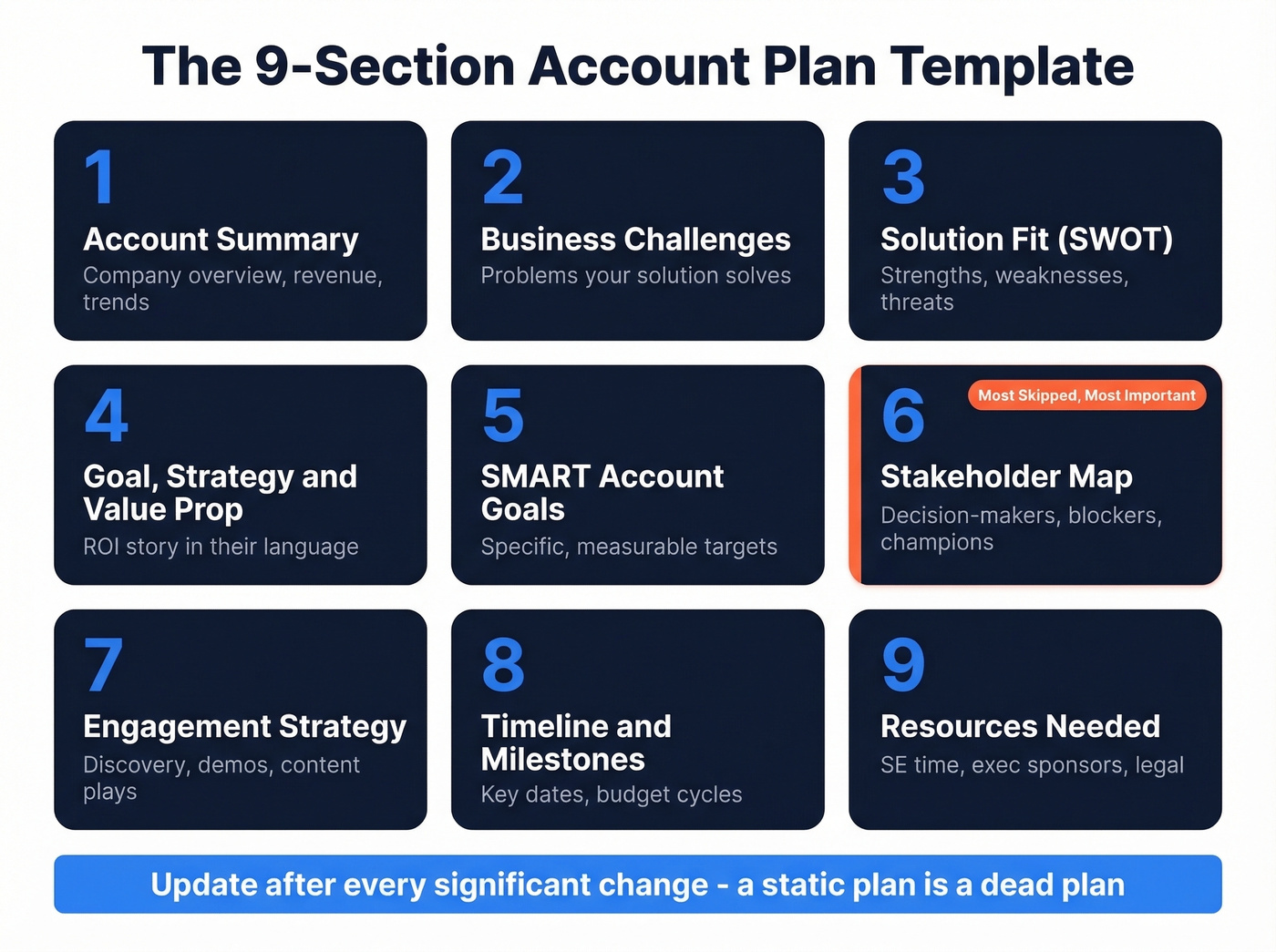
1. Account Summary. Company overview, revenue, funding stage, headcount trajectory, and macro industry trends. One practitioner on r/sales includes headcount investment trends and top 5 industry trends in every plan. Smart move - it forces you to think beyond your own product.
2. Business Challenges & Opportunities. What problems does this account face that your solution addresses? Rate urgency - "hair on fire" or "nice to have"?
3. Solution Fit (SWOT). Where you're strong, where you're weak, what opportunities exist for expansion, and what threatens the deal.
4. Goal, Strategy & Value Proposition. Your ROI story tailored to this account - their challenges, their metrics, their language.
5. SMART Account Goals. "Grow revenue" isn't a goal. "Expand from 3 seats to 25 seats by Q3, adding engineering as a new department" is.
6. Stakeholder Management Plan. Decision-makers, influencers, blockers, champions - mapped with motivations and engagement strategy. This is the section most reps skip and the one that matters most.
7. Engagement Strategy. Discovery plan, demo/POC approach, pricing strategy, referral plays, and content to share.
8. Timeline & Milestones. Key dates, decision points, budget cycles. Map your sales process against their buying process.
9. Resources Needed. Solutions engineering time, executive sponsor involvement, custom content, legal review. Call it out now so you're not scrambling later.
Update the plan after every significant change - new stakeholder, funding event, strategic shift, or competitive development. A static plan is a dead plan.
Filled-Out Example
Here's what sections 1, 2, 6, and 7 look like filled out for a fictional mid-market account. This is the part most guides skip - and the part that actually helps.
Account: Acme Cloud Solutions Mid-market B2B SaaS | 320 employees | $42M ARR | Series C ($28M raised Q1 2026) | Austin, TX
Section 1 - Account Summary: Acme provides infrastructure monitoring for DevOps teams. Headcount is up 40% YoY, primarily in engineering and sales. The observability market is consolidating - Datadog and New Relic are acquiring smaller players, creating anxiety among mid-market vendors about differentiation. Acme's CEO has spoken publicly about needing to "move upmarket" into enterprise accounts, which aligns directly with our platform's enterprise enablement capabilities.
Section 2 - Business Challenges: Acme's outbound team (12 reps) is struggling with data quality - their current provider delivers 25-30% bounce rates on cold email, burning sender reputation. Their CRM data decays faster than they can maintain it, with an estimated 30% of contact records going stale within 90 days. Pipeline generation is 35% below target for Q2, and the new VP of Sales (hired January 2026) has flagged this as her top priority.
Section 6 - Stakeholder Map:
| Name | Title | Role | Motivation | Risk |
|---|---|---|---|---|
| Sarah Chen | VP Sales | Decision-maker | Hit pipeline targets | New to role |
| Marcus Webb | RevOps Mgr | Influencer | Clean CRM data | Loyal to incumbent vendor |
| Priya Patel | CFO | Approver | Control spend | Budget-cautious |
| Jake Torres | SDR Lead | Champion | Better prospecting data | Flight risk |
Section 7 - Engagement Strategy: Lead with a data quality audit - offer to benchmark Acme's current bounce rate against industry averages using a 1,000-email sample. This gives Sarah quantifiable proof for her CFO conversation. Run the POC through Jake's SDR team first; if his reps see immediate results, he becomes an internal evangelist. Neutralize Marcus by involving him in the CRM integration scoping - make him the technical owner, not a bystander. Share the Snyk case study (similar team size, similar bounce rate problem, 180% pipeline increase) with Sarah before the executive presentation.

You just read it: a beautiful org chart with wrong emails and departed contacts is worse than no chart at all. Prospeo's 7-day data refresh cycle means your stakeholder maps reflect reality - not last quarter's LinkedIn scrape. 98% email accuracy across 300M+ profiles.
Build account plans on data that's actually current.
Stakeholder Mapping Done Right
B2B deals now involve an average of 11 stakeholders. Eleven people who can say no, slow things down, or redirect budget. If your plan only maps the person who took your first meeting, you're flying blind.
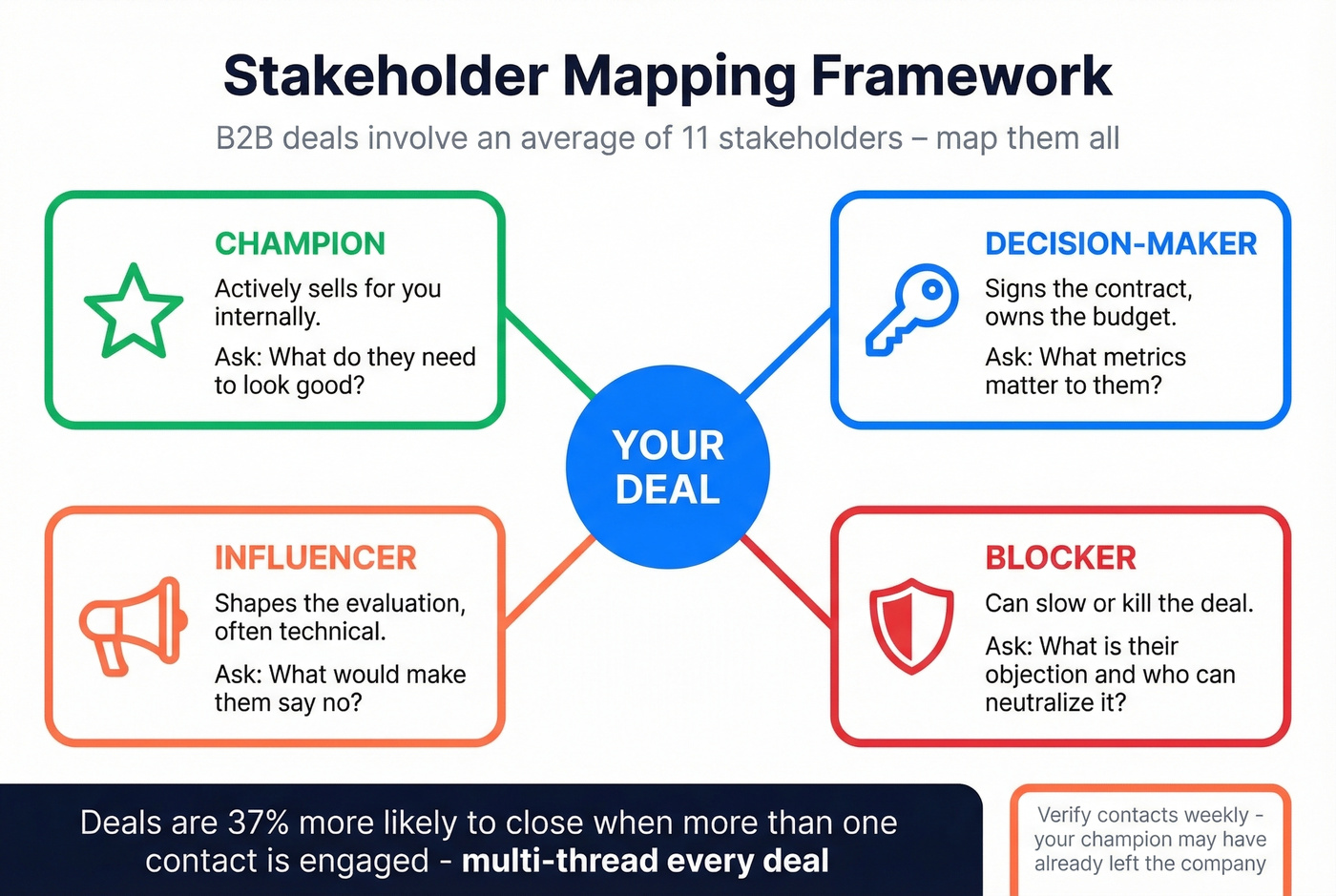
Multi-threading isn't optional. Outreach's data shows that deals are 37% more likely to close when more than one contact is engaged. That's the difference between a 25% win rate and a 34% win rate on the same pipeline.
Map every stakeholder as a decision-maker, influencer, blocker, or champion. For each person, document what they care about, what would make them say no, and how you'll reach and influence them.
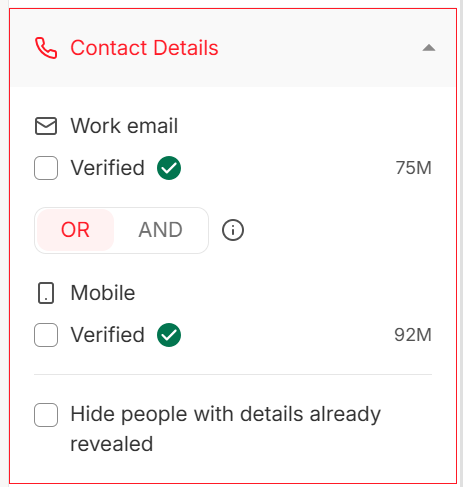
But here's where most plans break down: the stakeholder map is only useful if the people in it are still at the company and reachable. We've all had the "champion got promoted" moment - you show up to the QBR and discover your main contact left two months ago. Your carefully crafted engagement strategy is now aimed at a ghost. A data platform with a weekly refresh cycle solves this. Prospeo, for example, refreshes 300M+ profiles every 7 days at 98% email accuracy, so when you discover a new VP or an unknown blocker, you can verify their direct email and mobile before your first outreach - no manual research, no bounced messages tanking your sender reputation.
Go deep on stakeholder mapping when you're selling into accounts with 500+ employees where buying committees are large and turnover is real. Skip this depth if you're closing transactional deals with a single decision-maker in under 30 days.
How Often to Review Your Plan
Annual account plans are dead. Stakeholders change too often and competitive dynamics shift quarterly.
The baseline: quarterly reviews for Tier 1, semi-annual for Tier 2. A smarter heuristic from GSP's account planning framework: your plan should cover 3-4x your typical sales cycle length. If your average deal takes 3 months, your plan covers a 12-month horizon, reviewed quarterly.
Beyond scheduled reviews, certain events should trigger an immediate update: a new stakeholder enters the buying committee, the account announces funding or leadership changes, your champion departs, a competitor makes a displacement attempt, or strategic priorities shift based on an earnings call or org restructure. AI-powered tools can now flag many of these triggers automatically - funding alerts, job change notifications, intent spikes - so your plan stays current between formal reviews.
The review itself should take 30 minutes, not three hours. If updating requires a full afternoon, the plan is too complex. Trim it.
Common Account Planning Pitfalls
Five failure modes kill account plans. Recognizing them is half the battle.
1. CRM regurgitation. One CS leader on r/CustomerSuccess described their process as a "scavenger hunt for minute details that could be found in our CRM." If your plan is just a prettier version of the account record, it's not a plan - it's a report.
2. Too late in the cycle. Running plan presentations the quarter before renewal means you're reacting to churn risk instead of building expansion opportunities. Start planning at onboarding.
3. The checkbox trap. Leadership mandates plans but never reviews them. Reps learn quickly that nobody reads these things, so they put in minimum effort. If your VP isn't participating in reviews and helping prioritize resources, the plans will be performative.
4. Too many plans per rep. Five full plans, maximum. Every plan beyond five dilutes the quality of the others. If you have 50 "strategic" accounts, you don't have a strategy - you have a list.
5. Stale data. Wrong emails, departed contacts, outdated titles. Your stakeholder map says "VP of Engineering" but that person left six months ago and the new VP has different priorities entirely. This isn't a planning problem - it's a data hygiene problem, and it's solvable with platforms that refresh records weekly rather than letting data drift for months.

Connecting Plans to Your Methodology
An account plan without a qualification framework is a wish list. The plan tells you where you want to go; the methodology tells you whether you can actually get there.
MEDDPICC is the natural companion for enterprise account planning. When you're dealing with 11 stakeholders per deal, you need a structured way to qualify whether the deal is real, identify the economic buyer, and quantify the pain. The stakeholder map from your plan feeds directly into the Champion and Decision Process components.
For teams running consultative sales motions, the Challenger Sale framework pairs well with the "Business Challenges" section. You're not just documenting problems - you're identifying where you can teach the customer something they didn't know about their own business.
Methodology adoption pays off. Korn Ferry's Sales Maturity Survey found that teams with a formalized, dynamic methodology see 27% higher win rates and 21% higher quota attainment. But only 30% of sales teams follow a formal methodology consistently. The plan is where methodology meets execution - it forces reps to apply the framework to a specific account instead of treating it as abstract training.
Hot Take: Most Teams Don't Need Planning Software
Here's my slightly controversial opinion: if your average deal size is under $25K and your sales cycle is under 60 days, you probably don't need dedicated account planning software. A well-structured Google Doc with the 9 sections above will outperform any tool that your reps resent opening. The tool doesn't make the plan - the discipline does.
Once you're managing complex enterprise deals with 6+ month cycles, though, the right platform earns its keep.
Tools for Account Planning
Salesforce Account Plans (Native)
If you're on Salesforce Enterprise Edition or above, evaluate this first. The native feature is included at no extra cost and adds standard objects including Account Plan, Account Plan Objective, and Account Plan Objective Measure, plus the Buyer Relationship Map for interactive stakeholder hierarchies.
Look - if you're on Enterprise+ and still paying for a third-party planning app, test the native feature before renewing. It won't match the depth of dedicated KAM platforms, but for most teams running 5-10 strategic plans per rep, it's more than sufficient.
DemandFarm
DemandFarm is the go-to for dedicated key account management - visual org charts, whitespace analysis, and structured planning workflows. Best for enterprise teams with dedicated KAM roles managing complex, multi-year relationships. Expect to pay $1,000-$5,000+/month depending on seats and modules. If you're running fewer than 20 strategic accounts across the org, this is probably overkill.
Kapta
Kapta focuses on health scoring and voice-of-customer tracking. Particularly strong for CS-heavy organizations where retention metrics matter as much as expansion revenue. Pricing typically runs $1,000-3,000/month for mid-market teams.
GSP Account Plan App
A Salesforce-native app for teams that want structured planning inside their CRM but need more framework than the native feature provides. Flat pricing at $450/month with no per-user fee, making it economical for larger teams. Some teams build plans in visual collaboration tools like Mural instead - useful for stakeholder mapping workshops, but they lack the CRM integration that keeps plans actionable.
Section 6 of your account plan - stakeholder mapping - is the one most reps skip and the one that matters most. Prospeo gives you verified emails, direct dials, and 50+ data points per contact so every name on your org chart is reachable. Job change alerts catch departures before your plan goes stale.
Stop planning around contacts who left the company months ago.
FAQ
What's the difference between an account plan and a key account plan?
An account plan can apply to any account in your book, while a key account plan specifically targets your highest-value customers - accounts where losing one relationship has outsized financial impact. Bain's research shows a 5% retention increase in these accounts drives 25-95% more profit.
How many accounts should have formal plans?
Five to ten Tier 1 accounts per rep, maximum. Beyond five full plans, quality collapses - every additional plan dilutes strategic depth. Use abbreviated plans for Tier 2 (15-25 accounts) and signal-based monitoring for Tier 3.
Who owns the account plan?
The account executive owns it, but CS, marketing, and solutions engineering should contribute specific sections. Cross-functional input separates genuine strategy from a rep filling out a template alone.
How do I keep stakeholder data accurate?
Use a data platform with weekly refresh cycles rather than relying on manual updates. Stale contact data is the number one reason stakeholder maps become useless within a quarter - automated refresh solves the problem without adding research burden to your reps.
How long should an account plan be?
One to two pages for Tier 1 accounts. Updates should take no more than 30 minutes - if it takes longer, the plan is too complex and won't stay current. Brevity forces prioritization, which is the whole point.