

Affinity vs Attio: Which CRM Deserves Your Budget in 2026?
Your fund gets the Affinity renewal invoice and someone says, "Wait, we're paying $23,000 a year for this?" (That's what 10 seats on Affinity Scale works out to.) Meanwhile, a portfolio founder runs their whole pipeline on Attio's free tier and shrugs.
The Affinity vs Attio argument usually turns into a feature checklist. That's not the real fight. The real fight is whether your CRM actually reflects reality, or whether it's a pretty interface sitting on top of stale, unverified contact data.
Let's break it down like you'd do in an IC meeting: what each tool is great at, what you'll hate after 90 days, and what neither one solves.
30-second verdict
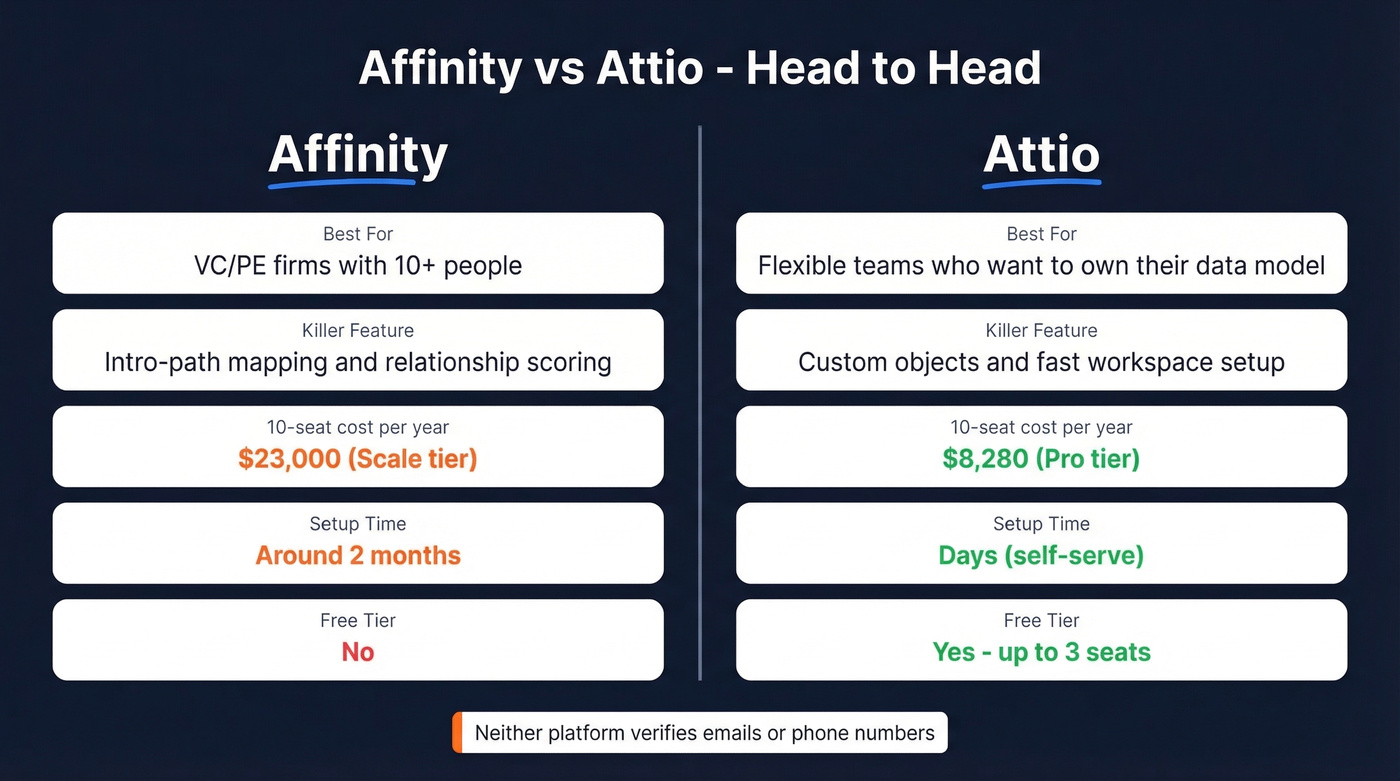
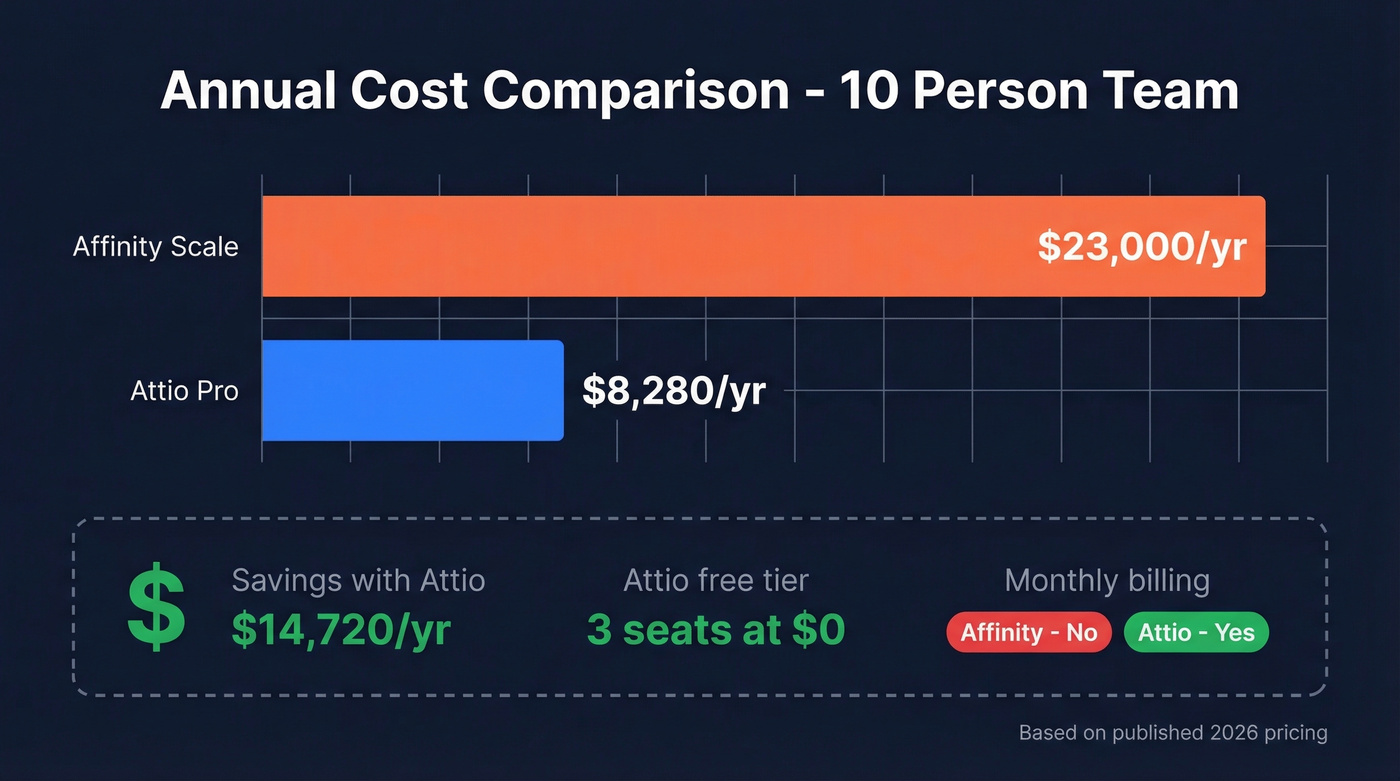
- Pick Affinity if you're a VC/PE firm with 10+ people and relationship intelligence is the product you actually use. Intro-path mapping is still the best in class. Pricing starts at $2,000/user/year, and a 10-person team lands around $23,000/year on Scale.
- Pick Attio if you want a flexible CRM you can shape to your workflow without paying enterprise VC-CRM pricing. A 10-person team on Pro costs $8,280/year, and there's a free tier for up to 3 seats.
- Skip both if your main pain is data quality. Neither Affinity nor Attio verifies emails or phone numbers in your pipeline, and that gap quietly wrecks outbound and reporting.
What each CRM actually does
Affinity is a relationship-intelligence CRM built for dealmakers. It passively captures email and calendar activity, then turns that interaction history into relationship strength scoring based on recency and frequency. The killer feature is intro-path mapping: it shows who on your team has the warmest connection to a target, and how "real" that connection is based on actual interactions.
Where Affinity shines: early-funnel origination, co-investor mapping, and "who knows who" questions that would otherwise live in someone's head or a messy spreadsheet.
Where it gets annoying: anything that feels like real workflow. If you need deep IC stages, diligence checklists, portfolio monitoring, or PE-style reporting, you usually end up looking at PE-native platforms like DealCloud, Dynamo, Navatar, or Juniper Square.
And look, relationship intelligence is Affinity's moat. But it can feel like a narrow moat in 2026, especially when you're paying premium pricing for a product that a lot of the team uses passively (because it's capturing emails) rather than actively (because they're living in it).
Attio is closer to a CRM workspace than a traditional CRM. You define the data model, not the vendor. The UI is clean, setup is fast, and the custom-object system (up to 12 on Pro) lets you model deal structures, portfolio companies, LP relationships, partner networks, or whatever else your team tracks.
In our experience, Attio wins when you want speed and control: you can get a usable system running in days, then iterate as your process changes. Affinity wins when the relationship graph is the whole reason you're buying a CRM in the first place.
One quick note: if relationship intelligence is your north star but Affinity's pricing makes you wince, 4Degrees is another name that keeps coming up in investor CRM shortlists.
Pricing breakdown
| Affinity | Attio | |
|---|---|---|
| Entry tier | Essential: $2,000/user/yr | Free: $0 (3 seats) |
| Mid tier | Scale: $2,300/user/yr | Plus: $29/user/mo (annual) |
| Top tier | Advanced: $2,700/user/yr | Pro: $69/user/mo (annual) |
| Enterprise | Custom | Custom (often ~$100-150/user/mo) |
| Monthly billing | ❌ No | ✅ Yes |
| Email sending | Not specified | Free: 200/mo, Plus: 1K/mo, Pro: unlimited |
| 10-person team/yr | $23,000 (Scale) | $8,280 (Pro) |
Attio's pricing looks simple until you hit the credit system. Credits power enrichment, automations, and AI features, and they disappear faster than you'd expect once you start doing real work.
- Free: 100 credits per user/month
- Plus: 500 credits
- Pro: 1,000 credits
If your team leans on enrichment or automation-heavy workflows, you'll either move up a tier or buy add-on credits. That's not a "gotcha," it's just the real cost model. Put it in the spreadsheet before you commit.
Affinity's bigger issue isn't just the number. It's the combination of high annual pricing, no monthly option, and a product experience that can feel oddly rigid for what you're paying. We've seen teams swallow the price because the relationship graph is valuable, then quietly build parallel systems for notes and workflow because the day-to-day CRM experience doesn't keep up.

Your CRM is only as good as the data inside it. Affinity and Attio both skip email verification - so your pipeline fills with dead contacts that torch deliverability and inflate reports. Prospeo's 5-step verification delivers 98% email accuracy at $0.01/lead, with a 7-day refresh cycle that keeps your CRM reflecting reality, not last quarter.
Stop building beautiful pipelines on top of broken data.
Feature-by-feature comparison
| Feature | Affinity | Attio |
|---|---|---|
| Relationship intelligence | ✅ Core (intro paths, scoring) | ❌ Not available |
| Custom objects | Limited | ✅ Up to 12 on Pro |
| Enrichment sources | 40+ sources | Included (credit-based) |
| CSV import (10K rows) | ~4 min 15 sec (benchmark) | ~45 sec (benchmark) |
| API latency | ~320ms (benchmark) | ~110ms (benchmark) |
| Setup time | ~2 months (G2) | Days (self-serve) |
| G2 rating | 4.4/5 (71 reviews) | 4.4/5 (284 reviews) |
| Email verification | ❌ | ❌ |
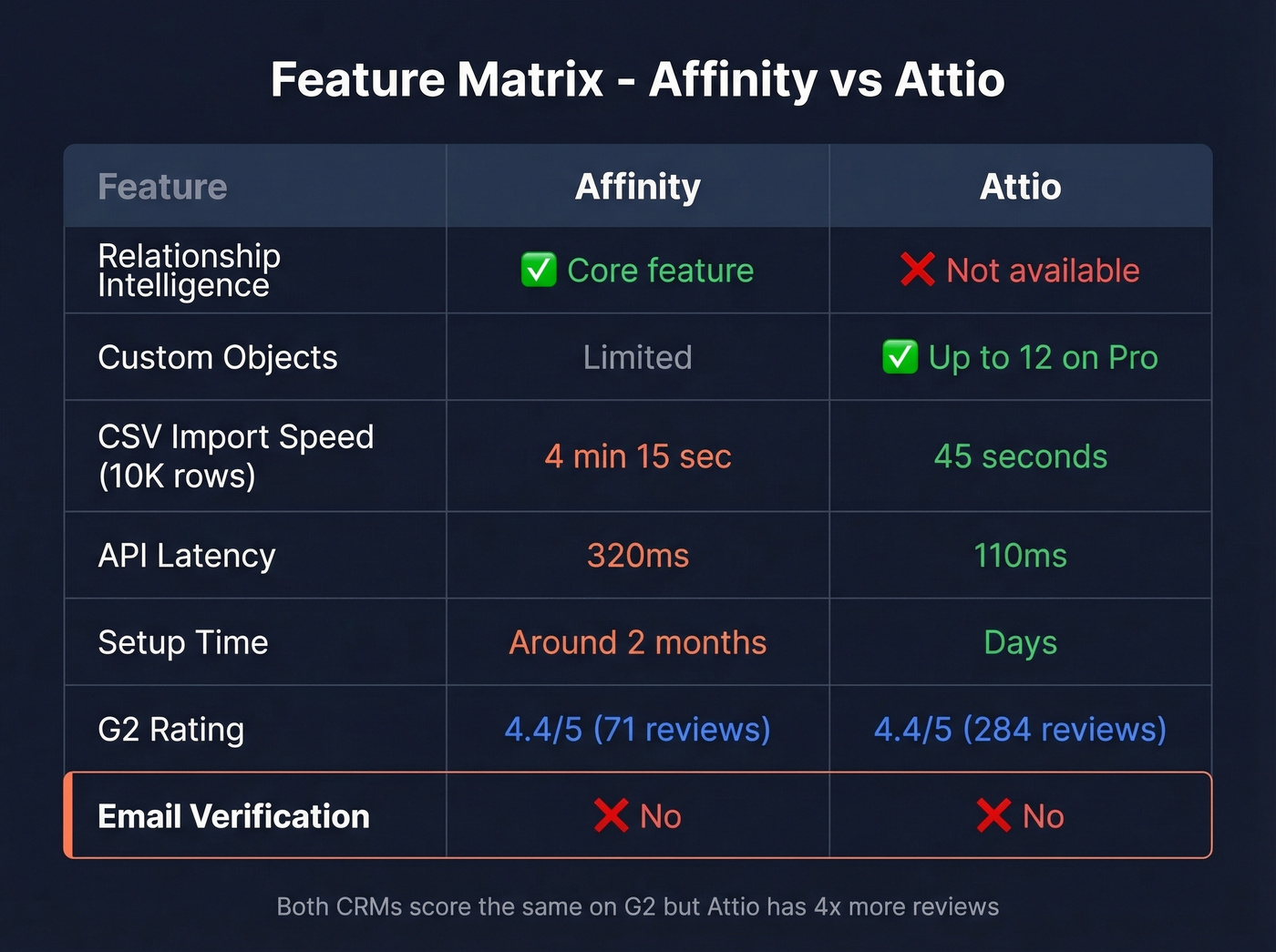
Attio has roughly 4x the G2 review volume Affinity does, which tracks with what we see in the wild: Attio's adopted far beyond VC/PE. It's also just faster in the basics. That CSV import benchmark (10,000 records) is a good example: four-plus minutes vs under a minute doesn't sound dramatic until you're doing repeated migrations, list loads, and cleanup passes during onboarding.
The last row is the one most teams ignore until it hurts: neither tool verifies emails. So you can have a gorgeous pipeline view and still torch your domain reputation with bounces, or waste partner time debating numbers that are inflated by dead contacts.
What users actually say (and what that means)
Affinity complaints tend to cluster around price and rigidity. G2 shows implementation time around 2 months, which lines up with the reality that Affinity isn't a "sign up and go" product for most firms.
There's also a very specific day-to-day gripe we keep hearing: notes. One widely shared switching story described Affinity notes as plain text, and their workaround was to spin up a Notion page per company just to get usable, rich notes. That's the kind of thing that sounds small until you realize it changes behavior: people stop logging updates, then the CRM becomes a place you check, not a place you work.
That same story basically summed it up as: "a tool everyone uses but nobody loves," followed by "zero complaints" after moving to Attio.
Attio's complaints are different. Teams want more native integrations (they list 86 integrations), reporting isn't as mature as older CRMs, and duplicate handling plus automation edge cases show up a lot once you start importing messy data. Real talk: if your data hygiene is already shaky, Attio will happily let you build a beautiful system on top of a messy foundation. That's not Attio's fault, but it becomes your problem fast.
Our take: most funds paying for Affinity are paying for one feature - intro-path mapping - and tolerating everything else. If fewer than half your team actively uses relationship intelligence week to week, you're burning budget. Attio plus a serious data-quality layer is often the better operating setup.
The data gap both CRMs miss
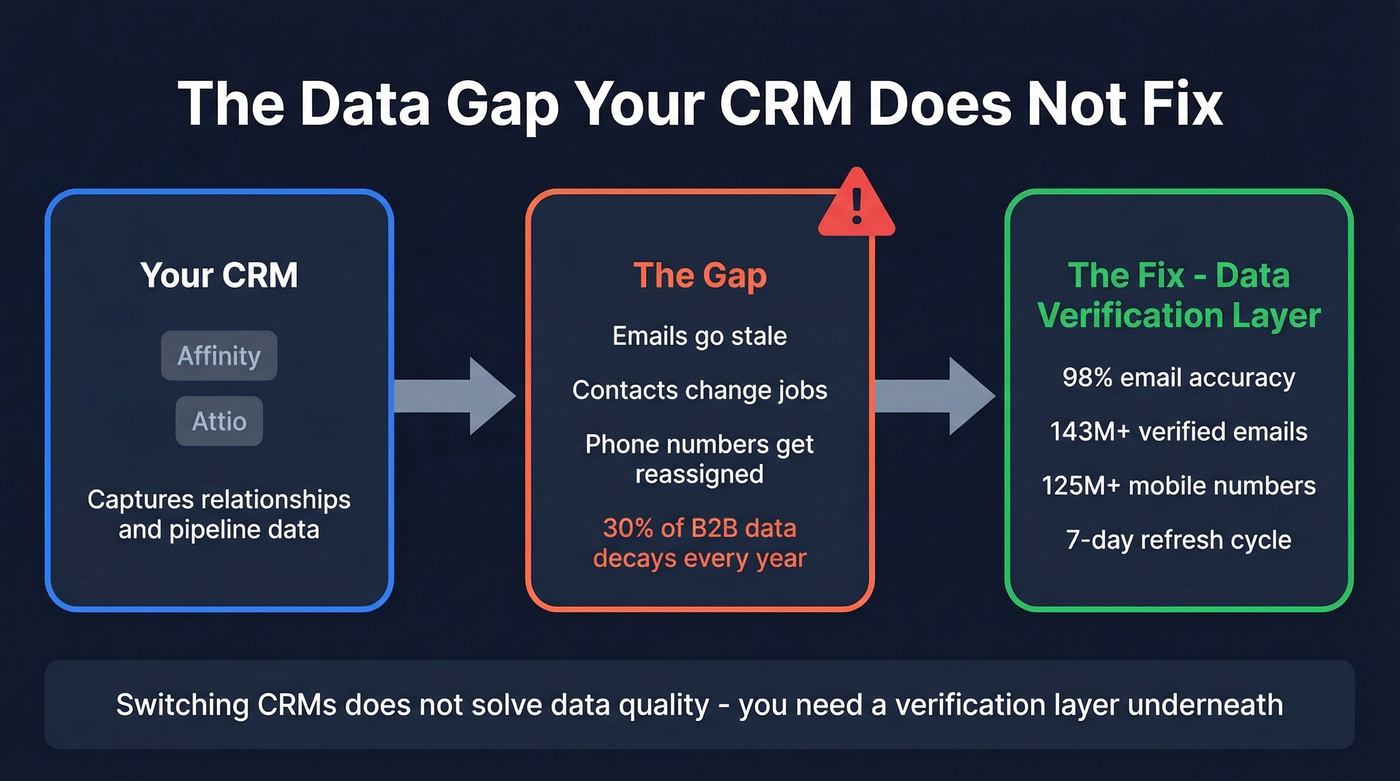
Neither Affinity nor Attio verifies the emails or phone numbers sitting in your pipeline. That matters because contact data decays fast, and the decay isn't evenly distributed: the exact people you care about (operators changing roles, fast-growing teams, newly funded companies) are the ones whose data changes most often.
Here's a scenario we've watched play out: a fund migrates from Affinity to Attio, imports a few years of contacts, and celebrates because the UI feels modern and the pipeline views finally make sense. Then outbound starts. Bounce rates spike, partners complain that "the CRM's wrong again," and someone ends up back in spreadsheets trying to clean lists manually. It's a waste of time, and it's completely avoidable.
This is where Prospeo fits naturally. It's not "another CRM." It's the data layer that keeps your CRM honest: 300M+ professional profiles, 143M+ verified emails, and 125M+ verified mobile numbers, all refreshed on a 7-day cycle. Email accuracy is 98%, API match rate is 92%, and CRM/CSV enrichment returns 50+ data points per contact.
If you're running outbound alongside deal flow, that freshness and verification isn't a nice-to-have. It's the difference between "we emailed 500 people" and "we actually reached 500 people."
For more on deliverability and why bounces hurt more than most teams think, see:
- https://support.google.com/a/answer/81126 (Google Workspace bulk sending guidelines)
- https://postmaster.google.com/ (Google Postmaster Tools)
- https://www.cloudflare.com/learning/email-security/spf-dkim-dmarc/ (SPF/DKIM/DMARC basics)

Switching CRMs won't fix the data gap. Whether you pick Affinity or Attio, you still need verified emails and direct dials to actually reach the people in your pipeline. Prospeo gives you 143M+ verified emails and 125M+ mobile numbers with native CRM enrichment - plug it into HubSpot or Salesforce and every contact comes back with 50+ verified data points.
Layer real contact data into whichever CRM you choose.
FAQ
Can I migrate from Affinity to Attio?
Yes. Contacts, companies, and notes export cleanly, and most teams can rebuild core views quickly. Budget 2-4 weeks for a full migration once you include cleanup, deduping, and rebuilding the workflows people actually use.
One caveat: Affinity's relationship intelligence scores are proprietary and don't transfer. You'll lose intro-path data and relationship strength history.
Is Attio really free?
Yes, up to 3 seats, but it's not a forever plan for most teams. The free tier has hard limits like 3 custom objects, 50,000 records, and 100 credits per user per month. Treat it like a serious trial: enough to prove the model, not enough to run a growing operation indefinitely.
How do I keep CRM contact data accurate?
Don't treat enrichment as a one-time migration task. Run it on a schedule, because contacts change jobs, emails go stale, and phone numbers get reassigned.
Prospeo helps here with a 7-day refresh cycle, 98% verified email accuracy, and native integrations so your team isn't stuck scrubbing spreadsheets every quarter.
Which CRM is better for small VC funds under 5 people?
Attio is usually the better starting point. The free tier covers up to 3 seats and gives you enough structure to track deal flow without committing to an annual contract.
Affinity starts at $2,000/user/year with no free option, which is hard to justify for lean teams unless relationship intelligence is mission-critical from day one.