

Best AI Forecasting Software in 2026 (By Use Case)
A RevOps lead we know ran a quarterly forecast review last month. The number was way off - not because the AI forecasting software failed, but because stale CRM data inflated pipeline and distorted every input the model touched. 88% of organizations now use AI in at least one business function, yet most report less than 5% EBIT impact. The tool isn't the problem. The inputs are.
"AI forecasting software" means four different things depending on who's asking. A VP of Sales, a supply chain director, a CFO, and a project manager all need forecasting - and they need entirely different tools. Let's break down what actually matters in each category.
Our Picks at a Glance
| Use Case | Top Pick | Starting Price |
|---|---|---|
| Sales data quality | Prospeo | Free tier; ~$0.01/email |
| Revenue forecasting | Clari / Forecastio | ~$820/user/yr / $199/mo |
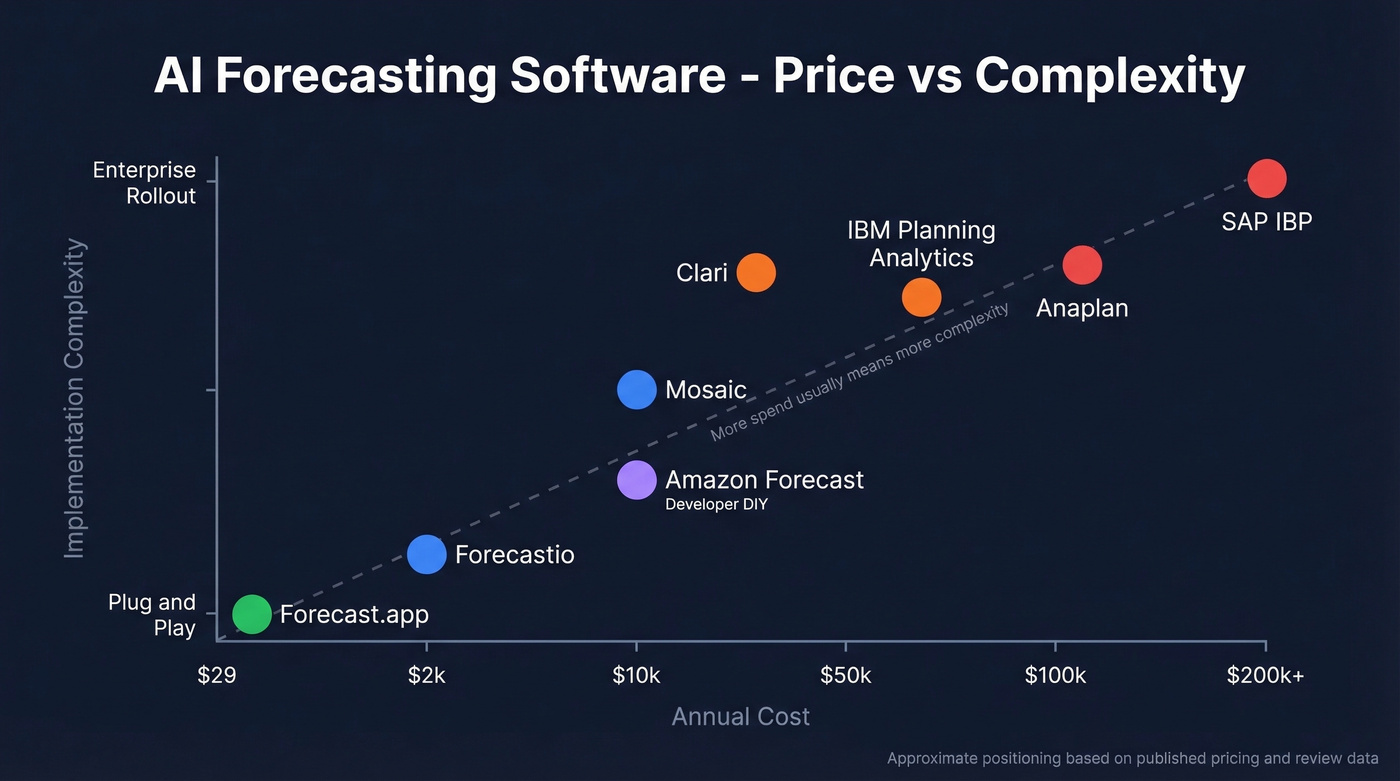
| Demand & supply chain | SAP IBP | $100k+/yr |
| FP&A | Anaplan / Mosaic | $50k+/yr / mid-4 to low-5 figures/yr |
| Project forecasting | Forecast.app | $29/yr |
The 4 Types of AI Forecasting
Before you evaluate anything, figure out which category you're actually shopping in. These tools don't compete with each other.
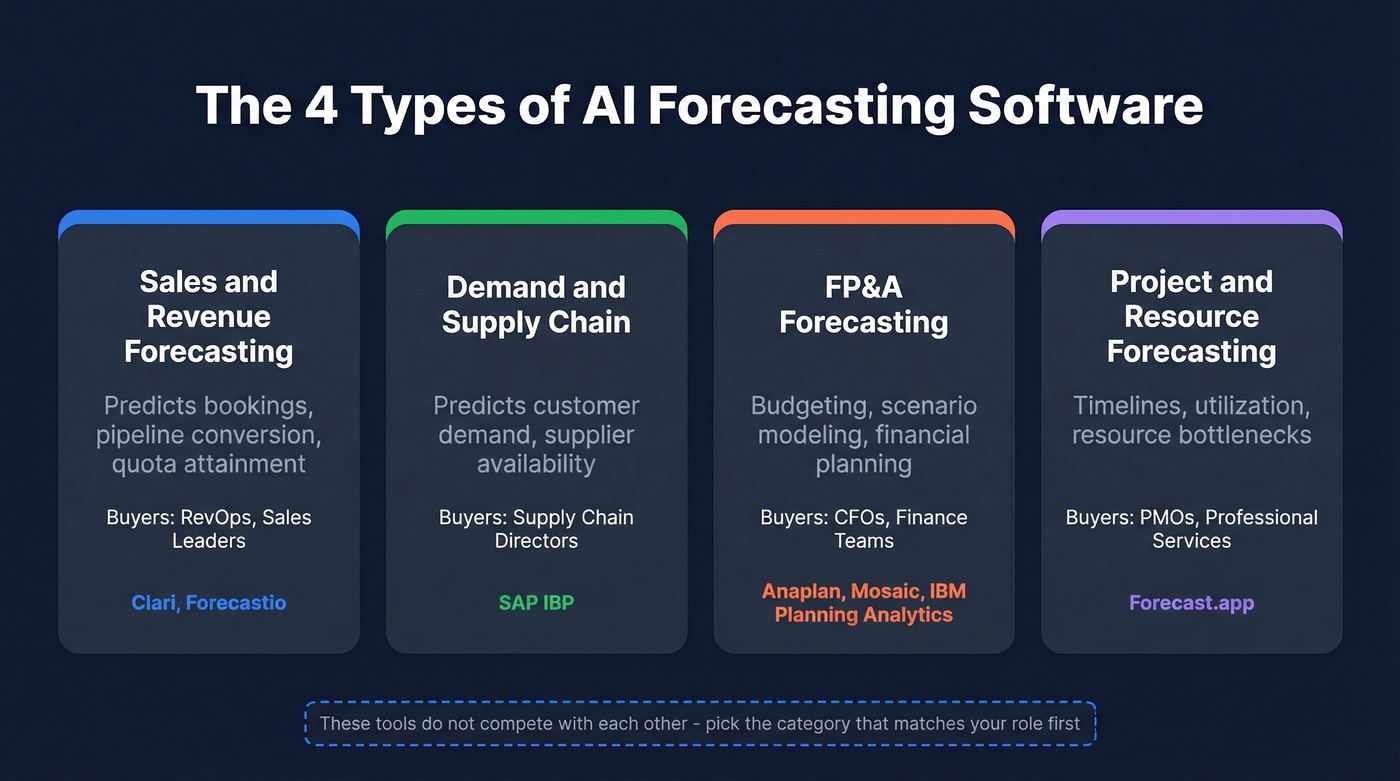
Sales & revenue forecasting predicts bookings, pipeline conversion, and quota attainment. RevOps and sales leadership start here, and this is where most revenue forecasting platforms live.
Demand & supply chain forecasting predicts customer demand and supplier availability. Disruptions cost companies roughly 6-10% of annual revenue, and good demand forecasting drives a 3-4% revenue lift.
FP&A forecasting covers budgeting, scenario modeling, and financial planning. CFOs and finance teams live here.
Project & resource forecasting predicts timelines, utilization, and resource needs - built for PMOs and professional services firms.
Top Tools by Category
Clari - Enterprise Revenue Forecasting
Clari is one of the dominant names in revenue forecasting. It ingests activity data across your entire revenue process and surfaces risk at the deal, rep, and quarter level. The AI doesn't just predict a number - it tells you why the number is moving.

The cost is real. Essentials runs ~$820/user/year, Growth jumps to ~$2,105/user/year, and implementation fees land between $15k-$75k. Expect 8-16 weeks to deploy. On the downside, complexity and onboarding effort come up often in reviews, and a recurring frustration is views resetting after platform updates. For 50+ seat sales orgs that need AI-driven pipeline inspection and board-ready forecasts, though, few tools cover as much ground.
Skip this if you have fewer than 20 reps or your deal volume doesn't justify a six-figure annual commitment.
Forecastio - Mid-Market Alternative to Clari
Forecastio exists for teams that've outgrown spreadsheets but aren't ready for Clari's price tag. Here's how they compare:
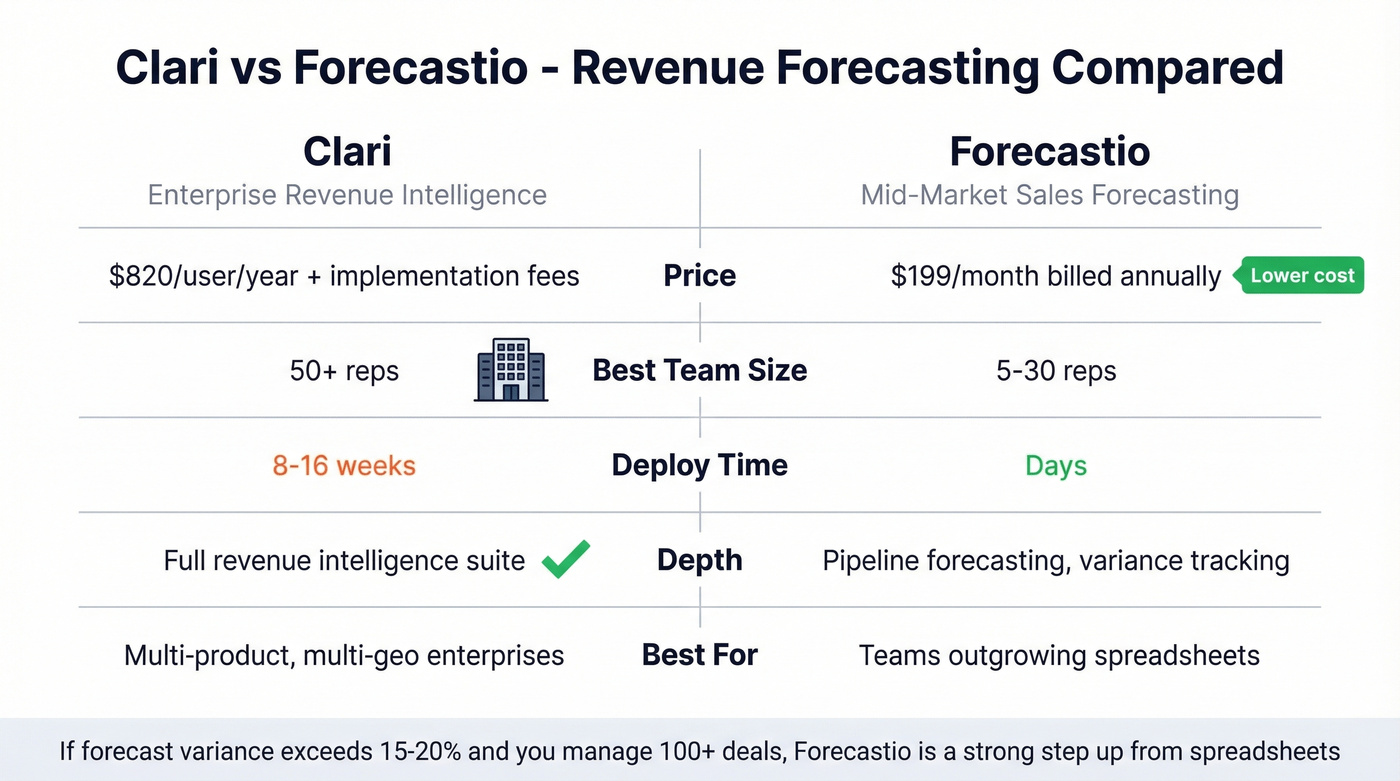
| Forecastio | Clari | |
|---|---|---|
| Price | $199/month, billed annually | ~$820/user/year + implementation |
| Best team size | 5-30 reps | 50+ reps |
| Deploy time | Days | 8-16 weeks |
| Depth | Pipeline forecasting, variance tracking | Full revenue intelligence suite |
If your forecast variance exceeds 15-20% and you're managing 100+ open deals, Forecastio is a strong step up from spreadsheets without committing to an enterprise revenue intelligence rollout. For multi-product, multi-geo revenue intelligence, Clari wins.
SAP Integrated Business Planning
SAP IBP carries a 4.3/5 on G2 across 284 reviews. The top praise theme is "Forecasting Accuracy" with 42 mentions. But complexity draws 35 mentions and learning curve draws 28 - and those reviewers aren't exaggerating.
Pricing starts north of $100k/year. If you're not already in the SAP ecosystem, the integration and change-management overhead alone should push you toward alternatives. If you are, IBP is a category winner for enterprise-grade demand and supply chain forecasting.
IBM Planning Analytics
A sleeper pick for finance teams that think in Excel. IBM Planning Analytics scores 4.4/5 on G2 across 247 reviews, and the Excel integration is genuinely strong - your team works in their native environment while the TM1 engine handles complex, multi-dimensional datasets underneath. Licensing runs $50k-$150k+/year. You'll need technical resources, but the modeling power is hard to match with lighter tools.
Anaplan
The go-to FP&A platform in large enterprises. Anaplan handles scenario planning, driver-based modeling, and cross-functional forecasting at a scale few platforms match. Expect $50k-$200k+/year plus significant implementation investment. This isn't a tool you trial for a quarter - it's a multi-year commitment.
If you're mid-market or your finance team is under 10 people, look at Mosaic instead.
Mosaic
Mosaic is the Anaplan alternative for teams that don't need Anaplan. It targets mid-market finance teams with real-time dashboards, scenario modeling, and integrations with common ERPs and billing systems. Pricing typically lands in the mid-four-figures to low five-figures per year - a fraction of enterprise FP&A platforms. If Anaplan's price tag made you wince, start here.
Forecast.app
For professional services teams and agencies that need AI-driven project timeline and resource forecasting. It predicts completion dates, flags resource bottlenecks, and helps with utilization planning. Lite starts at $29/year, Pro at $49/year, with a free trial available. Worth testing before you build another resource planning spreadsheet.
Amazon Forecast
AWS's pay-as-you-go time-series forecasting service. Developer-oriented - you bring your own data, configure your own models, and build custom pipelines. Ideal for engineering teams that want full control. Not for anyone who wants a dashboard out of the box.

Every AI forecasting tool on this list depends on one thing: clean pipeline data. Stale contacts, bounced emails, and wrong titles inflate your pipeline and wreck forecast accuracy. Prospeo refreshes 300M+ profiles every 7 days and delivers 98% email accuracy - so the data feeding your forecast reflects reality, not ghosts.
Fix your CRM inputs before you blame your forecasting model.
Full Comparison
| Tool | Category | Our Pick For | Starting Price | G2 Rating |
|---|---|---|---|---|
| Clari | Sales/revenue | Best enterprise RevOps | ~$820/user/yr | - |
| Forecastio | Sales/revenue | Best mid-market sales | $199/mo | - |
| SAP IBP | Demand/supply | Best enterprise supply chain | $100k+/yr | 4.3/5 |
| IBM Planning Analytics | Demand + FP&A | Best for complex datasets | $50k-$150k+/yr | 4.4/5 |
| Anaplan | FP&A | Best enterprise FP&A | $50k-$200k+/yr | - |
| Mosaic | FP&A | Best mid-market FP&A | Mid-4 to low-5 figures/yr | - |
| Forecast.app | Project/resource | Best for PSA teams | $29/yr | - |
| Amazon Forecast | Custom/developer | Best for engineering teams | Pay-as-you-go | - |
How to Evaluate AI Forecasting Tools
In our experience, teams that clean their CRM data before deploying any forecasting platform get to value faster. Before you demo anything, run through this checklist:
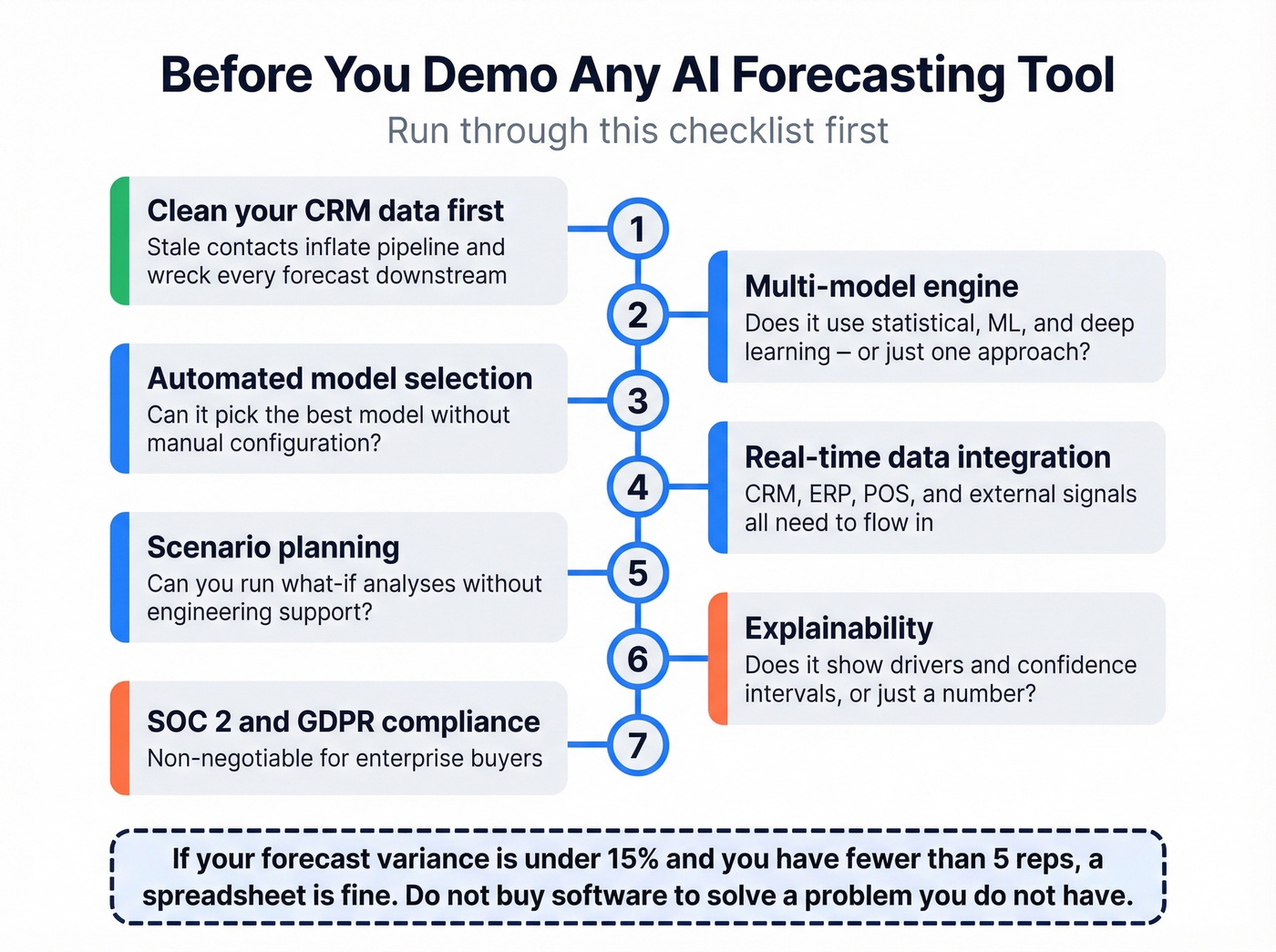
- Multi-model engine - does it use statistical, ML, and deep learning approaches, or just one?
- Automated model selection - can it pick the best model for your data without manual configuration?
- Real-time data integration - CRM, ERP, POS, and external signals all need to flow in
- Scenario planning - can you run what-if analyses without engineering support?
- Explainability - does it show drivers and confidence intervals, or just a number?
- Role-based access - finance, sales, and ops need different views
- SOC 2 / GDPR compliance - non-negotiable for enterprise
Here's the thing: community discussions are surprisingly sparse for this category. Most practitioner feedback lives on G2 and TrustRadius, which is where we pulled the review themes above.
If your forecast variance is under 15%, you have fewer than 5 reps, and you spend less than 3 hours a week on manual updates, a spreadsheet is fine. Don't buy software to solve a problem you don't have.
Mistakes That Kill Forecasting ROI
Most forecasting failures are process failures, not algorithm failures. We've watched teams spend six figures on platforms and still miss badly because nobody cleaned the CRM first.
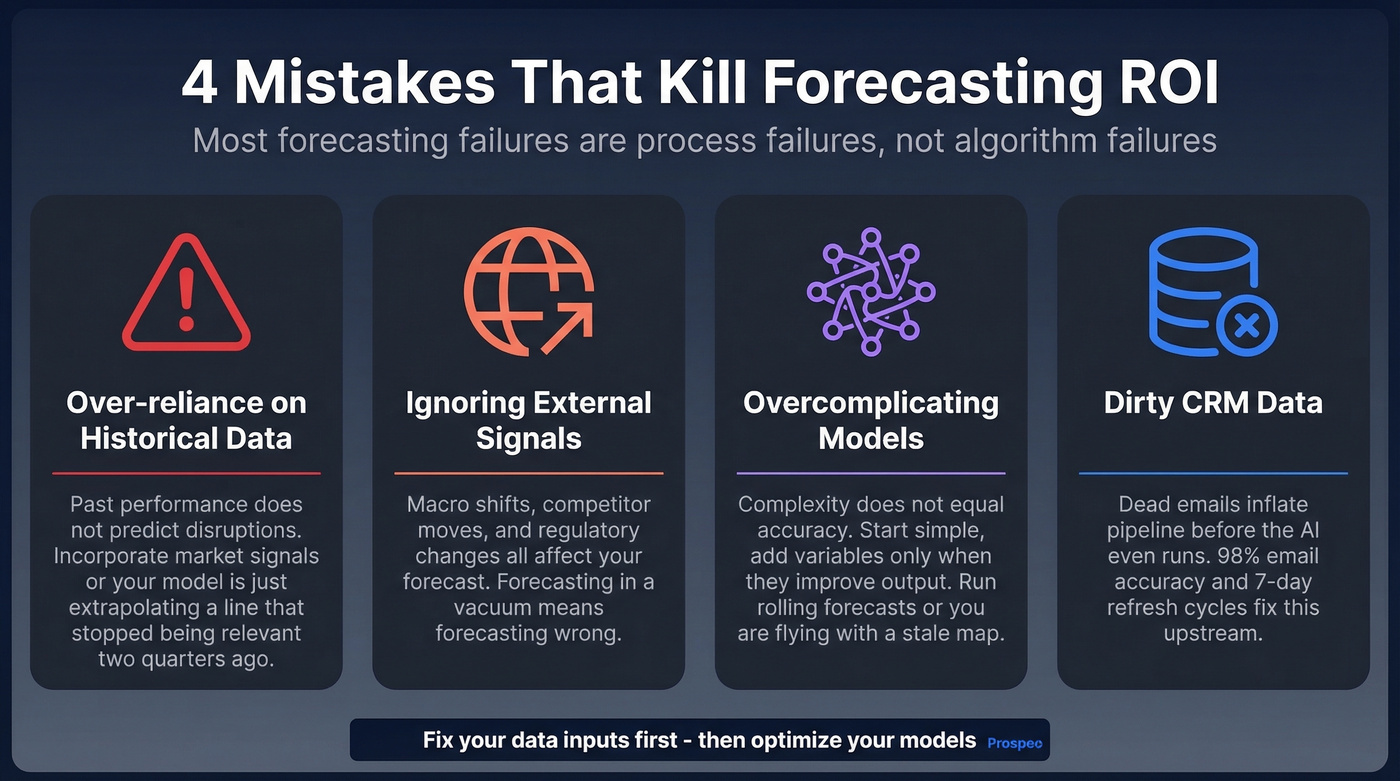
Over-reliance on historical data. Past performance doesn't predict disruptions. Incorporate market signals and external factors, or your model is just extrapolating a line that stopped being relevant two quarters ago.
Ignoring external signals. Macroeconomic shifts, competitor moves, and regulatory changes all affect your forecast. If you're not pulling in external data, you're forecasting in a vacuum.
Overcomplicating models. Complexity doesn't equal accuracy. Start simple, add variables only when they improve output. And if you're not running rolling forecasts, you're flying with a stale map.
Data integrity issues - the silent killer. If your CRM contacts have dead emails, your pipeline is inflated before the AI even runs. Prospeo's 7-day refresh cycle addresses this upstream, verifying emails at 98% accuracy so your forecast reflects reality instead of wishful thinking. Even the best predictive models can't compensate for a pipeline full of outdated contacts.
That RevOps lead's forecast missed because stale CRM data inflated pipeline. At $0.01 per email, Prospeo's enrichment API returns 50+ data points per contact with a 92% match rate - giving Clari, Forecastio, or whatever forecasting tool you pick the clean inputs it needs to actually work.
Accurate forecasts start with accurate data. Get both for $0.01 per lead.
FAQ
How much does AI forecasting software cost?
Forecast.app starts at $29/year for project forecasting. Mid-market sales tools like Forecastio run $199-$500/month. Enterprise platforms - Anaplan, SAP IBP - cost $50k-$200k+/year, often with $15k-$75k in implementation fees on top.
How long does implementation take?
Lightweight tools like Forecastio deploy in days. Enterprise platforms - Clari, SAP IBP, Anaplan - take 8-16 weeks minimum, often longer with custom integrations and data migration.
Can forecasting tools fix bad CRM data?
No. AI amplifies whatever you feed it - garbage in, confident garbage out. Fix your data first with a verification tool that refreshes contacts regularly, then let the algorithms do their job.
What's the difference between revenue and demand forecasting?
Revenue forecasting predicts bookings, pipeline conversion, and quota attainment for sales teams - tools like Clari and Forecastio own this space. Demand forecasting predicts customer purchasing volume and supplier availability for supply chain teams - SAP IBP and similar platforms handle this. They solve different problems for different departments.