

AI Sales Forecasting: What Works, What's Hype, and Where to Start
It's Thursday at 4 PM. Your VP of Sales is staring at a spreadsheet, manually adjusting close dates because "Johnson says the Acme deal is moving to next quarter." Three managers are pasting numbers into a shared Google Sheet. The CFO wants a commit number by 5. This is how most companies still forecast - and it's why 4 in 5 sales and finance leaders missed a quarterly forecast in the past year.
An AI sales forecast promises to fix this. Some of that promise is real. A lot of it isn't.
Let's separate the two.
The Quick Version
Fewer than 5 reps and under 100 deals per quarter? Skip AI forecasting entirely - a disciplined spreadsheet wins.
If you qualify, fix your CRM data first with an enrichment tool, then layer on forecasting. The best starting point for most teams is your CRM's built-in forecasting paired with clean data. Enterprise teams should look at Clari. Budget-friendly standalone: Forecastio, with paid plans starting at $199/month billed annually.
What AI Sales Forecasting Actually Is
Traditional forecasting takes your pipeline, multiplies each deal by a stage-based probability (30% at discovery, 60% at proposal), and spits out a weighted number. Those probabilities are static guesses that never update based on what's actually happening in your deals.
Sales forecasting using AI replaces those fixed percentages with dynamic models trained on your historical CRM data, rep activity patterns, engagement signals, and conversation data from calls and emails. Instead of "this deal is at the proposal stage, so it's 60% likely to close," an AI model says "this deal has a 38% chance of closing this quarter because the champion went dark two weeks ago and the economic buyer hasn't attended a single call."
That's a fundamentally different signal. And a far more useful one.
The Real State of Forecasting in 2026
Despite all the AI hype, most sales orgs are still terrible at forecasting. An Xactly survey of 400 professionals found that 98% acknowledge they struggle with forecast accuracy - while 95% simultaneously claim confidence in their planning process. And 97% agree the right data would make accurate forecasts easier. That gap between confidence and competence is where deals go to die.
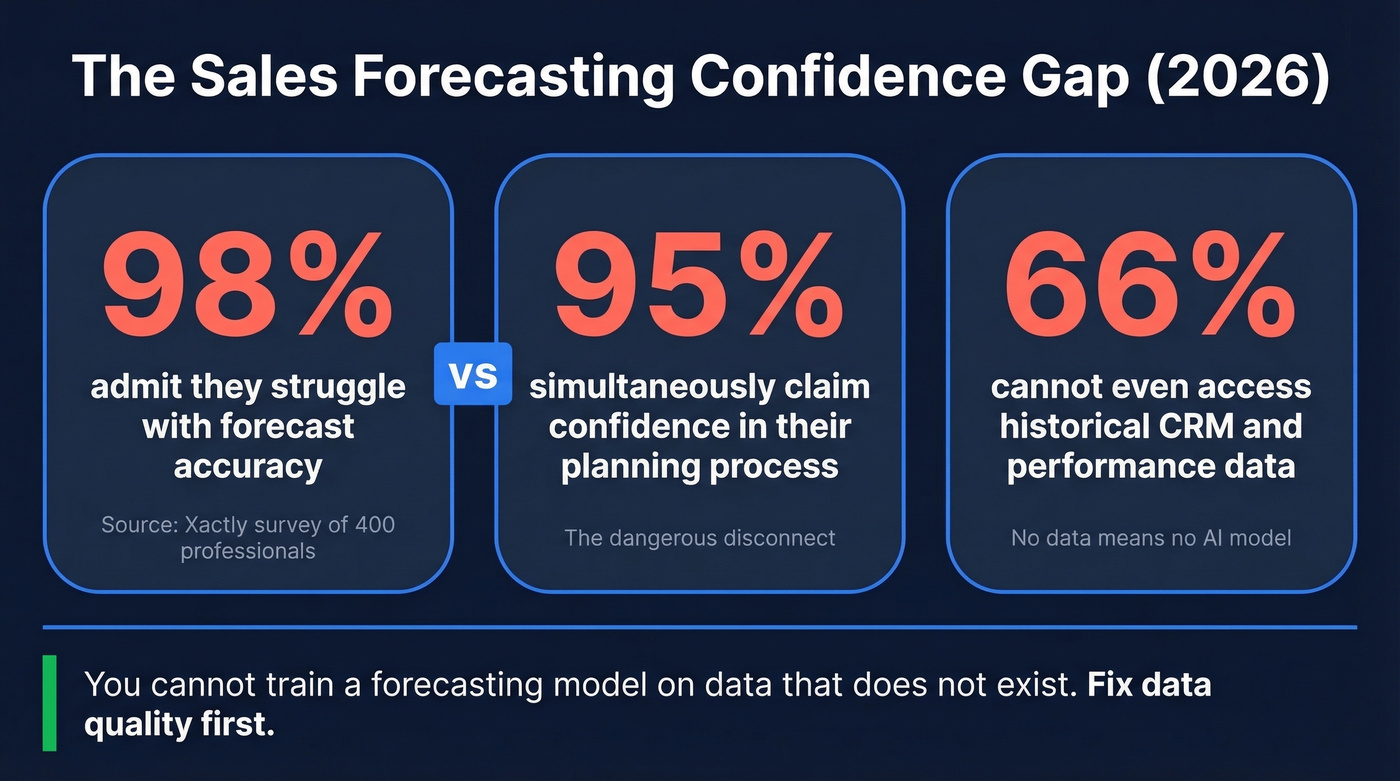
The same survey found 66% can't even access historical CRM and performance data - the raw material any forecasting model needs. You can't train a model on data that doesn't exist.

Gartner predicts 70% of large organizations will adopt AI-based forecasting by 2030 - that prediction covers demand forecasting broadly, but the barriers (data quality, change resistance, trust) are identical in sales. In 2026, most aren't there yet.
The reality on the ground matches what we see on r/SalesOperations: even teams running Salesforce and Gong still default back to spreadsheets because Excel gives them "the detail we want." Practitioners are openly asking whether ML forecasting is anything more than vendor hype.
Here's the honest answer: AI-driven forecasting works, but only if you have the data foundation and deal volume to support it. For everyone else, it's an expensive way to generate the same wrong number faster.
The Emerging Layer: AI Agents
The next wave isn't just predictive models - it's autonomous AI agents that monitor deals in real time, auto-update CRM fields, flag at-risk opportunities to managers, and simulate pricing impacts on forecast outcomes. Gartner predicts that by 2028, AI agents will outnumber sellers by 10x - yet fewer than 40% of sellers will report they improved productivity. More AI doesn't automatically mean better outcomes. The teams that win fix their data and process first.
How It Works Under the Hood
Data Inputs That Matter
Every AI forecasting model needs fuel. The most predictive inputs are CRM activity data (emails sent, meetings booked, calls logged), deal progression velocity, stakeholder engagement - who's involved, how senior, how active - and unstructured data from call recordings and email threads processed through NLP.
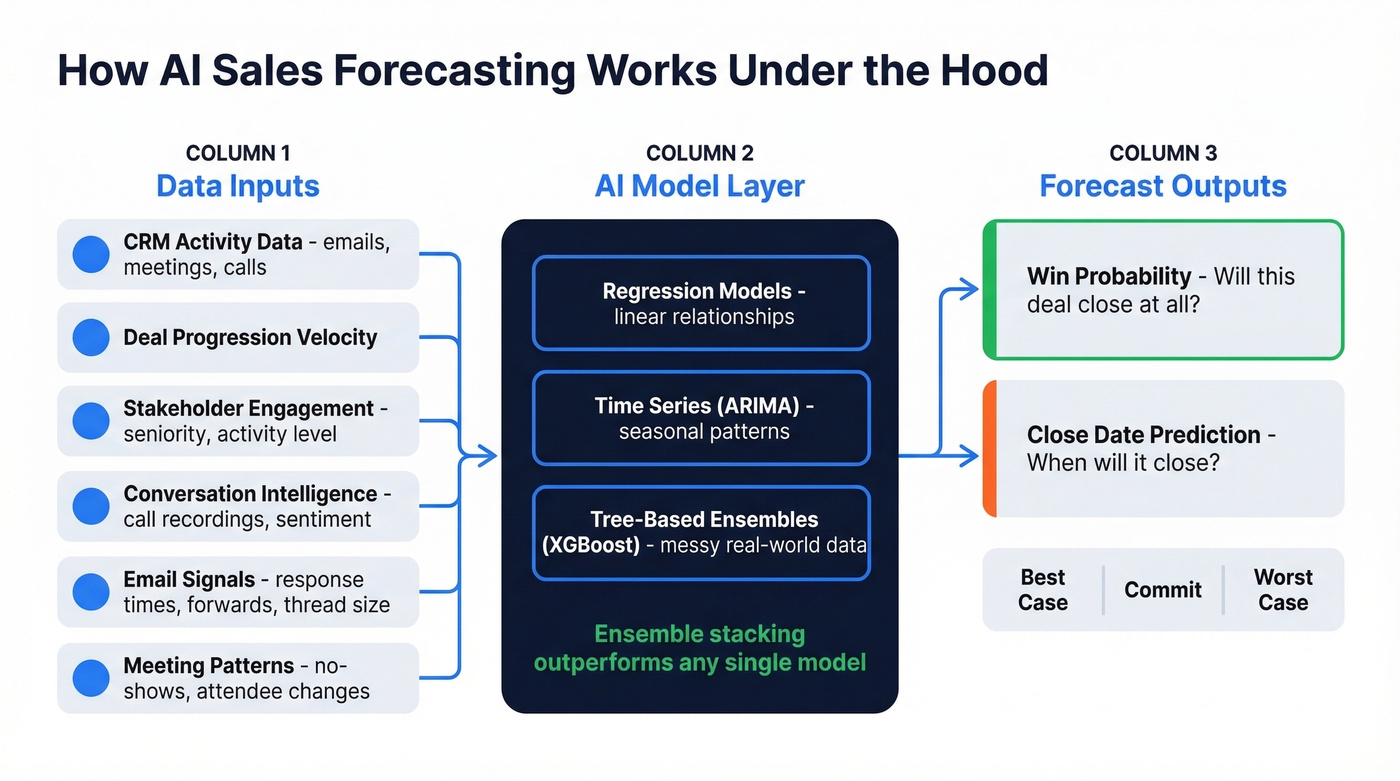
Conversation intelligence is becoming the richest signal source. Tools like Gong and Avoma extract buying signals from recorded calls: sentiment shifts mid-deal, competitor mentions, the presence or absence of next-step commitments. A rep logs a call as "went well," but the AI detects the prospect mentioned a competing vendor three times and never agreed to a follow-up. That discrepancy is gold for forecasting.
The models that perform best don't just look at what reps enter into Salesforce. They ingest signals reps never bother to log - email response times, meeting no-shows, the number of stakeholders on a thread, whether the champion forwarded your proposal internally. This is the core of how AI-driven revenue prediction differs from traditional weighted-pipeline approaches.
Model Types
Regression models (linear and logistic) handle straightforward relationships between inputs and outcomes. Time-series methods like ARIMA work well for seasonal patterns and recurring revenue.
Tree-based models - Random Forest, XGBoost, gradient-boosted machines - excel when you've got messy data with lots of exogenous variables like promotions, competitive pressure, or market shifts. Research from MDPI confirms what we've seen in practice: stacking (ensemble) approaches that combine multiple model types outperform any single model. The best AI-based forecasting tools use ensembles under the hood, even if they don't advertise it.
Win Probability vs. Close-Date Prediction
These are two different problems, and most teams conflate them.
Win probability tells you whether a deal will close at all. Close-date prediction tells you when. A deal can have a 90% win probability but still slip from Q1 to Q2, which wrecks your quarterly forecast just as badly as a lost deal.
The better tools - Clari, Gong Forecast, Forecastio - model both independently and offer scenario-based forecasting (best case, commit, worst case) so you can plan around uncertainty instead of pretending it doesn't exist. If your current tool only gives you a single "forecast score," you're missing half the picture.
When AI Forecasting Is Worth It
You're ready if:
- 5+ reps generating pipeline
- 100+ open deals at any given time
- Forecast-to-actual variance exceeds 15-20%
- Your team spends 3+ hours per week on manual forecast updates
- At least 12 months of clean CRM history
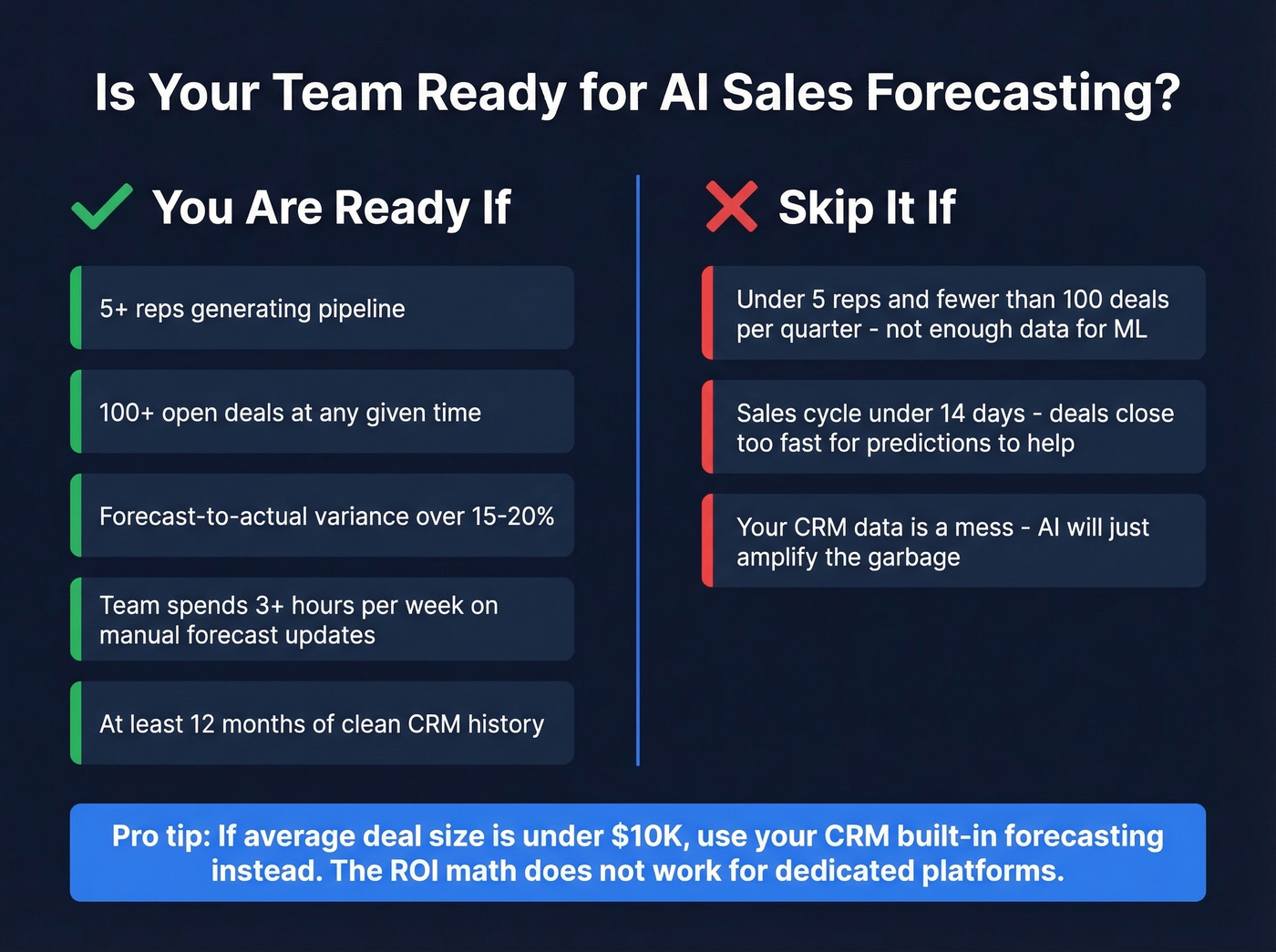
Skip it if:
- Under 5 reps and fewer than 100 deals per quarter - there isn't enough data for ML models to outperform a well-maintained spreadsheet
- Sales cycle under 14 days - deals close too fast for predictive models to add value
- Your CRM data is a mess - AI will just amplify the garbage
Look, if your average deal size is under $10K, you almost certainly don't need a dedicated forecasting platform. The ROI math doesn't work. Use your CRM's built-in forecasting, invest the savings in data quality, and revisit when your deal sizes or volume justify the spend.

66% of teams can't access the historical CRM data AI forecasting needs. Prospeo's enrichment fills the gaps - 92% match rate, 50+ data points per contact, refreshed every 7 days. Your forecast model is only as good as the data feeding it.
Fix your CRM data before you layer on AI forecasting.
Real-World Results Worth Studying
Danone partnered with ToolsGroup to deploy ML-based demand forecasting around promotions and media events. The results: 20% reduction in forecast error, pushing accuracy to 92%. Lost sales dropped 30%, service levels hit 98.6%, and demand planners' workload fell by 50%. They exceeded their service level target for 37 consecutive months. That's not a pilot - that's a sustained operational shift.
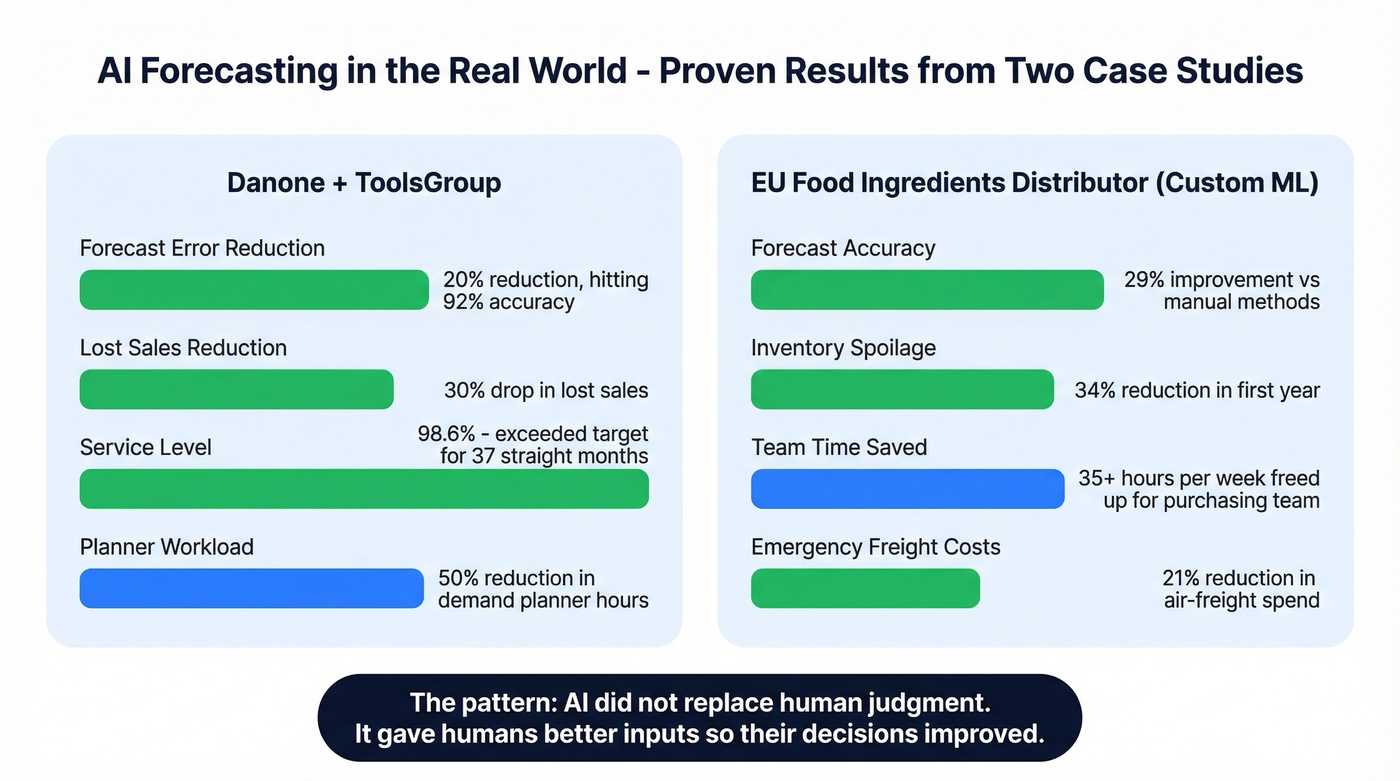
An EU food ingredients distributor built a custom ML forecasting system and saw a 29% improvement in forecast accuracy versus manual methods. Inventory spoilage dropped 34% in the first year, the purchasing team saved 35+ hours per week, and emergency air-freight costs fell 21%.
Both cases share a pattern: the AI didn't replace human judgment. It gave humans better inputs so their judgment improved. That's the real value - not automation for its own sake, but better signal quality for decision-makers.
Tools Compared (2026 Pricing)
| Tool | Best For | Starting Price | Key Strength |
|---|---|---|---|
| Clari | Enterprise SF teams | Custom; often $100+/user/mo plus services | Revenue intelligence |
| Gong Forecast | Gong CI users | Custom | Conversation signals |
| SF Einstein Forecasting | Salesforce orgs | Enterprise starts at $165/user/mo | Native CRM integration |
| HubSpot Forecasting | HubSpot-first teams | $450/mo for 5 paid users | Zero implementation |
| Forecastio | SMB on HubSpot | $199/mo (billed annually) | Affordable, fast setup |
| Avoma | Budget teams | $79/user/mo (Business plan) | CI + forecasting |
| Pipedrive | Small teams | $49/seat/mo (Professional) | Simple pipeline view |
| Zoho CRM (Zia) | Cost-sensitive orgs | $14-40/user/mo | Lowest entry price |
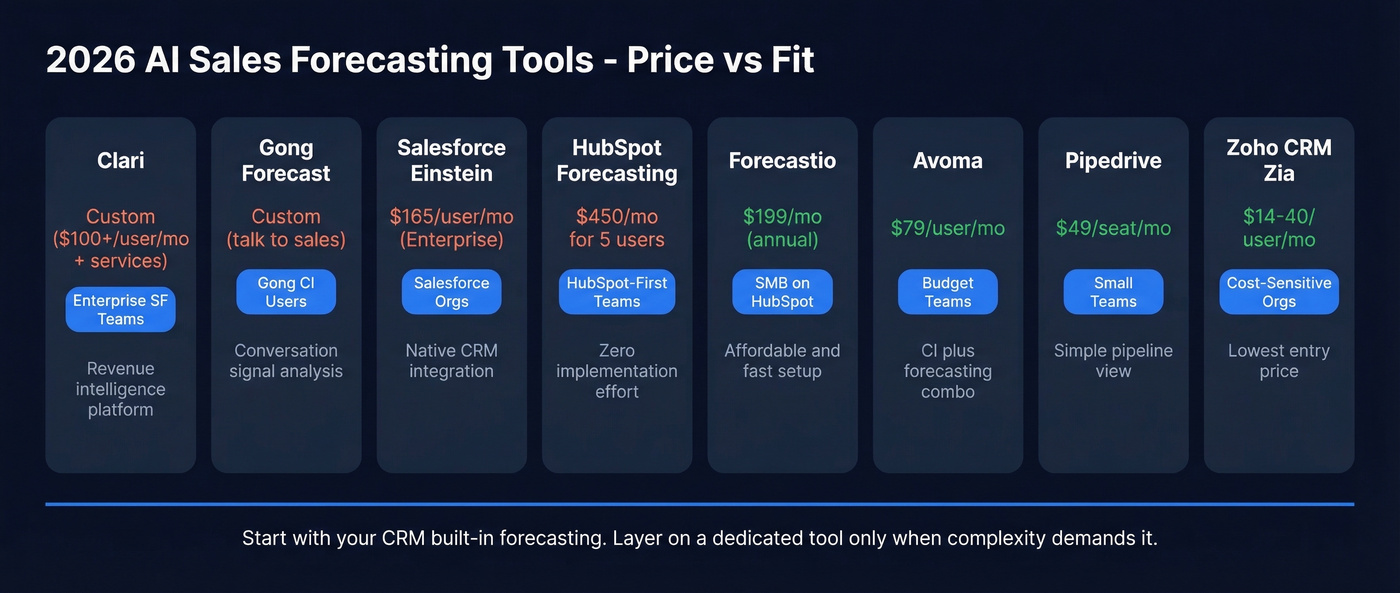
If a vendor won't publish pricing, expect higher variability in total cost and a longer buying cycle. Clari and Gong both require "talk to sales" - and Clari's total cost with professional services can run $15K-$75K on top of per-user fees.
For most teams, the smartest move is starting with whatever your CRM already offers. Salesforce and HubSpot's built-in forecasting handles a huge chunk of use cases, especially when paired with clean data. For HubSpot teams wanting something purpose-built without enterprise pricing, Forecastio at $199/month is a strong value. Enterprise teams with complex multi-product pipelines and board-level reporting needs should evaluate Clari for revenue intelligence workflows that tie forecasting to pipeline management.
Fix Your Data Before You Buy a Tool
Here's the dirty secret nobody selling forecasting software wants to talk about: your forecast is only as good as the data feeding it. Two-thirds of sales teams can't even access their own historical CRM and performance data. A forecasting platform trained on stale contacts, wrong job titles, and dead email addresses will produce confidently wrong numbers.
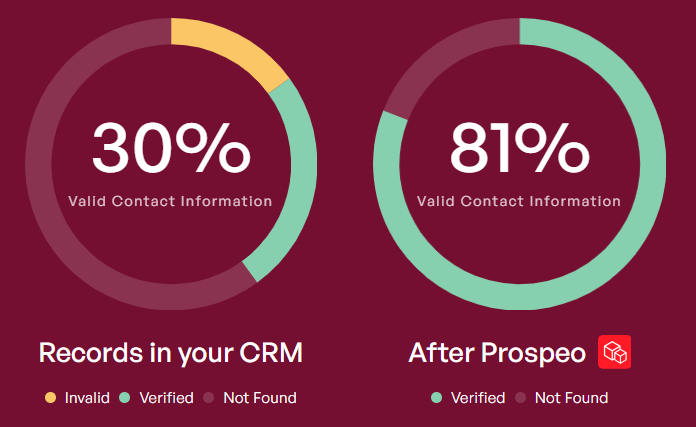
Gartner's guidance on AI in sales forecasting reinforces the foundation: define a data strategy beyond historical sales data, incorporating internal and external signals, and plan for trust and adoption - not just model selection.
The first investment shouldn't be a forecasting tool. It should be data enrichment. We've watched teams spend $50K on Clari only to realize their pipeline data was 40% stale. Prospeo's enrichment API matches 92% of records and returns 50+ data points per contact - verified emails, direct dials, current job titles, company signals - on a 7-day refresh cycle versus the industry average of 6 weeks. Before you spend five figures rolling out an enterprise forecasting platform, spend a few hundred dollars cleaning your CRM. The ROI math isn't even close.
How to Implement Step by Step
1. Audit and clean your CRM data. Bad contact data cascades into bad pipeline signals. Run enrichment in bulk - verify emails, fill in missing fields, update stale records - before you layer AI on top.
2. Define what "accuracy" means for your org. Is it forecast-to-actual variance within +/-10%? MAPE under 15%? Pick a metric and a target before you buy anything. Most teams skip this step and then can't tell if their new tool is working.
3. Start with your CRM's built-in forecasting. Salesforce and HubSpot both offer forecasting features you're probably already paying for. Exhaust those before adding another vendor.
4. Run AI and manual forecasts in parallel for two quarters. Don't rip out your existing process. Run both side by side and compare accuracy. This builds trust with leadership and gives you real data on whether the AI approach actually beats your current method.
5. Measure and iterate. Track forecast-vs-actual variance every quarter. If accuracy isn't improving after two full cycles, the problem is upstream - usually data quality or rep adoption.
The article says it: AI forecasting breaks when reps don't log contacts and stakeholders. Prospeo auto-enriches your pipeline with verified emails, direct dials, and 50+ data points - so your models see every buyer, not just the ones reps remembered to enter.
Stop training your forecast on incomplete data - enrich it first.
Mistakes That Kill Forecast Accuracy
Relying on rep gut feel over data. "I feel good about this deal" isn't a forecast input. If your model weights rep sentiment heavily, you're just automating optimism bias.
Static stage probabilities that never update. If your "proposal" stage has been 60% since 2019, it's wrong. Recalibrate quarterly based on actual win rates.
Ignoring unstructured data. Calls, emails, and meeting notes contain the strongest buying signals. If your tool only looks at structured CRM fields, it's missing the real story.
Using only lagging indicators. Closed-won data tells you what happened. Engagement velocity, stakeholder expansion, and response times tell you what's about to happen. AI-driven forecasts excel precisely because they weight these leading indicators more heavily.
Not tracking forecast-vs-actual variance. Most teams don't measure how accurate their forecasts really are. If you aren't tracking it, you can't improve it.
FAQ
How accurate should an AI sales forecast be?
Only 15% of companies achieve forecast accuracy within 5% of actual revenue. A realistic target for most B2B teams is +/-10-15% variance. Track forecast-vs-actual quarterly and aim for consistent improvement - reducing variance from 25% to 12% is a massive operational win that compounds over time.
Can small sales teams benefit from AI forecasting?
Teams with fewer than 5 reps and under 100 deals per quarter usually lack the data volume for ML models to outperform a spreadsheet. Start with disciplined manual forecasting and CRM hygiene. Once you cross the 100-deal threshold with 12+ months of clean history, purpose-built tools start earning their keep.
What's the first step to improving forecast accuracy?
Fix your CRM data. AI models inherit every data quality problem upstream. Run enrichment in bulk to verify emails, fill missing fields, and update stale records. Clean data first, then layer prediction on top.
How is AI-driven forecasting different from traditional methods?
Traditional forecasting relies on static stage-based probabilities and rep judgment. AI-driven forecasting analyzes hundreds of signals - activity patterns, engagement velocity, conversation sentiment, stakeholder involvement - and continuously recalibrates predictions as deals evolve. The result is a dynamic, data-informed number rather than a fixed guess.
The throughline is simple: the best AI sales forecast tool in the world can't fix bad data. Get your CRM right, start with what you already have, and add complexity only when the numbers justify it.