

7 Appointment Setting Strategies That Actually Book Meetings
You've got the script open, the dialer loaded, and a list of 200 "verified" contacts. Three hours later you've left 47 voicemails, been hung up on six times, and booked zero meetings. The problem isn't your pitch - most appointment setting strategies skip the parts that actually move numbers. Cold call appointment rates average 2.3% without a structured script, and that's before dead numbers and wrong contacts eat up your dial time.
Mastering the right skills is what separates teams that book consistently from those that burn through lists with nothing to show.
What Actually Moves the Needle
Three things matter more than anything else:
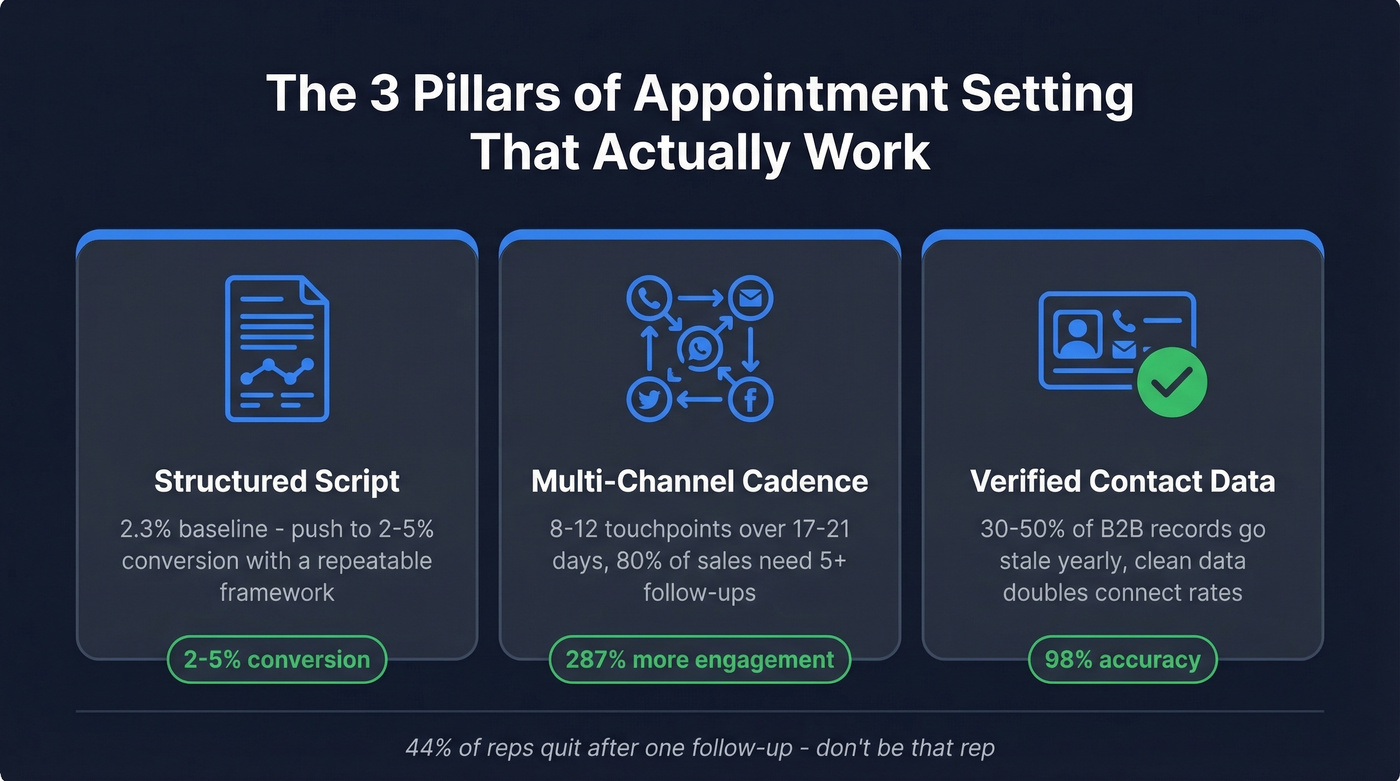
A structured script helps you beat the 2.3% baseline and push into the 2-5% range. Winging it isn't a strategy. A multi-channel cadence spanning 17-21 days with 8-12 touchpoints - because 80% of sales require 5+ follow-ups, yet 44% of reps quit after one. And verified contact data, because 30-50% of B2B records go stale within a year. You're dialing ghosts and don't know it.
7 B2B Techniques That Book More Meetings
1. Sell the Meeting, Not the Product
RAIN Group's prospecting research found that [58% of sales meetings aren't valuable](https://customerthink.com/new-rain-group-center-for-sales-research-study-debunks-common-myths-about-sales-prospecting/) to buyers. That's because reps dump features on the call instead of earning the next 20 minutes. One SDR leader on r/sales shared how their team books 10,000+ appointments a year with one rule: don't spill it all.
Here's the thing - your only job on the first touch is to create enough curiosity that the prospect agrees to a real conversation. If you're pitching product benefits before you've asked a single question, you've already lost. This is the foundation of successful appointment setting: earn the next step, nothing more.
2. Use a Structured Script
Here's a cold call opener that works:
"Hi [Name], I'll be brief. In three minutes, I can share how we help businesses like yours [solve specific problem]. Does that sound fair?"
When they say "I don't have time," respond with: "Totally understand - would Thursday at 2 PM or Friday morning work better for a quick callback?" Always offer a specific date and time. Never an open-ended "when works for you."
This structure helps push conversion from that 2.3% baseline toward the 2-5% range that personalized, timed outreach can deliver. Scripting is one of the most underrated techniques in any outbound playbook - it removes guesswork and gives every rep a repeatable framework they can actually improve on.
3. Build a Multi-Channel Cadence
Using 3+ channels drives up to 287% higher engagement than single-channel outreach. Here's a cadence we've seen work well:
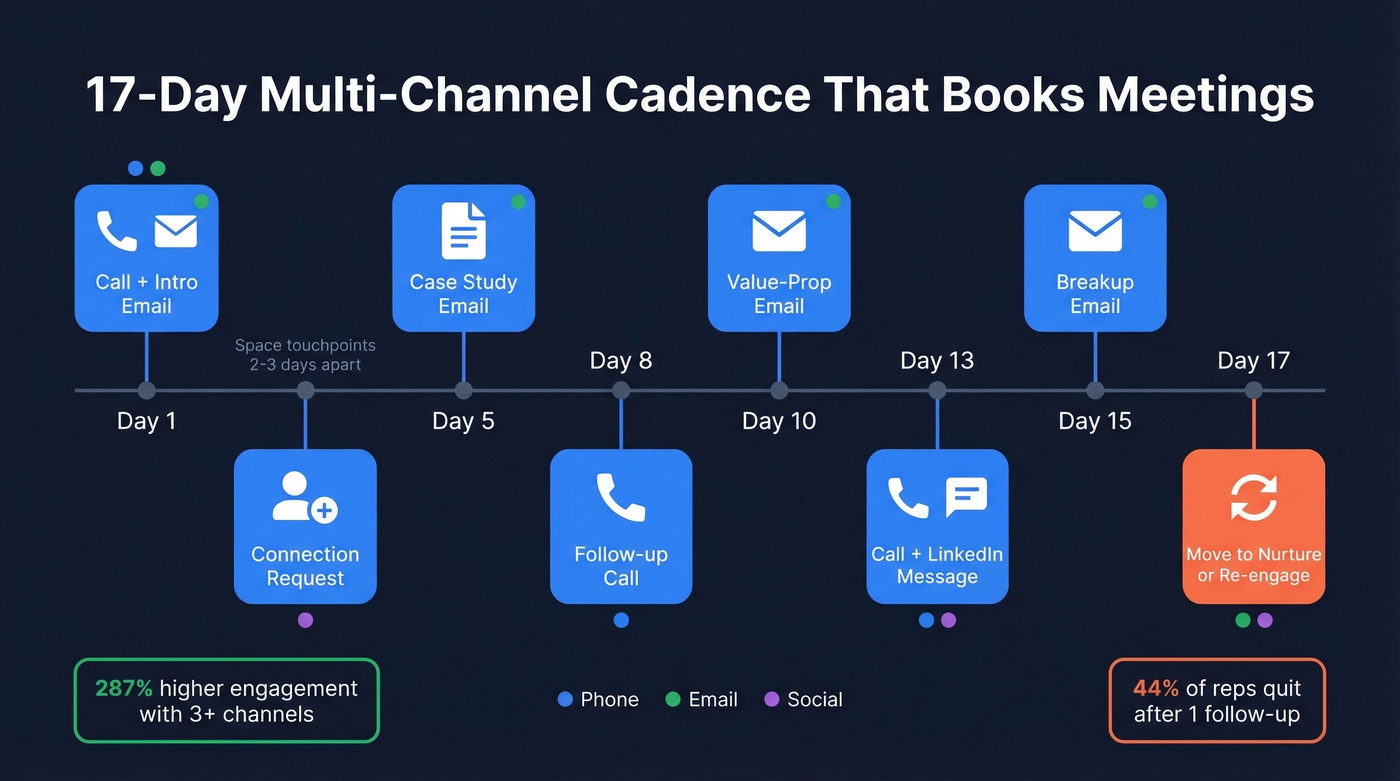
| Day | Action |
|---|---|
| Day 1 | Call + intro email |
| Day 3 | Connection request |
| Day 5 | Case study email |
| Day 8 | Follow-up call |
| Day 10 | Value-prop email |
Space touchpoints 2-3 days apart over 17-21 days. The biggest mistake? Stopping too early. 44% of reps quit after one follow-up, but 80% of deals require five or more touches. Your cadence isn't annoying - it's necessary.
4. Call at the Right Time
Forget the "best day to call" debates - time-of-day matters more. The 9-11 AM and 3-5 PM windows consistently produce the highest connect rates, but here's the move most reps miss: executives are easier to reach outside business hours. Try calling before 8 AM or after 6 PM. No gatekeeper, no "she's in a meeting." RAIN Group's research backs this up - you'll catch decision-makers at their desk when the noise is low.
| Window | Why It Works |
|---|---|
| 9-11 AM | Prospects are in planning mode, before meetings stack up |
| 3-5 PM | End-of-day wind-down, more open to quick conversations |
| Before 8 AM / After 6 PM | No gatekeeper, direct access to executives |
5. Handle Objections With Rebuttals
Every objection maps to one of four BANT categories - Budget, Authority, Need, or Timing. Here's what to say for the three you'll hear most:
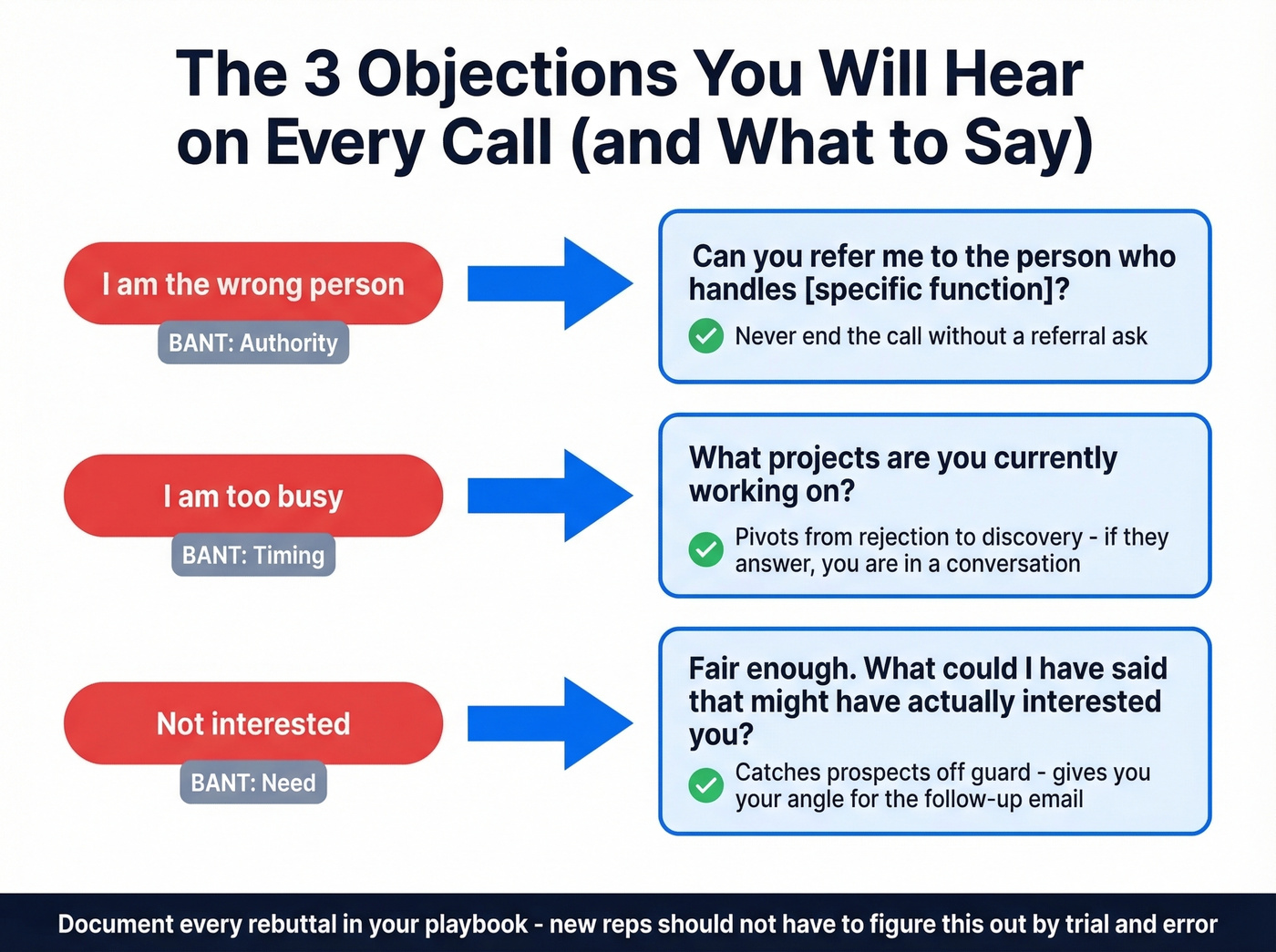
"I'm the wrong person." → "Can you refer me to the person who handles [specific function]?" Never let a wrong-person objection end the call without a referral ask.
"I'm too busy." → "What projects are you currently working on?" This pivots from rejection to discovery. If they answer, you're in a conversation.
"Not interested." → "Fair enough. What could I have said that might have actually interested you?" This catches prospects off guard - and now you have your angle for the follow-up email.
Objection handling is one of the core skills that separates top-performing SDRs from the rest of the team. It's also the hardest to teach, which is why documenting rebuttals in your playbook matters so much - new reps shouldn't have to figure this out by trial and error.
6. Fix Your Data Before You Dial
This is the one that frustrates us most, because it's the easiest fix and the most commonly ignored.
30-50% of B2B records go stale within a year. It takes about 18+ dials to get a customer on the line on average - and that number skyrockets when half your list is disconnected numbers and outdated emails. We've seen teams double their connect rate just by cleaning their list before launching a cadence. Prospeo's 98% email accuracy, 125M+ verified mobile numbers, and 7-day data refresh cycle mean you're reaching live contacts instead of burning hours on ghosts. No outbound process works if the underlying data is broken.

7. Work Accounts Top-Down and Bottom-Up
Don't just call the VP. Multi-thread the account:
- Director - your strategic entry point
- Manager - the person who feels the pain daily
- End user - the one who'll champion your tool internally
When the VP finally picks up and says "talk to my team," you can say "already have - they're interested." 71% of buyers want to hear from sellers early in their buying process. Hit the account from multiple angles while that window is open. This approach takes more upfront effort, but the conversion rate on multi-threaded accounts is dramatically higher than single-contact outreach because you're building internal consensus before the meeting even happens.

Your cadence, scripts, and objection handling won't matter if 30-50% of your list is dead. Prospeo refreshes data every 7 days - not 6 weeks - so your SDRs dial live numbers and land in real inboxes. 98% email accuracy. 125M+ verified mobiles. Teams using Prospeo book 35% more meetings than Apollo users.
Fix your data before your next dial session starts.
Benchmarks for 2026
If your SDRs are booking fewer than 8 meetings a month, the problem is almost always data quality, not effort. Here's what good looks like for a ramped team:
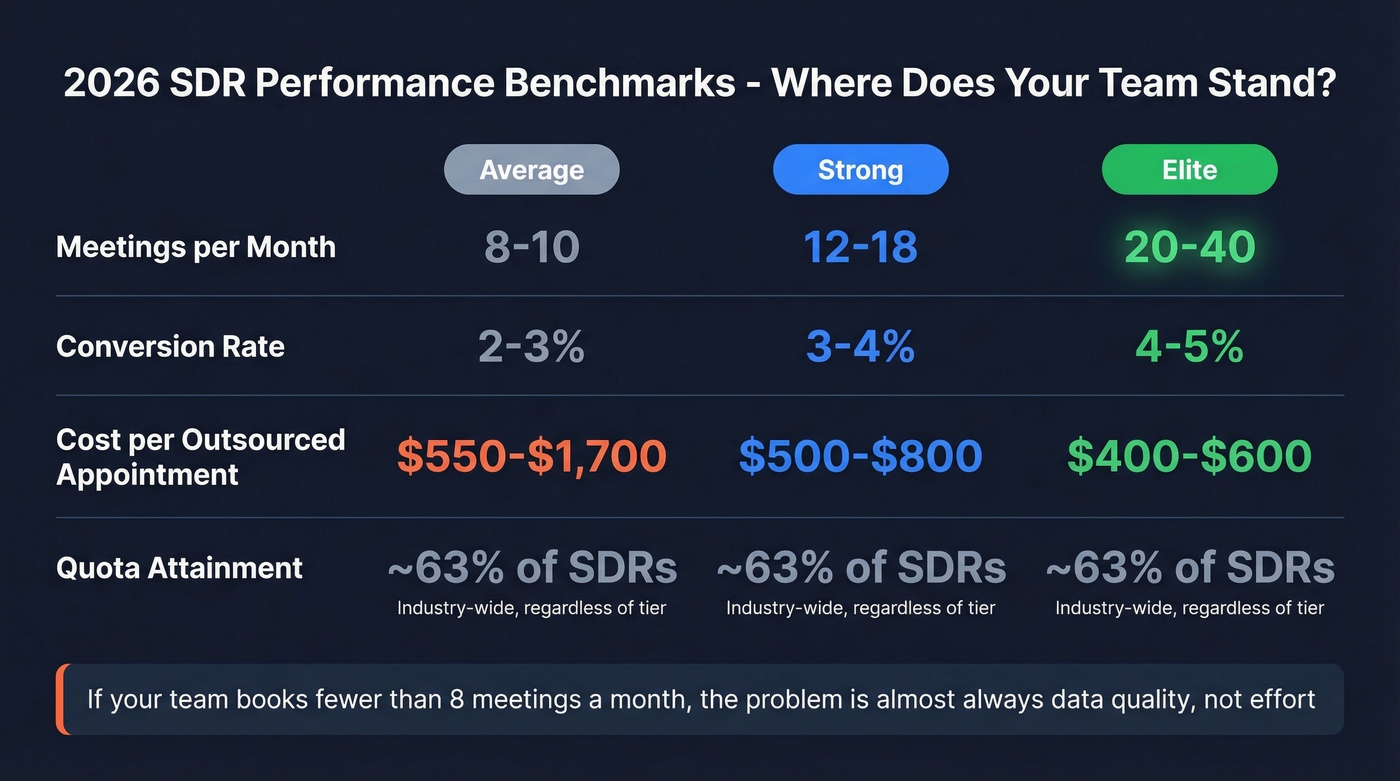
| Metric | Average | Strong | Elite |
|---|---|---|---|
| Meetings/month | 8-10 | 12-18 | 20-40 |
| Conversion rate | 2-3% | 3-4% | 4-5% |
| Dials to connect | 18+ | 18+ | 18+ |
| Cost/outsourced appt | $550-$1,700 | $500-$800 | $400-$600 |
| Quota attainment | ~63% of SDRs | ~63% | ~63% |
The tech stack matters more than most leaders admit. Start with three things: verified contact data, a sequencer like Outreach, Salesloft, or Instantly, and a scheduling link - Calendly works fine at $12/mo.
Let's be honest: if your average deal size is under $15K, you probably don't need a $30K/year data platform. But you absolutely need accurate data. The cost of dialing dead numbers and bouncing emails dwarfs the cost of any data tool.
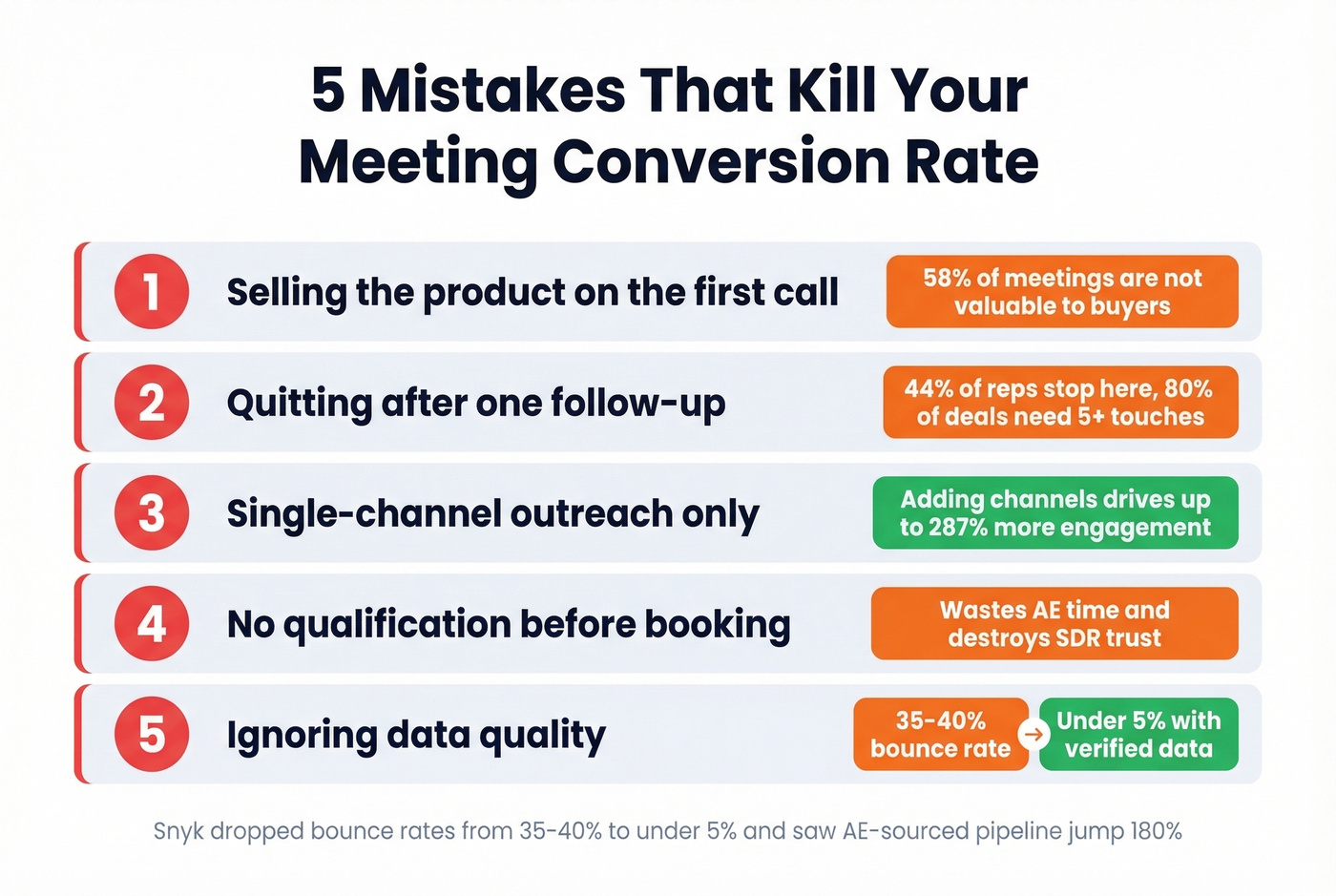
5 Mistakes That Tank Conversion
- Selling the product on the first call. Your job is to book 20 minutes, not close a deal. Save the demo for the AE.
- Quitting after one follow-up. 44% of reps do this. Don't be that rep.
- Single-channel outreach. This is the most common and most fixable problem on this list. Email-only or call-only cadences leave massive engagement on the table - we're talking up to 287% more engagement when you add channels.
- No qualification before booking. Unqualified meetings waste AE time and destroy trust between SDR and sales teams. Skip this if you want your AEs to stop taking your meetings altogether.
- Ignoring data quality. Generic messaging sent to stale contacts is the fastest way to burn your domain reputation and your team's morale. One of our customers, Snyk, saw their bounce rate drop from 35-40% to under 5% after switching to verified data - and AE-sourced pipeline jumped 180%.
Multi-threading accounts top-down and bottom-up requires verified contact data for every stakeholder - directors, managers, and end users. Prospeo gives you 30+ filters to find every buyer in the org, with direct dials that hit a 30% pickup rate. At $0.01 per email, arming your team costs less than a single outsourced appointment.
Reach every decision-maker in the account for less than a dollar.
FAQ
How many follow-ups before giving up?
At minimum, five. 80% of sales require five or more follow-ups, yet 44% of reps stop after one. Build a structured cadence with 8-12 touchpoints over 17-21 days, then move non-responders to a nurture sequence rather than deleting them.
What's a good conversion rate?
Two to five percent across outbound touches is the standard benchmark. Without a structured script, cold calls average just 2.3%. Personalization, proper timing, and multi-channel cadences push you toward the upper end.
Is cold calling still effective in 2026?
Yes. RAIN Group ranks phone calls among the top 5 most effective prospecting methods out of 15 studied. 75% of sales teams now use AI for lead scoring and sequencing, yielding 32% higher meeting acceptance rates. The channel isn't dead - lazy execution is.
How do I keep contact data accurate?
Use a provider with real-time verification and frequent refresh cycles. The industry average refresh is six weeks, which means most "verified" lists are already decaying by the time you dial. Look for providers that refresh weekly and include catch-all domain verification.
What goes into a complete playbook?
A strong playbook covers your ideal customer profile, qualifying criteria, call scripts, objection rebuttals, cadence structure, and handoff process to AEs. It should also define the metrics each rep is measured against - dials, connects, meetings booked, and conversion rate. Without documented standards, every rep invents their own process, and you can't diagnose what's broken.