

The B2B Follow-Up Email Guide That Starts With Data, Not Templates
You sent 200 follow-up emails last week. 38 bounced. Another 30 landed in spam. The ones that actually arrived? Most said "just checking in" and got treated accordingly.
The problem isn't persistence. It's that most B2B follow-up email advice skips the part that actually matters: whether your emails reach anyone at all.
The short version:
- Send 3-4 follow-ups max. Reply rates decline after email #1, and unsubscribe plus spam complaints more than triple after 4+ emails.
- Target Directors, not C-suite. Directors reply at 17.8% vs C-suite at 4.2% - same offer, same copy, wildly different results.
- Verify your list before sending. 17% of cold emails never reach the inbox, and bounces above 2% trigger spam filtering that tanks your entire domain.
Why Most Sales Follow-Ups Fail
The conventional wisdom says "follow up more." The data says otherwise. A Belkins study of 16.5 million cold emails across 93 business domains found the highest reply rate - 8.4% - came from the first email alone. Every subsequent follow-up performed worse.
That doesn't mean follow-ups are useless. It means most reps treat them as volume plays instead of precision plays - more emails to bad addresses with no new value. In our experience, the teams that fix deliverability first see follow-up reply rates double before they change a single word of copy. If 17% of your cold emails never reach the inbox, your outreach strategy has a math problem before it has a messaging problem.
Follow-Up Benchmarks Worth Knowing
| Metric | Benchmark |
|---|---|
| Best reply rate | 8.4% (email #1) |
| Follow-up contribution | 42% of total replies |
| Spam complaint spike | 3x after 4+ sends |
| Director reply rate | 17.8% |
| C-suite reply rate | 4.2% |
| Avg cold email reply | 3.4% |
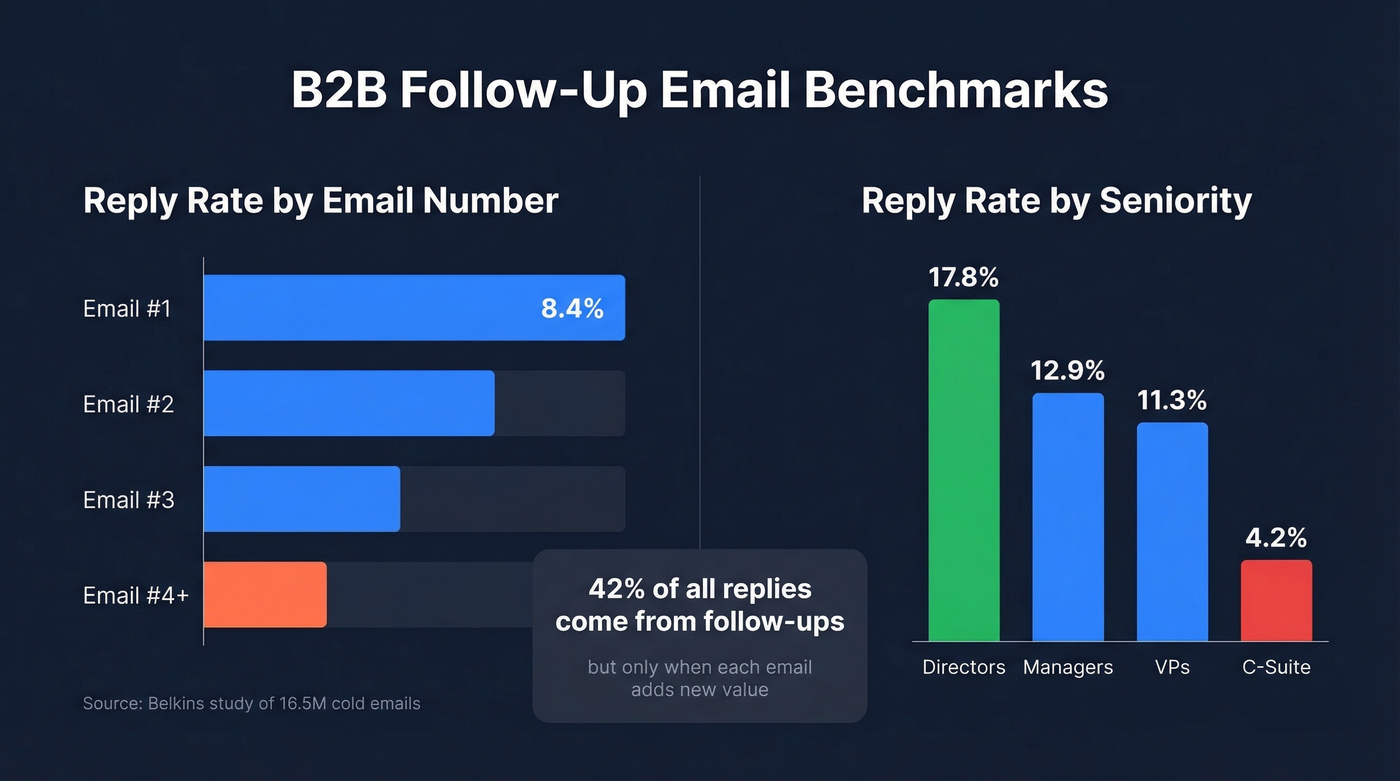
The 42% follow-up contribution is real - but it comes from well-targeted, value-adding follow-ups, not "bumping this to the top of your inbox." The seniority data comes from a Warmer.ai study of 2,847 cold emails across 12 industries. VPs replied at 11.3%, Managers at 12.9%. Directors crushed everyone at 17.8%.
Each follow-up needs to earn its place. After four emails, you're not persistent - you're a spam complaint waiting to happen.
The Deliverability Checklist
None of your follow-up templates matter if they land in spam.
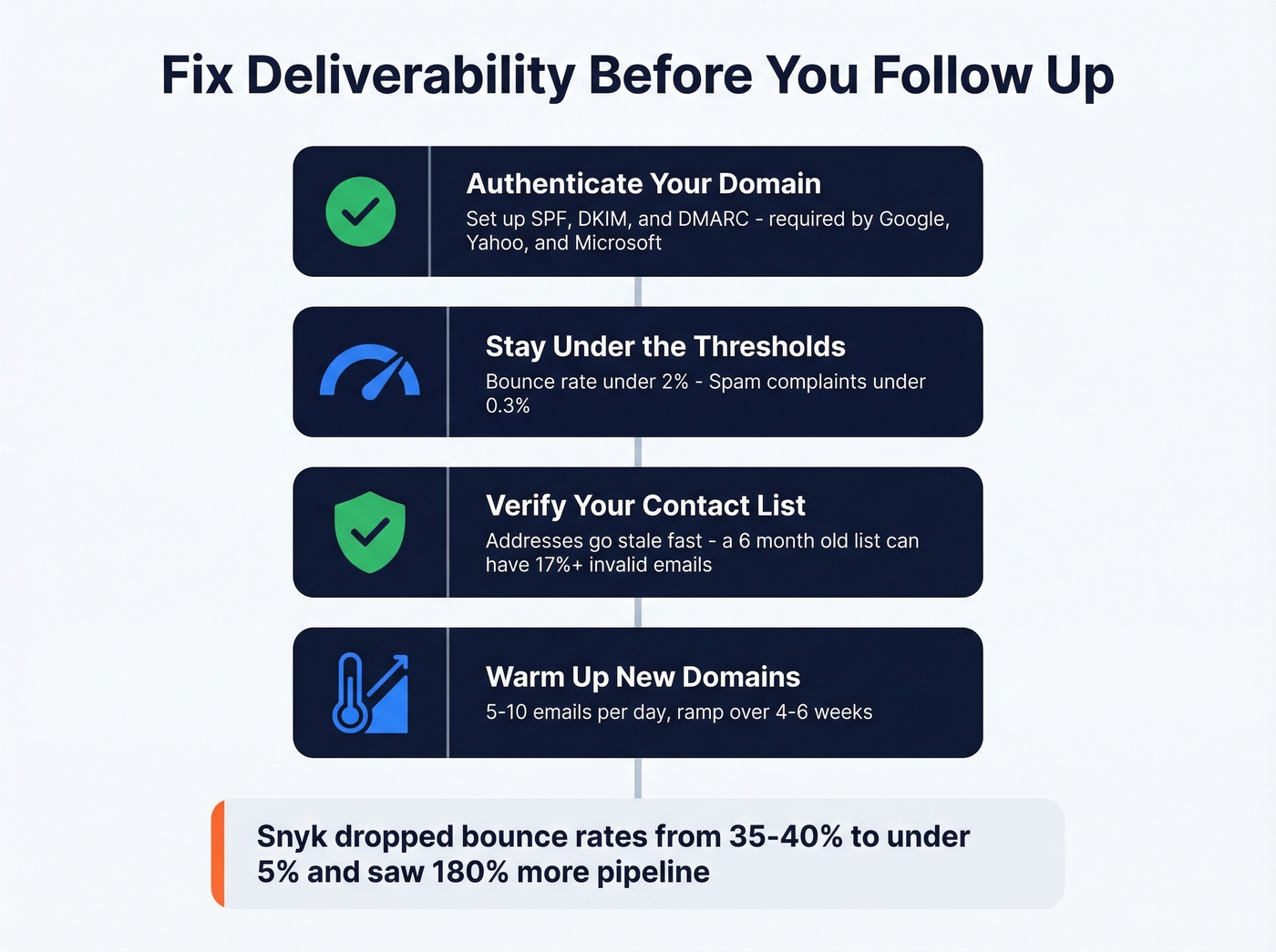
Authenticate your domain. Google and Yahoo now enforce SPF, DKIM, and DMARC for bulk senders, and Microsoft has similar requirements. If you haven't set these up, you're already behind.
Stay under the thresholds. Keep bounce rates under 2% and spam complaints under 0.3%. Those aren't suggestions - they're the guardrails that determine whether mailbox providers accept your emails.
Warm up new domains gradually - 5-10 emails per day, ramping over 4-6 weeks. And know your inbox placement reality: Outlook delivers to inbox just 75.6% of the time vs Gmail's 87.2%.
Verify your list. This is where most teams bleed. Sending follow-ups to addresses that were valid six months ago but now bounce damages your sender reputation for every other email you send. When Snyk switched their 50-person AE team to Prospeo for verification, bounce rates dropped from 35-40% to under 5%, AE-sourced pipeline jumped 180%, and the team generated 200+ new opportunities per month.
Who to Follow Up With
One team in the Warmer.ai study switched targeting from CMOs to Marketing Directors - same offer, same copy, different title - and replies jumped from 3.1% to 16.4%.
Directors are close enough to the problem to feel the pain, but not so senior that they've built walls against cold outreach. If you're burning follow-ups on C-suite contacts who reply at 4.2%, redirect that energy one level down. This single targeting shift can transform your entire sequence results without rewriting a word.

You just read that Directors reply at 17.8% vs C-suite at 4.2%. But targeting the right title means nothing if your emails bounce. Prospeo gives you 300M+ profiles with 98% email accuracy, 30+ filters to target Directors by department and seniority, and a 7-day data refresh so contacts stay current between follow-ups.
Stop following up with dead addresses. Start with verified data.
How Many Follow-Ups and When
There's a tension in the data. Belkins says "less is more" based on 16.5M emails. Sopro's 78M-email dataset recommends 4-6. We've found the sweet spot is 3-4 follow-ups max, each adding genuinely new value.
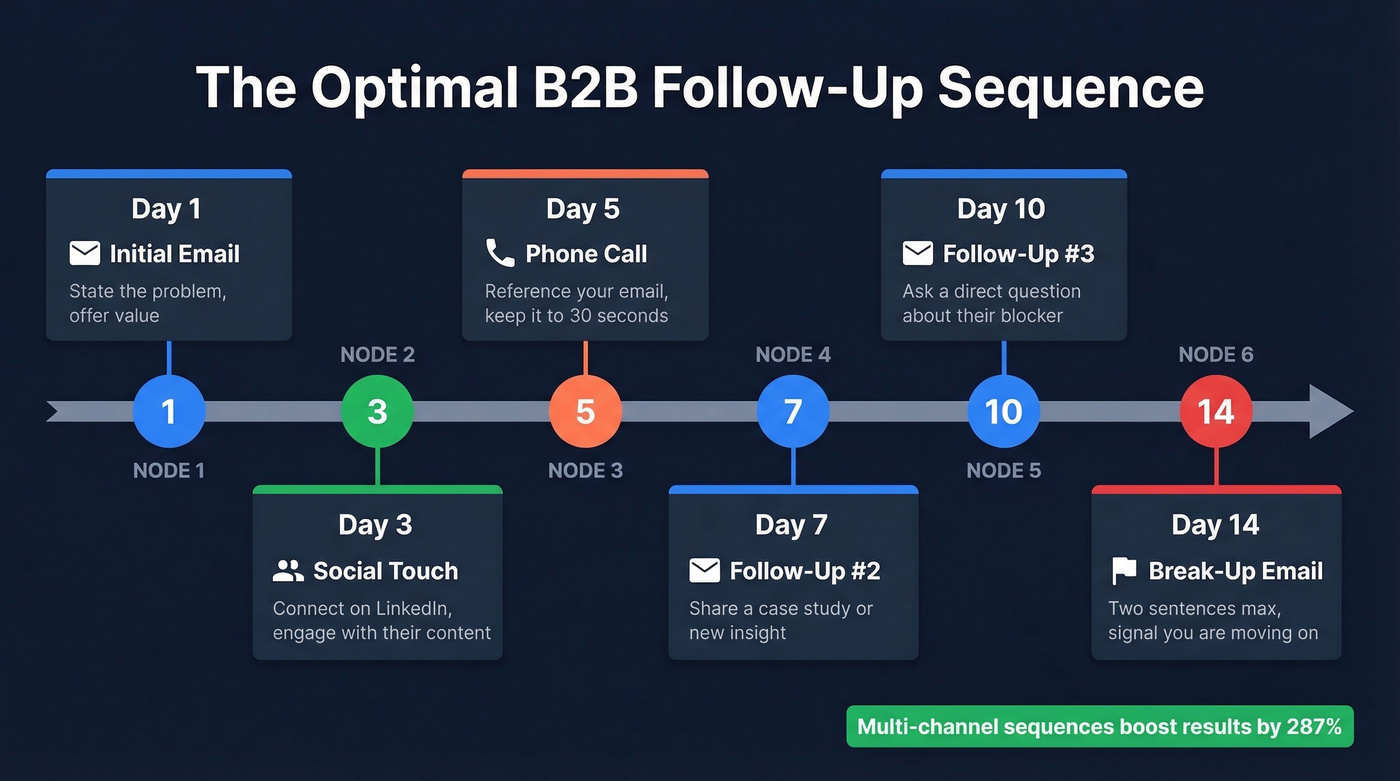
Space them 3-5 days apart. Launch sequences Monday, target peak engagement Wednesday. And skip email-only sequences entirely - a multi-channel sequence mixing Day 1 email, Day 3 social touch, Day 5 call, and Day 7 follow-up email can boost results by 287%. If you're not mixing in at least one phone or social touch, you're leaving the majority of potential results on the table.
Small businesses with 2-50 employees tolerate more touches. Enterprise prospects are allergic to persistence. Adjust accordingly.
5 Templates That Earn Replies
Keep every template between 50-125 words. Plain text. Threaded as a reply to your original. The examples below cover the five most common B2B scenarios - adapt the framing to your prospect's industry and seniority level.
Post-Meeting Recap
Subject: Quick recap + next step
Send within 24 hours. Summarize the one thing they cared about most, attach anything you promised, and propose a specific next step with a date. Don't recap the entire meeting - highlight the moment their energy shifted.
No Response (Value-Add)
Don't say "just following up." That phrase tells the prospect you have nothing new to say. Share a case study, benchmark, or insight they haven't seen instead. If email #1 was about the problem, email #2 should be about the cost of inaction.
Subject: [Relevant stat] for {{company}}
Trigger Event
Hyper-personalized emails referencing specific business challenges get an 18.3% reply rate vs 2.1% for generic outreach - an 8.7x difference. Reference a specific event: funding, a leadership hire, office expansion. Make the connection between their event and your value obvious in one sentence.
Subject: Congrats on the {{funding round / new role / expansion}}
Direct Question
One of the simplest follow-ups is a single direct question about the prospect's biggest blocker. Address one objection bucket: no need, cost concerns, no urgency, don't want it, or don't trust you. One question, one sentence of context, done.
Subject: Quick question about {{specific challenge}}
Break-Up Email
Two sentences. That's the constraint. Signal this is your last email and create urgency without desperation: "I'm finalizing my schedule for next week and wanted to check one more time before I move on."
Subject: Should I close your file?
Subject Lines That Get Opens
Keep subject lines to 6-10 words. Personalized subject lines get 50% higher open rates. Questions outperform statements by 21%. Including numbers boosts opens up to 113%.
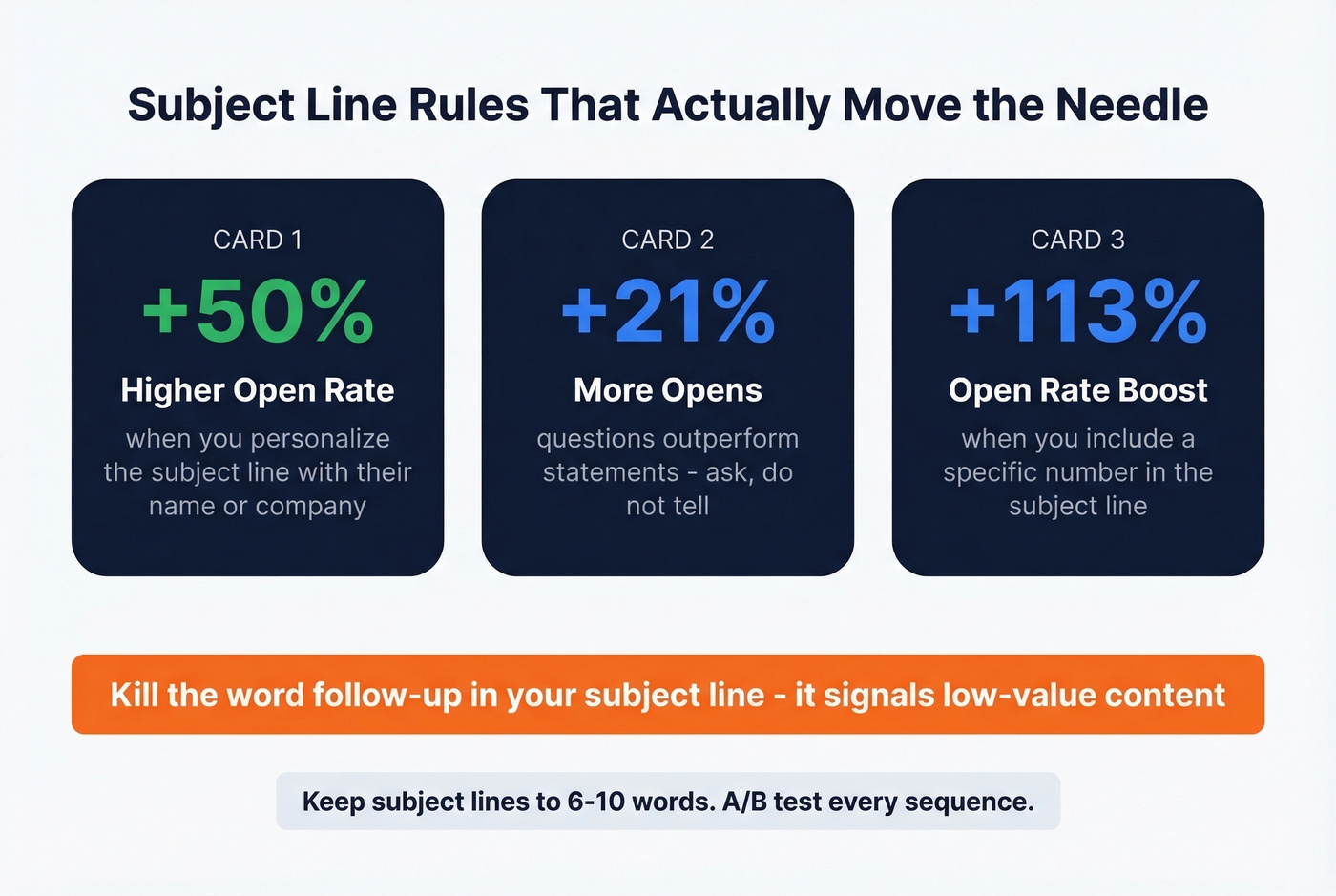
Kill the word "follow-up" in your subject line - it signals low-value content. Here's the thing: if you're not A/B testing subject lines, you're guessing with the single most important variable in your entire sequence.
Mistakes That Kill Replies
"Just checking in," "touching base," "circling back." Every follow-up needs to add value or ask a specific question. These phrases announce you have neither.
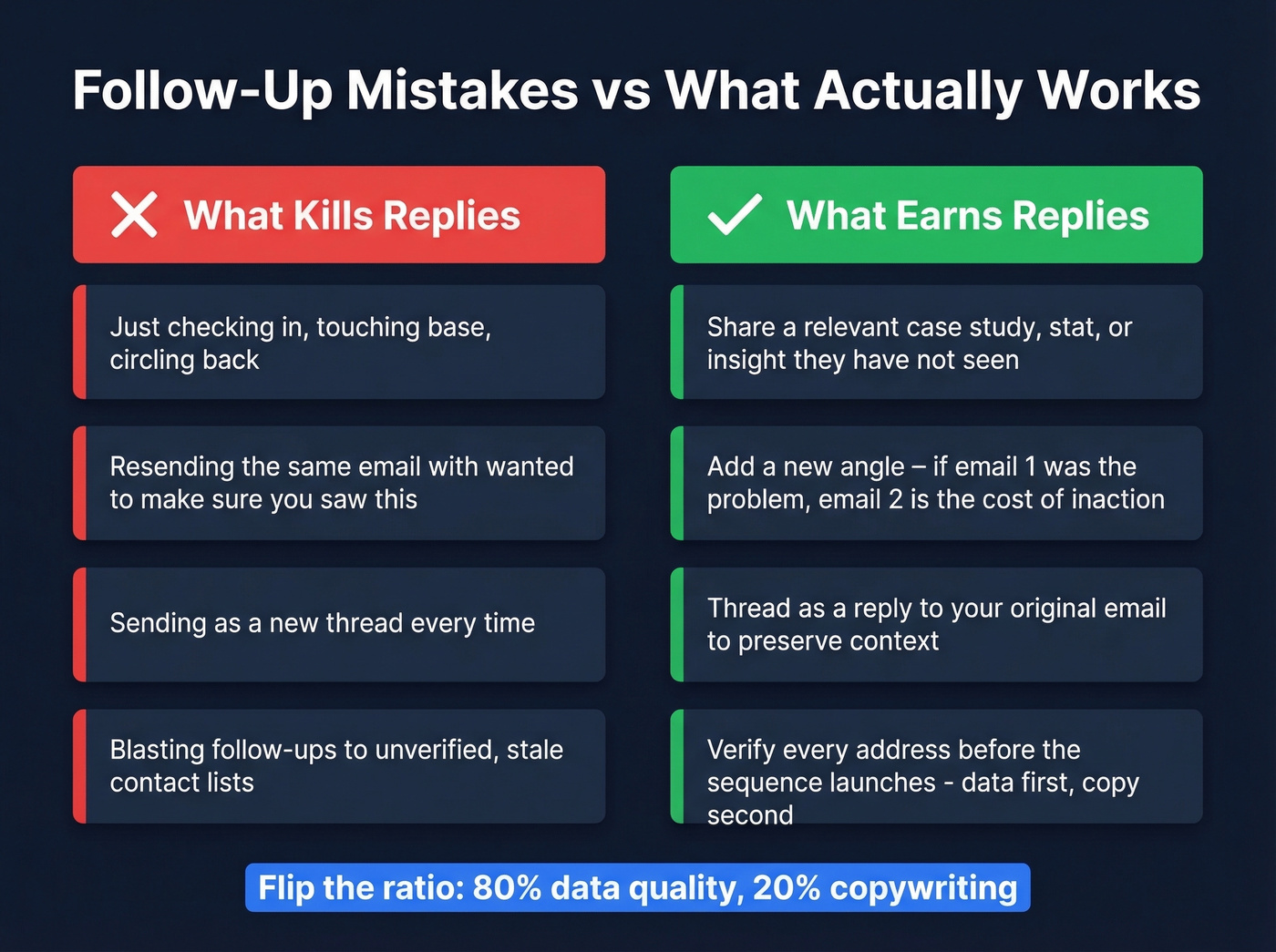
Bumping with no new information. Resending the same email with "wanted to make sure you saw this" is the fastest way to get archived permanently.
Not threading as a reply. Send follow-ups as replies to your original email. It preserves context and looks like a conversation, not a mass blast.
Sending to unverified addresses. We've seen teams lose entire sending domains over unverified lists - it's the most expensive mistake in outbound. An address that was valid six months ago but now bounces isn't a follow-up problem. It's a data problem. Verify before you send.
Let's be honest: most teams spend 80% of their energy wordsmithing copy and 20% on data quality. Flip that ratio. Perfect copy sent to a dead inbox is worth exactly nothing.
Snyk's 50-person AE team dropped bounce rates from 35-40% to under 5% and generated 200+ new opportunities per month after switching to Prospeo. Every follow-up in your sequence lands harder when the underlying data is verified - at $0.01 per email, fixing deliverability costs less than a single bounced sequence.
Verify your entire list before your next follow-up sequence goes out.
FAQ
How many follow-up emails should I send in B2B?
Three to four. Belkins' 16.5M-email study found that 4+ emails in a sequence more than triples unsubscribe and spam complaint rates. Each follow-up must add new value - a different angle, a case study, or a direct question.
When's the best time to send a B2B follow-up email?
Space follow-ups 3-5 days apart. Tuesday through Thursday, 9:30-11:30 AM in the prospect's time zone. Launch sequences Monday, target Wednesday for highest-priority sends.
How do I stop follow-up emails from going to spam?
Authenticate your domain with SPF, DKIM, and DMARC. Keep bounce rates under 2% and spam complaints under 0.3%. Verify contact data before launching any sequence - tools with catch-all domain verification, spam-trap removal, and honeypot filtering catch the addresses that silently destroy your sender reputation. Warm up new domains over 4-6 weeks.