

The Best B2B Lead Generation Websites for 2026
98% of B2B visitors leave your site without filling out a form. And with AI Overviews now pushing organic click-through rates down to around 8%, the visitors who do reach your site carry more intent than ever - which means the B2B lead generation websites you use to find, verify, and reach buyers matter more than they did a year ago. 83% of buyers complete roughly 70% of their research before talking to sales. You don't need 20 tools. You need 3-4 good ones that actually work together.
Here are the 12 lead generation platforms worth your time in 2026 - ranked by what they're actually good at, with real pricing and accuracy benchmarks.
Our Picks
| Tool | Best For | Starting Price | Verdict |
|---|---|---|---|
| Prospeo | Verified email accuracy | Free (75 emails/mo) | 98% email accuracy, 7-day refresh. The data quality benchmark. |
| Apollo | Free starting point | Free tier available | 275M+ contacts, great filters - verify externally. |
| Leadfeeder | Visitor identification | Free (100 companies) | Turns anonymous traffic into company-level leads. |
| Cognism | Enterprise ABM in EMEA | Custom (~$1,000/user/yr) | GDPR-first with strong European mobile coverage. |
Your Lead Gen Stack Isn't One Tool
The biggest mistake we see teams make is treating lead generation as a single-tool problem. It's not. It's a stack, and you need one strong tool from each of these four categories:
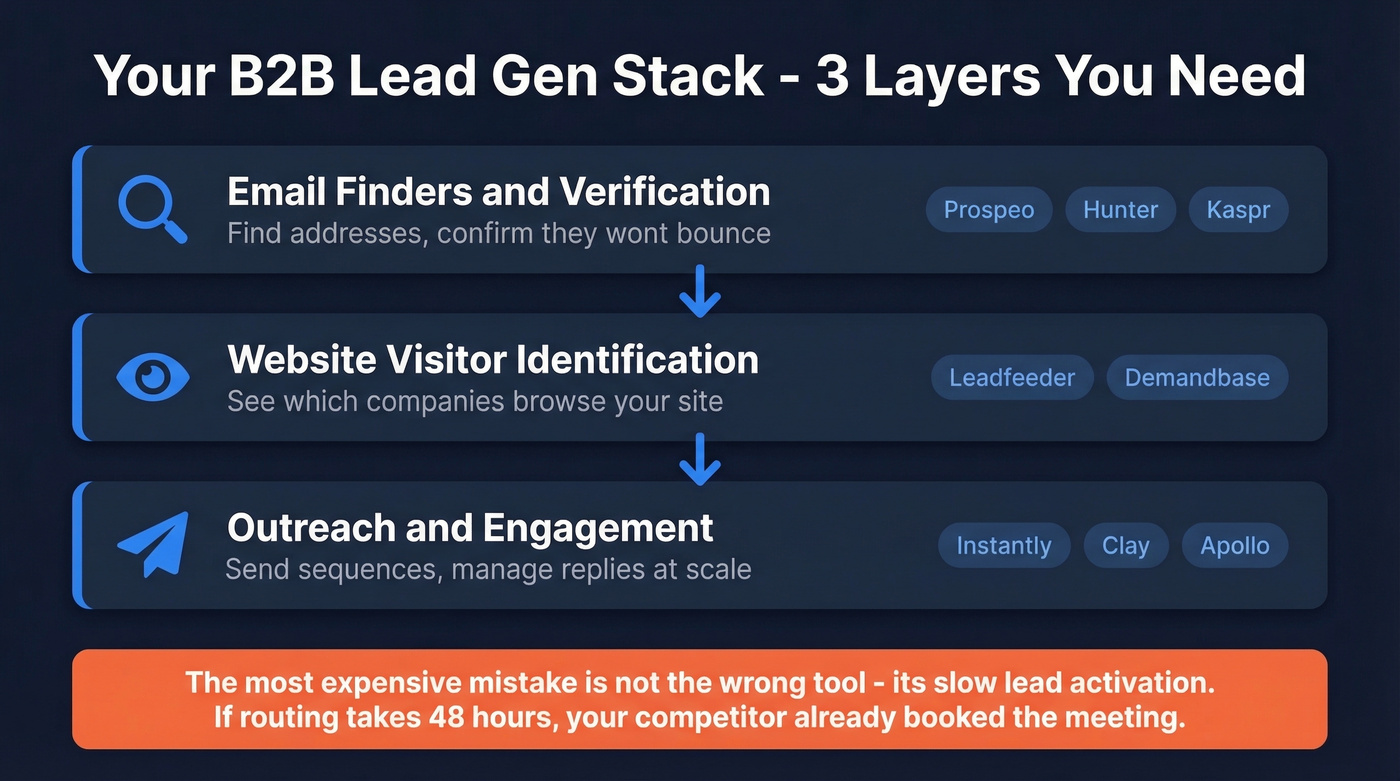
- Email finders & verification - tools that find addresses and confirm they won't bounce (Hunter, Kaspr)
- Website visitor identification - software that tells you which companies are browsing your site (Leadfeeder, Demandbase)
- Outreach & engagement - platforms that send sequences and manage replies (Instantly, Lemlist, Outreach)
This list covers software tools, not outsourced SDR services like CIENCE or Belkins - that's a different buying decision entirely. And the most expensive lead gen mistake isn't picking the wrong tool. It's slow lead activation. If your routing takes 48 hours, your competitor already booked the meeting.
The 12 Best B2B Lead Gen Platforms
Prospeo
Use this if you care about data accuracy more than feature count. Skip this if you need a built-in dialer or full ABM advertising suite - pair Prospeo with a dedicated outreach tool instead.
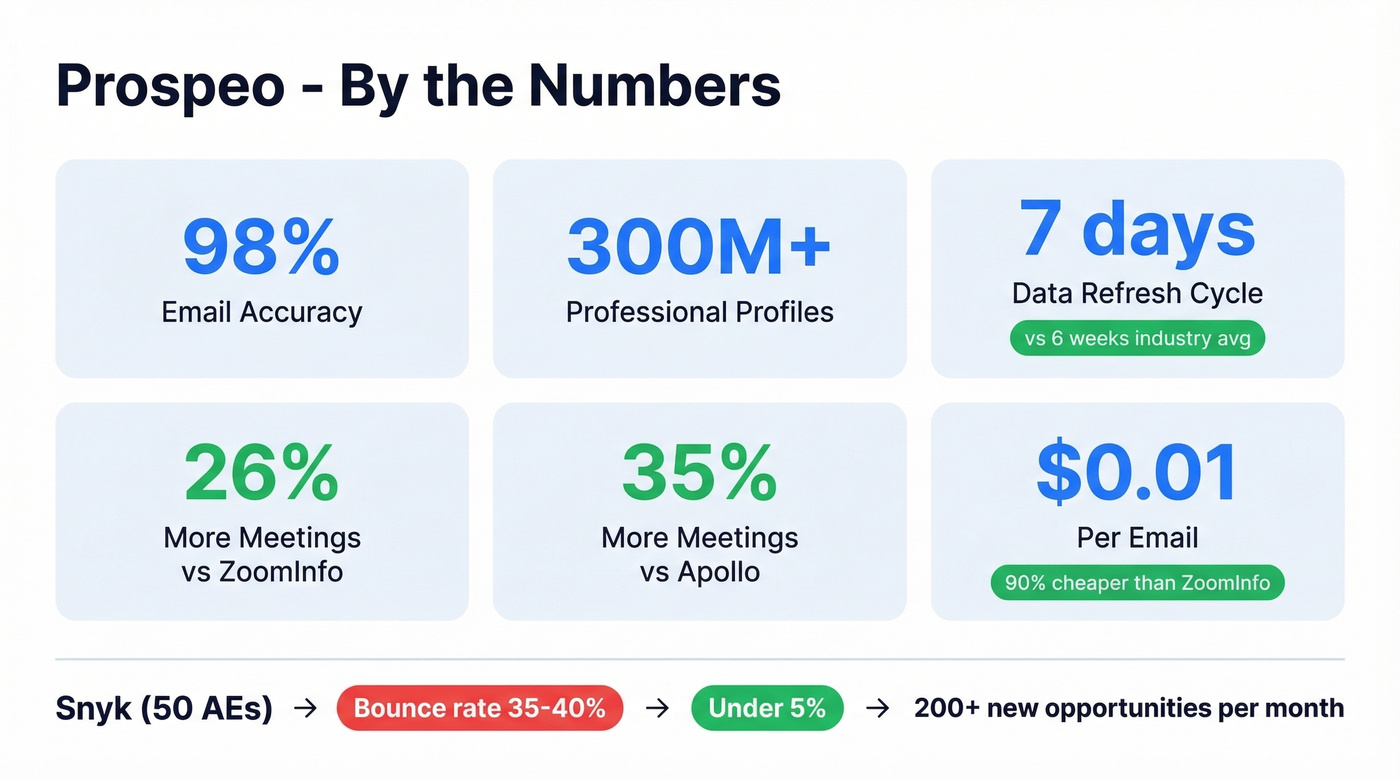
Prospeo's database covers 300M+ professional profiles, 143M+ verified emails, and 125M+ verified mobile numbers. The standout number is 98% email accuracy, backed by a proprietary 5-step verification process that includes catch-all handling, spam-trap removal, and honeypot filtering. Data refreshes every 7 days - the industry average is 6 weeks, which means many databases have already decayed 3%+ by the time they refresh. In practice, teams book 26% more meetings compared to ZoomInfo and 35% more compared to Apollo because the freshness gap shows up directly in pipeline.
The 30+ search filters go beyond basic firmographics. You get buyer intent powered by Bombora across 15,000 topics, technographics, job change signals, headcount growth, and funding data. The Chrome extension has 40K+ users and works across company websites and CRMs. Native integrations cover Salesforce, HubSpot, Smartlead, Instantly, Lemlist, Clay, Zapier, and Make.
Real-world proof: Snyk's 50 AEs cut their bounce rate from 35-40% to under 5% and generated 200+ new opportunities per month after switching. Pricing starts free - 75 verified emails and 100 Chrome extension credits per month, no contract required. Paid plans run about $0.01 per email, which is 90% cheaper than ZoomInfo's roughly $1 per lead.

Apollo
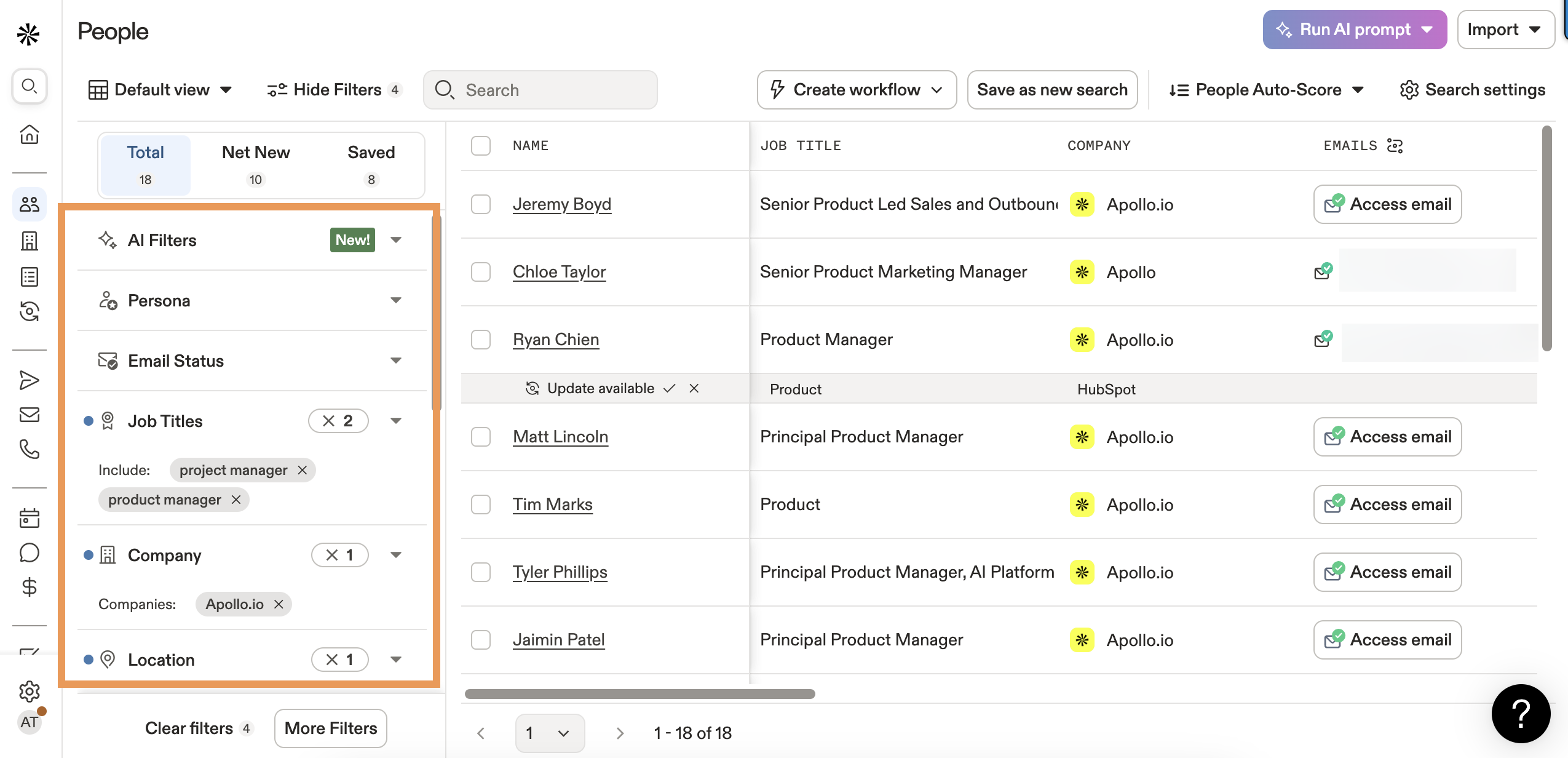
Apollo's 275M+ contact database and generous free tier make it the obvious starting point for teams that don't have budget yet. Paid plans run $49-$99/user/mo, with a $119/user/mo tier, and the built-in sequencing engine is genuinely powerful for automating multi-step outreach.
Here's the thing: Apollo's data is largely user-populated. The consensus on r/LeadGeneration is that it's a "jack of all trades, master of none" - practitioners recommend exporting a tight ICP list of ~1,000 contacts and verifying with at least two external tools before launching sequences. The built-in email tracking can hurt deliverability, and the Twilio-based dialer numbers get flagged as spam more often than you'd like.
Apollo is crazy powerful when you know its limits. Use it for list building and sequencing. Don't trust it as your sole source of truth on contact data.
ZoomInfo
ZoomInfo's 260M+ profiles and deep US database make it the enterprise default. If you're a 200+ person sales org with $50k+ to spend, the breadth of features - intent data, WebSights visitor tracking, conversation intelligence - is hard to match.
For everyone else, the math doesn't work. A mid-market contract runs ~$15k-$40k/year, and enterprise deals clear $50k easily. The "unlimited" plans have hidden export caps that catch teams off guard. Hidden fees can inflate bills 30-50%, and accuracy benchmarks land around 78% - solid but not exceptional.
Where ZoomInfo still wins: US database depth and workflow breadth. Where it loses: pricing transparency, SMB value, and global mobile coverage. There's no self-serve pricing page. You'll talk to sales, negotiate, and likely sign an annual contract.
Hot take: ZoomInfo is still the best all-in-one platform. But most teams don't need all-in-one - and they definitely don't need to pay $40k/year to find out.
Cognism
Cognism covers 400M+ profiles with a GDPR-first approach that makes it the clear pick for teams selling into Europe. Mobile phone coverage across EMEA is noticeably stronger than ZoomInfo's, and the Diamond Verified dataset adds a human-verification layer for priority contacts.
Custom pricing typically starts around $1,000/user/year and scales up from there. Intent data comes bundled in higher tiers. If your ICP is primarily in the UK, DACH, or Nordics, start with Cognism. ZoomInfo still edges ahead on US database depth and platform breadth, but for European compliance and mobile verification, Cognism wins.
Leadfeeder
Leadfeeder identifies the companies visiting your website, even when they don't fill out a form. The free plan tracks 100 companies with 7-day data retention. Paid plans start at EUR99/mo and scale to EUR1,199/mo depending on volume.
Let's be honest about the limitations, though. Company-level match rates run 30-65%, and person-level identification drops to 5-20%. Remote work has degraded IP matching significantly - with 60%+ of knowledge workers now remote or hybrid, a lot of traffic comes from residential ISPs that can't be resolved to a company. Leadfeeder is best for inbound-heavy teams that want to prioritize sales follow-up based on website engagement. It's not a replacement for outbound prospecting data.

Kaspr
Kaspr offers unlimited B2B email credits on paid plans, which is rare. The free tier gives you a starting point, Starter runs $49/user/mo on annual billing, and Business hits $79/user/mo. Phone credits are add-ons at $0.21-$0.36 per credit.
One catch: your professional network account needs 20+ connections to use the tool. Good for reps who need quick contact lookups during prospecting sessions rather than bulk exports.
UpLead
UpLead's 160M+ contacts with real-time email verification built in make it a clean mid-market alternative to ZoomInfo at a fraction of the cost. Entry plans start at $99/mo, mid-tier at $199/mo. The interface is straightforward - search, filter, verify, export. No bloat. For 5-15 person sales teams that need a reliable contact database without enterprise overhead, UpLead deserves a trial.
Hunter
Clay
Clay isn't a database - it's an orchestration layer that waterfalls enrichment across 100+ data providers. Practitioners on Reddit consistently name it as a favorite. Plans start at $149/mo.
If you're building custom prospecting workflows - pulling from multiple sources, enriching with firmographic and technographic data, then pushing to your sequencer - Clay is the connective tissue. Not for beginners, but incredibly powerful for RevOps teams that want full control over their data pipeline.
Instantly
Instantly is a cold email infrastructure tool, not a data provider. The lead finder is free, and outreach plans start around $30/mo. Domain rotation, inbox warmup, and send scheduling are the core features. You build the list in a contact database, then run sequences through Instantly at scale. Best for teams whose entire outbound motion is email-first.
Demandbase
Enterprise ABM platform combining intent data, advertising, and sales intelligence. Typically $25k-$50k/year. Overkill for teams under 50 reps, but powerful for large marketing orgs running coordinated ABM programs across display, web personalization, and sales alerts.
6sense
AI-powered intent and predictive analytics at enterprise scale. Expect $60k-$120k/year. Best for large marketing teams that need to identify in-market accounts before they raise their hand. If you don't have a dedicated ABM team, skip this - you won't get value from it.
OptinMonster
Different category entirely. OptinMonster captures inbound leads through popups, exit-intent overlays, and embedded forms. Free plan available; paid plans start at $9/mo. Useful for teams with strong website traffic that want to maximize form fills, not an outbound data provider.

You just read that most B2B lead gen databases refresh every 6 weeks. Prospeo refreshes every 7 days - which is why teams see 26% more meetings than ZoomInfo and 35% more than Apollo. 300M+ profiles, 98% email accuracy, $0.01/lead.
Build your lead gen stack on data that's actually fresh.
The article's advice is right: verify externally before you send. Prospeo's 5-step verification catches spam traps, honeypots, and catch-all domains that other lead generation websites miss. Snyk dropped bounce rates from 35% to under 5% across 50 AEs.
Stop burning your domain on bad data from other platforms.
Pricing Comparison
One of the biggest frustrations with B2B lead generation websites is vendors hiding pricing behind "talk to sales." Half the tools on this list - ZoomInfo, Cognism, Demandbase, 6sense - require a sales conversation before you see a number. The other half publish transparent, self-serve pricing. We've compiled everything into one table so you can compare without scheduling four demos.
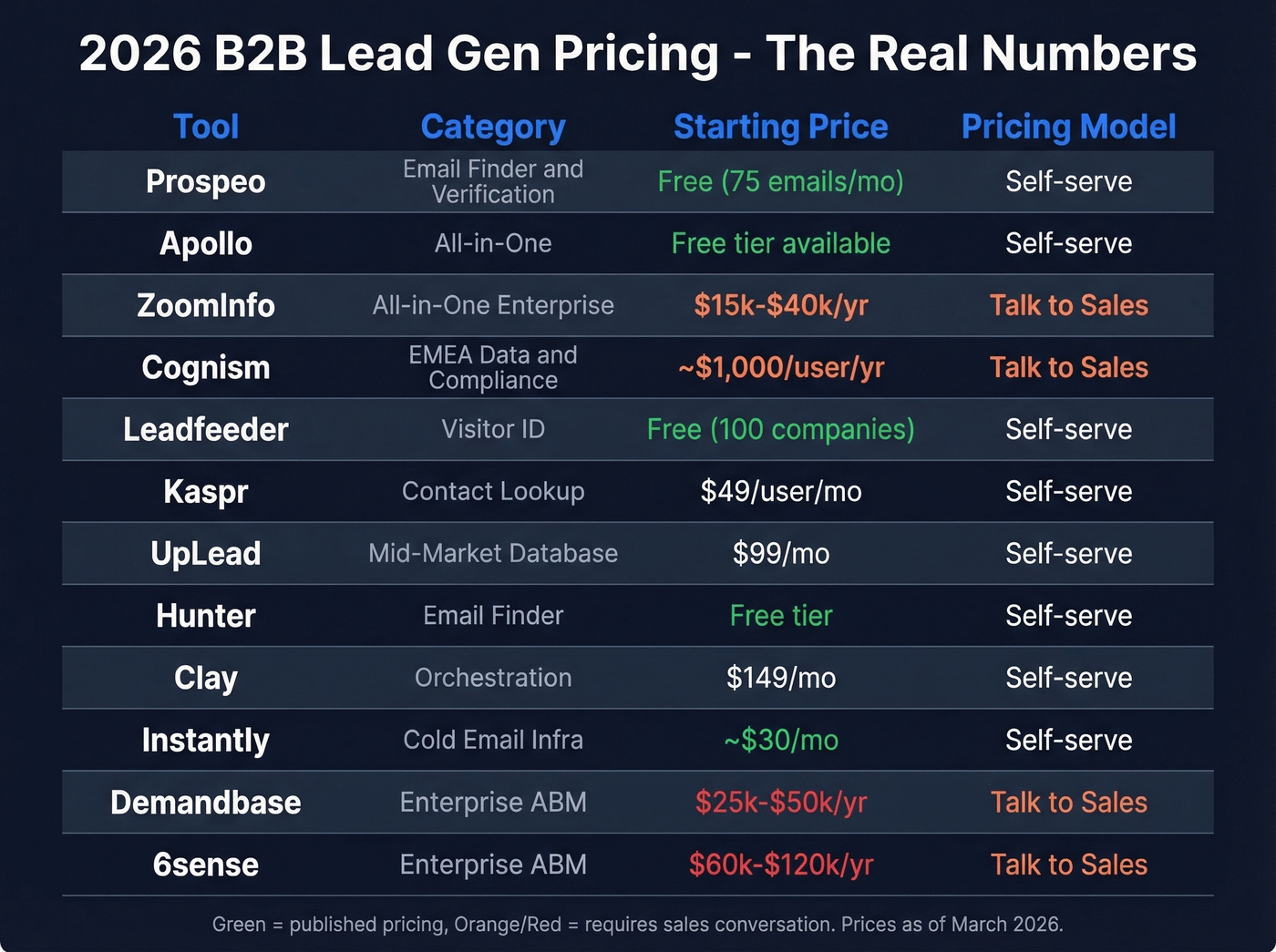
| Tool | Category | Starting Price | Best For | Pricing Model |
|---|---|---|---|---|
| Prospeo | Prospecting & data | Free ($0.01/email paid) | Verified accuracy | Self-serve |
| Apollo | Prospecting & data | Free; $49/user/mo | Free starting point | Self-serve |
| ZoomInfo | Prospecting & data | ~$15K/yr | Enterprise US orgs | Sales-required |
| Cognism | Prospecting & data | ~$1,000/user/yr | EMEA sales teams | Sales-required |
| Leadfeeder | Visitor ID | Free; EUR99/mo paid | Inbound-heavy teams | Self-serve |
| Kaspr | Email & phone finder | Free; $49/user/mo | Quick lookups | Self-serve |
| UpLead | Contact database | $99/mo | Mid-market teams | Self-serve |
| Hunter | Email finder | Free; $34/mo | Domain searches | Self-serve |
| Clay | Enrichment | $149/mo | Custom workflows | Self-serve |
| Instantly | Outreach | Free finder; ~$30/mo | Email at scale | Self-serve |
| Demandbase | Enterprise ABM | ~$25K-$50K/yr | Large ABM programs | Sales-required |
| 6sense | Enterprise ABM | ~$60K-$120K/yr | Predictive analytics | Sales-required |
| OptinMonster | Lead capture | Free; from $9/mo | Inbound conversion | Self-serve |
What a B2B Lead Actually Costs
Before picking tools, know your benchmarks. Channel-level CPL data varies wildly:
| Channel | Avg CPL |
|---|---|
| Trade shows | $840 |
| PPC | $463 |
| Paid LinkedIn | $408 |
| Cold email | $225 |
| SEO | $206 |
| Referrals | $25 |
Industry matters too - legal averages $650 per lead, while B2B SaaS runs closer to $188. The healthy benchmark for LTV:CAC is 3:1. If your cost per lead is $225 via cold email but your average deal is $500, the math doesn't work regardless of which tool you pick.
And if your sales team takes two days to follow up on a warm lead, the best data in the world won't save you. Misaligned handoffs between marketing and sales kill more pipeline than bad contact data ever will.
Why Data Freshness Beats Database Size
Every vendor brags about database size. Few talk about decay.
B2B contact databases decay roughly 2.1% per month - that's 22.5% annually. Gartner estimates poor data quality costs organizations $12.9M per year on average. We've tested dozens of contact databases over the past two years, and the accuracy gap between weekly and monthly refreshes is dramatic. By month three, a database on a 6-week refresh cycle has decayed 6.3%, which means one in sixteen contacts you're reaching out to is already stale.
Accuracy benchmarks tell the story: ZoomInfo 78%, Clay 75%, Apollo 72%, Hunter 68%. Database size is a vanity metric. Freshness is what determines whether your emails bounce and your calls connect.
Compliance Isn't Optional
The penalties for getting this wrong are real:
| Regulation | Penalty |
|---|---|
| TCPA | $500-$1,500 per violation |
| CAN-SPAM | Up to $43,280 per violation |
| CCPA | $2,500 per violation ($7,500 intentional) |
Your operational checklist: scrub against DNC lists monthly, track consent at the contact level, honor unsubscribe requests within 10 business days, and include a physical address in every email. Whatever tools you choose, verify their compliance posture before loading contacts into your sequences - ask your vendor directly and get it in writing.
FAQ
What's the difference between a lead generation tool and a lead database?
A database gives you searchable contact data - emails, phone numbers, firmographics. A lead generation tool is a broader category that includes capture forms, visitor tracking, outreach platforms, and enrichment layers. Most teams need one tool from each category to build a complete prospecting stack.
How much should I budget for B2B lead generation tools?
A solid self-serve stack costs $150-$400/month. Enterprise platforms run $15k-$120k/year. Start with free tiers - Prospeo, Apollo, and Leadfeeder all offer functional free plans - before committing serious budget.
How do I know if my lead data is accurate?
Send a test batch of 200-500 contacts through your first sequence. If your bounce rate exceeds 5%, your data provider is the problem, not your copy or targeting.
Do I need separate tools for finding and verifying emails?
Not always. Some platforms include built-in multi-step verification as part of their email finding process. If your tool doesn't verify natively, run contacts through a dedicated verification step before outreach - sending unverified emails is the fastest way to torch your domain reputation.
What are the best free B2B lead generation websites?
Apollo's free tier gives you the largest database at no cost. Prospeo offers 75 verified emails and 100 Chrome credits monthly with higher accuracy. Hunter and Leadfeeder both have functional free plans. Start with these before spending a dollar.