

B2B Research: What It Actually Costs, Which Tools Work, and How to Do It Right
61% of B2B buyers prefer a rep-free buying experience, and 73% actively avoid suppliers who send irrelevant outreach. If your B2B research is weak, your pipeline suffers before a single email goes out. Most guides on this topic are thinly veiled agency pitches. This one gives you real costs, real tools, and real methods - no fluff.
Here's the quick version:
- Understanding your market? Primary research (interviews + surveys), budget $5K-$30K per project.
- Reaching decision-makers? Self-serve data platforms for $0-$50/month.
- Knowing who's actively buying? Intent data from Bombora, 6sense, or similar - $12K-$300K+/year.
Why B2B Research Matters More Than Ever
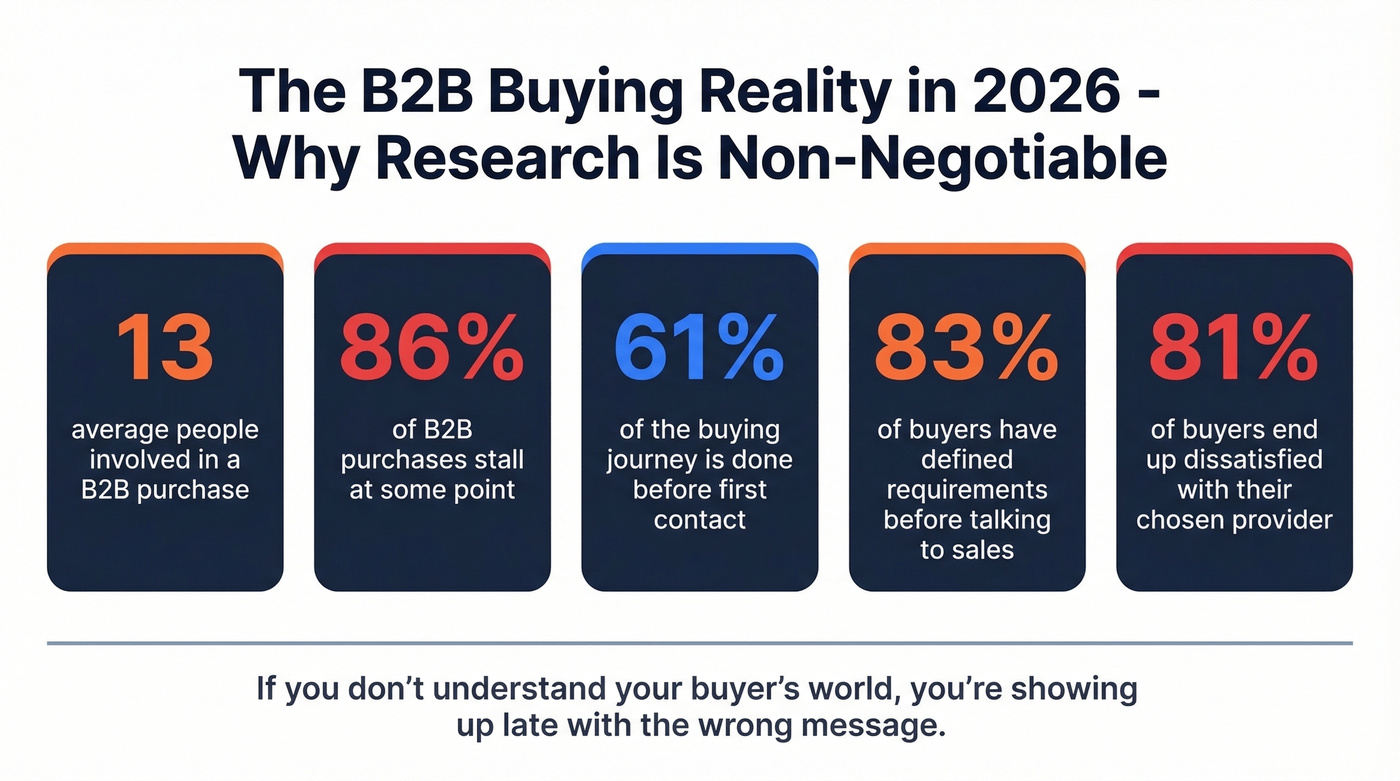
The B2B buying process is chaotic. The average purchase involves roughly 13 people across 2+ departments, and 86% of those purchases stall at some point. Even worse, 81% of buyers end up dissatisfied with the provider they choose. And 69% of buyers report inconsistencies between what's on your website and what sellers say - meaning your own content is actively undermining trust.
That's not a sales problem. It's a research problem on both sides of the table.
Buyers aren't waiting for your SDR to call. Per 6sense's 2025 data, first contact now happens at 61% of the buying journey - pulled earlier by roughly six to seven weeks compared to 2024. And 83% of the time, buyers have mostly or fully defined their requirements before they ever speak with sales.
If you don't understand your buyer's world - their org structure, tech stack, pain points, and buying committee - you're showing up late with the wrong message. The cost of not researching isn't just a missed deal. It's the compounding damage of irrelevant outreach that trains buyers to ignore you permanently.
B2B vs. B2C: Structural Differences
Most research guides treat B2B and B2C as interchangeable. They're not. The differences are structural, and they change everything about your methodology.
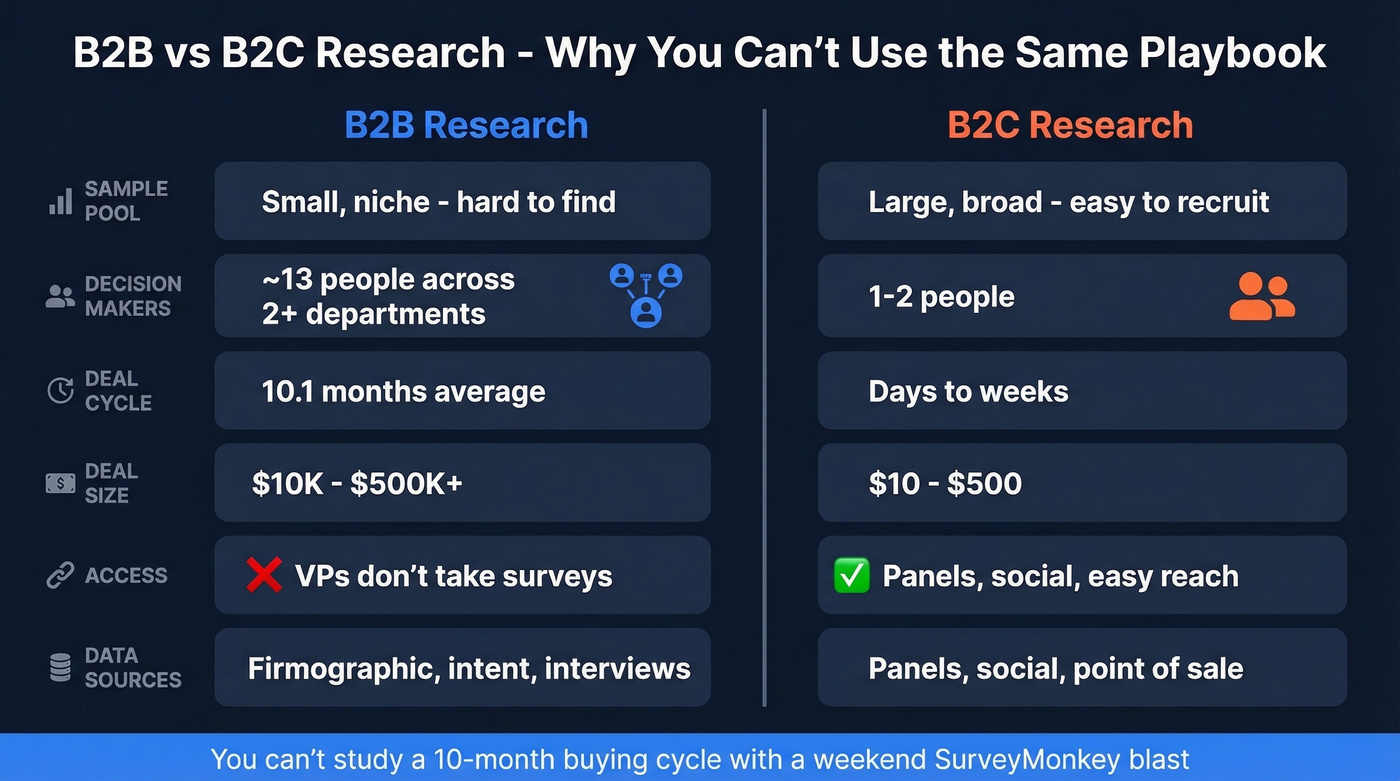
| Dimension | B2B | B2C |
|---|---|---|
| Sample pool | Small, niche | Large, broad |
| Respondent access | Hard (VPs don't take surveys) | Easy |
| Decision-makers | ~13 avg, multi-dept | 1-2 people |
| Deal cycle | 10.1 months avg | Days to weeks |
| Stakes per deal | $10K-$500K+ | $10-$500 |
| Data sources | Firmographic, intent, interviews | Panels, social, POS |
The average B2B sales cycle dropped from 11.3 months to 10.1 months between 2024 and 2025. That's still nearly a year. You can't study a 10-month buying cycle with a weekend SurveyMonkey blast. Effective B2B research demands smaller, more targeted samples, longer timelines, and methods designed for people who genuinely don't have time to fill out your form.
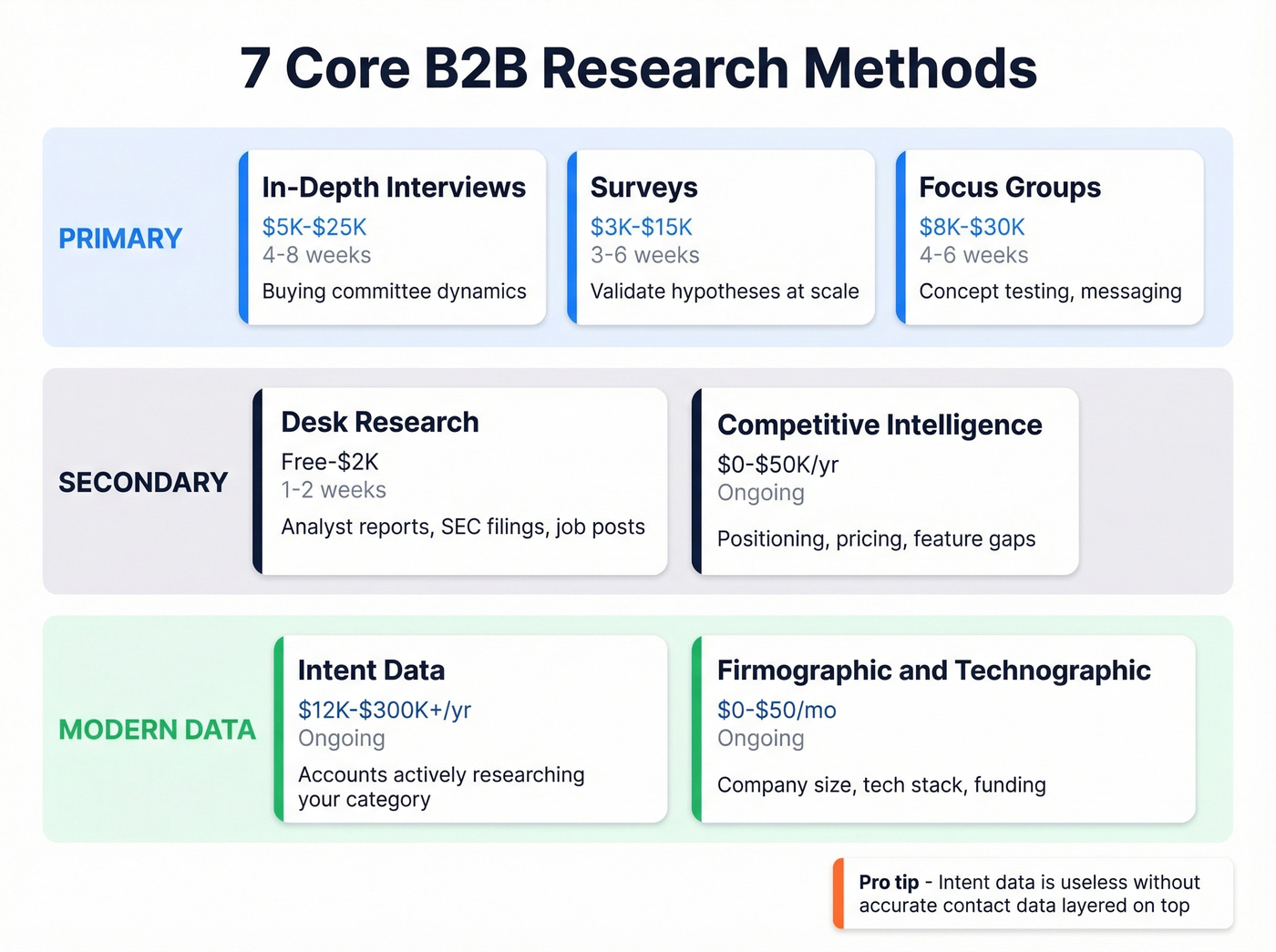
7 Core Methods
Primary Methods
| Method | When to Use | Cost | Timeline |
|---|---|---|---|
| In-depth interviews | Buying committee dynamics, uncovering hidden objections | $5K-$25K | 4-8 weeks |
| Surveys | Validating hypotheses at scale; 400 completes = ±5% margin of error at 95% confidence. Keep open-ended questions at 10% or less of total. | $3K-$15K | 3-6 weeks |
| Focus groups | Concept testing, messaging validation. Recruiting 6-8 directors per session is painful but worth it for real-time reaction. | $8K-$30K | 4-6 weeks |
For surveys involving pricing decisions or feature trade-offs, conjoint analysis is worth the extra investment - it forces respondents to make realistic trade-offs instead of rating everything "important."
Secondary Methods
| Method | When to Use | Cost | Timeline |
|---|---|---|---|
| Desk research | Starting point for any project. Analyst reports, SEC filings, job postings, patent filings. | Free-$2K | 1-2 weeks |
| Competitive intelligence | Mapping competitor positioning, pricing, feature gaps, hiring patterns. Tools like Klue (~$20K-$50K/year) or Crayon (~$25K-$60K/year) help, but a disciplined analyst with G2 reviews gets 80% there. | $0-$50K/yr | Ongoing |
Modern Data Methods
| Method | When to Use | Cost | Timeline |
|---|---|---|---|
| Intent data analysis | Identifying accounts actively researching your category. The intent data market hit $4.49B in 2026 and is projected to reach $20.89B by 2035. | $12K-$300K+/yr | Ongoing |
| Firmographic & technographic research | Mapping target account characteristics - size, revenue, tech stack, funding, headcount growth. This is the company data that forms the backbone of any account-based strategy. | $0-$50/mo | Ongoing |

B2B research without accurate contact data is just a spreadsheet exercise. Prospeo gives you 300M+ profiles with 30+ filters - buyer intent across 15,000 topics, technographics, headcount growth, funding - so you can turn research into real conversations. 98% email accuracy. 7-day refresh. $0.01/email.
Stop researching accounts you can't actually reach.
The B2B Research Tech Stack
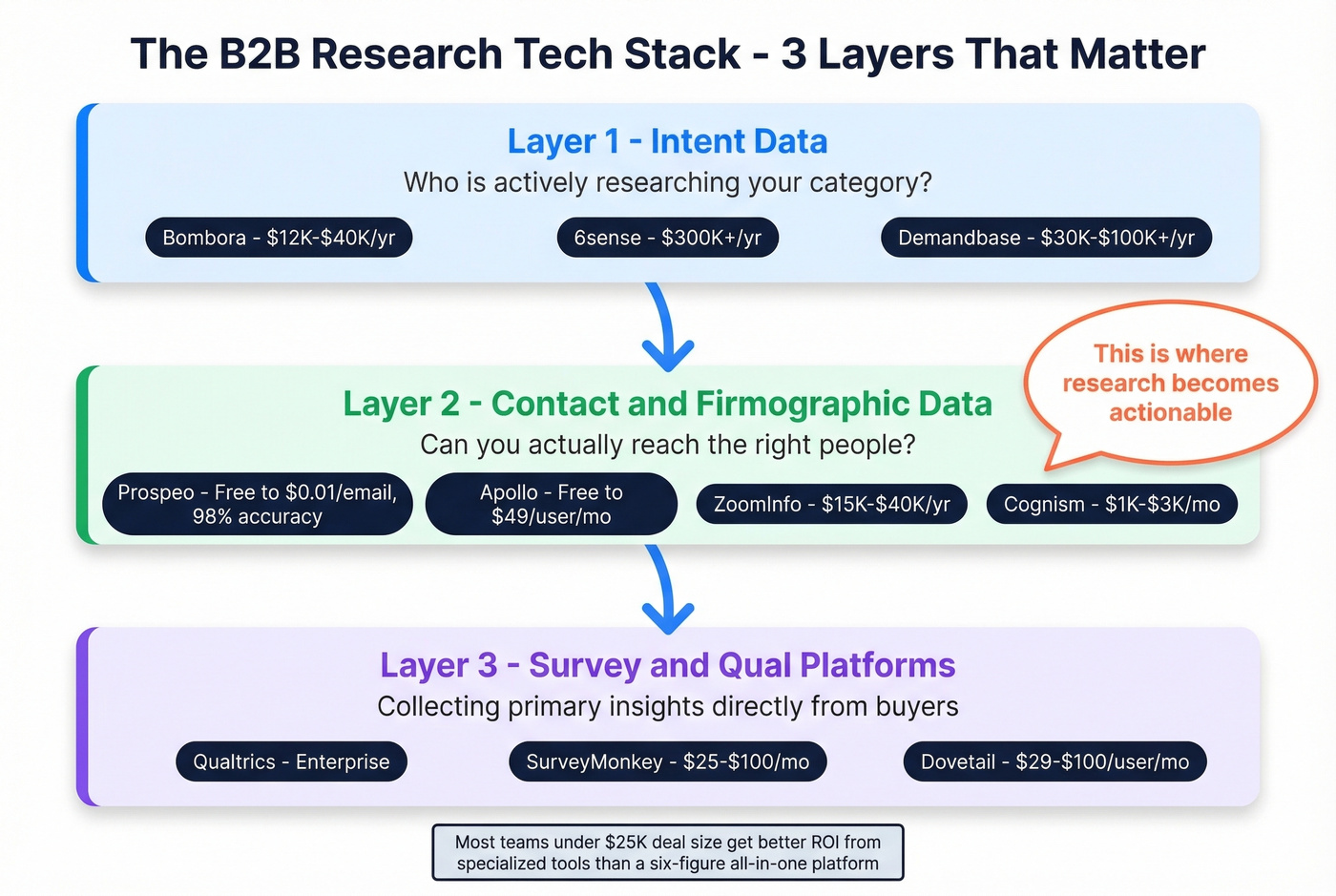
Three layers matter: intent data, contact/firmographic data, and survey platforms.
Intent Data Platforms
Bombora is a common starting point for topic-level intent at $12K-$40K/year. 6sense wraps intent into a full ABM orchestration platform at $300K+/year for enterprise deployments - serious money that only makes sense for coordinated multi-channel ABM. Demandbase sits in a similar tier, typically $30K-$100K+/year for mid-market. The Forrester Wave (Q1 2025) named Intentsify, 6sense, Bombora, Informa TechTarget, and Demandbase as leaders.
Here's the thing: intent data is only as good as the contact data you layer on top. Knowing that "Acme Corp is researching cybersecurity solutions" is useless if you can't reach the CISO.
Firmographic & Contact Data
This is where research becomes actionable. The market has consolidated around a few major platforms that differ significantly on accuracy, freshness, and cost - and choosing the right source of contact data can make or break your targeting.

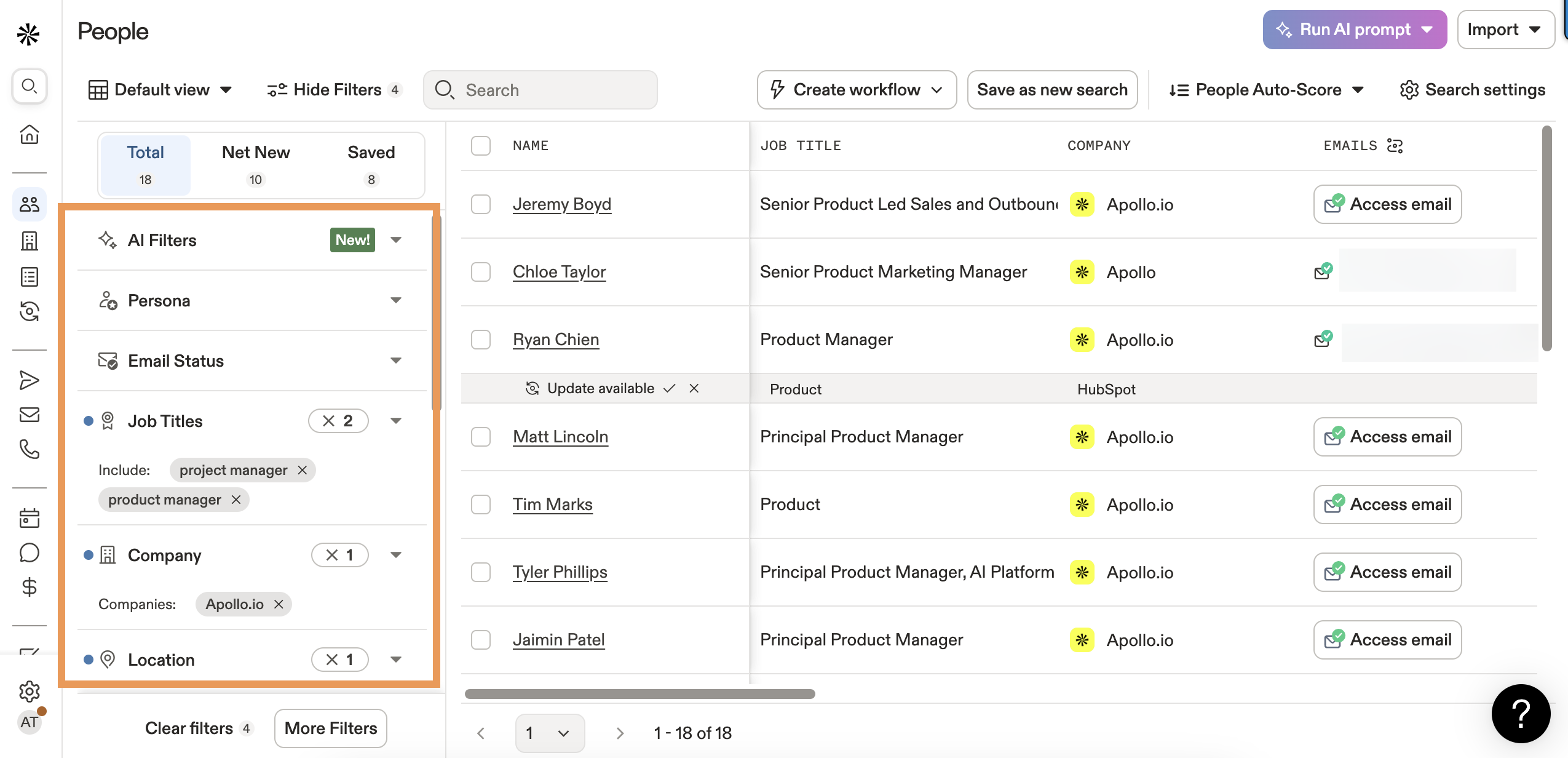
For teams that need accurate contact data without enterprise pricing, Prospeo's 300M+ profile database with 98% email accuracy is hard to beat. Data refreshes every 7 days - compared to the 6-week industry average - and 30+ search filters including buyer intent across 15,000 Bombora topics, technographics, and headcount growth let you build hyper-targeted research panels fast. The free tier gives you 75 verified emails per month; paid plans run about $0.01 per email.
Apollo covers 275M+ contacts across 73M+ companies with a generous free tier - the default starting point for bootstrapped teams. Paid plans start at $49/user/month. Broad database, but email accuracy runs lower than specialized verification platforms.
ZoomInfo remains the enterprise standard with 410M+ contacts, but mid-market contracts run $15K-$40K/year. Hard to justify for research-only use cases. Cognism shines for EMEA coverage and GDPR compliance at roughly $1,000-$3,000/month. Lusha offers quick lookups at $29.90/month - useful for spot research but limited for systematic studies. And if you're already on HubSpot Starter or above, Breeze Intelligence gives you access to 44M+ companies and 350M+ contacts - worth checking before you buy another tool.
| Tool | Database | Entry Price | Best For |
|---|---|---|---|
| Prospeo | 300M+ profiles | Free (75 emails/mo) | Email accuracy, freshness |
| Apollo | 275M+ contacts | Free, $49/user/mo | Broad prospecting |
| ZoomInfo | 410M+ contacts | ~$15K-$40K/yr | Enterprise scale |
| Cognism | 400M+ contacts | ~$1K-$3K/mo | EMEA coverage |
| Lusha | 100M+ profiles | $29.90/mo | Quick lookups |
| Bombora | N/A | $12K-$40K/yr | Topic-level intent |
| 6sense | N/A | $300K+/yr | Enterprise ABM |
Let's be honest: ZoomInfo is still the most comprehensive all-in-one platform. But most teams don't need all-in-one. If your average deal size is under $25K, you'll get better ROI from a specialized contact data tool paired with a standalone intent provider than from a six-figure platform contract you'll use at 30% capacity.
Survey & Qual Platforms
Qualtrics is the gold standard for complex B2B survey design - branching logic, conjoint analysis, panel integration. SurveyMonkey and Typeform handle simpler surveys at $25-$100/month. For qual, Dovetail (~$29-$100/user/month) helps you organize interview transcripts and surface themes across dozens of conversations.
Response Rate Benchmarks
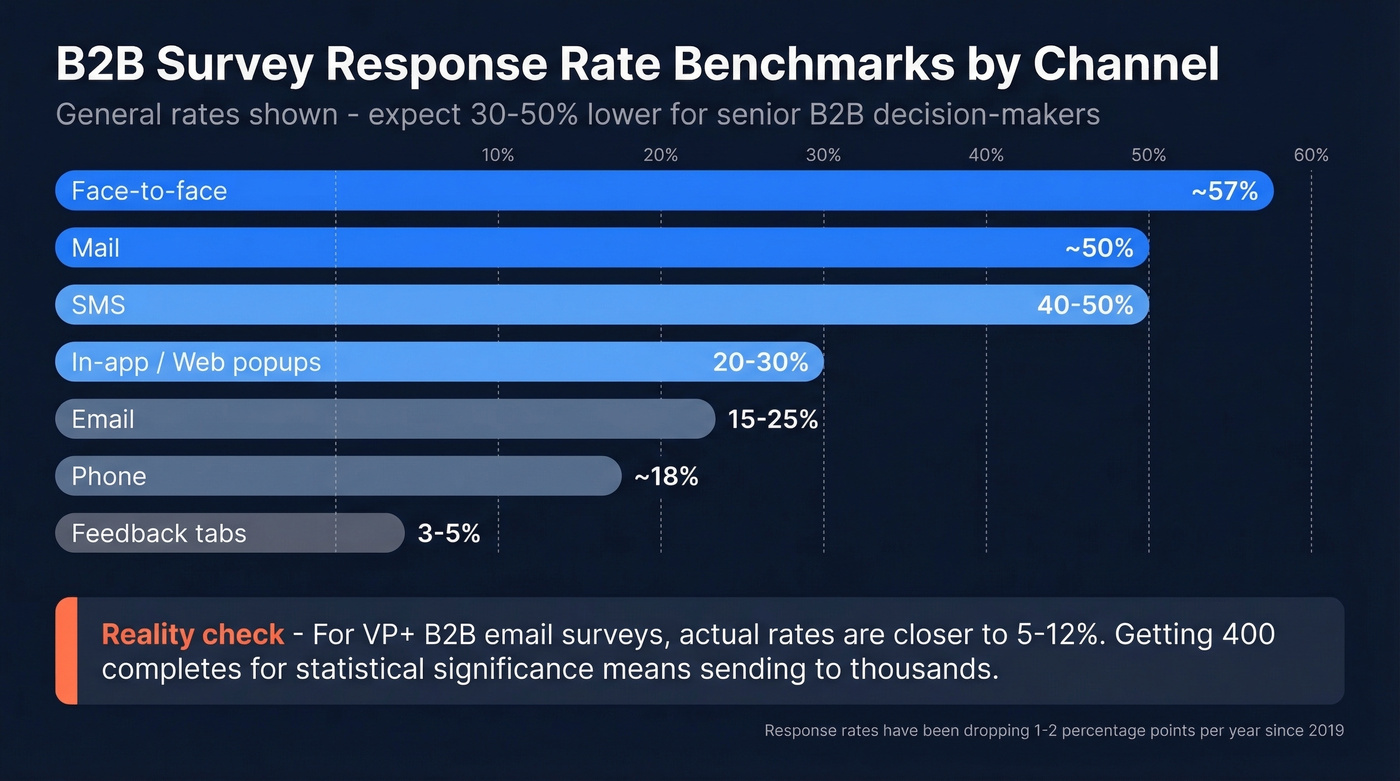
If you're planning primary research, you need realistic response rate expectations. B2B rates for senior decision-makers typically run 30-50% lower than these general numbers.
| Channel | Expected Response Rate |
|---|---|
| Face-to-face | ~57% |
| ~50% | |
| SMS | 40-50% |
| In-app / web popups | 20-30% |
| 15-25% | |
| Phone | ~18% |
| Feedback tabs | 3-5% |
For B2B email surveys targeting VP+ respondents, we've seen rates closer to 5-12%. That means getting 400 completes for ±5% margin of error requires sending to thousands - or supplementing with interviews and secondary data. Response rates have been slipping 1-2 percentage points per year since 2019, so budget more for incentives, keep surveys short, and use multi-touch approaches: email invite, then reminder, then phone follow-up.
Mistakes That Kill B2B Research
Using B2C panels for B2B audiences. Consumer research panels don't have verified VPs of Engineering. You get respondents who claim titles they don't hold. The data looks clean but leads nowhere. We've seen teams waste entire quarters on insights built from panel respondents who'd never actually buy their product.
Overloading surveys with open-ended questions. The 10% rule exists for a reason. Twenty questions means two can be open-ended. More than that, and your completion rate craters with time-pressed respondents.
Ignoring data freshness. Businesses lose an estimated 30% of revenue to bad data annually. The industry average refresh cycle is six weeks - that's five weeks of decay. Snyk's sales team saw bounce rates drop from 35-40% to under 5% after switching to a weekly refresh cycle, which tells you everything about how much stale data costs.
Insufficient sample sizes. Running a survey with 47 responses and calling it "market research" is a recipe for bad decisions. If you can't hit statistical significance, supplement with qualitative methods and be honest about the limitations.
Analysis paralysis. The research that never ships is worse than imperfect research that drives action. Set a deadline, define "good enough," and move. In our experience, the teams that struggle most aren't the ones with bad data - they're the ones sitting on good data for months without acting on it.
Intent data tells you who's buying. Firmographics tell you who fits. But neither matters if your contact data bounces. Prospeo's 5-step verification and weekly data refresh keep bounce rates under 4% - so every research insight connects to a real decision-maker.
Turn B2B research into pipeline with data that actually connects.
B2B Research Trends in 2026
The research playbook is changing fast. 94% of B2B buyers now use LLMs during their buying process - asking ChatGPT to compare vendors, summarize analyst reports, and draft requirements docs before they ever visit your website. On the search side, 72% of buyers encounter Google AI Overviews during research, and 90% click at least one cited source.
The counterweight is interesting: Gartner predicts that by 2030, 75% of B2B buyers will prefer sales experiences that prioritize human interaction over AI. AI handles early-stage information gathering; humans close. Meanwhile, 23% of B2B marketing teams now invest 16-20% of their budget in AI tools, up from 11% in 2024.
The teams winning right now use AI to accelerate the grunt work - data gathering, transcript analysis, pattern recognition - while investing more human time in the high-judgment calls: interpreting findings, designing experiments, and building relationships with the accounts that matter most. Skip this trend at your own risk. The gap between research-driven teams and everyone else is widening every quarter.
FAQ
How much does B2B research cost?
Most mid-market teams spend $5K-$30K per primary research project, while intent data adds $12K-$300K+ annually. A scrappy team can run meaningful studies for under $500/month using self-serve tools with free tiers paired with SurveyMonkey at $25-$100/month. Full-service agency projects can exceed $150K.
How long does a typical project take?
Desk research takes 1-2 weeks; primary research runs 4-12 weeks including design, fieldwork, and analysis. Comprehensive multi-method studies take 3-6 months. Intent and firmographic monitoring is ongoing - set up once, review continuously.
What's the difference between primary and secondary research?
Primary research means collecting new data directly through surveys, interviews, and focus groups. Secondary research means analyzing existing data - analyst reports, firmographic databases, intent signals, public filings. The best programs combine both: secondary data to frame hypotheses, primary research to validate them.
What tools do I need on a tight budget?
Start with a contact data platform that has a free tier, a survey tool at $25-$100/month, and disciplined desk research. Add intent data when budget allows. The real constraint is usually time, not money.
The throughline is simple: research quality beats research quantity every time. Start with accurate data, talk to real buyers, and ship findings before they go stale. The teams that treat B2B research as an ongoing discipline - not a one-off project - are the ones building pipeline that actually converts.