

The B2B Sales Funnel in 2026: Stages, Benchmarks, and Where Yours Is Leaking
92% of B2B buyers already have a vendor in mind before your sales funnel even touches them. The winning vendor lands on the Day One shortlist 95% of the time.
So the question isn't whether you need a funnel. It's whether yours is measuring the right things, catching the right leaks, and running on data that's actually accurate.
Here's the short version: only one stage consistently kills deals - the MQL-to-SQL handoff. Pipeline velocity is the single metric that tells you if your funnel is healthy. And if your top-of-funnel data is bad - bounced emails, wrong titles, stale numbers - nothing downstream matters. Fix the inputs before you optimize the stages.
What Is a B2B Sales Funnel?
A B2B sales funnel maps how buyers move from "never heard of you" to "signed contract." It's a demand-side framework that tracks the buyer's journey, not your internal deal stages. That's the distinction between a funnel and a pipeline.
The pipeline is the seller's view: deals in Stage 1, Stage 2, Closed Won. The funnel is the buyer's view: awareness, consideration, decision.
B2B funnels differ from B2C in three big ways. Cycle length: the average B2B buying cycle runs 10.1 months according to 6sense data. Committee size: Forrester's State of Business Buying report puts the average buying group at 13 people across 2+ departments. Deal value: when average contracts run five or six figures, every stage conversion rate has outsized impact on revenue. These differences mean B2C funnel advice - "optimize your checkout page," "add urgency timers" - is irrelevant here. B2B funnels break at handoffs, not landing pages.
The 6 Stages of a B2B Sales Funnel
Here's the stage-by-stage breakdown with the buyer action, seller action, and content type that actually moves people forward at each step.
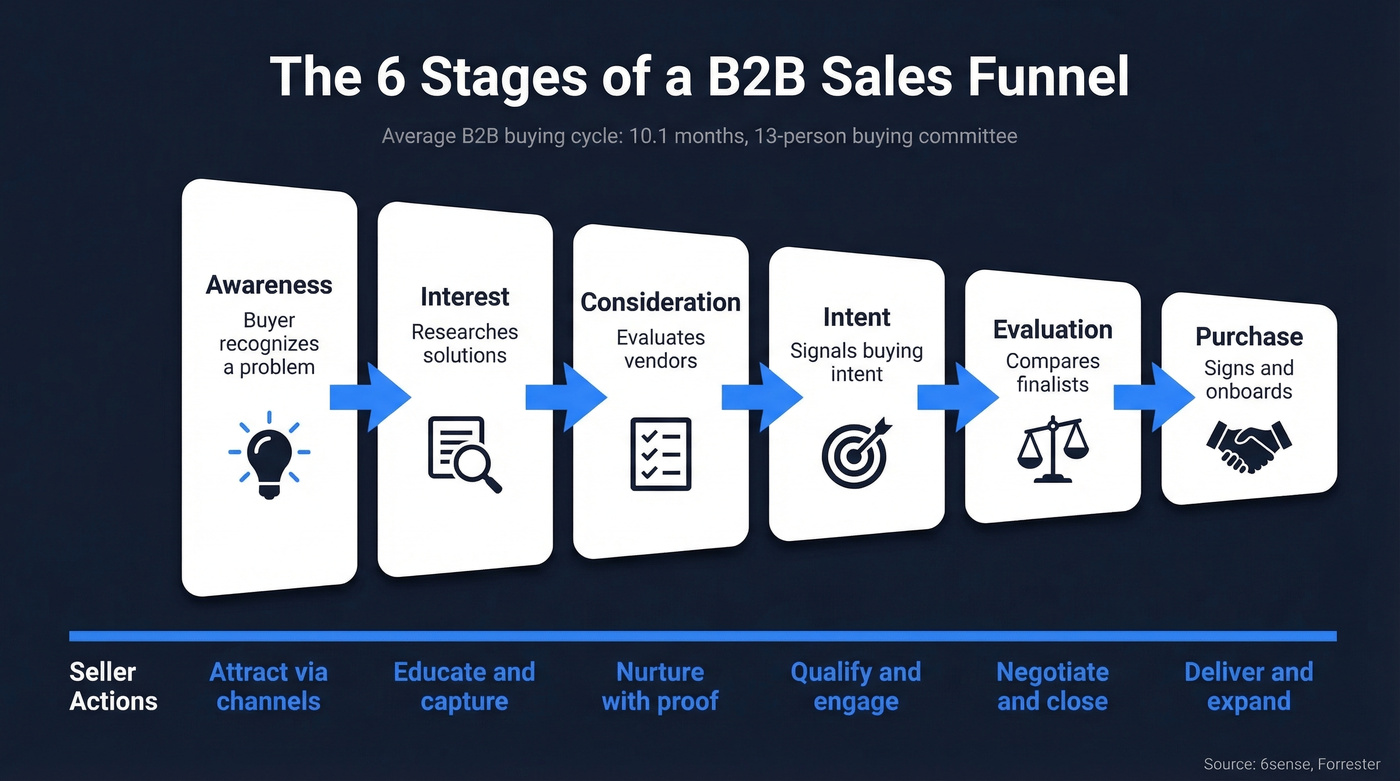
| Stage | Buyer Action | Seller Action | Key Content |
|---|---|---|---|
| Awareness | Recognizes a problem | Attract via channels | Blog, SEO, ads |
| Interest | Researches solutions | Educate and capture | Whitepapers, webinars |
| Consideration | Evaluates vendors | Nurture with proof | Case studies, demos |
| Intent | Signals buying intent | Qualify and engage | ROI calculators, trials |
| Evaluation | Compares finalists | Negotiate and close | Proposals, references |
| Purchase | Signs and onboards | Deliver and expand | Onboarding, CS handoff |
Awareness
Buyers recognize they have a problem worth solving. Your job is to be visible when that happens. 71% of buyers want seller engagement when they're exploring new ideas - not just when they're ready to buy. That stat flips the "don't sell too early" advice on its head. Show up with insight, not a pitch.
Interest
The buyer starts actively researching - reading comparison posts, attending webinars, downloading guides. Google found that 60% of buyers take 6+ actions before deciding on a new brand, and in B2B with 13-person committees, that number multiplies across every stakeholder. Your content needs to be in that mix, or you're not on the shortlist.
Consideration
Now they're evaluating specific vendors. Case studies, product demos, and social proof do the heavy lifting here. The buying committee is forming - remember, 13 people on average - and your champion needs ammunition to sell internally. Give them a one-page business case they can forward to the CFO.
Think of this through the buyer's pyramid: at any given time, only about 3% of your market is actively buying, another 7% is open to it, and the remaining 90% isn't ready. Your consideration-stage content exists to capture and convert that top 10%.
Intent
The buyer signals they're serious: requesting a demo, starting a trial, engaging with pricing pages. This is where qualification matters most. Ask sharp discovery questions - "What happens if you don't solve this in the next quarter?" or "Who else needs to sign off?" - to separate real intent from casual browsing.
Not every intent signal is equal. Chasing low-quality signals wastes your most expensive resource: rep time.
Evaluation & Decision
Finalists get compared head-to-head. Proposals go out, legal reviews happen, procurement gets involved. 54% of buyers want to talk to sellers at this stage. The rest are comparing your proposal against a competitor's in a spreadsheet you'll never see.
Purchase & Retention
The deal closes - but the funnel doesn't end. Returning customers spend 67% more than new ones, and referred customers convert at significantly higher rates than cold prospects. Post-sale expansion, renewals, and advocacy feed back into the top of the funnel. Ignore retention and you're refilling a leaky bucket every quarter.
Funnel Benchmarks by Industry
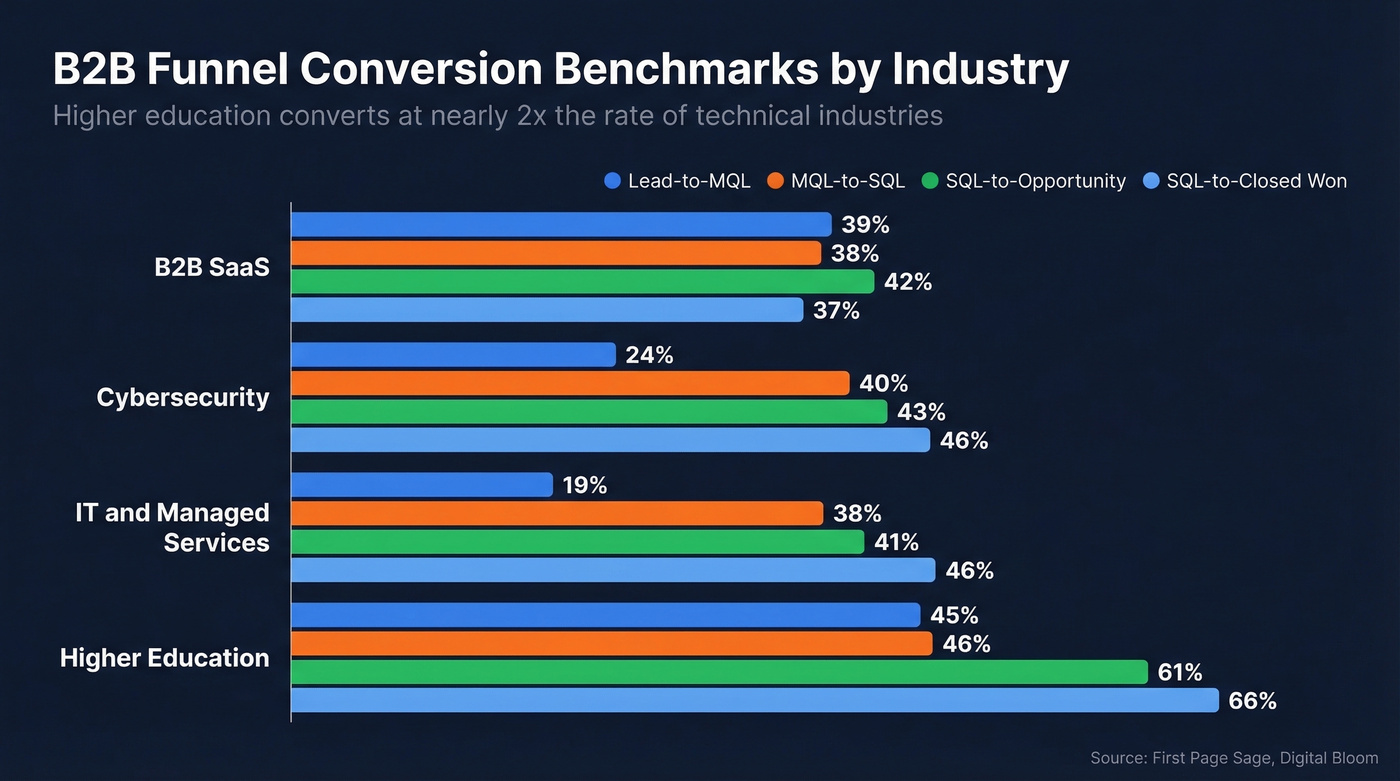
Benchmarks give you a diagnostic baseline. Without them, you're optimizing blind. Here are the numbers that matter, pulled from First Page Sage's benchmark report and Digital Bloom's pipeline analysis.
| Industry | Lead-to-MQL | MQL-to-SQL | SQL-to-Opportunity | SQL-to-Closed Won |
|---|---|---|---|---|
| B2B SaaS | 39% | 38% | 42% | 37% |
| Cybersecurity | 24% | 40% | 43% | 46% |
| IT & Managed Svcs | 19% | 38% | 41% | 46% |
| Higher Education | 45% | 46% | 61% | 66% |
A few things jump out. Cybersecurity and IT services have low lead-to-MQL rates (19-24%) but strong SQL-to-Closed Won rates (46%). That's a classic pattern for technical sales: hard to generate qualified interest, but once you're in a real conversation, the product sells itself.
Higher education is an outlier - every conversion rate runs higher than the other rows because the buyer pool is more defined and the buying process is more structured.
Enterprise vs. SMB
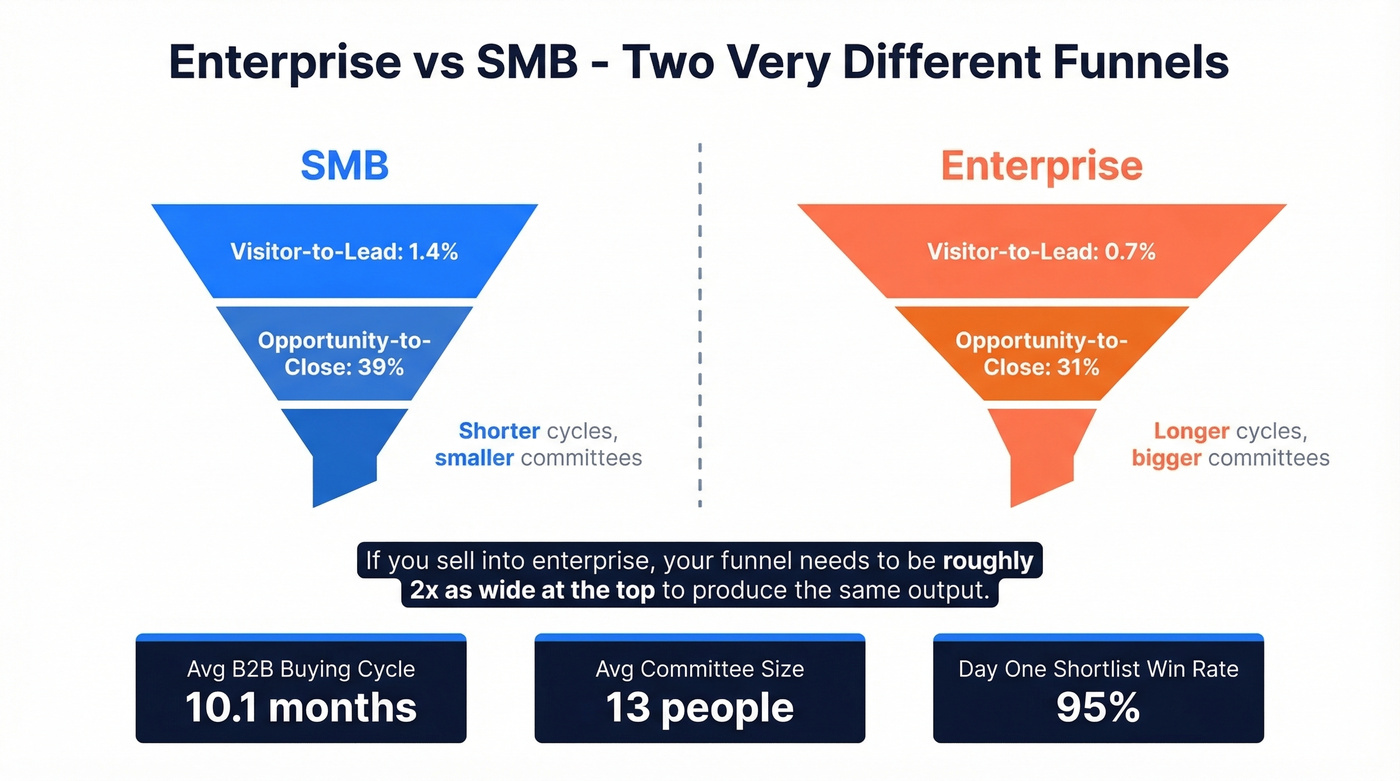
The split between enterprise and SMB funnels is dramatic. Enterprise visitor-to-lead conversion runs about 0.7% versus 1.4% for SMB. Opportunity-to-close drops to 31% for enterprise versus 39% for SMB. Longer cycles, bigger committees, more friction at every stage. If you're selling into enterprise, your funnel needs to be roughly twice as wide at the top to produce the same output.
Benchmarks by Channel
| Channel | Visitor-to-Lead | MQL-to-SQL | Opp-to-Close |
|---|---|---|---|
| SEO | 2.1% | 51% | 38% |
| PPC | 0.7% | 26% | 35% |
| Webinars | 2.2% | 30% | 33% |
| Events | 1.0% | 24% | 40% |
SEO leads convert to SQLs at 51% - nearly double PPC's 26%. Organic searchers have higher intent; they're actively looking for a solution, not reacting to an ad. Events have the highest close rate (40%) but the lowest volume. Diversify channels, but weight your investment toward the ones that produce quality, not just quantity.
Speed-to-Convert
Here's a data point that doesn't get enough attention: visitor-to-lead conversion typically happens in 1-3 days, but MQL-to-SQL takes 8-15 days. If your speed-to-lead exceeds 3 days, you're losing to competitors who respond faster.
In our experience, teams that measure and optimize time-between-stages catch funnel problems weeks earlier than those relying on monthly pipeline reviews.

Bad top-of-funnel data is the leak most teams never diagnose. Bounced emails, wrong titles, and stale phone numbers silently kill every stage below. Prospeo's 300M+ profiles refresh every 7 days - not every 6 weeks - so your funnel starts with contacts that actually connect.
Stop optimizing stages when the real problem is your data inputs.
How to Measure Funnel Health
Forget dashboards with 30 metrics. Start with three numbers: stage-to-stage conversion rate, pipeline velocity, and cost per opportunity. Everything else is a derivative.
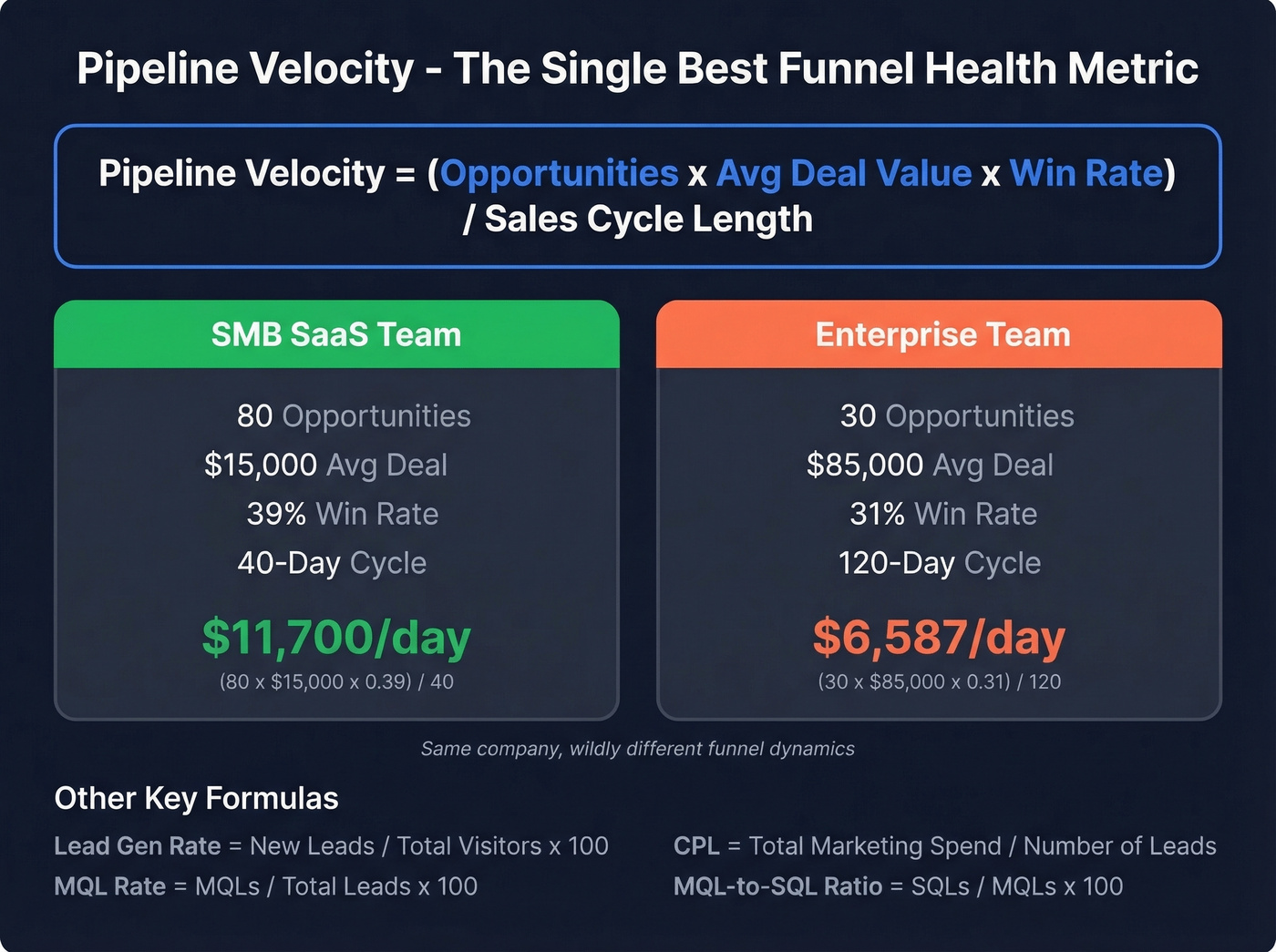
Pipeline velocity is the single best health metric:
Pipeline Velocity = (Opportunities x Avg Deal Value x Win Rate) / Sales Cycle Length
Let's run a worked example. An SMB SaaS team has 80 opportunities, a $15,000 average deal, a 39% win rate, and a 40-day cycle. That's (80 x $15,000 x 0.39) / 40 = $11,700/day in pipeline velocity.
An enterprise team with 30 opportunities, $85,000 deals, a 31% win rate, and a 120-day cycle gets (30 x $85,000 x 0.31) / 120 = $6,587/day. Same company, wildly different funnel dynamics.
Other formulas worth tracking:
- Lead gen rate = New leads / Total visitors x 100
- MQL rate = MQLs / Total leads x 100
- CPL = Total marketing spend / Number of leads
- MQL-to-SQL ratio = SQLs / MQLs x 100
If your MQL-to-SQL ratio is below 20%, your MQL definition is too loose. Tighten the criteria before you spend another dollar on top-of-funnel.
Is the Funnel Still Relevant?
Every few years, someone declares the funnel dead. BCG says marketers force-fit touchpoints into a linear model and proposes "influence maps" instead. HubSpot popularized the flywheel. McKinsey has the Customer Decision Journey loop.
Here's the tension that makes this debate interesting. Gartner surveyed 646 B2B buyers and found 67% prefer a rep-free buying experience. But Gartner also predicts that by 2030, 75% of B2B buyers will prefer experiences that prioritize human interaction over AI. Those aren't contradictory - they point to a hybrid model where buyers self-serve early and want humans for high-stakes decisions. And 45% of buyers in the same survey reported using AI during a recent purchase, further evidence that early funnel stages are increasingly self-directed.
McKinsey's data backs the hybrid thesis: 72% of B2B companies that sell through 7+ channels grow their market share, and about 40% of organizations have added hybrid seller roles blending digital and human touchpoints.
The dark funnel complicates things further. A huge chunk of the "journey" happens before your funnel can measure it - peer recommendations, community discussions, content consumption on channels you don't track. All invisible to your CRM.
Let's be honest: the funnel isn't dead. It's the simplest diagnostic framework we have. The buyer's journey is a messy spiderweb of loops and detours, but you still need a model to find where things break. Use it as a diagnostic tool, not a literal description of how people buy. Anyone telling you to "replace the funnel" is selling you a more complicated version of the same idea.
Five Mistakes That Kill Deals
The MQL-to-SQL Black Hole
This is the single biggest bottleneck in most B2B funnels. Digital Bloom's data shows MQL-to-SQL conversion can drop to 15-21% in underperforming organizations.
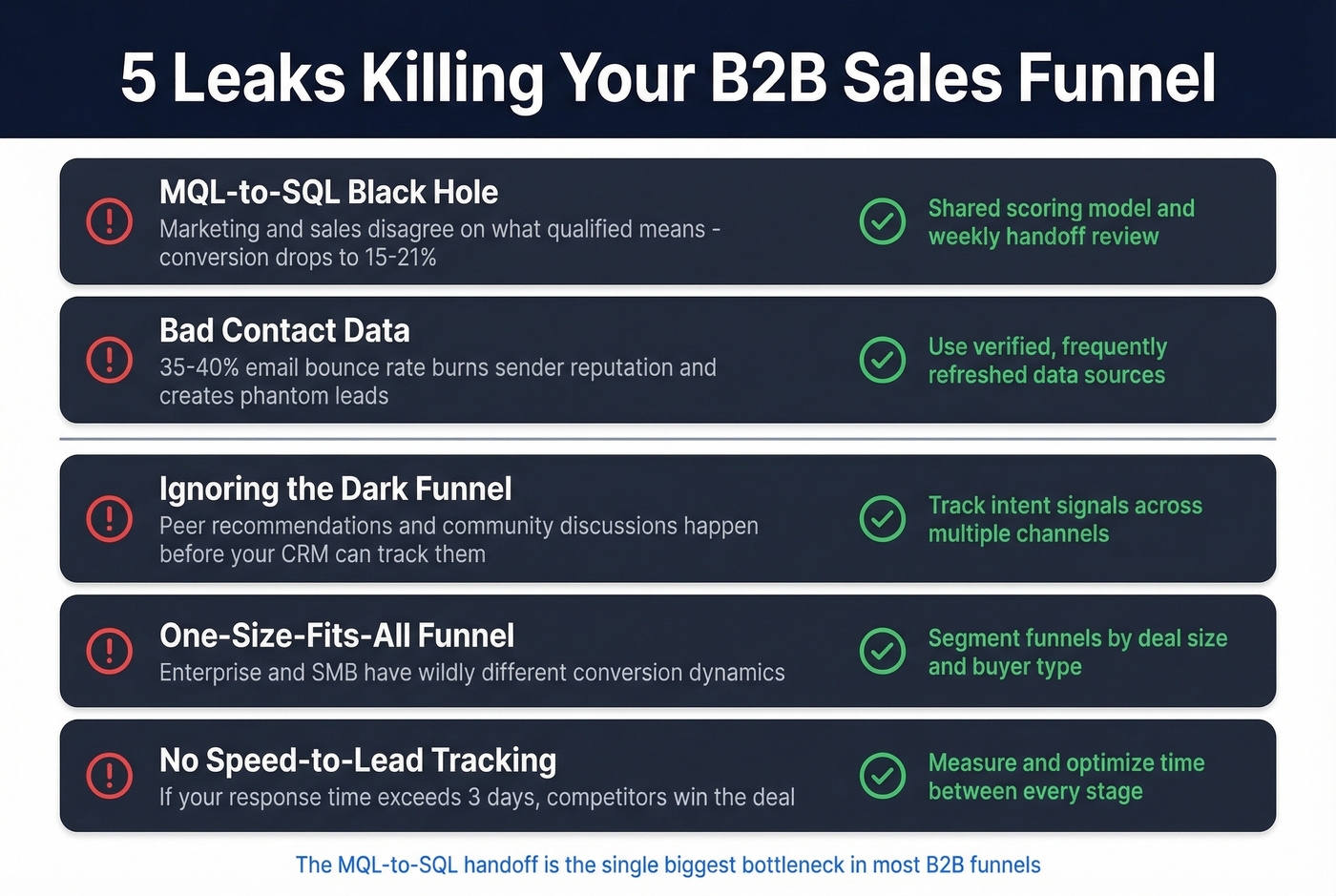
The problem is almost always definitional: marketing and sales disagree on what "qualified" means. Fix this with a shared scoring model and a weekly handoff review. We've seen teams double their SQL rate in 90 days just by aligning on three qualification criteria.
Bad Data Compounds Everything
You can have the best messaging, the sharpest ICP, and the most disciplined follow-up cadence - and still watch your funnel collapse when 35-40% of your emails bounce.
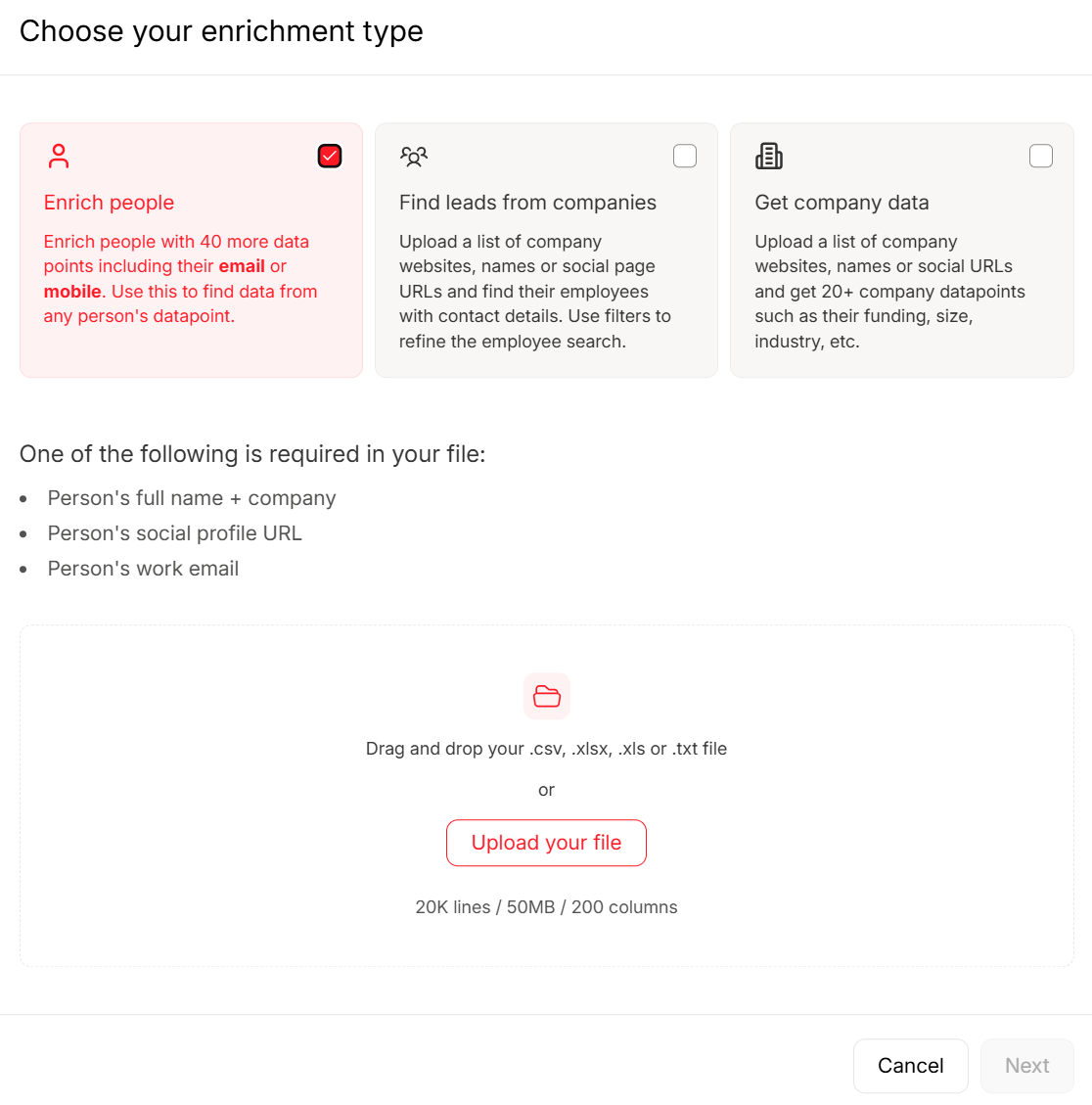
Bad contact data burns sender reputation and creates a false picture of funnel performance. Every bounced email is a phantom lead that makes your conversion rates look worse than they are. Verify your data before it enters the funnel - Prospeo customer Snyk cut bounce rates from 35-40% to under 5% and saw AE-sourced pipeline jump 180%.
Tool Sprawl, Zero Adoption
The average B2B sales team uses 10+ tools. Reps actively use about 3. Salesforce research shows reps spend only 28% of their time actually selling - the rest goes to data entry, tool-switching, and admin.
Every tool you add that doesn't live inside the CRM or inbox is a tool that won't get used. Here's a good rule of thumb: if a tool hasn't been opened by 80% of reps in the last 30 days, cut it.
No Qualification Math
A post on r/sales laid out the math perfectly. If your funnel has five stages and each converts at 50%, you need 160 pitches to close 10 deals. Drop that stage conversion to 33% and you need 810 pitches.
The lesson: disqualify early and aggressively. A "skinny funnel" with fewer, better-qualified opportunities will outperform a bloated one every time. Most teams resist this because it feels like shrinking the pipeline. It's not - it's focusing it.
Optimizing in Silos
Marketing optimizes ad spend. Sales optimizes close rates. RevOps optimizes CRM hygiene. Nobody looks at the funnel end-to-end.
Fragmented data leads to misattribution, reactive fixes, and the classic finger-pointing between marketing ("we sent you 500 MQLs") and sales ("none of them were real"). Build a shared dashboard that tracks stage-to-stage conversion from first touch to closed won. One view, one truth.
Tools for Each Funnel Stage
Don't add to the pile - replace what isn't working.
| Funnel Stage | Category | Tool | Price |
|---|---|---|---|
| Top (data) | B2B data | Prospeo | ~$0.01/email, free tier |
| Top (data) | Enterprise data | ZoomInfo | $14,995-$40K+/yr |
| Top (data) | Self-serve data | Apollo | Free-$99/mo/user |
| Mid (engagement) | Sales engagement | Outreach | ~$100-$200/user/mo |
| Mid (intelligence) | Conversation intel | Gong | ~$100-$200/user/mo |
| Full (CRM) | CRM | HubSpot | Free-$150/user/mo |
| Full (CRM) | CRM | Salesforce | $25-$330/user/mo |
| Intent/signals | Intent data | 6sense | ~$55K/yr |
For verified emails and direct dials at the top of the funnel, Prospeo delivers 98% email accuracy at a fraction of enterprise data providers, with intent data across 15,000 Bombora topics to prioritize accounts showing active buying signals.
Skip 6sense if you're under $5M ARR - the price tag doesn't justify the signal quality at that scale. Layer Bombora intent through a data provider that already includes it instead.
The MQL-to-SQL handoff breaks when reps waste hours chasing bad numbers and dead emails. Prospeo delivers 98% email accuracy and 125M+ verified mobiles with a 30% pickup rate - so your reps spend time in conversations, not bouncing off invalid contacts.
Teams using Prospeo book 35% more meetings than Apollo users.
FAQ
What's the difference between a sales funnel and a sales pipeline?
A funnel maps the buyer's journey from awareness to purchase; a pipeline tracks the seller's deals through internal CRM stages like "Discovery," "Proposal Sent," and "Closed Won." The funnel is what the buyer experiences - the pipeline is what your revenue team reports on.
What's a good MQL-to-SQL conversion rate?
B2B SaaS averages 38-40% for MQL-to-SQL conversion according to First Page Sage benchmarks. If you're below 20%, your MQL definition is too loose - tighten scoring criteria before blaming the sales team.
How long is the average B2B sales cycle?
6sense data puts it at 10.1 months end-to-end. Enterprise deals often take around 120 days from opportunity to close, while SMB deals close in 30-45 days. The gap comes down to committee size and procurement complexity.
How do you fix a leaky B2B sales funnel?
Benchmark each stage against industry averages, identify the biggest drop-off, and fix that single stage first. For most teams, the leak is bad contact data or a misaligned MQL-to-SQL handoff. Clean data alone can shift pipeline numbers dramatically - we've seen bounce rate fixes produce 100%+ pipeline lifts.
What are the main benefits of a B2B funnel?
A well-built funnel gives you three things: visibility into where deals stall, a shared language between marketing and sales, and a repeatable framework for diagnosing revenue problems. Without one, you're guessing at what's broken and fixing symptoms instead of root causes.