

Every B2B Search Engine Your Buyers Use (and You're Probably Ignoring Most of Them)
Your buyer picked a shortlist before your SDR ever made contact. The vendor favored before first contact wins roughly 80% of the time, and that winning vendor lands on the buyer's Day One shortlist 95% of the time. That shortlist gets built across B2B search engines, AI tools, review sites, and prospect databases - not just Google. The average B2B buying cycle has compressed from 11.3 months to 10.1 months, which means the research phase is shorter and more decisive than it's ever been.
Here's the thing: when your CMO asks whether you show up in ChatGPT results, the honest answer for most companies is no. And ChatGPT is just one of five categories where buyers form opinions. If you're only optimizing for Google, you're invisible in the channels that actually shape purchase decisions.
The Quick Version
Five types of B2B search engines matter right now. Most companies optimize for one.
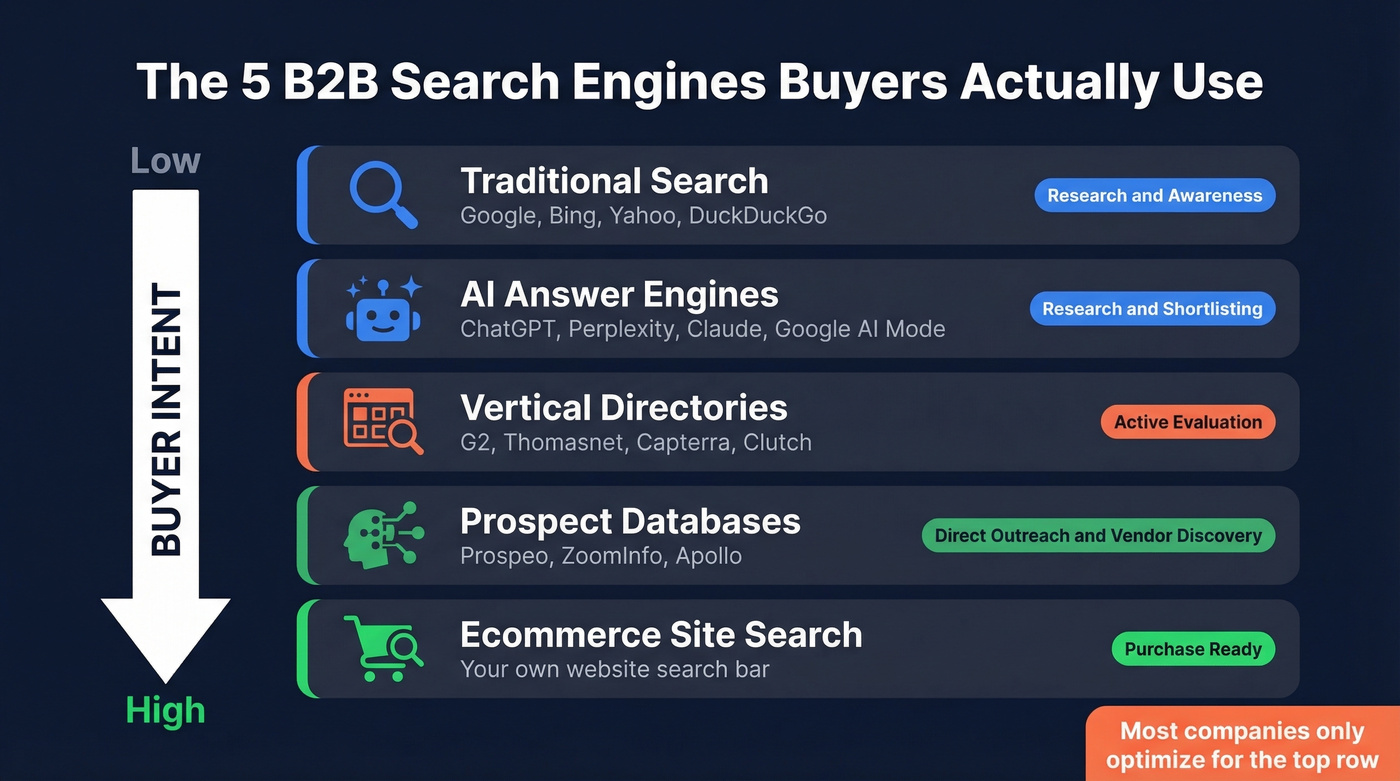
| Category | Examples | Buyer Intent |
|---|---|---|
| Traditional search | Google, Bing | Research / awareness |
| AI answer engines | ChatGPT, Perplexity, Google AI Mode | Research / shortlisting |
| Vertical directories | G2, Thomasnet, Capterra | Active evaluation |
| Prospect databases | Prospeo, ZoomInfo, Apollo | Direct outreach / vendor discovery |
| Ecommerce site search | Your own site's search bar | Purchase-ready |
Intent increases as you move down the table. The irony? Most B2B companies pour resources into the top row and ignore everything below it.
What Counts as a B2B Search Engine?
A B2B search engine is any platform where a buyer searches for products, services, vendors, or the people who sell them. Google is just one of five categories:
- Traditional search engines - Google, Bing, Yahoo, DuckDuckGo
- AI answer engines - ChatGPT, Perplexity, Claude, Google AI Mode
- Vertical directories and marketplaces - Thomasnet, G2, Capterra, Clutch, Alibaba
- Prospect databases - where buyers search for you by role, company, and intent signals
- Ecommerce site search - the search bar on your own B2B website
The contrarian thesis is simple: your competitors are fighting over Google rankings while your buyers are forming shortlists on G2, asking ChatGPT for recommendations, and searching prospect databases to find the right person to contact. Winning in B2B means showing up across all five.
Traditional Search Still Dominates
Google still leads, but the gap is narrowing.
| Engine | B2B Share | YoY Trend |
|---|---|---|
| 84.9% | Declining (~-1.8%) | |
| Bing | 3.7% | Growing (+12%) |
| Yahoo | 2.3% | Flat |
| DuckDuckGo | 1.9% | Stable |
Those B2B-specific numbers tell a different story than global traffic share. Looking at broader global data from SE Ranking, Google's organic share dropped from 94.8% to 93.05% in a single year, while Bing climbed from 3.51% to 4.61%.
Why does Bing matter for B2B? Enterprise desktops. Many corporate environments default to Microsoft Edge, which defaults to Bing. In our experience tracking referral sources across B2B sites, Bing drives more enterprise traffic than most marketers expect - if you're selling to IT departments, procurement teams, or anyone inside a Fortune 500, Bing isn't a rounding error. It's where a meaningful chunk of your buyers start their day.
Don't abandon Google SEO. But if you haven't checked your Bing Webmaster Tools in six months, you're leaving enterprise visibility on the table.
AI Answer Engines: Fastest-Growing Category
This is where the shift is fastest. ChatGPT holds 3.2% of B2B search share, Perplexity sits at 1.1%, and Claude rounds out at 0.6%. Those numbers sound small until you see the growth rates: Perplexity is growing at +21% annually, ChatGPT at +14%. Gartner predicted traditional search volume would drop 25% by 2026 due to AI chatbots, and that prediction is materializing right now.
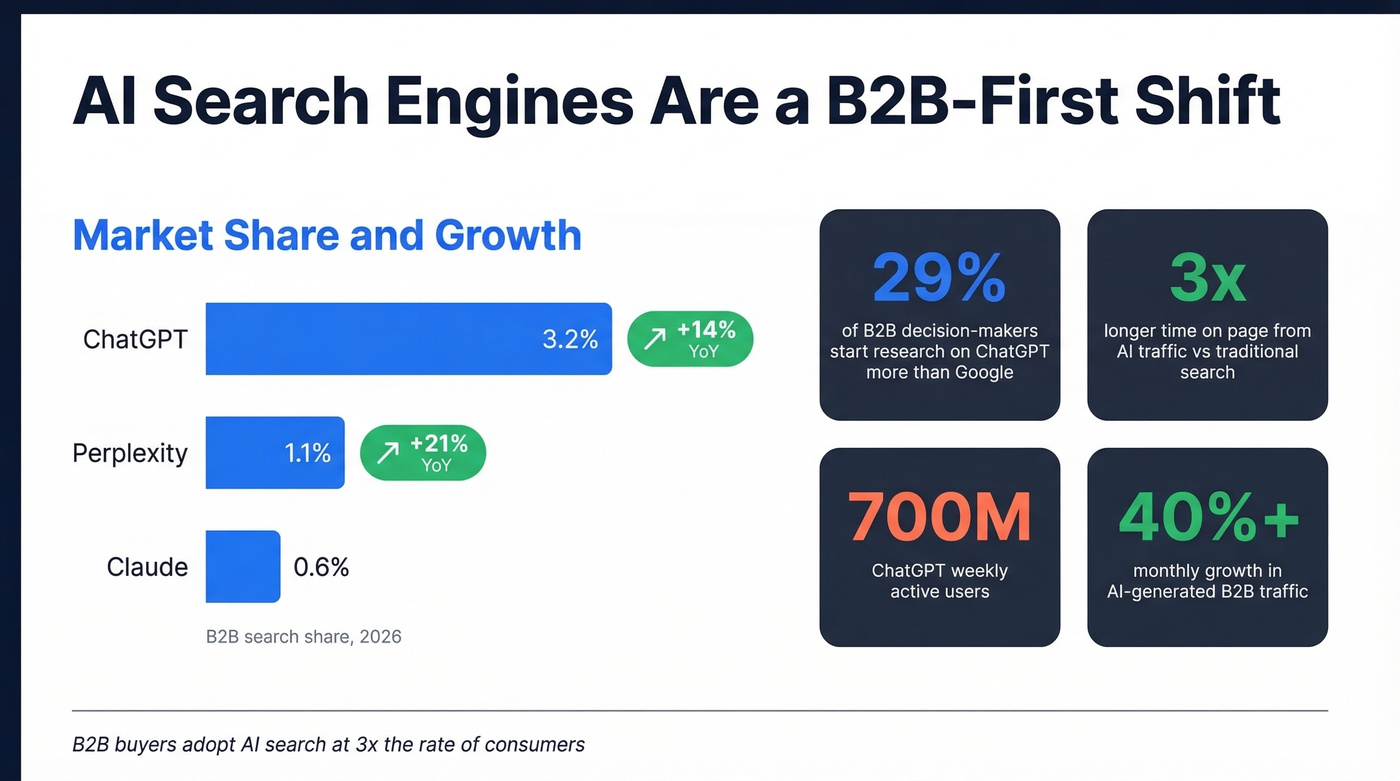
The scale is already significant. ChatGPT has 700M weekly active users. Perplexity pulls 179.5M monthly visits. Google AI Mode has reached roughly 100M users in the US and India alone. B2B buyers are adopting AI-powered search at 3x the rate of consumers, which makes this a B2B-first shift, not a consumer trend bleeding over.
Here's the stat that should get your attention: in a survey of 1,169 B2B decision-makers, 29% said they start research on ChatGPT more often than Google. Nearly 8 in 10 said AI search has changed how they conduct research. AI-generated traffic accounts for 2-6% of total B2B organic traffic, growing 40%+ per month, and visitors from AI platforms spend up to 3x longer on-page than traditional search visitors. These aren't tire-kickers - they're engaged buyers actively building shortlists.
AI features inside traditional engines like Google AI Overviews are different from AI-native answer engines like ChatGPT and Perplexity. Both matter, but they require different optimization strategies.
Getting Cited in AI Answers
The consensus on r/b2bmarketing is that AI tools still use traditional search as a retrieval layer - so classic SEO authority remains foundational. But three things help specifically with AI citation:
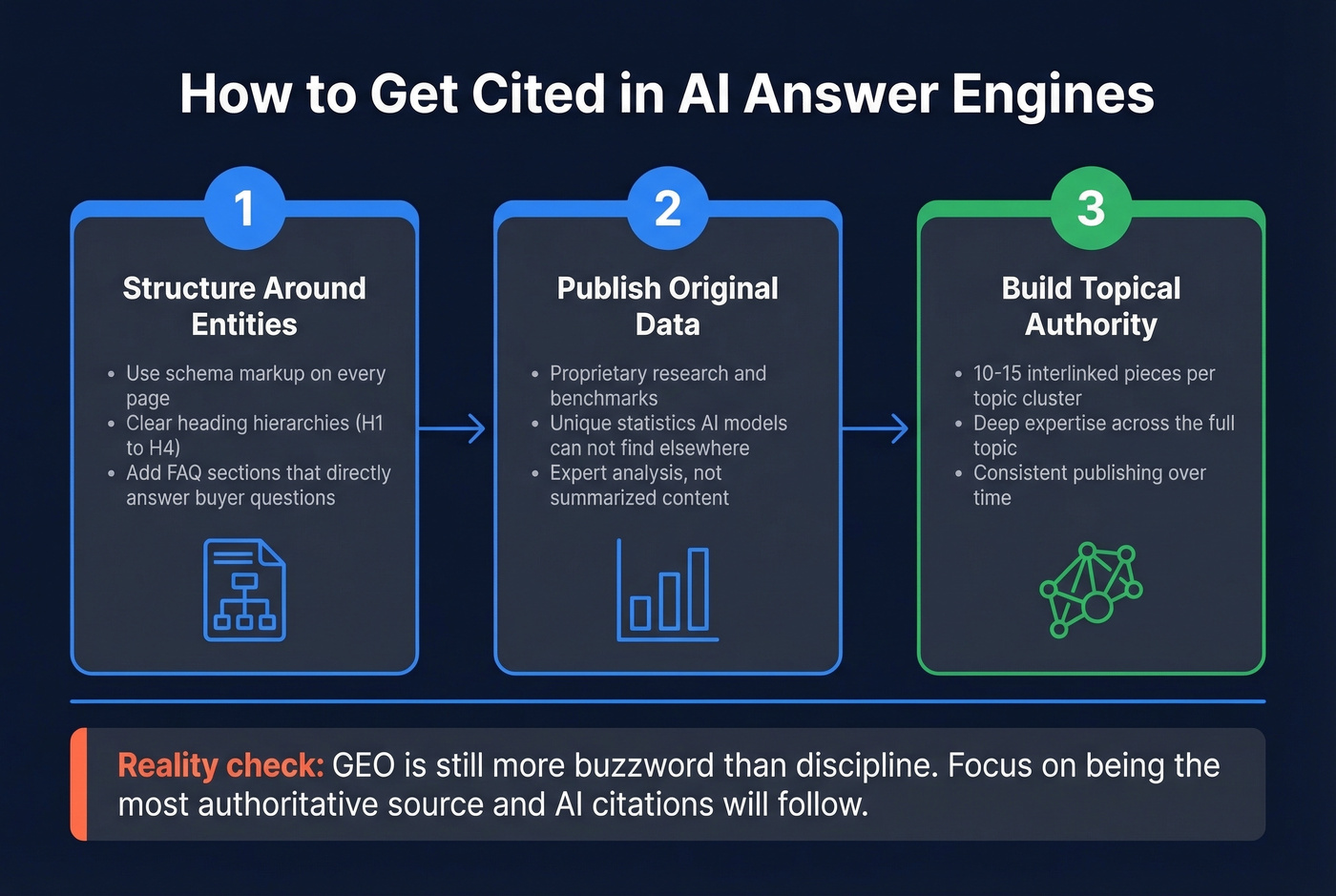
- Structure content around entities, not just keywords. AI models pull from well-structured, authoritative content. Use schema markup, clear heading hierarchies, and FAQ sections that directly answer buyer questions.
- Publish original data and benchmarks. AI answer engines prioritize sources with unique statistics, proprietary research, and expert analysis. Summarized content doesn't get cited.
- Build topical authority across multiple pages. A single blog post won't cut it. AI models favor domains that demonstrate deep expertise across a topic cluster - think 10-15 interlinked pieces, not one pillar page.
Let's be honest: GEO (generative engine optimization) is still more buzzword than discipline. Reddit threads on r/DigitalMarketing consistently flag that most "GEO agencies" are repackaging basic SEO advice. Focus on being the most authoritative source on your topic, and AI citations will follow.

Prospect databases are one of the five B2B search engines buyers use to build shortlists. Prospeo's database covers 300M+ profiles with 30+ filters - including buyer intent, technographics, and headcount growth - so when buyers search for vendors like you, the right people are already reachable at 98% email accuracy.
Show up where buyers actually search - and reach them first.
Vertical Directories and Marketplaces
These are the most underrated platforms in B2B search. Thomasnet alone serves over 1.4 million monthly buyers actively searching for suppliers and products. G2, Capterra, and Clutch each register at 0.1% of B2B search share - tiny individually, but outsized in influence because the buyers using them are deep in the purchase cycle.
Think about intent for a second. Someone searching Google for "best CRM software" might be writing a blog post. Someone searching G2 for "CRM software" is building a shortlist. The conversion potential per visitor is dramatically higher on vertical directories, and we've seen this play out across dozens of B2B categories.
Key platforms by vertical:
- Software/SaaS: G2, Capterra, Clutch, TrustRadius
- Manufacturing/Industrial: Thomasnet, GlobalSpec, Kompass
- Global Trade: Alibaba, Made-in-China, IndiaMART
- Professional Services: Clutch, UpCity, GoodFirms
If you're selling B2B software and your G2 profile has three reviews from 2023, you're losing deals to competitors who've invested in their directory presence. These platforms function as search engines for high-intent buyers - treat them that way.
B2B Prospect Search Engines
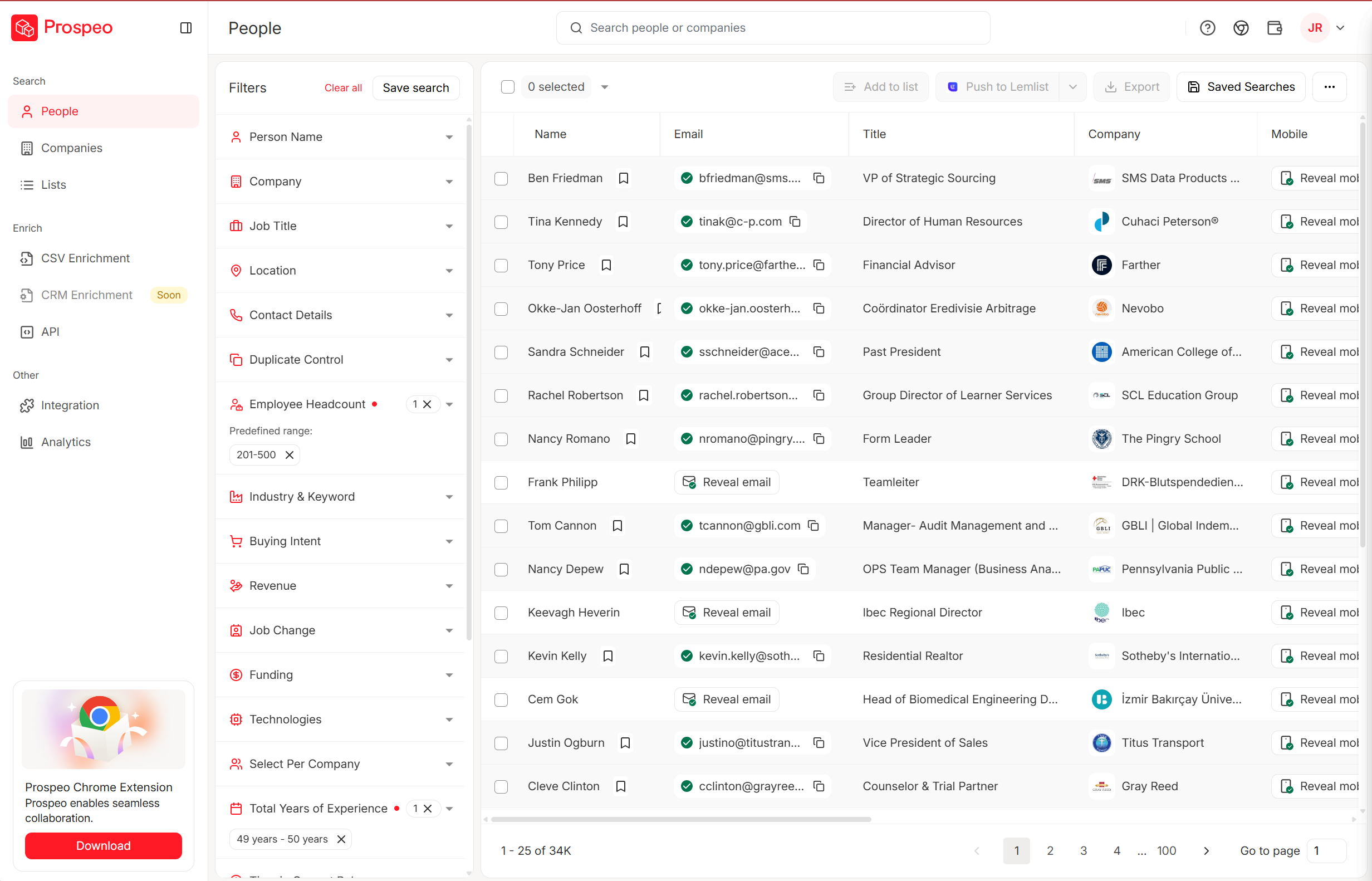
Here's the category most articles miss entirely: the databases where buyers search for people. When a procurement lead needs to find the right contact at a vendor, or when an SDR is building a target account list, they're using prospect databases as discovery tools.
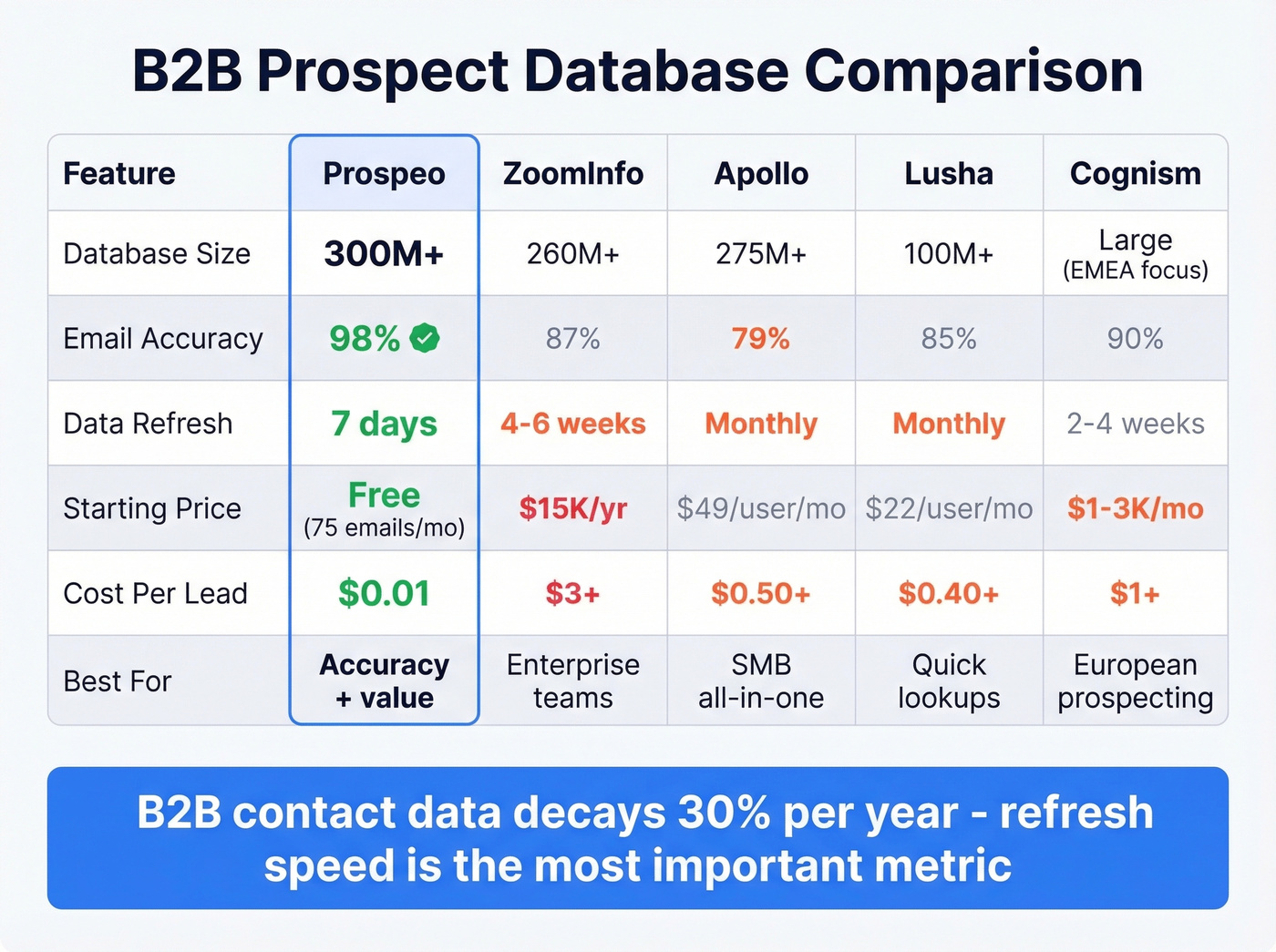
The core problem with every prospect database is data decay. B2B contact records decay roughly 30% per year - people change jobs, get promoted, switch companies. A database with 300 million records is worthless if a third of them are stale. Freshness matters more than raw size. That's why the best tools in this category function as real-time search engines for B2B leads, pulling and verifying data on demand rather than serving cached records from months ago.
| Tool | Database Size | Email Accuracy | Data Refresh | Best For | Starting Price |
|---|---|---|---|---|---|
| Prospeo | 300M+ profiles | 98% | 7 days | Accuracy + value | Free (75 emails/mo) |
| ZoomInfo | 260M+ profiles | 87% | ~4-6 weeks | Enterprise feature set | ~$15K/yr |
| Apollo | 275M+ contacts | 79% | ~monthly | SMB all-in-one | $49/user/mo |
| Lusha | 100M+ contacts | 85% | ~monthly | Quick mid-market lookups | ~$22/user/mo |
| Cognism | Large EMEA-focused DB | 90% (EMEA) | ~2-4 weeks | European prospecting | ~$1-3K/mo |
| Clearbit/Breeze | Enrichment-focused | 85% | Event-triggered | HubSpot-native enrichment | ~$30-$700/mo |
Prospeo
Prospeo solves the decay problem with a 7-day data refresh cycle while the industry average sits at roughly six weeks. The platform covers 300M+ professional profiles from 800M+ collected records, 143M+ verified emails, and 125M+ verified mobile numbers, all running through a 5-step verification process with catch-all handling, spam-trap removal, and honeypot filtering. The result is 98% email accuracy and a 30% mobile pickup rate.
What makes Prospeo work as a search engine is the filtering: 30+ search filters including buyer intent powered by Bombora across 15,000 topics, technographics, job changes, headcount growth, department headcount, funding events, and revenue. It's not just a contact database - it's a way to find companies actively in-market for what you sell, then get verified contact data for the right people. At roughly $0.01 per lead, it's 90% cheaper than ZoomInfo. One sales team saw bounce rates drop from 35% to under 4% after switching, which tracks - verified data means fewer bounces and more conversations that actually happen.
ZoomInfo: The Enterprise Incumbent
ZoomInfo earns its position with the broadest feature set in the category - intent data, workflow automation, chat, and a massive US-focused database. The problem is cost. Professional plans start around $14,995/year for 5,000 credits and up to 3 users. Add Advanced or Elite tiers, overages, and modules, and you're easily at $25-40K.
ZoomInfo pricing frustration is a recurring theme on r/sales, and it's warranted. For a Series A company, that's a significant line item for a tool your reps might only use for the search bar. The 4-6 week refresh cycle also means you're working with staler data than you'd expect at that price point.
Our take: ZoomInfo is still the best all-in-one platform for enterprise sales teams with six-figure tool budgets. But most teams don't need all-in-one - they need accurate emails and phone numbers. If your average deal size is under $25K, you're probably overpaying for features you'll never touch.
Apollo: Best Free Tier for Getting Started
Apollo's strength is accessibility. The free tier is genuinely useful, and paid plans run $49-$119/user/month with a database of 275M+ contacts and 73M companies. It doubles as a sequencing tool, which makes it the obvious starting point for SMB teams that want prospecting and outreach in one platform. The tradeoff is accuracy - we've seen email verification rates run noticeably lower than dedicated data platforms, which means more bounces and potential deliverability damage over time.
Skip These If...
Lusha runs a credit-based model starting at ~$22/user/month. Solid for mid-market teams that need quick lookups without a big contract, but skip it if you need deep filtering or intent data.
Cognism is the pick for European-focused teams with strong GDPR compliance and mobile verification in EMEA, typically $1-3K/month. Skip it if your market is primarily North America.
Clearbit, now Breeze Intelligence, is HubSpot-native enrichment priced on credit packs from ~$30/month up to ~$700/month. Best for teams already deep in HubSpot who need passive enrichment rather than active prospecting. Skip it if you need a standalone search tool.
You're optimizing for Google while buyers form shortlists on AI engines, directories, and prospect databases. Prospeo tracks 15,000 intent topics via Bombora so you can identify which companies are actively researching your category right now - across every search engine type - and reach decision-makers with verified emails and direct dials.
Stop waiting to be found. Start reaching in-market buyers at $0.01 per lead.
B2B Ecommerce Site Search
Your B2B site search is probably embarrassing. That's not an insult - it's a benchmark finding. A VML study scored 23 B2B ecommerce sites across 22 criteria and found that B2C sites scored 1.31x higher overall. The specific failures are painful: 56% of B2B sites only return results for exact keyword matches, 74% are missing product images in autocomplete suggestions, and over 60% have filter logic so broken that filters return less than 25% of relevant results.
This matters because online sales now average 27.5% of total B2B revenue. That number is climbing. Yet only 41% of B2B companies are fully AI operational in their site search, despite 67% saying they use AI/ML in some capacity.
If a buyer can't find your product on your own website, no amount of Google optimization will save you. Run a site search audit: test 20 common queries, check for synonym handling, verify that filters actually work, and look at your zero-results rate. Tools like Algolia, Elasticsearch, and Coveo exist specifically to solve this - and the ROI on fixing broken site search is usually immediate.
How to Get Found Across All Five
One actionable move per category:
Traditional search: Get the basics right. Structured data markup, mobile optimization - over 60% of B2B buyers use mobile during the purchase journey - and consistent content publishing. Check Bing Webmaster Tools, not just Google Search Console.
AI answer engines: Optimize for entities, not just keywords. Publish original research. Build topical authority across content clusters. Use schema markup aggressively - FAQ schema, HowTo schema, Organization schema. AI models cite structured, authoritative sources.
Vertical directories: Claim and optimize your profiles on G2, Capterra, Thomasnet, or whichever directories serve your vertical. Invest in getting current customer reviews. A stale profile with two-year-old reviews signals abandonment to every buyer who lands on it.
Prospect databases: Make sure your team's contact data is findable and accurate. Keep your company profiles updated across major data platforms so you show up when buyers search by intent signals, technographics, or job changes. Pairing a prospect database with intent intelligence lets you move from passive listing to proactive targeting.
Ecommerce site search: Audit your on-site search quarterly. Test for synonym handling, check your zero-results rate, and make sure filters actually narrow results correctly. If your site search is powered by default platform search, it's almost certainly underperforming.
The companies that win in 2026 aren't the ones with the best Google rankings. They're the ones with optimized G2 profiles, AI-citeable content, and verified contact data in prospect databases - showing up across every B2B search engine their buyers actually use, not just one.
FAQ
What's the most popular B2B search engine?
Google dominates with 84.9% of B2B search share, but AI answer engines are the fastest-growing category. Perplexity grows at 21% annually, and 29% of B2B decision-makers now start research on ChatGPT more often than Google.
Are AI search engines replacing Google for B2B buyers?
Not yet, but the shift is accelerating. AI-generated traffic accounts for 2-6% of B2B organic traffic, growing 40%+ per month. B2B buyers adopt AI search at 3x the consumer rate, making this a B2B-first trend.
How do vertical B2B directories differ from Google?
Directories like Thomasnet and G2 serve buyers already in purchase mode - searching for specific suppliers or software, not general information. Thomasnet alone sees 1.4M+ monthly buyers. Listing on these platforms puts you in front of buyers actively building shortlists.