

BANT+C: What the C Stands For and How to Use It
A pipeline audit at a mid-market SaaS company last quarter turned up something ugly: 40% of "qualified" opportunities had zero competitive intelligence attached. Reps didn't know the incumbent. They couldn't differentiate. They lost deals they should've won - not because the product was wrong, but because nobody bothered to ask what the prospect was already paying for. The BANT+C model exists to fix exactly that.
The Short Version
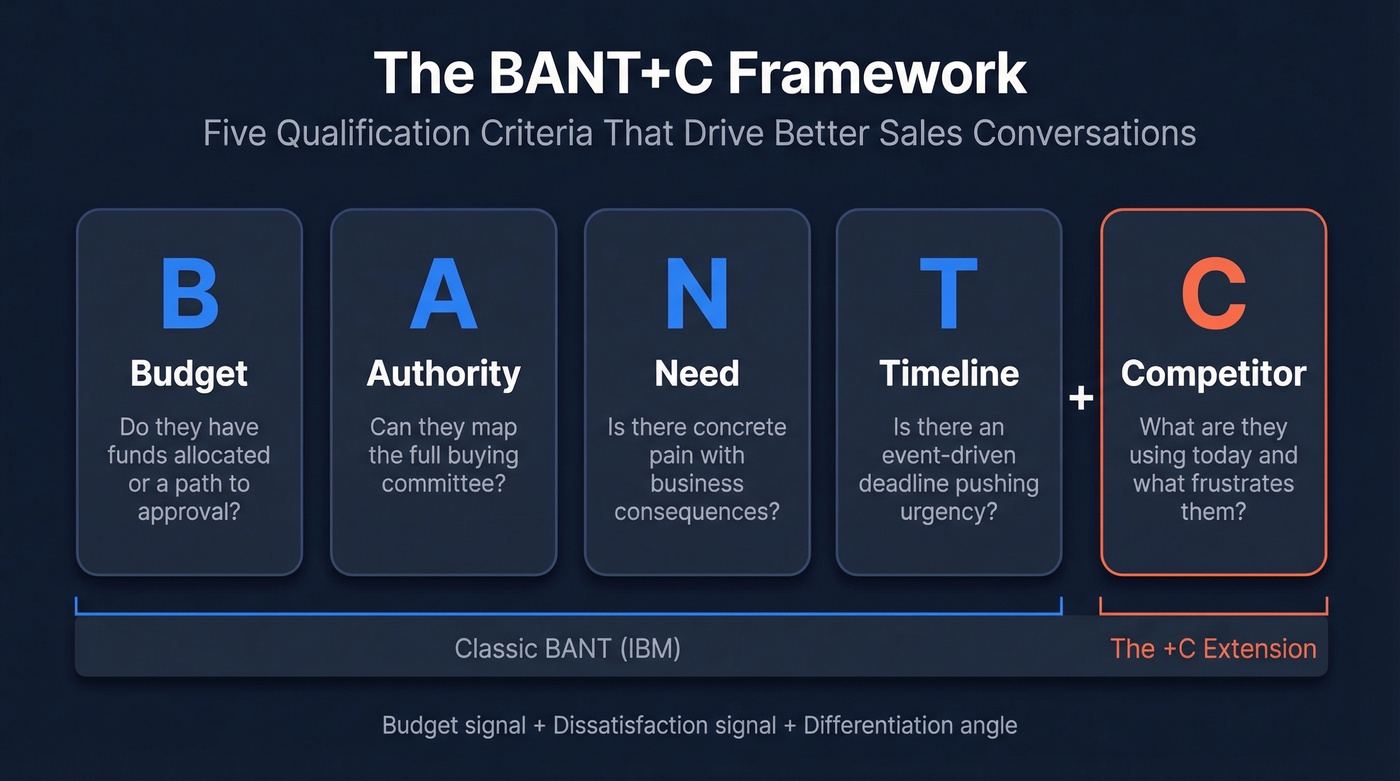
The C in BANT+C stands for Competitor. Knowing the incumbent tells you budget already exists - they're paying for something. It reveals dissatisfaction, because they wouldn't be talking to you otherwise. And it gives you a differentiation angle before you open your deck.
Teams applying structured qualification frameworks see up to 40% faster cycle times and 20% higher close rates. The framework isn't magic. It's a structure that drives the right conversations.
What Is the BANT+C Model?
BANT (Budget, Authority, Need, Timeline) is a classic qualification framework originally developed by IBM. BANT+C adds a fifth criterion - Competitor - to capture competitive intelligence during discovery.
CloudKettle packaged this extension in a free Salesforce app. The logic is straightforward: knowing the incumbent gives you a budget signal, a dissatisfaction signal, a differentiation opportunity, and customer success leverage. You can lead with testimonials from companies that switched from that exact competitor. In enterprise SaaS, five or more people are typically involved in a purchase, so BANT+C doesn't just help you qualify the deal - it helps you qualify every stakeholder conversation with competitive context.
The 5 Elements Explained
Budget
The rookie move is asking "Do you have budget?" point-blank. Instead, try: "What budget is currently set aside for this, or do we need to build a business case together?" That frames you as a partner, not an interrogator. Follow up with what price range feels viable this quarter.
Green light: funds allocated or a clear approval process. Red flag: "We don't really have a budget" with no path to creating one.
Authority
Here's the thing - nobody says "no" when you ask if they're the decision-maker. So don't ask that. Try: "Walk me through how your team bought the last tool like this." That single question maps the buying committee without putting anyone on the spot.
Modern buying groups include 6-10+ stakeholders, and deals are 37% more likely to close when more than one contact is engaged. Your goal isn't to find the single decision-maker - it's to map the committee. Ask who else influences the decision and who'd need to sign off before go-live.
Green light: they name specific people and roles. Red flag: unclear approvers or "I'll just handle it" from someone who clearly can't.
Need
Every deal that stalls in pipeline has the same root cause: vague need. "What's at stake if this issue persists beyond this quarter?" separates real pain from casual browsing. Follow with "What triggered you to start looking now?" - the trigger event is the single best predictor of deal velocity.
Green light: concrete pain with business consequences. Red flag: "We're just exploring" with no urgency behind it.
Timeline
"When do you want to buy?" gets a polite non-answer. "What breaks if you don't solve this by Q3?" gets the truth. Consequence-based timeline questions are the key - ask what event or deadline is driving the decision, then ask what happens if it slips.
Red flag: "Maybe this year" with no triggering event.
Competitor
Ask what they're using today, what's working about their current setup, and what isn't.
This is where the +C pays off. If the prospect names a competitor, you instantly know there's budget, there's a workflow, and there's a gap. Use a B2B data platform like Prospeo to research the prospect's tech stack before the call - technographic filters and intent data can reveal the incumbent so you walk in already knowing what you're replacing.
Green light: they name the competitor and articulate specific frustrations. Red flag: "We're not using anything" - which either means no budget exists or it's a wide-open greenfield. Dig deeper either way.

The +C in BANT+C only works if you walk into calls with competitive intel. Prospeo's technographic filters and intent data across 15,000 topics reveal what tools your prospects already use - so you know the incumbent before you even dial. At $0.01 per email with 98% accuracy, your reps actually reach the prospect to start qualifying.
Stop guessing the competitor. Start the call already knowing.
BANT+C Scoring Template
Assign each element 0-25 points. Total possible: 100.
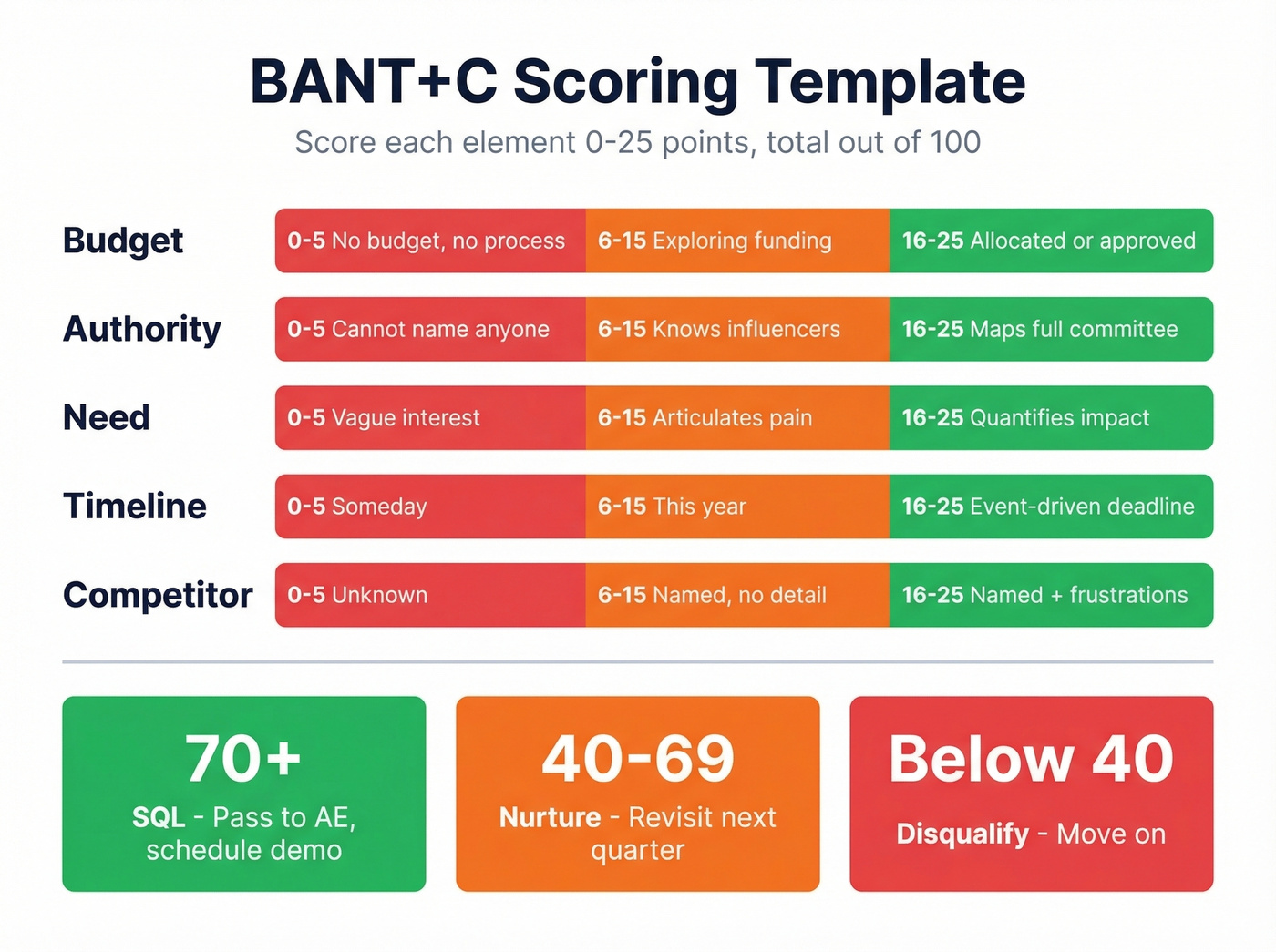
| Element | 0-5 (Weak) | 6-15 (Partial) | 16-25 (Strong) |
|---|---|---|---|
| Budget | No budget, no process | Exploring funding | Allocated or approved |
| Authority | Can't name anyone | Knows influencers | Maps full committee |
| Need | Vague interest | Articulates pain | Quantifies impact |
| Timeline | "Someday" | "This year" | Event-driven deadline |
| Competitor | Unknown | Named, no detail | Named + frustrations |
SQL (70+): Pass to AE, schedule demo.
Nurture (40-69): Keep in sequence, revisit next quarter.
Disqualify (below 40): Move on. Your reps' time is worth more.
CloudKettle's Salesforce app lets admins configure these weights via Custom Metadata Types, enforcing that weights sum to 100. The framework works just as well in HubSpot, Pipedrive, or a spreadsheet - the CRM doesn't matter, the discipline does.
Is BANT Dead?
BANT isn't dead. Lazy BANT is dead.
Browse r/sales and you'll find the "BANT is dead" debate every month. The critique is fair when BANT is executed as a rigid checklist - reps firing off questions like an interrogation. A Gartner Digital Markets survey found that 52% of salespeople still find BANT reliable, and 41% value its flexibility. The modern move is to flip the order: start with Need - making it NBAT in practice - because pain earns you the right to ask about budget and timeline. One team saw response rates jump from 8% to 31% after shifting from rigid checklist-style outreach to pain-focused messaging.
Proof that execution matters more than the acronym.
Let's be honest about the biggest qualification failure, though - it isn't the framework. It's the data. If 35% of your emails bounce, your reps never get to ask the first qualification question. We've seen teams cut bounce rates from 35% to under 4% with verified contact data, which meant reps actually reached prospects and could start qualifying in the first place.
BANT+C vs Other Frameworks
| Framework | Best For | Complexity | Stakeholder Depth |
|---|---|---|---|
| BANT+C | SMB, deals under $25K | Low | Basic committee map |
| MEDDIC | Mid-market to enterprise | High | Deep (Champion req.) |
| CHAMP | Pain-first selling | Medium | Moderate |
| GPCTBA/C&I | Executive conversations | High | Deep + outcome-focused |
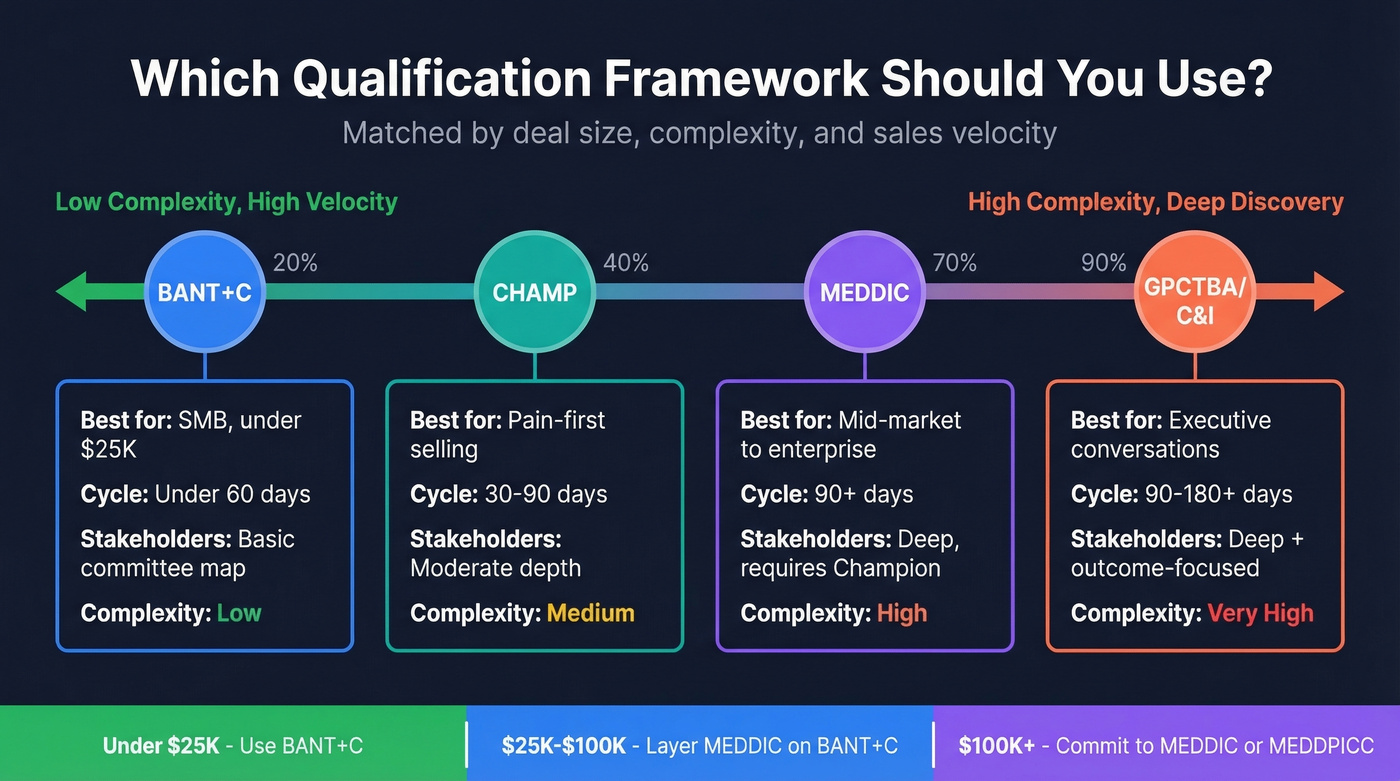
BANT+C is built for velocity. High-volume outbound, deal sizes under $25K, sales cycles under 60 days - it qualifies fast and disqualifies faster.
MEDDIC is built for complexity. One team switching from BANT to MEDDIC improved forecast accuracy from 62% to 89%, but that was an enterprise motion with 6+ stakeholders per deal. For a 5-person SMB buying committee, MEDDIC is overkill. Skip it unless your average deal size justifies the overhead.
CHAMP leads with Challenges, then Authority, Money, and Prioritization. Smart approach, but it can get loose without scoring discipline. GPCTBA/C&I - Goals, Plans, Challenges, Timeline, Budget, Authority, Consequences & Implications - is the most thorough and the most time-consuming. Reserve it for six-figure deals where narrative matters as much as numbers.
MEDDPICC explicitly adds Competition and Paper Process, which means the "C" concept shows up in enterprise frameworks too. The idea isn't unique to BANT+C - it's just that BANT+C packages it at the right complexity level for high-velocity sales.
Our recommendation by deal size: SMB under $25K, go with BANT+C. Mid-market $25K-$100K, layer in MEDDIC elements on top of BANT+C. Enterprise $100K+, commit to MEDDIC or MEDDPICC. In our experience, these cutoffs hold up across industries.
Implementing BANT+C in Your CRM
Most CRM implementations fail not because the framework is wrong, but because the fields are optional and free-text. Here's how to avoid that.
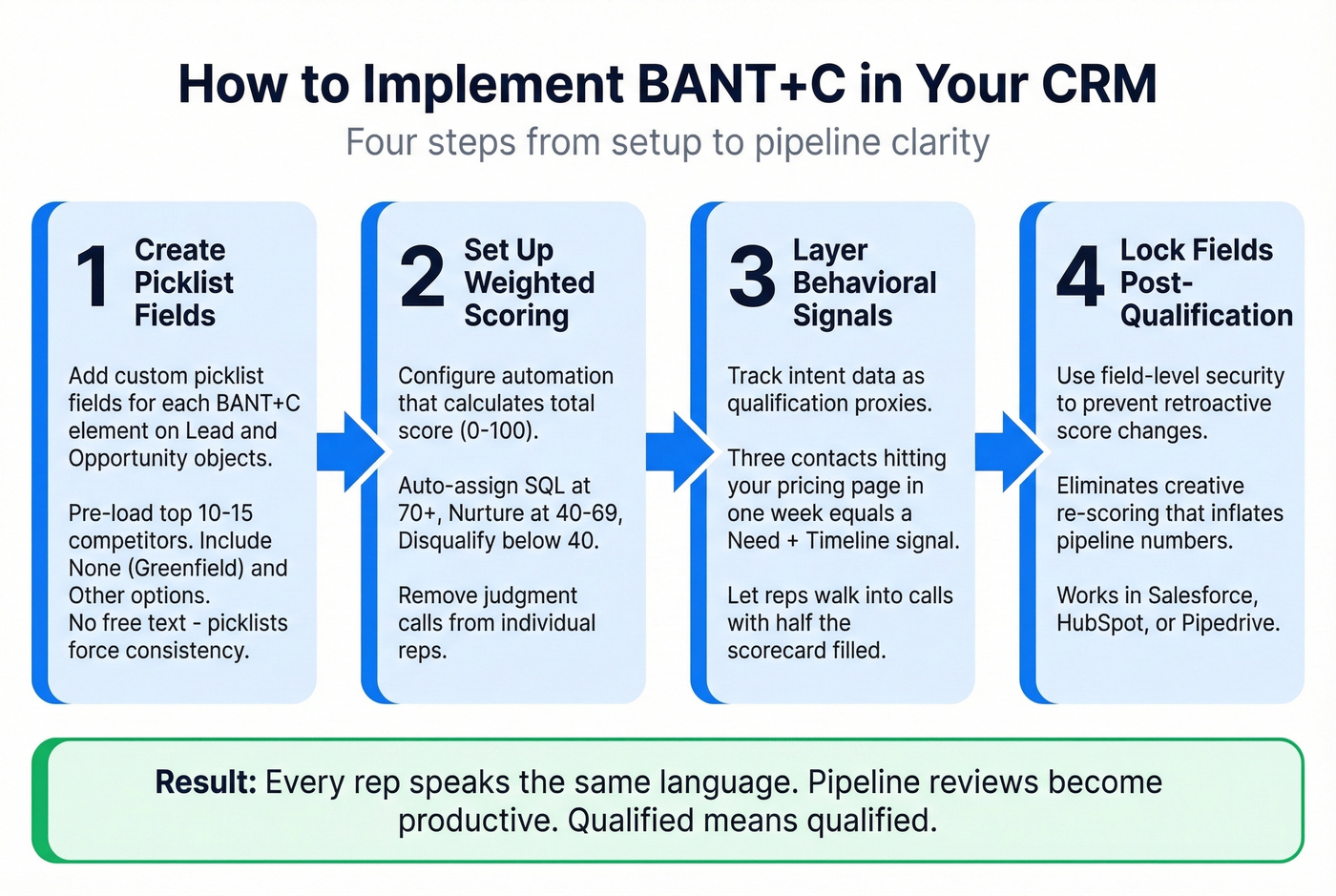
Create custom picklist fields for each element on Lead and Opportunity objects. Picklists force consistency; free text invites chaos. For the Competitor field specifically, pre-load your top 10-15 competitors and include "None (Greenfield)" and "Other" as options.
Set up weighted scoring automation that calculates a total score and auto-assigns SQL/Nurture/Disqualify status based on thresholds. This removes the judgment call from individual reps and makes your pipeline reviews dramatically more productive - everyone's speaking the same language when they say "this deal is qualified."
Layer in behavioral signals as qualification proxies. If three contacts from the same account download your pricing page in the same week, that's a Need + Timeline signal without a single discovery call. Intent data tracking tools can surface these buying signals automatically, so your reps walk into calls with half the scorecard already filled.
Lock fields post-qualification so reps can't retroactively change scores. CloudKettle's Salesforce app handles this with field-level security; HubSpot user permissions can restrict editing too. We've found this single step eliminates most of the "creative re-scoring" that inflates pipeline numbers.
Your BANT+C score is worthless if 35% of emails bounce and reps never reach the prospect. Prospeo's 5-step verification delivers 98% email accuracy with a 7-day data refresh cycle. Teams using Prospeo cut bounce rates from 35% to under 4% - meaning every qualified lead actually gets contacted.
Fix the data so your reps can finally qualify real buyers.
FAQ
What does BANT+C stand for?
Budget, Authority, Need, Timeline, Competitor - a sales qualification framework extending IBM's original BANT. The +C captures competitive intelligence during discovery so reps understand what they're replacing, not just whether the prospect can buy.
How many criteria should a lead meet to qualify?
Most teams require at least 3 of 5 criteria scored above threshold. A total score of 70+ out of 100 typically qualifies a lead as sales-ready. Below 40, disqualify and protect rep time.
When should I use MEDDIC instead of BANT+C?
When deals exceed $100K, involve 6+ stakeholders, or have sales cycles longer than 90 days. BANT+C is built for velocity; MEDDIC is built for complexity. Ask any SDR team lead and they'll tell you the same thing - BANT works when you use it as a conversation guide, not a checkbox exercise. MEDDIC earns its overhead only when deal complexity demands it.
How do I research competitors before a discovery call?
Use technographic data to identify a prospect's current stack before you dial. Prospeo's 30+ search filters - including technographics powered by Wappalyzer and live job posting signals - let you see what tools an account already uses, so you enter the call with the Competitor field half-filled.