

BDR AI: What Works, What Fails, and What It Actually Costs
A RevOps lead we know ran a BDR AI pilot last quarter. Six weeks in, the tool had contacted 14 existing customers, created 2,000+ duplicate records in HubSpot, and sent a personalization line referencing a company that went bankrupt in 2023. The tool cost $5,000/month. The cleanup cost more.
That story isn't unusual. Between 50% and 70% of AI SDR users churn within three months, and Gartner estimates roughly 85% of AI initiatives fail to deliver meaningful results. The technology works - when deployed correctly. Most teams don't deploy it correctly. Here's how to be in the minority that does.
What You Need (Quick Version)
Three budget tiers, three different stacks:
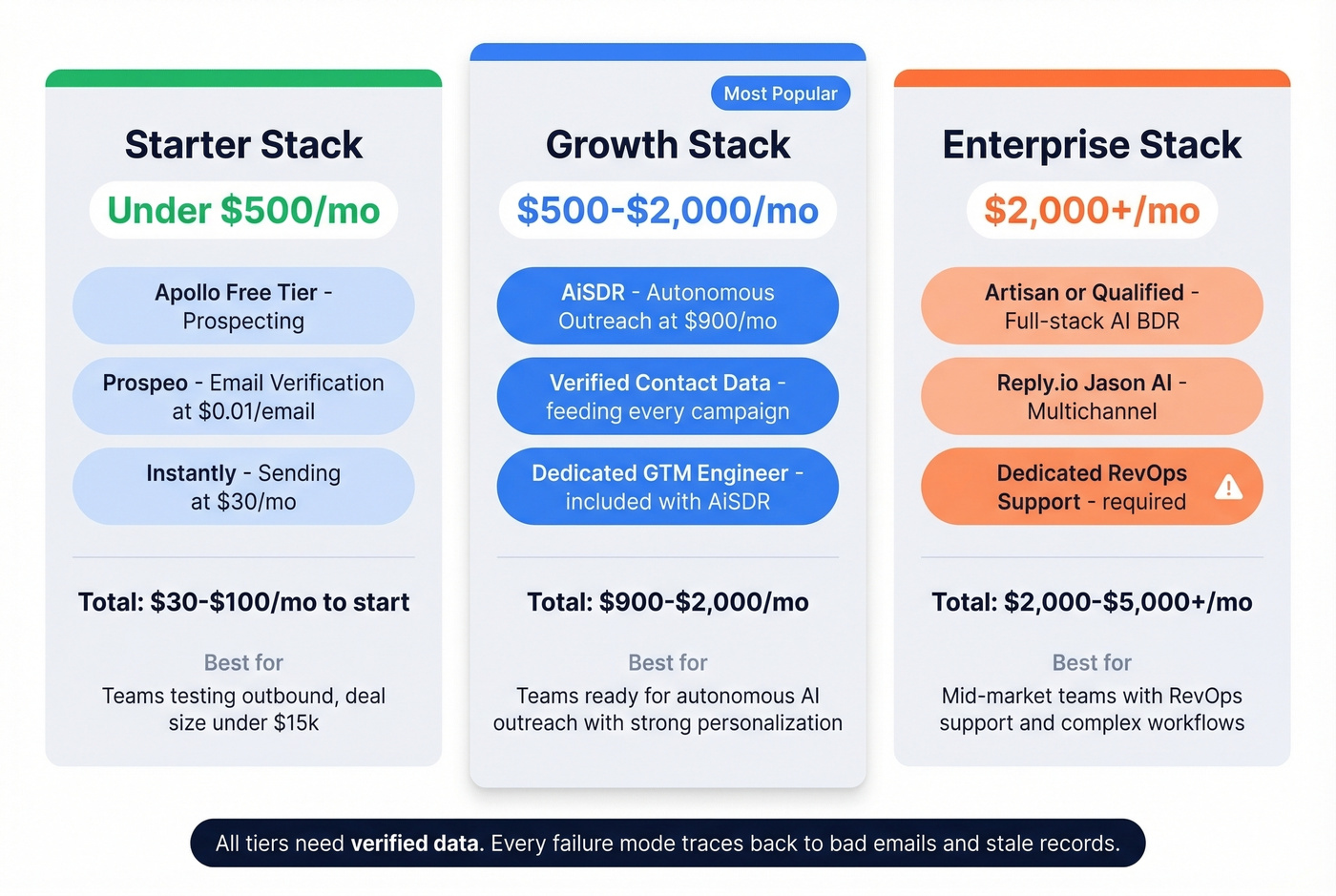
- Under $500/mo: Apollo's free tier for prospecting + a verification layer like Prospeo at ~$0.01/email + Instantly for sending at $30/mo. Total cost: around $30-$100/mo to start, depending on volume.
- $500-$2,000/mo: AiSDR at $900/mo for autonomous outreach, with verified contact data feeding every campaign.
- $2,000+/mo: Artisan or Qualified, but only if you've got dedicated RevOps support to manage integration and prevent CRM pollution. Reply.io's Jason AI also lives here.
Your AI business development rep is only as good as your data. Every failure mode we've seen traces back to bad emails, stale records, or missing enrichment. Fix that layer first.
What Is an AI BDR?
An AI BDR is software that automates the grunt work of business development - prospecting, outreach sequencing, follow-up cadences, lead qualification, and meeting scheduling. The best tools handle multichannel outreach across email, social, and sometimes phone, personalizing at a level that doesn't scream "robot wrote this."
AI BDR and AI SDR get used interchangeably by most vendors. Technically, BDRs focus on outbound prospecting while SDRs handle inbound qualification, but tools like AiSDR and Artisan do both. Don't get hung up on the label - what matters is whether the tool can actually execute your playbook.
Here's the thing: AI BDRs aren't plug-and-play. They require integration, fine-tuning, continuous optimization, and human reps for complex conversations. Most reps today use AI as a drafting assistant - tools like Lavender or Copy.ai for first drafts they then customize. Full autonomous agents go further, handling the entire sequence end-to-end. Think of them as tireless junior reps who never forget to follow up but also can't read a room.
AI BDR vs Human BDR - Real Numbers
Here's what the economics actually look like when you compare an AI business development representative to a traditional hire.
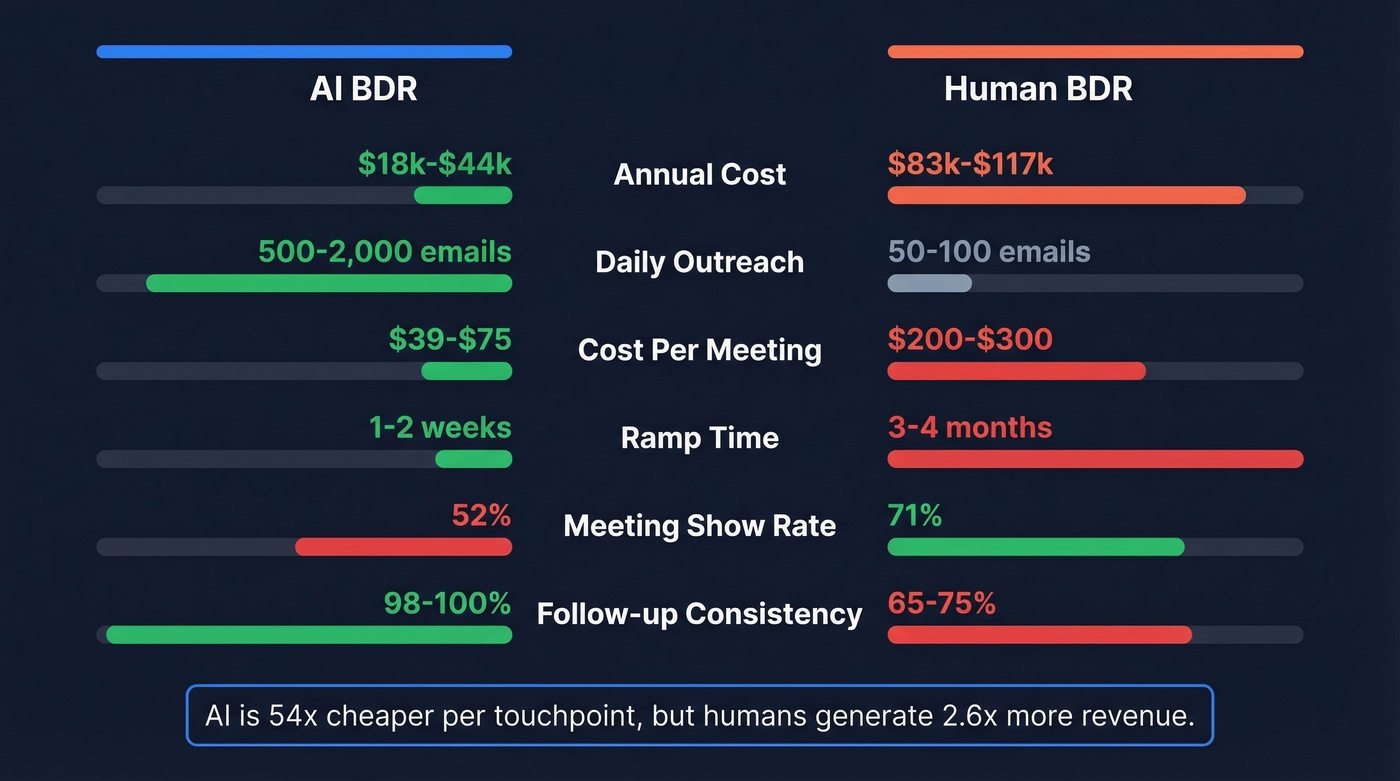
| Metric | AI BDR | Human BDR |
|---|---|---|
| Annual cost | $18k-$44k | $83k-$117k |
| Daily outreach | 500-2,000 | 50-100 |
| Cost per meeting | $39-$75 | $200-$300 |
| Ramp time | 1-2 weeks | 3-4 months |
| Show rate | ~52% | ~71% |
| Follow-up consistency | 98-100% | 65-75% |
An AI Agenix experiment running from mid-2025 through early 2026 found that while AI was 54x cheaper per touchpoint, human reps generated 2.6x more revenue ($147k vs $56k) and had significantly higher meeting show rates.
That gap matters. If your AI agent books 40 meetings but only 21 show up, while a human books 15 and 11 show, the math gets complicated fast. AI-optimized campaigns can push reply rates to 12-25% when targeting and personalization are dialed in, versus the 3-8% baseline for traditional outreach - but only when the underlying data is clean. Bain's research on AI in sales found that sellers spend roughly 25% of their time actually selling. The rest goes to admin, research, and CRM work. AI for business development isn't about replacing the selling; it's eliminating the 75% that isn't.
If your average deal size is under $15k, you probably don't need a $2,000/mo autonomous platform. A $100/mo stack of free-tier tools with verified data will get you 80% of the way there. Save the premium tools for when your pipeline justifies the spend.
Why Most AI BDR Pilots Fail
Three failure modes kill the majority of deployments.
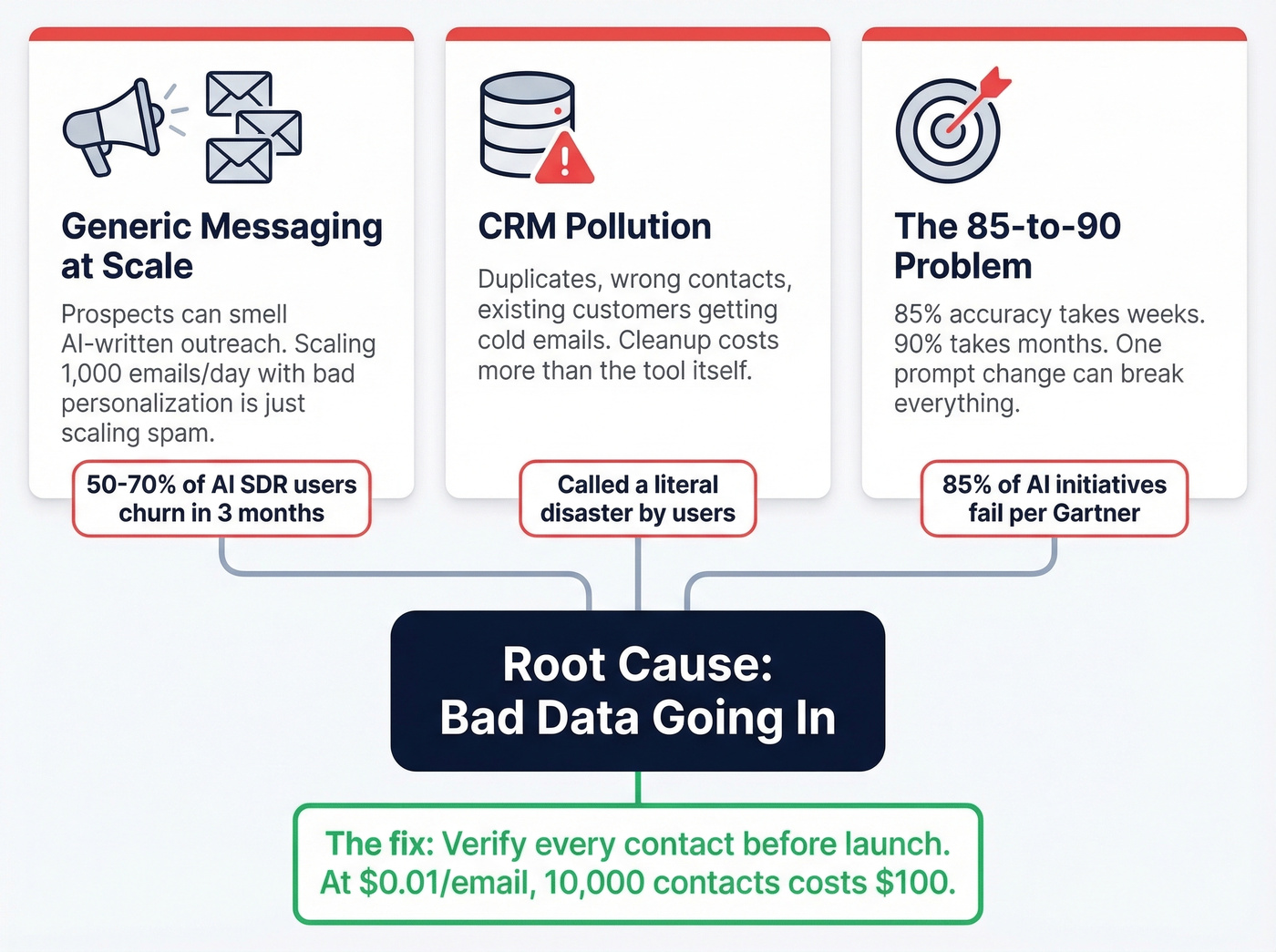
Generic Messaging at Scale
The #1 complaint on r/gtmengineering is that AI-generated outreach sounds obviously AI-generated. Prospects can smell it. When you're sending 1,000 emails a day that all read like "I noticed your company is doing great things in [INDUSTRY]," you're not scaling outreach - you're scaling spam.
CRM Pollution
This one causes real damage. One detailed Reddit review of 11x's "Alice" described it as a "literal disaster" - the tool added irrelevant companies to their CRM, contacted existing customers, created duplicates, and produced messaging that made no sense. The user spent more time on cleanup than they saved on prospecting. We've heard similar stories from at least three other teams in our network.
The 85-to-90 Problem
Getting an AI system to work at ~85% accuracy takes weeks. Pushing from 85% to 90% takes months, and one prompt change can throw the whole thing off. Vendors don't mention this on their pricing pages. Gartner's 85% AI failure rate isn't about the technology being bad - it's about teams underestimating the tuning required.
All three failure modes share a root cause: bad data going in. If your contact list has stale emails, wrong titles, or missing firmographic data, your AI agent will confidently send terrible outreach to the wrong people at scale. Before you launch any campaign, run your list through a verification tool with catch-all handling and spam-trap removal. At $0.01/email, verifying 10,000 contacts costs $100. That's the cheapest insurance you'll buy all year.


Every AI BDR failure mode in this article traces back to bad data. Prospeo's 5-step verification with catch-all handling and spam-trap removal delivers 98% email accuracy - refreshed every 7 days, not 6 weeks. At $0.01/email, verifying 10,000 contacts before your next AI campaign costs less than one hour of cleanup.
Stop your AI agent from confidently emailing dead addresses.
CRM pollution kills AI BDR pilots faster than bad messaging. Prospeo returns 50+ enrichment data points per contact at a 92% match rate - titles, firmographics, and intent signals your AI agent needs to target the right people. No duplicates. No bankrupted companies. No existing customers getting cold emails.
Give your AI BDR clean data and watch the hybrid model actually work.
The Hybrid Model: AI + Human Judgment
The data consistently points to one conclusion: AI plus human outperforms either alone. Teams running hybrid models report 35% productivity boosts and 2.5x revenue growth compared to pure-human or pure-AI approaches. Bain's research shows early AI adopters seeing 30%+ improvement in win rates when AI is paired with process redesign.
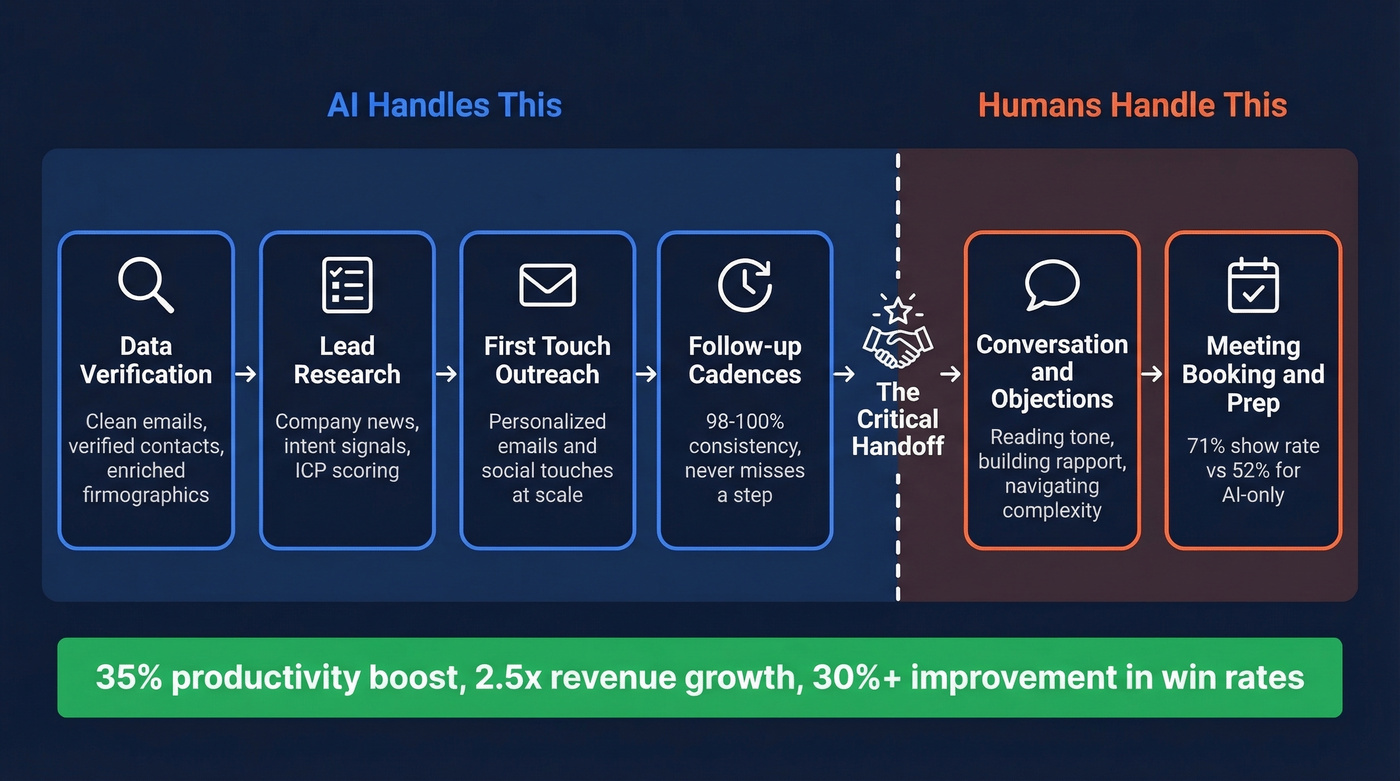
The framework is straightforward. AI handles volume, research, initial outreach, and follow-up cadences - the tasks where consistency and speed matter more than nuance. Humans handle the conversations that require reading tone, navigating objections, and building relationships. AI can double the time reps spend on actual selling by absorbing the surrounding administrative work.
Let's be honest about the meeting show rate gap: 71% for humans vs 52% for AI. Prospects who talk to a human before the meeting are more likely to show up. The winning play is AI for the first touch, human for the handoff. Greenhouse proved this at scale - after moving to AI agents with human support, their chat-to-meeting conversion jumped from 20% to 50-70%.
Best BDR AI Tools in 2026
AiSDR
Use this if you want the strongest personalization in the category and don't mind paying for it. AiSDR's contextual first lines are genuinely good - they pull from recent company news and website signals to write openers that don't sound templated. G2 users rate it 4.7/5 across 76 reviews, with personalization quality as the top praise theme. It includes managed onboarding with a dedicated GTM engineer, which matters more than most teams realize.
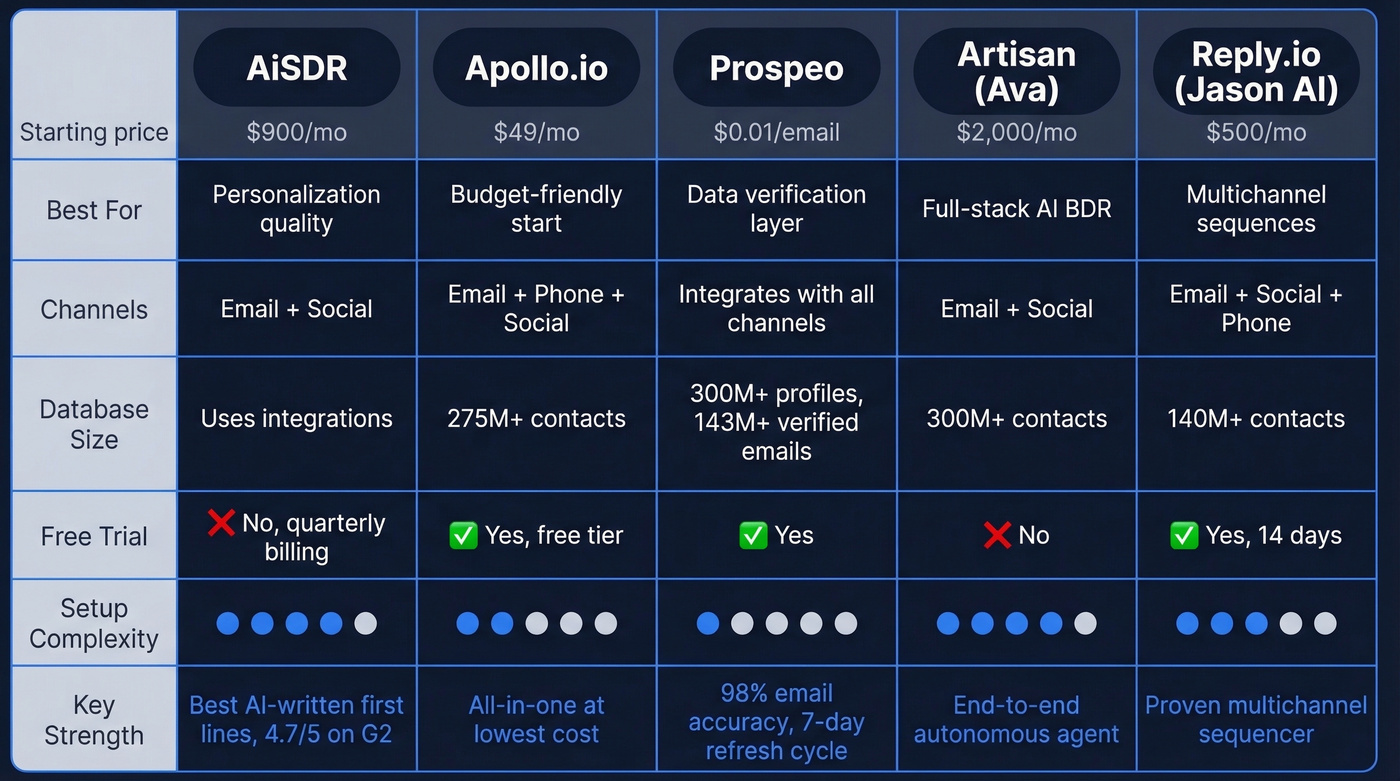
Skip this if you need a trial before committing. There's no free trial, billing is quarterly, and plans run $900-$2,500/mo. The 30-60 day warmup period before you see real results means you're three months and $2,700+ in before you know if it works. Email and social only - no dialer.

Apollo.io
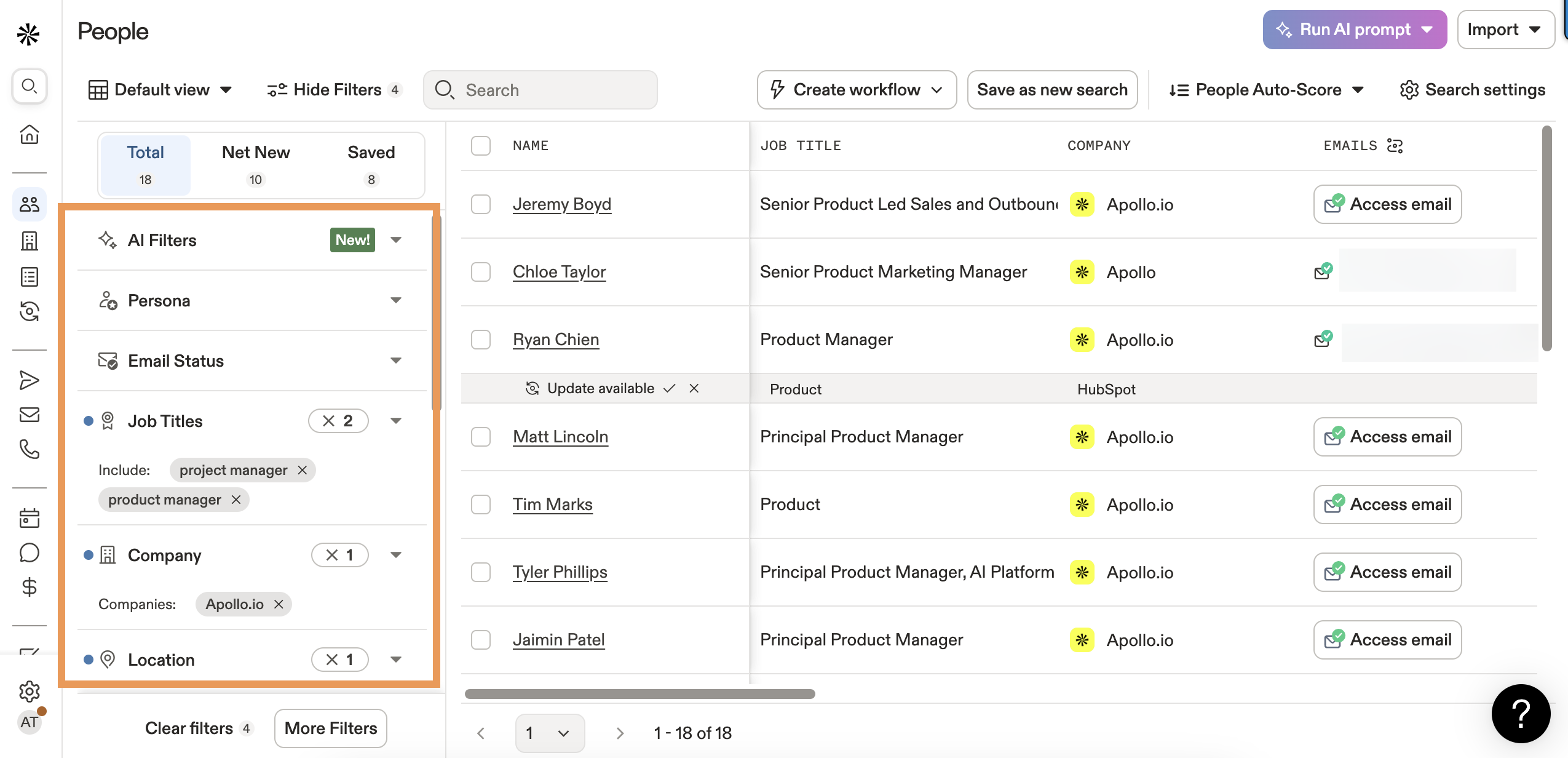
Apollo is the obvious starting point for teams testing AI-assisted outbound on a budget. The database covers 275M+ contacts, the free tier is genuinely usable, and paid plans start at $49/mo per user. The AI features - automated sequences and basic scoring - aren't as sophisticated as dedicated platforms, but they're good enough for teams sending under 500 emails/day.
Where Apollo falls short is email accuracy if you don't verify before sending. The platform tries to do everything - database, sequencer, dialer, analytics - and the breadth comes at the cost of depth in any single area. Pair it with a verification step and it becomes a much stronger foundation.
Prospeo (The Data Layer That Makes AI BDRs Work)
If you're running any AI-powered outbound workflow, Prospeo is the piece that prevents the two most expensive failures: bounces and CRM pollution. It offers 300M+ professional profiles, 143M+ verified emails, and 125M+ verified mobile numbers, all refreshed on a 7-day cycle versus the 6-week industry average. Email accuracy sits at 98%, and the 5-step verification process includes catch-all handling, spam-trap removal, and honeypot filtering.
On the integration side, it plugs directly into Salesforce, HubSpot, Smartlead, Instantly, Lemlist, Clay, Zapier, and Make - meaning it slots into whatever AI BDR stack you're building without custom plumbing. Real results back it up: Meritt tripled pipeline from $100K to $300K/week and dropped bounce rates from 35% to under 4%. Snyk's 50 AEs saw AE-sourced pipeline jump 180% with bounce rates falling from 35-40% to under 5%.
Artisan (Ava)
Use this if you want a full-stack AI BDR that handles everything from lead sourcing to meeting booking without stitching together five tools. Ava operates across email and social, sources its own leads from a 300M+ database, and manages the outbound workflow end-to-end. Starting at ~$2,000/mo, it's positioned for mid-market teams that want one vendor instead of a stack.
Skip this if you're a lean team without RevOps support. Artisan's power comes with complexity - the setup and ongoing optimization require someone who understands outbound infrastructure. Without that person, you'll hit the same CRM pollution problems that plague every autonomous agent. Budget 2-3 weeks of dedicated setup time before expecting results.
Reply.io (Jason AI)
Reply.io has been a solid multichannel sequencer for years, and Jason AI is their autonomous agent layer. Pricing runs $2,500-$5,000/mo for the AI agent tiers. The multichannel capability is the differentiator - most competitors are email-only or email-plus-social at best. If your outbound strategy depends on reaching prospects across three or more channels, Reply.io deserves a serious look.
Agent Frank (Salesforge)
The mid-range option that fills the gap between budget tools and premium platforms. At $499/mo with quarterly billing, Agent Frank handles autonomous prospecting and email outreach at a a price point that makes sense for teams who've outgrown Apollo but aren't ready for AiSDR's commitment. Worth evaluating if you're in that awkward middle ground.
11x (Alice)
The enterprise play, priced at $5,000-$10,000/mo. The Reddit horror stories are real - we've seen multiple accounts of CRM pollution and ignored blacklists. That said, 11x has the resources and enterprise integrations that larger orgs need. If you're evaluating 11x, demand a sandbox environment and run it against a controlled list before giving it access to your production CRM.
Qualified (Piper)
Qualified is the inbound-focused option - it lives on your website, engages visitors in real-time, qualifies them, and books meetings. It's rated 4.9/5 on G2 with 1,446 reviews, one of the highest review volumes in the category. If your problem is inbound conversion rather than outbound prospecting, Qualified is a clear category leader. Expect enterprise-level contracts.
Instantly, Clay, and Smartlead
These aren't AI agents themselves - they're infrastructure. Instantly ($30/mo) handles sending. Clay ($149/mo) handles data enrichment and workflow automation. Smartlead ($39/mo) focuses on deliverability and inbox rotation. You'll likely use one or more of these alongside whatever AI layer you choose.
BDR AI Pricing Breakdown
| Tool | Starting Price | Billing | Best For | Key Limitation |
|---|---|---|---|---|
| Prospeo | Free tier + ~$0.01/email | Monthly | Email verification and data | Verification-focused, not a sender |
| Instantly | $30/mo | Monthly | Sending infrastructure | No built-in prospecting |
| Smartlead | $39/mo | Monthly | Email warmup and rotation | Email only |
| Apollo.io | $49/mo/user | Monthly | Budget all-in-one | Needs external verification |
| Clay | $149/mo | Monthly | Data enrichment | No sending capability |
| Agent Frank | $499/mo | Quarterly | Mid-range AI BDR | Smaller user community |
| AiSDR | $900/mo | Quarterly | Personalized AI BDR | No free trial |
| Artisan (Ava) | ~$2,000/mo | Custom | Full-stack AI BDR | Needs RevOps to manage |
| Reply.io (Jason AI) | ~$2,500/mo | Custom | Multichannel AI | Complex setup |
| Qualified (Piper) | Not public | Custom | Inbound AI | Inbound only |
| 11x (Alice) | ~$5,000/mo | Custom | Enterprise AI BDR | CRM pollution risk |
The table tells half the story. Hidden costs add up fast: email infrastructure runs $50-$200/mo for domains and warmup tools, CRM cleanup eats 5-10 hours/month of RevOps time, and the 30-60 day warmup period means you're paying before you're sending at volume. A realistic total cost of ownership for a mid-tier setup runs $1,500-$3,500/mo once you factor in the supporting stack.
How to Deploy Without Wasting 3 Months
Week 1-2: Foundation
Start with your ICP - and be ruthlessly specific. Title, company size, industry, tech stack, and intent signals. Vague ICPs produce vague outreach, and no amount of AI personalization fixes a targeting problem.
Next, verify your contact database. Run your target list through a 5-step verification process to catch honeypot addresses and spam traps that basic tools miss. Remove bounced and catch-all addresses before your AI agent touches them. Then set up email infrastructure: buy 3-5 sending domains, configure SPF/DKIM/DMARC, and start warmup. If you're targeting EU prospects, make sure your setup is GDPR compliant - fines run up to 4% of annual turnover.
Week 3-4: First Campaigns
Launch small batches of 50-100 emails per day with human review of every AI-generated message for the first week. This is where most teams skip a step and regret it - the AI needs feedback to calibrate. Track reply rates, bounce rates, and unsubscribe rates daily. If bounces exceed 3%, stop and clean your list.
Day 30-60: Measure
You should see measurable pipeline impact by now. Key metrics: reply rate (target 3-8% baseline, 12-25% when targeting is dialed in), bounce rate under 2%, meetings booked per week, and cost per meeting. Aggressive estimates suggest break-even as fast as 15-30 days for well-targeted campaigns, though 2-4 months is more realistic for most SMB teams using a hybrid model.
Day 90: Decision Point
Full ROI visibility. Either the unit economics work or they don't. If cost per meeting is above $150, something's broken - usually data quality or targeting, not the tool itself. Go back to Week 1 and tighten your ICP before blaming the platform.
FAQ
Will AI BDRs replace human sales reps?
No. Hybrid models outperform either alone - AI Agenix's experiment found humans generated 2.6x more revenue despite AI being 54x cheaper per touchpoint. AI handles volume, research, and follow-up. Humans handle nuanced conversations and closing. Expect AI to augment 2-3 reps, not replace them.
What's the minimum budget for an AI BDR stack?
You can start under $200/month by combining Apollo's free tier with email verification at ~$0.01/email and Instantly for sending at $30/mo. Full autonomous platforms like AiSDR start at $900/month. The gap is the difference between a human-managed stack and fully autonomous outreach.
How long until an AI BDR produces pipeline?
Expect 30-60 days before measurable results. Most tools require email warmup of 2-4 weeks before sending at volume, and personalization improves as the system learns from reply data. Payback periods range from 2-4 months for SMB teams to 4-6 months for enterprise.
What's a good free option for AI-assisted outbound?
Prospeo's free tier (75 emails + 100 Chrome extension credits/month) paired with Apollo's free prospecting and Instantly at $30/mo gives you a functional outbound stack under $50/month. You won't get autonomous sequencing, but you'll get verified data and reliable sending - which matters more than automation when you're starting out.
The best BDR AI stack in 2026 isn't the most expensive one - it's the one built on clean data, a specific ICP, and a human who knows when to take over the conversation. Get those three right, and the tool you pick almost doesn't matter.