

The Best Sales Presentation Ever - And How to Build Yours
Your company handed you a 48-slide deck with a 12-slide "About Us" section and expects you to close enterprise deals with it. That's not a sales tool - it's a hostage situation.
The best sales presentation ever made didn't win because of design or slide count. It won because it opened with a shift in the buyer's world, not a product feature. Every guide on this topic rehashes the same Zuora deck from 2016. It's 2026. Let's learn from it instead of copying it.
What You Need (Quick Version)
- Framework first. The best sales presentations open with a shift in the buyer's world, not a feature list. Use the Raskin 5-step for enterprise deals, Problem-Solution-Benefit for transactional sales.
- 6-12 slides. One practitioner cut from 40 slides to 6 and saw a 35% close rate improvement. Engagement drops after 18 slides.
- Know your buyer. Your deck is only as good as your prospect research. Know who's in the room, what they care about, and what's changing in their world before you open slide one.
The 6-Slide Deck That Changed Everything
A founder on r/Entrepreneurs shared something that caught our attention. They'd been running a 40-slide deck covering features, use cases, integrations, testimonials, case studies, and an ROI calculator. The whole package. Calls ran long, prospects got lost, and close rates were mediocre.
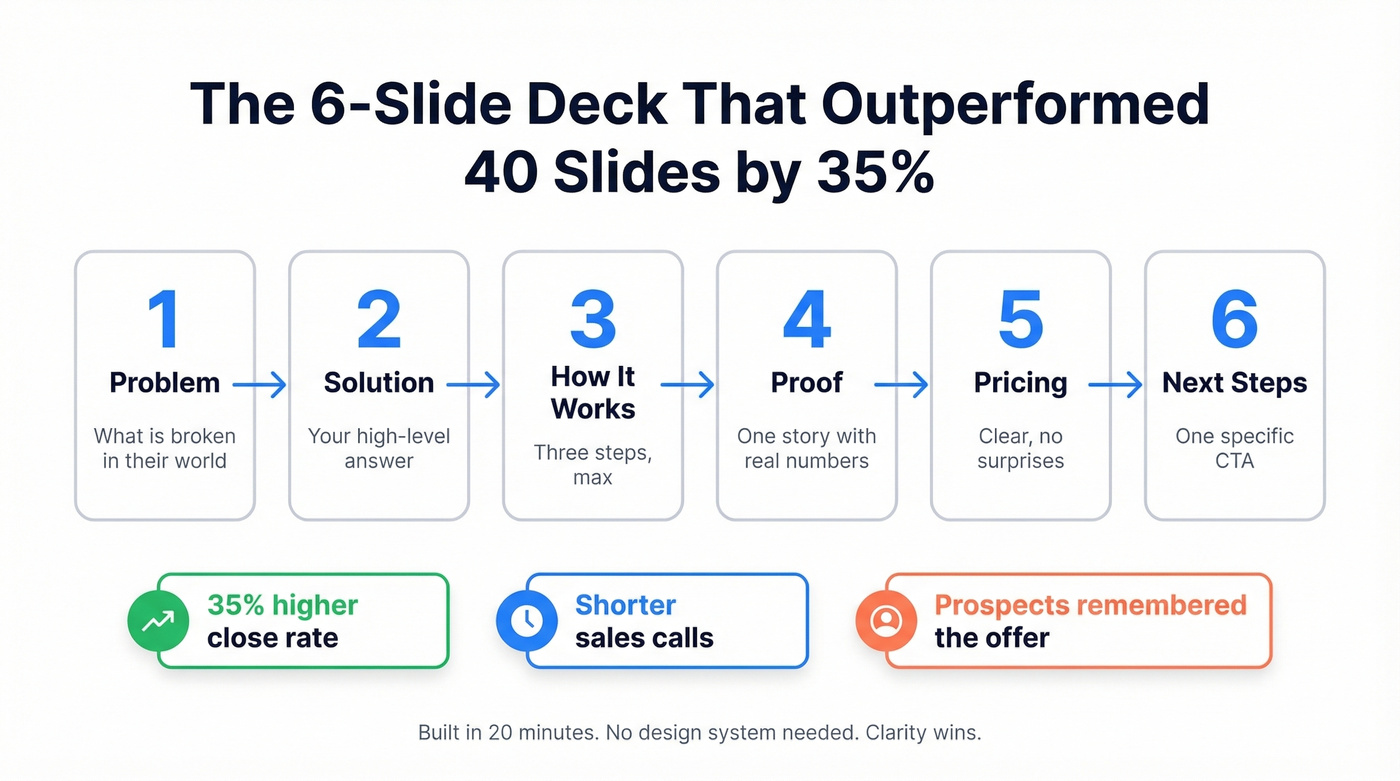
They scrapped everything and built a 6-slide deck in Gamma in about 20 minutes: problem, solution, how it works, proof point, pricing, next steps. Uglier. Faster. And it outperformed the polished version by a wide margin - close rate improved 35%, calls got shorter, and prospects actually remembered the offer afterward. Some in the thread called it the greatest sales deck ever shared on the subreddit.
That tracks with what Outreach's data analysis found: opportunities closed within 50 days have a 47% win rate. After that threshold, it drops to 20% or lower. Shorter, sharper presentations compress cycles. Long decks stretch them.
The lesson isn't "use exactly 6 slides." It's that most decks are built for the presenter's comfort, not the buyer's decision.
Traits of Winning Sales Presentations
We've studied decks from Zuora, Salesforce, Airbnb, and Drift - plus dozens of less famous ones that quietly close millions - and the same five or six traits show up every time. None of them are "great design."
They open with a shift, not a feature. Zuora doesn't start with "here's our billing platform." It starts with "the way people buy has changed for good." That reframes the entire conversation around the buyer's world.
They create winners and losers. Loss aversion is real. The best decks show what happens to companies that adapt versus those that don't. This isn't fear-mongering - it's context that creates urgency.
They paint the promised land before introducing the product. The buyer needs to want the destination before they'll care about the vehicle. Salesforce shows you a world without legacy software headaches before they ever mention their platform.
They use one specific proof story, not a logo wall. Gong's research found that sellers who use social proof techniques in sales calls have a 22% lower close rate. One detailed customer story with real numbers beats 50 logos every time.
They end with a single, clear CTA. Not "Questions?" Not "Thank you." A specific next step.
They're visual-first. People remember about 10% of what they hear after 3 days, but roughly 65% when it's paired with a relevant image. The best decks use visuals to carry the argument, not text bullets. Every slide headline should make the point even if the body text is ignored - because when your champion forwards the deck to the 16 people who weren't in the room, the headlines are all they'll read.
Three Frameworks That Actually Work
Raskin 5-Step (Enterprise Narrative)
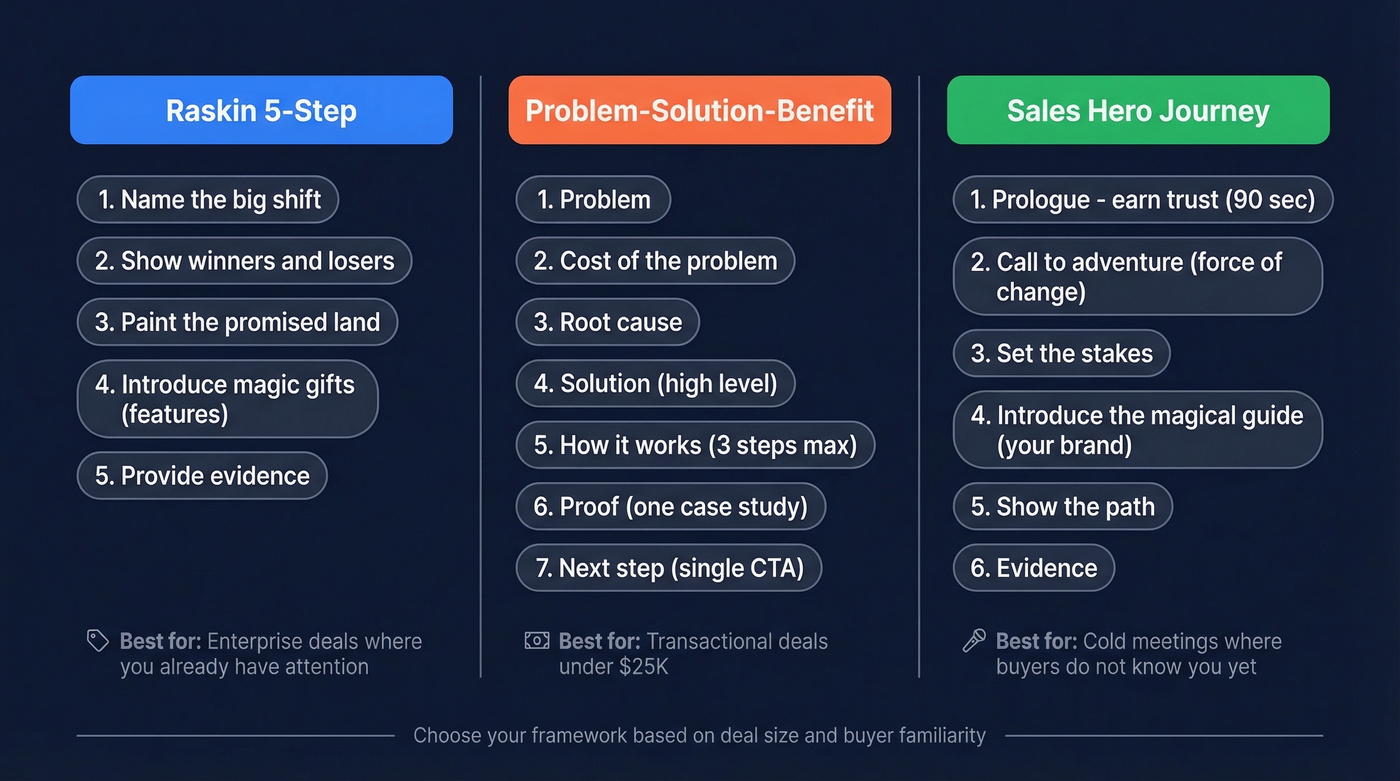
Andy Raskin's framework is the one everyone references, and for good reason. The structure: name a big shift in the world, show winners and losers, paint the promised land, introduce your "magic gifts" (features framed as enablers), provide evidence.
Here's the thing most people miss about Raskin's rationale. Starting with a problem puts prospects on the defensive - they don't want to admit it, or they don't recognize it yet. Starting with a shift gets them leaning in, because shifts are neutral. They're happening whether the prospect likes it or not.
Use this for enterprise deals where you need to create urgency around a market change. It's brilliant but incomplete - it's a content framework, not a delivery framework. It assumes your audience is already paying attention.
Problem-Solution-Benefit (Transactional Sales)
For deals under $25K, you don't need a narrative arc. You need clarity. Seven slides: Problem, Cost of the problem, Root cause, Solution (high-level), How it works (three steps max), Proof (one case study with numbers), Next step (single CTA).
Spend 70% of your preparation time on slides 1-3. If the buyer doesn't feel the problem deeply, nothing after it matters. Most reps rush through the problem to get to their demo. That's backwards.
Sales Hero's Journey (Modern Alternative)
This framework addresses the gap in Raskin by adding a 90-second "Prologue" before the narrative begins. The structure: Prologue (establish trust), Call to adventure (force of change), Set the stakes, Introduce the magical guide (your brand), Show the path, Evidence.
The prologue is a compressed founding story or credibility moment - under 90 seconds. It answers the unspoken question in every cold meeting: "Why should I listen to you?" Use this when presenting to buyers who don't know you yet. Raskin works when you already have attention. The Hero's Journey earns it first.

Your 6-slide deck is only as good as your prospect research. Prospeo gives you 50+ data points per contact - job title, tech stack, buyer intent, funding stage - so you can tailor every slide to the person across the table. 98% email accuracy means your follow-up actually lands.
Nail the research before you open slide one.
Real Decks Worth Studying
Zuora - The Canonical "Best Sales Deck"
The deck that launched a thousand blog posts. Zuora opens with "the subscription economy" - a shift that reframes every buyer's business model. Product details don't appear until deep into the presentation. Andy Raskin analyzed it in 2016 and called it the greatest sales deck he'd ever seen. Zuora CEO Tien Tzuo was Salesforce's 11th employee. He learned narrative selling from the source.
Salesforce - The Repeatable Keynote Machine
Salesforce has used a consistent 5-element narrative for over a decade: industry transformation, develop a villain, paint the vision, introduce the product, evidence through customer stories. "NO SOFTWARE" isn't just a logo - it's the villain. This structure cascades from Dreamforce keynotes down into individual sales decks. The repetition is the point. Buyers hear the same story everywhere, and it compounds.
Airbnb - The $600K Seed Deck
Not a sales deck in the traditional sense, but the principles transfer perfectly. Real photos in testimonials instead of stock imagery. A clear, jargon-free business model. Concrete numbers. It raised $600,000 and became the template for startup pitch decks everywhere. The lesson for sales teams: authenticity and clarity beat polish every time.
Drift - The Movement Narrative
Drift didn't sell a chatbot. It sold "conversational marketing" as a movement. If you're selling something buyers don't have a budget line for yet, study this one. Skip it if your product fits neatly into an existing category - the movement approach adds complexity you don't need.
The Reddit 6-Slide Deck
Problem, solution, how it works, proof, pricing, next steps. Built in Gamma in 20 minutes. No design system, no brand guidelines, no approval process. It outperformed a 40-slide polished deck by 35% on close rate. The r/Entrepreneurs consensus was clear: shorter decks that respect the buyer's time win.
Data Behind Great Presentations
Let's move past opinions and look at what the numbers say.

Analysis of 1.8 million opportunities found that multi-threading - engaging multiple contacts on the buyer side - boosts win rates by 130% on deals over $50K. Closed-won deals have 2x as many buyer contacts as closed-lost, and strategic enterprise deals average 17 contacts. Your presentation isn't just for the person in the room. It's for the 16 people who'll see it later.
On talk-to-listen ratio, the old benchmark was 43% talk / 57% listen. Updated analysis found that consistency matters more than the exact ratio. Low performers' talk time swings wildly between won and lost deals (54% vs 64%). Top performers stay steady regardless.
AI's impact is measurable now. Across 7.1 million opportunities, sellers who frequently use AI generate 77% more revenue than those who don't. AI-assisted tools are also shaving 11 days off sales cycles and boosting win rates by up to 10 points on deals over $50K. That's not a rounding error.
On engagement, pitch-deck benchmarks paint a brutal picture: 31% of viewers bounce within 10 seconds, and average review time for a deck is just 2 minutes and 24 seconds. Engagement drops after 18 slides. You don't have the luxury of a slow build. Your first three slides need to earn the next three.
Five Mistakes That Kill Sales Decks
1. Logo walls instead of stories. Social proof techniques correlate with a 22% lower close rate. One specific customer story with real numbers - revenue impact, timeline, before/after - outperforms 50 logos arranged in a grid.
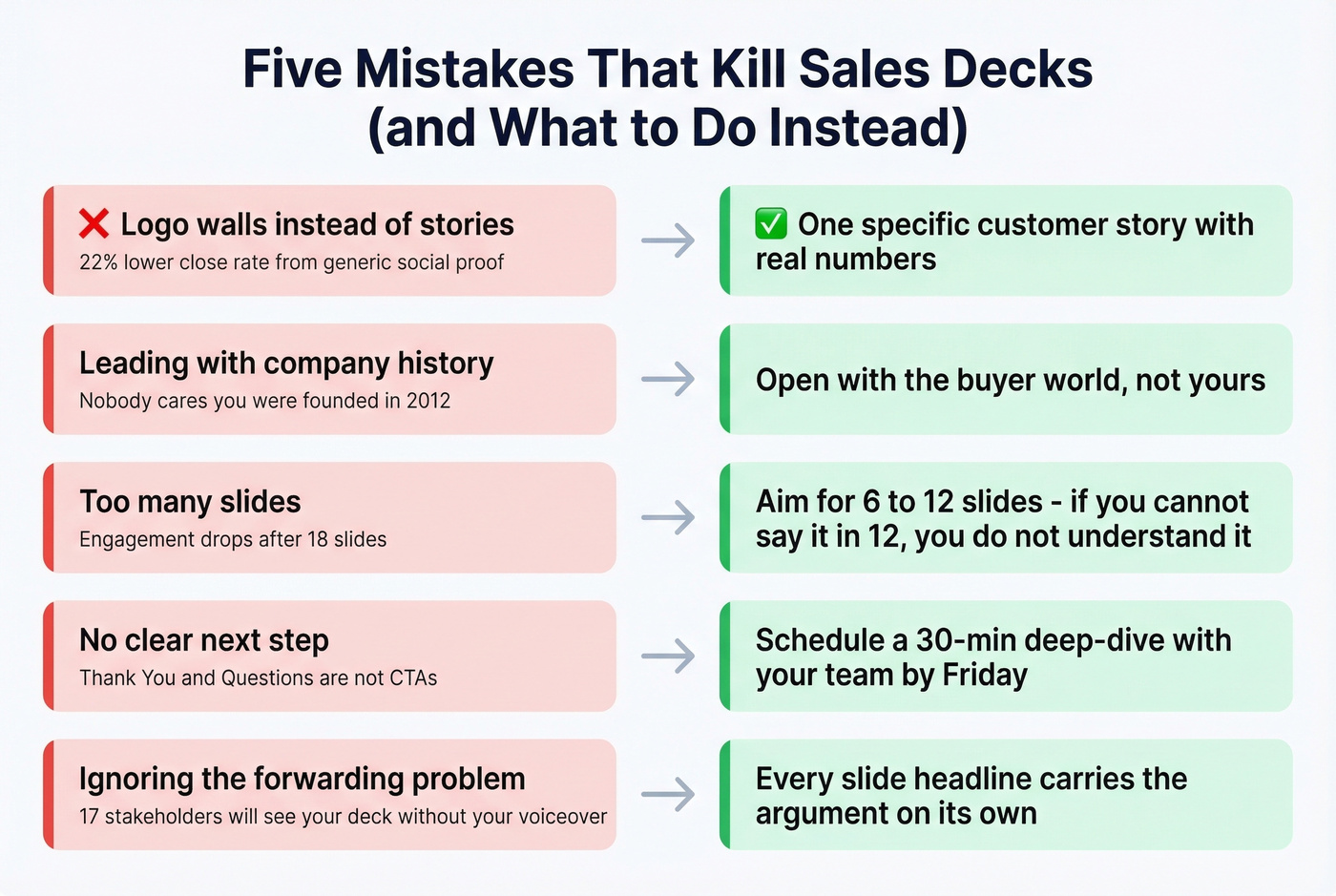
2. Leading with company history. Nobody in a buying meeting cares that you were founded in 2012 or that your CEO previously worked at Oracle. Open with the buyer's world, not yours. We've reviewed hundreds of sales decks, and the ones that close all share one thing: the first slide is about the prospect, never the seller.
3. Too many slides. Engagement drops after 18 slides. Aim for 6-12. If you can't make your case in 12 slides, you don't understand your case well enough.
4. No clear next step. "Thank You" isn't a CTA. "Questions?" isn't a CTA. "Let's schedule a 30-minute technical deep-dive with your team by Friday" is a CTA.
5. Ignoring the forwarding problem. Enterprise deals average 17 stakeholders. Your champion will forward your deck to people who weren't in the room. If your slides only make sense with your voiceover, you've lost the committee. In our experience, the forwarding problem kills more enterprise deals than bad design ever will. Every slide should stand alone - headline carries the argument, body provides the evidence.
Know Your Buyer Before Slide One
The Raskin framework tells you to "name a big shift in your buyer's world." To do that, you need to actually know their world. This is where most presentations fall apart - not in the design, not in the framework, but in the preparation.
Look, here's a hot take: if you're selling six-figure deals, the quality of your prospect research matters more than the quality of your slides. A mediocre deck delivered to a well-researched audience will outperform a beautiful deck delivered to strangers. Every single time.
Multi-threading data makes this concrete. Enterprise deals average 17 contacts. You need to know who's in the room, who's reading the deck later, what each stakeholder cares about, and what's changing in their business. Walking in blind with a generic "shift" slide is worse than having no framework at all. Tools like Prospeo can surface 50+ data points per contact - company size, tech stack, funding rounds, headcount growth, intent signals - so your "big shift" slide writes itself based on what the buyer actually cares about.

Every framework above says the same thing: know your buyer's world before you pitch. Prospeo tracks 15,000 intent topics so you can open with the exact shift happening in their industry - not a guess. Layer in job changes, headcount growth, and technographics to build a deck that feels like it was made for them. Because it was.
Stop presenting blind. Start with buyer intent data.
Tools for Building Your Deck
| Tool | Best For | Price |
|---|---|---|
| Google Slides | Collaboration | Free |
| Gamma | Speed, AI-assisted | Free; Plus ~$8-10/mo |
| Beautiful.ai | Design-challenged teams | ~$12/mo (annual) |
| Canva | Visual polish | Pro $15/mo |
| Pitch | Team workflows | ~$20/mo |
| PowerPoint (M365) | Enterprise standard | $6/user/mo; Copilot add-on +$21/user/mo |
| Visme | Interactive elements | ~$29/mo |
| Figma Slides | Design teams | ~$15/user/mo |
If speed is your priority, Gamma is the move - the Reddit practitioner built their winning deck in 20 minutes flat. For teams that need collaboration without a learning curve, Google Slides is hard to beat at free. If your team's design skills are limited, Beautiful.ai auto-formats slides so they don't look like they were made in 2008. PowerPoint with Copilot ($27/user/mo total) is worth it if you're already in the Microsoft ecosystem and want AI-assisted slide generation.
FAQ
How many slides should a sales presentation have?
Six to twelve for most B2B sales presentations. Engagement drops after 18 slides, and one practitioner saw a 35% close rate improvement going from 40 to 6. Focus preparation depth on the first three slides - they determine whether the prospect stays engaged or mentally checks out.
What's the best framework for a sales deck?
Use the Raskin 5-step narrative for enterprise deals where you need to create urgency around a market shift. Use Problem-Solution-Benefit (7 slides) for transactional sales under $25K. Use the Sales Hero's Journey when presenting to buyers who don't know you yet and you need to earn attention first.
How do I research buyers before a presentation?
Map every stakeholder on the buying committee - role, priorities, recent company moves. Prospeo's 30+ search filters and intent data let you surface what each contact cares about in minutes, with an 83% enrichment match rate across 300M+ profiles. Preparation beats polish every time.
Can AI help me build a better sales deck?
Sellers who frequently use AI generate 77% more revenue and close deals 11 days faster. AI tools like Gamma speed up deck creation, while platforms like Prospeo automate buyer research so you spend time on narrative, not data gathering.