

Best Bounced Email Checkers in 2026 (8 Tools Tested)
Your ESP just flagged your account. Bounce rate: 8.3%. Two more campaigns like that and you're staring at a suspended sender domain and a month of rebuilding reputation. Email databases decay at least 25% annually - at that rate, a 100K list loses roughly 480 addresses a week to job changes, domain shutdowns, and abandoned inboxes. A bounced email checker isn't optional anymore. It's infrastructure.
The threshold that matters: keep your bounce rate below 2% and you're healthy. Cross 5% and you're actively damaging your sender reputation.
Our Top Picks
| Pick | Tool | Best For | Price at 10K |
|---|---|---|---|
| #1 | Prospeo | Find + verify in one step | ~$100 ($0.01/ea) |
| #2 | ZeroBounce | Standalone bulk verification | $99/mo (ONE plan) |
| #3 | Hunter | Free tier + catch-all handling | Free-$49/mo |
How Email Verification Works
Every verification tool runs some version of the same pipeline, though the depth varies wildly:
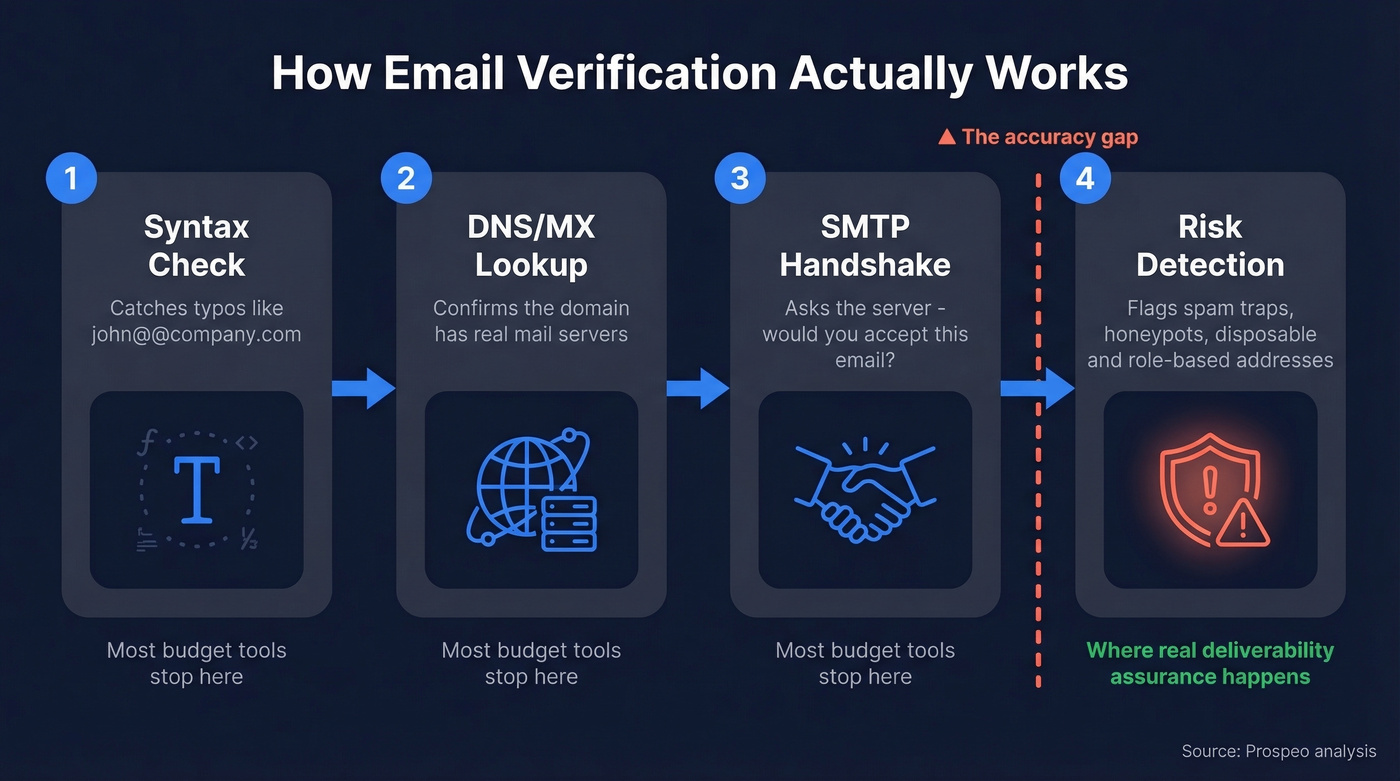
- Syntax check - Does the address follow valid formatting rules? Catches typos like "john@@company.com" instantly.
- DNS/MX lookup - Does the domain exist, and does it have mail exchange records pointing to a real mail server?
- SMTP handshake - The tool connects to the mail server and asks "would you accept mail for this address?" without actually sending anything. A "250 OK" response means the server accepted the recipient during the check.
- Risk detection - Advanced tools go further, checking for known spam traps, honeypots, disposable domains, and role-based addresses like info@ or support@ that tank deliverability.

The problem? Step 3 breaks completely on catch-all domains. Most budget tools stop there and call it a day. The real difference between a basic syntax scrub and actual deliverability assurance comes down to whether your tool handles catch-all detection and spam-trap filtering on top of the standard SMTP check.
The Catch-All Problem
Roughly 20-30% of B2B domains run catch-all configurations. These servers return "250 OK" for any address - real or completely fabricated. Send to fake@catchall-company.com and the server says "sure, I'll take it." Then the email silently drops, bounces hours later, or gets routed to a sinkhole.
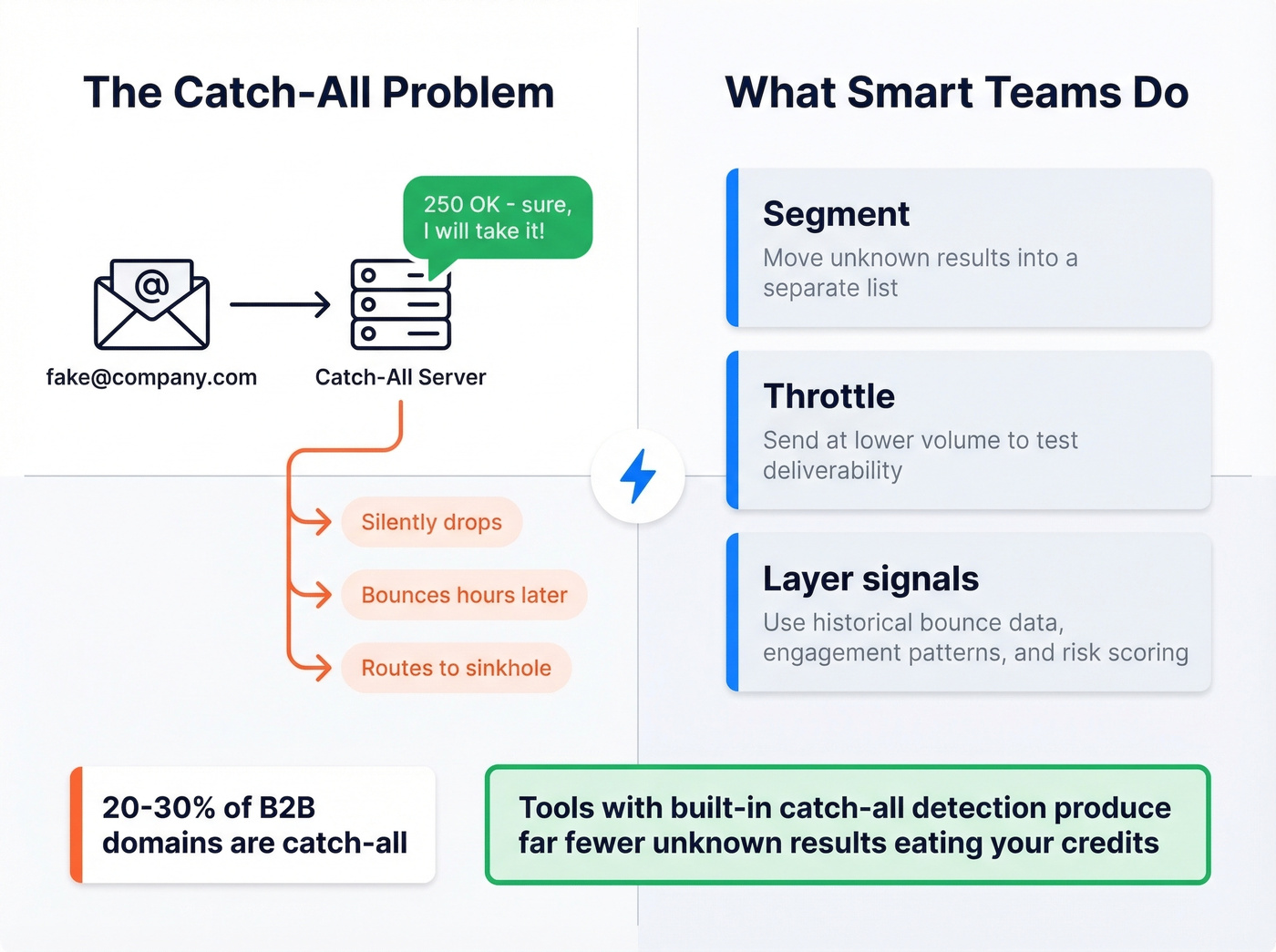
This is why your "verified" list can still bounce. In our experience, catch-all domains account for the majority of "unknown" results and produce the delayed bounces that blindside teams who think they've already cleaned their data.
What to do with "unknown" or "accept-all" results:
Don't send to them blindly - that's how you hit 8%+ bounce rates. Segment them into a separate, throttled campaign with lower volume. Use tools that layer additional signals like historical bounce data, engagement patterns, and risk scoring beyond raw SMTP responses. The verifiers that handle catch-all detection within their pipeline produce far fewer "unknown" results eating your credits.

Catch-all domains wreck bounce rates because most tools stop at the SMTP handshake. Prospeo's 5-step verification handles catch-all detection, spam-trap removal, and honeypot filtering - the exact layers that keep you under 2%. At $0.01/email with 98% accuracy, you pay for clean data, not cleanup.
Stop verifying garbage. Start with clean emails from day one.
8 Top Email Verification Tools Compared
1. Prospeo
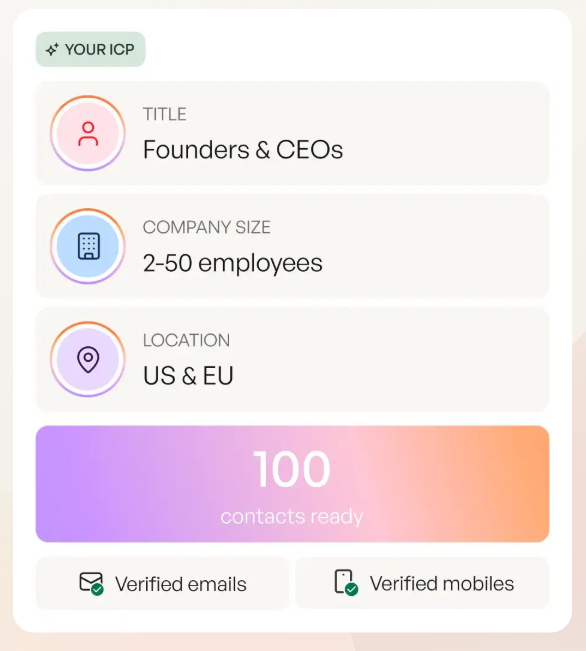
Most checkers verify after you've sourced bad data. Prospeo finds and verifies in one step - you're not cleaning garbage, you're starting clean. The platform runs a 5-step verification process covering syntax, DNS, SMTP, catch-all handling, and spam-trap/honeypot filtering across 143M+ verified emails. It delivers 98% accuracy with a 7-day refresh cycle that keeps data from going stale.
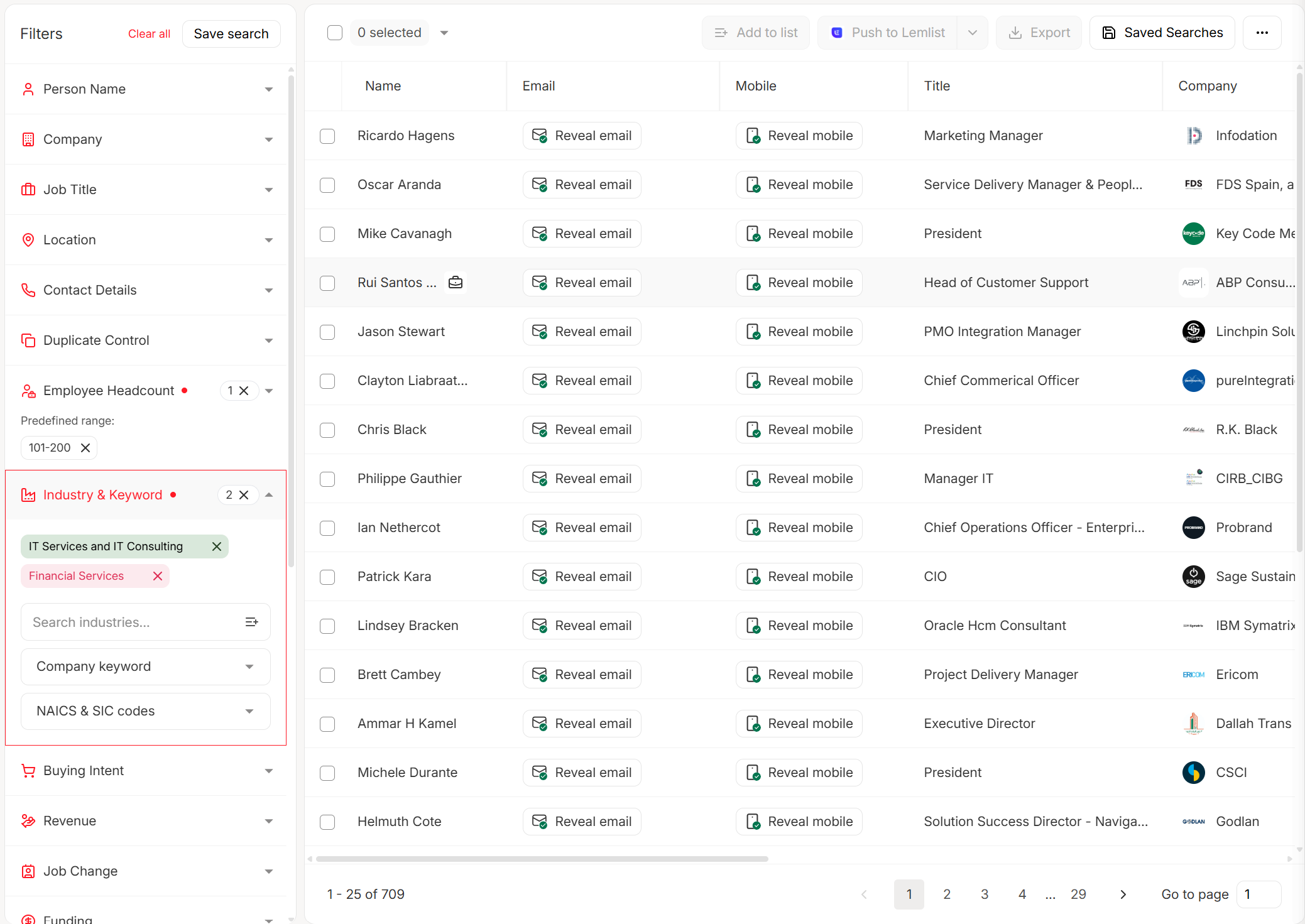
Use this if: You're running cold outreach and want to skip the "source emails, then clean them with a separate tool" dance. Integrations with Salesforce, HubSpot, Instantly, Lemlist, Smartlead, Clay, Zapier, and Make mean verified contacts flow straight into your sequences. At $0.01/email with a free tier of 75 emails and 100 Chrome extension credits monthly, it's priced for teams that send.
Real results: Snyk cut bounce rates from 35-40% to under 5% after switching. Stack Optimize maintains under 3% bounce across all clients. That's what starting clean looks like.
Already have a trusted database? The verification works standalone too - upload a list, scrub it, and send with confidence. But you'll get the most value using the full find-and-verify workflow.
2. ZeroBounce - Credit Policy Winner
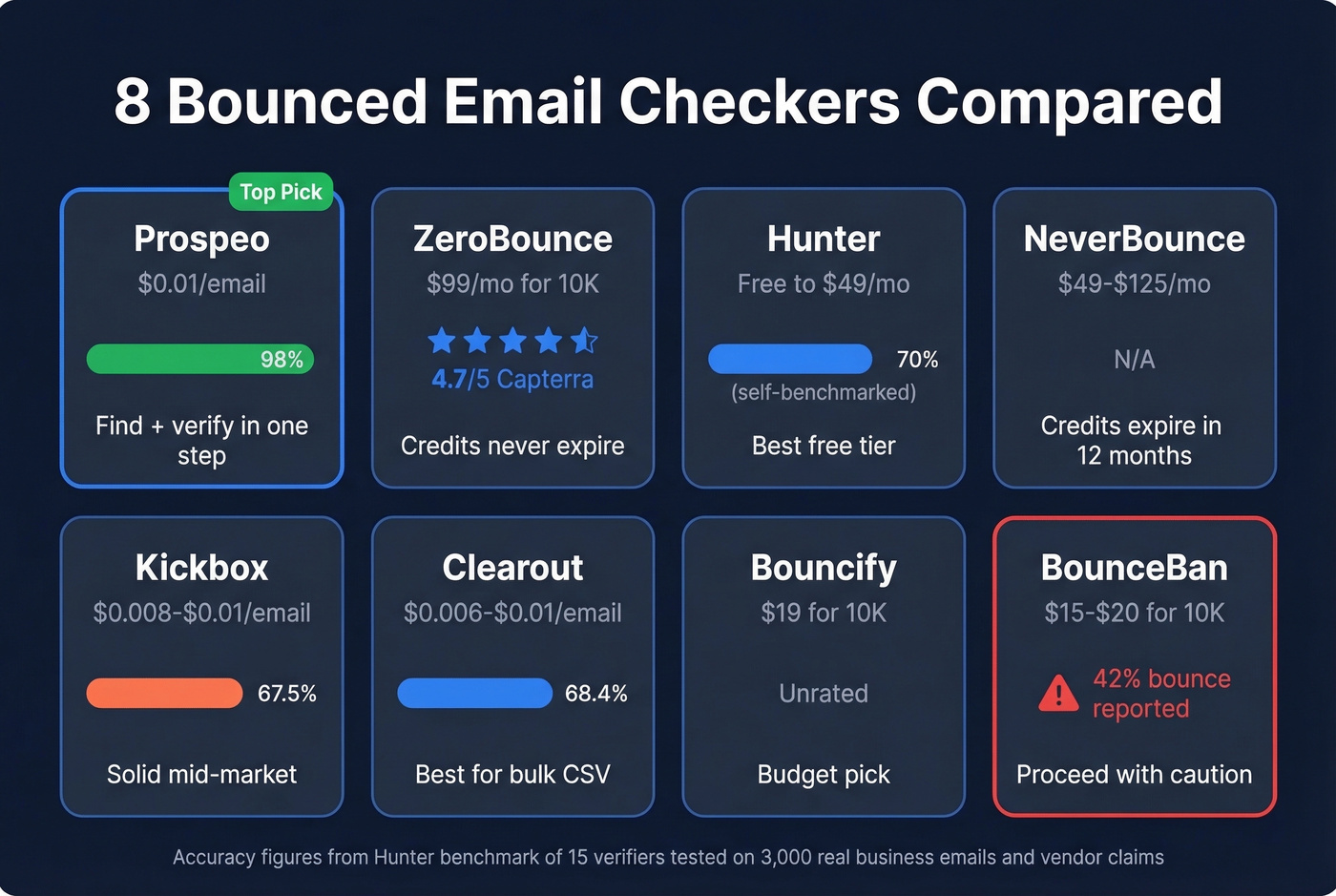
Here's the pricing angle that matters: ZeroBounce credits never expire. NeverBounce credits expire after 12 months. For the same 10K volume, you're paying $99/mo at ZeroBounce versus $125/mo at NeverBounce's Advanced plan. That's a $312/year difference before you factor in the credit expiration risk.
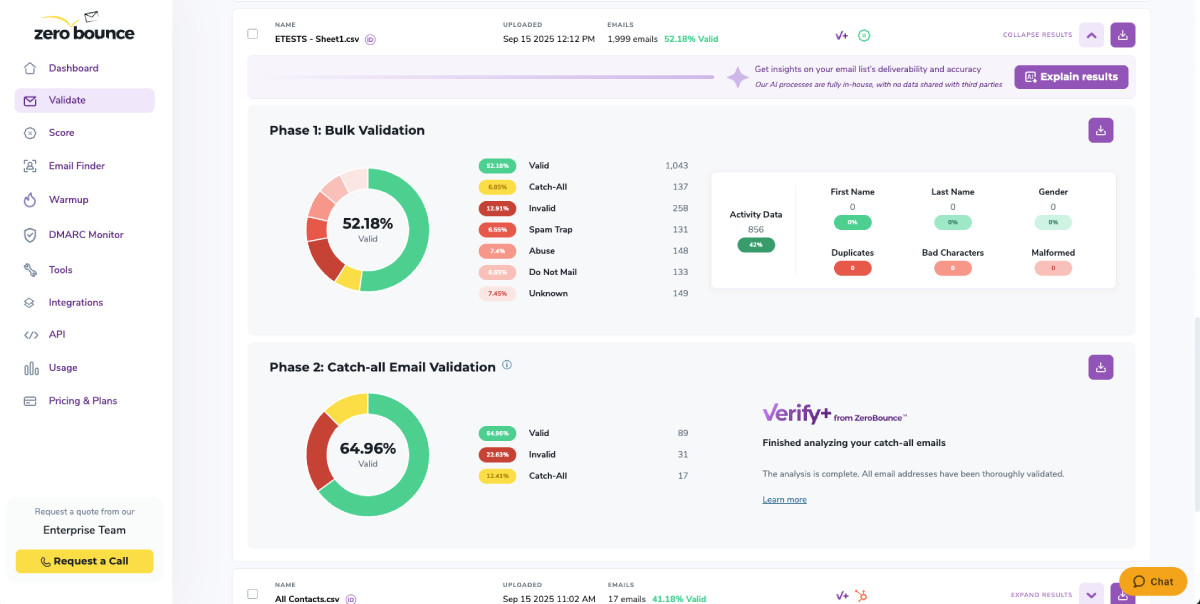
The ONE plan runs $99/mo for 10K verifications, with pay-as-you-go rates between $0.003 and $0.01 per email depending on volume. The free tier gives you 100 validations monthly. Unknown results don't cost you credits either, which matters when you're processing lists heavy on catch-all domains. One thing to watch: their Email Finder burns 20 credits per successful query, so don't confuse verification credits with finder credits.
ZeroBounce holds a 4.7/5 on Capterra across 549 reviews - that's a large enough sample to trust. One Reddit user on r/Emailmarketing dropped from 22% to 7% bounce rate within three weeks of adding ZeroBounce. A major improvement, though still above the 2% target most teams should aim for. That gap is usually a data quality problem, not a verification problem.
3. Hunter - The Transparent Benchmark
Hunter's the tool most people try first, and for good reason. The free tier gives you 100 verifications/month, paid plans start at ~$49/mo, and they support accept-all verification with a proprietary solution for several major email providers. If you're looking for an email bounce checker free of upfront commitment, Hunter's free plan is the best place to start.

What sets Hunter apart is transparency. In their published benchmark of 15 verifiers tested against 3,000 real business emails, Hunter came out on top at 70% overall accuracy. Fair disclosure: the dataset was derived from email activity patterns observed on Hunter, which could advantage their own tool. But they released the raw spreadsheet - that's more than anyone else has done. With 6+ million users and ratings of 4.6 on Capterra and 4.4 on G2, Hunter is the safe pick for teams getting started.
Skip this if: You're processing 100K+ emails monthly. Hunter's pricing gets expensive at scale compared to dedicated bulk verifiers.
4. NeverBounce
| NeverBounce | ZeroBounce | |
|---|---|---|
| 10K price | $49/mo (Growth) or $125/mo (Advanced) | $99/mo |
| Credit expiry | 12 months | Never |
| Duplicate charges | None on Growth plan | Standard |
| Pay-as-you-go | $0.008/credit | $0.003-$0.01 |
NeverBounce is the name everyone knows, but the pricing has sharp edges. The Growth plan's duplicate-free policy helps if you're re-verifying overlapping lists, but the 12-month credit expiration and higher price at the Advanced tier make ZeroBounce the better value for most teams.
5. Kickbox
Kickbox hit 67.53% accuracy in Hunter's benchmark of 15 verifiers. Pricing sits around $0.008-$0.01/email. Solid mid-market option, not the cheapest, not the most accurate.
6. Clearout
Clearout took second place in Hunter's benchmark at 68.37% accuracy. It's built for bulk verification - upload a CSV, get results fast, move on. Pricing runs roughly $0.006-$0.01/email depending on volume. For large marketing lists cleaned quarterly, Clearout deserves a trial.
7. Bouncify
The budget pick at $19 for 10K verifications with 100 free verifications to test. We've recommended Bouncify to bootstrapped teams who need basic verification without breaking the bank. It won't match the accuracy of Tier 1 tools, but at this price point, it doesn't need to.
8. BounceBan
Proceed with caution. One Reddit user reported a 42% bounce rate on a list BounceBan had "cleaned," with another list bouncing at 31%. The tool has just 2 Trustpilot reviews at 3.8/5. Pricing appears to start around $15-20 for 10K, but with accuracy this questionable, the savings aren't worth the domain reputation risk.
Snyk dropped bounce rates from 35-40% to under 5%. Stack Optimize holds under 3% across every client. The difference? They stopped sourcing emails in one tool and scrubbing them in another. Prospeo finds and verifies in a single step across 143M+ emails refreshed every 7 days.
One workflow. Verified emails. Zero bounced-email cleanup.
Pricing at a Glance
BriteVerify is included below for reference - at ~$80/10K it's a well-known option, though we didn't test it in depth for this roundup.
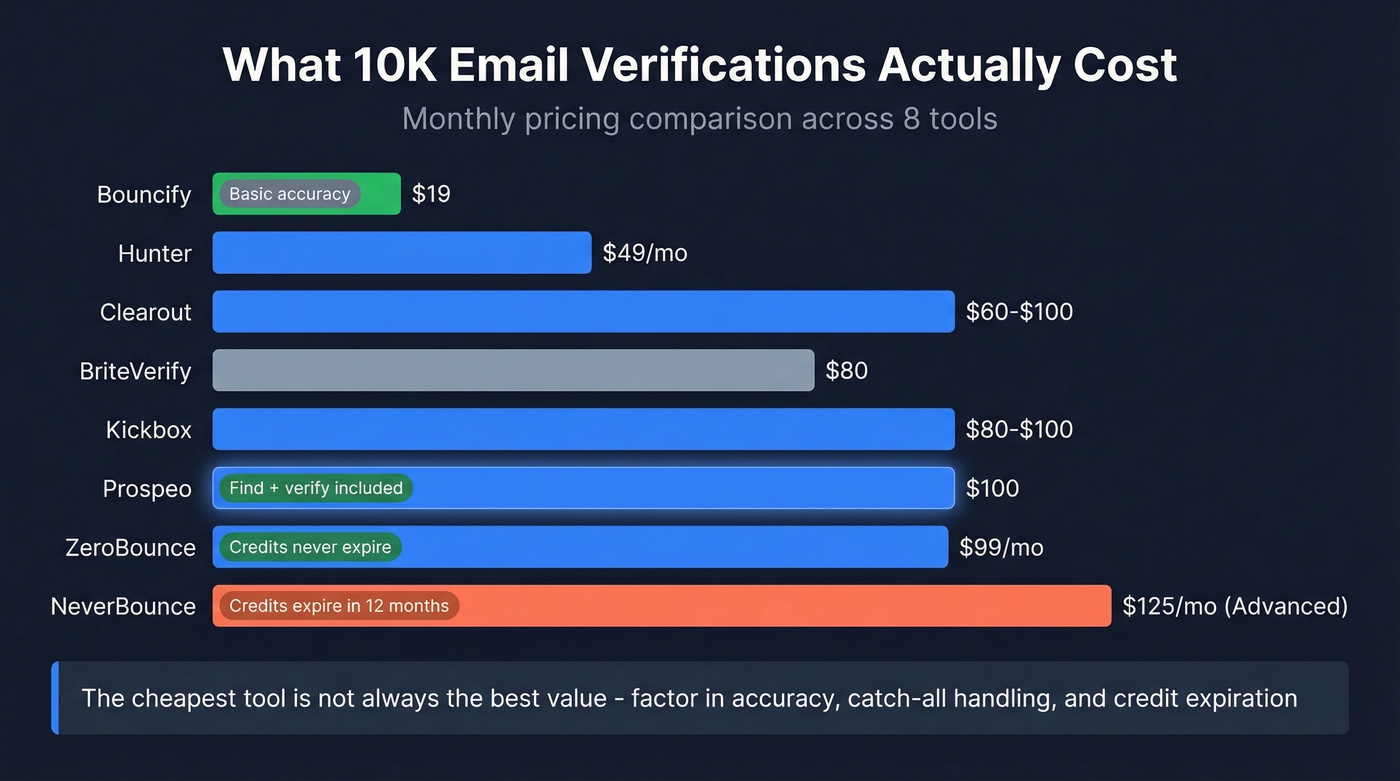
| Tool | 10K Price | 100K Price | Free Tier | Credits Expire? |
|---|---|---|---|---|
| Prospeo | ~$100 | ~$800-$1,000 | 75 emails/mo | No |
| ZeroBounce | $99/mo | ~$350-$500 | 100/mo | Never |
| Hunter | ~$49/mo | ~$299-$399/mo | 100/mo | No |
| NeverBounce | $49-$125/mo | ~$300-$500 | None listed | 12 months |
| Kickbox | ~$80-$100 | ~$400-$600 | Not public | No |
| Clearout | ~$60-$100 | ~$350-$500 | Not public | No |
| Bouncify | $19 | ~$150-$190 | 100 | No |
| BriteVerify | ~$80 | ~$500-$700 | Not public | No |
The NeverBounce vs ZeroBounce comparison at 10K is telling: $125/mo vs $99/mo for the same volume, and ZeroBounce's credits never expire.
How to Choose the Right Tool
Four use cases, four answers.
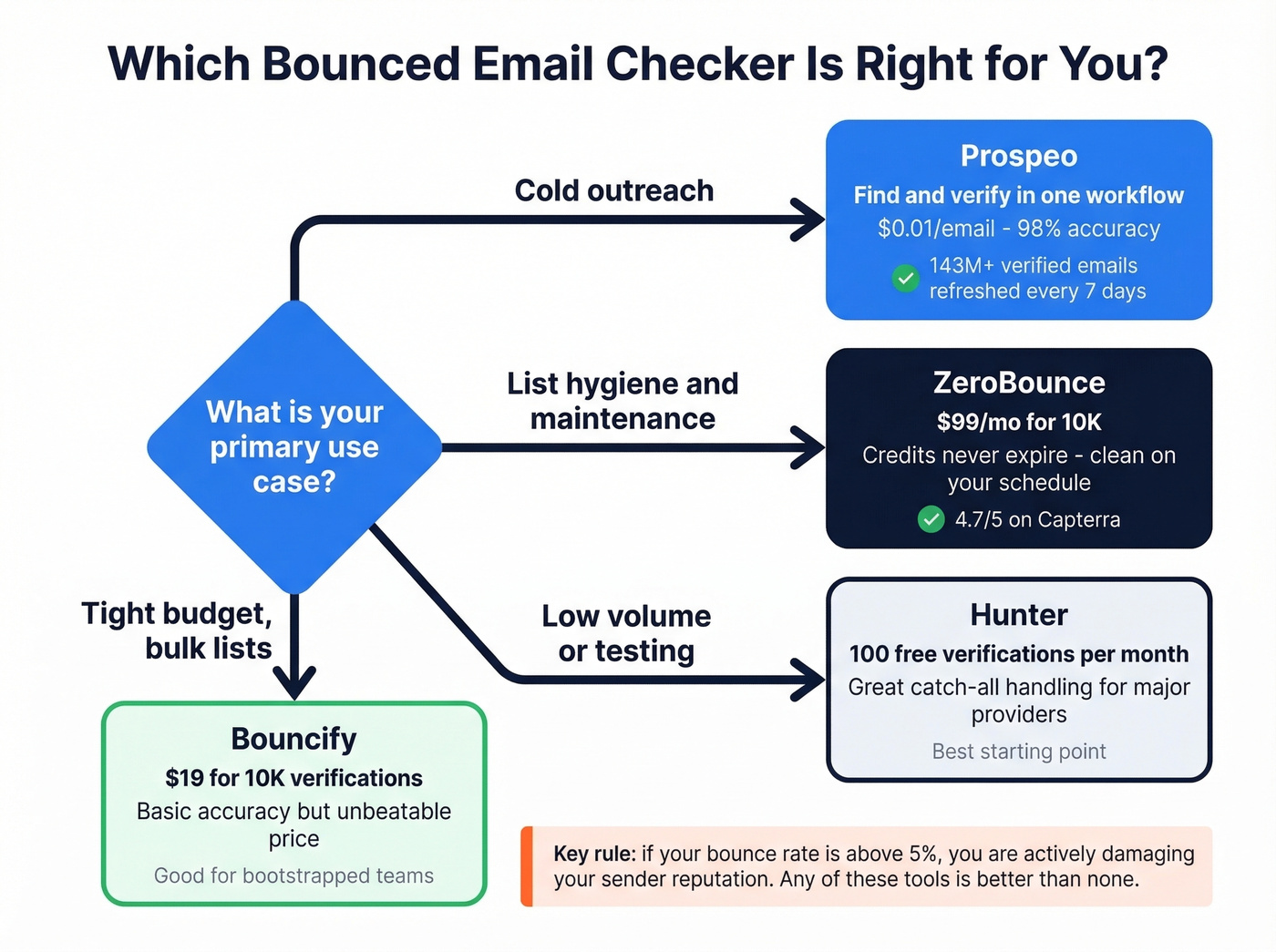
Cold outreach teams → Prospeo. You need emails verified at the point of discovery, not cleaned after the fact. Find and verify in one workflow eliminates the gap where bad data enters your sequences.
Mailing list hygiene → ZeroBounce. You've got existing lists that need regular cleaning. Running a mailing list checker on a quarterly schedule prevents decay from silently wrecking your deliverability. Credits that never expire mean you can buy in bulk and clean on your schedule.
Low-volume testing → Hunter. The free tier handles 100 verifications/month, and the catch-all handling for major providers is genuinely useful for small-batch prospecting.
Budget-constrained bulk → Bouncify. At $19 for 10K, it's hard to beat on pure cost-per-verification.
Let's be honest: if your bounce rate is above 5%, you don't have a verification problem - you have a data quality problem. We've seen teams cut bounce rates in half just by switching from post-send analysis to pre-send verification with better source data. Verification is the last line of defense, not the first. Teams that source from outdated databases and then try to "clean" their way to deliverability are fighting the wrong battle entirely, burning credits on addresses that should never have entered their pipeline in the first place. Start with better data and a solid bounced email checker becomes a safety net, not a crutch.
FAQ
What's a good bounce rate for cold email?
Below 2% is healthy and keeps your sender reputation intact. Above 5% risks domain reputation damage and spam folder placement. Many ESPs start flagging accounts in the 3-5% range.
How often should I re-verify my email list?
Every 30-60 days for active outreach lists. Email databases decay roughly 25% annually, so quarterly verification is the bare minimum for marketing lists. Monthly re-verification is safer if you're sending daily sequences.
Why does my tool mark emails as "unknown"?
Usually catch-all domains. These servers accept mail for any address, returning "250 OK" even for non-existent mailboxes. Roughly 20-30% of B2B domains are catch-all, which is why "unknown" results are so common in business email verification.
What's a good free alternative to paid verification tools?
Prospeo offers 75 free email verifications per month with full 5-step verification including catch-all handling. Hunter provides 100 free verifications monthly. Both are strong starting points before committing to a paid plan.
Pre-send verification vs. post-send bounce analysis?
Pre-send verification checks addresses before you send, protecting your sender reputation proactively. Post-send analysis only tells you what bounced after the damage is done - your domain has already taken the hit. Always verify before sending.