

C-Suite Titles Explained: Roles, Salaries, Hierarchy & Emerging Positions
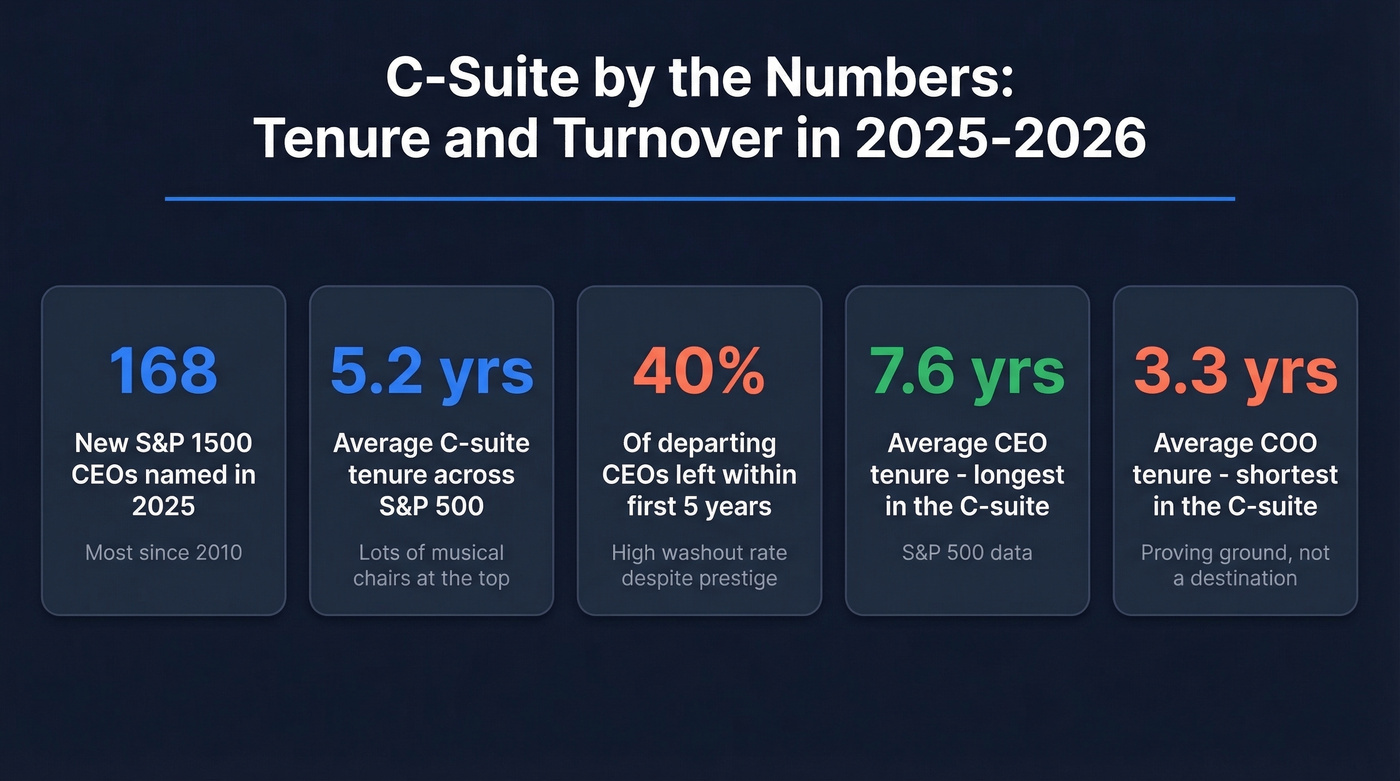
168 new S&P 1500 CEOs were named in 2025 - the most since 2010. Nearly 40% of departing CEOs left within their first five years. The C-suite isn't just growing; it's churning faster than most people realize.
Whether you're mapping an org chart, planning your career path, or figuring out who to target at a prospect account, understanding c-suite titles - what they mean, what they pay, and how they fit together - is foundational knowledge that doesn't go stale.
What Is the C-Suite?
The "C" stands for "Chief." Every C-suite title starts with it: Chief Executive Officer, Chief Financial Officer, Chief Technology Officer. The term emerged in the late 20th century as shorthand for the cluster of top executives who share that prefix and, more importantly, share the strategic decision-making authority that shapes a company's direction.
But the C-suite isn't a fixed group. Traditionally, many companies centered it on three roles: CEO, COO, and CFO. Today, Deloitte's analysis of 46,000 C-suite job postings and Fortune 500 composition data shows organizations systematically adding more roles to the executive table. AI governance, cybersecurity, sustainability mandates, and data privacy have all spawned new chief-level positions.
The upshot: "C-suite" can mean seven roles at one company and fifteen at another. The average S&P 500 company now carries 5.2 years of average C-suite tenure across its top executives. That's a lot of musical chairs at the top.
Quick Reference Summary
If you're short on time, here's the snapshot:
- Seven core c-suite titles at mid-to-large companies: CEO, CFO, COO, CTO, CIO, CMO, and CHRO.
- The hierarchy in one sentence: Board of Directors → CEO → COO/President → CFO and other Chiefs → EVP/SVP → VP tiers.
- 3 emerging titles worth watching: CAIO (Chief AI Officer), Chief Sustainability Officer, and Chief Data Officer.
- Average C-suite tenure: 5.2 years. CEOs last longest at 7.6 years (S&P 500) or 8.5 years (S&P 1500). COOs have the shortest average at 3.3 years.
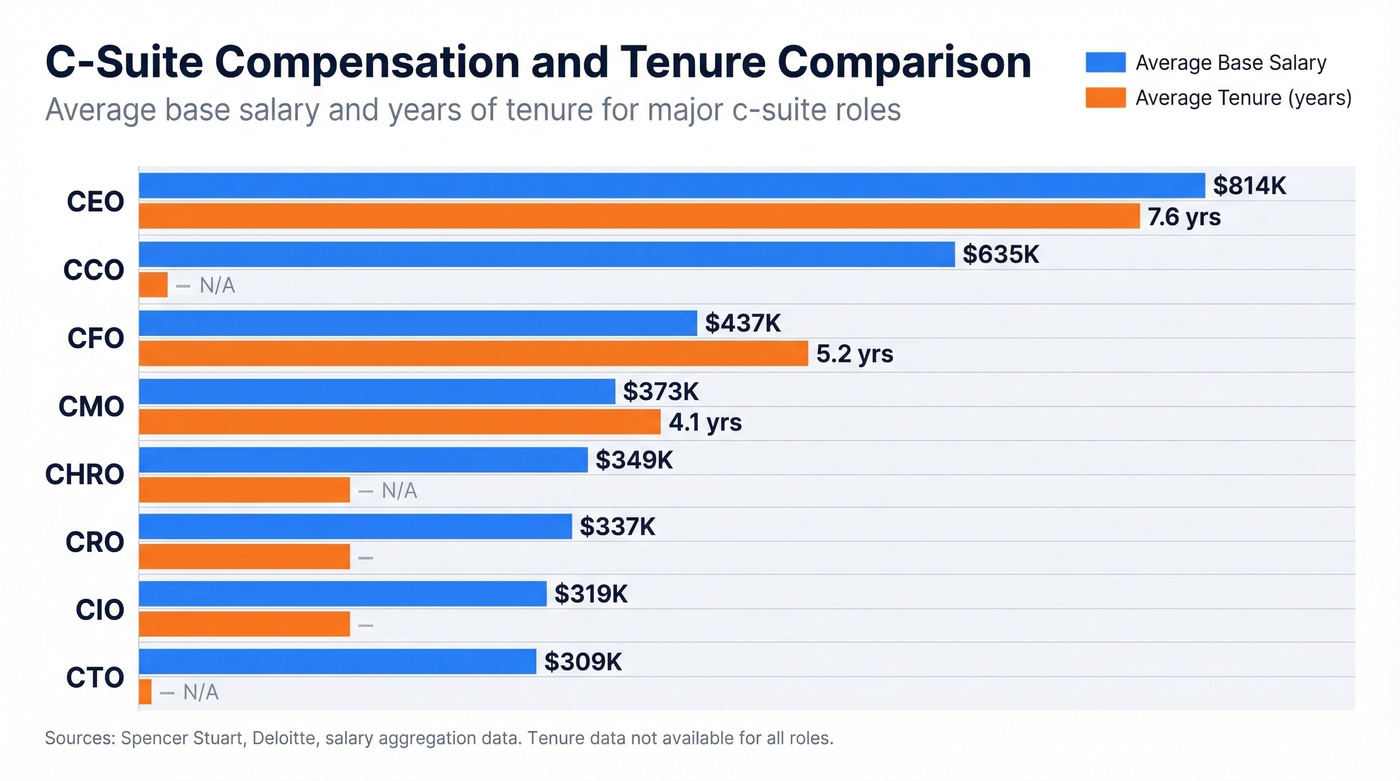
- Salary range: CEO averages $814K base; CFO $437K; many other roles sit between $215K and $466K. The CCO (Chief Commercial Officer) is a high-paid outlier at $635K.
Jump to the salary table for the full compensation breakdown, or the acronym collision guide if you're confused about what "CCO" or "CSO" actually means - each one maps to three different titles.
C-Suite Hierarchy Explained
The reporting structure at the top of a company looks simpler than it is. Here's the standard model, per US Chamber of Commerce guidance and executive search firm frameworks:
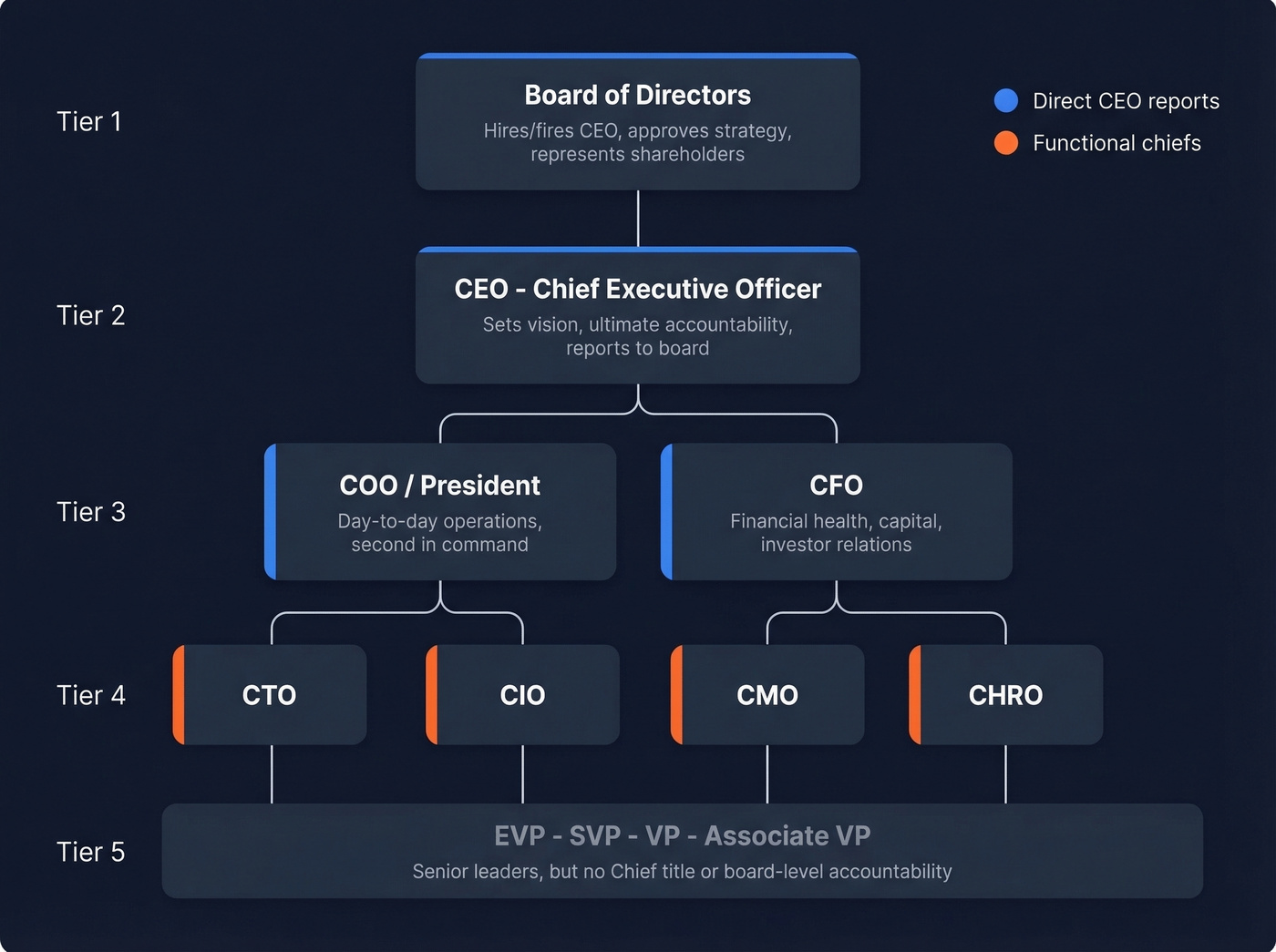
Board of Directors sits at the apex. They don't run the company day-to-day, but they hire and fire the CEO, approve major strategy, and represent shareholders.
CEO reports to the board and oversees the entire executive team. In the power hierarchy, the CEO is unambiguously first.
COO / President is second-in-command. The President title is often the same position as COO at some companies. The COO handles day-to-day operations so the CEO can focus on strategy, board relations, and external-facing work.
CFO and other C-suite executives report to the CEO, or in some structures, to the COO. The CFO is often considered third in the power order after CEO and COO, though this varies by industry - a CFO at a financial services firm carries more organizational weight than a CFO at a pre-revenue startup.
EVP / SVP / VP tiers sit below the C-suite. These are senior leaders, but they don't carry the "Chief" title or the board-level accountability that comes with it. Multiple VP tiers exist - Executive VP, Senior VP, VP, Associate VP - and the distinctions matter more at large enterprises than at growth-stage companies.
One important nuance: "President" doesn't always mean COO. At some companies, the President is a separate role focused on a specific business unit or revenue line. At others, it's a title given to the CEO's heir apparent as a stepping stone. Context matters more than the org chart template.
Core C-Suite Roles Explained
These roles form the backbone of the executive team at most mid-to-large companies.
CEO (Chief Executive Officer)
The CEO is the highest-ranking executive, reporting directly to the board of directors. They set company strategy, represent the organization externally, and bear ultimate accountability for performance - from long-term vision to stakeholder relationships to financial results.
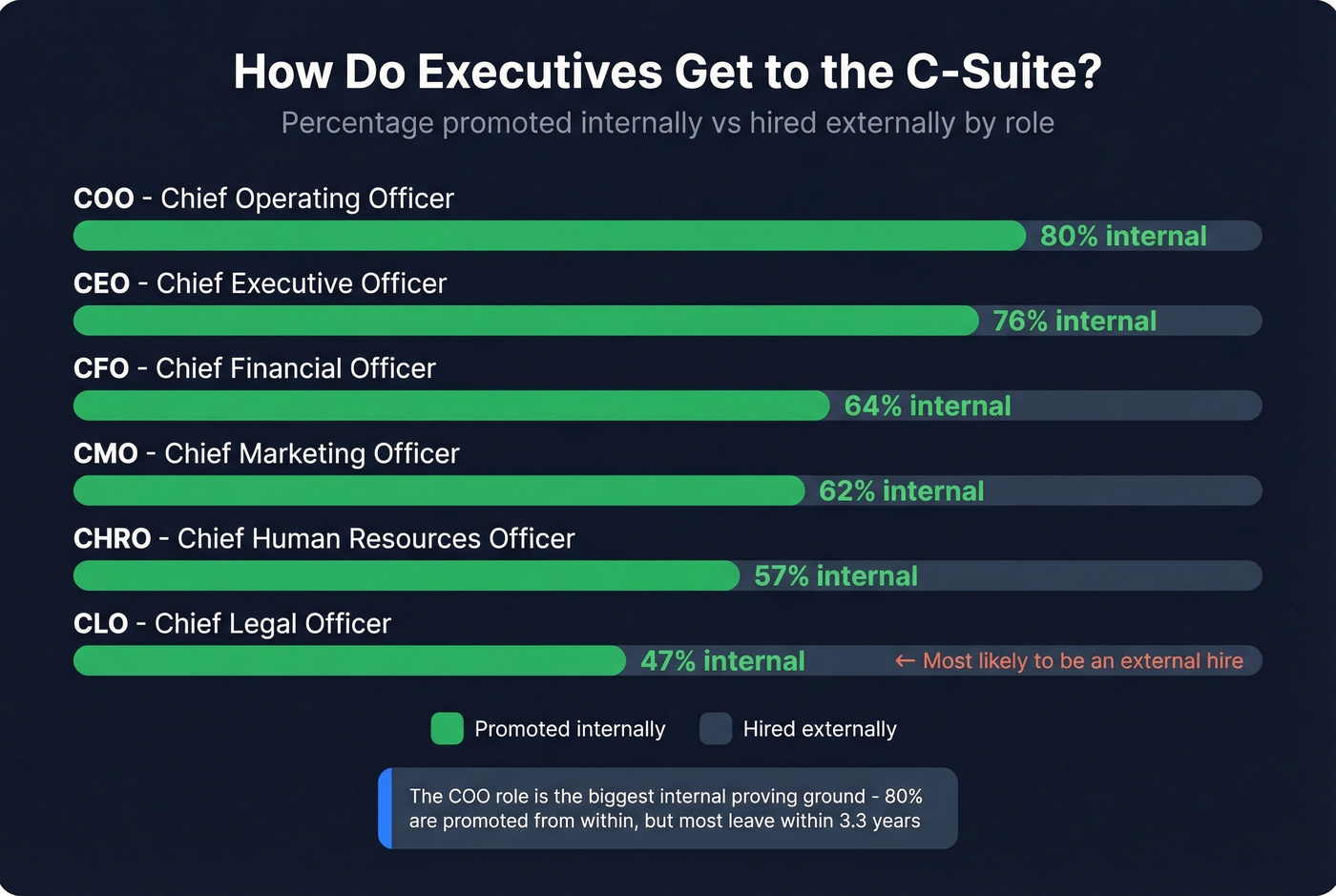
Average tenure for S&P 500 CEOs is 7.6 years; across the broader S&P 1500, it's 8.5 years - the longest of any C-suite role either way. 76% of sitting S&P 500 CEOs were internal promotions, though among 2025 new appointments across the S&P 1500, that figure drops to 60%. 84% of those appointees were first-time CEOs, most coming up through COO or divisional CEO roles. Only about 9% were promoted from the CFO seat.
Average base salary runs $814K nationally, though public-company CEOs with equity packages regularly earn $5M-$20M+ in total comp. And roughly 40% of CEOs who departed in 2025 left within their first five years. The role has a high washout rate despite the prestige.
CFO (Chief Financial Officer)
The CFO owns the financial health of the organization: financial planning, reporting, and analysis; capital structure and fundraising; investor relations and earnings communications; regulatory and audit compliance.
Average base salary is $437K. CFO total compensation typically runs 34-39% of CEO compensation. 64% of CFOs are promoted internally. Virtually every public company has one, and most growth-stage companies add the role around their Series A or B fundraise. The typical path to CFO runs through VP of Finance or Controller.
COO (Chief Operating Officer)
Only 284 of 503 S&P 500 companies even have a COO. The role is sometimes temporary - created when a company needs operational discipline during a transition and dissolved once the work is done.
When the role exists, the COO runs day-to-day operations: supply chain, manufacturing, service delivery, internal processes. They translate the CEO's strategy into execution and serve as the CEO's internal counterpart. The COO has the shortest average tenure of any C-suite role at just 3.3 years, and 80% are internal promotions. It's a proving ground, not a destination. Most COOs either get promoted to CEO or move on within three years.
CTO (Chief Technology Officer)
At startups, the CTO is often a co-founder who writes code. At enterprises, the CTO focuses on product roadmap, R&D strategy, and evaluating emerging technologies. Infrastructure often falls to the CIO. The CTO decides what gets built and how, leads technical architecture, and manages engineering teams.
Average base salary is $309K. The typical background is VP of Engineering or a senior technical leadership role at a peer company.
CIO (Chief Information Officer)
The CIO manages internal IT infrastructure, enterprise systems, cybersecurity posture, and digital transformation initiatives. Where the CTO looks outward at the product, the CIO looks inward at operations.
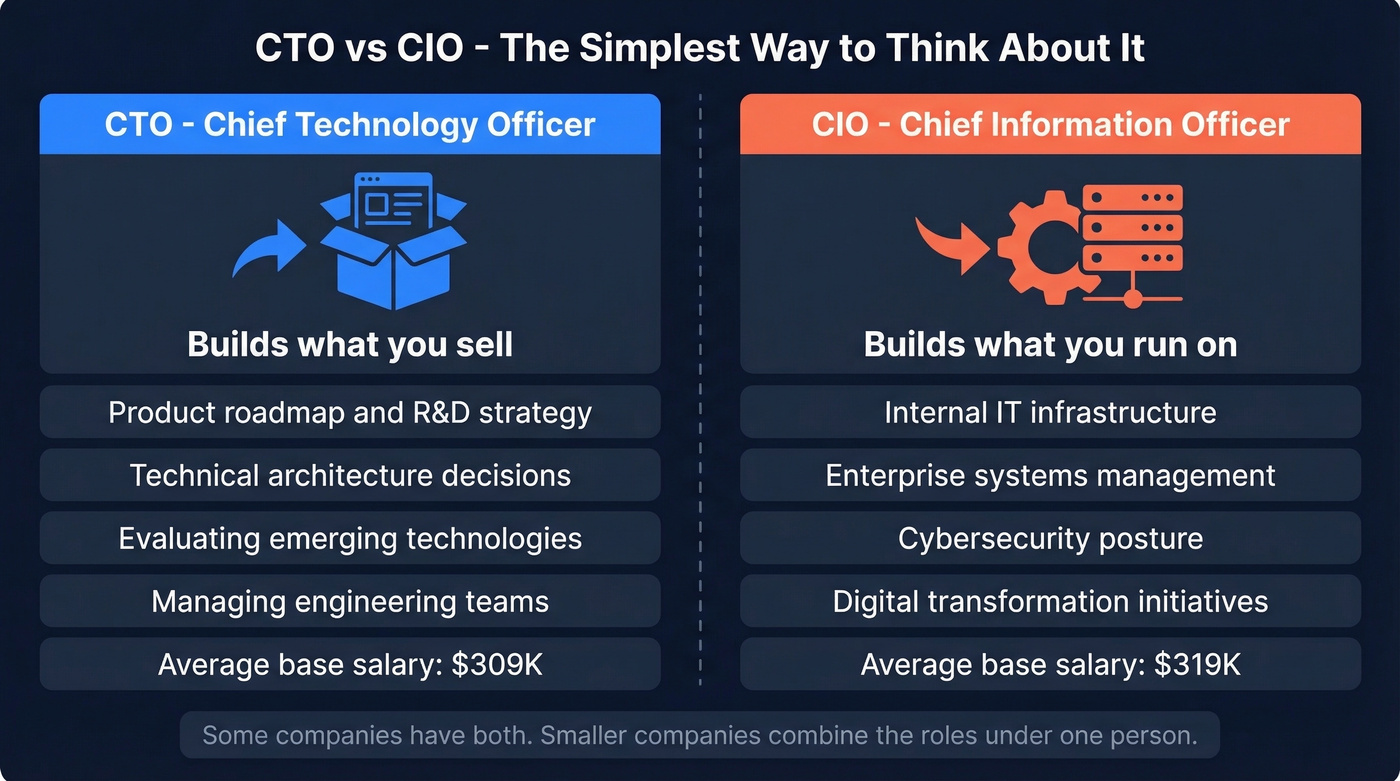
The CIO vs. CTO distinction trips people up constantly. The simplest way to think about it: the CTO builds what you sell; the CIO builds what you run on. Some companies have both. Smaller companies combine the roles under one person. Average base salary is $319K, with a 45% internal hire rate.
CMO (Chief Marketing Officer)
The CMO owns brand strategy, demand generation, market positioning, and increasingly, revenue attribution. The role has expanded significantly as marketing has become more data-driven and accountable - driving pipeline contribution, managing marketing analytics, and overseeing content, communications, and product marketing.
Average tenure is 4.1 years, shorter than most C-suite roles, reflecting the pressure CMOs face to show measurable pipeline impact. Average base salary is $373K, with about 62% promoted internally. Roughly two-thirds of S&P 500 companies have a CMO, though the title sometimes gets replaced with "Chief Growth Officer" or "Chief Revenue Officer" at companies that want marketing and sales under one leader.
Ask any startup founder who's hired a "CMO" at 20 employees - they'll tell you they really needed a Head of Marketing who could execute, not a chief who wanted to set strategy.
CHRO (Chief Human Resources Officer)
The CHRO leads people strategy: talent acquisition, compensation, organizational development, culture, and compliance with employment law. Average base salary is $349K, with 57% promoted internally.
The CHRO vs. CPO (Chief People Officer) distinction is worth noting. CHRO is more common in traditional and regulated industries where compliance and labor law are central. CPO tends to show up at tech companies and startups where culture, engagement, and employer branding are the primary focus. Same function, different emphasis.
Additional Executive Titles
Beyond the core set, these roles appear frequently enough that you'll run into them at mid-market and enterprise companies.
CLO / General Counsel
The Chief Legal Officer oversees all legal matters: contracts, litigation, regulatory compliance, intellectual property, and increasingly, AI governance and data privacy. Average tenure is 6.1 years - the second-longest in the C-suite after CEO. 47% are promoted internally.
AI regulation, data privacy laws like GDPR and state-level U.S. legislation, and ESG disclosure requirements have made legal a strategic function, not just a cost center. If your company doesn't have a CLO at the C-level, you're behind.
CRO (Chief Revenue Officer)
The CRO owns the full revenue cycle: marketing, sales, and customer success aligned under one leader. Average base salary is $337K. The role exists because companies got tired of marketing and sales blaming each other for missed targets. The CRO is supposed to fix that by owning the entire funnel. Among c-suite sales titles, the CRO has become the most common way organizations consolidate go-to-market accountability under a single executive.
CCO (Chief Commercial Officer)
The CCO is one of the highest-paid non-CEO roles in many organizations - at an average of $635K base, it's the highest-paid non-CEO title in this salary dataset. The title overlaps significantly with CRO; both own revenue. But the CCO often carries a broader mandate that includes partnerships, market expansion, and commercial strategy beyond just pipeline and bookings.
CISO (Chief Information Security Officer)
The CISO focuses exclusively on cybersecurity: threat detection, incident response, security architecture, and compliance with frameworks like SOC 2 and ISO 27001. The role is growing fast as cyber threats escalate. CISOs report to the CIO at some companies and directly to the CEO at others - the reporting line is a signal of how seriously the organization takes security.
Chief Communications Officer
About three-quarters of S&P 500 companies have a Chief Communications Officer. What's notable: 57% are external hires - the highest external hire rate of any role in Spencer Stuart's functional C-suite snapshot. This makes sense. Communications is one of the few functions where outside perspective and a fresh network are valued more than institutional knowledge.
Finding the Right Contact
If you're an SDR figuring out whether to email the CRO, CMO, or VP of Sales at a target account, understanding these distinctions matters. And once you know who to target, you need verified contact data - C-suite contacts churn fast with that 5.2-year average tenure. Prospeo's 7-day refresh cycle and 98% email accuracy keep outreach current even through executive turnover.


With 168 new S&P 1500 CEOs named last year and 5.2-year average tenure, the C-suite is a moving target. Prospeo tracks 300M+ professional profiles on a 7-day refresh cycle - so when a new CFO, COO, or CAIO steps in, you get their verified email (98% accuracy) before your competitors even update their spreadsheets.
Stop prospecting yesterday's org chart. Get real-time C-suite data.
The Acronym Collision Guide
Here's the thing: the acronym collisions are absurd. CCO means three different things depending on who you ask. This table should keep you sane:
| Acronym | Title 1 | Title 2 | Title 3 |
|---|---|---|---|
| CCO | Chief Commercial Officer | Chief Customer Officer | Chief Comms Officer |
| CDO | Chief Data Officer | Chief Digital Officer | - |
| CSO | Chief Security Officer | Chief Strategy Officer | Chief Sustainability Officer |
| CPO | Chief Product Officer | Chief People Officer | Chief Procurement Officer |
| CAO | Chief Administrative Officer | Chief Accounting Officer | - |
| CIO | Chief Information Officer | Chief Investment Officer | - |
The CIO collision is particularly confusing in financial services, where "Chief Investment Officer" is the more common usage. If someone at a hedge fund tells you they're the CIO, they're not managing the IT helpdesk.
When you encounter an ambiguous acronym, context is everything. Industry, company size, and the person's background will tell you which version of the title they hold. When in doubt, check their actual responsibilities - the title alone won't tell you enough.
Emerging C-Suite Titles in 2026
CAIO (Chief AI Officer)
The fastest-growing new C-suite role of the decade. 26% of organizations now have a CAIO, up from 11% just two years earlier, per IBM's Institute for Business Value survey of 2,300+ organizations. More than half report directly to the CEO or board.
The role has already evolved through two phases. The first wave of CAIO appointments in 2022-2023 was largely a signal of intent - boards wanted someone with "AI" in their title to show investors they were paying attention. CAIO 2.0 is different. Today's CAIOs are operational leaders responsible for embedding AI into production workflows, establishing responsible-use guardrails, defining ROI metrics, and coordinating models, data, and platforms across the organization. Named companies with CAIO roles include JPMorgan Chase, Walmart, Siemens, GE HealthCare, SAP, and Pfizer. Base salary ranges from $250K to $400K+, with total comp significantly higher when equity is included.
The CAIO overlaps with the CIO, CTO, and CDO in ways that aren't fully resolved yet. Some companies will eventually fold the CAIO responsibilities back into the CTO or CIO role once AI becomes as routine as cloud infrastructure. Others will keep it as a permanent seat at the table. We're still in the sorting-out phase.
Chief Sustainability Officer
ESG pressure from regulators, investors, and customers has pushed the Chief Sustainability Officer into the C-suite at many large enterprises. The role owns environmental strategy, carbon reporting, supply chain sustainability, and compliance with disclosure mandates like the EU's CSRD. Expect this title to become standard at public companies within the next few years.
Chief Data Officer
The CDO owns data governance, analytics strategy, and the organizational data infrastructure that feeds everything from AI models to marketing attribution. Don't confuse this with the Chief Digital Officer - same acronym, different job. The CDO is about data as an asset; the Chief Digital Officer is about digital transformation as a strategy.
Chief Transformation Officer
This role is temporary by design. The CTO - yes, another acronym collision - leads large-scale change programs: mergers, digital transformations, business model pivots. Once the transformation is complete, the role dissolves.
Chief Ethics & Compliance Officer
AI regulation and data privacy legislation are driving demand for this role. The Chief Ethics & Compliance Officer ensures the organization meets regulatory requirements and operates within ethical guardrails, particularly around AI deployment, data usage, and algorithmic decision-making.
C-Suite by the Numbers
Two tables tell most of the story.
S&P 500 C-Suite Snapshot
Spencer Stuart's S&P 500 snapshot highlights how uneven "standard" executive titles really are:
- 503 CEOs in the S&P 500 (co-CEOs included), but only 284 COOs.
- CFO and Chief Legal Officer are the next most common roles after CEO.
- Roughly two-thirds of S&P 500 companies have a CMO and about two-thirds also have a Chief Supply Chain Officer.
- About three-quarters have a Chief Communications Officer.
- Average tenure of sitting S&P 500 C-suite leaders: 5.2 years - CEOs at 7.6, COOs at 3.3, CMOs at 4.1, and Chief Legal Officers at 6.1.
- Internal appointments: 59% of functional C-suite leaders overall, with big differences by function.
C-Suite Salary Ranges (U.S. National Averages)
| Role | Low | Average | High |
|---|---|---|---|
| CEO | $640K | $814K | $1,005K |
| CCO | $476K | $635K | $887K |
| COO | $389K | $466K | $583K |
| CFO | $348K | $437K | $537K |
| CMO | $300K | $373K | $456K |
| CHRO | $287K | $349K | $409K |
| CRO | $291K | $337K | $406K |
| CIO | $244K | $319K | $425K |
| CTO | $257K | $309K | $373K |
| CAIO | $250K | ~$325K* | $400K+ |
| CSO | $179K | $215K | $251K |
CAIO average is estimated based on the $250K-$400K+ range reported by industry sources.
The gap between CEO comp and every other C-suite role is wider than most people realize. CEOs earn roughly 2-3x the average of their direct reports in base salary alone. Factor in equity, and the gap explodes. CEO pay has risen 30%+ since 2019, while inflation over the same period ran about 19%. Russell 3000 median CEO pay rose 5.3% from 2022 to 2023, and clawback policies are gaining momentum - boards are increasingly tying executive pay to performance with contractual recovery provisions.
CFOs generally earn 34-39% of CEO compensation. CMOs, CHROs, and CLOs fall in the 22-33% range. The CCO is a major outlier at $635K average - the highest-paid non-CEO role listed, reflecting the direct revenue accountability the position carries.
Why the C-Suite Keeps Growing
Deloitte's analysis of Fortune 500 composition and 46,000 C-suite job postings from 2018-2023 reached a clear conclusion: organizations are systematically adding more roles to the C-suite while expanding the scope of established ones.
The macro drivers are stacking up. AI governance demands a CAIO. Cybersecurity threats demand a CISO. Sustainability mandates demand a CSO. Data privacy regulations demand a Chief Ethics & Compliance Officer. Digital transformation demands a CDO. Each new pressure creates a case for a new chief.
CEO turnover is accelerating the trend. Those 168 new S&P 1500 CEOs represent the highest turnover since 2010. Small-cap companies saw the biggest increase in CEO transitions, and the tech sector nearly doubled, from 18 in 2024 to 33 in 2025. New CEOs bring new structures, and new structures mean new C-suite seats.
Let's be honest: stop adding C-titles and start defining accountability. The scope expansion Deloitte documents is creating ambiguity, not clarity. When the CAIO, CTO, CIO, and CDO all have overlapping AI responsibilities, nobody owns the outcome. A title isn't a strategy. An accountability matrix is. In our experience mapping org charts for outreach, the COO title is the most unreliable - it means something different at every company, and the consensus on r/sales is that "COO" at a 30-person startup and "COO" at a Fortune 500 are essentially different jobs.
When to Add Each Role
Not every company needs a full C-suite. Here's a stage-based framework.
Startup (1-50 employees): CEO plus CTO or a technical co-founder. Maybe a fractional CFO around fundraising. That's it. A 10-person company with a CEO, CTO, CFO, CMO, and COO has more chiefs than workers. Investors notice.
Growth stage (50-200 employees): Add a full-time CFO around your Series A or B - someone who can own financial planning, not just bookkeeping. Formalize the CTO role if your technical co-founder has been wearing multiple hats. Bring in a Head of People, not yet a CHRO - the title should match the scope. A VP of Marketing makes more sense than a CMO at this stage.
Scale stage (200-500+ employees): Now the C-suite starts filling out. CHRO, CLO, CIO or CTO (whichever you don't have), and CMO all become defensible. Consider a COO if operational complexity is outpacing the CEO's bandwidth. At 500+, a CRO makes sense if you're aligning marketing, sales, and customer success under one revenue leader. CISO becomes critical once you're handling sensitive data at scale.
Enterprise (1,000+ employees): Full C-suite. Evaluate CAIO, Chief Sustainability Officer, and CDO based on your industry and regulatory environment. Financial services and healthcare will need these roles sooner than most. Tech companies may fold AI responsibilities into the CTO role instead of creating a separate CAIO.
The key principle: add a C-level role when the function is strategic enough to warrant a seat at the executive table and complex enough that a VP can't own it alongside other responsibilities. If you can't articulate why the role needs board-level visibility, it's probably a VP.
Skip the title inflation if you're under $50M in revenue. Most companies at that stage don't need more than four c-suite titles - CEO, CTO or CIO, CFO, and one more based on your biggest strategic challenge. Every additional chief dilutes accountability and adds a coordination tax. The companies that execute best aren't the ones with the most chiefs; they're the ones where every chief owns a clear outcome.
Knowing that only 284 of 503 S&P 500 companies have a COO - or that the CCO earns $635K - is useful context. But context without contact data is just trivia. Prospeo gives you 30+ filters including job title, seniority, and department headcount so you can find the exact C-suite decision-maker at $0.01 per verified email.
Turn C-suite knowledge into booked meetings. 143M+ verified emails ready.
FAQ
What does the "C" in C-suite stand for?
"Chief." Every C-suite title begins with "Chief" - Chief Executive Officer, Chief Financial Officer, Chief Technology Officer, and so on. The term became common shorthand in the late 20th century for the cluster of top executives whose titles share that prefix and who hold strategic decision-making authority.
What's the highest-ranking C-suite title?
The CEO is the highest-ranking executive, reporting to the board of directors and overseeing all other C-suite members. The COO is typically second-in-command, followed by the CFO, though the exact power order varies by company and industry.
What's the difference between a CIO and a CTO?
The CTO focuses on product technology, R&D, and external-facing tech strategy - what you build and sell. The CIO manages internal IT infrastructure, enterprise systems, and security - what you run on. Some companies have both; smaller companies combine them under one person.
Which c-suite sales titles matter for prospecting?
CRO (Chief Revenue Officer) and CCO (Chief Commercial Officer) are the two most important. The CRO owns the full revenue cycle - marketing, sales, and customer success - while the CCO often carries a broader commercial mandate including partnerships. We've found that pairing the right title targeting with a data source that refreshes weekly makes a real difference, since C-suite contacts turn over faster than most teams expect.
How many C-suite roles does a typical company have?
It varies wildly. Startups may have one or two chief officers; large enterprises can have a dozen or more. Only 284 of 503 S&P 500 companies have a COO, so even "standard" titles aren't universal. The average S&P 500 company carries 5.2 years of tenure across its sitting C-suite leaders.