

Cold Email Templates for Research That Professors Actually Reply To
You sent 10 emails to professors last month and got zero replies. You're not alone - one student documented 525+ cold emails before landing a research position. Professors receive roughly 121 emails per day and spend about 11 seconds deciding whether to read or delete yours. A good cold email template for research outreach isn't about your qualifications. It's about how you're asking.
What You Need (Quick Version)
Three things separate emails that get replies from emails that get deleted:
- Reference one recent paper - something from the last 1-3 years, not their most-cited work
- Ask one specific research question - a question is easier to reply to than a request
- Send two follow-ups - one email isn't a real attempt
Keep your first email under 80 words. Everything below is the how.
Emails Professors Delete Instantly
A former associate professor on Quora listed the exact emails they never respond to:
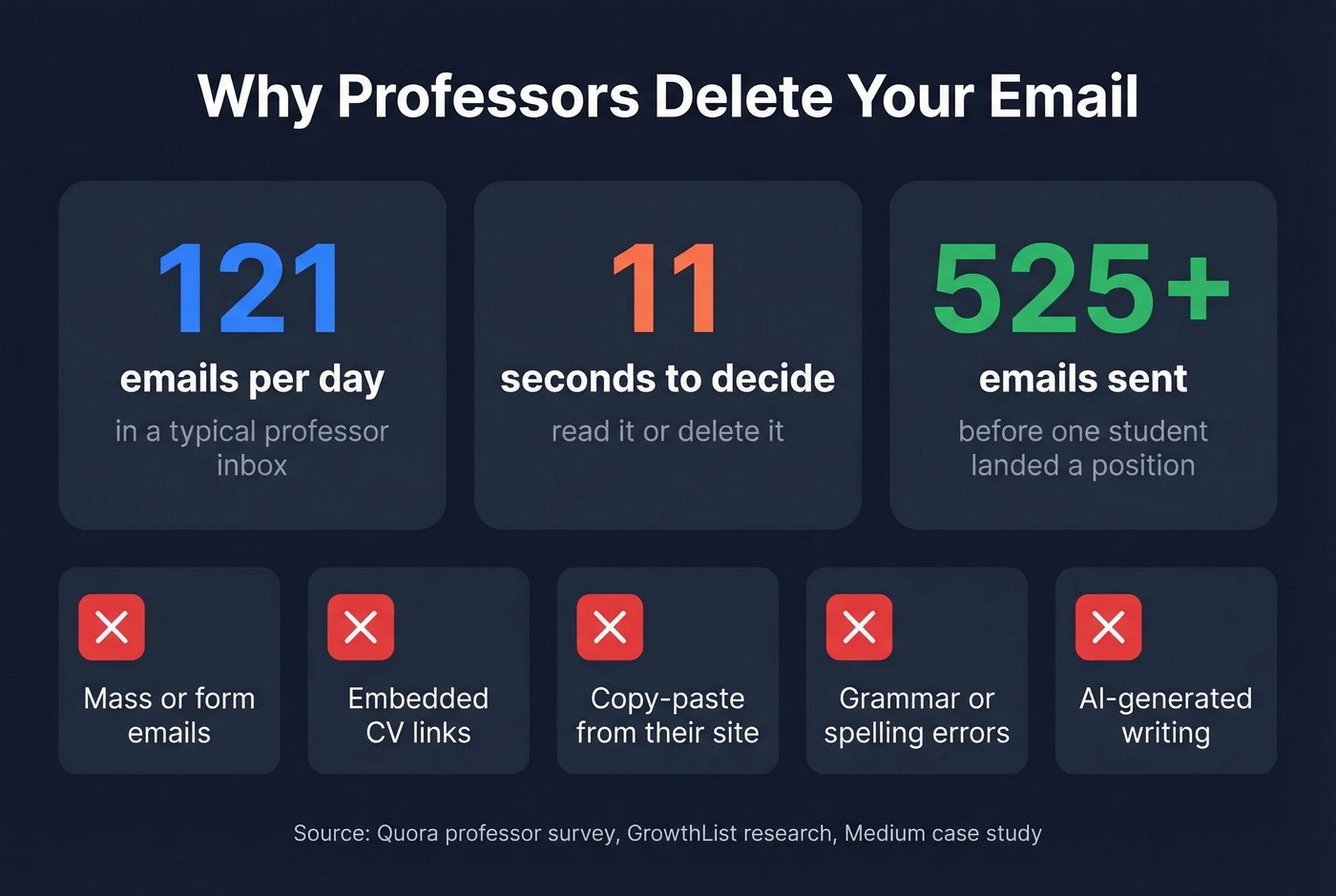
- Mass/form emails - anything that reads like it went to 50 people
- Embedded CV links - don't make them click to learn who you are
- Copy/paste from their website - they wrote it, they know what it says
- Grammar and spelling errors - especially misspelling their name or research area
- Demanding tone - "it would only take 1-2 hours of your time" is a delete trigger
One more from r/gradadmissions: professors spot AI-generated emails and delete them immediately. If ChatGPT wrote your email, they can tell. Write it yourself.
Build a Short List First
Don't email 20 professors with one template. Email 2-3 with real fit proof, then expand.
Harvard's URAF recommends tracking a simple shortlist: faculty name, what project interests you, and the specific questions you'd ask. Princeton's approach is even simpler - read one or two papers and check the lab's People page. That's your two-line personalization method.
Before you draft anything, prepare these details: your time commitment per week, your GPA or relevant coursework as a proxy for bandwidth, and your post-graduation goals. Professors care about these practical details more than a list of honors. If you can't articulate why this lab fits your trajectory, don't email them yet.
Bad vs. Good: A Side-by-Side
Here's what a weak email looks like next to a strong one. We've reviewed hundreds of these - the difference is always specificity.
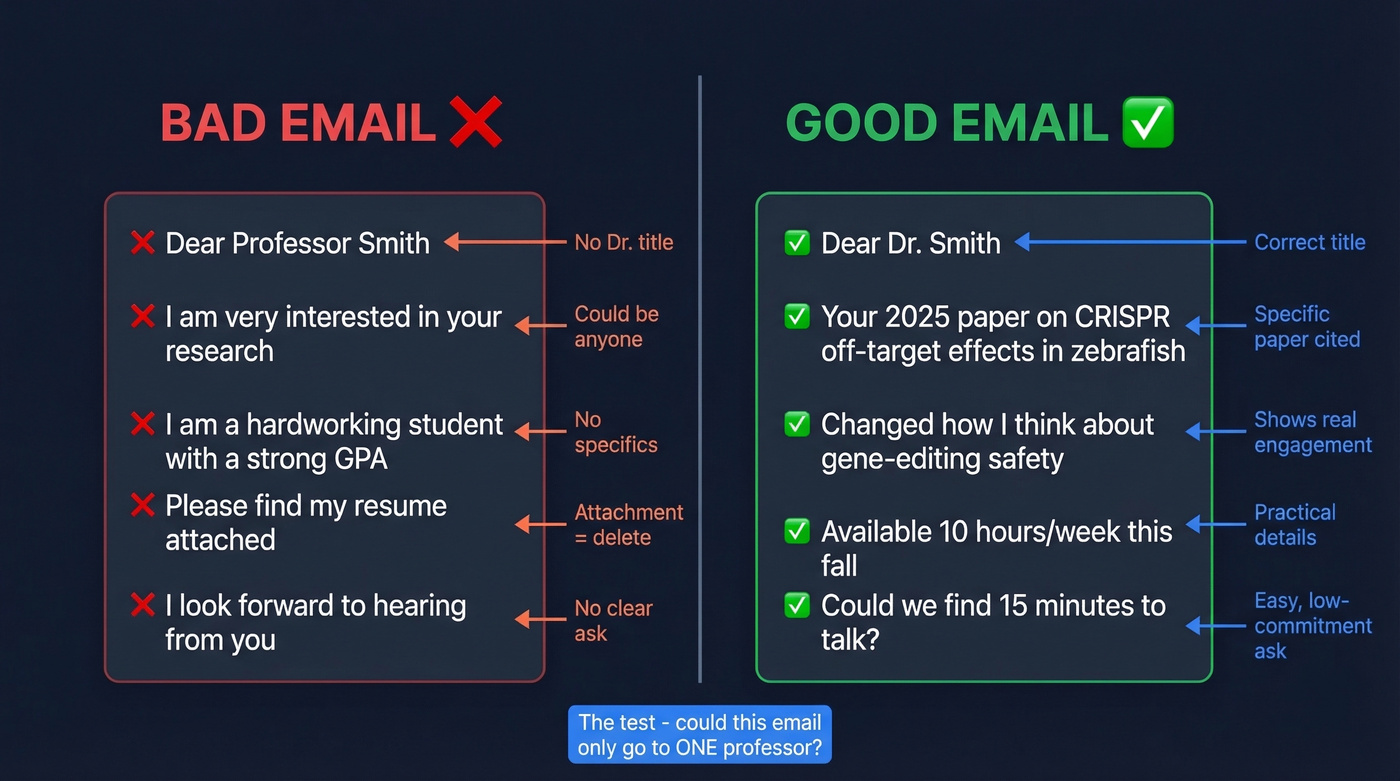
Bad:
Dear Professor Smith, I am very interested in your research and would love to join your lab. I am a hardworking student with a strong GPA. Please find my resume attached. I look forward to hearing from you.
Good:
Dear Dr. Smith, I'm a junior biology major at UMD. Your 2025 paper on CRISPR off-target effects in zebrafish changed how I think about gene-editing safety. I'm curious whether your lab is extending that work to other model organisms. I'm available 10 hours/week this fall - could we find 15 minutes to talk?
The weak version could go to any professor on earth. The strong version could only go to one. That's the test.
Templates for Research Positions
Undergrad (No Experience)
Subject: Undergraduate Research Opportunity - [Lab Name]
Dear Dr. [Last Name],
My name is [Name], a [year] [major] student at [University]. I read your [year] paper on [specific topic] and found [specific detail] particularly interesting because [one sentence why].
I'm available [X hours/week] starting [term] and would love to learn more about contributing to your lab. I've attached my resume and unofficial transcript.
Would you have 15 minutes to discuss current opportunities?
Best, [Name]
Why this works: The ask is a meeting, not a position. That's an easy yes. You're leading with their work, not your resume - exactly what the UofT Synapse guide recommends.
Undergrad (Some Experience)
Subject: Research Opportunity - [Specific Method/Topic]
Dear Dr. [Last Name],
I'm [Name], a [year] [major] at [University]. In [previous lab/course], I worked on [specific technique or project], which led me to your [year] paper on [topic]. Your approach to [specific method] connects directly to questions I've been exploring about [related area].
I'd love to contribute to [specific project or lab direction]. I'm available [hours/week] and comfortable with [relevant skill].
Could we find 15 minutes to talk?
Best, [Name]
Don't list every skill you have. Pick the one most relevant to their current work. As Princeton's guide puts it, a good cold email shows genuine interest and initiative - not how impressive you are.
Human-Subjects / IRB-Aware Lab
Subject: Research Assistant Inquiry - [Lab Name] Human Subjects Research
Dear Dr. [Last Name],
I'm [Name], a [year] [major] at [University]. I'm interested in your work on [specific study/topic] and am writing to ask about research assistant opportunities.
I've completed CITI training and understand IRB compliance requirements for human-subjects research. In [previous experience], I gained skills in data collection, participant scheduling, and protocol adherence.
Would you or your lab manager have time for a brief conversation about current openings?
Best, [Name]
Mentioning CITI training and IRB awareness signals you won't be a compliance liability - the Columbia IRB blog recommends this explicitly. Also note the ask targets "you or your lab manager." If the PI doesn't respond, emailing the lab manager or a grad student directly is a legitimate next step.
If you're in humanities or social sciences, swap "lab" for "research group" or "project team" and adjust the technical skills accordingly. The structure works the same.
Requesting Data or Collaboration
Subject: Prospective Graduate Student Question - [Research Area]
Dear Dr. [Last Name],
I'm [Name], completing my [degree] in [field] at [University]. My research on [topic] has focused on [brief description], and I've attached my CV for context.
Your [year] paper on [topic] resonated with my interest in [specific question]. I'm particularly curious about [one specific research question about their work].
Are you accepting graduate students for [year]? I'd welcome a brief call to discuss fit. If your lab isn't the right match, I'd appreciate any referrals.
Thank you, [Name]
Including "question" in the subject line makes it easier for a professor to justify opening the email - it signals a reply-worthy message, not a mass blast. The three-paragraph structure here (who you are, why this lab, a clear ask) is the proven format for grad applicants, and it works just as well when you're reaching out to request data from a researcher whose dataset complements your own.

Building your professor shortlist? Prospeo's Email Finder verifies addresses before you hit send - 98% accuracy across 300M+ professional profiles, including academia. Stop guessing at email formats and bouncing off university spam filters.
Get verified professor emails for $0.01 each. No bounces, no wasted outreach.
Subject Lines That Get Opened
Your subject line has one job: tell them exactly why you're emailing. No cleverness, no clickbait.
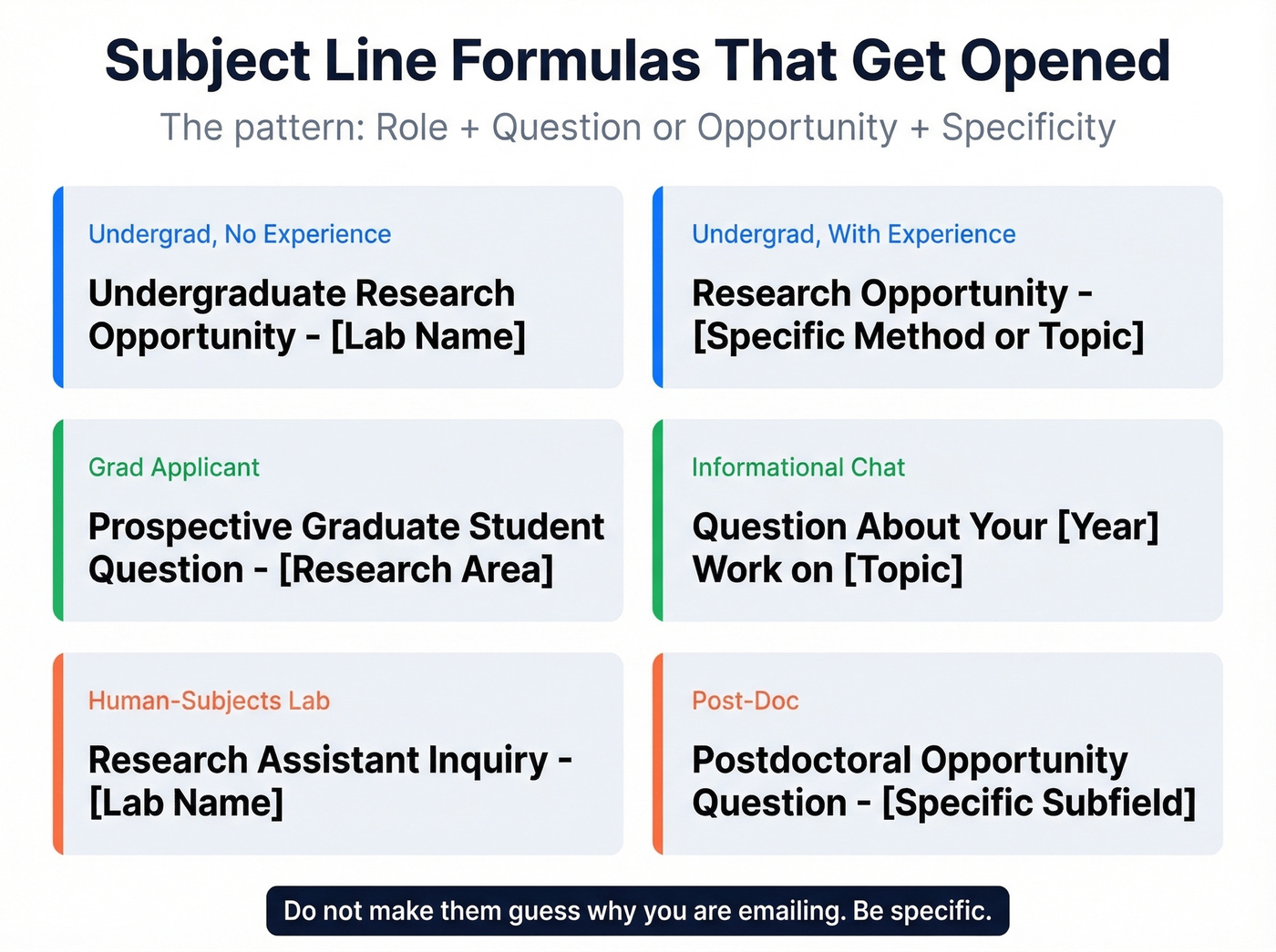
- Undergrad, no experience: "Undergraduate Research Opportunity - [Lab Name]"
- Undergrad, with experience: "Research Opportunity - [Specific Method or Topic]"
- Grad applicant: "Prospective Graduate Student Question - [Research Area]"
- Informational chat: "Question About Your [Year] Work on [Topic]"
- Human-subjects lab: "Research Assistant Inquiry - [Lab Name]"
- Post-doc: "Postdoctoral Opportunity Question - [Specific Subfield]"
The pattern is role + "question" or "opportunity" + specificity. Don't make them guess.
When to Send
Timing matters more than people think. Send your first email on a Tuesday-Thursday morning, ideally between 9-11 AM in the professor's time zone. Mondays are inbox graveyards. Fridays are mental checkout.
For grad and PhD applicants, start outreach several months before application deadlines - summer or early fall for most programs. If you share a mutual contact with the professor, ask that person to send a brief heads-up email before your cold outreach. This one move dramatically increases your odds of getting a reply.
The 3-Email Follow-Up Sequence
One email isn't a real attempt. The Instantly 2026 benchmark found that 42% of all cold email replies come from follow-up steps, and sending just two follow-ups increases response rates by 46% compared to a single outreach. In our experience, the second follow-up is where most academic replies actually come from - professors aren't ignoring you, they're buried.
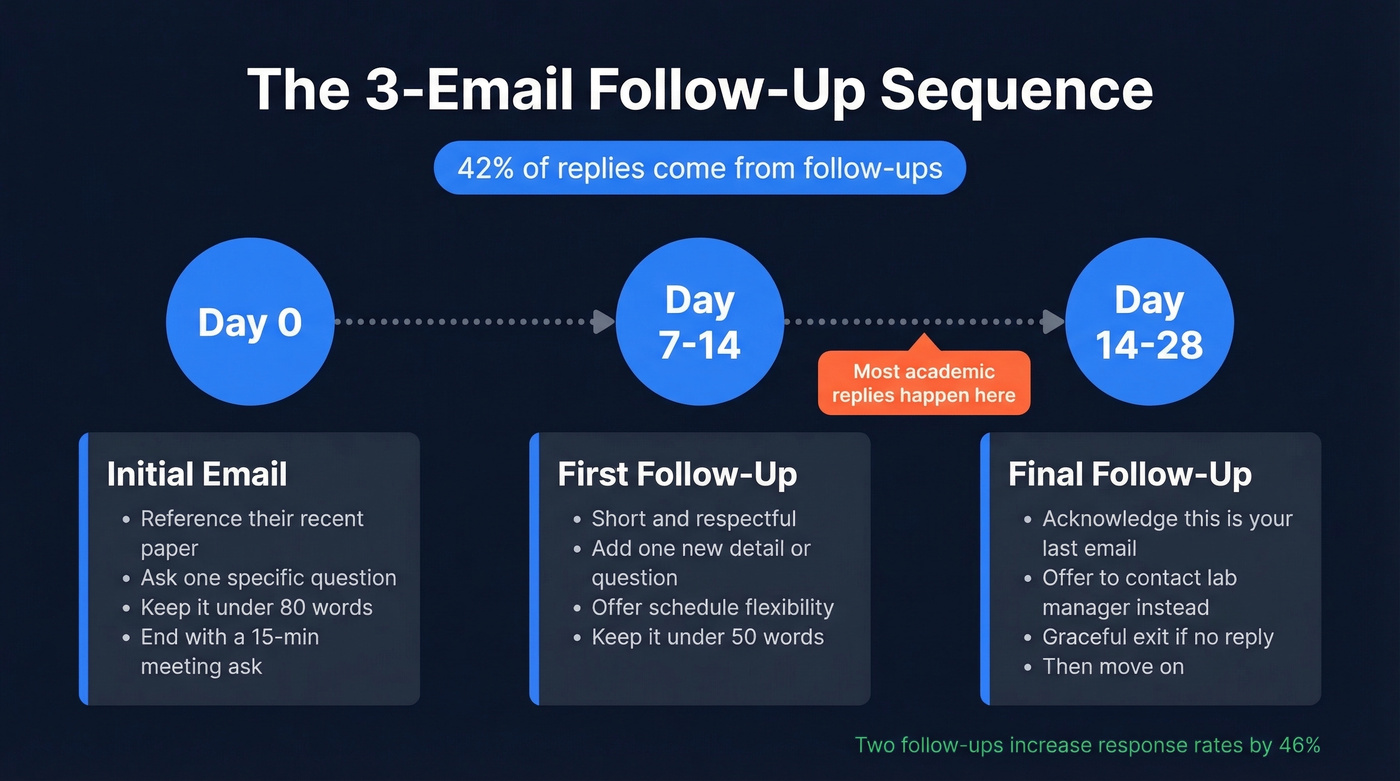
Day 0 - Initial email (use templates above)
Day 7-14 - First follow-up:
Dear Dr. [Last Name],
I wanted to follow up on my email about [specific topic/opportunity]. I understand you're busy - I'd be happy to work around your schedule for even a brief conversation.
[One new sentence: a question about their recent work, or a new reason for fit.]
Best, [Name]
Day 14-28 - Second follow-up:
Dear Dr. [Last Name],
I'm following up one last time regarding research opportunities in your lab. If the timing isn't right, I completely understand. Would it be helpful if I reached out to [lab manager name / grad student name] instead?
Thank you for your time, [Name]
Two follow-ups is the standard academic cadence. After that, move on - or email a lab manager or grad student directly.
When They Reply
You got a response. Don't blow it.
Reply within 24 hours, suggest 2-3 specific meeting times in their time zone, and prepare a one-page summary of their recent work and how your skills connect. Treat the meeting like a job interview: have two questions ready about their current projects and one concrete way you could contribute.
Finding Emails Beyond University Directories
Professors often list their email on department pages or in the "corresponding author" line of published papers. But when you're emailing researchers at think tanks, corporate R&D labs, or non-university institutes, their contact info often isn't public. Prospeo's email finder handles exactly this - it finds and verifies work emails across organizations with 98% accuracy, and the free tier gives you 75 verified emails per month.
What Reply Rate to Expect
Here's the thing: if your reply rate is below 15%, the problem isn't volume - it's personalization. Stop sending more emails and start writing better ones.
The Instantly 2026 benchmark puts average cold email reply rates at 3.43%, with top performers hitting 5.5%+. Those are B2B sales numbers. Personalized academic emails to well-researched professors should beat them handily. One student reported roughly two-thirds of 18 professors responded, and students on Reddit regularly report response rates in the 30-40% range when emails are well-researched. If you're following the templates above and actually doing the homework, expect 20-40% from a targeted shortlist. Volume with no personalization? You'll be closer to 5%.
You're crafting the perfect research cold email - don't let a wrong address kill it. Prospeo's Chrome Extension finds verified emails from any university profile page in one click. 40,000+ users already rely on it.
One click on a faculty page. Verified email, ready to send.
FAQ
How long should a research cold email be?
Under 80 words for the first email. The best-performing cold emails stay under this threshold, and professors spend about 11 seconds deciding whether to read or delete. Three short paragraphs maximum - intro, why this lab, and a single simple ask.
Is it okay to email multiple professors at once?
Yes, but never CC them on the same email. Start with 2-3 professors you've genuinely researched. Mass-sending identical templates gets you deleted - professors talk to each other, especially within the same department.
When should I follow up if a professor doesn't reply?
Wait 1-2 weeks, then send a short follow-up referencing your original message. Send a second follow-up 1-2 weeks after that. Two follow-ups is the standard academic cadence - after that, move on or email a lab manager or grad student instead.
What if I can't find a professor's email address?
Check the department directory, lab website, or recent publications - the corresponding author email is usually listed. For researchers at companies or non-university institutes, tools like Prospeo can find and verify work emails on a free tier.