

Common Objections in Court: The 2026 Reference Guide
You're on your feet, opposing counsel just asked a question that feels wrong, and you've got about two seconds to respond. Knowing which objection to raise - and why - is the difference between protecting your case and watching bad evidence land in front of the jury.
This guide covers every common objection you'll encounter at trial or deposition, with exact phrasing, Federal Rules of Evidence citations, and the judgment calls that separate effective advocates from noisy ones. Bookmark this.
Master these 5 objections first: relevance, hearsay, leading, foundation, and speculation. They cover most of what you'll encounter at trial or deposition. One key distinction to internalize early: at trial, the judge rules immediately (sustained or overruled). In depositions, your objection preserves the record, but the witness usually still answers - unless you're asserting privilege.
What Is a Courtroom Objection?
An objection is a formal protest made by an attorney (or self-represented party) when they believe a question, answer, or piece of evidence violates the rules of evidence or procedure. It's how you keep unreliable, irrelevant, or unfairly prejudicial material out of the record.
When you object, the judge makes one of two rulings. Sustained means the judge agrees - the question can't be answered, or the evidence is excluded. Overruled means the judge disagrees, and the questioning continues. The goal isn't to object constantly. It's to object at the right moments, with the right basis, so the record is clean and the jury hears only what the rules allow.
Five Objections That Cover Most Situations
If you're new to trial work or preparing for your first deposition, start here. These five come up in virtually every contested proceeding:
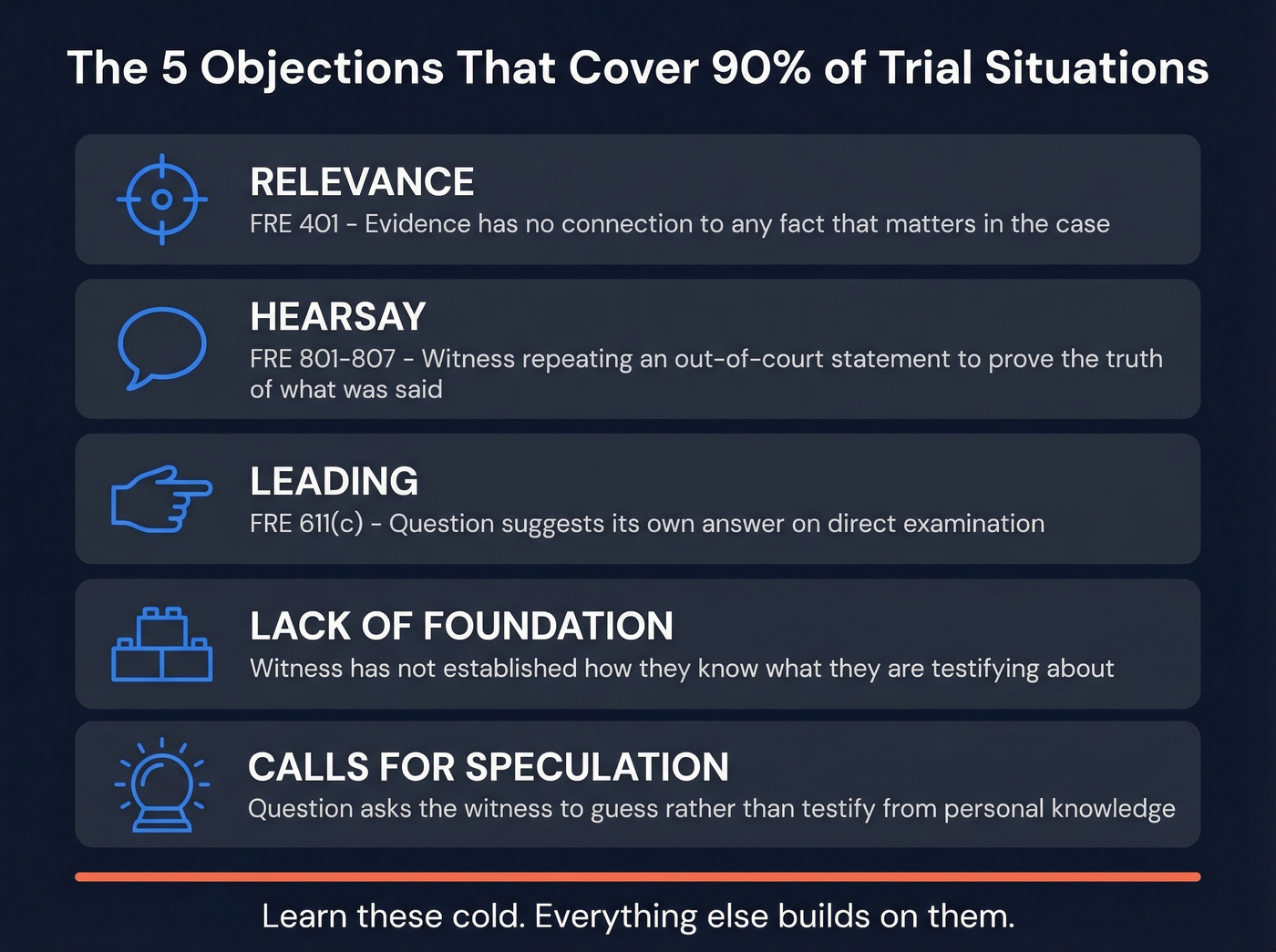
- Relevance - The evidence has no connection to a fact that matters in the case. (FRE 401)
- Hearsay - A witness is repeating an out-of-court statement to prove the truth of what was said. (FRE 801-807)
- Leading - The question suggests the answer, typically on direct examination. (FRE 611(c))
- Lack of foundation - The witness hasn't established how they know what they're testifying about.
- Calls for speculation - The question asks the witness to guess rather than testify from personal knowledge.
Learn these cold. Everything else builds on them.
Overcoming objections raised against your own questions is equally important - if opposing counsel objects, you need to know how to rephrase or lay the proper foundation to get your evidence admitted.
All Courtroom Objections by Category
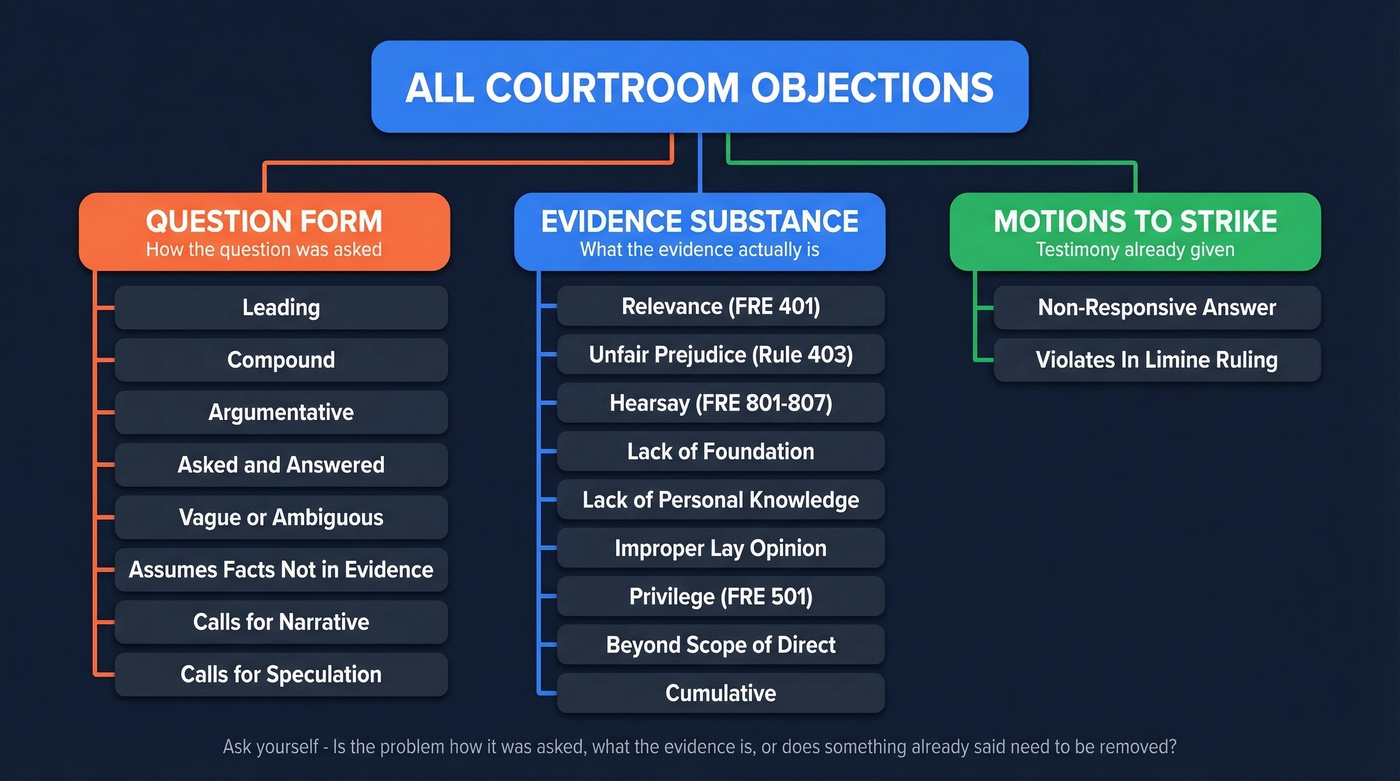
The cleanest way to organize courtroom objections is the three-bucket taxonomy: objections to the form of the question, objections to the evidence itself, and motions to strike testimony already given. Ask yourself whether the problem is how the question was asked (form), what the evidence is (substance), or whether something already said needs to be removed (strike). That fork determines which bucket you're in.
Objections to Question Form
These target how the question is asked, not the substance of the answer. Understanding the reasons for each helps you react faster under pressure.
Leading question. The question suggests its own answer - "You saw the defendant leave at 9 PM, didn't you?" Prohibited on direct examination under FRE 611(c), but perfectly fine on cross. Use this when opposing counsel is feeding answers to their own witness on direct.
Compound question. Two or more questions jammed into one: "Did you go to the store and talk to the manager?" The witness can't answer clearly because they might have done one but not the other. Object to force counsel to break it apart.
Argumentative. The attorney isn't asking a question - they're badgering the witness. Use this when cross-examination stops being inquiry and starts being a closing argument directed at the witness.
Q: "So you expect this court to believe you just happened to be there by coincidence?" Opposing counsel: "Objection, Your Honor - argumentative."
Asked and answered). The witness already answered this question. Counsel is repeating it hoping for a different response. Judges sustain this quickly because it wastes time.
Vague or ambiguous. The question is so unclear the witness can't reasonably understand what's being asked. "What happened with the thing?" isn't a proper question.
Assumes facts not in evidence. The question bakes in a factual premise that hasn't been established - "When did you stop stealing from the company?" assumes stealing occurred. If no evidence of theft is in the record, object immediately.
Calls for a narrative. An open-ended question inviting the witness to tell a story rather than answer a specific point. "Tell us everything that happened that day" gives the witness too much latitude and makes it nearly impossible to object to individual statements within the answer.
Calls for speculation. The question asks the witness to guess about something outside their personal knowledge. Unless the witness is qualified as an expert, they can't speculate about another person's intentions or plans.
Objections to the Evidence
These challenge whether the evidence itself - testimony, documents, physical items - should be admitted.
Relevance (FRE 401). Evidence must make a fact of consequence more or less probable. If it doesn't, it's irrelevant and inadmissible. This is the most common objection for a reason: it's the first filter everything has to pass through.
Unfair prejudice / Rule 403. Even relevant evidence can be excluded if its probative value is substantially outweighed by unfair prejudice, confusion, or waste of time. Classic example: introducing a defendant's prior jail history when it has minimal relevance to the current charge. We've seen this one swing entire trials - a gruesome photo that's technically relevant but designed to inflame the jury can do more damage than any testimony.
Hearsay (FRE 801-807). An out-of-court statement offered to prove the truth of the matter asserted. "My neighbor told me the defendant was speeding" is textbook hearsay - the neighbor isn't on the stand and can't be cross-examined. The hearsay rules contain dozens of exceptions (excited utterance, business records, statements against interest), so the objection often triggers a mini-argument about which exception applies.
Lack of foundation. The witness hasn't established the basis for their testimony. If someone testifies "That was John's voice on the phone," they need to first explain how they know John's voice:
Q: "Are you familiar with John's voice?" A: "Yes, we've worked together for six years." Q: "Did you recognize the voice on the call?" A: "Yes, it was John."
Without that predicate, the identification is objectionable.
Lack of personal knowledge (FRE 602). A witness can only testify about things they personally observed or experienced. "I heard from Sarah that the contract was signed" isn't personal knowledge - it's secondhand.
Improper lay opinion (FRE 701). Non-expert witnesses can offer opinions only if they're rationally based on their perception and helpful to the jury. A lay witness can say "He seemed drunk." They can't say "His blood alcohol was above .08."
Privilege (FRE 501). Attorney-client, doctor-patient, spousal - privileged communications are protected from disclosure. This is one of the few objections that can actually prevent a deposition witness from answering.
Beyond the scope of direct (FRE 611(b)). On cross-examination, questions must relate to topics covered during direct. If direct covered the contract negotiation, cross can't suddenly pivot to the witness's personal finances unless the judge allows it.
Cumulative (Rule 403). The evidence is repetitive. The point has already been made through other testimony or exhibits. Judges have discretion to exclude cumulative evidence to keep the trial moving.
Motions to Strike
Motions to strike address testimony that's already been given. The most frequent scenario is a non-responsive answer - the witness goes off on a tangent unrelated to the question. You move to strike the non-responsive portion, and the judge typically issues a curative instruction telling the jury to disregard it.
The other scenario involves testimony that violates a prior in limine ruling - the judge already decided certain evidence was inadmissible, and someone introduced it anyway. Same remedy: strike it from the record and instruct the jury.
How Objections Work in Depositions
Depositions play by different rules than trial. The distinction trips up even experienced attorneys.
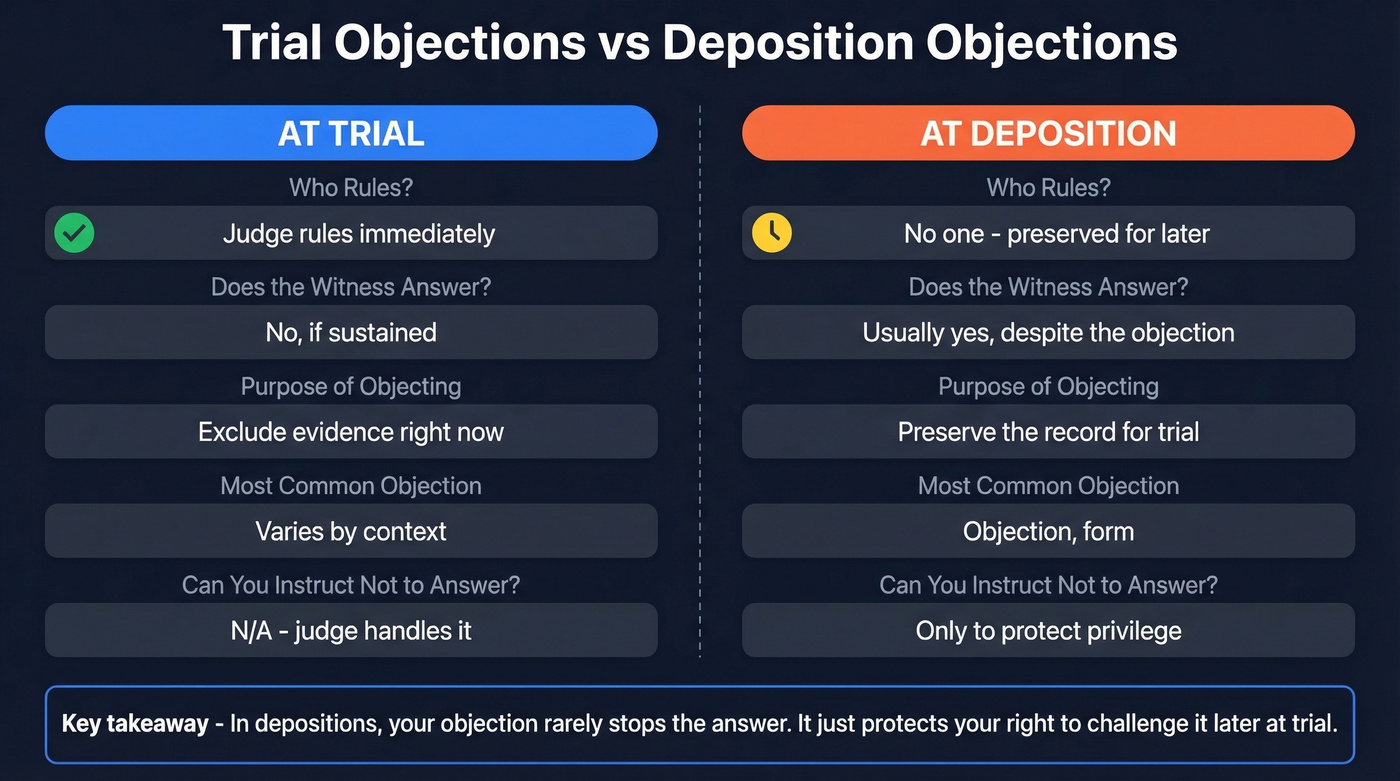
| Trial | Deposition | |
|---|---|---|
| Who rules? | Judge, immediately | No one (preserved for later) |
| Does the witness answer? | Not if sustained | Usually yes, despite objection |
| Purpose of objecting | Exclude evidence now | Preserve the record for trial |
| Most frequent objection | Varies by context | "Form of the question" |
| Can you instruct not to answer? | N/A | Only for privilege |
Here's the thing: objections in depositions preserve your right to challenge the testimony later, but they rarely stop the answer in real time. Discovery is broad, and courts want the record complete. Rocket Matter's deposition guide lays this out well.
"Form of the question" is the Swiss Army knife of deposition objections. It covers leading, compound, vague, and argumentative questions in a single phrase. In many depositions, lawyers keep it to "objection, form" without elaborating, because anything more risks a speaking objection - and speaking objections are a fast track to sanctions in some jurisdictions.

Courtroom objections protect your case. In sales, the best way to overcome objections is reaching the right person with verified data. Prospeo gives you 98% accurate emails and 125M+ verified mobile numbers so your outreach connects before objections even start.
Stop objecting to bad data - start closing with verified contacts.
After a Sustained Objection
When the judge sustains your objection, the most common outcome is a curative instruction - the judge tells the jury to disregard what they just heard. For contested rulings, either side can request a sidebar or bench conference to argue the point outside the jury's hearing.
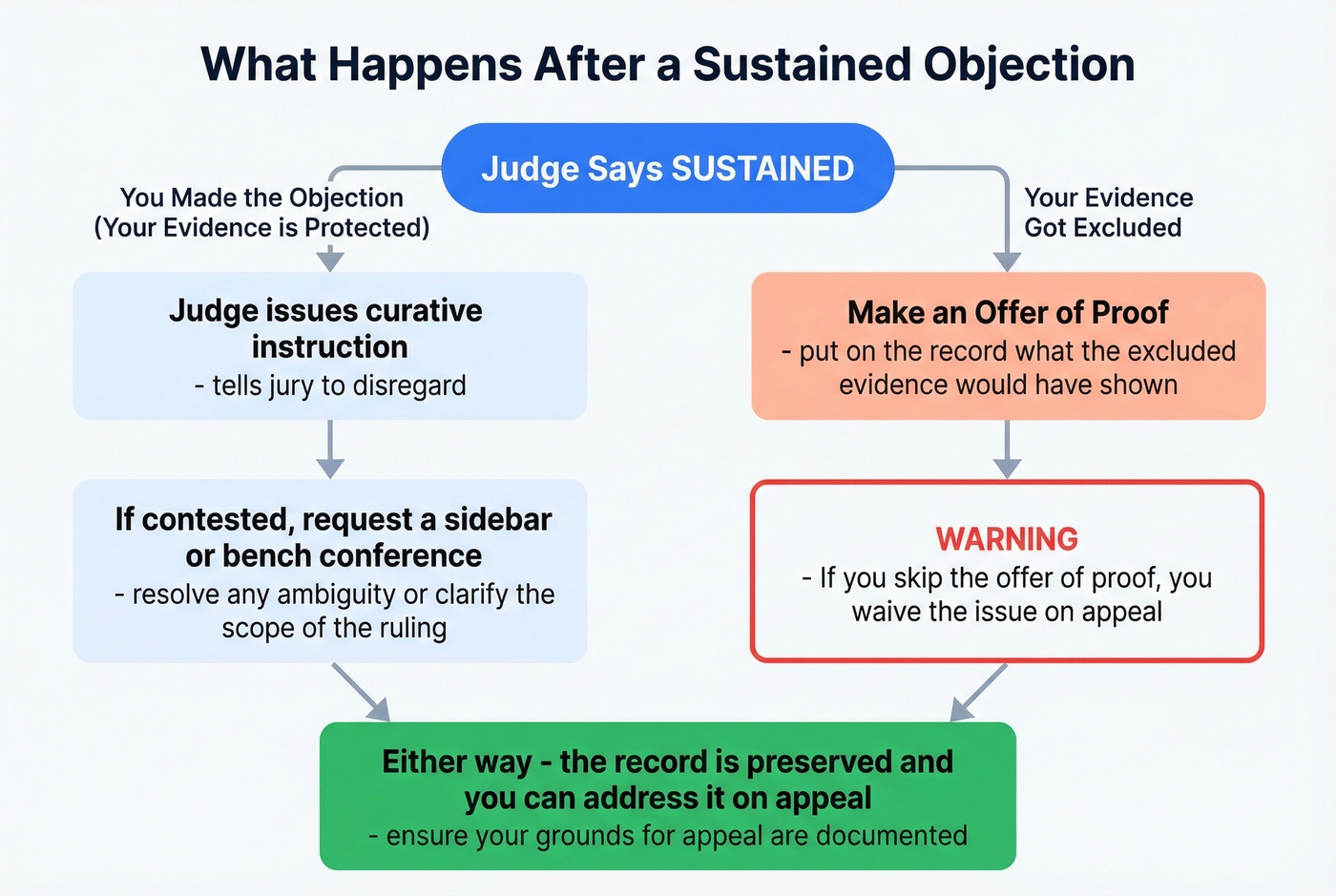
Here's what most people forget: if your evidence gets excluded, you need to make an offer of proof. This means putting on the record what the excluded evidence would have shown. Without it, you lose the ability to challenge the ruling on appeal. The offer of proof is your insurance policy - skip it, and you've waived the issue.
When NOT to Object
Let's be honest: the best trial attorneys object less than you think.
Over-objecting is one of the fastest ways to alienate a jury. Every time you stand up and say "objection," the jury wonders what you're trying to hide. If the answer won't hurt your case, let it go. Judges get fatigued too. I've watched attorneys memorize every FRE rule number but completely lack the judgment to pick their battles - an attorney who objects to every third question loses credibility on the objections that actually matter.
The materiality threshold is simple: if the testimony doesn't move the needle on a contested fact, save your objection for something that does. Skip the technicalities. Save your credibility for the one objection that changes the case.
Objections Beyond the Courtroom
The courtroom isn't the only place where objections matter. Sales professionals face buyer objections every day - price pushback, timing concerns, competitor comparisons - and the underlying skill is the same: listen to the specific reason for the objection, address it directly, and move forward.
In sales, unsolved objections kill deals the way unsustained objections let bad evidence into the record. The unspoken concern a prospect never voices is analogous to a waived objection at trial: if it's never raised, it can't be addressed, and the outcome suffers. Whether you're surfacing buyer concerns in a discovery call or raising a hearsay objection at trial, the discipline is identical - identify the problem, articulate it precisely, and resolve it before it does damage. Tools like Prospeo help sales teams do the research upfront so they can anticipate objections before the call even starts, but the core skill is the same one trial lawyers drill: preparation beats improvisation.
Objection Cheat Sheet
| Objection | Definition | Example Phrasing | FRE Rule |
|---|---|---|---|
| Relevance | No connection to a fact at issue | "Objection, relevance" | 401 |
| Unfair prejudice | Probative value substantially outweighed by harm | "Objection, 403 - prejudicial" | 403 |
| Hearsay | Out-of-court statement for truth | "Objection, hearsay" | 801-807 |
| Leading | Suggests the answer on direct | "Objection, leading" | 611(c) |
| Compound | Multiple questions in one | "Objection, compound" | - |
| Argumentative | Arguing, not questioning | "Objection, argumentative" | - |
| Asked and answered | Already responded to this | "Asked and answered" | - |
| Vague/ambiguous | Question is unclear | "Objection, vague" | - |
| Assumes facts | Embeds unproven premise | "Assumes facts not in evidence" | Common law |
| Calls for narrative | Invites open-ended story | "Objection, narrative" | - |
| Calls for speculation | Asks witness to guess | "Objection, speculation" | - |
| Lack of foundation | Basis not established | "Objection, foundation" | - |
| Lack of personal knowledge | Witness didn't observe it | "Objection, personal knowledge" | 602 |
| Improper lay opinion | Non-expert giving expert opinion | "Objection, improper opinion" | 701 |
| Privilege | Protected communication | "Objection, privilege" | 501 |
| Beyond scope | Cross exceeds direct topics | "Beyond the scope of direct" | 611(b) |
| Cumulative | Evidence is repetitive | "Objection, cumulative" | 403 |
| Non-responsive (motion) | Answer doesn't match question | "Move to strike, non-responsive" | - |
Great lawyers prepare for every objection. Great sales teams eliminate them by targeting in-market buyers with intent data across 15,000 topics. Prospeo's 300M+ profiles and 30+ filters help you reach decision-makers who actually want to hear from you.
Bypass sales objections entirely - prospect smarter for $0.01 per lead.
FAQ
Can you object in small claims court?
Yes, but keep it informal. Small claims judges rarely expect FRE citations - use plain-language protests like "that's not relevant" or "they're repeating what someone else told them." Formal rule numbers will annoy the judge more than help your case.
What's a speaking objection?
A speaking objection goes beyond stating the basis and argues the reasoning, which risks coaching the witness. Judges dislike them, and in depositions they can draw sanctions. State "objection, form," sit down, and save the argument for the bench conference.
How do you preserve an objection for appeal?
Make a timely, specific objection on the record when the evidence is offered. If you fail to object, you waive the issue. For recurring evidentiary problems, request a continuing objection so you don't need to stand up each time the same evidence category arises. Cornell's LII overview of FRE 103 breaks down the preservation requirements in detail.
Are sales objections related to courtroom objections?
Only loosely. In court, an objection is a procedural tool governed by the Federal Rules of Evidence. In sales, objections are buyer concerns - price, timing, need - that require persuasion rather than legal authority. The shared skill is active listening: identifying the real reason behind the objection and responding with precision.