


7 Best Common Room Alternatives in 2026
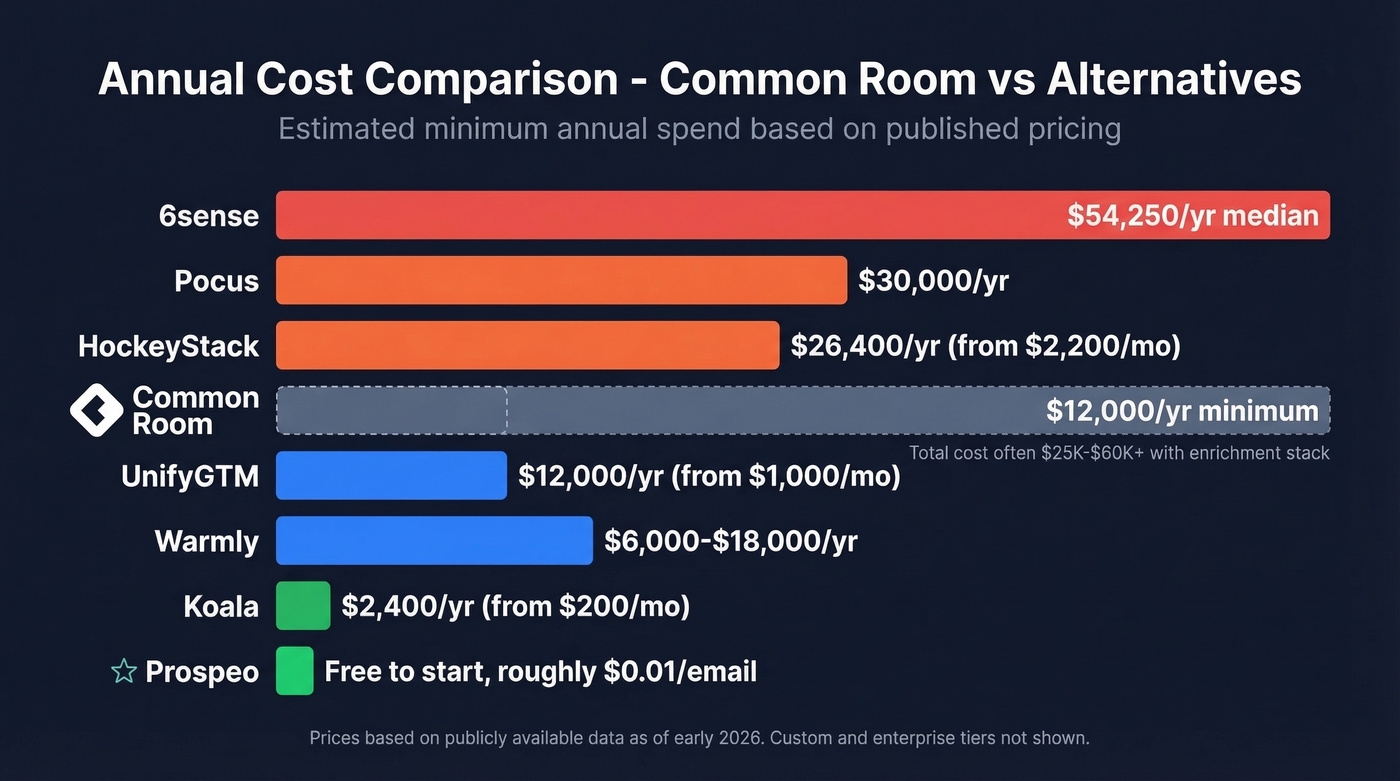
Common Room (4.5/5 on G2, 106 reviews) aggregates buying signals, resolves identities, and tracks community activity. It's a strong product. But at $12K/year minimum for a Starter plan with just 2 seats and 35K contacts, cost escalation hits fast - Team and Enterprise tiers are custom-priced, and many teams land in the $30K-$60K+ range once you factor in contacts, seats, and add-ons.
You're not the only one looking for alternatives. G2 reviewers consistently flag a steep learning curve, limited customization around alerts and email digests, and missing features like data syncing and account ownership visibility. The Chrome extension doesn't work in Sales Navigator either, which is a dealbreaker for plenty of outbound teams.
Here's the deeper issue: Common Room surfaces signals beautifully, then leaves you stacking separate enrichment and outreach tools to actually act on them. That gap between "knowing" and "doing" is where money disappears. Let's look at seven replacements worth evaluating, organized by what you actually need.
Quick Comparison
| Tool | Best For | Starting Price | G2 Rating |
|---|---|---|---|
| Prospeo | Verified contact data & email accuracy | Free; ~$0.01/email | - |
| Koala | Budget signal intel | Free; from $200/mo | - |
| UnifyGTM | Signals + outbound | From $1,000/mo | - |
| Pocus | PLG sales motions | From $30K/yr | 4.4/5 |
| Warmly | Visitor identification | Free; ~$500-$1,500/mo | 4.6/5 |
| 6sense | Enterprise ABM | ~$54K/yr median | - |
| HockeyStack | Revenue attribution | From $2,200/mo | - |
Signal vs. Execution vs. Data Accuracy
Before picking a replacement, understand what you're actually replacing. These tools fall into three buckets.
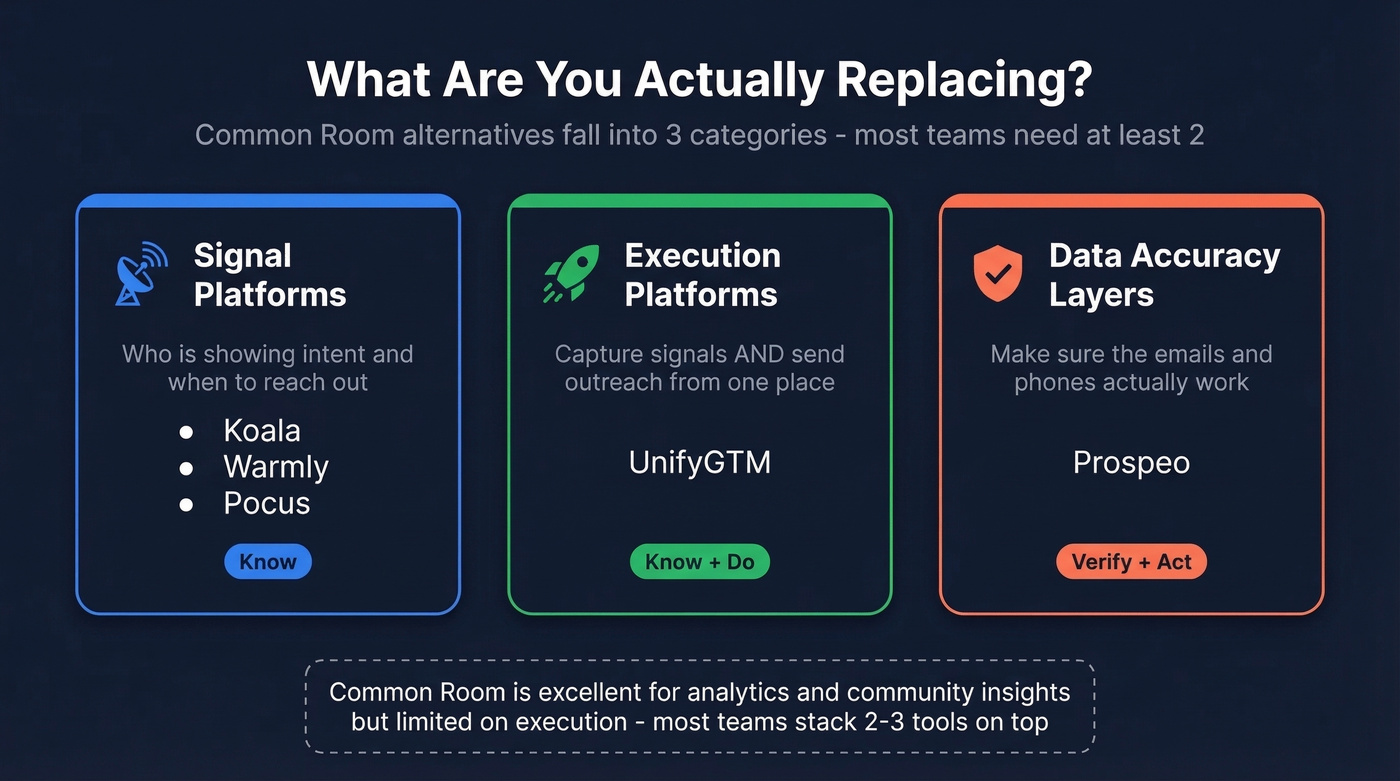
Signal platforms (Koala, Warmly, Pocus) tell you who's showing intent and when to reach out. Execution platforms (UnifyGTM) capture signals and send the outreach from the same place. Data accuracy layers make sure the emails and phone numbers you're acting on actually work. One Reddit thread nails it: Common Room is "excellent for analytics/community insights but limited on execution." Most teams need at least two of these three categories covered.
Here's our hot take: the biggest hidden cost of Common Room isn't the subscription. It's the enrichment and verification tools you stack on top. We've seen teams under 10 reps routinely push past $25K/year in total spend once you add a sequencer, a data provider, and an email verification service. That's the real number to beat.
The Best Common Room Alternatives
Prospeo - Verified Contact Data
Common Room's built-in database creates a bounce-rate problem most teams don't notice until their first big sequence tanks deliverability. Prospeo covers 300M+ professional profiles with 98% email accuracy and 125M+ verified mobile numbers hitting a 30% pickup rate. Data refreshes every 7 days - the industry average is closer to 6 weeks, which means most providers are serving you stale records while charging a premium for them.

The intent data gap is stark. Common Room's Starter plan includes 6 Bombora Company Surge topics. Prospeo covers 15,000. Combined with 30+ search filters spanning buyer intent, technographics, job changes, headcount growth, and funding signals, you get signal and data quality in one layer instead of two or three. Meritt cut their bounce rate from 35% to under 4% after switching and tripled pipeline from $100K to $300K/week. Everything is self-serve with no contracts - start free with 75 verified emails and 100 Chrome extension credits per month, then scale at roughly $0.01 per email. For teams whose real bottleneck is contact data quality rather than signal aggregation, this is where the money should go first.
Koala - Budget Signal Platform
Koala is a strong low-cost way to get signal intelligence without a $12K/year annual commitment. The free tier gives you 2 seats and 100 credits/month with full feature access - company deanonymization, identity graph, waterfall enrichment, intent scoring, Slack alerts, and CRM integrations. Teams that just need to know who's showing intent can run Koala indefinitely at zero cost.
The catch: Koala tells you who to contact but doesn't send the emails. You'll still need a sequencer and a verified data source on top of it. Pricing tiers are transparent - Starter at $200/mo (1,000 credits), Growth at $1,000/mo (5,000 credits, 14-day free trial), and Business at custom pricing. That Growth tier matches Common Room Starter's $1,000/mo starting price, but with annual billing on Common Room's side. Skip Koala if your team needs execution baked in - you'll end up rebuilding the same tool-stacking problem you're trying to escape.
UnifyGTM - Signal-to-Outbound Execution
UnifyGTM closes Common Room's biggest gap: it captures signals and sends the outreach from the same platform. No stitching together multiple tools. Intent sources include website intent, 6sense, G2, job changes, and social signals, all feeding directly into automated plays with managed Gmail mailboxes.
Credit-based pricing is unusually transparent. A company reveal costs 0.1 credits, an email costs 2, a phone number costs 4. The monthly Growth plan starts at $1,000/mo with 2,500 credits, 5 managed mailboxes, and 3 platform users. The annual Growth plan runs $1,740/mo billed annually and includes 50,000 credits for the year - a much better per-credit rate. Extra mailboxes run $20-$25/mo depending on plan. Teams consolidating from Common Room plus a sequencer plus a data provider into UnifyGTM often reduce total stack spend by 30-40%. The tradeoff is that UnifyGTM's signal coverage isn't as broad as Common Room's community-focused aggregation, so if community analytics drive your strategy, this won't fully replace it.
Pocus - PLG Sales Motions
Teams running product-led growth with product-usage data feeding sales workflows will get the most from Pocus. The AI playbooks connect product signals to rep actions, and the personalization layer drives real PQL-to-SQL conversion. At $30K/year for 20 seats with unlimited AI usage, it's priced for teams all-in on product-led sales.
G2 reviewers (4.4/5, 134 reviews) flag occasional data inaccuracies and the tool surfacing accounts reps are already working. Test before committing. If your primary need is outbound prospecting or community signal aggregation, look elsewhere - Pocus is purpose-built for the PLG motion and doesn't pretend otherwise.
Warmly - Visitor Identification
Warmly focuses on real-time website visitor identification with instant Slack alerts. At 4.6/5 on G2 with 203 reviews, it's the highest-rated tool on this list. Users consistently praise the ease of setup and the Slack integration workflow. The free tier makes it easy to test, and paid plans run roughly $500-$1,500/mo depending on traffic volume.
Worth knowing: visitor identification accuracy varies and tends to be weaker for smaller, less well-known companies. If your ICP is mid-market and up, Warmly works great. If you're targeting early-stage startups, expect gaps in coverage.
6sense - Enterprise ABM
6sense is predictive ABM at enterprise scale - buying stage classification, intent orchestration, the full suite. Vendr pegs the median contract at $54,250/year, and full deployments typically land in the mid-five to six figures. Best for teams with 50+ reps and dedicated ops resources. Overkill for everyone else.
HockeyStack - Revenue Attribution
HockeyStack is a revenue analytics platform, not a prospecting tool. Multi-touch attribution, buyer path analytics, and account scoring starting at roughly $2,200/mo with a median contract around $28K/year. If your problem is "we don't know which channels drive pipeline," HockeyStack answers that. If your problem is "we need more pipeline," it won't help - look at the other tools on this list instead.

Common Room's biggest hidden cost is the enrichment stack you build on top. Prospeo gives you 15,000 intent topics, 300M+ profiles, and 98% verified emails - signal and data quality in one platform at ~$0.01/email.
Stop paying for signals you can't act on. Start free today.
Pricing Comparison
| Tool | Starting Price | Pricing Model | Key Limits |
|---|---|---|---|
| Common Room | $1,000/mo ($12K/yr) | Contact-based + seats | 35K contacts, 2 seats |
| Prospeo | Free; ~$0.01/email | Credit-based | No contracts, self-serve |
| Koala | Free; from $200/mo | Credit + seats | 100 credits/mo (free) |
| UnifyGTM | From $1,000/mo | Credit-based | 2,500 credits, 5 mailboxes |
| Pocus | From $30K/yr | Seat-based | 20 seats |
| Warmly | Free; ~$500-$1,500/mo | Tiered | Traffic-based tiers |
| 6sense | ~$54K/yr median | Custom | Enterprise only |
| HockeyStack | From $2,200/mo | Custom | Annual contracts, quote-based |
How to Choose the Right Tool
Three decision paths.
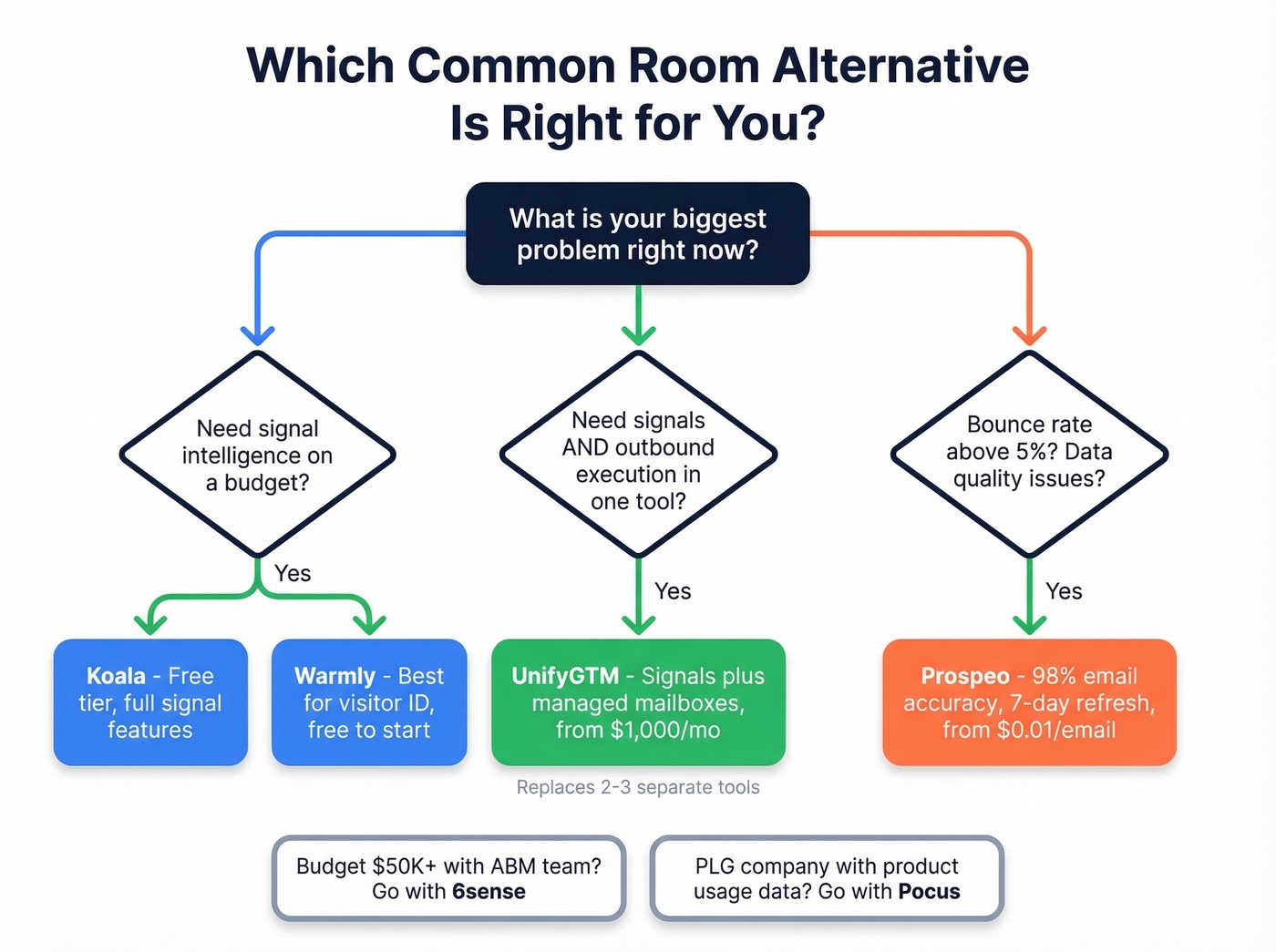
Your problem is signal intelligence on a budget. Go with Koala's free tier to start, or Warmly if visitor ID is the priority. Both get you running without a $12K annual commitment.
Your problem is signals AND outbound execution. UnifyGTM collapses the stack - signals, enrichment, and managed mailboxes in one platform. Worth the $1,000/mo if it replaces two or three other tools you're currently paying for separately.
Your real problem is contact data quality. Look, if your sequences are bouncing above 5%, no signal platform fixes that. A dedicated data layer with 98% email accuracy and a 7-day refresh cycle solves the root cause at a fraction of Common Room's cost.
For teams with $50K+ budgets and a dedicated ABM team, 6sense is the play. For PLG companies where product-usage signals feed sales, Pocus is built for exactly that motion.
Common Room Alternatives FAQ
What does Common Room actually do?
Common Room aggregates buying signals across community channels, product usage, website visits, and social activity, then resolves them to individual contacts using its Person360 identity engine. RoomieAI agents handle signal capture, research, and outbound personalization. It's rated 4.5/5 on G2 (106 reviews), and the Starter plan runs $1,000/mo billed annually.
Is Common Room worth $12K/year?
For most outbound teams under 10 reps, no. Total cost of ownership often exceeds $25K/year once you add enrichment, verification, and sequencing tools on top. Koala's free tier or a self-serve data platform can cover 80% of the prospecting value at a fraction of the price. Common Room earns its cost only if you're heavily using community analytics and multi-channel signal aggregation - and most outbound teams aren't.
Can I replace Common Room with a data provider?
If your primary use case is finding and contacting prospects rather than community analytics, yes. A B2B data platform with 30+ search filters, thousands of intent topics, and verified emails handles the prospecting function without the signal-aggregation overhead. You lose the community layer, but most outbound teams weren't using that anyway.
What's the cheapest alternative?
Koala and Warmly both offer functional free tiers. Koala gives you 2 seats and 100 credits/month with full signal intelligence features. Warmly's free plan covers basic visitor identification. For contact data, Prospeo's free tier includes 75 verified emails and 100 Chrome extension credits monthly - credit-based pricing at ~$0.01 per email with no annual commitment.