

Company Data Enrichment: What It Is, How It Works, and What It Costs in 2026
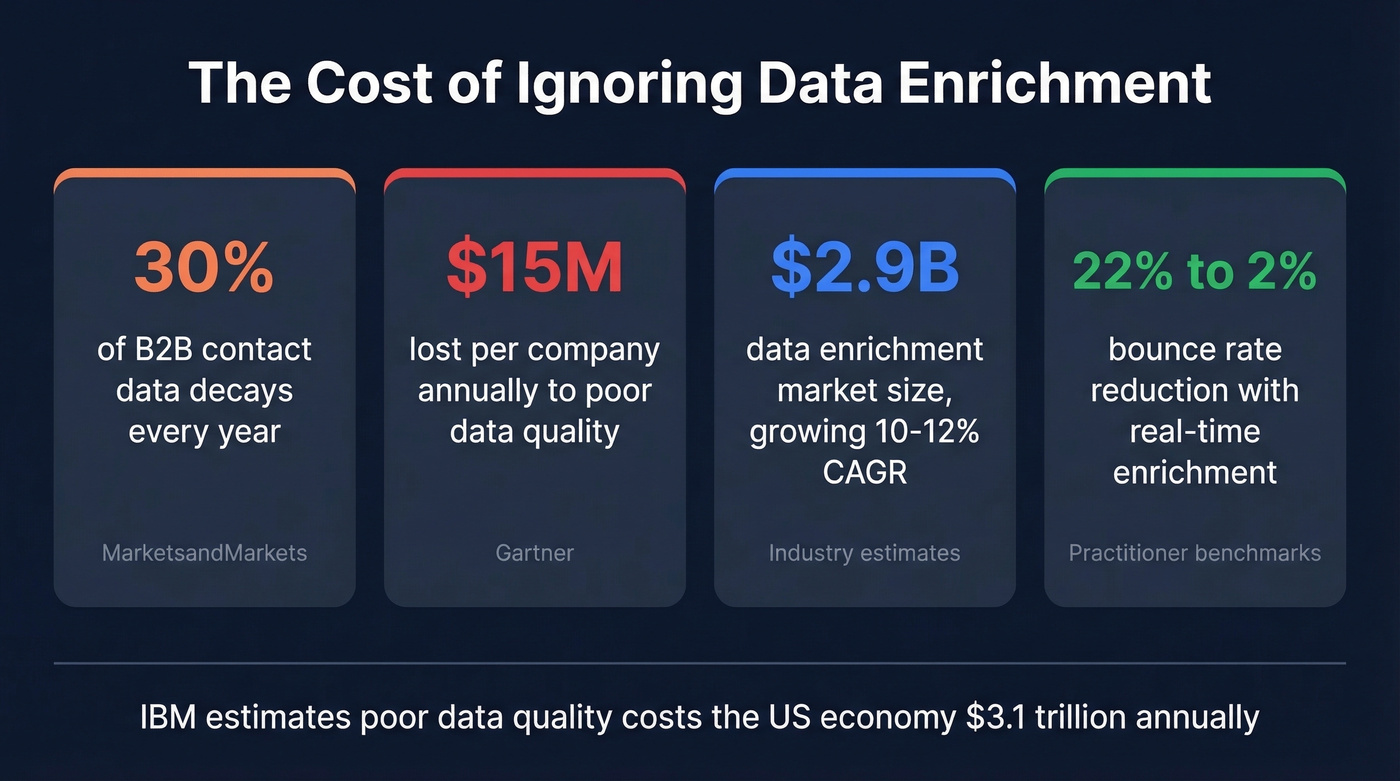
Finance just flagged a $28K renewal for your data platform. Four reps have seats. Three describe the data as "okay but not great." Meanwhile, your CRM is quietly rotting - 30% of B2B contact data decays annually, and Gartner estimates the average company loses $15 million a year to poor data quality.
That's not a data problem. It's a revenue problem wearing a data costume. Company data enrichment is how you fix it.
The Short Version
Company data enrichment appends firmographic, technographic, intent, and contact data to your existing CRM records. The playbook isn't complicated:
- Pick 1-2 high-accuracy providers as your primary enrichment layer
- Implement waterfall logic to fill coverage gaps
- Re-enrich monthly for pipeline accounts, quarterly for everything else
- Audit credit burn and failed lookups every month
What Is B2B Data Enrichment?
Data enrichment takes a bare CRM record - maybe a company name and a domain - and layers on the information that makes it actionable. Revenue range, employee count, tech stack, funding history, buying intent signals, and verified contact details for the people you actually need to reach.
Account-level enrichment fills in firmographic and technographic fields: industry, headquarters, annual revenue, technologies used. Contact enrichment adds people-level data - verified emails, direct dials, job titles, reporting structure. Most modern platforms handle both, but the workflows and accuracy benchmarks differ significantly.
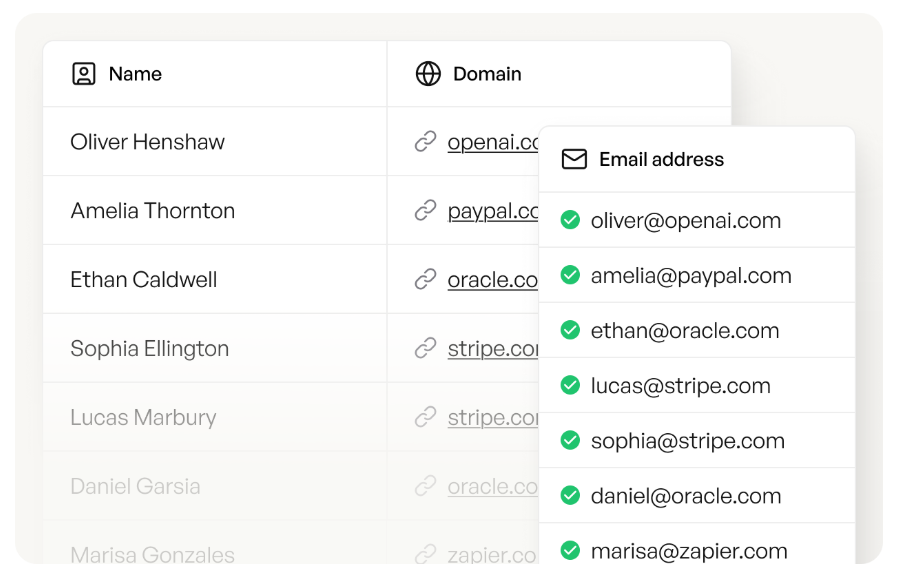
Here's the thing: enrichment isn't the same as data cleansing. Cleansing fixes what's already there - deduplicating records, standardizing formats, removing invalid entries. Business data enrichment adds what's missing. You need both, and the order matters. Cleanse first, then enrich. Otherwise you're layering fresh data on top of garbage.
The market reflects how critical this has become. The data enrichment solutions market sits at roughly $2.9B and is growing at 10-12% CAGR through 2030. IBM pegs the total cost of poor data quality to the US economy at $3.1 trillion annually. Without solid enrichment, none of your outbound, ABM, or lead-scoring motions work.
One architecture decision worth making early: batch vs. real-time enrichment. Batch enrichment processes records in bulk on a schedule - great for quarterly database hygiene. Real-time enrichment fires on record creation or update, keeping data fresh as leads enter your funnel. Most mature teams use both: real-time at the point of capture, batch for ongoing maintenance.
What Decays Fastest
B2B data decays at roughly 2.1% per month - that's 22-25% annually. But the decay isn't uniform.
| Field | Single-Source Accuracy | Waterfall Accuracy | Annual Decay |
|---|---|---|---|
| Work Email | 70-85% | 92-98% | 25-30% |
| Direct Dial | 45-65% | 70-85% | 20-25% |
| Job Title | 75-85% | 88-95% | 30-35% |
| Tech Stack | 65-80% | 80-90% | 25-35% |
Job titles decay fast because people change roles constantly. Direct dials are the hardest to get right in the first place, which is why single-source accuracy bottoms out at 45%. Tech stack data shifts as companies adopt and sunset tools, making it unreliable within a year without refreshes.
The concrete impact: companies running real-time enrichment have cut email bounce rates from 22% down to 2%. A CRM untouched for six months is roughly 11-13% stale. After a year, you're working with data that's about a quarter wrong. That compounds every quarter you ignore it.
How Waterfall Enrichment Works
Waterfall enrichment is the single biggest accuracy upgrade most teams haven't implemented. Descript's VP of Finance reported a 5-6x uplift in enrichment coverage after switching from a single provider to a multi-provider waterfall. The concept is straightforward: query multiple providers sequentially, filling gaps field by field until the record is complete.
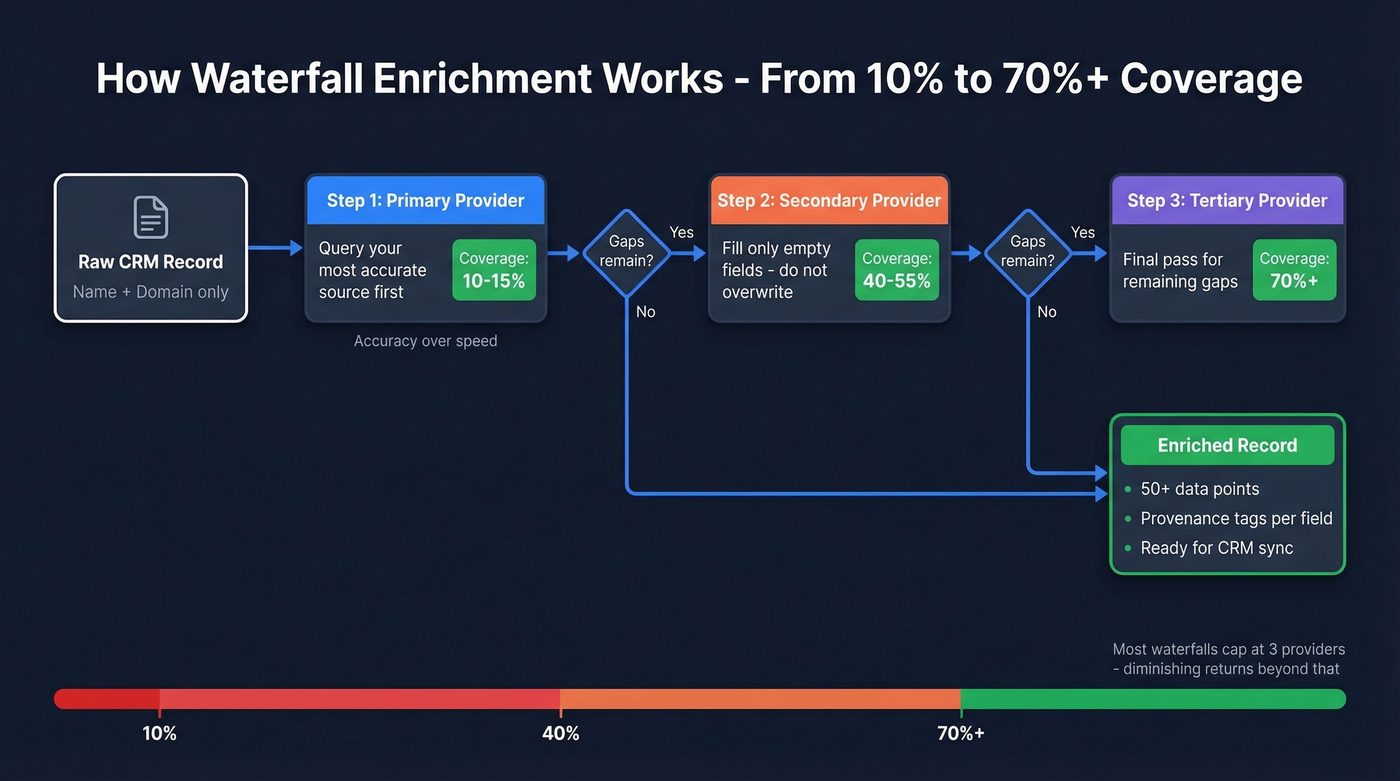
- Send the record to your primary provider - your most accurate source. The first pass needs to be right, not just fast.
- Check for gaps. If the primary returns the email but not the direct dial, flag those empty fields.
- Query a secondary provider for unfilled fields only. You're cascading for coverage, not re-enriching what's already filled.
- Repeat with a tertiary provider if gaps remain. Most waterfalls cap at 3 providers - beyond that, diminishing returns kick in hard.
- Tag each field with provenance metadata so you know which provider filled which field for accuracy audits and compliance.
A single vendor typically delivers 10-15% email coverage on a cold list. A well-designed 3-vendor waterfall pushes that to 70%+.
The ordering principle matters: accuracy first, then cascade for coverage. A wrong phone number wastes a rep's time; a missing one just means you try email instead. Build validation rules that protect high-confidence fields from being overwritten by lower-confidence sources.
Before committing to any waterfall architecture, run a 100-record ground-truth test. In our experience, this method catches accuracy gaps that vendor demos never reveal. Take contacts you've manually verified, enrich them through each provider independently, and measure coverage and accuracy per field. It takes an afternoon and saves months of bad data.

You just read that a single vendor covers 10-15% of a cold list. Prospeo's enrichment API returns 50+ data points per record at an 83% match rate - with 98% email accuracy and a 7-day refresh cycle. That's your primary waterfall layer sorted at $0.01/email.
Stop paying $30K/year to enrich records that decay in six weeks.
Best Tools for Company Data Enrichment
Let's be honest: ZoomInfo is still the deepest US database. But most teams don't need that depth - and they definitely don't need the $30K contract that comes with it. A high-accuracy provider paired with a workflow tool like Clay can cover most day-to-day enrichment use cases at a fraction of the cost.
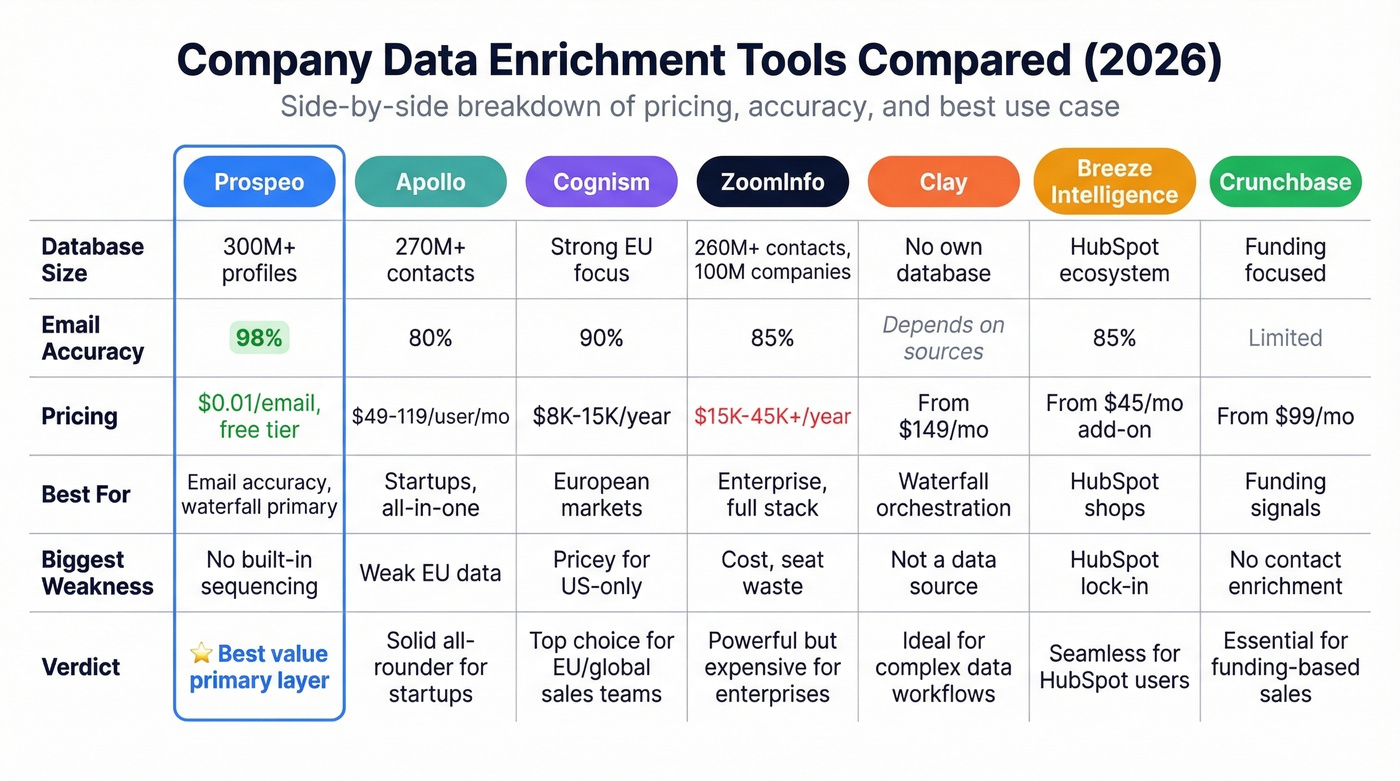
RevOps teams on r/salesoperations consistently flag three pain points with enrichment tools: credit burn on failed lookups, stale European data from US-centric providers, and overwrite conflicts in multi-provider setups. Every tool below is evaluated against those real-world frustrations.
Prospeo - Best for Email Accuracy
Prospeo's database covers 300M+ professional profiles with 98% email accuracy. The enrichment API returns 50+ data points per record with an 83% enrichment match rate, covering firmographics, technographics, intent signals across 15,000 Bombora topics, and verified contact details. The 30+ search filters and 7-day data refresh cycle - roughly 6x faster than the industry average - keep records current between enrichment runs.
Snyk's 50-person sales team cut bounce rates from 35% to under 5% after switching. Their AE-sourced pipeline jumped 180%, generating 200+ new opportunities per month. Pricing is credit-based and transparent: ~$0.01 per email, with a free tier offering 75 emails and 100 Chrome extension credits monthly. No contracts, no sales calls required.
Skip this if you need a full outbound sequencing platform bundled with your data - pair with Lemlist or Instantly instead.
Snyk cut bounce rates from 35% to under 5% and generated 200+ new opportunities per month after switching their enrichment layer. The difference: 300M+ profiles verified every 7 days, not every 6 weeks. Run your own 100-record ground-truth test - free tier included.
Test Prospeo against your current provider. The data speaks for itself.
Apollo - Budget-Friendly All-in-One
Apollo is the default for startups that want enrichment and outreach in one platform. The 270M+ contact database paired with built-in email sequences, a dialer, and basic intent signals covers a lot of ground for $49-$119/user/month. Email accuracy benchmarks around 80% - workable, but you'll notice the gap on high-volume campaigns. The free plan gives you 100 credits/month to test.
The catch: Apollo's European data is noticeably thinner than its US coverage. If your ICP spans EMEA, you'll need a supplementary source.
Cognism - The European Data Specialist
If your ICP is European, Cognism is the only provider worth serious evaluation. Their Diamond Data program phone-verifies mobile numbers with human researchers - a genuine differentiator for teams that live on the phone. They refresh 95% of VP+ contacts every 60 days and benchmark around 90% email accuracy.
Pricing runs ~$8K-$15K/year. Steep for small teams, reasonable compared to ZoomInfo. US-only teams won't get enough value from the price premium.
ZoomInfo - Enterprise-Grade, Enterprise Budget
ZoomInfo's 260M+ contacts and about 100M companies make it the deepest US database available. Full stop. Email accuracy sits around 85%. The platform is genuinely powerful for large organizations that use the full stack - enrichment, intent, chat, workflow automation.
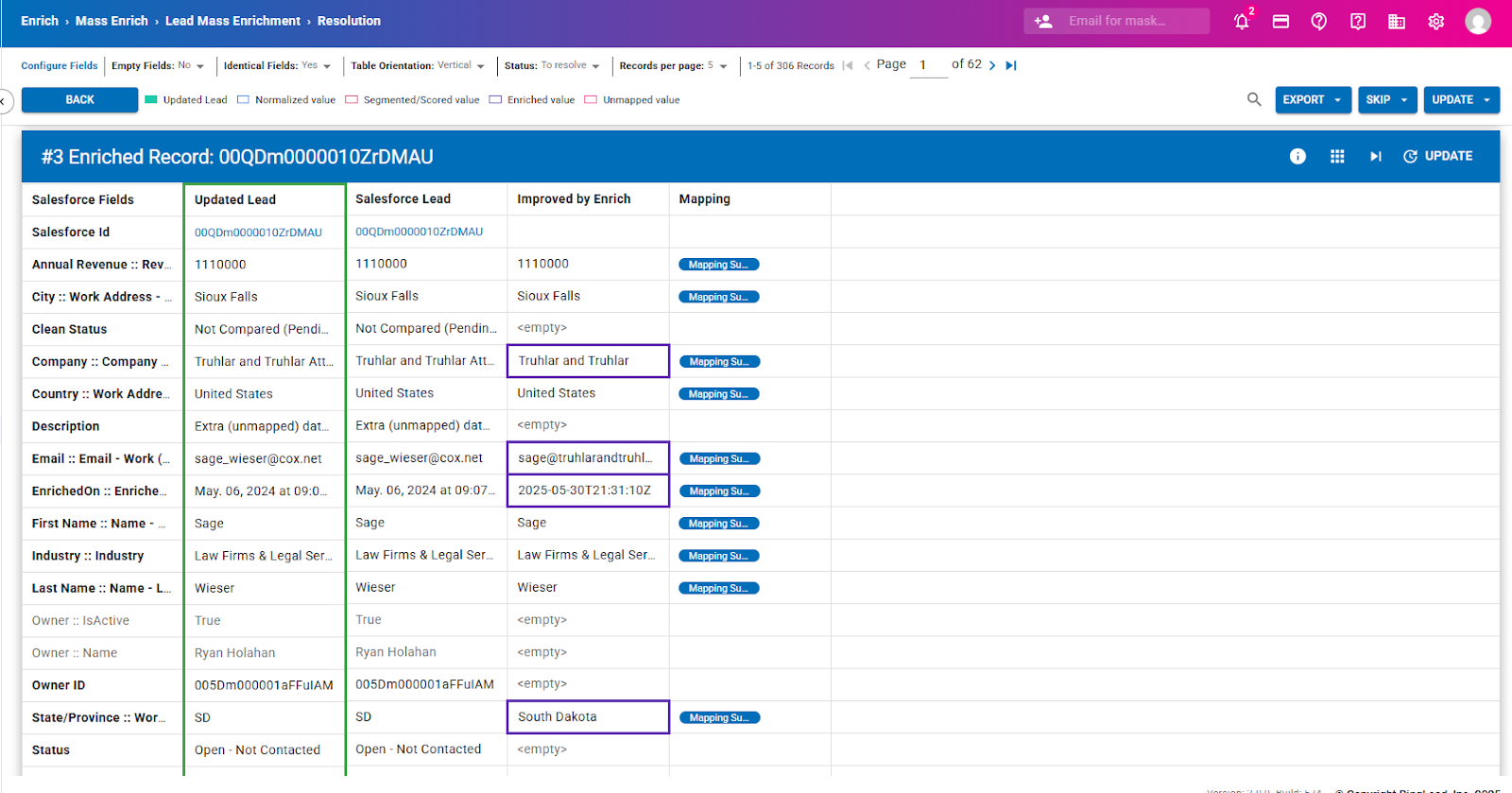
The problem: most teams don't use the full stack. We've seen plenty of mid-market companies paying $30K+ for a platform where reps only use the search bar. At $15K-$45K+/year with 10-20% annual renewal increases, the ROI math only works at 50+ seats.
Clay - Waterfall Orchestration Layer
Clay isn't a database. It's a workflow tool that connects dozens of enrichment sources into sequenced, conditional logic. Starting at $149/month with unlimited users, it's the best way to operationalize a multi-provider waterfall. Accuracy depends entirely on which providers you plug in. Clay is the plumbing, not the water.
Clearbit (Breeze Intelligence) - HubSpot-Native
Breeze Intelligence works inside HubSpot as an add-on, starting at $45/month on top of an existing HubSpot subscription. Email accuracy benchmarks around 85%. If you're already all-in on HubSpot, it's the path of least resistance. Outside that ecosystem, there are better options.
Crunchbase - Best for Funding Data
From $99/month. Excellent for funding rounds, growth signals, and startup intelligence. Limited for contact enrichment - think of it as a firmographic supplement, not a primary provider.
Tool Comparison
For most teams, Prospeo is the strongest starting point - highest email accuracy, fastest refresh, lowest cost per record. Scale to ZoomInfo only if you have 50+ reps and budget to match.
| Tool | Best For | Email Accuracy | Starting Price | Database Size | Refresh |
|---|---|---|---|---|---|
| Prospeo | Email accuracy | 98% | Free / ~$0.01/email | 300M+ profiles | 7 days |
| Apollo | Budget + outreach | 80% | Free / $49/user/mo | 270M+ contacts | ~30 days |
| Cognism | EU data, compliance | 90% | ~$8K/year | Not disclosed | 60 days |
| ZoomInfo | Enterprise scale | 85% | ~$15K/year | 260M+ contacts | ~6 weeks |
| Clay | Waterfall orchestration | Varies | $149/month | Aggregator | Varies |
| Clearbit (Breeze) | HubSpot users | 85% | $45/month | Not disclosed | N/A |
| Crunchbase | Funding data | N/A | $99/month | Not disclosed | N/A |
What Enrichment Actually Costs
Enrichment pricing falls into five models: monthly credits, per-seat, flat fee, pay-as-you-go, and enterprise custom quotes. Understanding which model you're buying matters more than the sticker price.
| Method | Cost/Record | Speed | Accuracy |
|---|---|---|---|
| Single-source API | $0.10-$0.50 | 1-5 sec | 70-85% |
| Waterfall (3 providers) | $0.15-$0.40 | 2-30 sec | 90-98% |
| Manual research | $2-$5 | ~10 min | High but unscalable |
The credit gotchas are where teams get burned. A "full enrichment" on many platforms costs 3-5 credits per record, not 1. Some tools charge credits on failed lookups - you pay even when they find nothing. Credits often expire monthly with no rollover, punishing teams with variable volumes. And CRM integrations are frequently gated to higher tiers, so the $49/month plan becomes $119/month once you need the Salesforce sync.
Enterprise platforms like ZoomInfo and Cognism typically run $12,000-$80,000 annually. That makes sense for 50+ rep organizations running the full GTM stack. For teams under that threshold, a high-accuracy provider plus Clay delivers comparable coverage at a fraction of the cost.
Turning Enriched Data Into Revenue
Enrichment only matters if it changes how reps sell. The teams that get the most from their data connect enrichment outputs directly to scoring models, routing rules, and personalization workflows.
Use firmographic fields like revenue range and employee count to auto-score and tier inbound leads before a rep ever touches them. Route accounts to the right rep based on enriched industry and geography fields - no more manual assignment bottlenecks.
Surface expansion signals like recent funding rounds, new hires in target departments, or tech stack changes as trigger-based alerts in your CRM. These tell reps when to reach out, not just who to reach out to. Feed enriched data into your sequencing tool to personalize first-touch messaging at scale - referencing a prospect's actual tech stack or recent growth milestone beats generic templates every time.
Without this closed loop from enrichment to action, you're paying for data that sits in fields nobody reads.
Mistakes That Burn Budget
Treating all sources as equal. Run a 100-record pilot against ground-truth data before committing. Demand transparency on update cycles and accuracy methodology.
Over-enrichment. Only enrich fields tied to qualification or closing. Appending 80 data points when your reps use 6 is expensive clutter.
Set-and-forget. B2B data decays ~2.1% per month. Schedule re-enrichment monthly for active pipeline, quarterly for your general database.
Enriching at the wrong funnel stage. Use basic firmographics at lead capture, full enrichment at sales-accepted stage. Don't spend $0.40/record on leads that haven't been qualified yet.
Compliance negligence. Document your lawful basis for every enrichment source. This isn't optional under GDPR and increasingly under US state privacy laws. I've watched teams scramble to retroactively document consent after a DSAR came in - it's not a position you want to be in.
Ignoring credit burn. Audit failed-lookup charges monthly. Some providers charge full credits when they can't find a match, and those costs add up fast on large lists.
Compliance Checklist
GDPR applies to business contact data if it identifies an individual - name, work email, direct dial all qualify, regardless of business context.
- Document lawful basis per contact (legitimate interest requires a formal assessment)
- Practice data minimization - only enrich fields you'll actually use
- Respond to DSARs within 30 days
- Vet every enrichment vendor for proof of consent or lawful basis
- Tag each enriched field with provenance metadata for audit trails
- Build opt-out handling into your enrichment workflow
- Purge enriched data you're not actively using
Penalties are real: GDPR fines reach EUR 20M or 4% of global revenue. CPRA statutory damages run $100-$750 per violation.
FAQ
What's the difference between data enrichment and data cleansing?
Enrichment adds new data points to existing records; cleansing fixes or removes bad data already in your CRM. Always cleanse first, then enrich - otherwise you're layering fresh information on top of duplicates and formatting errors.
How often should I re-enrich my CRM?
Monthly for active pipeline accounts, quarterly for the rest of your database. B2B data decays 22-30% annually, so six months of neglect leaves roughly 11-13% of records stale - enough to tank deliverability and waste rep time.
What should I budget for company data enrichment?
Expect $0.10-$0.50 per record for single-source API enrichment and $0.15-$0.40 for a waterfall setup. Prospeo starts at ~$0.01 per email with a free tier of 75 credits; enterprise platforms like ZoomInfo run $15K-$45K+/year.
Can I build a waterfall without Clay?
Yes. Most CRMs support sequential API calls via native automation or Zapier/Make. Clay simplifies orchestration, but you can start with 2 providers and simple if/then logic before investing in a dedicated tool.
Does GDPR apply to B2B contact data?
Yes - if the data identifies an individual (name, work email, direct dial), GDPR applies regardless of business context. Document your lawful basis for each enrichment source and respond to data subject access requests within 30 days.
Start with a 100-record test. Pick one high-accuracy provider, enrich your records through it, measure what comes back, and build from there. The teams that treat company data enrichment as infrastructure - not a one-time project - are the ones whose data actually stays useful.