

How to Build a Competitive Intelligence Report That Actually Drives Decisions
Your VP of Sales just lost seven deals to the same competitor in a single quarter. When you ask the team what changed - new pricing, a feature launch, a repositioning - nobody can tell you. That's not a sales problem. That's a CI problem.
68% of B2B deals involve at least one direct competitor, yet 52% of compete programs lack a sales executive sponsor and 44% have zero competitor visibility inside their CRM. The average sales team rates itself 3.8 out of 10 on competitive preparedness. A competitive intelligence report closes that gap - if you build it right.
What You Need (Quick Version)
A solid CI report has 7 sections, takes roughly 7-10 hours to build from scratch, and should be refreshed monthly. Track 3-5 competitors, not 15. For most teams, 3 is the sweet spot because deep coverage of a few rivals beats shallow coverage of a dozen every time. Use the template below, populate it with verified data, assign a single owner for monthly updates, and stop treating competitor analysis like a one-time homework assignment.
What CI Reports Actually Are
A competitive intelligence report isn't a dump of competitor screenshots and pricing pages. It's a structured document that moves through four stages: context, evidence, interpretation, and recommendation. Most reports fail because they stop at evidence without ever reaching what it means or what to do about it.
CI splits into two modes. Tactical CI powers deal-level battlecards, pricing objection handling, and feature comparisons your reps use mid-call. Strategic CI tracks long-term positioning shifts, market entry signals, and competitive trends that shape your roadmap. You need both, and the template below covers both.
CI also differs from general market research. Market research studies overall market size, buyer trends, and growth rates. A competitor analysis zooms in on specific rivals and translates their moves into actions for your team. Think of market research as the map and CI as the radar tracking individual ships.
The 7-Section Template
Executive Summary
One page max. Answer three questions: What are the most significant competitive changes since the last report? What do those changes mean for our business? What should we do about it?
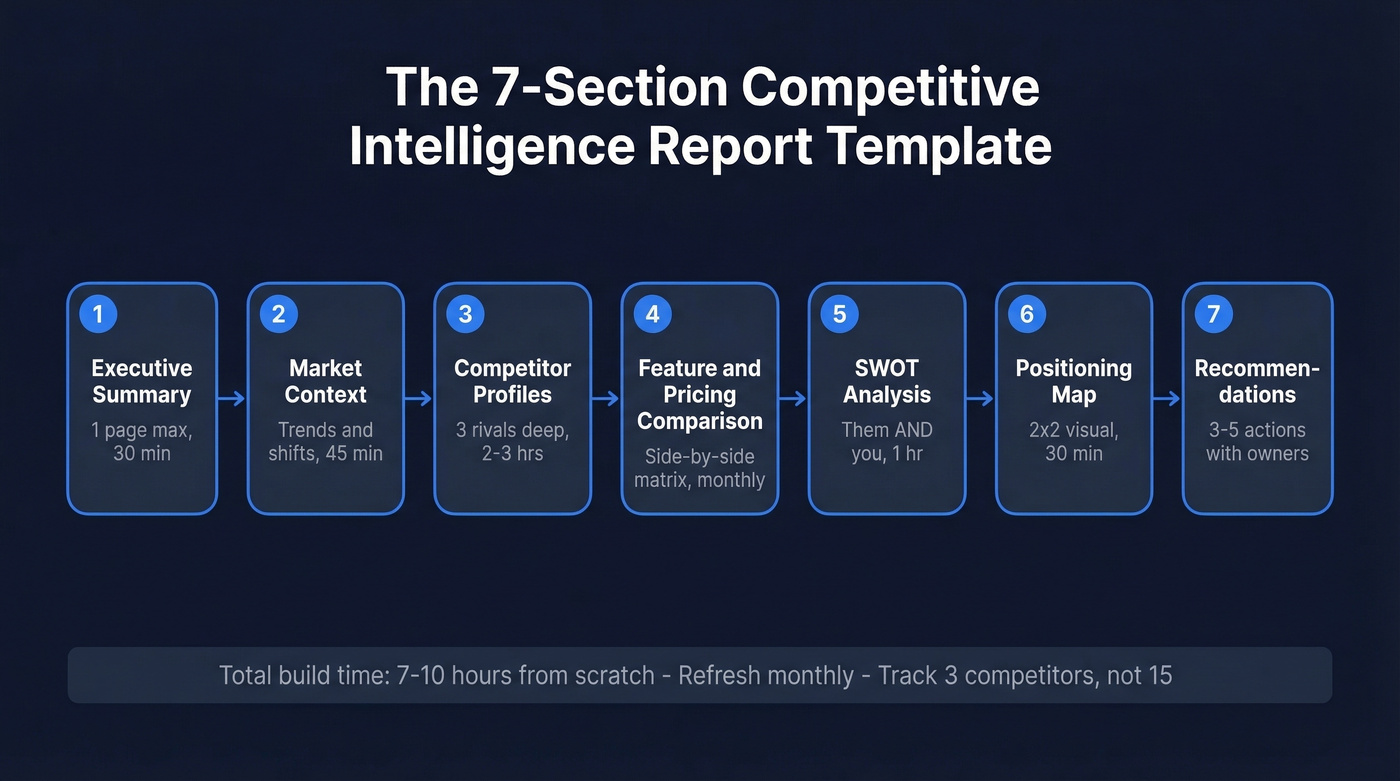
Decision-makers read this section and skip the rest, so make every sentence count. Budget about 30 minutes here.
Market Context
Before getting into individual competitors, frame the playing field. The average S&P 500 company tenure has fallen from 61 years in 1958 to under 20 years today - markets move fast. Cover market size and growth trajectory, two to four key trends shaping the space, notable buyer behavior shifts, and new entrants or exits. This section takes about 45 minutes.
Competitor Profiles
This is the heaviest lift - plan for 2-3 hours. For each competitor, document founding date, HQ, headcount, funding, estimated revenue, target market, go-to-market motion, key strengths, and vulnerabilities. Include a recent moves timeline covering product launches, pricing changes, leadership hires, and messaging shifts.
Here's our strong recommendation: track 3 competitors. Your top 2 direct rivals and 1 emerging threat. We've built CI reports for sales teams ranging from 10 to 200 reps, and the pattern is always the same - teams that try to maintain deep profiles on 15 competitors end up with shallow, outdated intel on all of them. For contact-level fields like decision-maker emails, direct dials, and org charts, a tool with a weekly data refresh cycle keeps these profiles current without manual research.
Feature & Pricing Comparison
Build a side-by-side feature matrix with consistent notation: "All plans," "Pro+," "Enterprise only," "Add-on," or "--" for missing. Wrong pricing can leave 10-15% of revenue on the table, and you can't fix what you don't track.
Review competitor pricing quarterly at minimum and update feature matrices monthly. Stale matrices erode trust fast - one outdated price point and your reps stop trusting the whole document.
SWOT Analysis
Do a SWOT for each competitor and for your own company. Most teams skip the self-assessment, which defeats the purpose. For each item, include evidence and rate impact and likelihood. A competitor's weakness only matters if you can exploit it. Budget about an hour.
Market Positioning Map
Create a 2x2 positioning map. Good axis pairs: price vs. feature depth, SMB vs. enterprise focus, or self-serve vs. sales-assisted. Circle size can represent estimated market share. This visual is the fastest way to show leadership where the whitespace is - 30 minutes well spent.
Recommendations & Next Steps
Every section above feeds into this one. Prioritize 3-5 actions: product gaps to close, messaging to sharpen, pricing adjustments to test, or segments to attack. Assign owners and deadlines. A report without recommendations is just a research paper.
What to Monitor and How Often
A practitioner on r/indiehackers breaks monitoring into six data streams: product changes, marketing evolution, customer reviews, hiring patterns, funding signals, and partnership activity. You don't need to watch all six daily.
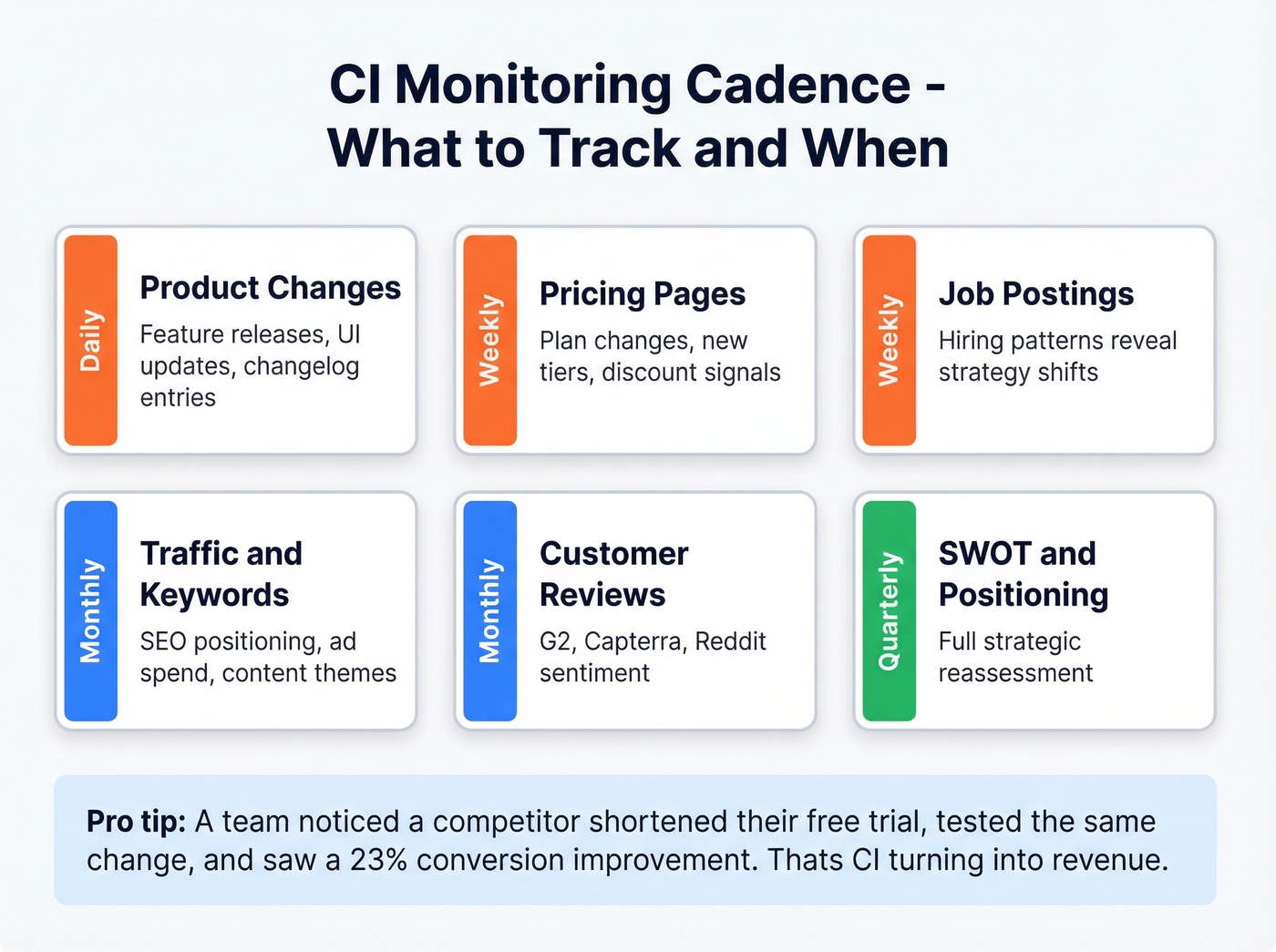
| Signal | Frequency |
|---|---|
| Pricing pages & feature releases | Weekly |
| Job postings | Weekly |
| Traffic & keywords | Monthly |
| SWOT & positioning map | Quarterly |
One concrete example from that thread: a team noticed a competitor shortened their free trial, tested the same change, and saw a 23% conversion improvement. That's competitive intelligence translating directly into revenue. Separately, Reddit users have noted that AI tools like NotebookLM can accelerate competitor research but still require heavy human curation to avoid hallucinated insights. Don't outsource the interpretation step to a chatbot.

Your competitor profiles are only as good as the data behind them. Prospeo gives you verified decision-maker emails (98% accuracy), direct dials (125M+), org charts, and hiring signals - refreshed every 7 days so your CI report never goes stale.
Stop building competitive intelligence on outdated contact data.
CI Tools and What They Cost
74% of tech marketers say competitive and market intelligence is a challenge they need to address within 12 months. AI adoption in CI has surged 76% year-over-year, with 60% of CI practitioners now using AI daily. Tools help, but only if you pick the right ones for your budget and team size.
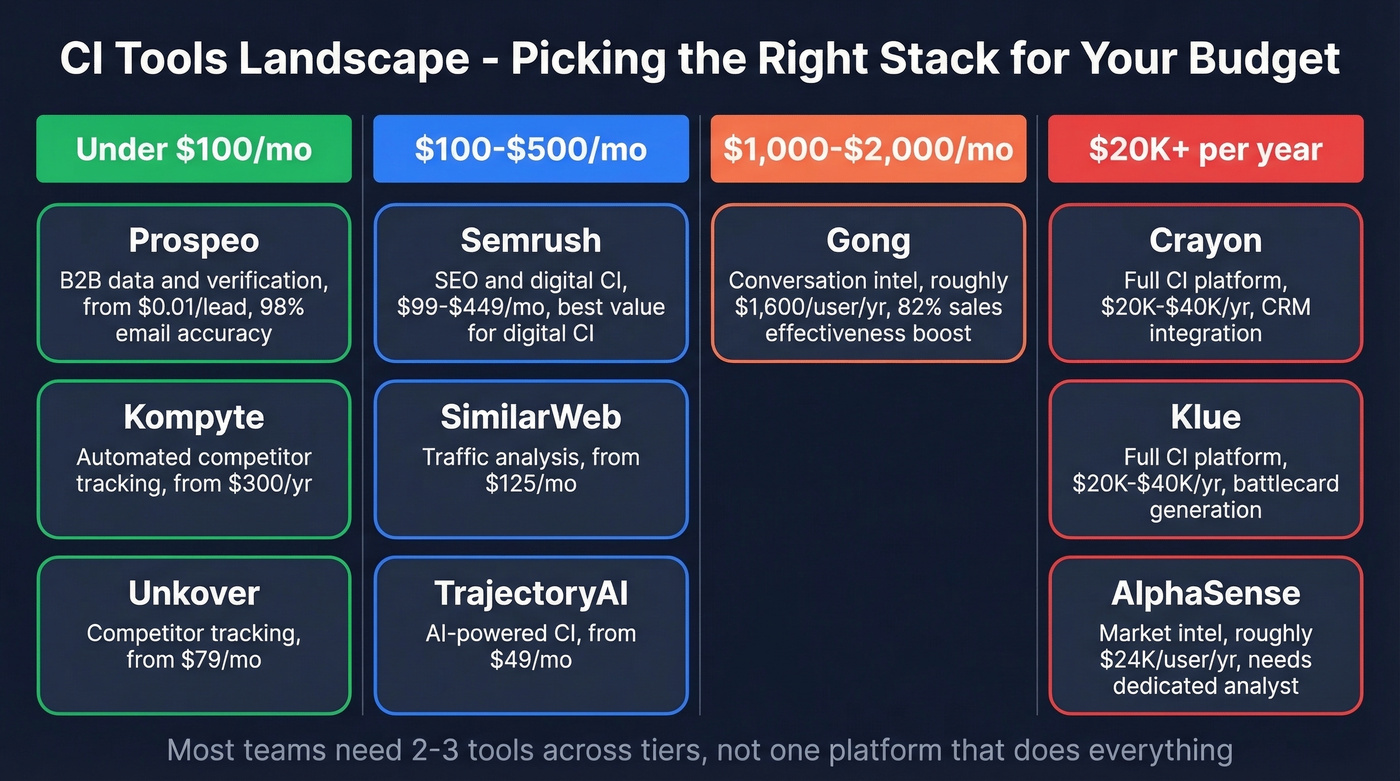
| Tool | Category | Starting Price |
|---|---|---|
| Prospeo | B2B data & verification | Free; paid ~$0.01/lead |
| Crayon | CI platform | ~$20K-$40K/yr |
| Klue | CI platform | ~$20K-$40K/yr |
| Kompyte | Budget CI | From $300/yr |
| AlphaSense | Market intel | ~$24K/user/yr |
| Semrush | SEO/digital CI | $99-$449/mo |
| SimilarWeb | Traffic analysis | From $125/mo |
| Gong | Conversation intel | ~$1,600/user/yr |
| TrajectoryAI | AI-powered CI | From $49/mo |
| Unkover | Competitor tracking | From $79/mo |
Enterprise compete programs. Crayon and Klue are the standard. They track competitor changes, generate battlecards, and integrate with CRMs. The tradeoff is price - $20K-$40K/year puts them out of reach for most startups. Worth it if sales enablement is your primary CI output.
Best value for digital CI under $500/mo. Semrush, hands down. Keyword gap analysis, traffic estimates, ad monitoring, and content tracking at $99-$449/mo. It won't replace a dedicated CI platform, but for digital positioning intelligence, nothing else covers this much ground at this price.
Skip AlphaSense unless you have a dedicated analyst team. At ~$24K/user/year, it's built for deep financial and market intelligence research, not for arming sales reps with battlecards. Powerful in the right hands, overkill for most.
Kompyte is one of the most accessible entry points for structured CI at $300/year - automated competitor tracking without the enterprise price tag. SimilarWeb fills a specific niche around traffic and engagement benchmarks that Semrush doesn't fully replicate. Gong isn't a CI tool per se, but conversation intelligence data reveals exactly how competitors come up in live deals. Teams using conversation intelligence for compete see an 82% increase in sales effectiveness. TrajectoryAI and Unkover are newer entrants worth watching for AI-native competitor monitoring.

Contact data quality is the invisible layer that makes or breaks your competitor profiles. Prospeo sits in a different category from the platforms above - it's the data freshness layer that keeps those profiles actionable. With 98% email accuracy, 125M+ verified mobile numbers, and a 7-day refresh cycle versus the 6-week industry average, the people listed in your competitor profiles stay reachable. Teams like Snyk use it to keep 50 AEs prospecting with under 5% bounce rates - the kind of data hygiene that prevents stale intel from undermining your CI program.
Enterprise CI platforms cost $20K-$40K/year but still can't verify a prospect's email. Prospeo fills the gap at $0.01/lead - 30+ filters for technographics, headcount growth, funding, and intent data across 15,000 topics to track competitor customers moving in-market.
Layer real buyer intent signals into every competitor analysis you build.
Beyond SWOT: Frameworks for Fast Markets
SWOT is table stakes. It's the framework everyone knows, which means it produces the least differentiated insight. In fast-moving markets, two alternatives pull more weight.
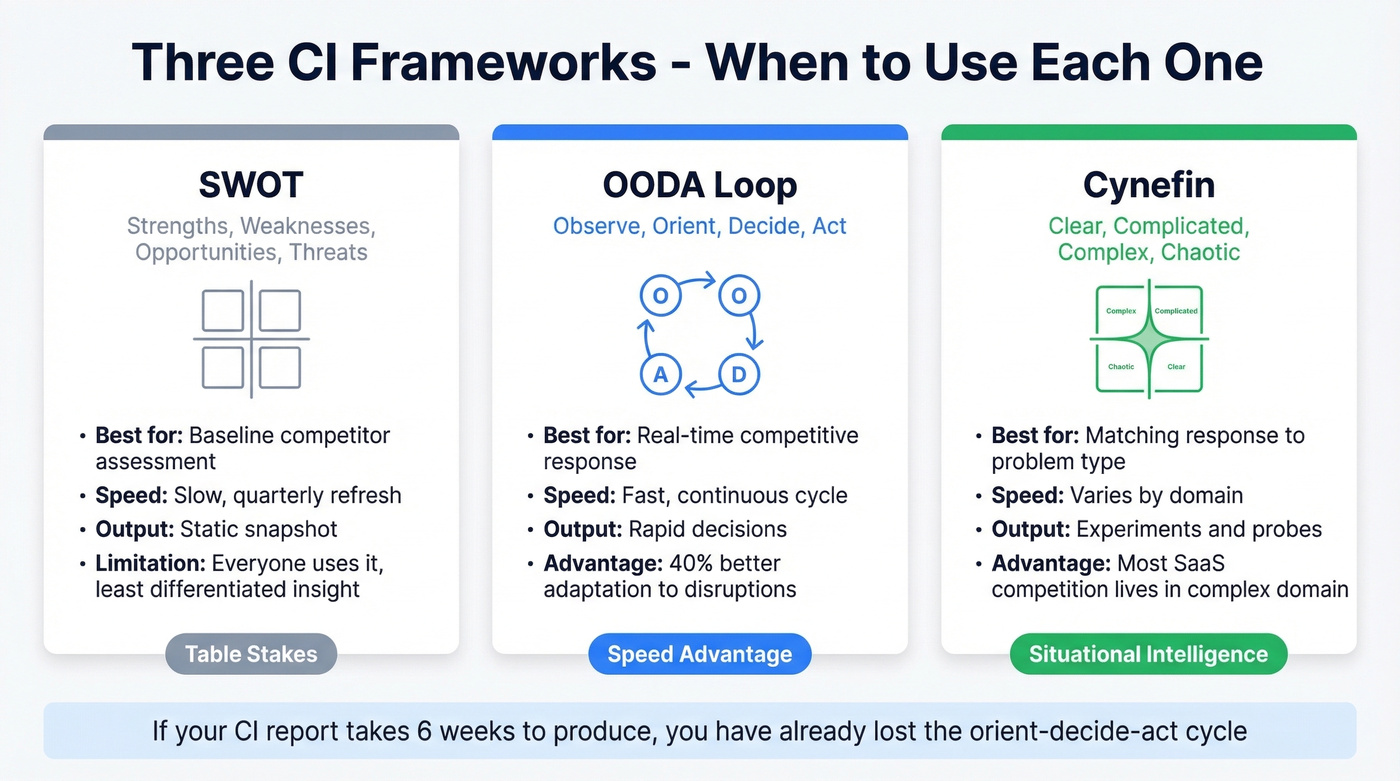
The OODA loop - Observe, Orient, Decide, Act - is a speed advantage model. It emphasizes real-time data infrastructure and distributed decision authority. Organizations with faster decision cycles show 40% better adaptation to disruptions. If your competitive intelligence report takes 6 weeks to produce, you've already lost the orient-decide-act cycle.
The Cynefin framework matches your response to the problem type. Clear domains get standard playbooks. Complicated domains need expert analysis. Complex domains require experimentation - probe, sense, respond. Most competitive situations in SaaS live in the complicated-to-complex range, which means your CI output should drive experiments, not just document observations.
Mistakes That Kill Your CI Program
Here's the thing: most CI programs die from self-inflicted wounds, not lack of tools.
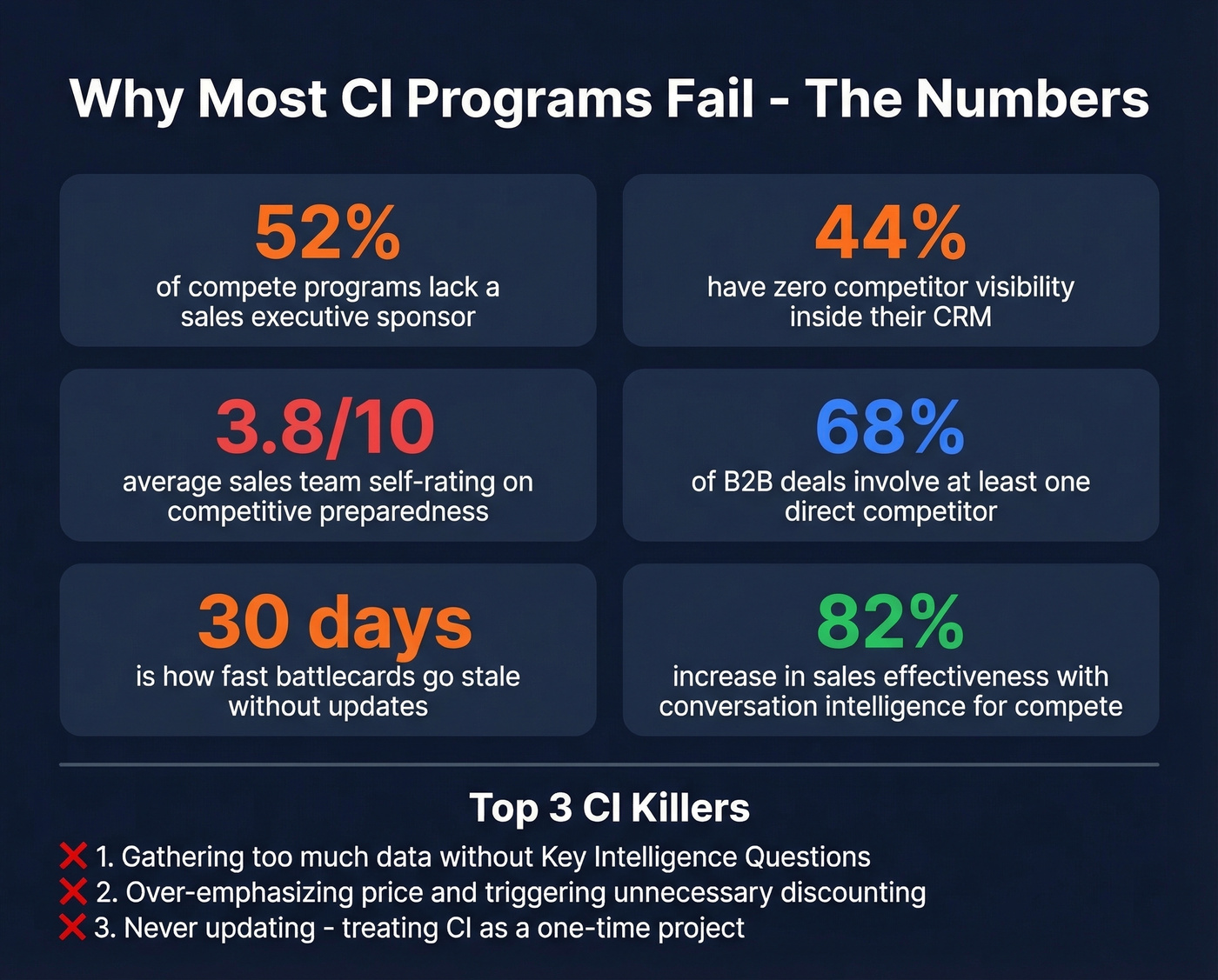
Gathering too much data. Information overload is the #1 CI killer. Define Key Intelligence Questions tied to business goals before you collect anything. If a data point doesn't answer a KIQ, skip it.
Over-emphasizing price. Competitor pricing matters, but obsessing over it leads to unnecessary discounting and margin erosion. Price is one input, not the whole picture.
Never updating. Battlecards go stale in 30 days. We've seen a team lose 7 deals worth $340K ARR because their battlecards were 6 weeks out of date. Set calendar reminders. Assign an owner.
Tracking 15 competitors instead of 3. We've watched this play out repeatedly: teams build a massive competitor spreadsheet, update it once, then abandon it. Three deep profiles beat fifteen shallow ones every time.
Ignoring your own SWOT. Nokia and Blockbuster didn't fail because they lacked competitor data. They failed because they didn't honestly assess their own vulnerabilities. These are among the most cited competitive intelligence examples in business school case studies, and the lesson still applies: self-awareness is half the battle.
The Business Case for CI
Let's be honest: if your report takes 40 hours to build and is outdated in 30 days, you don't have a CI program - you have a recurring homework assignment.
Sales reps spend 8-12 hours per month on competitor research. For a 50-person sales org, that's over $400,000/year in direct labor. CI automation cuts that by 85-95%. 71% of businesses using battlecards report higher win rates, and monthly battlecard updates can drive up to 59% win rate lift.
Most teams don't need a $30K CI platform. They need a $99/mo Semrush subscription, a well-maintained 7-section template, and someone who owns the monthly refresh. The best CI teams spend 80% of their time on interpretation and recommendations, not collection. The template above, combined with the right tools and a consistent cadence, flips that ratio.
FAQ
How often should you update a competitive intelligence report?
Monthly for pricing, features, and competitor profiles. Quarterly for SWOT and positioning maps. Battlecards go stale in 30 days - assign a single owner for the refresh cycle and use automated tracking tools like Kompyte or Crayon to flag changes between manual reviews.
How many competitors should you track?
Three: your top 2 direct competitors and 1 emerging threat. Deep coverage of 3 beats shallow coverage of 15. Expand only when you have the bandwidth to maintain weekly monitoring on each additional rival.
What's the difference between CI and market research?
Market research studies the overall market - size, trends, buyer behavior. CI focuses on what specific competitors are doing, what it means for your strategy, and what actions to take.
What's a good free tool for competitor contact data?
Prospeo's free tier gives you 75 verified emails and 100 Chrome extension credits per month - enough to populate competitor org charts and decision-maker profiles. Pair it with Semrush's free keyword reports for a zero-cost CI starter stack.