

Competitive Selling: A Data-Backed Playbook for Winning More Deals
Your AE just froze on a discovery call. The prospect said, "We're also evaluating [competitor]," and instead of pivoting, your rep mumbled something about "unique value proposition" and moved on. That deal is now 50/50 at best - and 50/50 in competitive selling means you're losing.
The numbers back this up: 68% of sales opportunities are competitive. Competitive mentions in deals are up 57% since 2022. Win rates hover around 20-21%, competitive deals often add 10-30% to cycle time, average cycles stretch to 6.5 months, and only 16% of reps hit quota. If you're not running this as a system - with data, process, tools, and trained behaviors - you're leaving pipeline on the table every single quarter.
The Quick Version
Competitive selling isn't a mindset. It's a system.
Three highest-impact moves: inoculate prospects against competitor claims before they hear them, multi-thread every deal over $50K across at least three stakeholders, and keep your talk-to-listen ratio at 43/57. The rest of this guide gives you the data, frameworks, battlecard templates, and tools to build the full system.
What Is Competitive Selling?
It's the practice of winning deals where buyers are actively evaluating multiple vendors - using research, frameworks, battlecards, and deliberate rep behaviors to differentiate and close.
Most guides treat it as a list of tips for individual reps. "Know your competitor." "Don't bash them." "Sell on value." That's fine advice, but it's not a system. A real program is organizational: it combines intelligence gathering, enablement content, deal-level tactics, and feedback loops that improve over time. A Gong analysis of 24,077 competitive deals is the best dataset we have on what actually works, and we'll reference it throughout.
When to Discuss Competitors
The biggest mistake isn't bashing competitors. It's bringing them up at the wrong time.
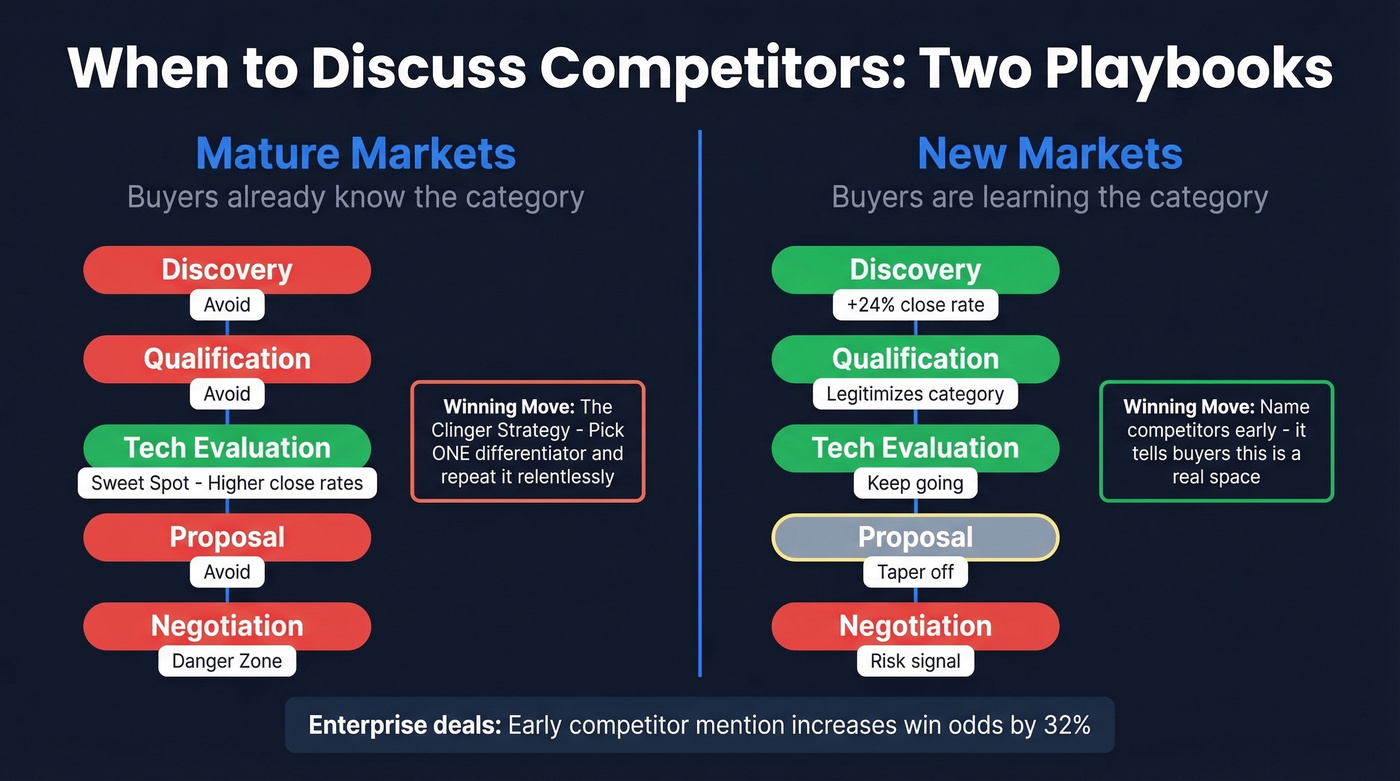
The data reveals two completely different playbooks depending on your market maturity.
In mature markets - where buyers already know the category and the players - discussing competitors at any stage correlates with lower win rates, with one exception: the technology evaluation stage. During evaluation, competitor discussions actually correlate with higher close rates than deals where competition never comes up. Outside that window, every mention drags your odds down. The winning move in mature markets is the "clinger strategy": identify one buyer-valued differentiator and return to it relentlessly. Lost deals show scattered, diluted messaging. Won deals show disciplined repetition of a single wedge.
In new markets - where you're educating buyers on the category itself - the playbook flips entirely. Discussing competitors early correlates with a 24% higher likelihood of closing. Naming competitors legitimizes the category. It tells the buyer, "This is a real space with real options, and here's why we're the best one." If you're selling AI-powered contract analysis and most buyers haven't heard of the category, you're in a new market. Wait too long and you've missed the framing window.
One more signal worth watching: in enterprise deals, an early competitor mention increases odds of winning by 32%. But late-stage competitor mentions - especially during negotiation - are a risk signal. If a competitor's name surfaces for the first time in month five, that deal is under threat.
7 Research-Backed Tactics to Win Against Competitors
1. Inoculate Before They Object
This is the single most underused tactic in competitive selling. Inoculation theory comes from social psychologist William McGuire's research in the 1960s: exposing someone to a weakened version of a counterargument, plus a refutation, makes them resistant to the full argument later. Same principle as vaccines - a small dose builds immunity.
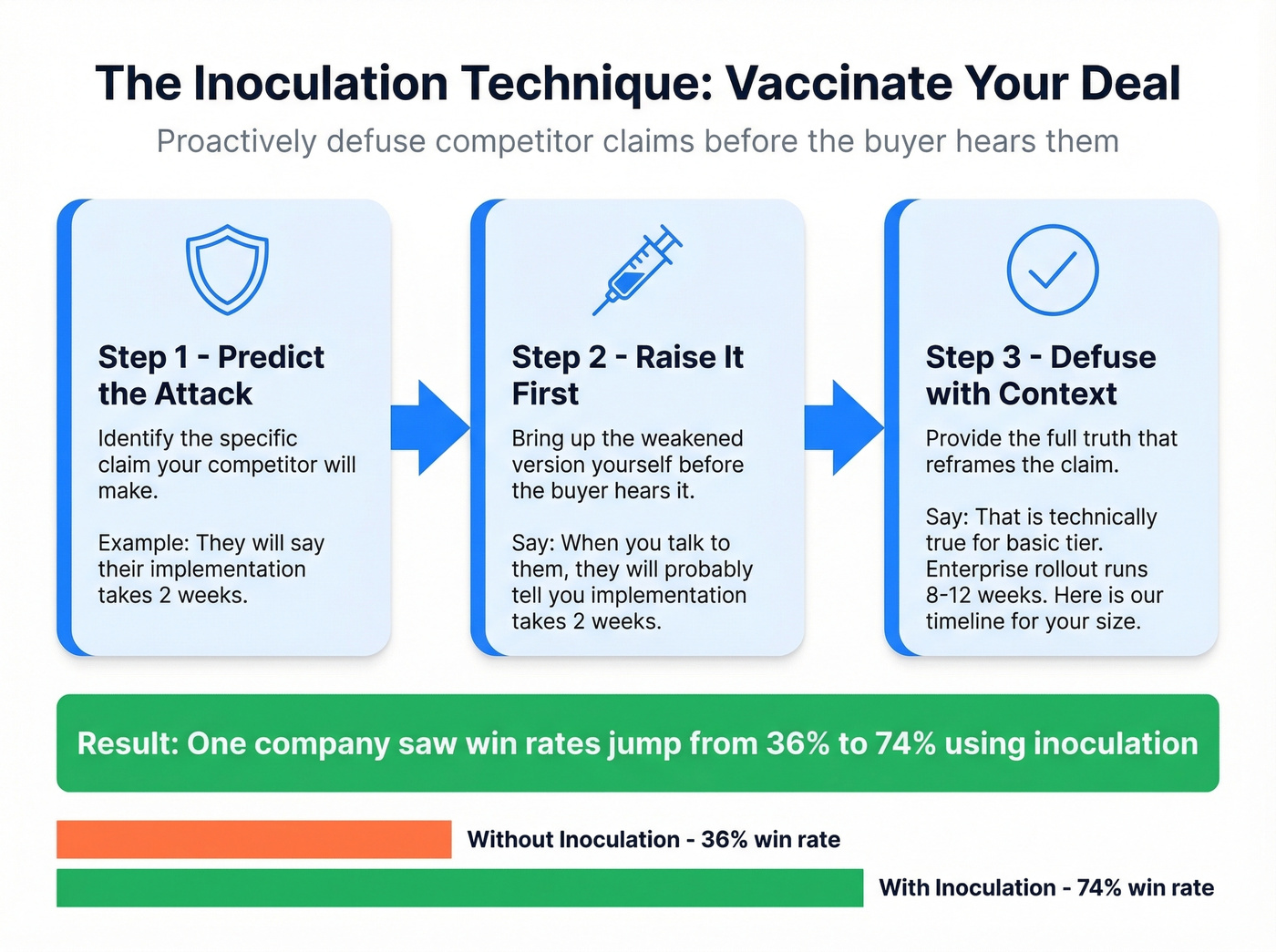
In sales, this means proactively raising the objection your competitor will plant, then defusing it before the prospect ever hears the pitch. Here's a sample talk track: "When you talk to [Competitor], they'll probably tell you their implementation takes two weeks. That's technically true - for the basic tier. The enterprise rollout you'd need typically runs 8-12 weeks. Let me show you our timeline for a company your size."
One company applied inoculation as part of a multi-pronged strategy and saw win rates against a larger competitor jump from 36% to 74%. Not a typo.
2. The ARR Framework for Live Objections
When a prospect raises a competitor mid-call and you haven't inoculated, use ARR: Address the concern directly (don't dodge), Reframe it around the buyer's stated priority, and Redirect back to your differentiator. Inoculation is proactive; ARR is reactive. You need both. The key is never letting a competitor mention hang in the air unanswered - silence reads as concession.
3. Use Objections as Discovery
When a prospect says "We're also looking at [Competitor]," most reps either panic or launch into a feature comparison. Neither works.
Treat it as a discovery moment instead. "That's great - what specifically about them caught your attention?" or "What would they need to show you to win this?" These questions reveal the buyer's actual evaluation criteria, which is worth more than any battlecard. We've found that the reps who ask these questions consistently outperform the ones who jump straight into depositioning, because they're selling to the buyer's real priorities rather than their own assumptions.
4. Build the Value Wedge
Your differentiators don't matter unless they align with what the buyer already cares about. The value wedge is the overlap between what you do uniquely well and what the buyer has explicitly said is a priority. If your prospect keeps talking about time-to-value and your pitch is about feature depth, you're losing. Map every differentiator to a stated buyer need - not to your feature list.
5. Multi-Thread Every Major Deal
This one's non-negotiable. Analysis of 1.8 million opportunities found that 77% of deals involve multiple contacts, and closed-won deals have roughly 2x as many buyer contacts as closed-lost. Multi-threading boosts win rates by 130% in deals over $50K. The average buying committee has ballooned to 25 stakeholders, up from 16 in 2017. If you're single-threaded on a six-figure deal, you're not competing - you're hoping. Get three contacts deep minimum: your champion, an economic buyer, and a technical evaluator.
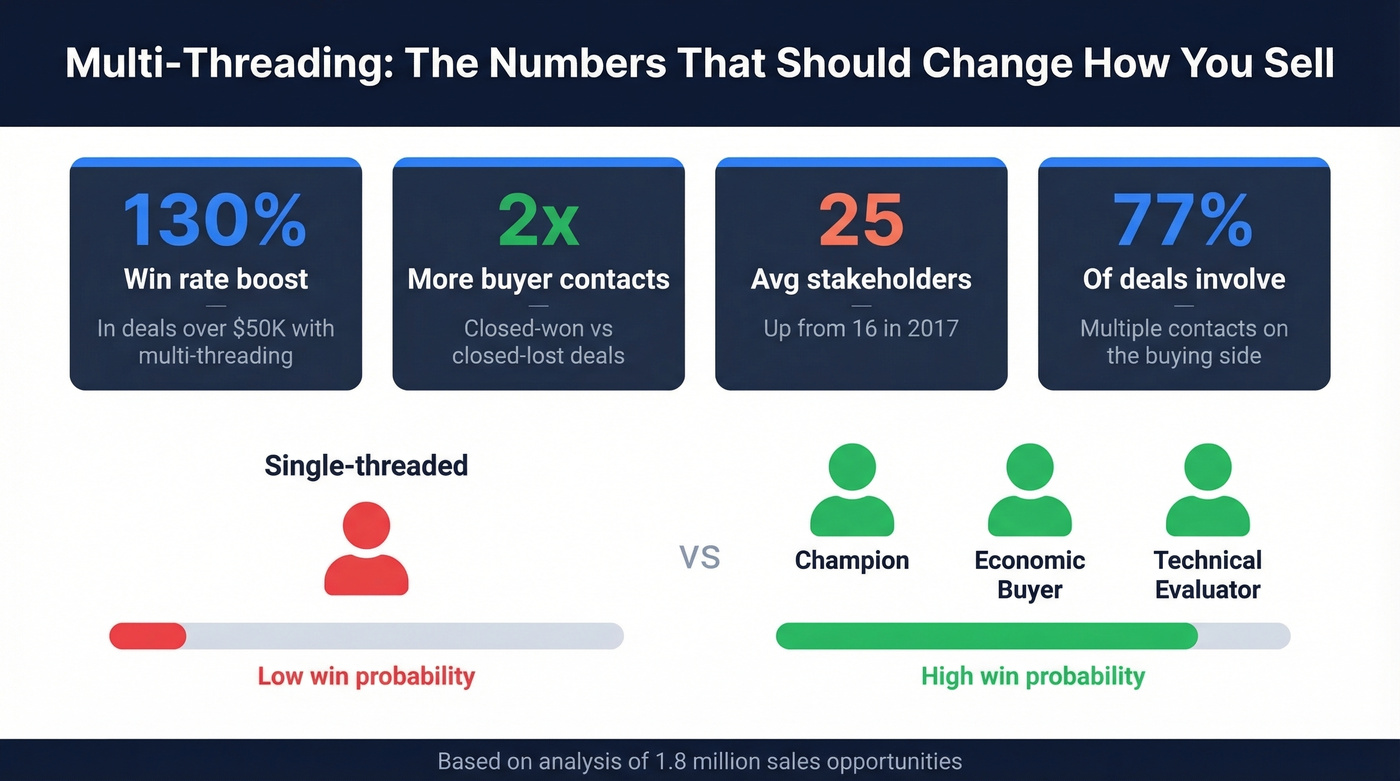
Here's the thing: multi-threading only works if you can actually reach those stakeholders with verified contact data. Bounced emails and wrong numbers kill momentum faster than a bad demo. Prospeo's 98% email accuracy and 125M+ verified mobile numbers mean your reps can reach the full buying committee instead of pinging one champion and praying.
6. Bring in the Sales Engineer
Won deals have selling teams that are 67% larger than lost deals. SE involvement lifts win rates by up to 30% in enterprise deals. The mistake teams make is saving the SE for the demo. Deploy them earlier - during discovery or technical evaluation - when they can shape requirements rather than just respond to them.
7. The 43/57 Rule
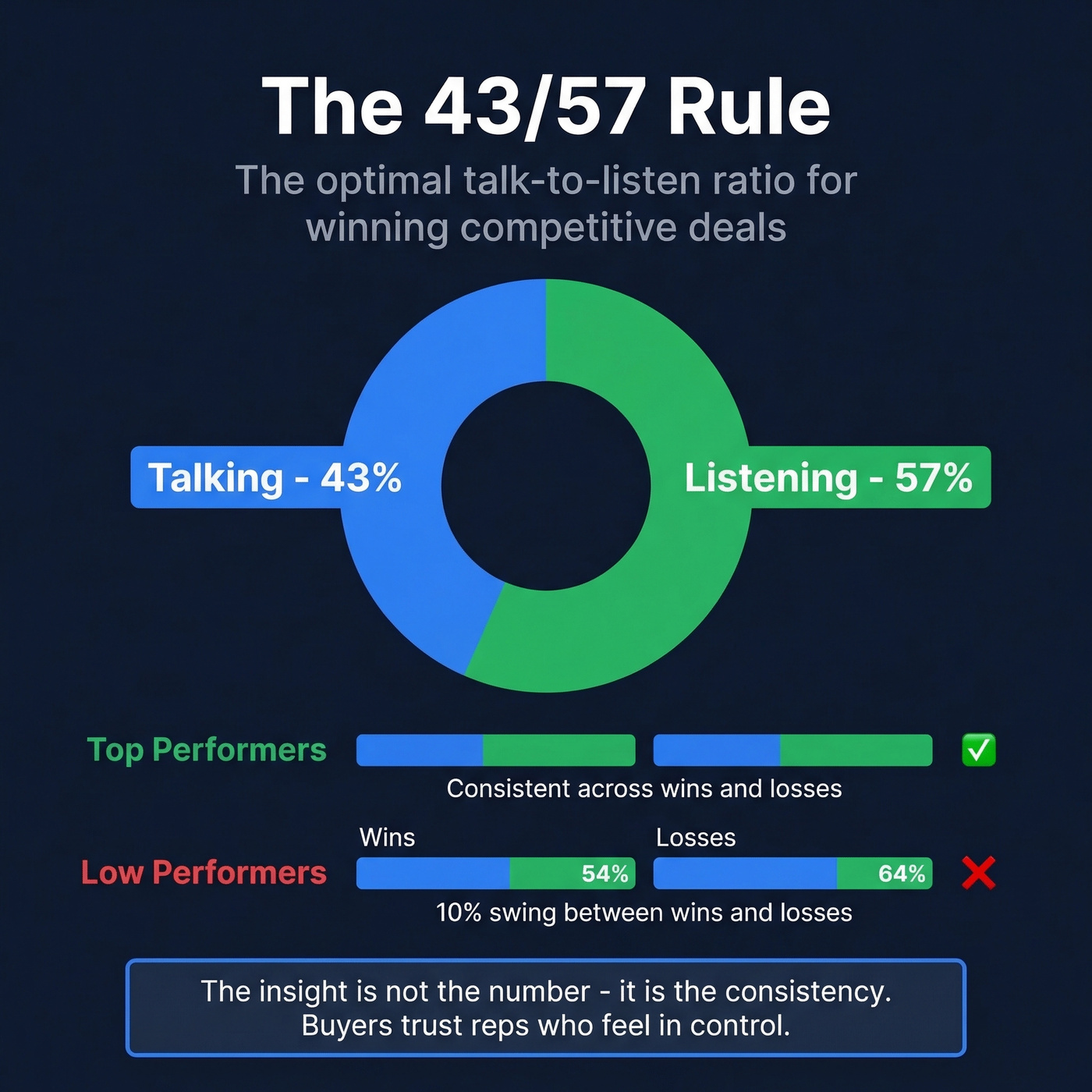
The optimal talk-to-listen ratio is 43% talking, 57% listening. But the real insight isn't the number - it's the consistency. Low-performing reps swing their talk time by 10% between won and lost deals (54% in wins vs. 64% in losses). Top performers hold steady. They don't over-talk when nervous or under-talk when confused. Consistency signals control, and buyers trust reps who feel in control.

77% of competitive deals involve multiple contacts, and closed-won deals have 2x more buyer touchpoints. Multi-threading only works if your data connects. Prospeo gives your reps 98% verified emails and 125M+ direct dials so they reach the full buying committee - not just one champion.
Stop single-threading competitive deals with bad contact data.
Handling Competitive Questions Without Bashing
You've read "don't bash competitors" in every sales article since 2015. Here's what to actually say instead.
The three reactions that kill deals, per Intercom: attacking the competitor (makes you look insecure), ignoring the competitor (makes you look uninformed), and launching into a feature-by-feature comparison (makes you look desperate). All three shift the conversation away from the buyer's problem and toward your anxiety. Negative selling backfires because it triggers the prospect to defend the competitor. You've just turned your buyer into your competitor's advocate.
The correct move is to say something genuinely positive about the competitor first. "They're a solid company - their [specific strength] is real." Then pivot to your differentiator. "Where we're different is [value wedge]. Would it be helpful if I showed you how that plays out for companies like yours?" This works because it demonstrates confidence. A rep who can acknowledge a competitor's strength without flinching signals that they know their own product is strong enough to win on merit.
Battlecards Reps Actually Use
Most battlecards die in a Google Drive folder. The ones that work share three qualities: they're accurate, brief, and consistent - the ABC standard.
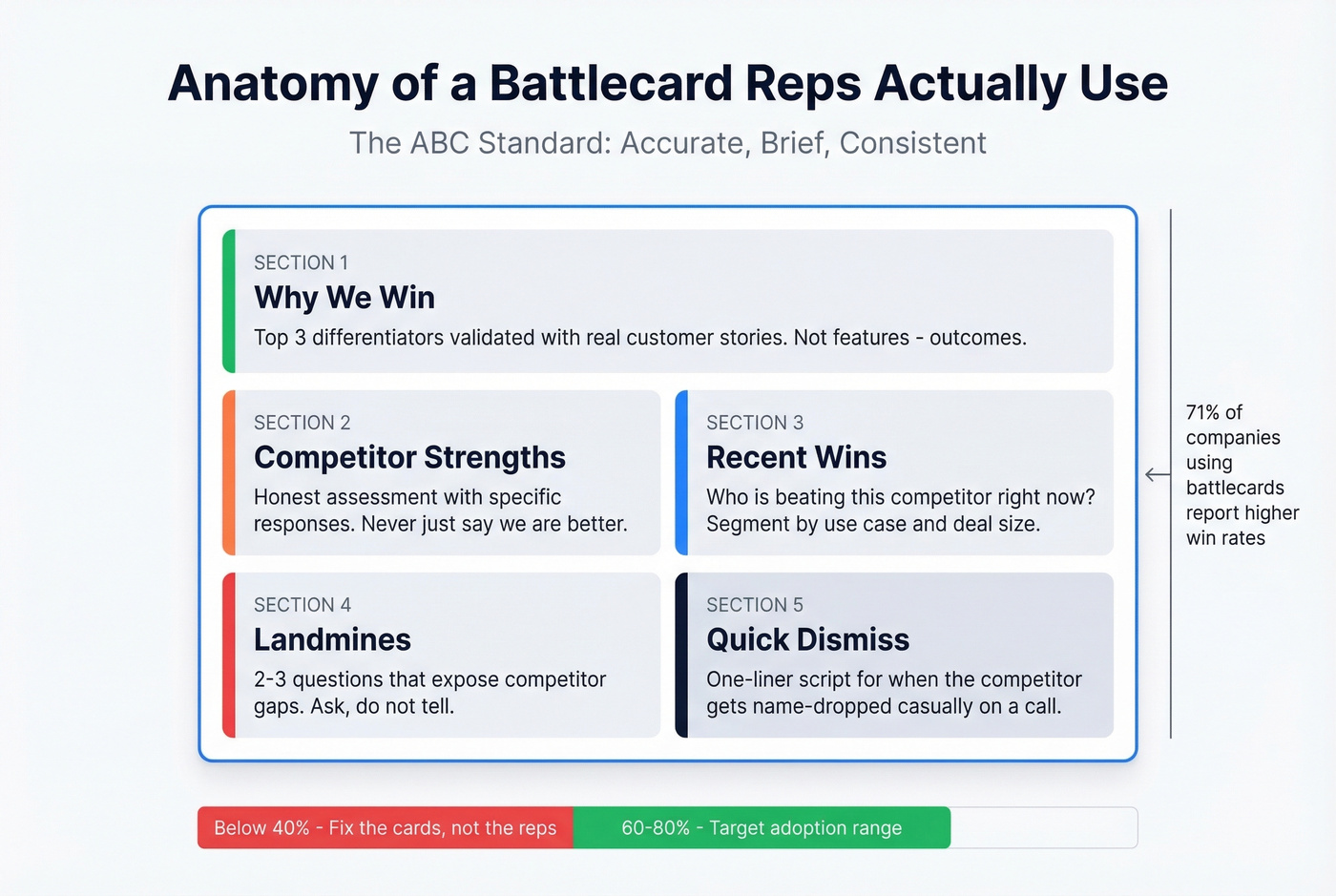
Every battlecard needs these fields: Why We Win (top 3 differentiators validated with customer stories), Competitor Strengths (with specific responses - not "we're better"), Recent Wins (who's beating this competitor right now, segmented by use case), Landmines (2-3 questions that expose competitor gaps), and a Quick Dismiss script for when the competitor gets name-dropped casually.
Not every rep needs the same card:
| Battlecard Type | Stage | Key Content |
|---|---|---|
| BDR | Discovery | Probing questions, early "us vs. them" framing |
| Why We Win/Lose | Mid-funnel | Top differentiators, customer stories |
| Late-Stage Depositioning | Negotiation | Quick dismiss, trap-setting questions, objection handling |
| Product/Executive | Any | Feature comparison, pricing snapshot |
71% of companies using battlecards report higher win rates. But that stat only holds if reps actually open them. Set an adoption target of 60-80% of reps accessing battlecards monthly, and track it like you'd track pipeline hygiene. If adoption is below 40%, the problem isn't the reps - it's the cards. Make them shorter, make them searchable, and update them monthly.
Building a Competitive Sales Strategy That Scales
Individual tactics don't scale without a program behind them. The EPIC framework gives you the structure: Evaluate your current competitive position, Plan your intelligence priorities before collecting data, generate Insight from win/loss analysis, and Communicate findings to the people who can act on them.
The Qualtrics model is worth studying. They built CEO-level visibility into competitive data, ran a real-time dashboard tracking win rates against specific competitors, and convened a monthly cross-functional task force to review trends and assign actions. The critical move: sales leadership made CRM competitor fields mandatory and tied completion to compensation. Data quality transformed overnight. We've seen other teams replicate this approach and double their competitive win rate just by enforcing CRM competitor fields.
The failure modes are predictable. Insights get trapped in a quarterly deck nobody reads. There's no owner with authority to drive changes. The cadence is too slow - quarterly reviews mean you're fighting the last war. Sales perceives the program as blame rather than enablement.
Avoid all four by running an always-on interview cadence, routing insights to specific owners with SLAs, and building a searchable story bank that feeds directly into battlecards. The best programs combine internal win/loss data with external market signals - pricing changes, product launches, new messaging - so reps are never caught off guard.
Aligning Marketing Intelligence With Sales
Let's be honest: in most organizations, marketing competitive intelligence and sales competitive intelligence live in completely separate worlds.
Marketing monitors competitor websites, ad spend, content themes, and analyst coverage. Sales hears what competitors are saying on calls and in proposals. Both sides have signal the other desperately needs, and neither shares it consistently. The best programs create a shared intelligence loop where marketing distills findings into actionable updates that feed directly into battlecards and talk tracks, while sales reports real-time competitor claims back to marketing for positioning refinement. Without this loop, marketing builds campaigns in a vacuum and sales improvises on every call.
Tools and What They Cost
Reps spend only 28-30% of their time actually selling. The rest goes to research, data entry, and admin. The right tools claw back that time and surface competitor signals automatically.
Look - you don't need a $30K CI platform to start winning head-to-head deals. You need accurate data, a one-page battlecard, and a discovery framework. But the right stack accelerates everything. The CI market is projected to hit $1.46B by 2030. Here's how the stack breaks down:
| Tool | Category | Starting Price | Best For |
|---|---|---|---|
| Prospeo | B2B data + contact accuracy | Free tier (75 emails/mo); ~$0.01/email | First-mover outreach with verified contacts |
| Klue | Competitive intelligence | ~$20K-$40K/yr | Battlecard management at scale |
| Crayon | Competitive intelligence | ~$20K-$40K/yr | Automated competitor monitoring |
| Kompyte | Competitive intelligence | From ~$300/yr | Startups needing budget CI |
| Gong | Conversation intelligence | ~$30K-$100K+/yr | Competitive deal analysis |
| Semrush | SEO competitive analysis | From $139/mo | Digital competitive positioning |
Our take: most teams don't need a six-figure CI platform. If your average deal size is under $25K, a well-maintained battlecard in Notion plus a solid data layer will outperform an enterprise CI tool that nobody logs into. Gong's AI functionality does correlate with a 35% higher win rate for teams that use it - but only if your reps are actually coached on the insights. Tools without process are just expensive dashboards.
Skip the enterprise CI platforms if you're under 20 reps and your deal sizes are sub-$30K. Start with a free battlecard template, a conversation recording tool, and accurate contact data. Scale the stack as your competitive program matures.
Competitive selling is a system - and systems break when reps can't reach decision-makers. Prospeo's 7-day data refresh means your battlecards point to real people at real emails, not stale records from six weeks ago. At $0.01 per email, arming 50 AEs costs less than one lost deal.
Fresh data wins head-to-head deals. Stale data loses them.
FAQ
What is competitive selling?
It's a systematic approach to winning deals where buyers evaluate multiple vendors, combining research, battlecards, and deliberate rep behaviors to differentiate and close. Unlike generic sales tips, it's an organizational program with intelligence gathering, enablement content, and feedback loops that improve win rates over time.
How do you sell against a cheaper competitor?
Never compete on price alone - discounting signals weakness and trains buyers to negotiate harder. Build a value wedge by identifying the buyer's top priority that the cheaper alternative can't address, then anchor every conversation to that differentiator with customer proof points.
When should you bring up competitors on a sales call?
In new markets, mention competitors early - data shows a 24% higher close rate. In mature markets, wait until the evaluation stage. Late-stage competitor mentions (month five or later) signal the deal is under threat and require immediate multi-threading.
What should a competitive battlecard include?
Five fields minimum: why you win (top 3 differentiators), competitor strengths with specific responses, recent wins against that competitor, 2-3 landmine questions exposing gaps, and a quick-dismiss script. Keep it to one page, update monthly, and track adoption - aim for 60-80% of reps accessing cards each month.
What's a good free tool for competitive deal outreach?
Prospeo's free tier includes 75 verified emails per month with 98% accuracy - enough to test multi-threading on 5-10 competitive deals. Pair it with a free battlecard template in Notion and a basic call recording tool, and you've got a functional competitive stack at zero cost.