

Discovery Call Coaching: The Data-Backed Playbook for Calls That Convert
You've been there. A 45-minute discovery call that felt great - real pain uncovered, genuine interest - and then the prospect says "let me think about it" and vanishes. That wasn't a discovery call. It was a free consulting session you didn't get paid for.
The three objections reps hear most - "I need to think about it," "not the right time," and "too expensive" - all trace back to insufficient discovery. Not bad pricing. Not a weak demo. The rep didn't ask enough of the right questions early enough, and the prospect never felt the urgency to act. If you want to get better through discovery call coaching, you need to treat these conversations as structured sales interactions, not therapy sessions.
The Numbers That Matter
- Ask 11-14 questions across a ~38-minute call. Keep talk time at 46% or less.
- Use SPIN for consultative sales. Use BANT for transactional qualification. Pick one and commit.
- Send a recap email within 2 hours. Confirm the next meeting on the call itself - 86% of deals stall without clear next steps.
Benchmarks: What Good Actually Looks Like
The standard advice is "listen more than you talk." Nobody gives you the actual ratio. It's 46% or less. If you want deeper benchmarks, start with a B2B discovery call baseline and track improvements over time.
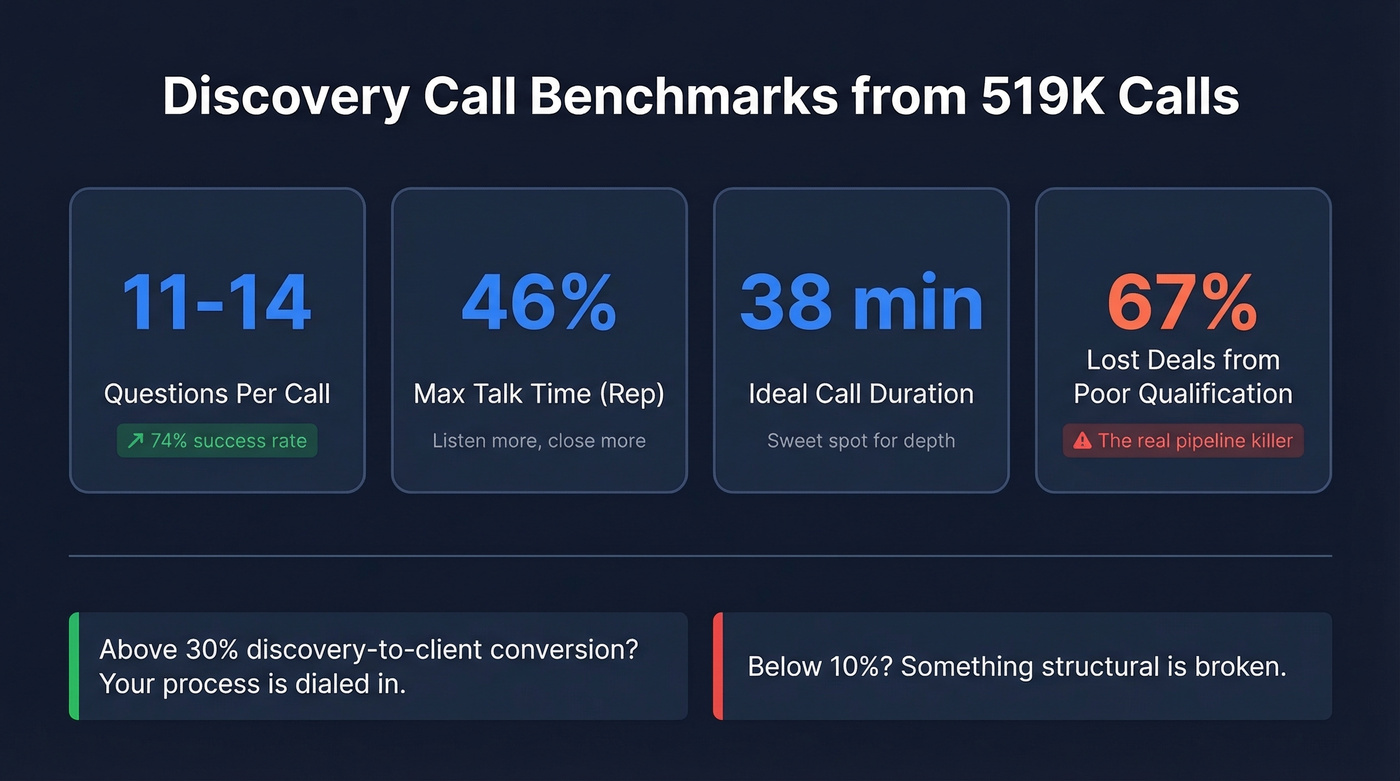
That number comes from an analysis of 519,000 recorded sales calls. Reps who ask 11-14 questions hit a 74% success rate; fewer than 7 questions drops success to 46%. The sweet spot for duration is ~38 minutes - shorter calls mean shallow discovery that doesn't uncover real pain, and longer calls usually mean the rep is talking too much or solving problems for free.
Here's the stat that should keep you up at night: 67% of lost sales trace back to poor qualification. Structured coaching on discovery technique improves effectiveness by up to 40% and lifts win rates by 15-25%. For coaching businesses specifically, a 10-30% discovery-to-client conversion rate is typical. Consistently above 30%? Your process is dialed in. Below 10%? Something structural is broken.
A 3-Phase Call Flow
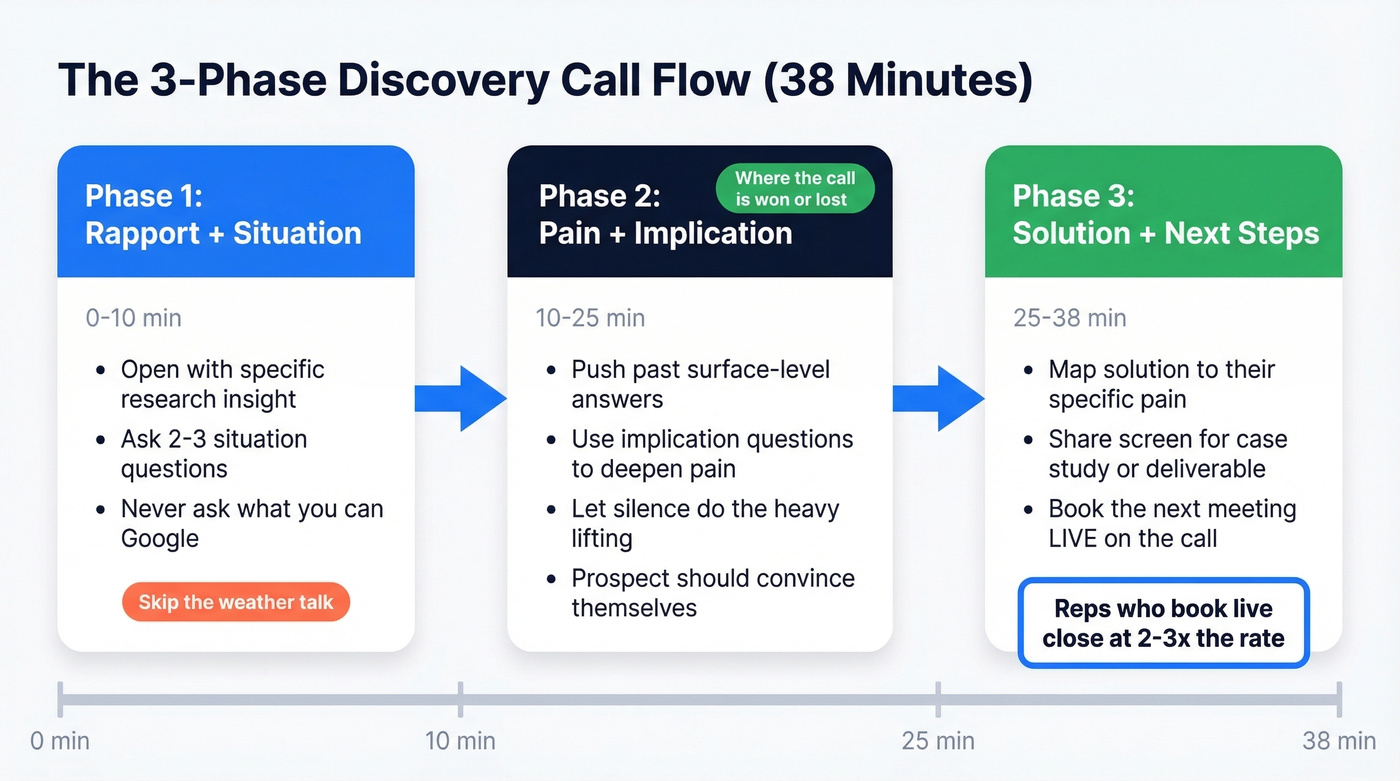
Phase 1: Rapport + Situation (0-10 min)
Skip the weather talk. Open with something specific from your research, then ask 2-3 situation questions to confirm context. (If you need scripts, use a discovery call template to keep it tight.)
- "I saw your team grew from 8 to 20 this year - what's driving that expansion?"
- "Walk me through how you're currently handling [specific process] today."
The SPIN rule here is non-negotiable: any situation question you can answer via pre-call research shouldn't be asked. Asking "So what does your company do?" when you could've spent 90 seconds on their website is an instant credibility killer. Do your homework.
Phase 2: Pain + Implication (10-25 min)
This is where the call is won or lost. We've reviewed hundreds of recorded calls, and the pattern is always the same - reps who stay surface-level ("What challenges are you facing?") get polite, vague answers. Reps who push into implications get emotional, specific ones.
Don't march through questions like a checklist. If a problem question opens a door, walk through it with an implication question before moving on. "What happens when that process breaks down?" leads to "How does that impact your team's ability to hit quota?" leads to "If nothing changes in six months, what does that look like?" Each question should deepen the previous answer, not change the subject. The prospect should be convincing themselves they need help - not waiting for your pitch. (For more examples, pull from SPIN questions and adapt them to your offer.)
Here's the thing: most reps bail on this phase too early because silence feels uncomfortable. Let it breathe. A three-second pause after a prospect finishes talking often produces the most honest, useful answer of the entire call.
Phase 3: Solution + Next Steps (25-38 min)
Map your solution directly to the pain they just articulated. Share your screen to walk through a case study or deliverable rather than just describing it - it reduces overwhelm and preempts objections. If you’re transitioning into a walkthrough, use a simple product demo checklist so you don’t ramble.
Then book the next meeting before you hang up. Don't say "I'll send over some times." Book it live. In our experience, reps who book live close at 2-3x the rate of those who "send times later." That's not a small difference. That's the difference between a healthy pipeline and a graveyard of "let me get back to you" emails.

Phase 1 says never ask a question you can answer with pre-call research. Prospeo gives you 50+ data points per contact - job changes, tech stack, funding, headcount growth - so you walk into every discovery call armed with context that builds instant credibility.
Stop wasting your first 10 minutes on questions Google could answer.
Pick a Framework and Commit
| SPIN | BANT | |
|---|---|---|
| Origin | Neil Rackham, 35K+ calls | IBM, 1960s |
| Best for | Complex, consultative sales | Fast, transactional qualification |
| Risk | Over-engineering simple deals | Missing deep pain in complex ones |
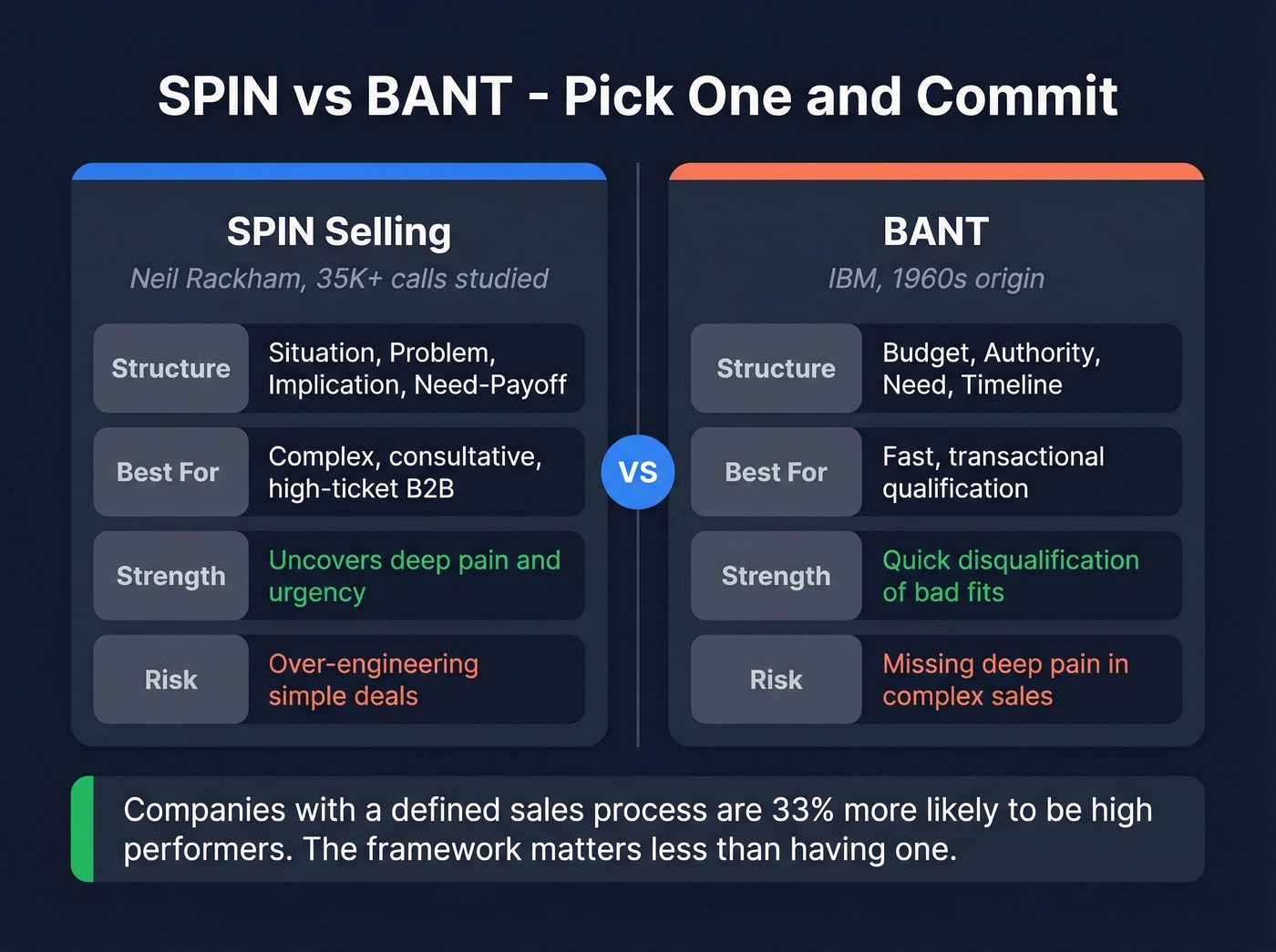
SPIN is the default recommendation for anyone selling services, coaching, or high-ticket B2B. BANT works when you need to qualify fast - inbound leads where budget and timeline are the real gatekeepers. Companies with a defined sales process are 33% more likely to be high performers. The framework matters less than having one. If you’re still deciding, compare more B2B sales methodologies before you lock it in.
Let's be honest: most coaches don't need a framework at all. They need to stop giving away the solution during discovery. If your prospect leaves the call feeling like their problem is already half-solved, you've coached for free. A framework's real job is to keep you on the sales side of that line.
Free vs. Paid Discovery Calls
Free works if you run a tight, structured call that stays on the sales side. The moment free calls consistently attract tire-kickers who ghost after 30 minutes of free advice, switch.
The paid model: charge $99-$150 for a strategy session. Deduct it from the project fee if they hire you. Offer a refund if you can't help. This filters for commitment without scaring off serious prospects. One sales coach on r/sales described switching to paid discovery calls and watching their close rate jump from 12% to 35% overnight - not because the calls were better, but because the people showing up were actually serious.
Caroline Leon advocates a complimentary "gift session" - a pitch-free coaching experience where you don't discuss working together at all. If the prospect wants to move forward, they book a separate enrollment call. It takes patience, but some of those prospects convert months later. Skip this approach if your sales cycle is under 30 days or you're running high-volume outbound - it's built for relationship-heavy, long-pipeline businesses.
Follow-Up That Prevents Ghosting
Send your recap email within 2 hours. Keep it 50-125 words. If you want a broader system, build it into your follow-up after sales call process so it’s consistent across reps.
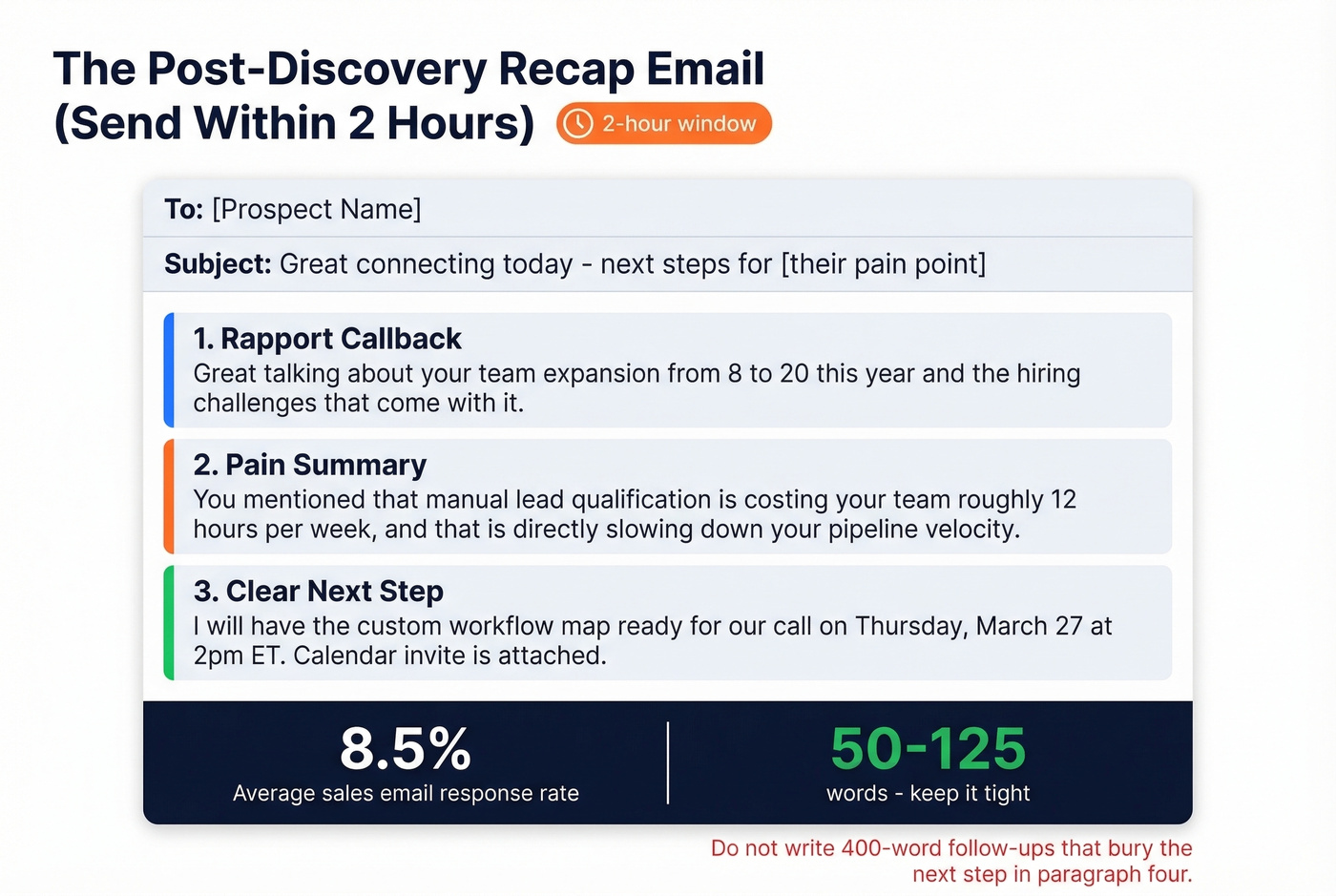
Rapport callback - "Great talking about [specific thing they mentioned]." Pain summary - "You mentioned [pain point] is costing you [impact]." Next step - "I'll have [deliverable] ready for our call on [day, date, time] - calendar invite attached."
The average sales outreach email gets an 8.5% response rate. A warm recap after a real conversation should crush that - but only if it's concise and action-oriented. We've seen reps write 400-word follow-ups that bury the next step in paragraph four. Don't do that. Three short paragraphs, one clear action, done. (If you need copy, start from proven prospect email templates and trim aggressively.)
Build a Pre-Call Research Stack
Before you prep a single question, research the prospect's company, role, recent news, and tech stack. Then verify your contact data. The worst discovery call is one that never happens because the number was wrong or the email bounced. If you’re tightening this workflow, prioritize pipeline hygiene so bad data doesn’t keep leaking into your call list.
Prospeo handles that verification step with 98% email accuracy across 143M+ verified addresses and 125M+ verified mobile numbers on a 7-day refresh cycle. The free tier covers 75 email verifications per month - enough to validate a weekly call list without spending anything. (If you want to go deeper on the mechanics, see the best way to verify an email address.)
For scheduling, Calendly starts free with paid plans around ~$10-20/user/month. Acuity runs ~$16-50/month and works better if you need intake forms that pre-qualify before the call. TidyCal is a one-time ~$29-39 purchase for teams done with subscriptions. For conversation intelligence, Gong is enterprise pricing (typically $100+/user/month) and Avoma offers a free tier with paid plans around ~$24-79/user/month.
You just coached your reps to book the next meeting live and send a recap within 2 hours. But none of that matters if they're calling the wrong person. Prospeo's 300M+ profiles with 30+ filters - including buyer intent and department headcount - ensure every discovery call starts with a qualified prospect, not a tire-kicker.
Fix your pipeline before you fix your talk ratio.
FAQ
How many questions should I ask on a discovery call?
Aim for 11-14. Data from 519,000 calls shows fewer than 7 drops success rates to 46%, while 11-14 questions hit 74%. More than 14 creates diminishing returns and starts feeling like an interrogation.
Should I charge for discovery calls?
Only if free calls consistently attract tire-kickers. A $99-$150 paid session with a refund option filters for commitment without scaring off real prospects. Deduct the fee from your engagement price to remove friction.
What's the best way to make sure discovery calls actually happen?
Verify contact data before you dial. Bounced emails and wrong numbers kill more pipeline than bad pitches ever will.