

The Best Way to Verify an Email Address in 2026
You cleaned your list last month. You sent today. 6% bounced. Nobody warned you that email lists decay roughly 2% every month - around 24% of your contacts going stale every year. The average bounce rate across industries sits at 2.48%, and if you're above that, your sender reputation is already taking hits.
For context: ecommerce averages just 0.19% while construction hits 2.20%. Know your industry baseline before you panic - or before you get complacent.
Quick Answer
- Spot checks: A free single-email verifier like Hunter or Verifalia. Zero cost, good enough for one-offs.
- Bulk list cleaning: ZeroBounce or NeverBounce. Upload a CSV, get results in minutes, pay per verification.
How Email Verification Actually Works
Every verification tool runs the same pipeline under the hood. Understanding these steps helps you figure out which tools are doing real work and which are cutting corners.
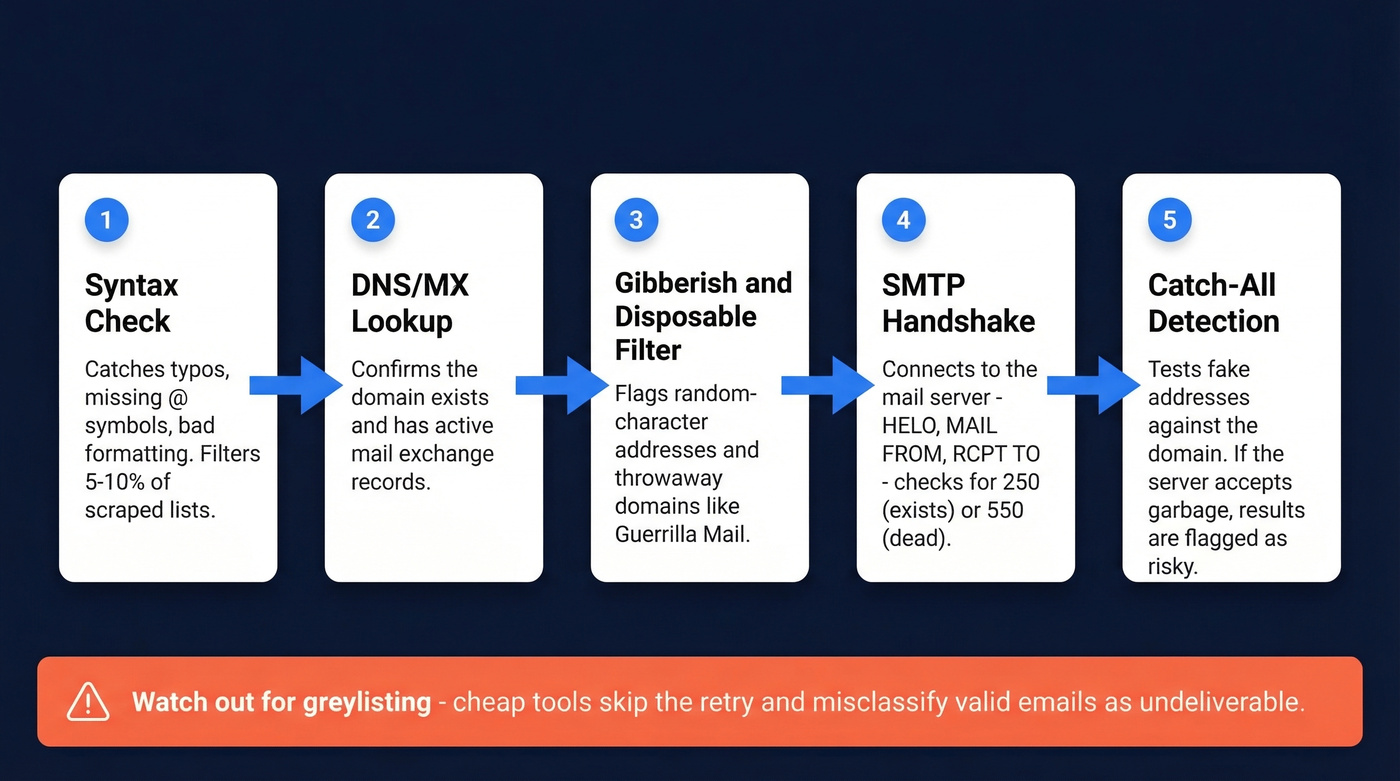
Syntax check. Valid formatting? This catches typos, missing @ symbols, and extraction errors - roughly 5-10% of bad addresses on scraped lists. DNS/MX lookup. Does the domain exist with active mail exchange records? Gibberish and disposable filtering. Addresses like asjkdf@company.com get flagged, along with throwaway domains from services like Guerrilla Mail. (If you need a blocklist, start with a disposable email domains list.)
SMTP handshake. The tool connects to the mail server and initiates a conversation - HELO, MAIL FROM, RCPT TO - without sending a message. A 250 response means the mailbox exists. A 550 means it doesn't. A 450 or 421 is a temporary failure, usually greylisting. (More detail: SMTP verification.)
Catch-all detection. Some domains return 250 for every address, valid or not. Tools test random fake addresses against the domain - if the server accepts garbage, every result gets flagged as "accept-all" or "risky."
Here's the wrinkle most people don't know about: greylisting. Mail servers deliberately reject the first connection and expect legitimate senders to retry after 15-30 minutes. We've seen cheap verifiers that skip the retry misclassify perfectly valid addresses as undeliverable, which means you're throwing away good leads because your tool was impatient.


Most verifiers top out at 70% real-world accuracy. Prospeo's 5-step verification catches what others miss - catch-all traps, spam traps, honeypots - before the email ever enters your list. 143M+ emails at 98% accuracy, refreshed every 7 days.
Skip the verify-then-clean treadmill. Start with data that's already verified.
Why Accuracy Matters More Than Speed
Every verification tool markets "99% accuracy." Hunter is the only vendor that's actually published a rigorous, reproducible benchmark - they tested 15 verification providers against 3,000 real business emails, segmented by company size. The top overall accuracy score? 70%. Not 99%. Seventy percent.
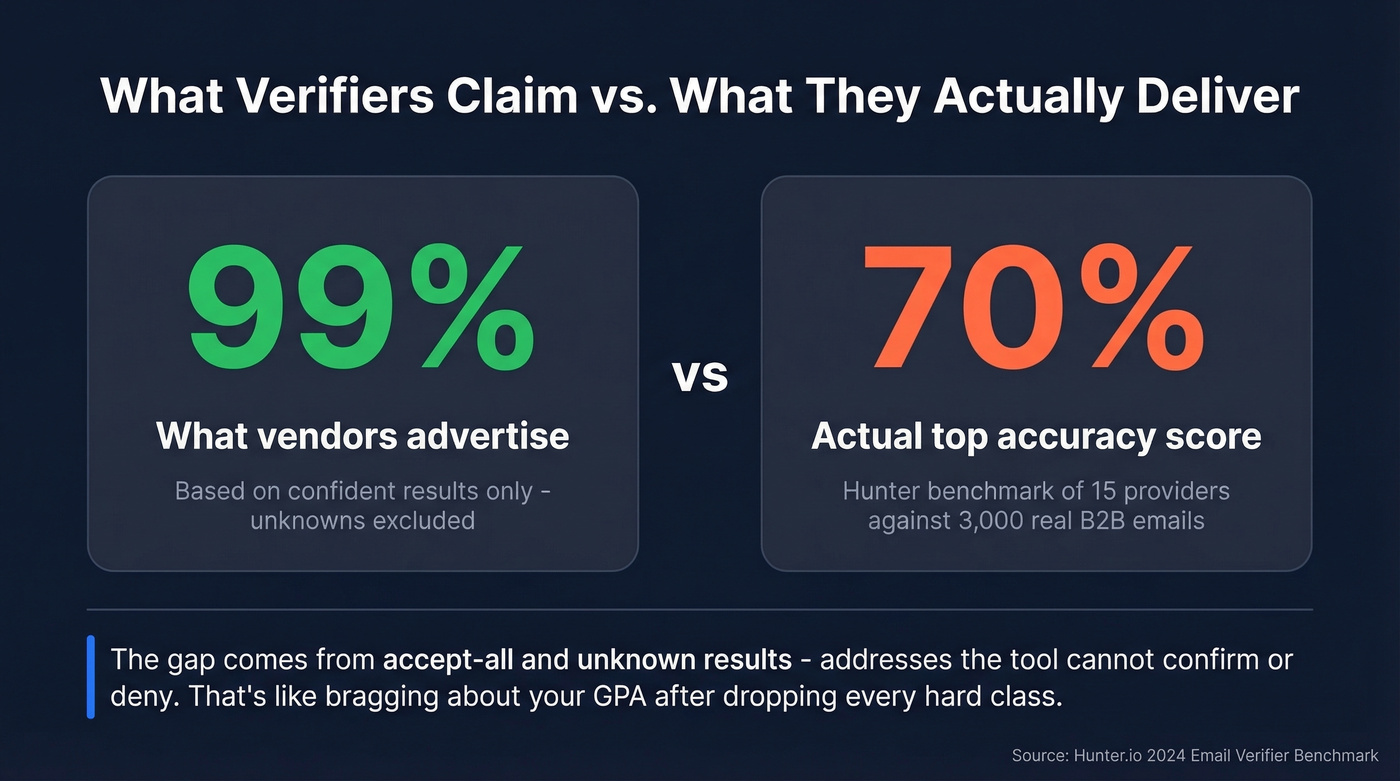
The gap comes from unknown and accept-all results - addresses the tool genuinely can't confirm or deny. In our experience, the accept-all bucket is where most false confidence lives. When a vendor claims 99%, they're measuring only the addresses they were confident about and ignoring the rest. That's like a student bragging about their GPA after dropping every hard class.
This is exactly why upstream verification beats after-the-fact cleaning. Prospeo runs a proprietary 5-step verification before an email enters its 143M+ verified database, refreshing all records on a 7-day cycle. Meritt saw their bounce rate drop from 35% to under 4% after switching. (If you're comparing approaches, see email validation vs verification.)
Top Tools Compared
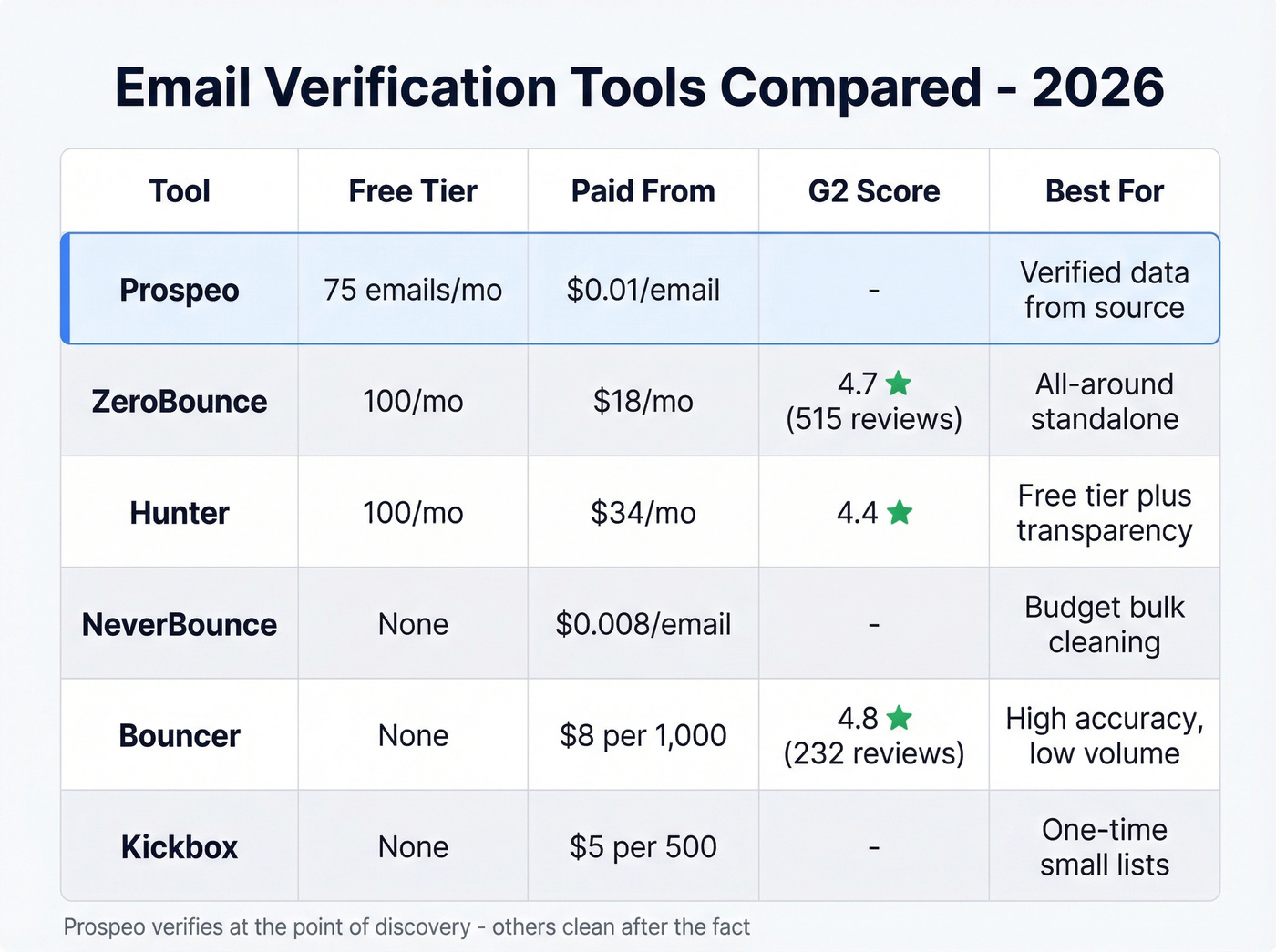
| Tool | Free Tier | Paid From | G2 Score | Best For |
|---|---|---|---|---|
| Prospeo | 75 emails/mo | ~$0.01/email | - | Verified data from source |
| ZeroBounce | 100/mo | $18/mo | 4.7 (515) | All-around standalone |
| Hunter | 100/mo | $34/mo | 4.4 | Free tier + transparency |
| NeverBounce | - | ~$0.008/email | - | Budget bulk cleaning |
| Bouncer | - | $8/1,000 | 4.8 (232) | High accuracy, low volume |
| Kickbox | - | $5/500 | - | One-time small lists |
Prospeo
Prospeo takes a fundamentally different approach: instead of cleaning bad data after the fact, it verifies every email at the point of discovery using a proprietary 5-step process - syntax, DNS, SMTP handshake, catch-all handling, and spam-trap removal. The result is a 143M+ verified email database with 98% accuracy, refreshed every 7 days while the industry average sits at 6 weeks. At roughly $0.01 per email with 75 free credits per month, it's the most cost-effective option for teams building outbound lists from scratch. Stack Optimize built to $1M ARR using this data, maintaining 94%+ deliverability and under 3% bounce across all client campaigns with zero domain flags. If you're tired of the find-then-verify-then-clean treadmill, this is the off-ramp. (Related: verified email addresses.)
ZeroBounce
ZeroBounce is the strongest standalone verifier for teams already sitting on lists they need to clean. A G2 rating of 4.7 across 515 reviews and Capterra at 4.7 with 458 - that consistency across platforms is telling. Pricing starts at $18/mo for 2,000 verifications, with a $20 pay-as-you-go option for 2,000 as a common comparison point. The 100 free monthly verifications are enough for spot-checking before you commit.
Use this if you've got a CRM full of contacts and need a deep clean. Skip it if you're building lists from scratch - you'd be better off starting with verified data upstream. (If you want more options, see bulk email address list cleaner.)
Hunter
Start here if you're bootstrapping. Hunter's free plan includes 100 verifications per month, and they're the only vendor publishing real benchmark data with disclosed methodology. That transparency alone earns trust. Paid plans start at $34/mo. (More context: Hunter.io use cases.)
Their verifier checks format, gibberish, disposable domains, webmail detection, MX records, SMTP responses, runs a database lookup against Hunter's B2B data, and uses a proprietary accept-all verification system. With 6M+ users, it's battle-tested. The obvious pick for zero-budget verification.
Budget Options
NeverBounce is the go-to for pure volume at ~$0.008 per email with no monthly commitment. Cleaning a 50,000-row CSV once a quarter? Hard to beat on price. Bouncer punches above its weight with the highest G2 score on this list (4.8, 232 reviews) and charges $8 per 1,000 verifications - great for small teams running targeted campaigns. Kickbox starts at just $5 for 500 verifications, the lowest-commitment option for a one-time event list.
Mistakes That Kill Sender Reputation
Verify-and-forget. You cleaned your list in January and sent in March. In those two months, ~4% of addresses went invalid. Re-verify before every major send, or at minimum monthly. (If you're building a process, use an email verification list SOP.)
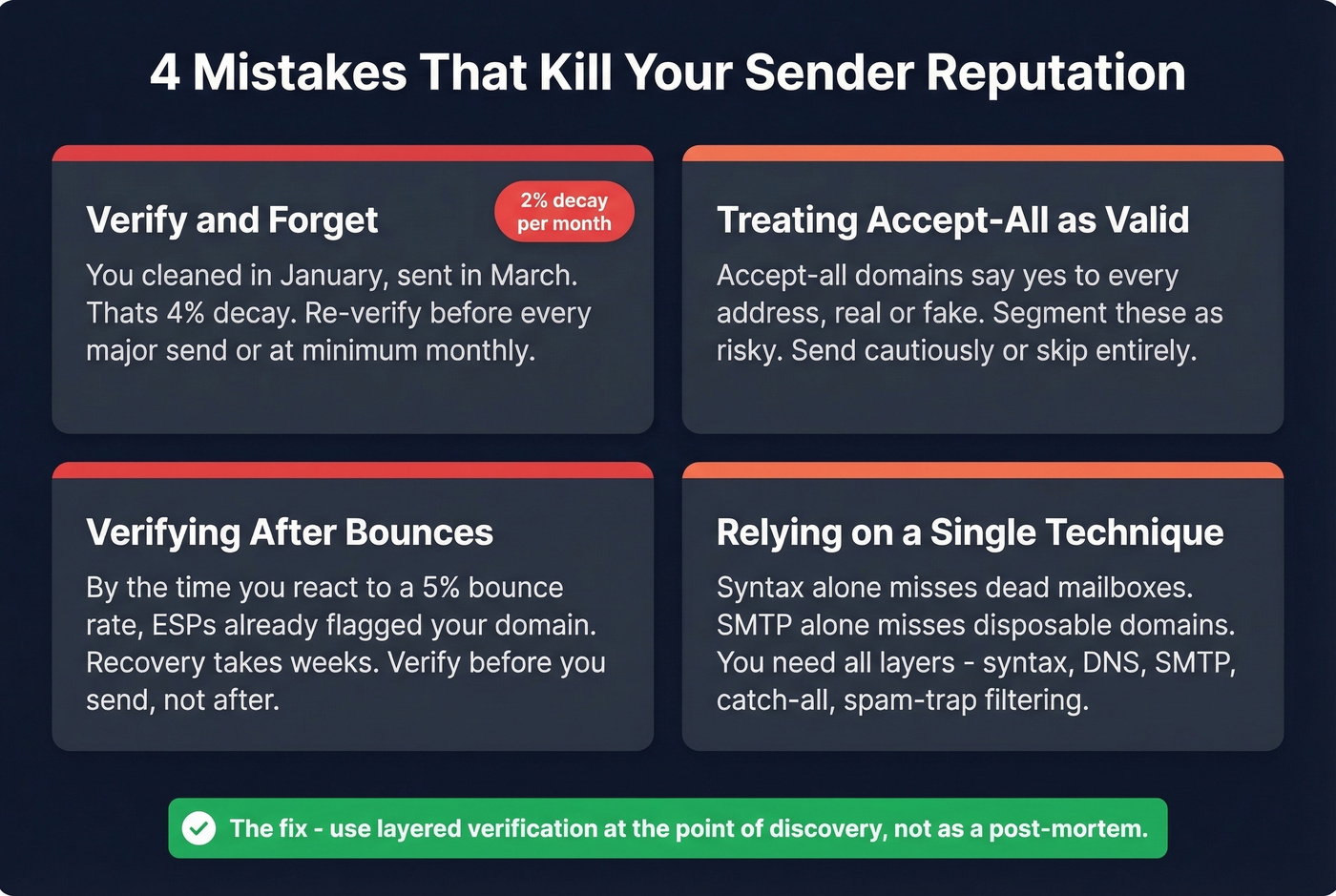
Treating accept-all as valid. Accept-all domains return a 250 response for every address - valid or not. We've seen teams send confidently to these "verified" addresses and get hammered with bounces and spam traps. Treat accept-all as risky. Segment them. Send cautiously or skip them entirely.
Verifying after bounces instead of before. By the time you're reacting to a 5% bounce rate, the damage is done. ESPs flag your domain, deliverability drops across your entire sending infrastructure, and recovery takes weeks. Verification is a pre-send discipline, not a post-mortem. (If you're troubleshooting, start with email marketing bounce rate.)
Relying on a single technique. Syntax checks alone won't catch inactive mailboxes, and SMTP handshakes alone won't catch disposable domains. You need layers - syntax, DNS, SMTP, catch-all detection, and spam-trap filtering - so each step catches what the others miss.
Let's be honest: if your average deal size is under $10k and you're spending more than $200/month on verification credits cleaning the same list every quarter, you're solving the wrong problem. Switch to a platform that gives you verified data from the start and stop paying the bad-data tax.
Your list decays 2% every month. Prospeo refreshes all 300M+ records on a 7-day cycle while competitors wait 6 weeks. At $0.01 per email with 75 free monthly credits, it's the cheapest way to never worry about bounce rates again.
Meritt dropped from 35% bounce to under 4%. Your list is next.
FAQ
Can I verify an email without sending a message?
Yes. SMTP verification connects to the mail server and initiates a handshake without delivering any message. The server's response code (250 = exists, 550 = doesn't) tells the tool whether the mailbox is active. Every major verifier uses this method.
How often should I re-verify my list?
Before every large send, or at minimum monthly. Lists decay roughly 2% per month - a list verified 3 months ago could have around 6% invalid addresses, enough to trigger ESP penalties.
What does "catch-all" mean in results?
The domain's mail server accepts all incoming emails regardless of whether the specific mailbox exists. Verification tools can't confirm individual addresses on these domains. Treat catch-all results as risky - segment them separately and send at low volume, or skip them entirely.
What's the best way to verify an email address for cold outreach?
Use a platform that combines finding and verifying in one step. Running separate tools - a finder, then a standalone verifier, then a disposable-domain checker - introduces gaps where bad data slips through. A single-step approach where emails are verified at the point of discovery keeps deliverability high without extra cost or workflow complexity.