

7 Hunter.io Use Cases: What It's Actually Good For (and Where It Falls Short)
Most articles about Hunter.io use cases are written by Hunter's marketing team. This one isn't. Hunter earns its 4.4/5 on G2 across 634 reviews, but it's great at some things and mediocre at others.
Here's the short version: Hunter is best for SEO link building outreach - its domain-based model was literally built for this - and most overhyped for cold email at scale, where the credit system chokes you fast. If you need phone numbers or bigger database coverage, skip to the alternatives section.
How Hunter's Email Lookup Works
Hunter runs a five-step workflow: Discover/Signals companies using filters, then Domain Search or Email Finder to surface professional emails, then Verify those emails (valid, invalid, accept-all with a confidence score), store contacts in Leads, and send outreach via Sequences.
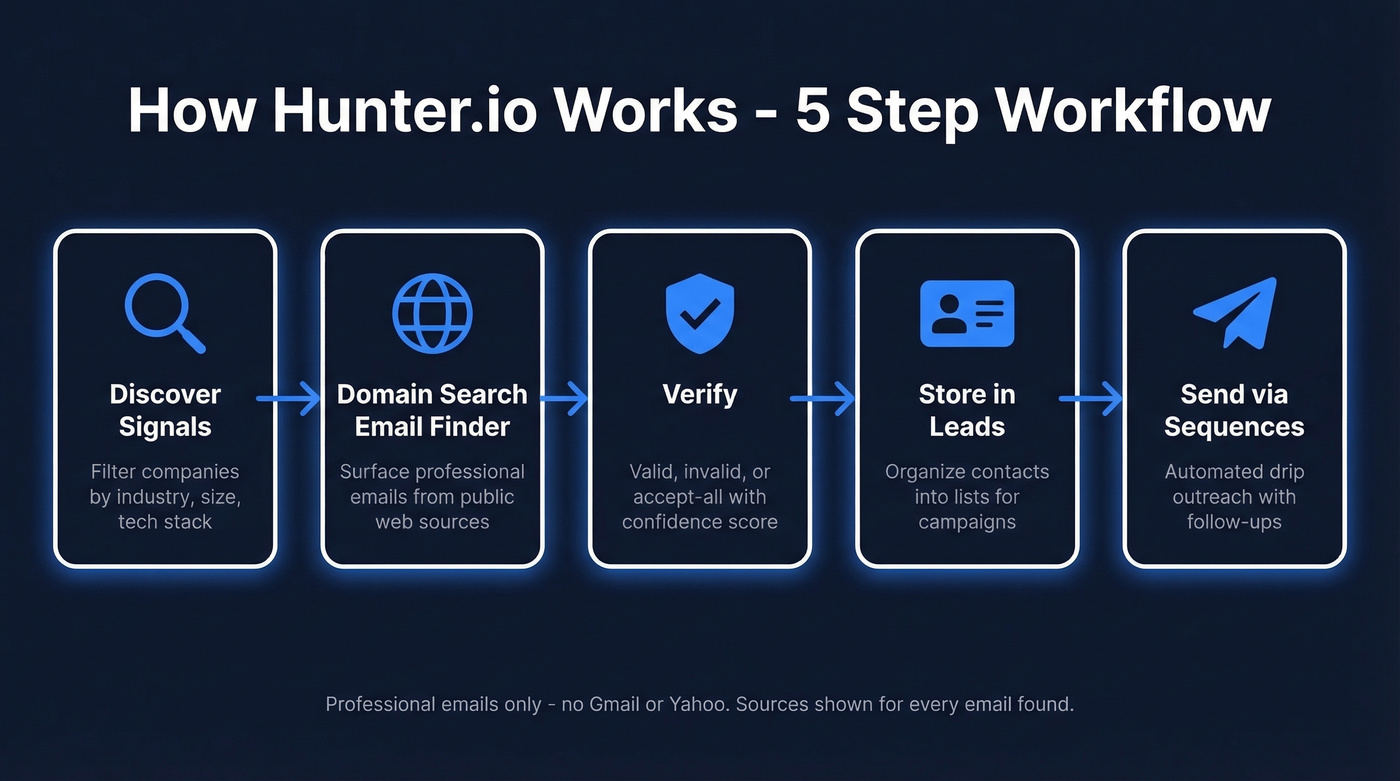
It focuses exclusively on professional emails - no @gmail or @yahoo. Its email lookup sources data from the public web, not third-party databases, so it shows you where each email was found and when. That transparency matters for compliance conversations.

Hunter Pricing in 2026
| Plan | Price | Credits/mo | Email accounts | Seq. recipients |
|---|---|---|---|---|
| Free | $0 | 50 | 1 | 500 |
| Starter | $49/mo ($34 annual) | 2,000 | 3 | 2,500 |
| Growth | $149/mo ($104 annual) | 10,000 | 10 | 5,000 |
| Scale | $299/mo ($209 annual) | 25,000 | 20 | 15,000 |
| Enterprise | Custom | Custom | Custom | Custom |
Credits cover Email Finder, Domain Search, and Email Verifier. The free plan's 50 credits is essentially a demo - enough to test, not enough to work. Full details on Hunter's pricing page.

Hunter's 2,000 credits at $49/mo disappear fast. Prospeo starts at $0.01/email with 98% accuracy, 125M+ verified mobile numbers, and no credit walls that choke your outbound volume.
Stop rationing credits - start building pipeline that actually converts.
The 7 Best Ways to Use Hunter.io
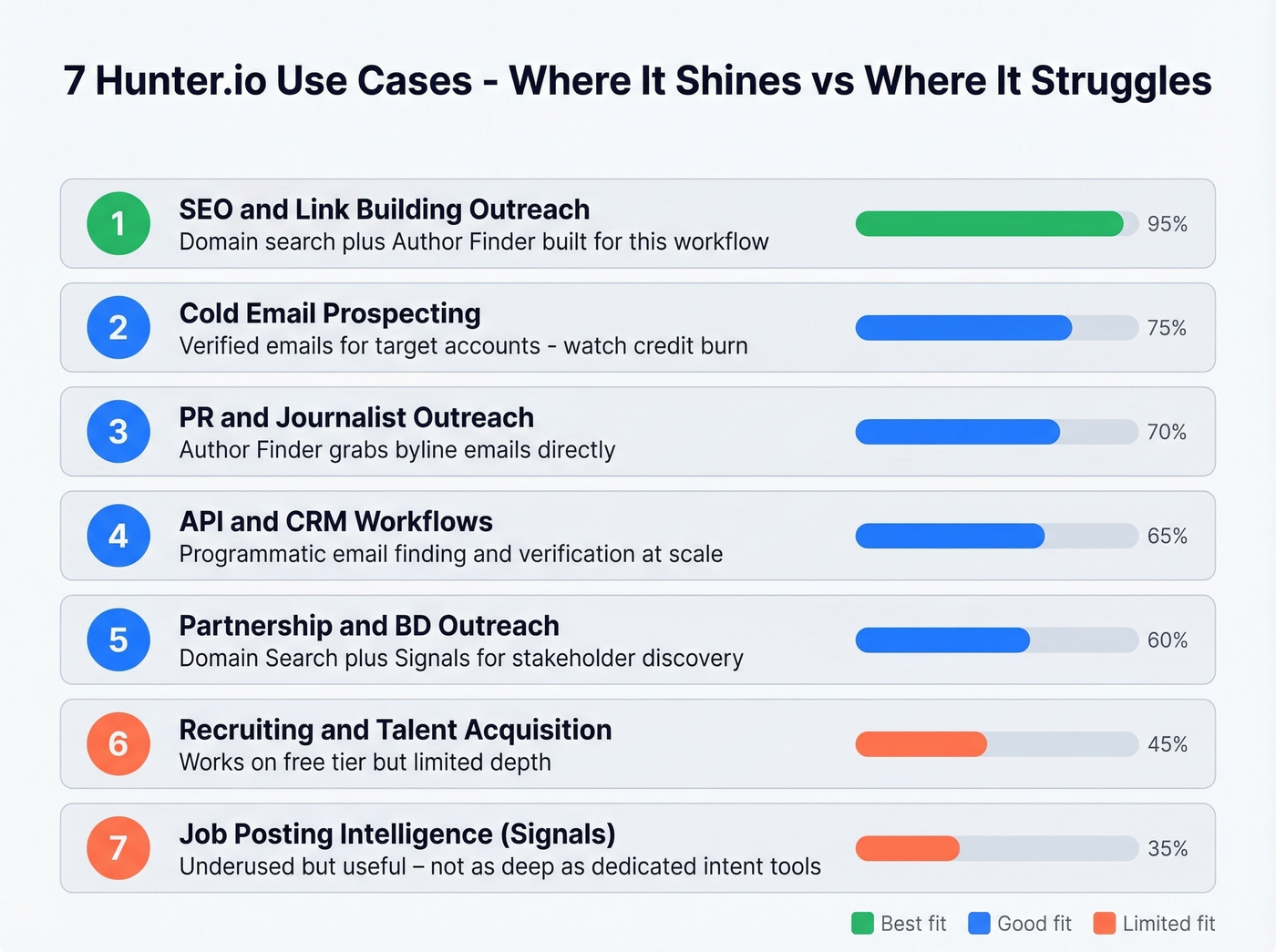
1. Cold Email Prospecting
Your SDR team needs verified emails for decision-makers at 50 target accounts by Monday. Hunter handles this: run Domain Search, pull emails, verify anything below 90% confidence, push to Sequences. But watch the credit burn. A Starter plan's 2,000 credits can vanish in week one if your team is running real volume.
If you're building a repeatable outbound motion, pair this with a tighter sales prospecting process so you’re not burning credits on the wrong accounts.
One practical tip from r/microsaas that applies here: always target personal decision-maker inboxes, not generic contact@ or info@ addresses. Hunter surfaces both, so filter aggressively.
2. SEO & Link Building Outreach
This is where Hunter shines brightest. We've seen this workflow produce the most consistent results of any Hunter use case, and it's the one that justifies the subscription for most marketing teams.
Picture this: you're a marketing manager who needs 200 blog editor emails by Friday for a link building campaign. Here's how it works:
- Use Ahrefs Content Explorer to surface unlinked mentions, broken competitor links, or listicles in your niche.
- Hunter's Author Finder pulls the email for whoever wrote the piece - you want the blog editor, not a generic info@ address.
- The Google Sheets add-on lets you paste a column of names + domains and pull emails at scale.
- Follow up on Day 1, Day 4, Day 11, Day 25. Two to three follow-ups minimum (use these sales follow-up templates if you need a starting point).
An Ahrefs case study documented 96 new links from 54 domains in under three months, run by a single person using this exact workflow. That ROI justifies a Growth plan on its own.
3. PR & Journalist Outreach
Hunter works well for journalists because reporters publish bylines constantly, making Author Finder a practical way to reach the writer directly. Use it with the URL of a relevant article, grab the writer's email, and personalize your pitch around their recent coverage. Generic press@ addresses get ignored. A direct email to the journalist who covers your beat doesn't.
Some teams take a more systematic approach - tracking down every relevant reporter on a beat by crawling publication domains one by one through Domain Search.
4. Recruiting & Talent Acquisition
Most people overlook this one. A recruiter workflow on Medium walks through using Hunter's Chrome extension while browsing a target company's website: click the icon, and it surfaces emails associated with that domain plus suggested email formats when Hunter doesn't have a direct match. This works on the free tier. Fifty credits a month is enough for a recruiter filling one or two roles.
If you’re doing this at scale, you’ll eventually want data enrichment services to keep records current.
5. Partnership & BD Outreach
Domain Search is the natural starting point for business development. Identify your target company, pull the domain, and filter by department to find the right stakeholder. Hunter's Signals feature adds a layer here - it monitors companies' job postings and lets you filter by keywords including roles, which can signal expansion into areas relevant to your partnership pitch.
This pairs well with an account-based selling approach when your partner list is small and high-value.
6. API & CRM Workflows
For teams with developer resources, Hunter's API handles programmatic email finding and verification. Think bulk CSV processing for list cleaning, real-time verification before records hit your CRM, and automated workflows via native integrations with HubSpot, Salesforce, and Zapier. The API is where Hunter's per-credit pricing starts to make more sense than manual lookups.
If you’re standardizing how contacts flow into your stack, it helps to align on contact management software basics first.
7. Job Posting Intelligence (Signals)
Let's be honest: Signals is the most underused feature in Hunter's entire platform, and most users don't even know it exists. It tracks companies' job postings as intent signals. Here's what to look for specifically: if a job description mentions a tool your product replaces, that's a displacement signal. If the title is "VP of Sales" and the overview mentions "building an outbound function from scratch," that's a greenfield opportunity.
It's not as sophisticated as dedicated intent platforms, but it's a useful built-in way to turn hiring activity into outreach triggers. If you want to go deeper on this, see how to track sales triggers.

Where Hunter Falls Short
Credits choke scale. The G2 "cons" aggregation shows "expensive" (10 mentions) and "limited credits" (10 mentions) as top negatives. Scaling means jumping to Growth ($149/mo) or Scale ($299/mo), and even 25,000 credits has a ceiling for teams doing serious outbound.
If you’re sending high volume, you’ll also want to manage email velocity so deliverability doesn’t become the real bottleneck.
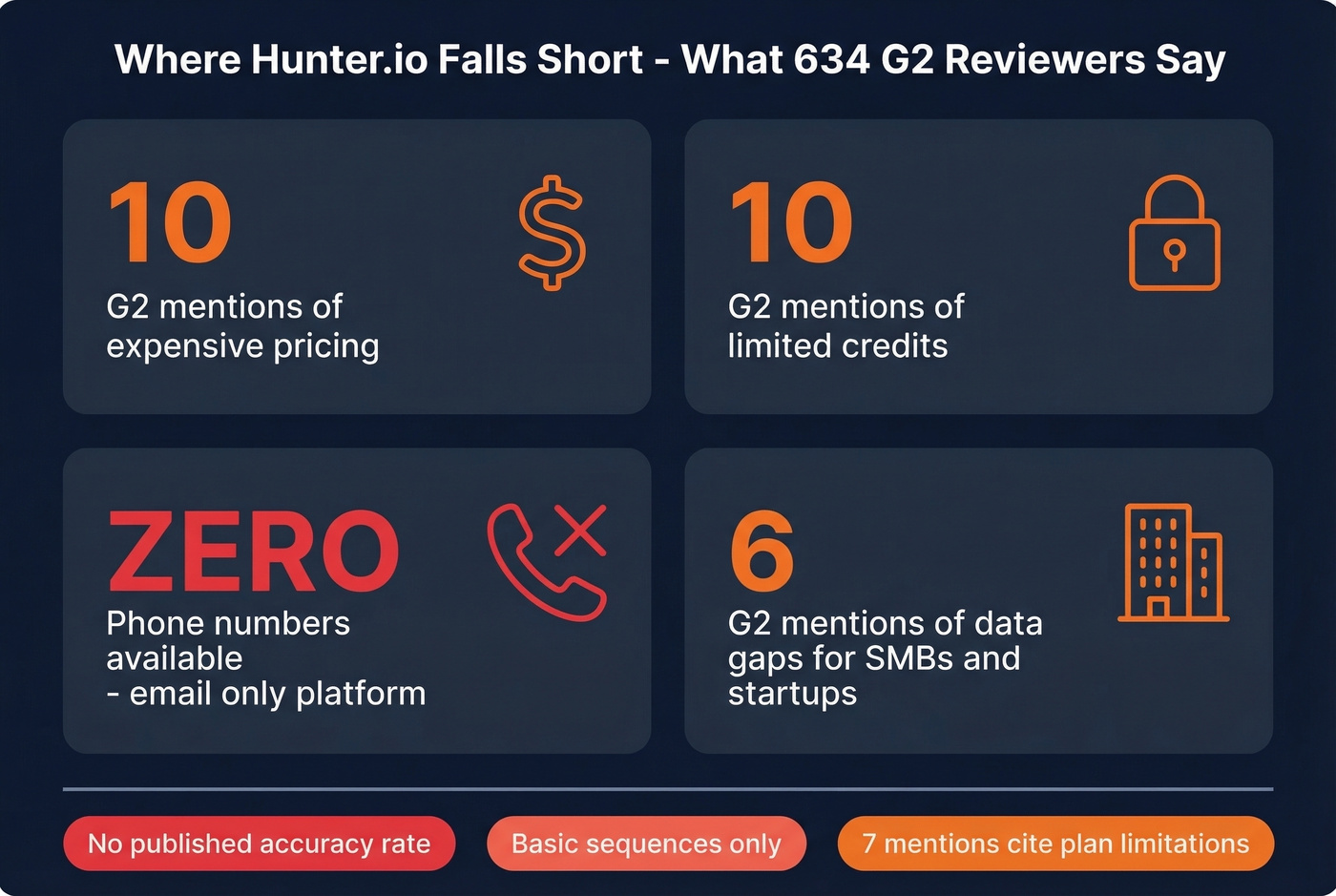
No phone numbers. Hunter is email-only. In 2026, most outbound motions require direct dials - you'll need a separate tool for that.
Thin SMB/startup coverage is another real gap. Six G2 "cons" mentions flag limited contacts and data gaps for smaller companies, which makes sense - Hunter's web-crawling model naturally favors companies with large web footprints. Another seven mentions cite plan limitations including lack of professional profile integration, which competitors handle natively.
Sequences handles simple drip campaigns but isn't competing with Instantly, Smartlead, or Lemlist on deliverability features, inbox rotation, or analytics depth. And Hunter doesn't publish a platform-wide email accuracy percentage, which is frustrating when you're trying to compare tools head-to-head. (If you’re comparing verifiers specifically, start with these Bouncer alternatives.)
When to Use Something Else
If you're hitting these walls, the fix is usually adding a dedicated data platform alongside Hunter or replacing it entirely. If you want a broader comparison set, see our Hunter alternatives roundup.
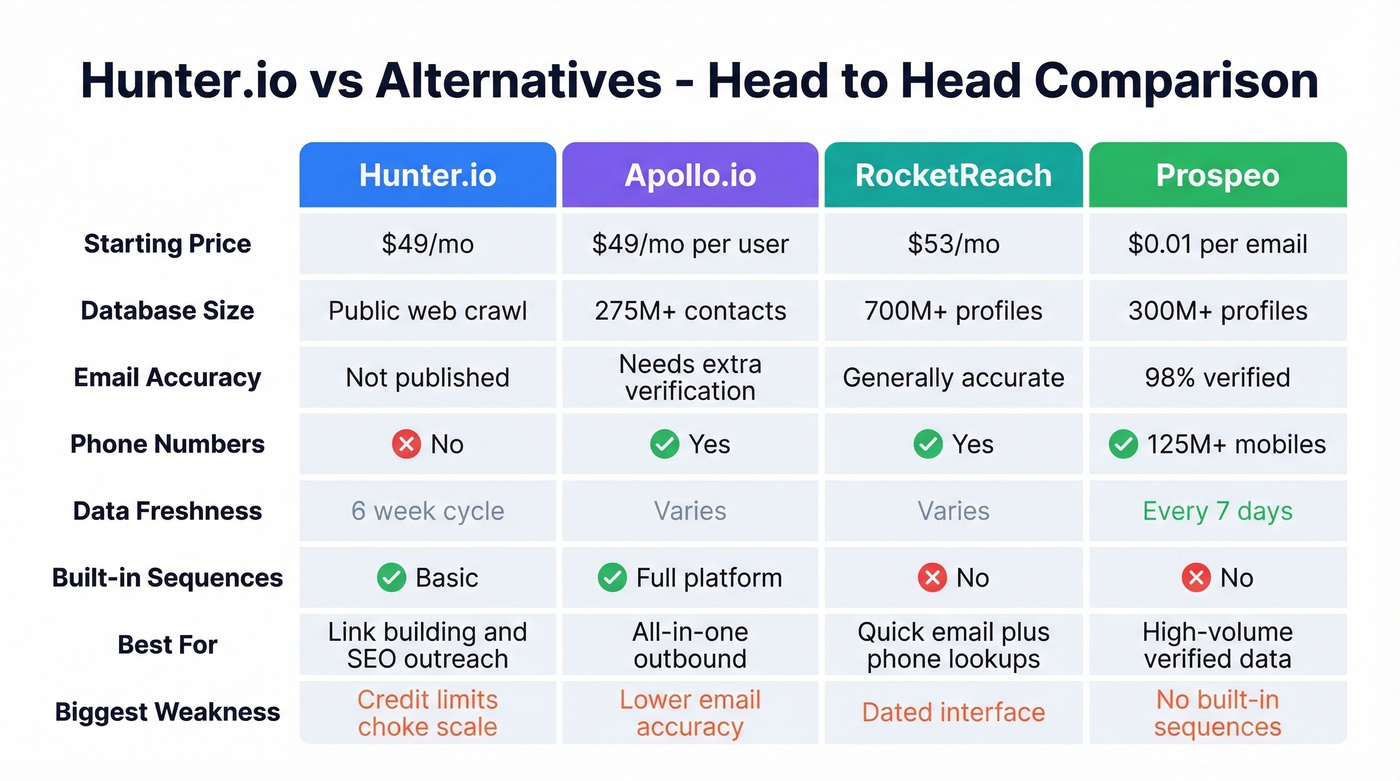
Apollo.io (~$49-99/mo per user) offers a broader database and more capable sequencing. The tradeoff: Hunter often beats Apollo on valid email rates, and Apollo's data needs an extra verification pass. In our experience, teams that switch from Hunter to Apollo gain volume but lose some email quality.
On Reddit's r/coldemail, RocketReach (~$53-179/mo) gets called out as accurate for combined email and phone lookups. The interface feels dated compared to newer tools, but the data holds up. For teams that just need prospect contact details quickly without a full platform, tools like GetProspect also serve as lightweight alternatives worth testing.
Skip Hunter entirely if your team sends more than 5,000 cold emails a month and needs direct dials alongside email. The credit math just doesn't work at that volume. At that point, you’re usually shopping for outbound lead generation tools rather than a pure email finder.
Hunter doesn't offer phone numbers, publishes no accuracy rate, and thins out on SMB coverage. Prospeo delivers 300M+ profiles, direct dials with 30% pickup rates, and refreshes every 7 days - not 6 weeks.
Every use case above works better with data that's actually complete.
FAQ
What are the best Hunter.io use cases for small teams?
SEO link building and recruiting deliver the most value on Hunter's free or Starter tier. Both workflows stay under 50-2,000 credits/month, keeping costs predictable while producing measurable results.
How accurate is Hunter.io's email data?
Hunter doesn't publish a platform-wide accuracy percentage. Emails above 90% confidence score deliver reliably. Run a separate verification pass on anything below that, or use a tool with published accuracy rates to cross-check before sending.
Is Hunter.io legal to use?
Hunter indexes publicly available web data and maintains GDPR/CCPA compliance. You're still responsible for establishing lawful basis when contacting EU prospects. Review your DPA obligations before running outreach campaigns.
Does Hunter.io find phone numbers?
No - Hunter is email-only. For verified mobile numbers alongside emails, you'll need a dedicated data platform. Prospeo offers 125M+ verified mobiles with a 30% pickup rate; Apollo and RocketReach also include phone data.
Hunter.io vs Apollo - which is better?
Hunter wins on email verification transparency and source attribution. Apollo offers a much larger database and a full outbound platform with sequencing. Pick Hunter for clean, source-visible email data; pick Apollo if you want an all-in-one engine and can tolerate lower accuracy on emails.