

B2B Sales Methodologies: 12 Frameworks Compared (With a Decision Matrix)
There's a popular thread on r/sales where a practitioner argues that Sandler, BANT, Challenger, and MEDDIC "pretty much sound the same" - that they all reduce to need, budget, stakeholders, and timeline. Fair point. It's also completely wrong. B2B sales methodologies don't differ in what they ask. They differ in when they ask it, how they frame it, and what behavior they drive in the rep. That distinction is the difference between a team that forecasts accurately and one that loses deals it thought were closed.
Here's the context that makes methodology choice matter more than ever: 96% of prospects research your company before they'll talk to a rep, and 71% prefer doing their own homework over engaging sales at all. Your reps aren't guiding a buyer through a funnel. They're entering a conversation that's already halfway done, and the framework you pick determines whether they add value or get ignored.
Quick Picks by Team Size
If you don't want to read 2,000 words, here's the shortcut:
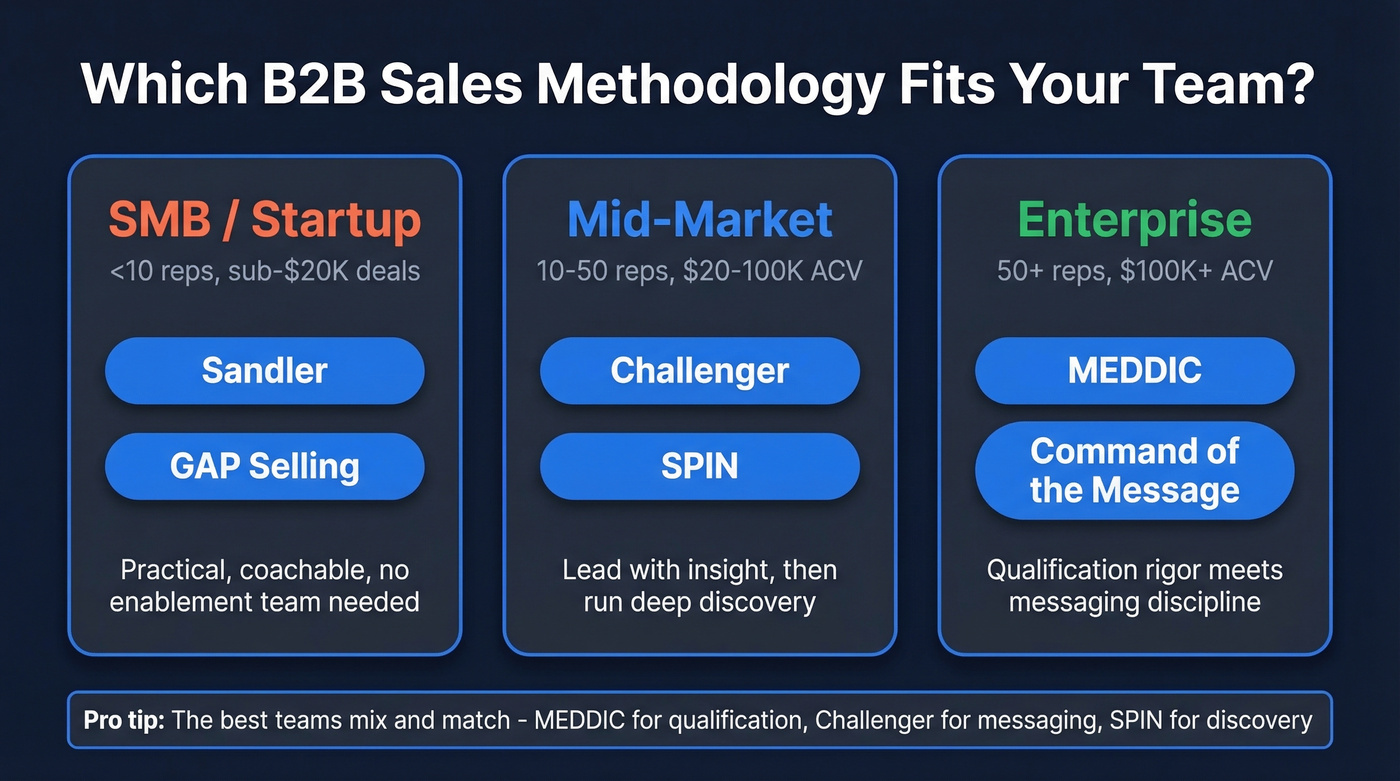
- Enterprise (50+ reps, $100K+ ACV): MEDDIC + Command of the Message. Qualification rigor meets messaging discipline.
- Mid-market (10-50 reps, $20-100K ACV): Challenger + SPIN. Lead with insight, then run deep discovery.
- SMB/Startup (<10 reps, sub-$20K deals): Sandler or GAP Selling. Practical, coachable, no dedicated enablement team required.
One thing every high-performing team we've studied has in common: they don't commit to a single methodology like it's a religion. The best teams mix and match - MEDDIC for qualification, Challenger for messaging, SPIN for discovery. Pick a primary framework, then layer situational plays on top.
Methodology vs. Process
A sales process is the stages a deal moves through - prospecting, discovery, proposal, negotiation, close. A sales methodology is how reps execute within each stage. Process is the map. Methodology is the driving style.
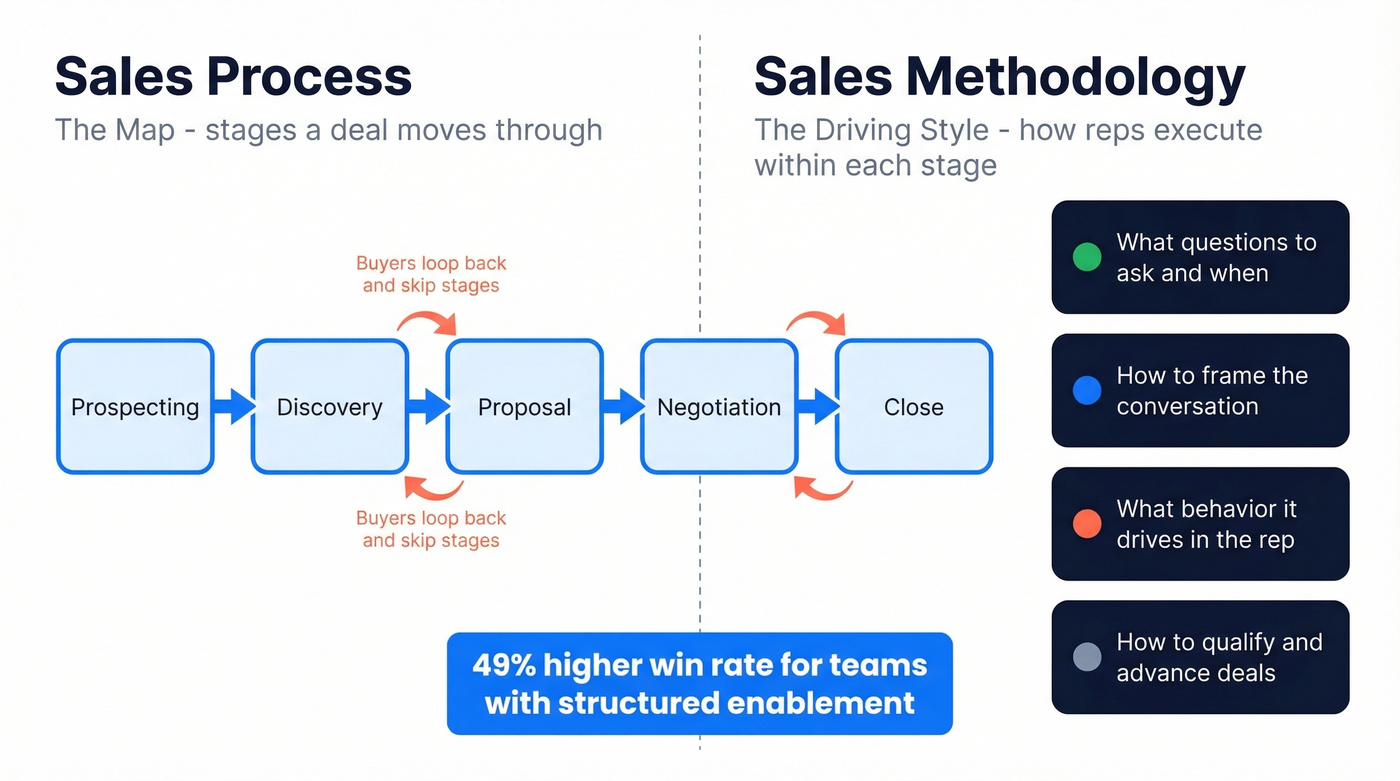
Modern buying is non-linear. Prospects jump between stages, loop back, and involve new stakeholders mid-cycle. That's why methodology matters more than process: organizations with a structured enablement strategy achieve a 49% higher win rate on forecasted deals. Not because they picked the "right" methodology - because they picked one, operationalized it, and coached to it consistently. With the sales enablement market projected to hit $8.79B by 2029, the industry is betting heavily that structured execution beats ad-hoc talent.
12 Frameworks: Pros and Cons
MEDDIC and Challenger are two of the most common enterprise frameworks, but adoption doesn't equal fit. Here's what each methodology actually does - and who should skip it.
MEDDIC / MEDDPICC
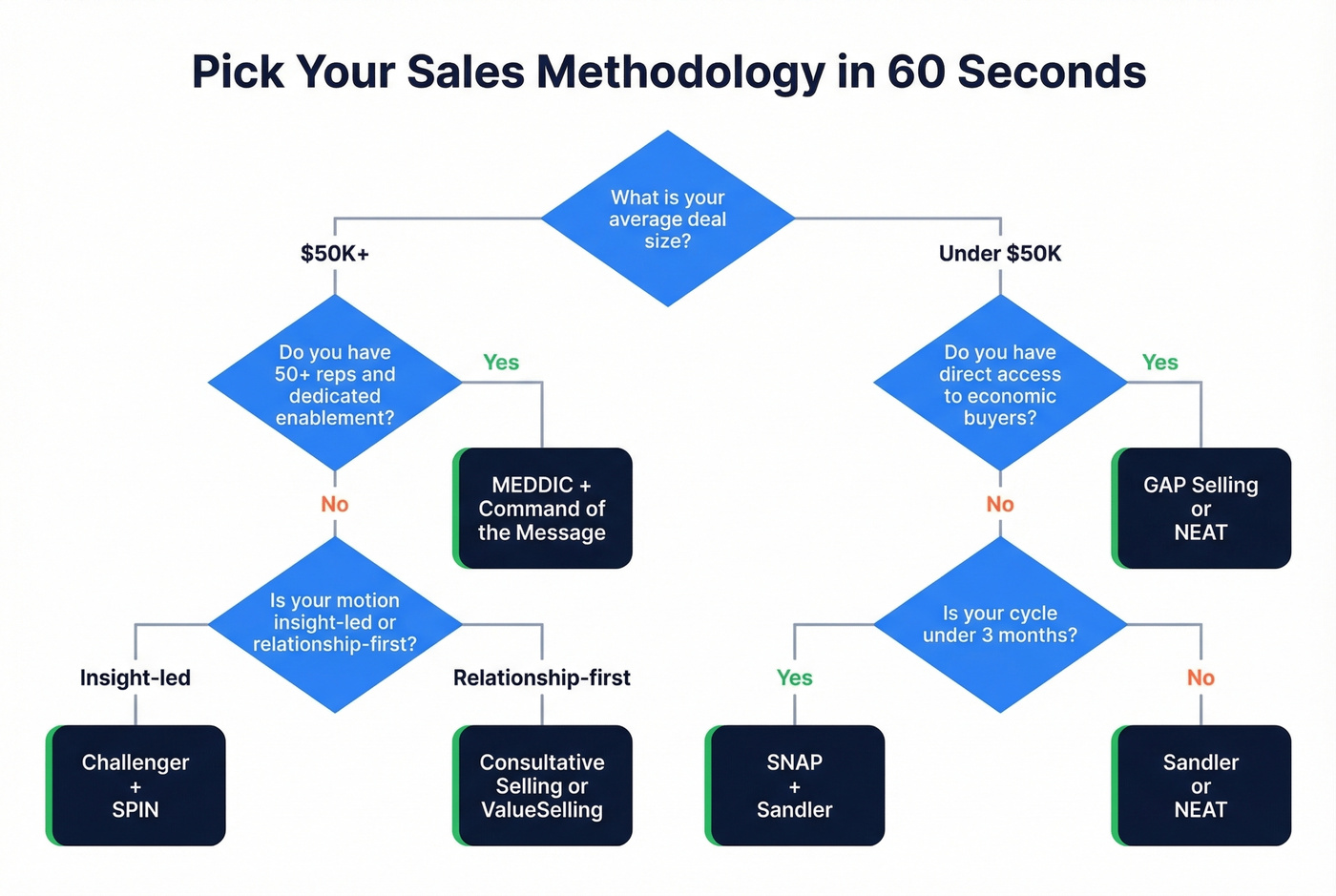
Metrics, Economic Buyer, Decision Criteria, Decision Process, Identify Pain, Champion - plus Competition and Paper Process in the extended version. Every element maps to a discrete CRM field, making MEDDIC the most AI-compatible framework in practice. If you're selling six-figure contracts with 6+ month cycles, MEDDIC isn't one option among many. It's the obvious choice.
Skip it if your deals are transactional or single-threaded. You'll drown reps in process overhead they don't need, and they'll resent you for it.
Challenger Sale
Built on CEB research across 6,000+ sales reps, Challenger teaches reps to lead with commercial insight - teach, tailor, take control. Xerox reported a 17% sales increase and $65M in contract value after implementing it. But here's what most teams miss: Challenger requires company-wide buy-in to develop the "teaching" content, and most orgs underinvest in that part. Without strong marketing-sales alignment on insight creation, you're just telling reps to "be provocative" with no ammunition.
Powerful when fully resourced. Disappointing when half-committed.
SPIN Selling
The most empirically grounded framework in existence. Neil Rackham's team analyzed 35,000+ sales calls across 20+ countries over 12 years to develop the Situation, Problem, Implication, Need-Payoff questioning sequence. SPIN is still the best discovery training for new reps - period. It teaches reps to shut up, ask layered questions, and let the buyer articulate their own pain. That skill transfers to every other methodology you'll ever adopt.
It's less prescriptive on deal progression and closing mechanics, but that's a feature, not a bug. Pair it with MEDDIC or Challenger for the full picture. If you're studying the science of complex selling, SPIN's research base is the gold standard.
Sandler Selling System
Sandler is commonly delivered via ongoing training and coaching subscriptions that often land in the hundreds to low thousands per rep per month, depending on program structure. That solves the "we trained once and forgot" problem that kills most rollouts. The methodology emphasizes mutual qualification and gives reps permission to disqualify early - a mindset shift that's harder than it sounds.
Skip this if you're running enterprise deal management. Sandler doesn't provide the structural rigor for multi-stakeholder buying committees. For SMB and agency sales, though, it's the most practical framework you can implement without a dedicated enablement team.
GAP Selling
Keenan's framework is problem-centric: map the current state, define the future state, quantify the gap. Powerful when you have access to economic buyers who can articulate numerical goals. But practitioners on Reddit flag a real friction point - drilling contacts on their numerical goals backfires when you're talking to Facilities, IT, or Procurement contacts who just want a timely quote and don't have visibility into strategic business metrics.
Best for mid-market with direct access to decision-makers. Breaks down with non-economic stakeholders.
Command of the Message
Command of the Message (Force Management) is a 9-stage framework that turns reps into value-articulation machines - Current State, Negative Consequences, Desired State, Positive Outcomes, Required Capabilities, Success Metrics, Positioning, Differentiation, Proof Points. Think of it as an enterprise messaging playbook. If MEDDIC tells you who to sell to and where the deal stands, Command of the Message tells you what to say. They're the best one-two punch in enterprise sales, but Command alone requires dedicated enablement resources most mid-market teams don't have.
Consultative vs. Solution Selling
These two share enough DNA to compare directly. Consultative Selling, originated by Mack Hanan, positions the rep as a trusted advisor - relationship-first, long-cycle, high switching-cost industries. Solution Selling introduced pain-based diagnosis in the 1980s and has since been absorbed into consultative and GAP approaches.
If you're evaluating today, Consultative Selling is the living framework; Solution Selling is the historical foundation it built on. Both struggle in high-velocity motions where buyers want efficiency, not a relationship. And both let reps hide behind "relationship building" to avoid closing - coach against that tendency hard.
NEAT Selling
Need, Economic impact, Access to authority, Timeline. NEAT ranks second for AI compatibility after MEDDIC - its elements are clean, discrete, and easy to instrument in a CRM. It's essentially a modernized BANT that forces reps to quantify economic impact rather than just confirm budget exists.
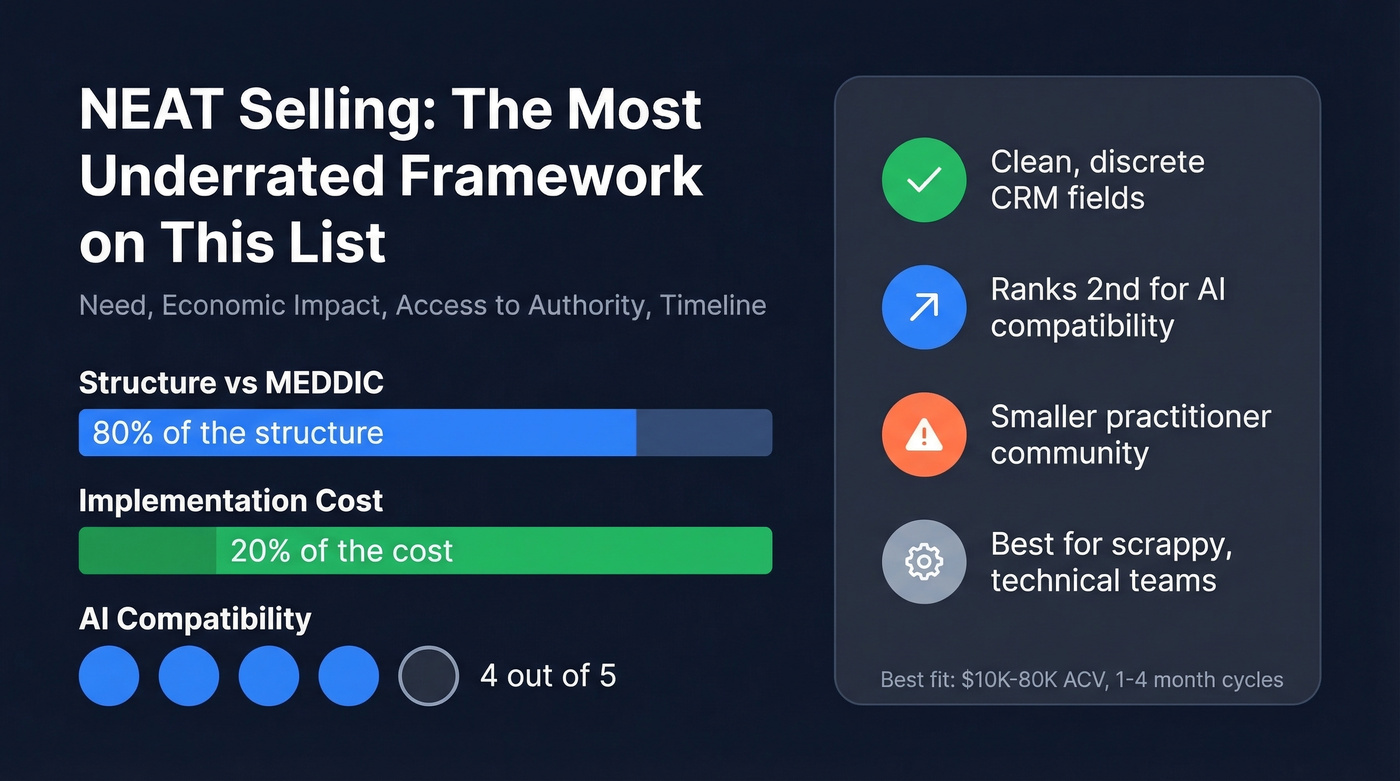
Let's be honest: NEAT is the most underrated framework on this list. For teams building AI-augmented workflows on a mid-market budget, NEAT delivers 80% of MEDDIC's structure at 20% of the implementation cost. The tradeoff is fewer training resources and a smaller practitioner community, but if you're scrappy and technical, that won't slow you down.
Account-Based Selling
ABS aligns sales and marketing around named target accounts, coordinating multi-threaded outreach across the buying committee. The right approach for teams running ABM motions with a defined ICP and high-value targets. The limitation is structural: ABS doesn't scale to high-volume outbound. If you're working 500+ accounts per rep, this isn't your framework. It also requires tight sales-marketing alignment that most orgs claim to have and don't.
ValueSelling Framework
ROI-centric methodology that forces reps to quantify business impact before proposing a solution. Every conversation ties back to a "Qualified Prospect Formula" connecting the buyer's problem to measurable financial outcomes. Strong for mid-market deals where buyers need internal justification to get budget approved - the rep builds the business case with the champion. Can feel formulaic if reps over-index on the financial model at the expense of rapport.
SNAP Selling
Jill Konrath designed SNAP for overwhelmed buyers: keep it Simple, be iNvaluable, always Align, raise Priorities. Useful as a communication layer for reps selling into busy executives who delete anything requiring effort to parse. But SNAP is rarely sufficient as a standalone methodology - think of it as a mindset that sits on top of a structural framework like MEDDIC or Challenger, not a replacement for one.

No methodology compensates for bad data. MEDDIC, Challenger, SPIN - they all assume your reps reach real buyers. Prospeo gives you 300M+ profiles with 98% email accuracy and 125M+ verified mobiles, so the framework you choose actually connects.
Stop perfecting your methodology on contacts that bounce.
Comparison Table
The AI Compatibility column is the one most guides skip - and it's increasingly the one that matters most, given that reps spend only 28% of their week actually selling. The rest is admin that structured frameworks can help automate.
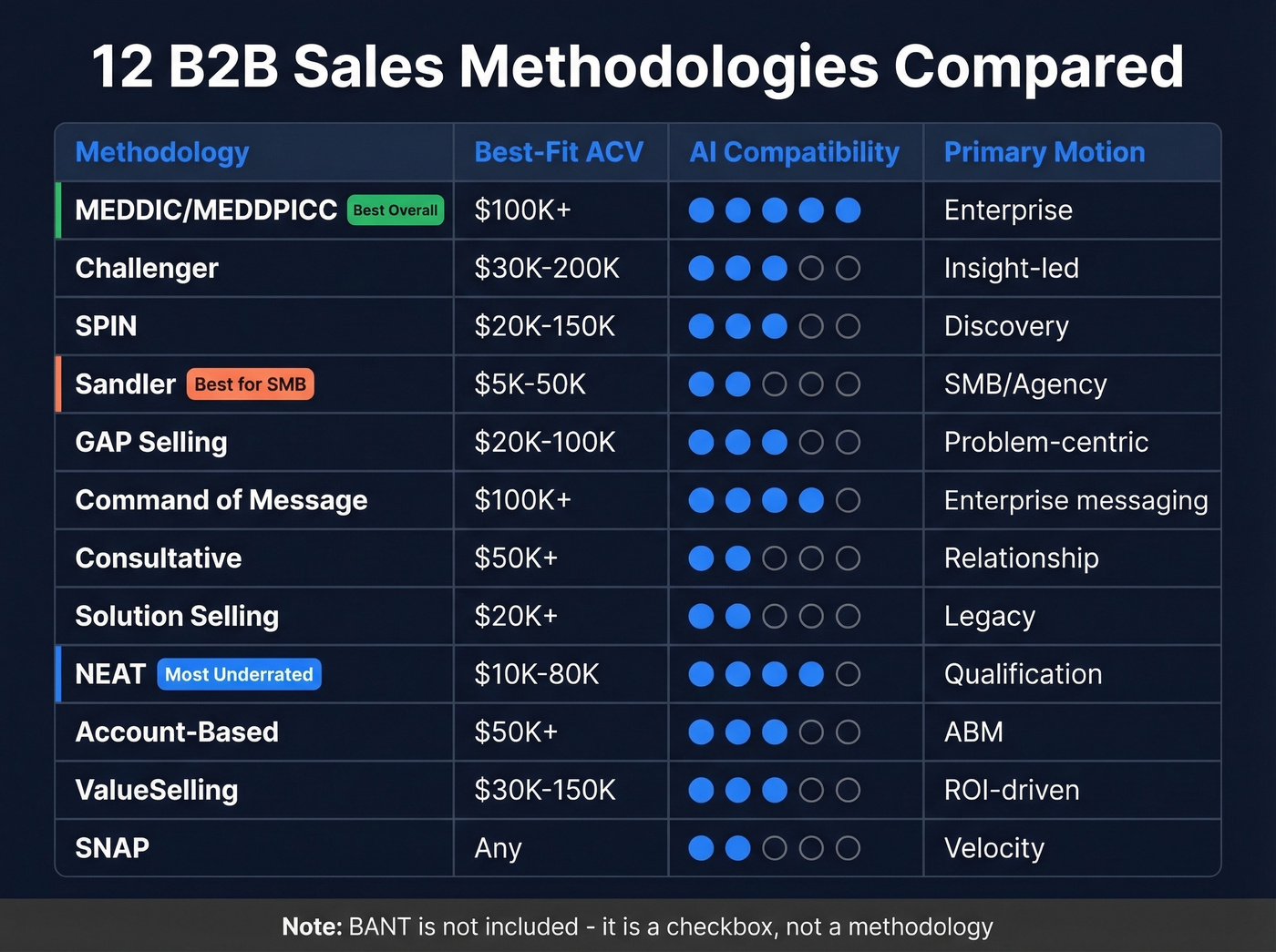
Note: BANT isn't on this list. BANT is a checkbox, not a methodology.
| Methodology | Best-Fit ACV | Cycle | Team Size | AI Compat. | Primary Motion |
|---|---|---|---|---|---|
| MEDDIC/MEDDPICC | $100K+ | 6+ mo | 50+ reps | ★★★★★ | Enterprise |
| Challenger | $30K-200K | 3-9 mo | 20+ reps | ★★★☆☆ | Insight-led |
| SPIN | $20K-150K | 2-6 mo | Any | ★★★☆☆ | Discovery |
| Sandler | $5K-50K | 1-3 mo | <20 reps | ★★☆☆☆ | SMB/Agency |
| GAP Selling | $20K-100K | 2-6 mo | Any | ★★★☆☆ | Problem-centric |
| Command of Msg | $100K+ | 6+ mo | 50+ reps | ★★★★☆ | Enterprise msg |
| Consultative | $50K+ | 6+ mo | Any | ★★☆☆☆ | Relationship |
| Solution Selling | $20K+ | 3-6 mo | Any | ★★☆☆☆ | Legacy |
| NEAT | $10K-80K | 1-4 mo | Any | ★★★★☆ | Qualification |
| Account-Based | $50K+ | 6+ mo | 20+ reps | ★★★☆☆ | ABM |
| ValueSelling | $30K-150K | 3-6 mo | 10+ reps | ★★★☆☆ | ROI-driven |
| SNAP | Any | <3 mo | Any | ★★☆☆☆ | Velocity |
Our picks: Best overall → MEDDIC | Best for SMB → Sandler | Most underrated → NEAT | Best discovery training → SPIN
Which Frameworks Work Best with AI in 2026

MEDDIC is the clear winner for AI-powered sales teams. Each element maps to a distinct CRM field, and modern conversation intelligence tools can listen to a discovery call and auto-populate those fields from the transcript. That's not a minor convenience - when reps spend only 28% of their week selling, automating methodology compliance is a compounding advantage.
NEAT ranks second. Its four elements are clean and discrete enough for automated extraction. SPIN and Sandler, by contrast, produce conversational outputs that are harder for AI to parse into structured data. They're still excellent frameworks for developing rep skills, but they don't generate the structured artifacts that AI workflows thrive on.
The teams pulling ahead right now treat their methodology as an operating system - one that generates structured data AI can act on, not just a training philosophy reps forget after onboarding.
How to Roll Out Without Killing Morale
The biggest rollout mistake we see is jamming a complex methodology down new reps' throats before they've mastered the fundamentals. Teach active listening, objection handling, and deal qualification basics first. Then layer the methodology on top.
A sequenced approach that works:
- Days 1-30: Pilot with your top performers. Study the elite 4% - what behaviors separate them? Codify those into the methodology framework.
- Days 31-60: Team-wide enablement. Build a sales playbook with personas, question templates, and stage exit criteria.
- Days 61-90: Coaching reinforcement and CRM instrumentation. Enrich your contact database first - tools like Prospeo return 50+ data points per contact at a 92% match rate, giving reps the context to run discovery calls that actually follow the methodology instead of scrambling for basic firmographic info mid-conversation. Only 26% of reps get weekly coaching, but weekly coaching is linked to 25% higher quota attainment. Make it non-negotiable.
The ROI is real: sales training delivers 353% ROI - $4.53 for every $1 spent - and structured onboarding retains 50% more new hires while cutting ramp time by 34%.
The Data Problem Nobody Talks About
Picture this: your SDR team runs MEDDIC flawlessly. They identify the champion, map the buying committee, nail the discovery call. Then they send a follow-up email to the VP of Engineering - and it bounces. The database is on a six-week refresh cycle. The champion moved companies last month. The deal stalls because nobody can reach the right person.
I've watched this happen to teams that spent six figures on methodology training. Your framework tells you who to reach and what to say. Your data determines whether you actually reach them.
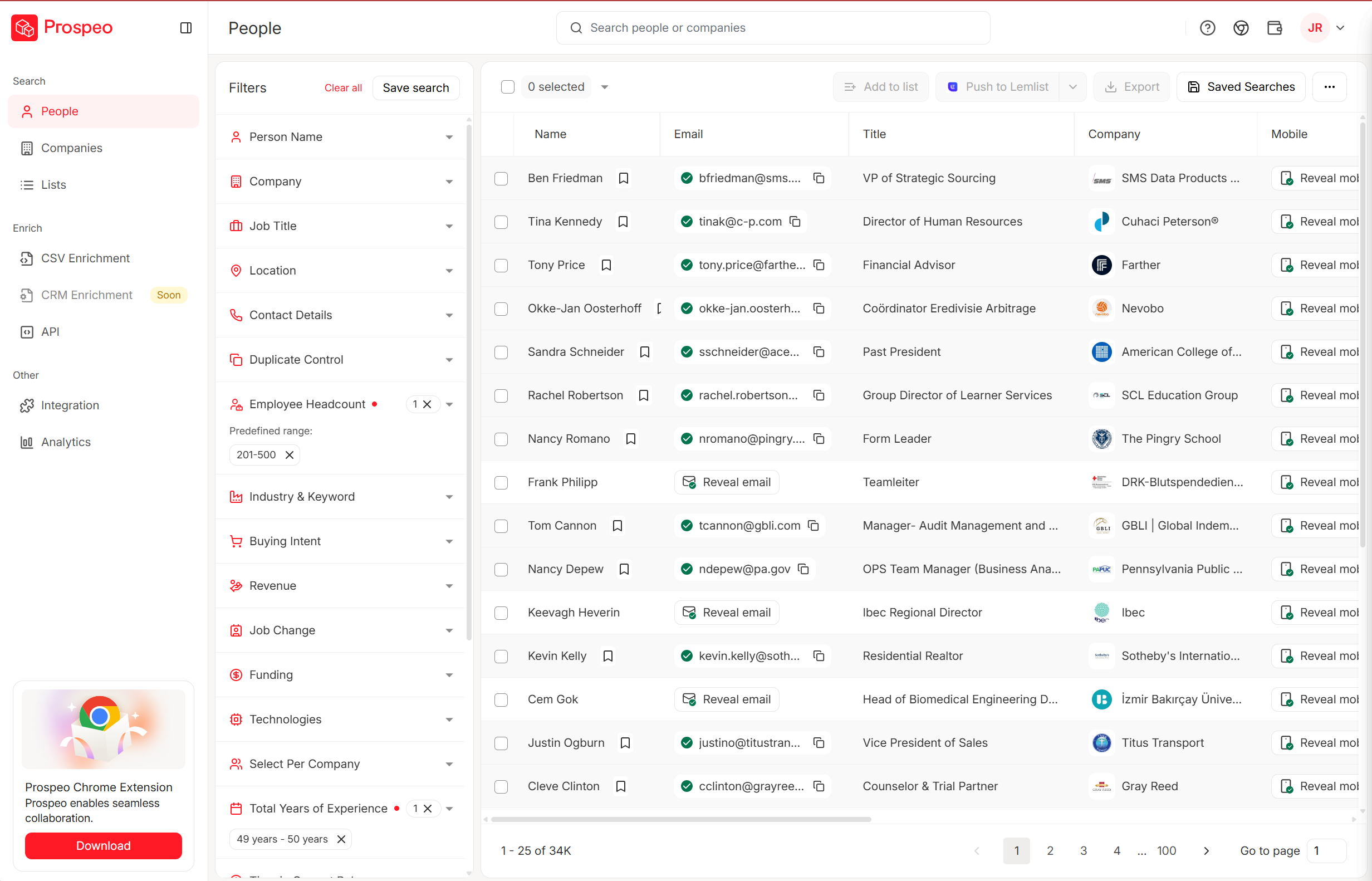
This is where most methodology rollouts quietly fail. You invest in training, coaching, and CRM instrumentation - then watch deals stall because the contact data underneath it all is rotten. A 7-day refresh cycle on your data provider catches job changes and contact updates before they tank your sequences. At ~$0.01 per email with no annual contract, that kind of infrastructure investment makes every methodology work better.
If you're rebuilding your outbound motion, start with sales prospecting and a clean lead generation workflow. Then lock in data enrichment so your sequences hit real inboxes, and use sales follow-up templates to keep deals moving.
Pick the framework, build the playbook, get the data right. Everything else is noise.
Teams using Prospeo book 26% more meetings than ZoomInfo and 35% more than Apollo - not because of a better methodology, but because 98% accurate emails and a 30% mobile pickup rate mean reps spend time selling, not chasing dead leads.
Feed your sales framework data that actually converts.
FAQ
What's the difference between a sales methodology and a sales process?
A process defines the stages - prospecting, discovery, proposal, negotiation, close. A methodology defines how reps behave within each stage. Two teams can share the same five-stage process, but one uses MEDDIC to qualify rigorously at each gate while the other uses Challenger to lead with insight. Same map, different driving style.
Which is the best sales methodology for B2B startups?
Sandler or GAP Selling. Both are practical enough to implement without a dedicated enablement team or a $30K+ training budget. Sandler's subscription coaching provides ongoing reinforcement; GAP Selling builds strong discovery habits from day one. For lean teams, Prospeo's free tier of 75 emails/month lets you start enriching contacts without upfront cost.
Can you combine multiple B2B sales methodologies?
Yes, and the best teams do. The most common winning combination: MEDDIC for qualification, Challenger for messaging, SPIN for discovery. Pick one primary framework that matches your deal complexity, then layer situational plays from complementary methodologies.
How long does it take to roll out a new methodology?
Expect 90 days minimum. Thirty days for a pilot with top performers, 30 for team-wide enablement and playbook development, 30 for coaching reinforcement and CRM instrumentation. Rushing this timeline is the number-one reason rollouts fail - teams that skip the pilot phase see 2x higher abandonment rates.