

SPIN Questions: 50+ Examples That Win Deals
A RevOps lead we know ran discovery calls for three months using a 40-question SPIN cheat sheet taped to his monitor. His close rate didn't move. Then he threw out the sheet, memorized one killer question per stage, and started actually listening. Pipeline doubled in a quarter.
SPIN questions aren't about volume. They're about asking the right four at the right moment.
What You Need (Quick Version)
SPIN selling questions are four types of sales questions - Situation, Problem, Implication, and Need-Payoff - developed by Neil Rackham after analyzing 35,000+ sales calls spanning 23 countries over 12 years. Teams that adopt the framework consistently benchmark around a 17% boost in sales productivity.
| Type | Purpose | Killer Example |
|---|---|---|
| Situation | Map the buyer's current state | "Walk me through how your team sources prospect data today." |
| Problem | Surface pain and dissatisfaction | "What happens when your outbound emails bounce?" |
| Implication | Expand consequences of the problem | "How does a high bounce rate affect domain reputation across all campaigns?" |
| Need-Payoff | Let the buyer articulate the value | "If you could verify every email before sending, how would that change outbound volume?" |
Stop memorizing 40 questions. Master four - one per stage - and adapt on the fly. The full bank below is a reference, not a script.
What Is the SPIN Framework?
Neil Rackham didn't invent SPIN in a boardroom. He built it from the largest field study of sales effectiveness ever conducted - over 35,000 sales calls, 10,000 salespeople, 23 countries. The research, conducted through Huthwaite International, found that top-performing reps in complex B2B sales consistently used four categories of questions in a specific progression. He published the findings in SPIN Selling (1988), and the framework has outlasted every sales trend since.
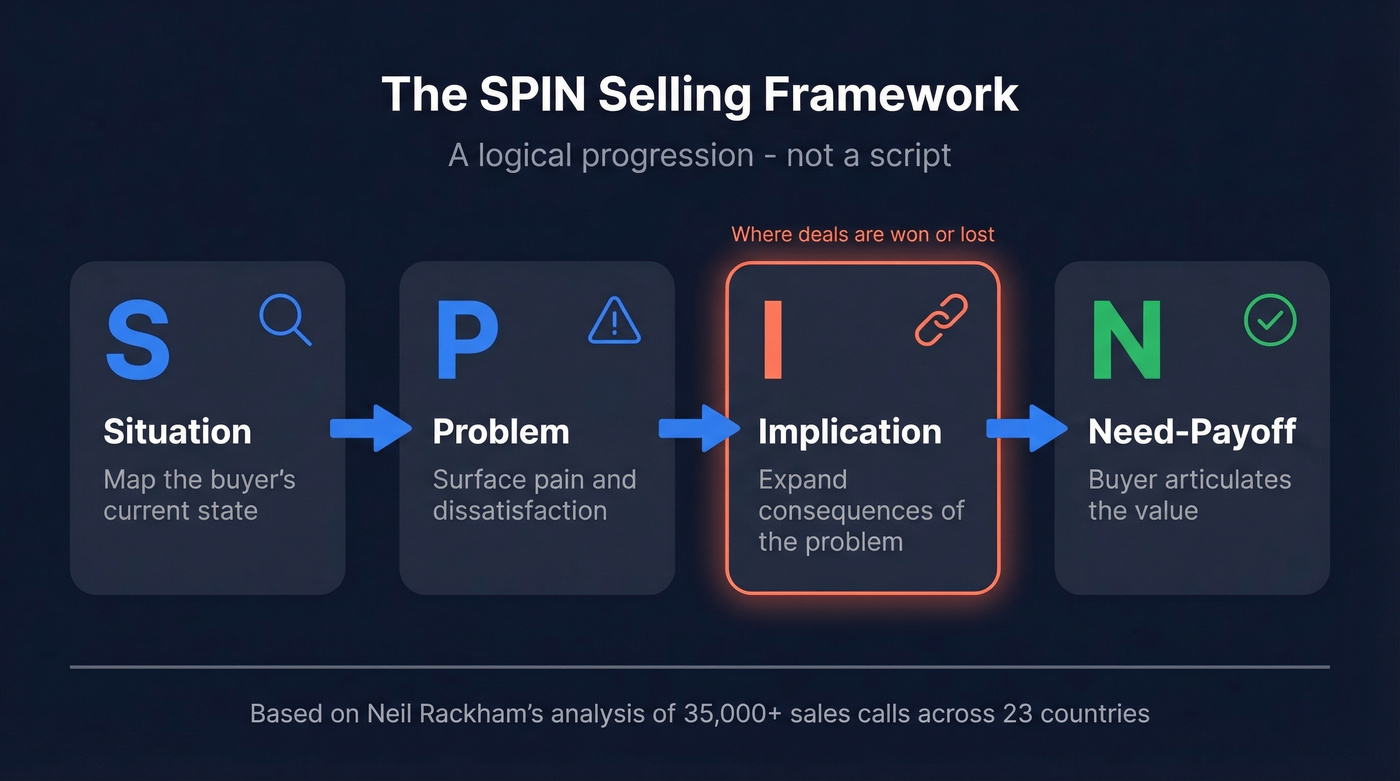
As Rackham put it: "The objective is not to close a sale, but to open a relationship."
SPIN isn't a closing technique. It's a logical persuasive structure designed to move buyers from vague dissatisfaction to an explicit desire for your solution - without ever feeling pushed. The framework maps to four stages of a sales call: Opening, Investigating, Demonstrating Capability, and Obtaining Commitment. The Investigating stage is where SPIN does its heaviest lifting, and where most reps either win or lose the deal before they ever pitch.
The Four Types With 50+ Examples
Situation Questions (Use Sparingly)
Situation questions gather facts about the buyer's current environment. They're necessary but dangerous. Rackham's research shows that successful sellers ask fewer of them and make each one sharper. Too many and you sound like you're running a census, not having a conversation.
The rule: aim for 2-3 max per call. Do your homework beforehand so you're not asking things you could've found on their website.
SaaS:
- "How does your team currently source prospect contact data?"
- "What CRM are you running, and how many reps are active in it?"
- "Who owns the decision on sales tooling - RevOps, the VP of Sales, or someone else?"
- "What does your current outbound tech stack look like?"
Services:
- "How are you generating new client leads right now?"
- "What's your average deal cycle from first touch to signed contract?"
- "How large is the team running business development?"
- "What percentage of revenue comes from inbound vs. outbound?"
In manufacturing, the sharpest situation questions target procurement structure and operational scale: how many facilities run the equipment, who's involved in evaluating new production line investments, what the vendor qualification process looks like, and how procurement approvals flow.
Problem Questions
Problem questions surface pain points and dissatisfaction. They uncover what Rackham called implied needs - problems the buyer acknowledges but hasn't committed to solving. People live with problems for years. An implied need doesn't mean the buyer will act. Your job is to find the problem, then develop it into something they can't ignore.
Don't rush past this stage. Sit in the discomfort with them.
| Industry | Problem Question |
|---|---|
| SaaS | "What's the biggest bottleneck in your outbound workflow right now?" |
| SaaS | "How often do your reps hit dead-end contact data?" |
| SaaS | "Where do deals stall most frequently in your pipeline?" |
| SaaS | "What frustrates your team about the current prospecting process?" |
| Services | "What's the hardest part of scaling client acquisition right now?" |
| Services | "How often do proposals go out and never get a response?" |
| Services | "Where are you losing the most time between lead and close?" |
| Services | "What's not working about your current lead gen approach?" |
| Manufacturing | "What quality issues come up most often with your current supplier?" |
| Manufacturing | "How much unplanned downtime are you dealing with per quarter?" |
| Manufacturing | "Where does the current process create the most waste?" |
| Manufacturing | "What's the biggest headache with your existing equipment maintenance?" |
Implication Questions (Where Deals Are Won)
This is where most sellers fall apart. The consensus on r/sales is that implication questions are "the most difficult puzzle piece" of the framework. Reps tend to collapse all implications into three buckets - people, process, and price - then run out of angles after two questions.
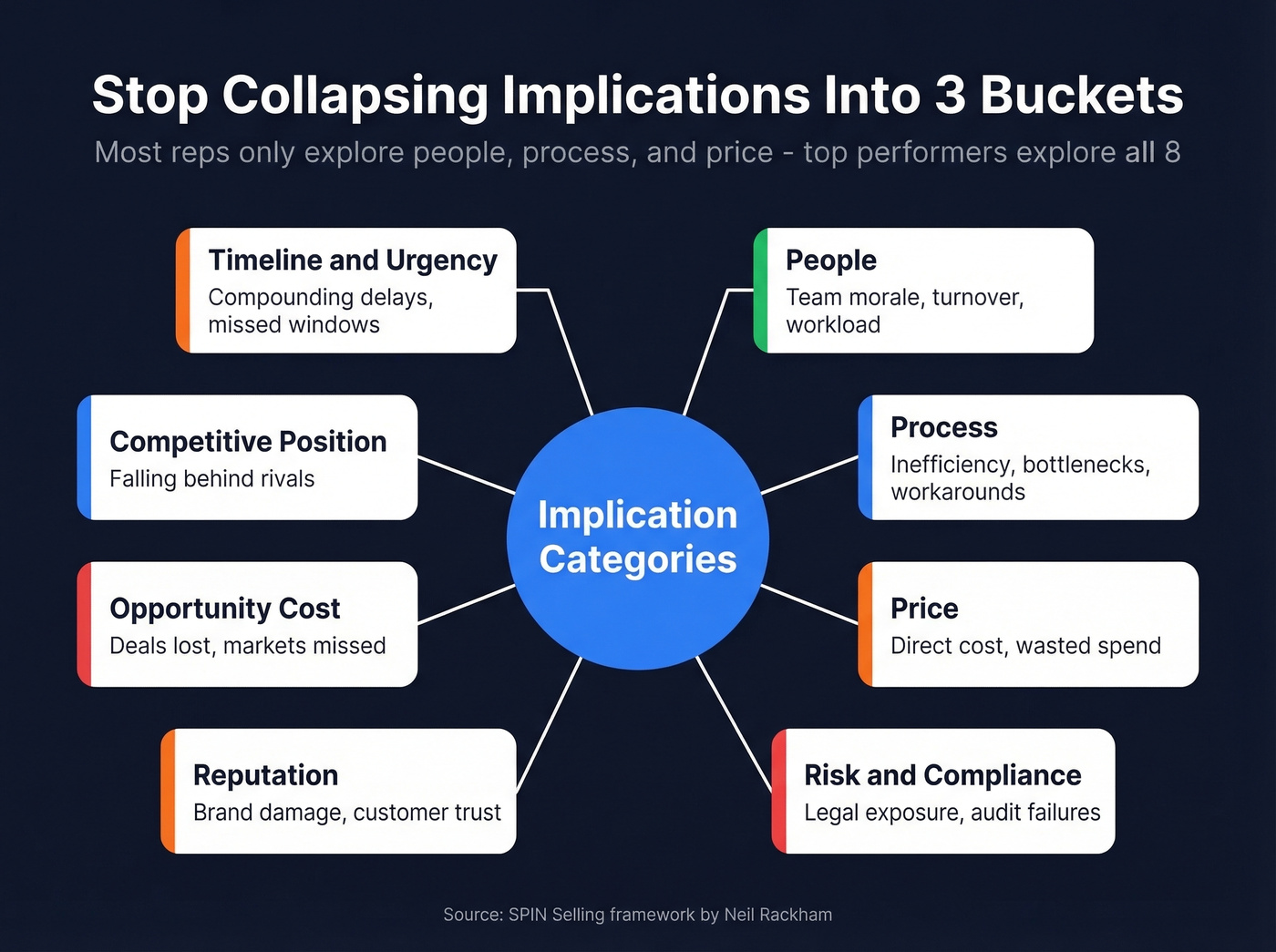
Here's the thing: there are at least eight categories you can explore.
- People - team morale, turnover, workload
- Process - inefficiency, bottlenecks, workarounds
- Price - direct cost, wasted spend
- Risk/Compliance - legal exposure, audit failures
- Reputation - brand damage, customer trust
- Opportunity cost - deals lost, markets missed
- Competitive position - falling behind rivals
- Timeline/Urgency - compounding delays, missed windows
Rackham illustrated this with a manufacturing example: a buyer living with an aging machine doesn't just face downtime - they face the scramble to find replacement parts and the embarrassment of explaining to customers why deliveries are late. One problem, three cascading consequences.
Use this thinking to build implication chains - sequences where one consequence triggers the next:
Chain: Outdated prospect data -> bounced emails -> domain reputation damage -> all campaigns affected
- "When your reps send to outdated emails, what's your bounce rate looking like?"
- "How does a high bounce rate affect your sender domain reputation?"
- "If your domain gets flagged, doesn't that tank deliverability for every campaign - not just the one with bad data?"

That's three questions, each building on the last, turning a minor data quality annoyance into a company-wide deliverability crisis. The buyer went from "yeah, some emails bounce" to "this is threatening all our outbound." Mastering implication chains is what separates average reps from top performers.
SaaS:
- "If reps are spending 30% of their time on bad data, what's that costing in pipeline per quarter?"
- "When deals stall because you can't reach the right stakeholder, how does that affect your forecast accuracy?"
- "If your competitor reaches these prospects first with better data, what happens to your win rate?"
- "How does low connect rate affect rep morale and retention?"
Services:
- "When proposals go unanswered, how does that affect your team's confidence in the pipeline?"
- "If client acquisition costs keep rising, what does that do to your margins over the next year?"
- "What happens to your reputation if delivery timelines slip because you're chasing the wrong prospects?"
Manufacturing:
- "If unplanned downtime hits during peak season, what's the revenue impact per day?"
- "How does supplier inconsistency affect your ability to meet contractual obligations?"
- "If a compliance audit flags this process, what's the remediation timeline and cost?"
- "When parts availability delays production, how does that cascade to your customer commitments?"
Need-Payoff Questions
Need-payoff questions flip the conversation. Instead of you explaining the value, the buyer articulates it themselves. You're developing implied needs into explicit needs - moving from "we have a problem" to "we want a solution that does X."
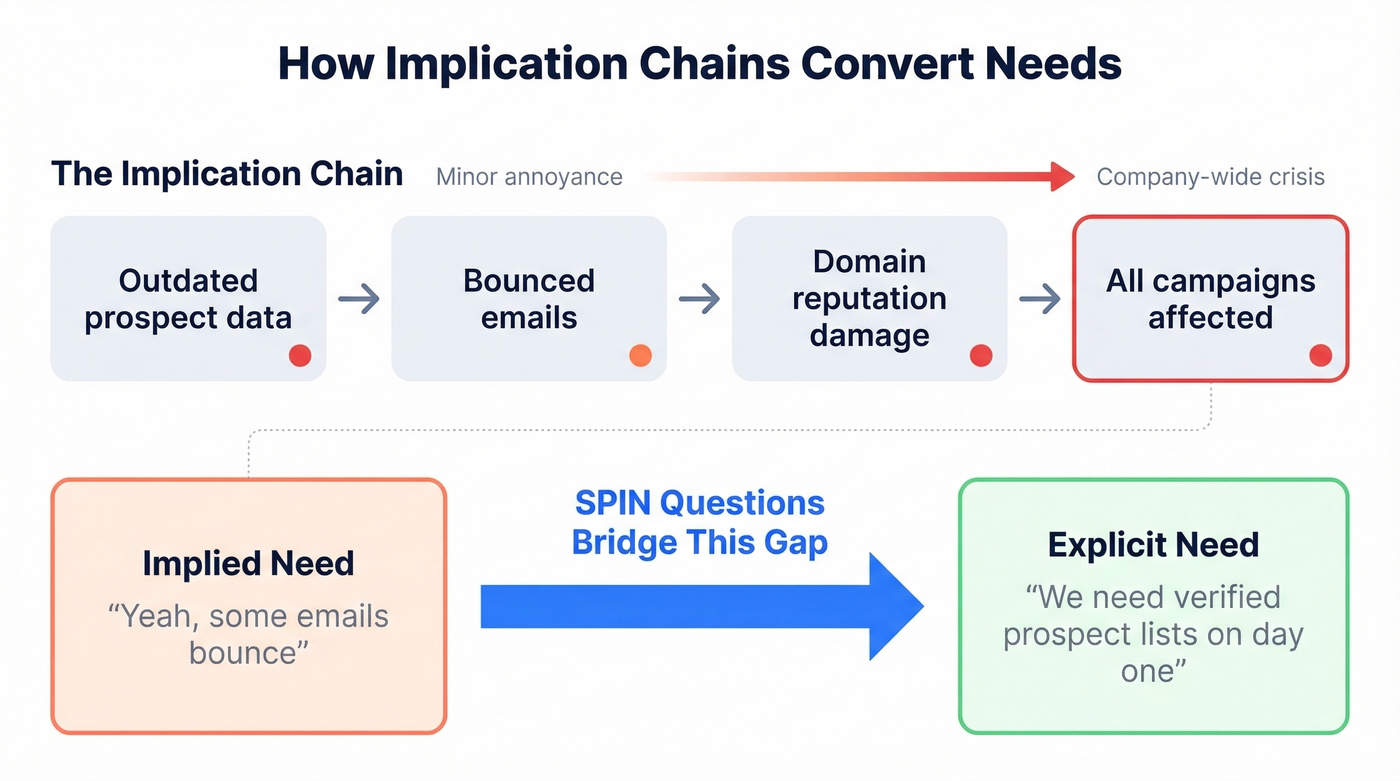
This is where the buyer sells themselves. Let them.
Here's what a good need-payoff exchange sounds like in practice:
Rep: "If you could hand every new rep a verified prospect list on day one - bounce rates under 5%, direct dials included - how would that change your ramp timeline?"
VP: "That would cut ramp in half. And protect our domain. That's exactly what we need."
Notice the shift. The VP went from an implied need ("data quality is annoying") to an explicit need ("we need verified prospect lists on day one"). That's the framework working. Now the full bank:
SaaS:
- "If you could verify every email before sending, how would that change your outbound volume?"
- "What would it mean for your team if reps spent 80% of their time selling instead of researching contacts?"
- "How would real-time data accuracy affect your forecast confidence?"
- "If you could cut bounce rates to under 5%, what would that unlock for your campaigns?"
- "What would it look like if every new hire had a pipeline-ready list on day one?"
Services:
- "If you could reach decision-makers on the first attempt, how would that change your close timeline?"
- "What would a 30% reduction in client acquisition cost mean for your growth targets?"
- "How would it help if your team had verified contact data before every outreach?"
Manufacturing:
- "If you could eliminate unplanned downtime, what would that be worth per quarter?"
- "How would guaranteed parts availability change your production planning?"
- "What would it mean for your team if supplier qualification took days instead of weeks?"
- "If compliance risk dropped to near-zero, how would that affect your expansion plans?"
- "What would faster vendor onboarding mean for your ability to respond to new orders?"
Mapping SPIN to the Sales Call
Each question type maps to a specific stage of the conversation. Rackham identified four possible outcomes for every call: an Advance (buyer agrees to a concrete next step), a Continuation (conversation continues but no commitment), an Order, or a No-sale. Top performers design every call to achieve an Advance - and the right questions are the engine.
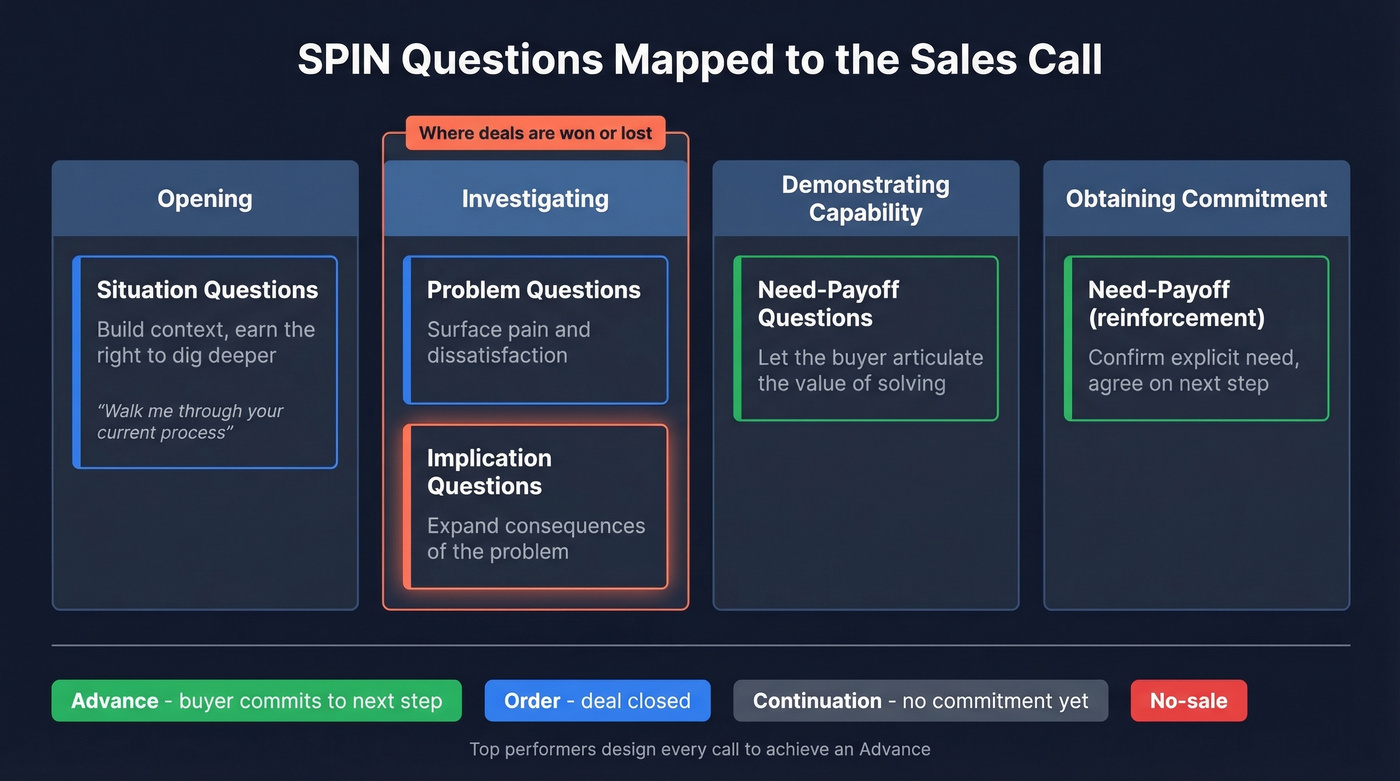
| Call Stage | Primary Question Type | Goal |
|---|---|---|
| Opening | Situation | Build context, earn the right to dig deeper |
| Investigating | Problem -> Implication | Surface pain, expand consequences |
| Demonstrating Capability | Need-Payoff | Let the buyer articulate the value of solving |
| Obtaining Commitment | Need-Payoff (reinforcement) | Confirm explicit need, agree on next step |
The Investigating stage is where the framework operates at full capacity. That's where deals are won or lost. The rest is setup and follow-through.

That implication chain - outdated data → bounced emails → domain damage → dead campaigns - isn't hypothetical. It's what happens with 79-87% accurate data. Prospeo delivers 98% email accuracy with 7-day refresh cycles, so your reps never have to explain why deliverability tanked.
Ask better SPIN questions when you already know the data connects.
A Full SPIN Discovery Call
You're selling a B2B data platform to a VP of Sales at a mid-market SaaS company. The SDR booked the meeting. You've got 30 minutes.
The anti-pattern: Ten minutes in, you've asked six situation questions about their tech stack, team size, and quota structure. The VP is checking their phone. You haven't uncovered a single problem. The meeting ends with "send me some info." We've all been there.
Now the right way:
Rep: "I saw you're scaling the outbound team from 8 to 15 reps this quarter. What's driving that?" [Situation - researched context, not basic fact-finding]
VP: "We're behind on pipeline targets. The board wants 3x coverage."
Rep: "When you've ramped new reps before, where do they get stuck in the first 60 days?" [Problem]
VP: "Honestly, data quality. They spend half their time finding contacts that actually work."
Rep: "So if half their time goes to finding contacts, what does that do to ramp time and first-quarter quota attainment?" [Implication - expands the cost]
VP: "It's brutal. Ramp takes 8-10 weeks instead of 4-5. And we're burning through sequences with 30% bounce rates."
Rep: "A 30% bounce rate - how is that affecting your domain reputation across all your outbound campaigns, not just the new reps'?" [Implication - cascading consequence]
VP: "That's... actually something we've been worried about. Our deliverability has dropped."
Rep: "If you could hand every new rep a verified prospect list on day one - bounce rates under 5%, direct dials included - how would that change your ramp timeline?" [Need-Payoff]
VP: "That would cut ramp in half. And protect our domain. Yeah, that's what we need."
Five questions total. Not forty. The VP articulated the explicit need on their own.
Five Common Mistakes
1. Too many Situation questions. The research is clear: top sellers ask fewer and make them more focused. If you're asking things you could've found on their website or in their 10-K, you're wasting the buyer's time and your credibility.
2. Skipping Need-Payoff. Reps uncover a devastating implication and immediately jump to their pitch. Resist. When the buyer articulates the value, they own it. When you articulate it, they're skeptical. Need-payoff questions are the bridge between uncovering pain and securing commitment - don't skip them.
3. Treating SPIN as a script. Critics argue that rigid adoption tanks results - which tracks. The framework fails when it's treated as a checklist instead of a thinking tool. The moment a buyer feels interrogated, you've lost. In our experience, the best reps internalize the logic and forget the labels entirely during the actual call.
4. Overloading after discovery. A subtler mistake from r/sales: reps who nail the conversation then immediately dump a big deck, case studies, and a pricing sheet into the buyer's inbox. You just got them to articulate their own need - don't bury that clarity under a mountain of collateral. Send one thing that maps to the explicit need they stated.
5. Negotiating too early. Rackham found that "concessions create an appetite for concessions." If you start negotiating before you've fully developed the need, you're training the buyer to push for more. Negotiate as late as possible.
Let's be honest about scope: if your average deal size is under $10K, SPIN is usually overkill. A three-question discovery framework and a strong demo will close faster. Skip the full methodology for transactional sales. SPIN earns its keep on five- and six-figure deals where the buyer needs internal justification and multiple stakeholders have to align.
Does SPIN Still Work in 2026?
"It's just correlation, not causation." Fair point. Rackham observed that successful sales calls had more implication and need-payoff questions. That doesn't prove the questions caused the success. But after 35,000 calls across 23 countries, the pattern is strong enough that dismissing it requires a better alternative - and nobody's produced one with comparable research depth.
"It only works for high-ticket sales." Also fair. The framework was built for complex B2B sales with multiple stakeholders and long cycles. For $50/month subscriptions with a one-call close, use something simpler.
The real adaptation for 2026: buyers complete 70-80% of their research before talking to a rep. They already know your features. Situation questions can't be "what does your company do?" anymore - they need to target priorities, constraints, and internal dynamics. The buyer has information. They lack insight into how your solution fits their specific, messy situation. That's where well-crafted SPIN questions still win.
SPIN vs. Challenger vs. MEDDIC
| Framework | Research Base | Best For | Key Limitation |
|---|---|---|---|
| SPIN | 35,000+ calls, 23 countries | Trust-based complex B2B | Less prescriptive on teaching |
| Challenger | CEB research, 6,000+ reps | Deals where status quo is the enemy | Aggressive without domain expertise |
| MEDDIC | Enterprise practitioner-developed | Formal procurement processes | Overkill for mid-market |
The Reddit sentiment that "all methodologies are basically the same" has a kernel of truth - they all reduce to understanding need, budget, stakeholders, and timeline. But the execution differs enormously. Learn SPIN first. It builds the discovery muscle that every other framework assumes you already have. Layer Challenger when you need to lead with insight. Add MEDDIC when you're selling into enterprise procurement with multiple sign-offs.
Reaching the Right Person Before the Call
Here's a pattern we see constantly: your SDR booked the meeting, but the prospect's email bounced twice and the phone number was disconnected. By the time you actually reach them, they've talked to two competitors.
Every SPIN question in the world is useless if the call never happens. Data quality is the upstream problem that kills discovery before it starts. Tools like Prospeo give you 98% email accuracy and 125M+ verified mobile numbers refreshed every 7 days - so you're not wasting your best questions on voicemails and bounced emails.
The best Problem question in the world won't save a deal if your rep can't reach the decision-maker. Prospeo gives you 300M+ verified profiles, 125M+ direct dials with a 30% pickup rate, and 30+ filters to find exactly the right stakeholder before the call even starts.
Stop asking 'how do you source prospect data' - show them how it's done.
FAQ
What does SPIN stand for in sales?
Situation, Problem, Implication, and Need-Payoff - four question types developed by Neil Rackham after studying 35,000+ sales calls across 23 countries. The framework moves buyers from vague dissatisfaction to an explicit desire for a solution, making it the most research-backed discovery methodology in B2B sales.
Which question type is hardest to master?
Implication questions, by far. Most sellers exhaust people, process, and price angles in two questions, then stall. Use the 8-category framework above to build cascading chains that reveal the full cost of inaction.
How many Situation questions should I ask per call?
Two to three, maximum. Top performers in Rackham's research asked fewer situation questions but made each one sharply focused on something they genuinely couldn't find through pre-call research - priorities, constraints, and internal dynamics rather than basic company facts.
Does SPIN selling work for SaaS?
Yes, for complex B2B SaaS with multi-stakeholder deals and average contract values above $10K. The key 2026 adaptation: buyers already know your features, so problem and implication questions do the heavy lifting while situation questions target internal priorities, not product awareness.
What tools help run better discovery calls?
A CRM for tracking call stages, conversation intelligence software like Gong or Chorus for reviewing question patterns, and a verified data platform for accurate contact info so discovery calls actually happen. Fewer bounces, more live conversations - that's the foundation everything else builds on.