

Prospect Email Templates: 12 Data-Backed Examples (and Why Most Templates Fail)
Someone on r/SaaS sent 2,000 cold emails last quarter and got 6 replies. Zero customers. They declared cold outreach dead. Meanwhile, a founder on r/Entrepreneur rebuilt their infrastructure, cleaned their list, and doubled their reply rate from 3% to 6% - generating 16 qualified leads a month on a $420 stack. The difference wasn't the prospect email template. It was everything around it.
What follows covers prospecting email templates specifically - the hardest emails to get right. Post-sale and renewal templates are a different discipline entirely.
What You Need Before Any Template
You don't need 55 templates. You need 5 good ones and a clean list. Three things matter more than any template on this page:
- Verified contact data. If your bounce rate is high, your domain reputation tanks before anyone reads your clever opener. That r/Entrepreneur founder? Bounce was 11% before they fixed their list. (If you’re diagnosing bounces, see bounce rate.)
- Deliverability infrastructure. SPF, DKIM, DMARC, warmup, dedicated sending domains. (Use a full email deliverability checklist.)
- One well-personalized template that you test and iterate weekly. (More on personalized outreach.)
The average cold email reply rate is 3.43%. Elite campaigns hit 10%+. The gap between those numbers isn't copy - it's the system behind the copy. And here's the stat that should change how you plan: 58% of replies come from the first email, which means 42% come from follow-ups most reps never send.
Why Most Prospecting Emails Fail
Templates don't fail because the words are wrong. They fail because they land in spam, hit dead inboxes, or read like every other AI-generated pitch cluttering the prospect's morning. (If you’re troubleshooting spam placement, use an email spam checker.)
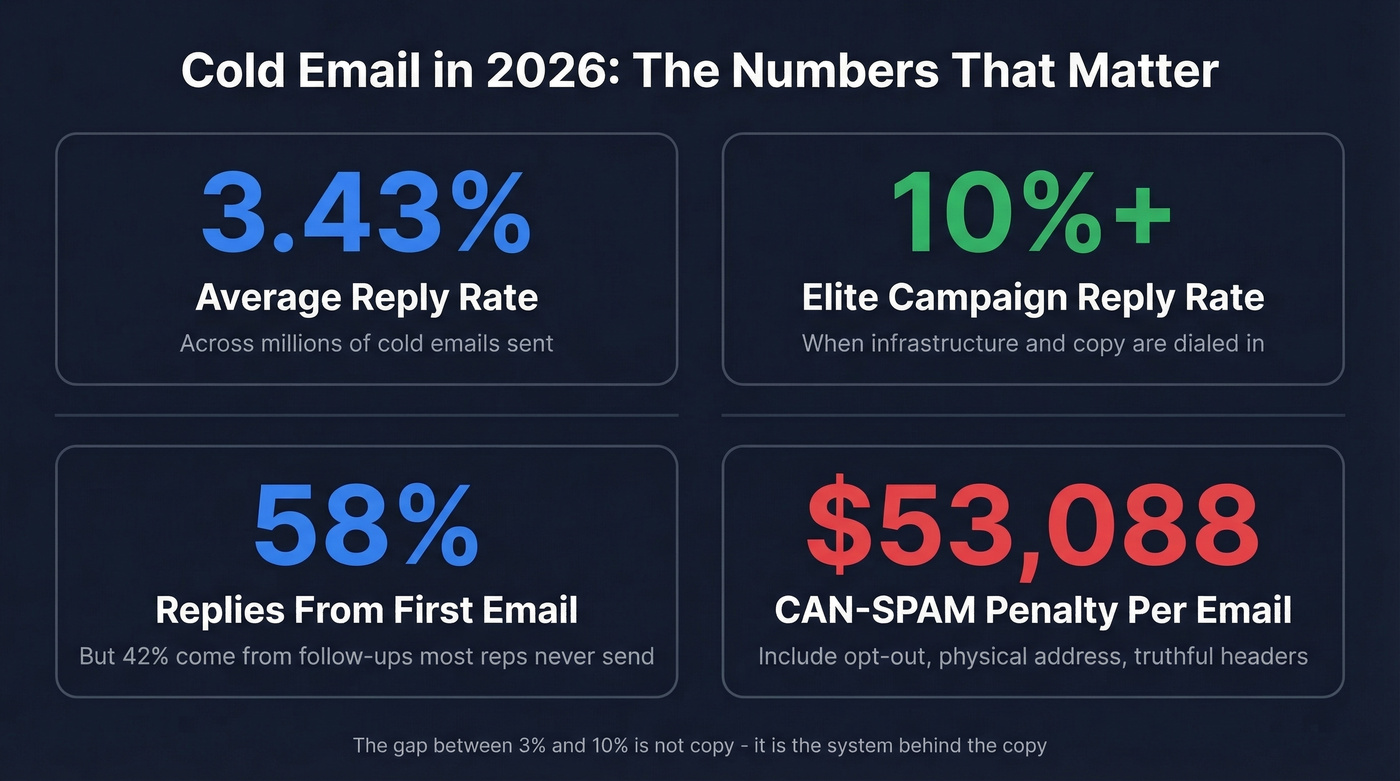
The Reddit consensus on cold email splits into two camps. One says it's dead. The other says it works better than ever - if you do the work. The data backs the second camp, and it backs it hard. A 3.43% average reply rate across millions of emails means cold email is alive, but the floor is low and the ceiling rewards preparation.
Reply rates dropped from 6.8% in 2023 to 4-6% as AI-generated volume flooded inboxes. Practitioners on r/SaaS are blunt: "AI-generated emails are easy to spot in 2026." The templates below work because they're short, specific, and built on a foundation that actually delivers them to the inbox.
Before You Send: The Prerequisites
Skip this section at your own risk.
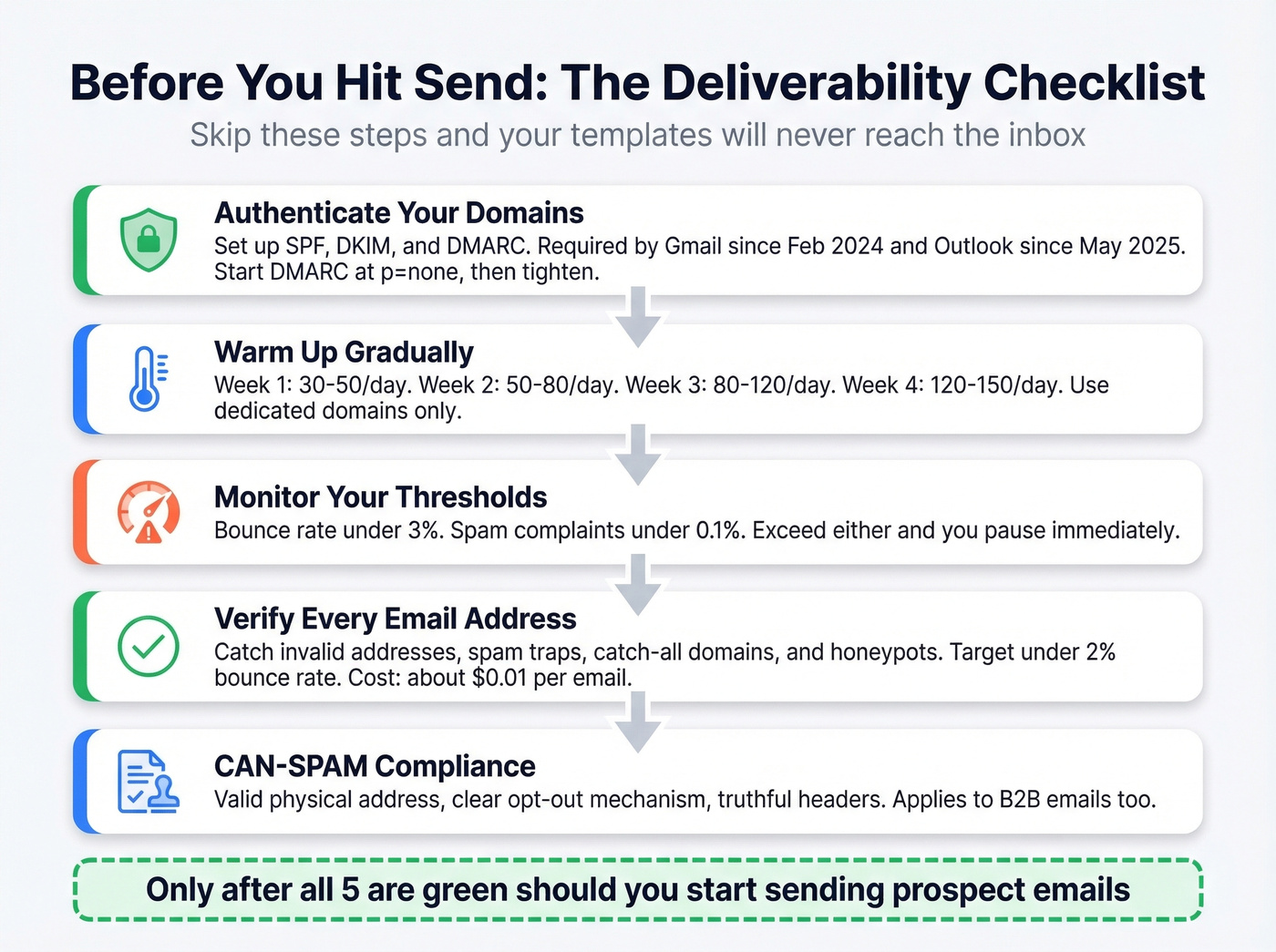
Authentication (do this first). Set up SPF, DKIM, and DMARC on every sending domain. Gmail has required all three since February 2024 per its bulk sender guidelines. Outlook enforced the same for high-volume senders as of May 2025. Start DMARC at p=none with reporting, then tighten to quarantine once alignment is clean. (If you want the technical nuance, read DMARC alignment and use these SPF examples.)
Warmup your domains. Don't blast 150 emails on day one. Ramp gradually: 30-50/day in week one, 50-80 in week two, 80-120 in week three, and 120-150 only if bounce and complaint metrics stay green. Use dedicated domains - never your primary. We've seen domains burned in under a week from skipping warmup. (More on safe email velocity.)
Hit these thresholds or pause: bounce rate under 3%, spam complaints under 0.1%. Exceed either and you cool down immediately.
CAN-SPAM compliance. Every commercial email - including B2B - needs a valid physical address, a clear opt-out mechanism, and truthful headers. Penalties run up to $53,088 per email.
Verify your list. This is the prerequisite that separates 3% reply rates from 6%+. That Reddit founder who doubled their results? Their bounce rate went from 11% to under 2% after they stopped buying lists and started verifying every address. Prospeo's 5-step verification catches invalid addresses, spam traps, catch-all domains, and honeypots before they torch your sender reputation - at ~$0.01/email, it's the cheapest insurance in your stack. (If you need remediation, start with spam trap removal.)

Subject Lines: What 5.5M Emails Reveal
Belkins analyzed 5.5 million emails sent throughout 2024. The findings contradict a lot of the advice floating around. (If you want more options, pull from these email subject line examples.)
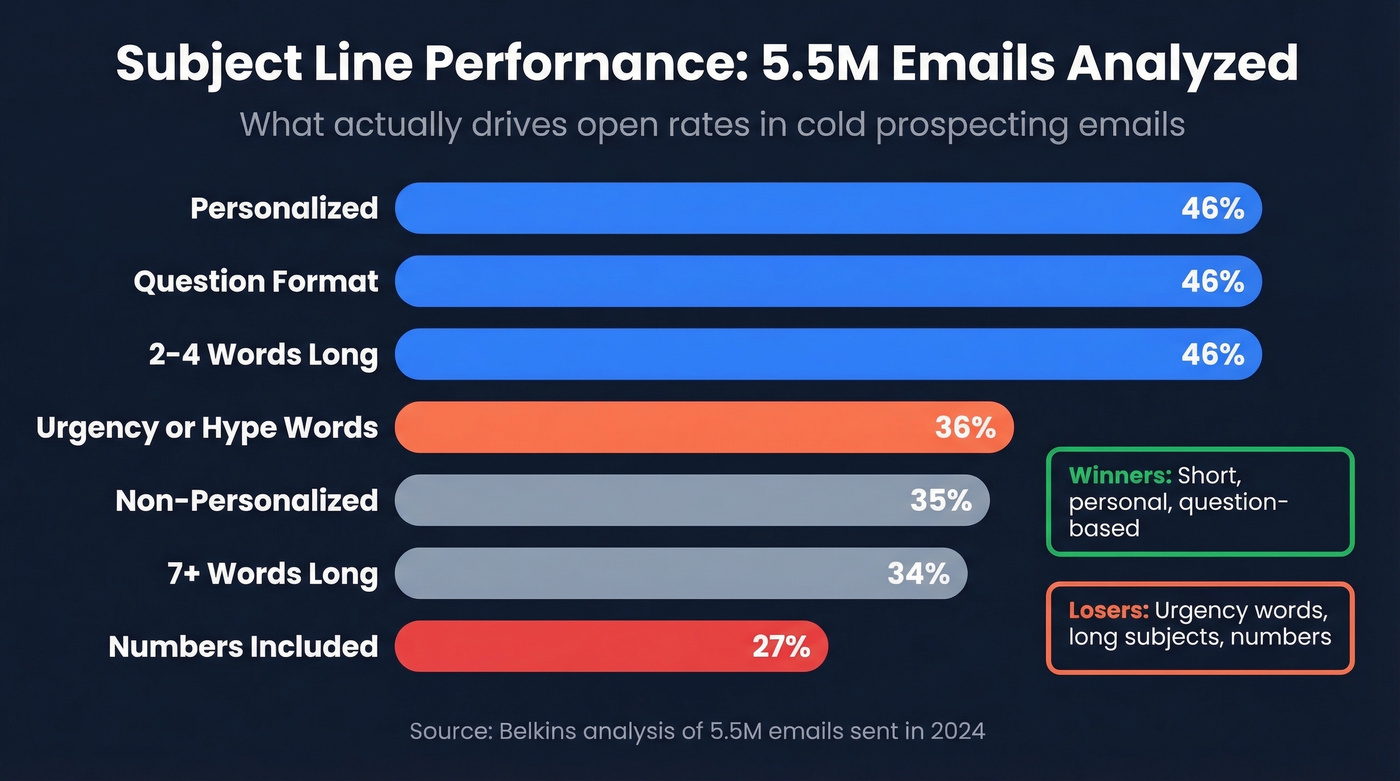
| Factor | Open Rate |
|---|---|
| Personalized | 46% |
| Non-personalized | 35% |
| Question-style | 46% |
| 2-4 words | 46% |
| 7+ words | ~34% |
| Numbers included | 27% |
| Urgency/hype words | <36% |
Short, personalized, question-format subject lines win. Numbers slightly underperform - 27% opens with numbers vs 28% without. Urgency words ("ASAP," "limited time") actively drag performance below 36%. Write subject lines that sound like a human colleague, not a marketing funnel.

That Reddit founder cut bounce rates from 11% to under 2% by verifying every address before sending. Prospeo's 5-step verification - spam-trap removal, catch-all handling, honeypot filtering - delivers 98% email accuracy at ~$0.01 per email. Your templates can't convert if they never reach the inbox.
Fix your list before you fix your copy.
12 Sales Prospecting Email Templates
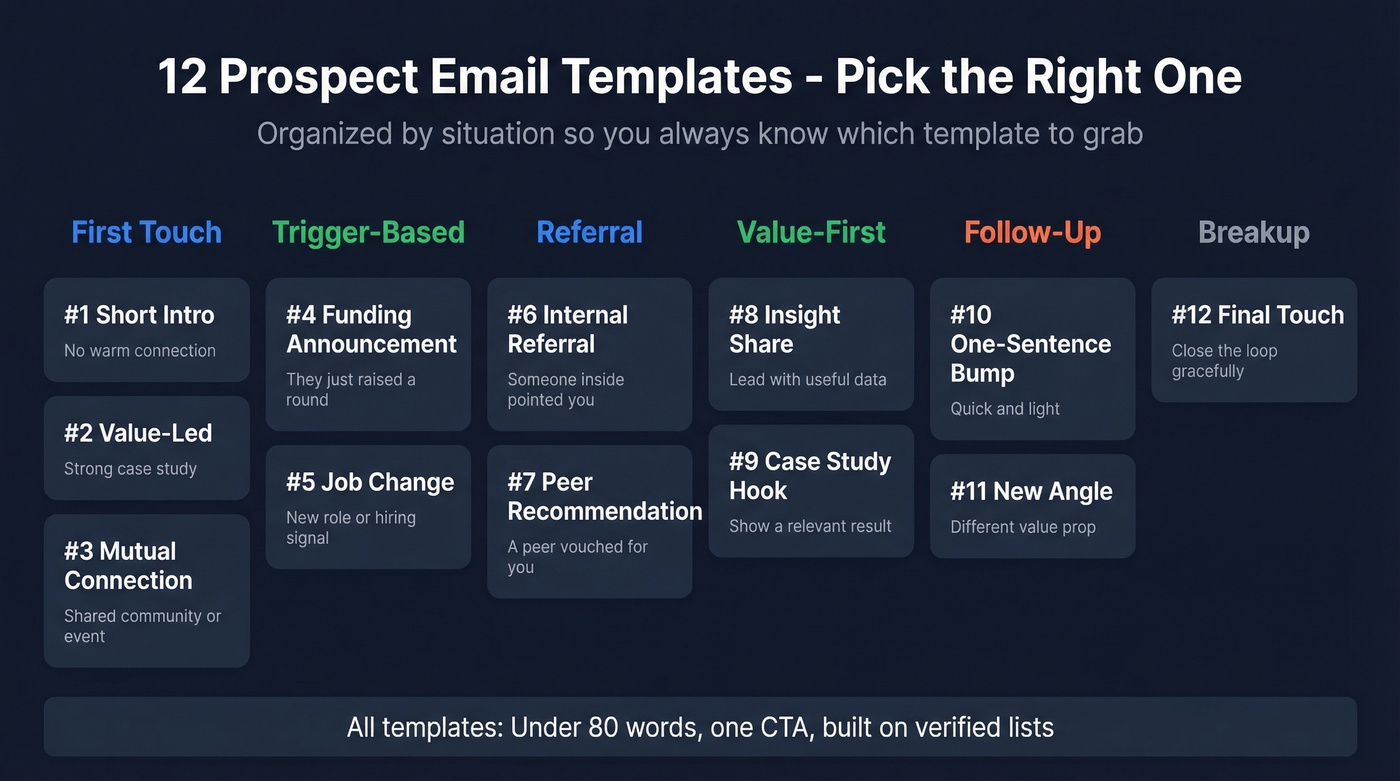
Every template below follows the data: under 80 words, one clear ask, no HTML bloat. Adapt the personalization - don't copy-paste verbatim. (For more tactics beyond templates, see sales prospecting techniques.)
First Touch (Cold)
Template 1: Short Intro
Best for: No warm connection, limited intel. This is your default opener.
Subject: Quick question about [specific process]
Hi [First Name],
I noticed [Company] is [specific observation - hiring for X role / expanding into Y market / using Z tool]. We help similar teams [one-sentence value prop].
Worth a 15-minute call this week?
[Your name]
A specific observation proves you did homework. One ask keeps friction low.
Template 2: Value-Led
Best for: You have a strong case study with a company in their space.
Subject: [Their company] + [your outcome]
Hi [First Name],
[Similar company] cut their [metric] by [X%] in [timeframe] using [your approach]. [Company] looks like a fit based on [specific reason].
Open to hearing how?
[Your name]
Leading with a concrete result makes the email about them, not you.
Template 3: Mutual Connection
Best for: You share a community, event, or mutual contact - even a loose one.
Subject: Fellow [community/event/group] member
Hi [First Name],
We both [attended X event / are in Y community / connected through Z]. I've been following what [Company] is doing with [initiative] - it's sharp work.
We help teams like yours [one-sentence value prop]. Worth a quick conversation?
[Your name]
Build Your Own: Observation - Bridge - Vision
This framework from a practitioner who analyzed 10K cold emails on Reddit converts because it's specific:
- Observation: Reference something real - a comment they made, a job posting, a product launch.
- Bridge: Connect it to a problem you solve.
- Vision: Paint the outcome in one sentence.
- Ask: One low-friction CTA. (More CTA patterns: email call to action.)
Trigger-Based
These outbound email templates ride a timing signal - funding, a job change, a product launch. Trigger-based emails outperform generic cold outreach because the prospect is already in motion.
Template 4: Funding Announcement
Subject: Congrats on the raise
Hi [First Name],
Saw [Company] closed your [Series X]. Congrats. Teams at this stage usually need to [scale hiring / ramp pipeline / build infrastructure] fast.
We help with [specific outcome]. Want to see how?
Template 5: Job Change / Hiring Signal
Subject: New role, fresh start?
Hi [First Name],
Congrats on the move to [Company]. New [title] roles usually inherit [specific challenge]. We've helped other [titles] tackle that in their first 90 days.
Open to a quick intro?
Referral / Warm Intro
Referral emails are the highest-converting outreach messages you can send. The name in the subject line does most of the work.
Template 6: Internal Referral
Subject: [Referrer name] suggested I reach out
Hi [First Name],
[Referrer] mentioned you're the right person to talk to about [topic]. We've been working with their team on [outcome].
Would love 15 minutes to see if it's relevant for you too.
Template 7: Peer Recommendation
Subject: [Peer's company] thought you'd want to see this
Hi [First Name],
[Peer name] at [Peer company] has been using [your product/approach] to [outcome]. They thought it'd be a fit for [Company] given [reason].
Worth exploring?
Value-First
Skip the pitch entirely. Give something useful first. These work best when you have genuine content - a benchmark report, a case study, original data - that's relevant to their world.
Template 8: Insight Share
Subject: Data on [their industry/challenge]
Hi [First Name],
We just published [report/benchmark] on [topic relevant to them]. One finding: [specific stat]. Thought it'd be useful given [Company]'s focus on [area].
Happy to share the full thing - just reply and I'll send it over.
Template 9: Case Study Hook
Subject: How [similar company] solved [problem]
Hi [First Name],
[Similar company] was dealing with [problem your prospect likely has]. They [specific result] in [timeframe]. I can share the breakdown if it's relevant to what [Company] is working on.
Follow-Up
Template 10: One-Sentence Bump
Subject: Re: [original subject]
Hi [First Name], just bumping this up - did the timing work for a quick call this week?
Template 11: New Angle
Subject: Different thought on [topic]
Hi [First Name],
I realize my last email might not have landed. Here's a different angle: [new value prop or relevant insight]. If [Company] is dealing with [problem], this might click better.
Worth 10 minutes?
Breakup
Template 12: Final Touch
Subject: Should I close the loop?
Hi [First Name],
I've reached out a few times and don't want to be a pest. If the timing's off, no worries - I'll close this out. If something changes, I'm easy to find.
Either way, good luck with [specific initiative].
Building a Full Prospecting Sequence
42% of replies come from follow-ups, and most reps give up too early. Campaigns with 4-7 steps generate roughly 3x the reply rate of those with just 1-3. One practitioner reported that 80% of their replies came after the third touchpoint. (If you want a deeper set of follow-up options, use these sales follow-up templates.)
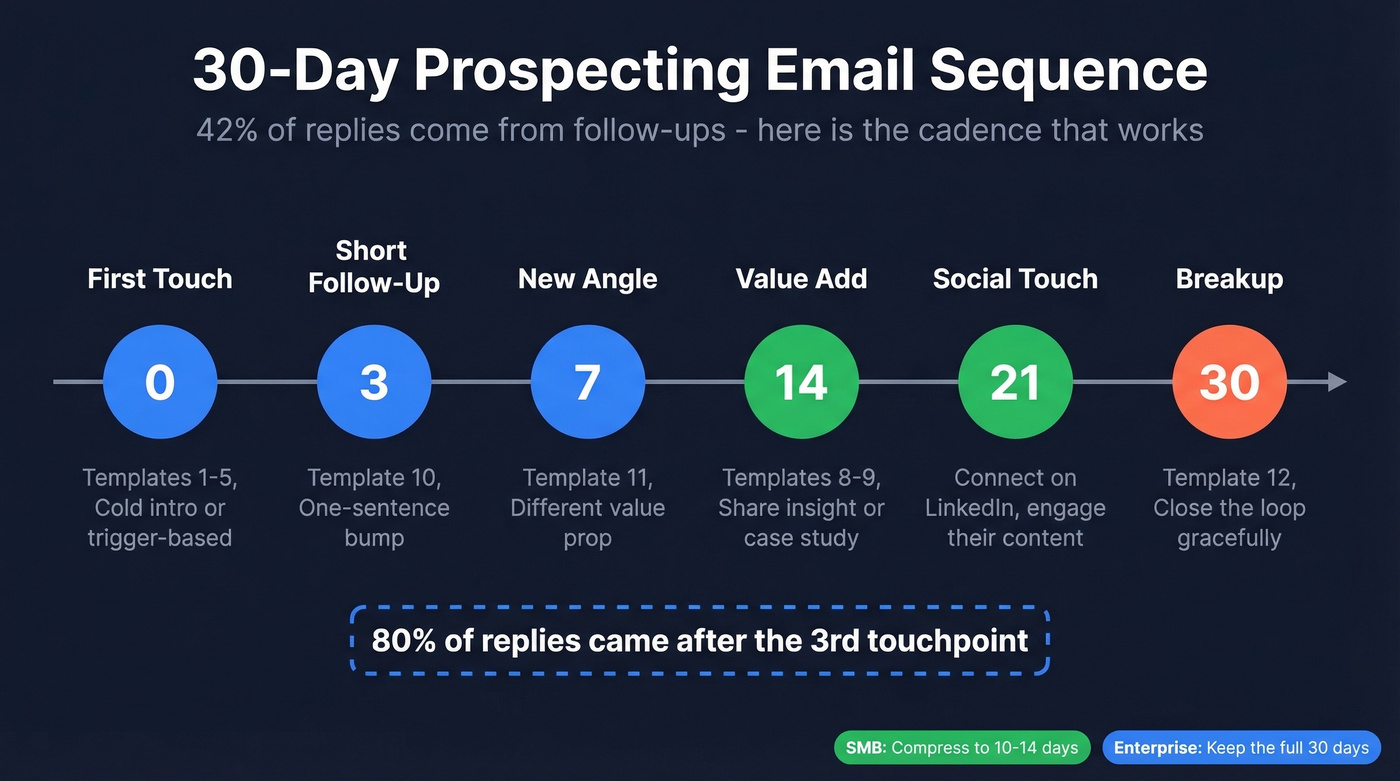
Here's a cadence that balances persistence with respect:
- Day 0: First touch (Template 1-5)
- Day 3: Short follow-up (Template 10)
- Day 7: New angle (Template 11)
- Day 14: Value-add (Template 8 or 9)
- Day 21: Social touch (connect on a professional network, engage with their content)
- Day 30: Breakup (Template 12)
Some practitioners compress this to 10-14 days for faster reply velocity. In our experience, the 30-day spread works better for enterprise prospects, while the compressed cadence suits SMB and startup buyers who make decisions faster. Reaching executives often requires around 9 touches, compared to about 4 for lower-level contacts - so if you're targeting the C-suite, plan a longer sequence.
Here's the thing: one practitioner on Reddit sent 30-50 deeply personalized emails per day and hit a 10% reply rate - impressive on paper. But most replies ghosted after the first conversation. High reply rates don't guarantee conversions. Your follow-up sequence and qualification matter just as much as the initial template.
Space emails 3-7 days apart. Mix channels - email, then social, then email again.
Timing, Length, and Testing
Best send days: Tuesday and Wednesday, with Wednesday slightly ahead. We've found Wednesday morning sends consistently outperform Monday. (More data: best time to send cold emails.)
Best send window: 9-11 AM in the recipient's timezone. Not yours - theirs.
Ideal length: Under 80 words. One Reddit practitioner cut their emails from 141 words to under 56 and saw a meaningful jump in reply rate.
A/B testing: Run a 20% test group, roll the winner to the remaining 80%. Test one variable at a time - subject line, CTA, opener. Weekly iteration beats monthly overhauls.
Let's be honest about something: if your deal size is under $10K, you probably don't need a 7-step sequence with deep personalization. Three tight emails to a verified list will outperform seven mediocre ones to a dirty list every time. The AI saturation problem is real - average reply rates compressed from 6.8% to 4-6% as volume scaled. The antidote isn't more emails. It's better prospecting messages sent to verified contacts.
Mistakes That Kill Campaigns
Sending from your primary domain. Use dedicated sending domains. If they get flagged, your main domain stays clean.
Skipping warmup. Plan for a 4-week gradual ramp. There's no shortcut here, and I've watched teams learn this the expensive way.
Not cleaning your list. Run your list through verification before every campaign. At ~$0.01/email with catch-all handling and spam-trap removal, there's no excuse to skip it.
Multiple CTAs. One email, one ask. "Book a call, check out our blog, and follow us on social" is three asks too many.
HTML-heavy emails. Plain text typically outperforms. Images, fancy formatting, and multiple links trigger spam filters.
No unsubscribe link. Beyond being legally required, it keeps complaint rates below the 0.1% threshold that tanks deliverability.
Too many emails per account. Cap at around 25-30 per mailbox per day. Spread volume across multiple sending accounts.
AI-generated copy you didn't edit. Prospects can spot it. If you use AI to draft, rewrite the opener and CTA in your own voice. The best sales prospecting emails always sound like a real person wrote them.
Every template above needs one thing to work: a verified email behind it. Prospeo gives you 300M+ professional profiles with 30+ filters - buyer intent, job changes, funding signals - so your trigger-based emails land on time and on target. 7-day data refresh means you're never emailing someone who left the company last month.
Build the list these templates were made for.
FAQ
What's a good reply rate for cold emails?
The overall average is 3.43%, with elite campaigns exceeding 10%. Consistently above 5% means your fundamentals - data quality, deliverability, and copy - are solid. Below 2% means something structural is broken.
How many follow-ups should I send?
Four to seven touchpoints is the sweet spot. 42% of all replies come from follow-ups, and campaigns with 4-7 steps generate roughly 3x the reply rate of shorter sequences. Stop at 7 unless each additional touch adds genuinely new value.
Is cold email legal in 2026?
Yes, in the US, as long as you comply with CAN-SPAM: include an opt-out, a physical address, and truthful headers. In the EU, you need consent or a legitimate interest basis and must show relevance to the recipient's role. Penalties for US violations run up to $53,088 per email.
How do I verify emails before sending a campaign?
Use a dedicated verification tool that checks for invalid addresses, spam traps, catch-all domains, and honeypots. Verifying before every send is the single highest-ROI step for protecting deliverability - and at ~$0.01/email, it's trivially cheap compared to the cost of a burned domain.
How long should a prospecting email be?
Under 80 words. The best-performing campaigns keep emails short and focused on a single ask. One Reddit practitioner cut their emails from 141 words to under 56 and saw their reply rate jump meaningfully.