

The Discovery Call Template That Actually Works (Backed by 519K Calls)
It's Tuesday at 2:55pm. You've got a discovery call in five minutes. The CRM record is six months stale, your notes say "inbound - website form," and you're about to wing it with the same three questions you always ask.
That call is already dead.
67% of lost deals trace back to poor discovery - not bad demos, not pricing objections. What follows isn't another generic question list. It's a minute-by-minute discovery call template built on analysis of 519K+ sales conversations, with the benchmarks that separate reps who qualify from reps who guess.
The Single Most Important Benchmark
46:54. That's the talk-to-listen ratio top performers hit on discovery calls. If you're talking more than your prospect, you're losing.
Here's what you'll walk away with: a 30-minute template with exact timing for each phase, a question bank of 16 proven questions organized by category, a framework comparison so you pick the right methodology for your deal size, and pre-call and post-call checklists you can copy into your CRM today.
Discovery Call vs. Qualifying Call
These aren't the same thing, and confusing them is how deals stall. A qualifying call is 10 minutes with an SDR covering basics: headcount, current provider, buying timeline. It's triage.
A discovery call is 25-45 minutes with an AE going deep - pain, business impact, stakeholders, decision process, what happens if they do nothing. Different purposes, different pipeline stages, different skills required.
The Numbers Behind Great Discovery
Analysis of 326K sales calls found the average rep talks 60% of the time. Reps who win talk 57%. Reps who lose talk 62%. Five percentage points is the difference between pipeline and a "no decision" rotting in your CRM.
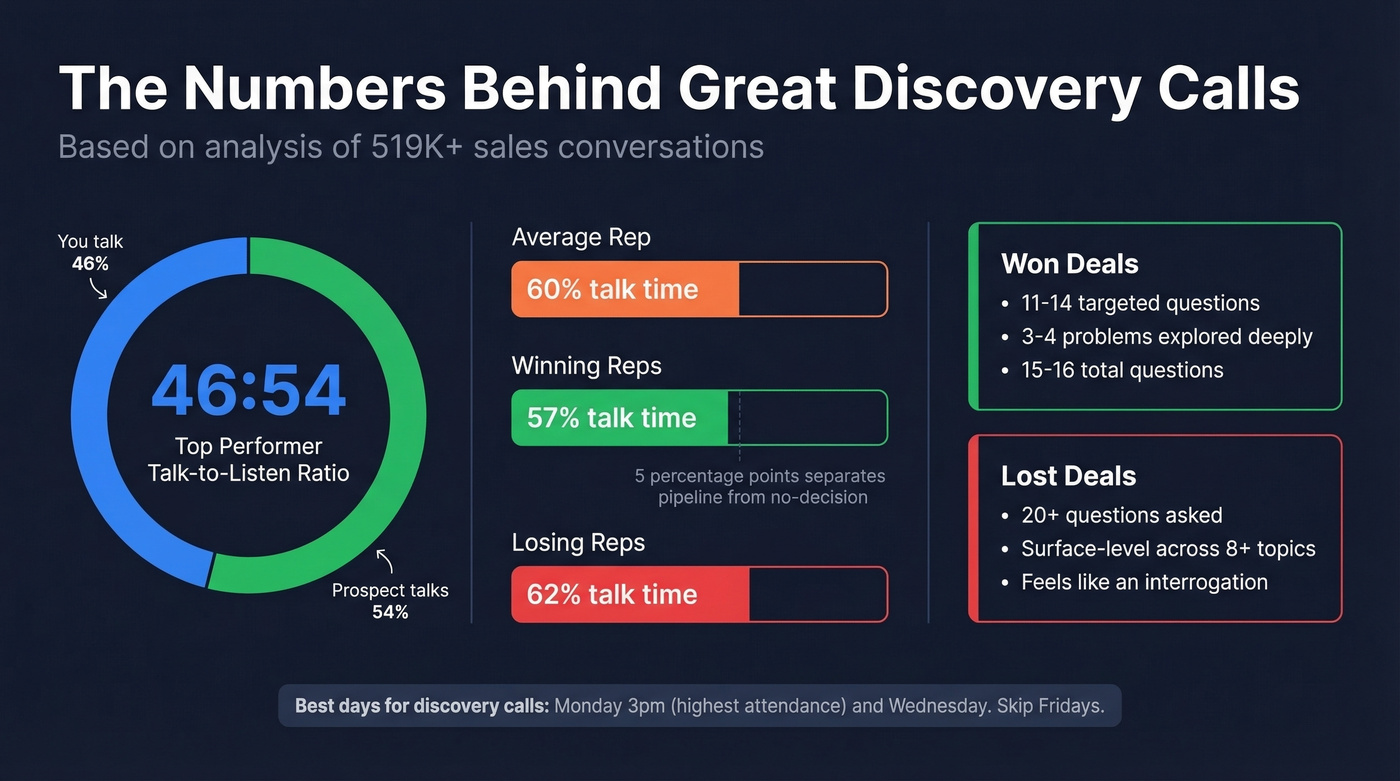
One nuance worth flagging: Gong publishes multiple benchmarks across different datasets and call types. In the 326K-call analysis, closed-won calls average roughly 57% rep talk time. In the discovery-specific analysis of 519K conversations, top performers land around 46:54. Gong also cites a broader "golden ratio" of 43% talking to 57% listening. The exact number shifts depending on the dataset, but the direction never does - less talking wins.
The larger dataset narrows it further. Top performers ask 11-14 targeted questions and go deep into 3-4 customer problems. Won deals averaged 15-16 questions total (including follow-ups), while lost deals hit 20+. That's not discovery. That's interrogation, and prospects shut down.
Monday at 3pm has the highest attendance rate. Wednesday is a close second. Skip Fridays - no-show rates spike.
Here's the thing: more questions doesn't mean better discovery. After 14, returns diminish fast. The skill isn't asking more - it's asking deeper.
The 30-Minute Discovery Call Template
Setting the Agenda (0-4 min)
Start with the ACE framework: Appreciate, Confirm time, End goal.
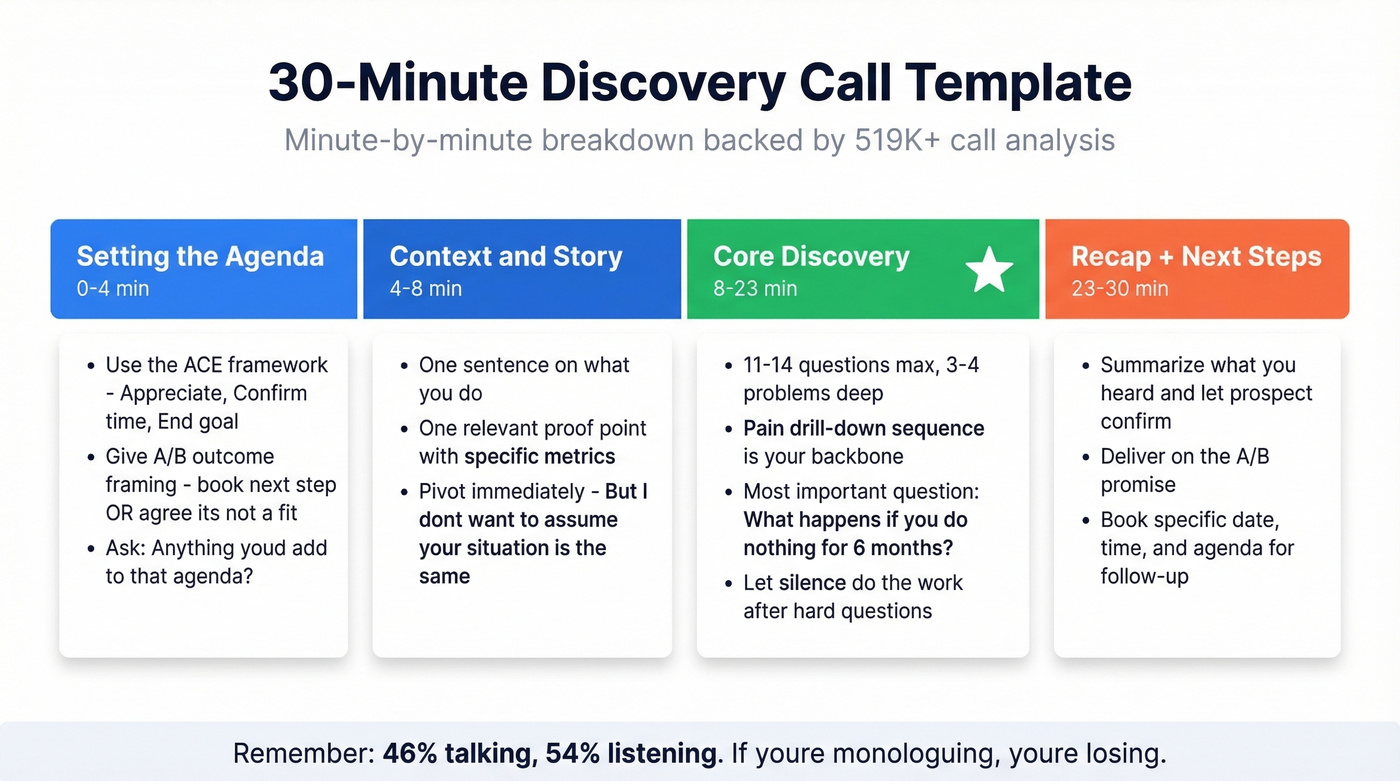
"Hey [Name], thanks for making time. I've got us down for 30 minutes - still work? I'll share a quick sentence on what we do, then I want to hear about [their challenge], and we'll figure out if it makes sense to keep talking. At the end, either we book a deeper dive, or we agree this isn't a fit and save each other time. Anything you'd add to that agenda?"
That last question is the "contract." You're giving the prospect permission to reshape the agenda, which builds trust and surfaces what they actually care about. The A/B outcome framing - book a next step or stop the process - comes from a framework that consistently gets praise on r/sales because it kills the awkward "so... what do you think?" ending.
Context and Story (4-8 min)
This isn't a pitch. One sentence on what you do, followed by a relevant proof point: "We help [type of company] solve [specific problem]. Last quarter we worked with [similar company] that cut [metric] by [number]." Then pivot immediately: "But I don't want to assume your situation is the same. Can you walk me through what's happening on your end?"
Core Discovery Questions (8-23 min)
This is the 15-minute core and where most reps blow it. Remember: 11-14 questions, 3-4 problems deep. Don't go wide across eight surface-level topics.
The pain drill-down sequence is your backbone:
- "How long has this been a problem?"
- "Why is it still a problem?"
- "What have you tried?"
- "Why didn't that work?"
- "What happens if you do nothing for another 6 months?"
That last question is the most important question in B2B sales. It forces the prospect to articulate the cost of inaction - the real thing you're competing against. Not a competitor. Inertia.
In our experience, the reps who nail discovery aren't the ones with the best questions. They're the ones who shut up after asking a hard question and let the silence do the work.
Recap + Next Steps (23-30 min)
Summarize what you heard and let the prospect confirm: "So if I'm hearing you right, the core issue is [X], it's costing you roughly [Y], and you need a solution by [Z]. Did I miss anything?"
Then deliver on the A/B promise. If it's a fit: "I'd love to show you exactly how we'd solve this. Can we book 45 minutes on Thursday?" If it's not, say so honestly. Being disarmingly blunt about fit saves everyone time and earns you referrals from people who respect your honesty. Clear next steps - a specific date, time, and agenda for the follow-up - are what separate pipeline that moves from pipeline that stalls.

67% of lost deals trace back to poor discovery - and poor discovery starts with stale CRM data. Prospeo refreshes 300M+ profiles every 7 days, so your pre-call research gives you verified emails, direct dials, tech stack, and headcount growth signals before you ever say hello.
Stop winging discovery calls with six-month-old CRM records.
Pre-Call Research Checklist
96% of buyers research you before the call. Return the favor. Copy this into your CRM notes five minutes before every call:
- Prospect profile: Role, title, time in role, previous companies, mutual connections
- Company profile: Headcount, growth trajectory, recent funding, tech stack, recent news
- Call purpose: Why did they raise their hand? What triggered this conversation?
- Desired outcome: What does "success" look like for this 30 minutes?
- Hypothesis: What problem do you think they have? (You'll validate or discard this in the first 5 minutes.)
Look, you don't need a better script. You need better data. The prep is the edge, not the template. Verify your prospect's contact info before the call - tools like Prospeo pull verified emails and direct dials from 300M+ profiles on a 7-day refresh cycle, so your prep actually leads to a conversation instead of a voicemail on a dead line.
Discovery Question Bank
About 25% of sellers say discovery questions are their top weakness. The fix isn't memorizing 50 questions - it's having 16 great ones and picking 11-14 per call based on what you learn.
Pain / Problem
- "Walk me through your current process for [relevant workflow]."
- "What prompted you to look at this now?"
- "What's the cost of this problem - in dollars, time, or headcount?"
- "What happens if you do nothing for another quarter?"
Budget / Authority
- "Who else needs to be involved in this decision?"
- "What would need to be true for this to be a priority this quarter?"
- "Have you allocated budget for solving this, or would we need to build a case?"
Timeline / Urgency
- "Is there a specific event driving your timeline - a renewal, a board meeting, a launch?"
- "When would you need to see results by?"
- "What's your typical buying process look like for a tool like this?"
Current State / Competition
- "What are you using today, and what's working or not working about it?"
- "Have you evaluated other solutions? What did you like or not like?"
- "How do you measure success for this function right now?"
Don't use all of these. Pick the ones that match your hypothesis, then follow the threads. Curiosity beats checklists every time.
Which Framework Should You Use?
Real talk: every framework reduces to need, budget, stakeholders, and timeline. The consensus on r/sales is that teams over-emphasize methodology too early. Teach fundamentals first, then pick a framework that fits your deal complexity.
If you want a deeper library of prompts, start with a dedicated set of discovery questions and then tailor them to your ICP.
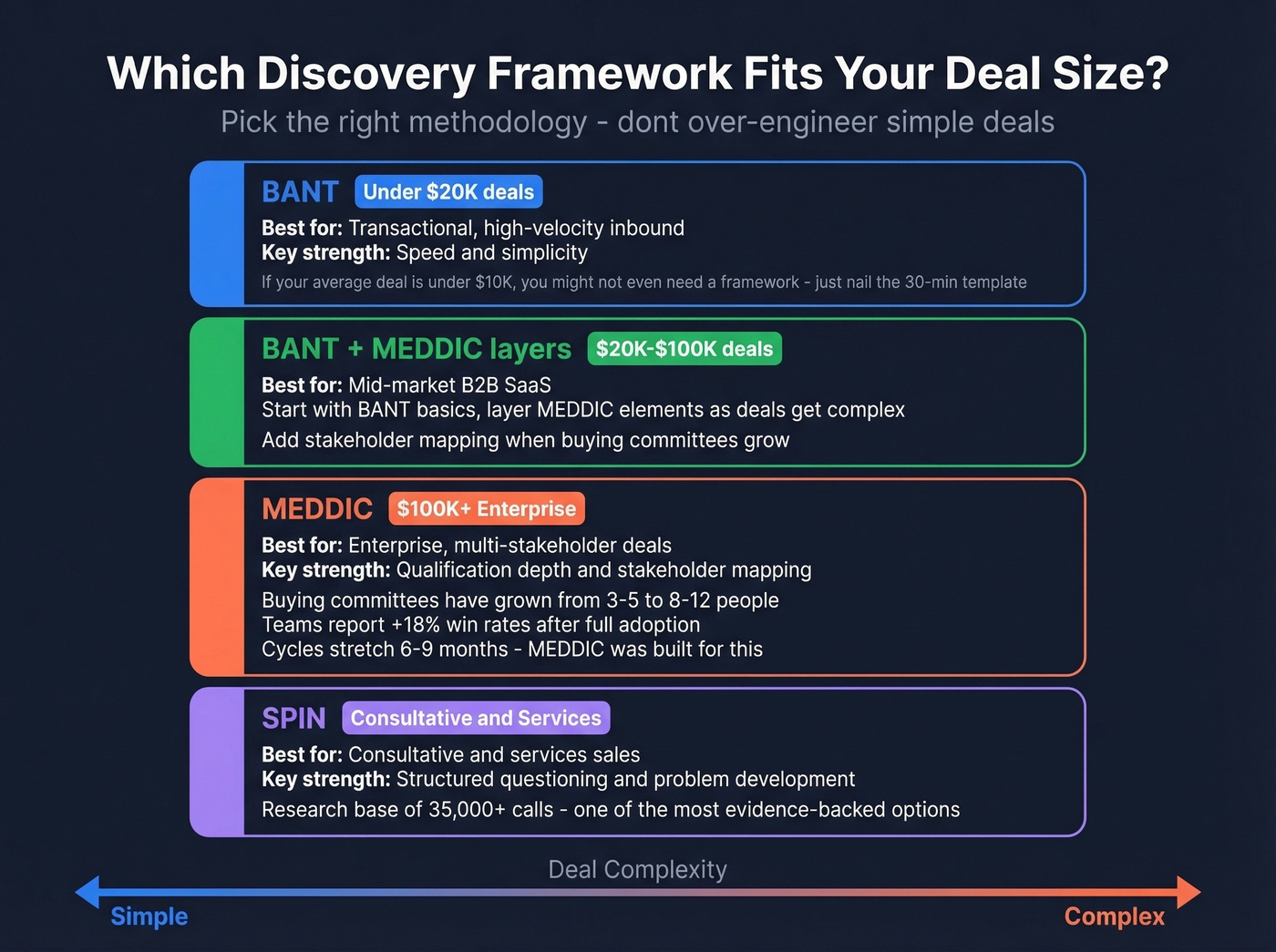
| Framework | Best For | Key Strength |
|---|---|---|
| BANT | Transactional, high-velocity inbound | Speed and simplicity |
| MEDDIC | Enterprise, multi-stakeholder deals | Qualification depth + stakeholder mapping |
| SPIN | Consultative and services sales | Structured questioning and problem development |
| NEAT | Buyer-led, modern SaaS | Economic-impact framing |
For most B2B SaaS teams selling $20K-$100K deals, start with BANT and layer MEDDIC elements as deals get complex. For enterprise ($100K+), go straight to MEDDIC - enterprise buying committees have ballooned from 3-5 to 8-12 stakeholders, and cycles now stretch 6-9 months. That's exactly the complexity MEDDIC was built to handle, and teams report +18% win rates after full adoption. For consultative or services sales, SPIN's research base of 35,000+ calls makes it one of the most evidence-backed options available.
For enterprise deals, remember: you get delegated to who you sound like. Sound tactical, stay tactical. Sound strategic, earn exec access.
Hot take: If your average deal is under $10K, you probably don't need a framework at all. Just nail the 30-minute template above, ask 11-14 good questions, and close on the next step. Frameworks are scaffolding for complex deals - they're overhead for simple ones.
Mistakes That Kill Deals
Talking too much. The data is unambiguous: 62% talk time correlates with lost deals. If you're monologuing, you're losing.
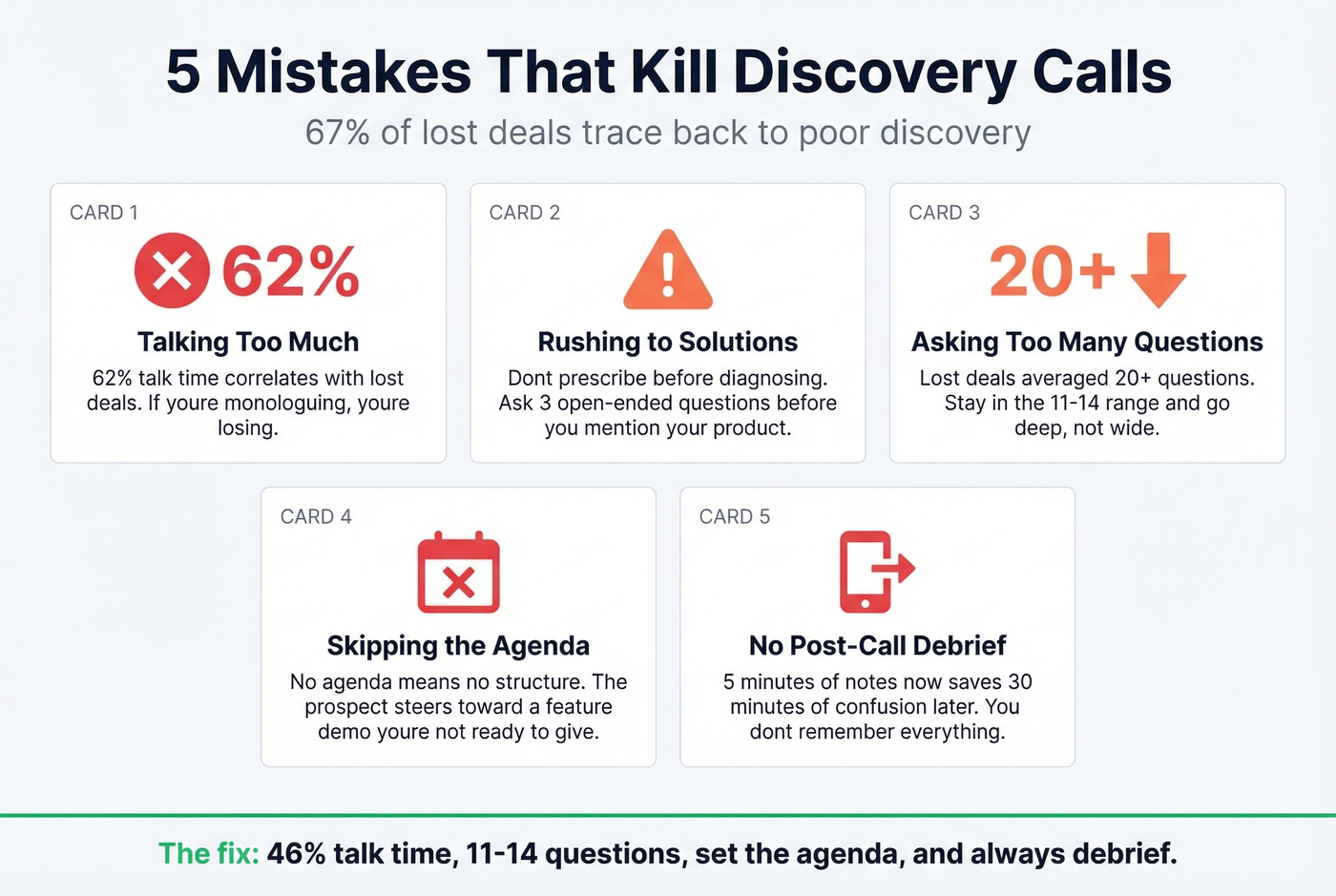
Rushing to solutions. HubSpot uses the doctor analogy - you wouldn't trust a doctor who prescribed medication before asking about symptoms. Ask three open-ended questions before you mention your product.
Asking too many questions. Lost deals averaged 20 questions. Stay in the 11-14 range and go deep instead of wide.
Skipping the agenda. No agenda means no structure, which means the prospect steers the call toward a feature demo you're not ready to give.
No post-call debrief. If you hang up and immediately jump to the next call, you'll forget half of what you learned. Five minutes of notes now saves 30 minutes of confusion later.
We've tested all four frameworks across different deal sizes, and the pattern holds: the reps who debrief consistently outperform the ones who "remember everything." They don't. Neither do you.
Post-Call Debrief Checklist
Complete this within five minutes of hanging up. It takes 90 seconds and saves your deal review from becoming guesswork.
- Pain confirmed? Y/N
- Authority identified (who signs, who influences)? Y/N
- Timeline established? Y/N
- Compelling event identified? Y/N
- Next step agreed with specific date? Y/N
- Budget discussed or signaled? Y/N
The gut-check question: "Would I trust this person to actually buy software this quarter?" If the answer is no, don't put it in your pipeline. Your forecast will thank you.
If you want to tighten what happens after the call, use a set of sales follow-up templates so next steps don’t drift.
Your pre-call checklist is useless if the phone number rings out and the email bounces. Prospeo delivers 98% email accuracy and 125M+ verified mobile numbers with a 30% pickup rate - so your discovery calls actually happen.
Turn every scheduled discovery call into a real conversation.
FAQ
How long should a discovery call be?
Thirty minutes is the standard, and the data backs it. That's enough time for 11-14 questions across 3-4 problems without losing the prospect's attention. Enterprise deals with multiple stakeholders may warrant 45 minutes, but don't default to longer - tighter calls force better questions.
How many questions should I ask?
Aim for 11-14 targeted questions. Analysis of 519K+ calls found that fewer than 11 doesn't go deep enough, while more than 14 correlates with worse outcomes. Go deep on 3-4 problems rather than skimming across a dozen.
What's the difference between BANT and MEDDIC?
BANT covers Budget, Authority, Need, and Timeline - fast and effective for transactional inbound deals under $25K. MEDDIC adds Metrics, Economic Buyer, Decision Criteria, Decision Process, Identify Pain, and Champion - built for committees of 8+ stakeholders and cycles past three months. Most teams start with BANT and graduate to MEDDIC as deal complexity grows.
Can you share discovery call examples for different deal sizes?
For a $15K SaaS deal, a strong call might last 25 minutes: set a tight agenda, ask 12 questions focused on one core pain, and book a demo before hanging up. For a $150K enterprise deal, expect 40-45 minutes across two or three pain areas, with questions mapping the buying committee and decision criteria. The 30-minute template above flexes for both - compress the question phase for smaller deals, expand it for larger ones.
What if my prospect's contact info is wrong before the call?
Stale CRM data is the silent killer of discovery calls - all that prep wasted on a number that rings out. Verify emails and phone numbers before every call using a tool with a short refresh cycle so you're not prepping for a conversation that never connects.