

How to Run a B2B Discovery Call That Actually Closes Deals
Your SDR booked the meeting. The prospect accepted. You open with "So, tell me about your role" - and you can practically hear them check out. That's not a B2B discovery call. That's a formality disguised as a conversation. 96% of buyers have already researched your product before they pick up the phone. If your discovery doesn't match that level of preparation, you've already lost.
The Quick Version
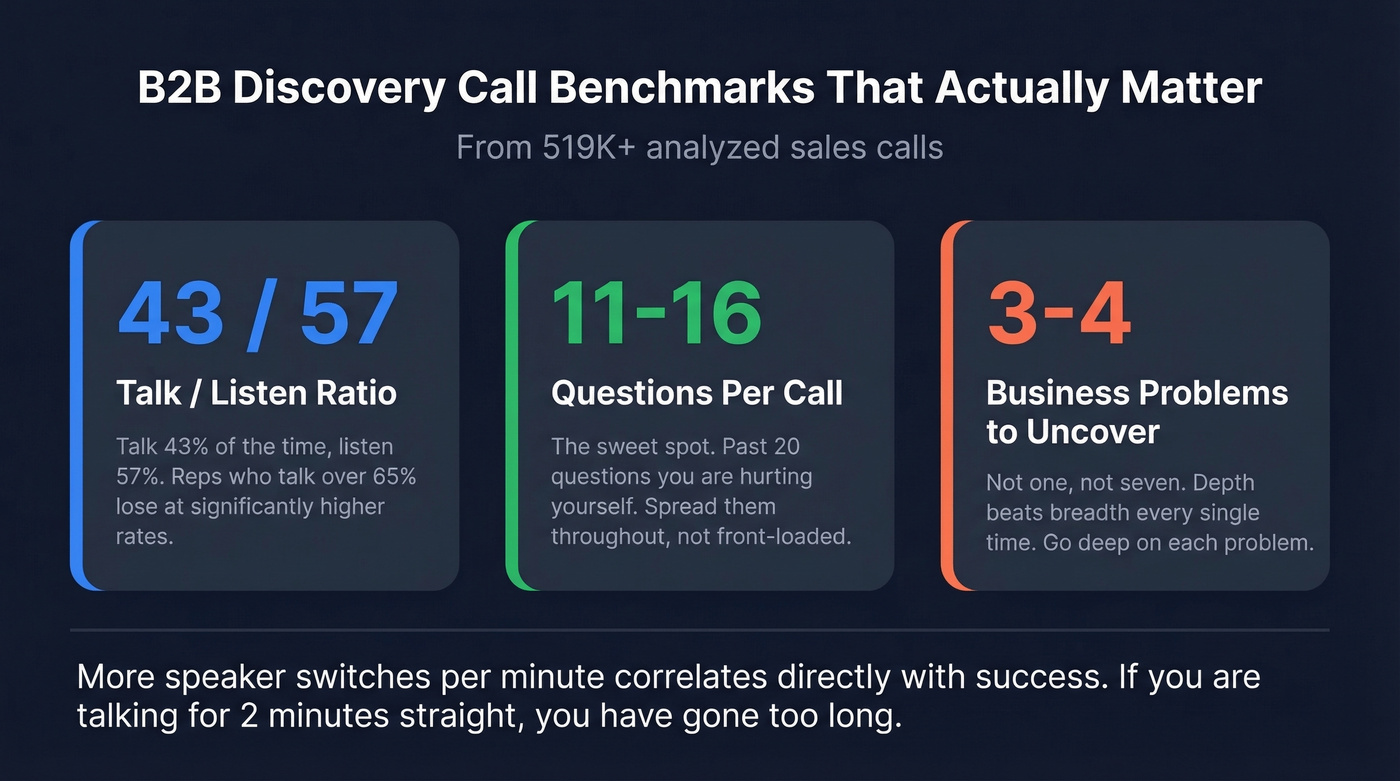
- Talk 43% of the time, listen 57%. That's the golden ratio from an [analysis of 326K+ sales calls](https://www.gong.io/blog/talk-to-listen-conversion-ratio). Reps who talk more than 65% of the call lose at significantly higher rates.
- Ask 11-16 questions, spread throughout the call. Not front-loaded like a checklist. Winners ask 15-16 questions; losers ask around 20 and turn the call into an interrogation.
- Uncover 3-4 business problems. Not one, not seven. Depth beats breadth every single time.
Here's the minute-by-minute structure, framework comparison, question bank, and follow-up template to make it happen.
What Is a B2B Discovery Call?
A B2B discovery call isn't a cold call, and it isn't a demo. Cold calls interrupt strangers. Demos present features. Discovery does something harder: it qualifies the opportunity while simultaneously building trust. Think of it as the conversation where you earn the right to demo.
You're not gathering information for your CRM fields. You're diagnosing whether this prospect has a real problem you can solve, whether they have the authority and urgency to act, and whether they trust you enough to keep talking. Skip this step or rush through it, and every subsequent conversation in the sales cycle sits on a shaky foundation.
The Numbers Behind Great Discovery Calls
Let's ground this in data, not opinion. Two landmark studies should shape how every B2B rep runs discovery.
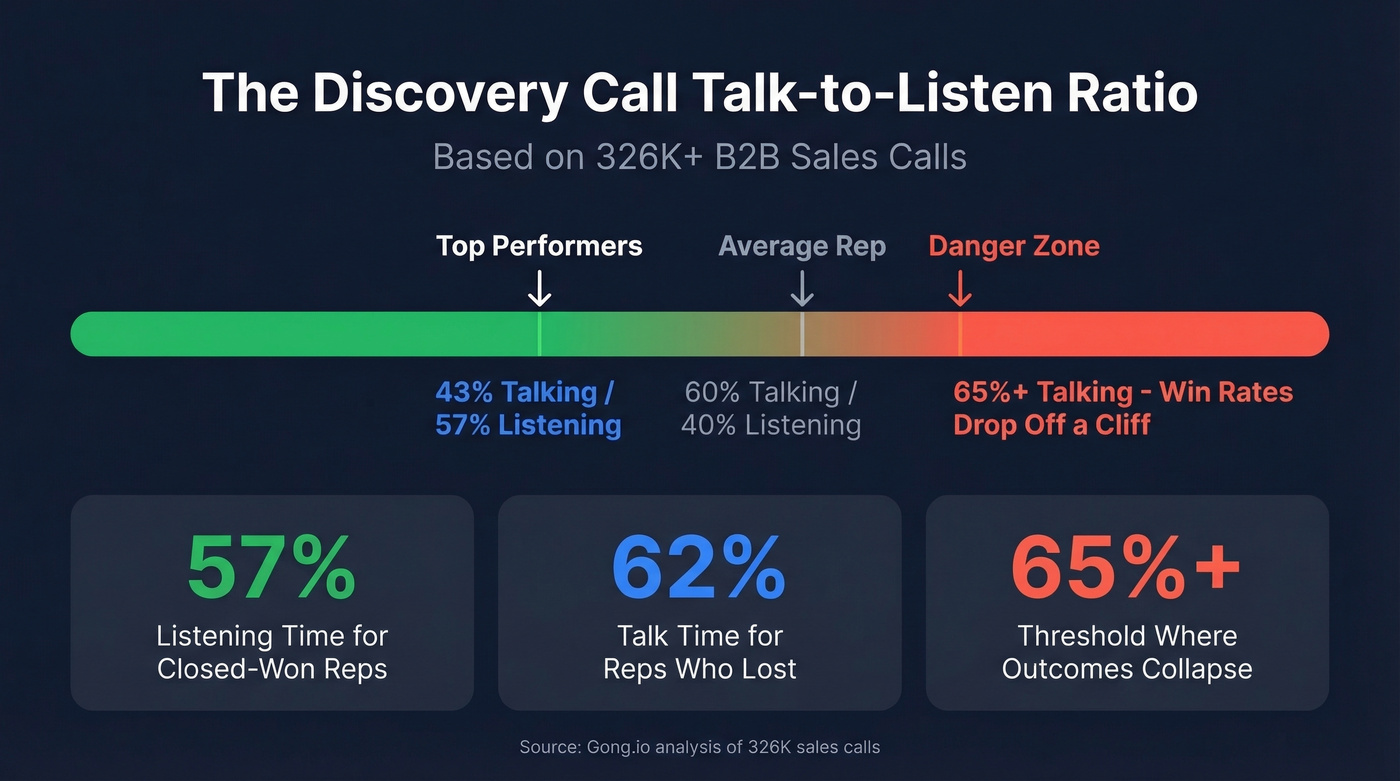
The first, based on 326K sales calls, found that the average rep talks 60% of the time and listens 40%. That's the average - and the average rep doesn't hit quota. Closed-won reps averaged 57% talk time. Reps who lost talked 62%. The aspirational golden ratio - 43% talking, 57% listening - represents the best performers. Once you cross the 65% talk-time threshold, outcomes drop off a cliff. Chris Orlob's analysis of this Gong data popularized these benchmarks and fundamentally changed how top teams approach call discovery.
The second study analyzed 519,000 discovery calls and found something counterintuitive: asking more questions doesn't help. The original study pegged the sweet spot at 11-14 questions per call; a later update of the 326K-call dataset found winners asking 15-16. Either way, the ceiling is clear - past 20, you're hurting yourself. Top performers uncovered 3-4 distinct business problems and spread questions throughout the conversation like a tennis match, not a rapid-fire interrogation in the first five minutes.
Stop memorizing 30 questions. You need 11-16, max. The skill isn't in the quantity - it's in knowing which ones to ask based on what the prospect just told you. More "speaker switches per minute" - that back-and-forth rhythm - correlates directly with success. If you're talking for two minutes straight, you've already gone too long.
How to Prepare Before the Call
Calling without knowing a prospect's tech stack is like showing up to a job interview without reading the job description. You'll ask questions they've already answered on their website, and they'll mentally check out.
Remember that 96% stat? Buyers have researched you. The question is whether you've researched them. Here's your pre-call checklist:
- Company context: Revenue range, headcount, recent funding, industry vertical, growth trajectory
- Stakeholder map: Who's on the call, who else is involved in the decision, who signs the check
- Tech stack: What tools do they already use in the space you're selling into?
- Triggers and timing: Recent job postings, leadership changes, product launches, or press mentions that signal urgency
- Intent signals: Are they actively researching solutions in your category?
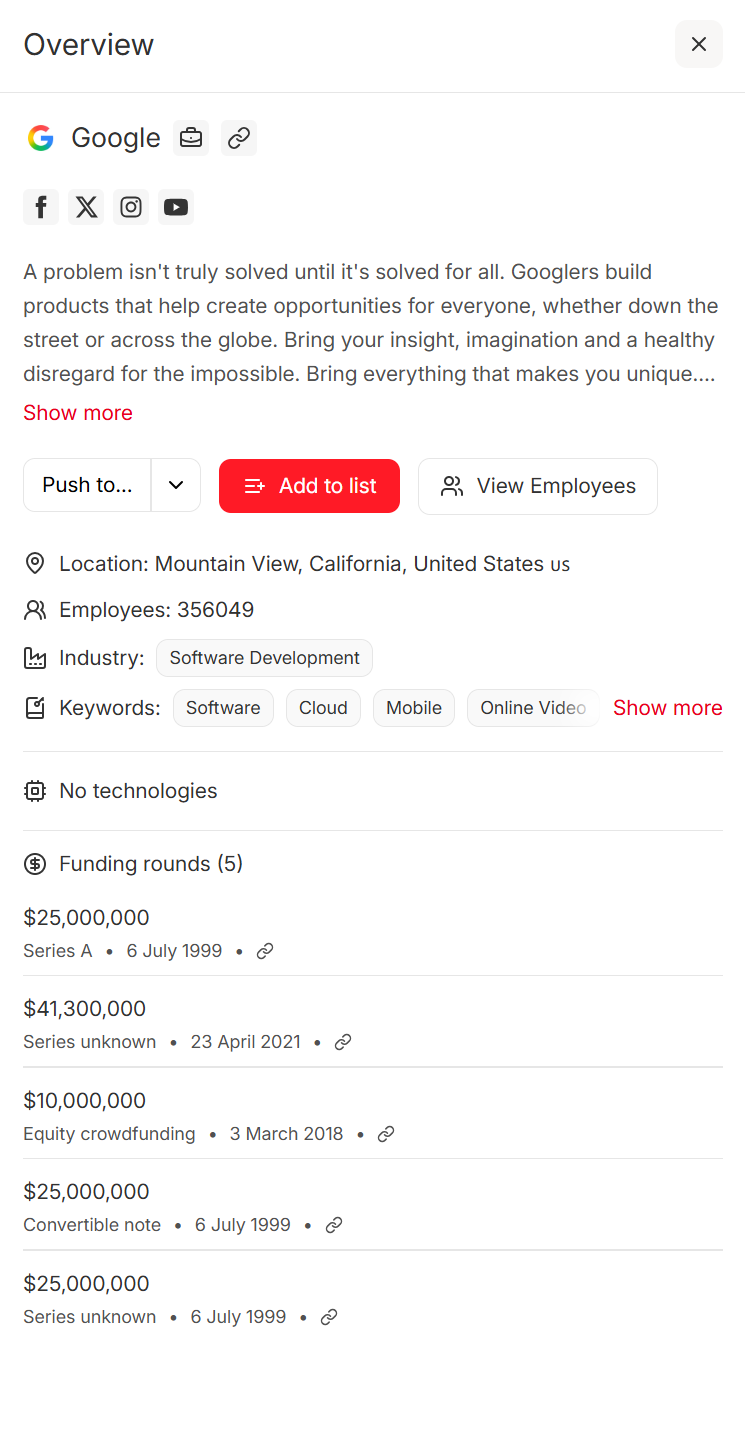
This is where your prep tools matter as much as your talk track. Running a prospect through Prospeo's enrichment before the call surfaces 50+ data points - tech stack, headcount growth, funding history, and intent signals across 15,000 topics. If you're comparing vendors, start with this list of data enrichment services. We've seen teams cut pre-call research from 15 minutes to under 3 by running enrichment before every discovery block. When you're doing 8-10 calls a day, that's hours back in your week.
Which Discovery Framework Should You Use?
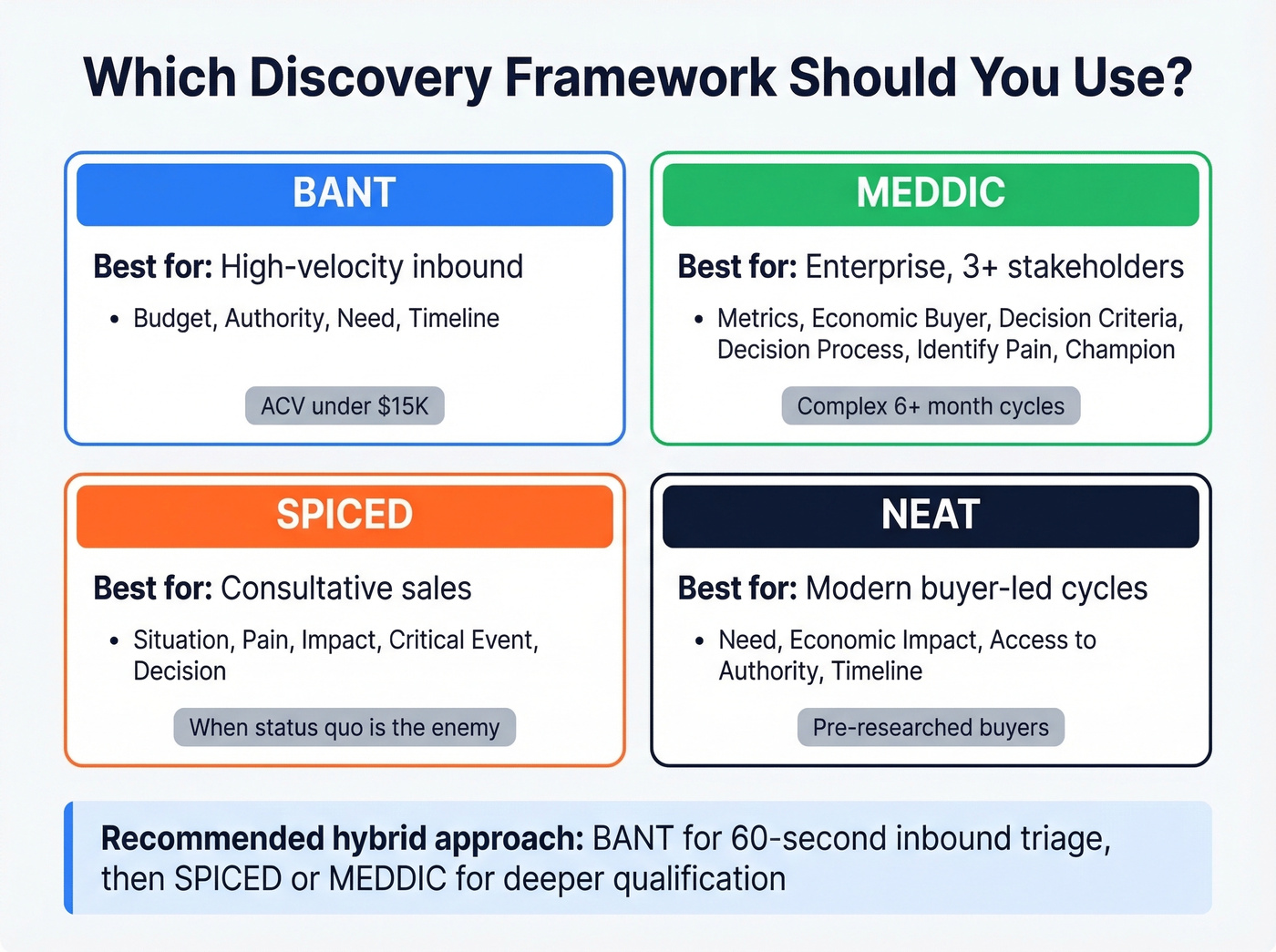
There are four frameworks worth knowing. Most teams only need one or two.
| Framework | Best For | Core Questions | When to Use |
|---|---|---|---|
| BANT | High-velocity inbound | Budget? Authority? Need? Timeline? | Initial screening |
| MEDDIC | Enterprise, 3+ stakeholders | Who's the champion? What are the decision criteria? | Complex, multi-stakeholder |
| SPICED | Consultative sales | What's the critical event? What's the cost of inaction? | Status-quo-is-the-enemy deals |
| NEAT | Modern buyer-led cycles | What's the economic impact? Who has access to authority? | Pre-researched buyers |
Here's the thing: BANT should be retired for anything above a $15K ACV. "Do you have budget?" is a yes/no question that tells you almost nothing about whether a deal will actually close. BANT was designed by IBM decades ago for a buying environment that no longer exists. It's fine as a 60-second inbound triage - and that's where it should stay.
For most mid-market SaaS teams, the hybrid approach works best: BANT as a quick first screen, then SPICED or MEDDIC for deeper qualification. SPICED shines when the prospect's biggest competitor is their own inertia - it forces you to uncover the critical event that makes "do nothing" unacceptable. MEDDIC is non-negotiable for enterprise deals where procurement, legal, and multiple decision-makers turn a 30-day cycle into a 6-month marathon.
I've watched reps lose six-figure deals because they asked "do you have budget?" instead of uncovering the business case. The framework you choose determines the depth of insight you walk away with. If you want a deeper bank of prompts, use these discovery questions to build your own 11-16-question flow.

Your discovery calls are only as good as your pre-call research. Prospeo enriches every prospect with 50+ data points - tech stack, headcount growth, funding, and intent signals across 15,000 topics - so you walk into every call already knowing what matters.
Cut pre-call research from 15 minutes to under 3.
The 30-Minute Call Structure
Opening (First 2 Minutes)
Two solid options, depending on your style.
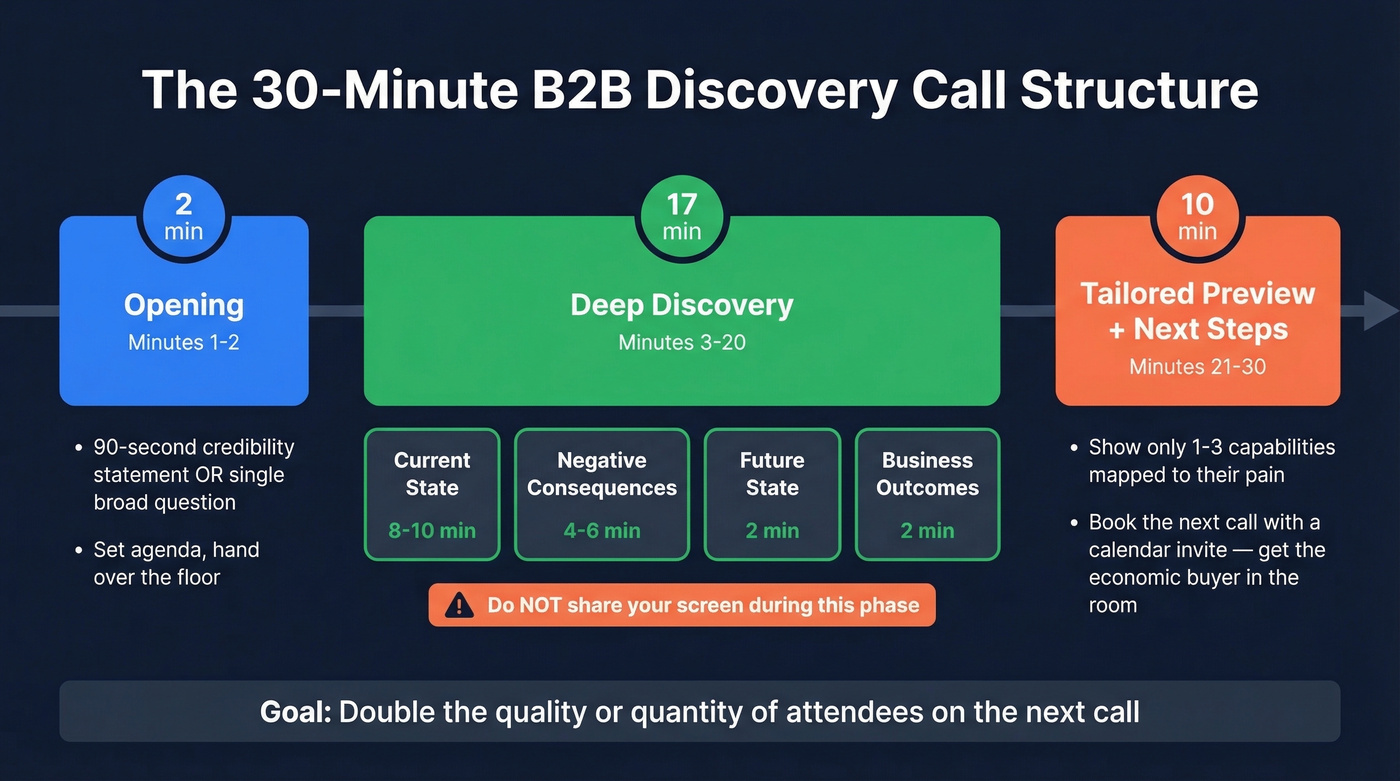
Option A: The 90-second commercial. Scott Channell's approach: open with a brief credibility statement, name a common problem you solve for companies like theirs, then hand the floor over. "We help [type of company] solve [specific problem] - typically they're dealing with [pain point]. Is that something you're running into?" Structured, confident, immediately relevant. (If you need examples, steal from these sample elevator pitches.)
Option B: The single broad question. Sam McKenna's approach - skip the preamble and ask one open-ended question. "What prompted you to take this call?" This works especially well when the prospect is senior and doesn't want to be pitched.
Either way, set a brief agenda and get to discovery fast.
Deep Discovery (Minutes 3-20)
This is where the call is won or lost. Allocate your time roughly like this:
- Current state (8-10 min): What are they doing today? Tools, processes, team structures. Listen more than you talk.
- Negative consequences (4-6 min): What's breaking? What's the cost - in dollars, time, or missed opportunities?
- Future state (2 min): What does "good" look like? Let them paint the picture.
- Business outcomes (2 min): Tie their future state to measurable results.
Don't share your screen during this phase. The moment you show a product, the conversation shifts from their problems to your features. One practical tactic: take notes as an outline while they talk, then circle back to each point for deeper probing. This keeps the conversation natural and ensures nothing gets lost.
Tailored Preview + Next Steps (Minutes 21-30)
You've earned the right to show something. But show only 1-3 capabilities that directly map to the pain they described. This isn't a demo - it's a preview that proves you were listening. If you want a tighter process for the next meeting, use a product demo checklist.
Then close with a concrete next step. Not "let's circle back" - an actual calendar invite with a specific date, time, and attendees. The goal of every discovery conversation is to double the quality or quantity of attendees on the next call. If you can get the economic buyer into the follow-up, you've dramatically increased your odds.
Discovery Questions by Stage
Context and Current State
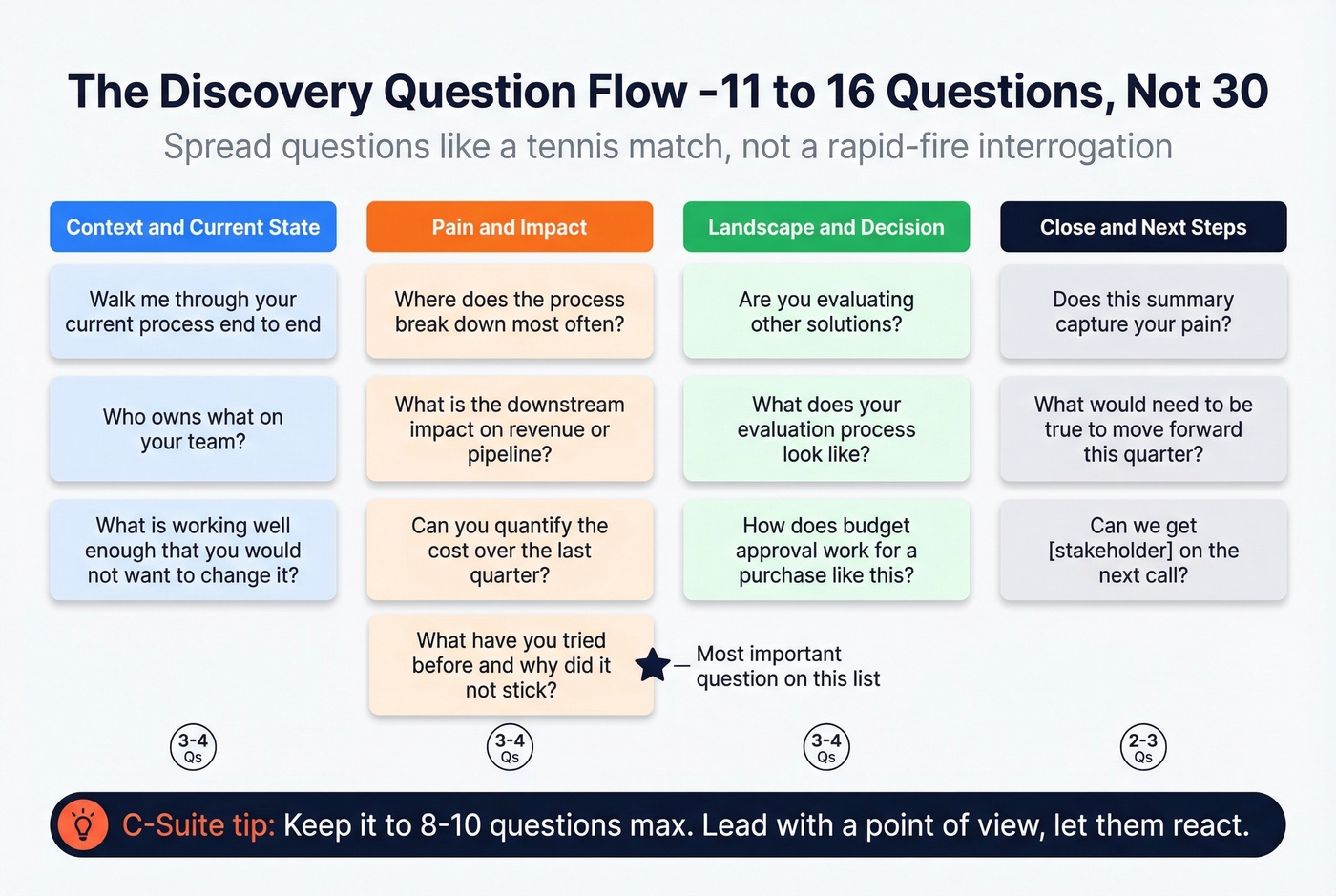
Start by asking the prospect to walk you through their current process end-to-end. Then probe into team structure and ownership - who handles what, and how long the current tools have been in place. The question "What's working well enough that you wouldn't want to change it?" is underrated. It disarms defensiveness and gives you a map of what not to threaten.
Pain and Impact
- "Where does the current process break down most often?"
- "When [problem] happens, what's the downstream impact on [revenue/pipeline/team]?"
- "If you could quantify the cost of this issue over the last quarter, what would that number look like?"
- "What have you tried so far to fix this, and why didn't it stick?"
That fourth question is the most important one on this list. If they've tried and failed before, you need to know why - otherwise you'll propose the same thing and get the same objection.
Competitive Landscape and Decision Process
These two stages work best when woven together rather than treated as separate interrogation blocks. Ask whether they're evaluating other solutions, then naturally transition into who else needs to weigh in. "What does your typical evaluation process look like?" reveals procurement complexity. "Is there a timeline driving this - a contract renewal, a board meeting?" uncovers urgency. And "How does budget approval work for a purchase like this?" tells you whether you're talking to the decision-maker or a champion who still needs to sell internally.
Close and Next Steps
- "Based on what we've discussed, it sounds like [summary of pain]. Does that capture it?"
- "What would need to be true for you to move forward this quarter?"
- "Can we get [stakeholder name] on the next call to validate the impact together?"
One critical nuance: when you're selling to the C-suite, too many discovery questions actively harm your sale. Executives want insight, not interrogation. Keep C-suite discovery to 8-10 questions, lead with a point of view, and let them react.
Mistakes That Kill Deals
1. Talking more than 65% of the time. The data across 326K calls is unambiguous: the more you talk, the more you lose. Record your next five calls and time yourself. The results will be uncomfortable.
2. Front-loading all your questions. Average sellers dump questions in the first five minutes, then pivot to pitching. Top sellers spread questions across the entire call.
3. Asking 20+ questions. Winners ask 15-16. Losers ask around 20. More questions doesn't mean more insight - it means the prospect feels processed, not understood. That's exactly how discovery fatigue sets in. When buyers sit through repetitive, checkbox-style calls with every vendor, they disengage before you've even reached the pain.
4. Pitching before understanding pain. If you start talking features before minute 15, you're guessing at what matters. Guessing is expensive.
5. Skipping pre-call research. Enrichment tools surface verified contact data, tech stack, and intent signals automatically - there's no excuse for calling blind in 2026. Five minutes of research saves you from asking questions the prospect's website already answers.
6. Ending without clear next steps. "I'll send you some info" isn't a next step. A calendar invite with the economic buyer CC'd is a next step.
7. Running the same discovery for enterprise and SMB. A 10-person startup and a 5,000-person enterprise have completely different buying processes. Enterprise deals require multi-threading across multiple contacts and often need several discovery conversations before you've mapped the full picture. Skip this if you're only selling to startups - but the moment your ACV crosses $50K, you need to adapt. (This is where an enterprise B2B sales motion starts to look very different.)
When discovery is done well, MQL-to-SQL conversion rates can reach 40% for top performers versus the 12-21% industry average. The quality of your discovery directly determines the quality of your pipeline. If you want to benchmark the rest of your funnel, start with sales conversion rate.
After the Call: Follow-Up That Advances the Deal
Send your follow-up within 24 hours - not 48, not "early next week" - while the conversation is still fresh.
Your follow-up email needs exactly four elements:
- Thank them - one sentence, not a paragraph
- Summarize the key problems they shared (proves you listened)
- Address any open questions that came up
- Confirm the next step with a specific date, time, and attendees
Here's a template you can steal:
Subject: Next steps - [Company Name] + [Your Company]
Hi [Name],
Thanks for the time today. Here's what I took away:
You're currently dealing with [Problem 1] and [Problem 2], which is costing your team [impact]. You mentioned [Problem 3] is becoming more urgent because of [trigger/timeline].
Based on that, I think it makes sense to show you how we handle [specific capability] and [specific capability]. I've sent a calendar invite for [date/time] - I'd suggest including [stakeholder name] so we can validate the impact from their perspective too.
Let me know if anything needs adjusting.
For enterprise deals, position the follow-up as a bridge to additional stakeholders. The goal isn't just to recap - it's to expand the conversation to the people who'll actually influence the decision. If you want more variations, pull from these sales follow-up templates.
Can You Run a One-Call Close?
Some teams - especially those selling lower-ACV SaaS products - try to compress discovery and closing into a single conversation. It can work when the deal size is small, the buyer has full authority, and the problem is well-understood before the call begins. But for most B2B discovery calls with deal sizes above $20K, collapsing the process sacrifices the depth you need to build a real business case. If you're tempted by the one-call close, make sure you've done enough pre-call research to skip the context-gathering phase entirely - otherwise you'll rush discovery and lose the deal trying to save a meeting. If you need a full end-to-end motion, map it against these steps to close a sale.
The 519K-call study proves it: uncovering 3-4 real business problems wins deals. But you can't ask the right questions without the right context. Prospeo surfaces buyer intent, job changes, and growth signals at 98% email accuracy - so every discovery call starts with leverage, not guesswork.
Walk into every discovery call with an unfair advantage.
FAQ
How long should a B2B discovery call last?
Aim for 30-45 minutes. That's long enough to go deep on 3-4 business problems without losing the prospect's attention. For deals under $15K, 25 minutes can work if you've done thorough pre-call research.
How many discovery questions should I ask?
Between 11 and 16, spread throughout the call - not front-loaded. Gong's analysis of 519K calls shows outcomes decline past 20 questions. Quality and timing matter more than quantity.
What's the difference between a discovery call and a demo?
Discovery qualifies the opportunity and uncovers pain. Demos present solutions to that pain. Running a demo before discovery means you're guessing at what matters - and guessing wastes everyone's time. Always earn the right to demo first.
How do I prepare for discovery with limited time?
Pull tech stack, headcount, and intent data using an enrichment tool, then focus on three things: their most likely pain point, who else is involved in the decision, and one insight they haven't considered. Three minutes of focused enrichment beats fifteen minutes of unfocused Googling.
Which discovery framework is best for SaaS sales?
SPICED for consultative mid-market deals, MEDDIC for enterprise with complex procurement. Use BANT only as a first-screen qualifier for high-velocity inbound. SPICED tends to outperform for SaaS specifically because it forces you to identify the critical event driving urgency - something buyers often struggle to articulate on their own.