

What Lead Generation Really Costs in 2026 (And Why Your CPL Is Probably Wrong)
Someone on r/LeadGeneration recently posted about their automated scraping system that generates leads at $0.33 each. Meanwhile, the average B2B SaaS CPL sits at $237. That's about a 720x difference - and both numbers are technically "correct." The gap tells you everything about why the cost of lead generation is an unanswerable question until you define what a "lead" actually means to your business.
Quick Version
If you're short on time:
- Average B2B cost per lead ranges from $91 to $982 depending on industry.
- Your dashboard CPL is probably 30-50% lower than your real CPL. Most teams forget to count software, labor, creative, and overhead.
- Organic channels cost less per lead but take longer to produce. Paid channels are faster but more expensive, and the gap widens in competitive industries.
- Per Sopro's benchmark, referrals ($25 avg) and affiliate marketing ($73 avg) are the cheapest channels - but they don't scale the way outbound and paid do.
- Stop optimizing CPL. Start optimizing cost per revenue dollar. A $500 lead that closes at 15% into a $40K deal beats a $20 lead that ghosts your SDR every single time.
What Counts as a "Lead"?
The word "lead" does more damage to marketing budgets than any other term in B2B. A marketing-qualified lead (MQL) is someone who's shown interest - downloaded a whitepaper, attended a webinar, filled out a form. A sales-qualified lead (SQL) has been vetted and confirmed to have a real problem worth solving. An opportunity is an SQL that's entered a formal sales process.
Each stage has a cost multiplier. If your CPL at the MQL level is $50 and only 20% of MQLs become SQLs, your real cost per sales-qualified lead is $250. If only 10% of those SQLs become opportunities, you're at $2,500 per opportunity. This is why "CPL" conversations go off the rails: some sellers define a "lead" as a raw contact record, while others mean a qualified conversation.
CPL vs CPA vs CAC
These three metrics get conflated constantly.
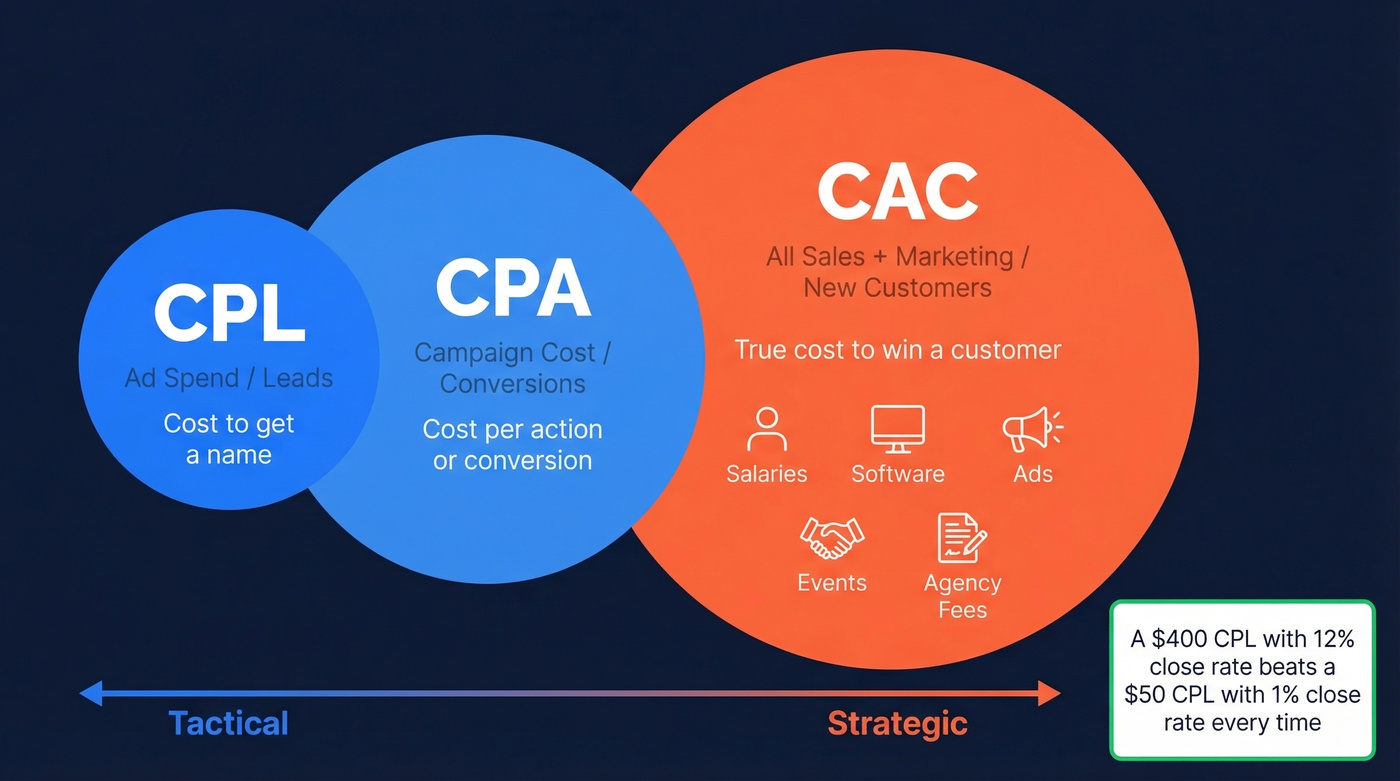
| Metric | Formula | What It Measures |
|---|---|---|
| CPL | Spend / Leads | Cost to get a name |
| CPA | Campaign Cost / Conversions | Cost per action/conversion |
| CAC | All Sales + Marketing / New Customers | Cost to win a customer |
CPL is tactical - it tells you how efficiently a campaign or channel generates interest. CPA is slightly broader, covering any defined conversion event. CAC is the strategic number, and it includes everything: salaries, software licenses, product demos, creative development, paid media, events, sponsorships, and agency fees.
Most teams obsess over CPL because it's easy to measure. But CPL without CAC context is like tracking batting average without looking at runs scored. A channel with a $400 CPL and a 12% close rate will produce cheaper customers than a channel with a $50 CPL and a 1% close rate.
Why Your Dashboard Lies About Lead Gen Costs
Most marketing dashboards show you ad spend divided by form fills. That number is incomplete. When you include the real inputs - CRM costs, landing page tools, SDR time, creative production, marketing ops overhead - actual CPL jumps 30-50% above what your dashboard reports.
Then there's the data quality problem. Invalid traffic and mis-clicks wasted roughly $72 billion in ad spend in 2024. That's the macro number. The micro version hits closer to home: if you buy a cheap list and don't verify it, bounces and outdated records quietly destroy your economics. You waste sends, burn domain reputation, and your SDRs spend hours chasing dead ends instead of talking to real buyers.
Here's the thing - data hygiene is a direct CPL lever. Verifying emails before you send at $0.01 per address is negligible compared to the expense of sending to bad data, tanking your sender reputation, and watching reply rates crater.


Bad data is the hidden line item inflating your CPL. Bounced emails, dead contacts, and burned domains silently add 30-50% to your real cost per lead. Prospeo's 5-step verification delivers 98% email accuracy at $0.01 per lead - so every dollar you spend on outreach actually reaches a real person.
Stop paying $237 per lead when verified contacts cost a penny.
Average CPL by Industry
The most detailed benchmark we've found comes from First Page Sage's 2026 report, covering data collected from January 2022 through June 2025 across 30 industries.
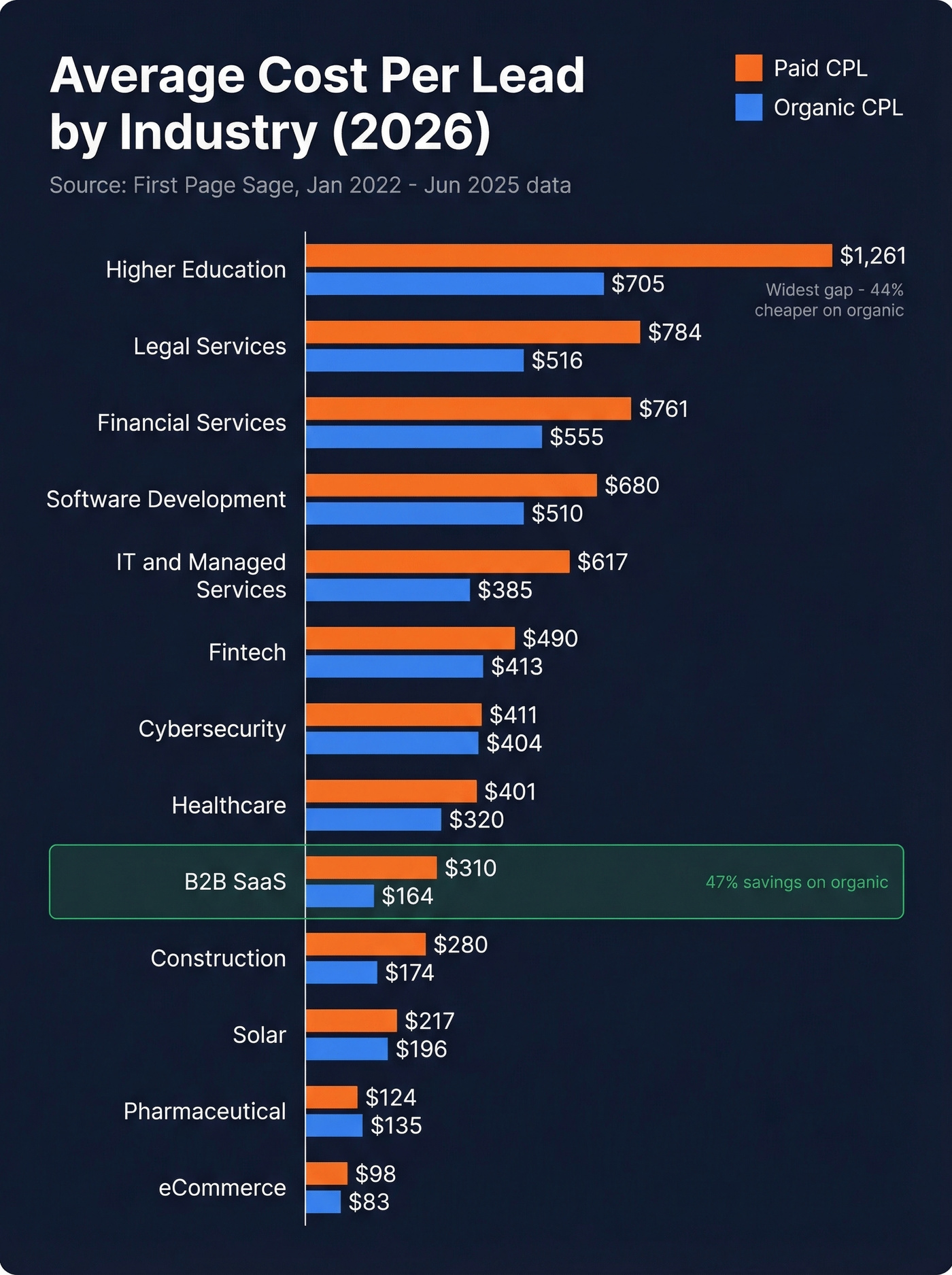
| Industry | Paid CPL | Organic CPL | Blended |
|---|---|---|---|
| Higher Education | $1,261 | $705 | $982 |
| Legal Services | $784 | $516 | $649 |
| Financial Services | $761 | $555 | $653 |
| Oil & Gas | $772 | $502 | $637 |
| Software Development | $680 | $510 | $591 |
| Transport/Logistics | $670 | $505 | $588 |
| Manufacturing | $691 | $415 | $553 |
| IT & Managed Services | $617 | $385 | $503 |
| Industrial IoT | $590 | $404 | $497 |
| Staffing & Recruiting | $476 | $518 | $497 |
| Fintech | $490 | $413 | $452 |
| Real Estate | $480 | $416 | $448 |
| Business Insurance | $460 | $388 | $424 |
| Cybersecurity | $411 | $404 | $406 |
| Healthcare | $401 | $320 | $361 |
| Aerospace/Aviation | $469 | $277 | $373 |
| PCB Design & Mfg | $480 | $271 | $376 |
| Addiction Treatment | $380 | $213 | $297 |
| Engineering | $371 | $201 | $287 |
| Automotive | $295 | $271 | $283 |
| Environmental Svcs | $346 | $207 | $278 |
| Hotels & Resorts | $308 | $224 | $266 |
| Biotech | $274 | $236 | $255 |
| B2B SaaS | $310 | $164 | $237 |
| Construction | $280 | $174 | $227 |
| Solar | $217 | $196 | $206 |
| Pharmaceutical | $124 | $135 | $131 |
| Entertainment | $116 | $111 | $114 |
| HVAC | $115 | $69 | $92 |
| eCommerce | $98 | $83 | $91 |
Higher Education has the widest paid-to-organic gap - $1,261 vs $705 - a 44% lower CPL on organic. Staffing & Recruiting is one of the rare industries where organic CPL ($518) exceeds paid ($476). And B2B SaaS shows a big organic discount: $164 organic vs $310 paid, a 47% savings on organic.
Cost Per Lead by Channel
Industry benchmarks tell you where you compete. Channel benchmarks tell you where to spend. These numbers come from Sopro's 2025 B2B benchmark report.
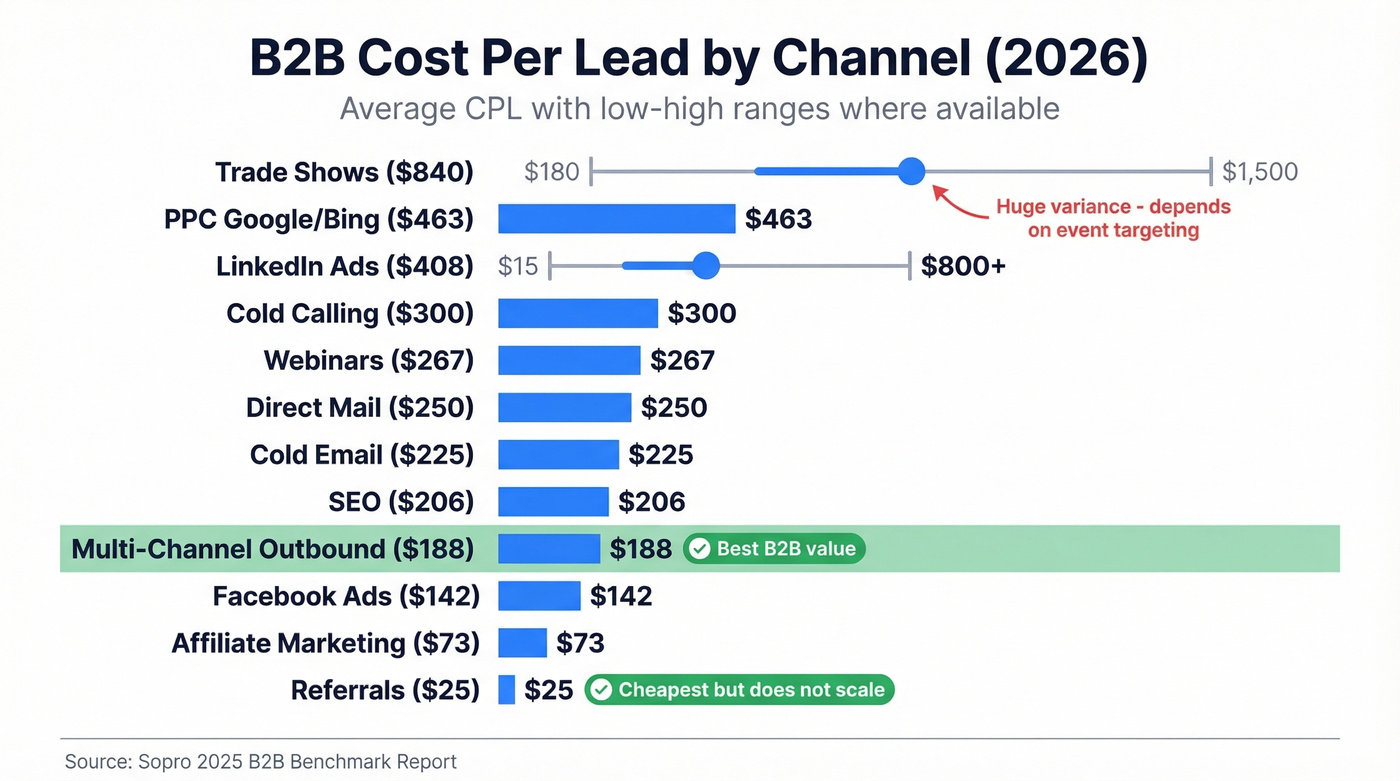
| Channel | Avg CPL | Low | High |
|---|---|---|---|
| Trade Shows | $840 | $180 | $1,500+ |
| PPC (Google/Bing) | $463 | $175 | $751 |
| LinkedIn Ads | $408 | $15 | $800+ |
| Cold Calling | $300 | - | - |
| Webinars | $267 | $33 | $500 |
| Direct Mail | $250 | - | - |
| Cold Email | $225 | $150 | $300 |
| SEO | $206 | $14 | $397 |
| Multi-Channel Outbound | $188 | $80 | $296 |
| Facebook Ads | $142 | $102 | $182 |
| Affiliate Marketing | $73 | $54 | $92 |
| Referrals | $25 | - | - |
Averages here are misleading. Trade shows range from $180 to over $1,500 per lead - the difference between a well-targeted niche conference and a massive expo where your booth gets lost in a sea of identical banners. LinkedIn Ads swing from $15 to $800+, which means the channel works brilliantly for some audiences and is a money pit for others.
The sweet spot for B2B outbound is multi-channel prospecting at $188 average, combining email, phone, and social touches into coordinated sequences. Referrals at $25 are the cheapest by far, but you can't build a pipeline on referrals alone. They don't scale predictably.
What Lead Gen Actually Costs to Run
In-House Tool Stack
Here's what a realistic in-house lead gen stack costs in 2026:
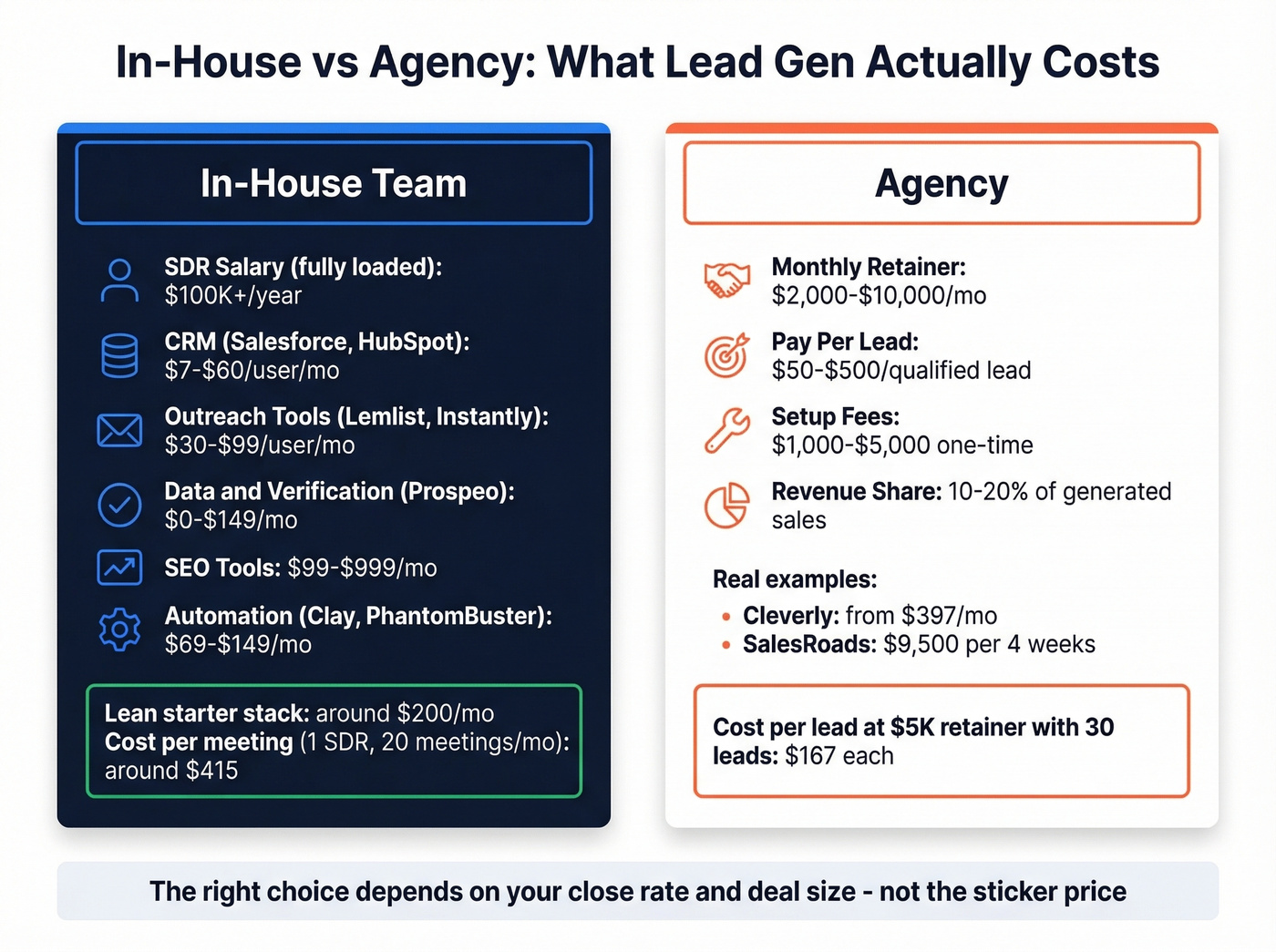
| Category | Tool Examples | Monthly Cost |
|---|---|---|
| CRM | Salesforce, HubSpot | $7-$60/user |
| Outreach | Lemlist ($99/user), Instantly | $30-$99/user |
| Data & Verification | Prospeo ($0.01/email, free tier), Apollo ($59/user) | $0-$149 |
| SEO | Ahrefs ($99+), Semrush ($119+) | $99-$999 |
| Marketing Automation | Mailchimp ($10+), ActiveCampaign ($15+) | $10-$300 |
| Automation | Clay ($149), PhantomBuster ($69) | $69-$149 |
A lean starter stack can stay around $200/month for a solo user if you pick one sequencer, keep your CRM simple, and use a tool like Prospeo for verified contact data - 75 free verified emails per month is enough to launch outbound for a small team without spending a dime on data.
We've seen teams spend $2,000/month on tools before they've sent their first campaign. Don't do that. Start lean, prove the channel works, then add tools as bottlenecks emerge.
Agency Pricing
| Model | Typical Range |
|---|---|
| Pay-per-lead | $50-$500/qualified lead |
| Monthly retainer | $2,000-$10,000/mo |
| Setup fees | $1,000-$5,000 |
| Revenue share | 10-20% of generated sales |
Agencies aren't overpriced - they're priced for companies that can't do the math themselves or need to ramp faster than hiring allows. A $5,000/month retainer that produces 30 qualified leads at $167 each is a great deal if those leads close at 10% into $25K deals. It's a terrible deal if your close rate is 1%.
For reference, agencies like Cleverly list plans starting at $397/month, while SalesRoads lists $9,500 per 4 weeks for appointment setting.
In-House Staffing
The average US SDR salary is $77,254/year. Add benefits, tools, management overhead, and office costs, and one SDR runs $100K+ fully loaded. If you assume that cost and 20 qualified meetings per month, your cost per meeting is roughly $415 - before any tools or data costs. Compare that to an agency charging $200 per qualified lead and the math gets interesting fast.
How to Calculate What You Should Spend
Here's the framework we use. Start with your customer lifetime value and work backward.
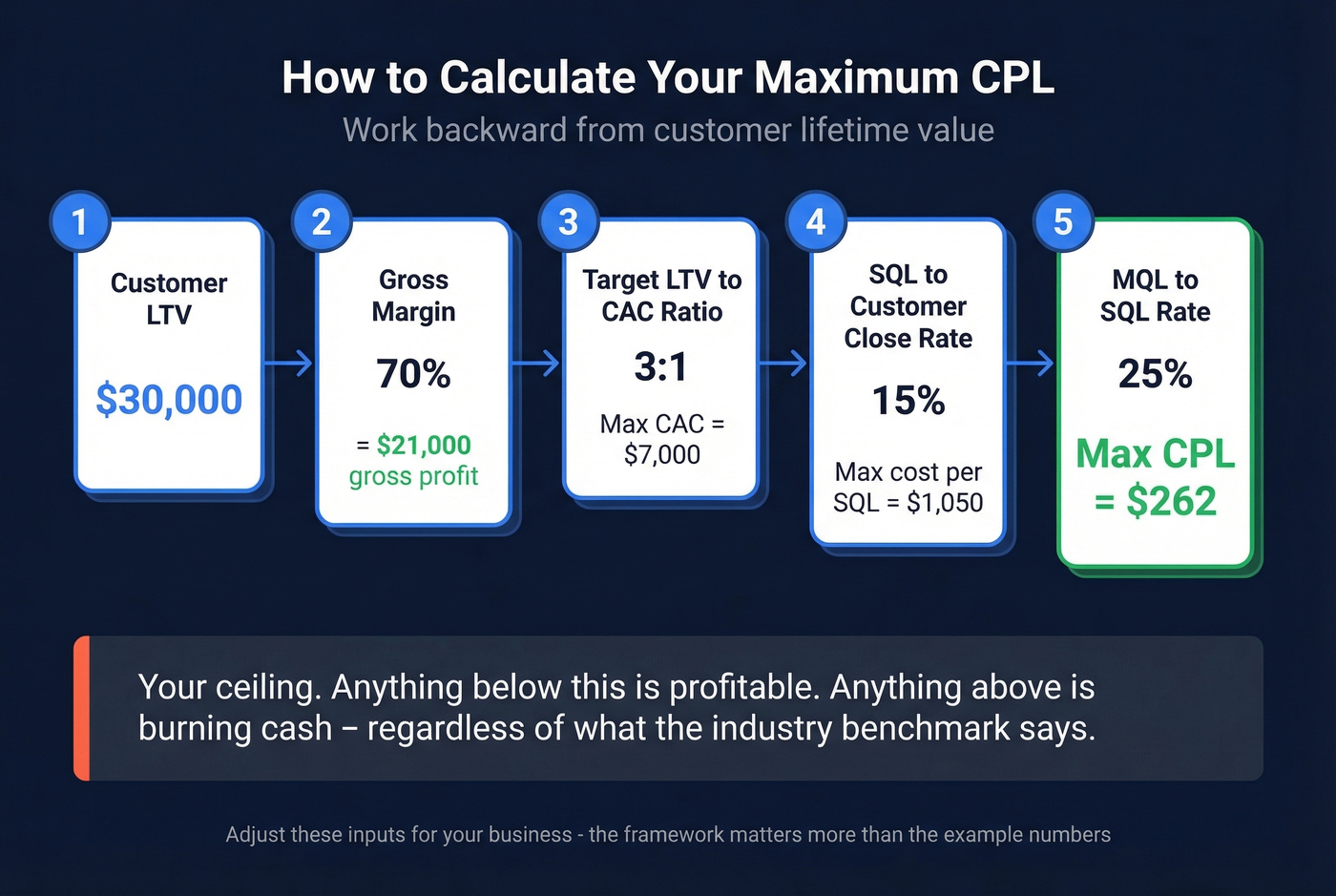
Say your average customer is worth $30,000 in LTV with 70% gross margin. That's $21,000 in gross profit per customer. If you're targeting a 3:1 LTV-to-CAC ratio, your maximum CAC is $7,000. If your close rate from SQL to customer is 15%, you can afford to pay up to $1,050 per SQL. And if 25% of your MQLs become SQLs, your max MQL CPL is $262.
That's your ceiling. Anything below it is profitable. Anything above it is burning cash - regardless of what the industry benchmark says.
Let's be honest: most teams never do this math. They benchmark against industry averages and call it a day. But a $500 CPL is cheap if your LTV is $200K, and a $50 CPL is expensive if your LTV is $2K. If you're selling deals under $15K, you probably don't need ZoomInfo-level data or enterprise agency retainers - a lean stack and disciplined outbound will outperform.
Stop optimizing CPL. Start optimizing cost per revenue dollar.
Factors That Drive CPL Up or Down
Not all lead generation expenses are created equal. Understanding what drives them gives you more control than any single tactic.
Invest in brand first. This is the long game most teams skip, and it's the single highest-leverage move you can make. 92% of B2B buyers start with a vendor already in mind, and the winning vendor is on the Day One shortlist 95% of the time. Forrester data shows 41% of buyers have a preferred vendor before they even begin formal evaluation, and the pre-contact favorite wins roughly 80% of deals. With the average B2B buying cycle running 10.1 months and first vendor contact not happening until 61% through the journey, your brand is doing the selling long before your SDR picks up the phone. Brand awareness doesn't show up in your CPL dashboard, but it drives every conversion metric downstream.
Retarget before you prospect cold. Retargeting conversions are cheaper than cold conversions. If you're spending on paid channels without retargeting pixels, you're leaving the cheapest conversions on the table.
Fix your landing pages. Even small improvements in conversion rate can materially drop CPL. Most B2B landing pages are cluttered with navigation, vague CTAs, and too many form fields. Strip them down.
Build multi-step funnels. Don't ask for a demo on the first touch. Offer something low-commitment - a calculator, a benchmark report, a short video - then nurture to the conversion.
Test short-form video creative. Short-form video often lowers CPL versus static images across paid channels. If you're still running the same carousel ads from two years ago, you're overpaying.
Clean your data before you send. Bounced emails, stale contacts, and wrong numbers inflate your CPL invisibly. Every email that bounces is money spent on nothing. Verify before you send - always.
Multi-channel outbound hits the CPL sweet spot at $188 average - but only if your contact data connects. Prospeo gives you 300M+ profiles with 30+ filters, 125M+ verified mobiles, and a 7-day data refresh cycle so your lists never go stale. Teams using Prospeo book 35% more meetings than Apollo users.
Build outbound lists that actually convert - starting free.
FAQ
How much does lead generation cost?
Lead generation costs range from under $100 per lead in eCommerce and HVAC to nearly $1,000 in higher education and legal services. The true cost depends on your industry, channel mix, sales cycle length, and how you define a "lead." Use the LTV-to-CAC framework above to determine what you should spend rather than relying on averages alone.
What's a good cost per lead?
A "good" CPL is any number that keeps your LTV-to-CAC ratio at 3:1 or better. A $500 lead that converts at 20% into a $50K deal is far better than a $20 lead that never responds. Benchmark against your own unit economics, not industry averages.
How do you calculate lead generation costs?
Divide total marketing spend - including software, labor, creative production, and overhead - by the number of leads generated. Most companies only count ad spend and undercount by 30-50%, meaning their real CPL is significantly higher than what dashboards show.
Is it cheaper to generate leads in-house or through an agency?
In-house is usually cheaper per lead at scale - a basic tool stack starts around $200/month. Agencies ($2,000-$10,000/month retainers) make sense when you lack expertise or need to ramp quickly. Calculate your specific close rates and deal sizes before deciding; a $5,000 retainer producing 30 leads at a 10% close rate into $25K deals pays for itself.
How can I reduce my cost per lead without sacrificing quality?
Verify contact data before sending to eliminate wasted sends, retarget warm visitors before prospecting cold, optimize landing page conversion rates, and use multi-channel sequences instead of single-channel campaigns. Teams that fix data quality alone typically see CPL drop 15-30% from reduced bounces and higher deliverability.