

Customer Objection Handling: What 300M+ Sales Calls Actually Reveal
A RevOps lead we know ran a call recording audit last quarter. Her team's top closer and worst performer hit the same objections - almost word for word. The difference wasn't what prospects threw at them. It was what happened in the three seconds after.
Analysis of 300M+ cold calls confirms this pattern: the top 5 objections account for 74% of all objections. Master a small set of responses, and you've covered most of what you'll ever face on the phone.
The Three Buckets Every Objection Falls Into
Almost every objection from a customer lands in one of three categories:
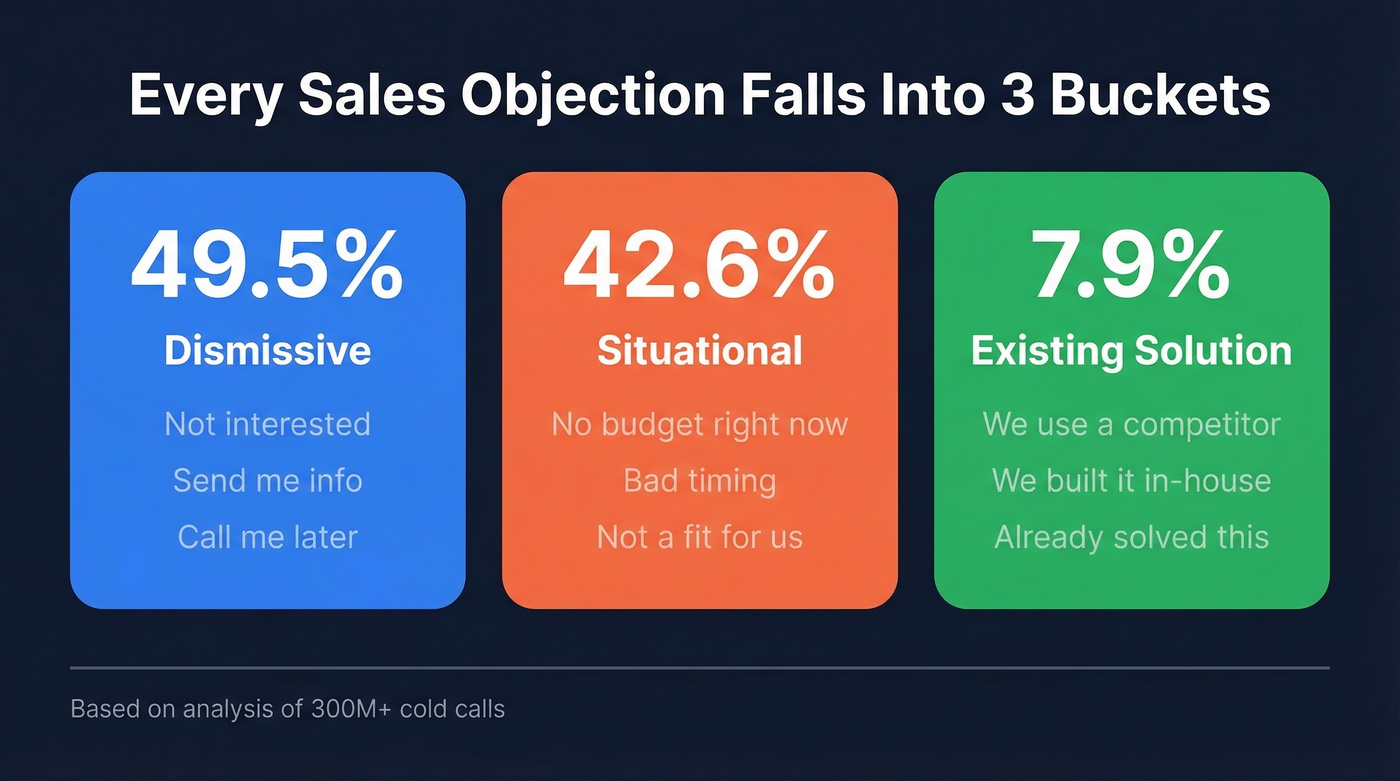
- Dismissive (49.5%) - "Not interested," "Send me info," "Where'd you get my number?"
- Situational (42.6%) - "No budget," "Bad timing," "Not a fit"
- Existing solution (7.9%) - "We already use [competitor]," "We built it in-house"
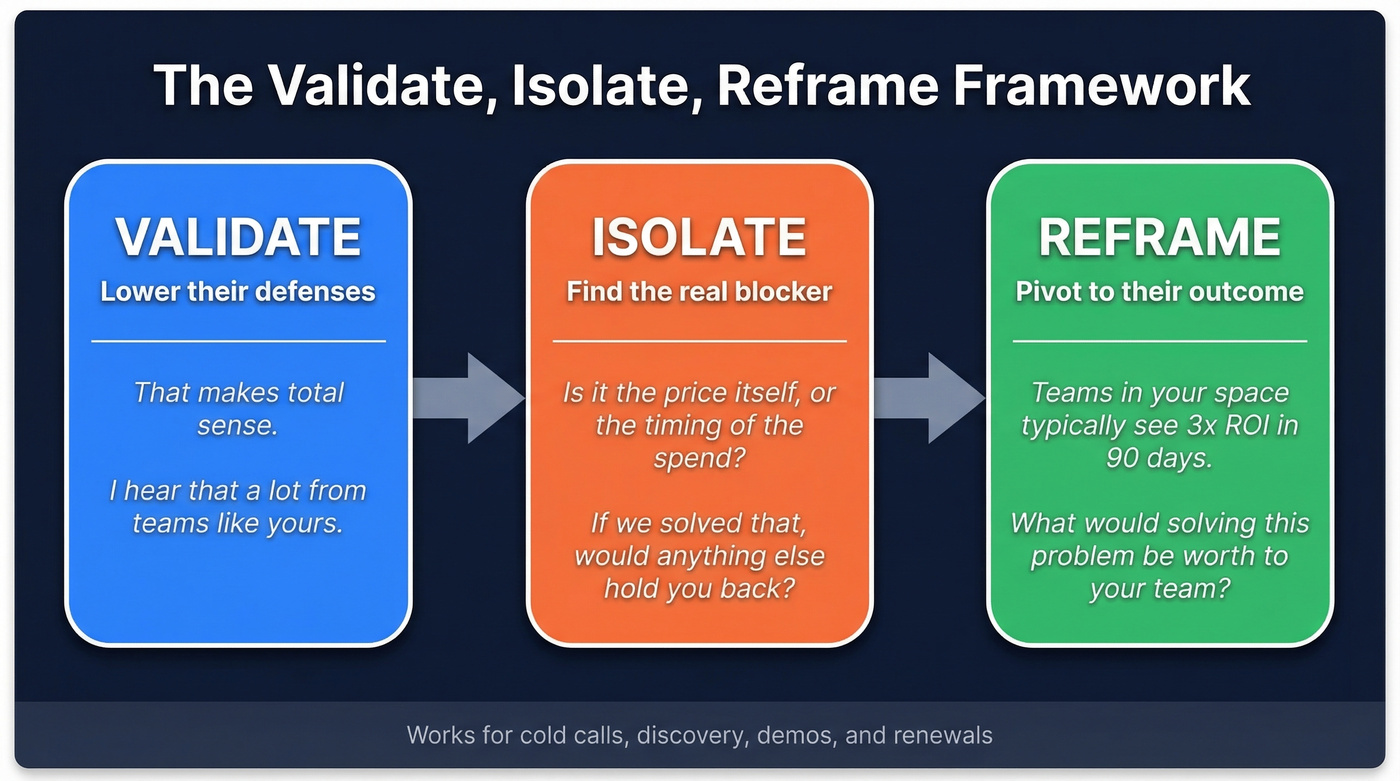
One framework covers all three: Validate, Isolate, Reframe. We'll break down scripts for price, competitor, timing, authority, feature gaps, and brush-offs. Then we'll get into the upstream fix that prevents half these objections from happening in the first place.
What Objection Handling Actually Is
Objection handling is the skill of responding to a prospect's concern in a way that moves the conversation forward rather than ending it. Not persuasion tricks. Not pressure tactics. Listening, understanding the real issue, and reframing around value.
One distinction that matters: objections aren't obstructions. An objection signals uncertainty - "I'm not sure this solves our problem." An obstruction is an excuse to end the conversation - "I don't have time for this." Objections deserve exploration. Obstructions deserve brevity and a reason to stay.
Most customer objections in sales map cleanly to BANT: Budget, Authority, Need, Timing. Recognizing which bucket you're in tells you which script to reach for. Top reps lean on openers like "Help me understand..." to quickly surface what's actually underneath the first pushback.
The Data Behind the Three Types
The 300M-call dataset breaks every objection into three categories. This isn't theoretical - it's what actually happens on the phone.
| Category | Share | Common Examples |
|---|---|---|
| Dismissive | 49.5% | "Not interested," "Send info," "Call later" |
| Situational | 42.6% | "No budget," "No bandwidth," "Not a fit" |
| Existing solution | 7.9% | "We use [competitor]," "Built in-house" |
Nearly half of all objections are dismissive - the prospect isn't engaging with your value prop at all. They're trying to get off the phone. That's why frameworks that start with "acknowledge the concern" often fail on cold calls. There's no concern to acknowledge. Just a reflex.
Persistence matters more than most reps think. Research summarized by Invesp shows 60% of customers say no four times before saying yes, and 80% of sales require five or more follow-ups. Yet 48% of agents give up without attempting one follow-up. The gap between "good at handling objections" and "actually closes deals" is often just willingness to come back.
Methods of Handling Customer Objections
There are at least seven named frameworks floating around sales enablement. Here's how they compare so you can pick one and stop overthinking it.
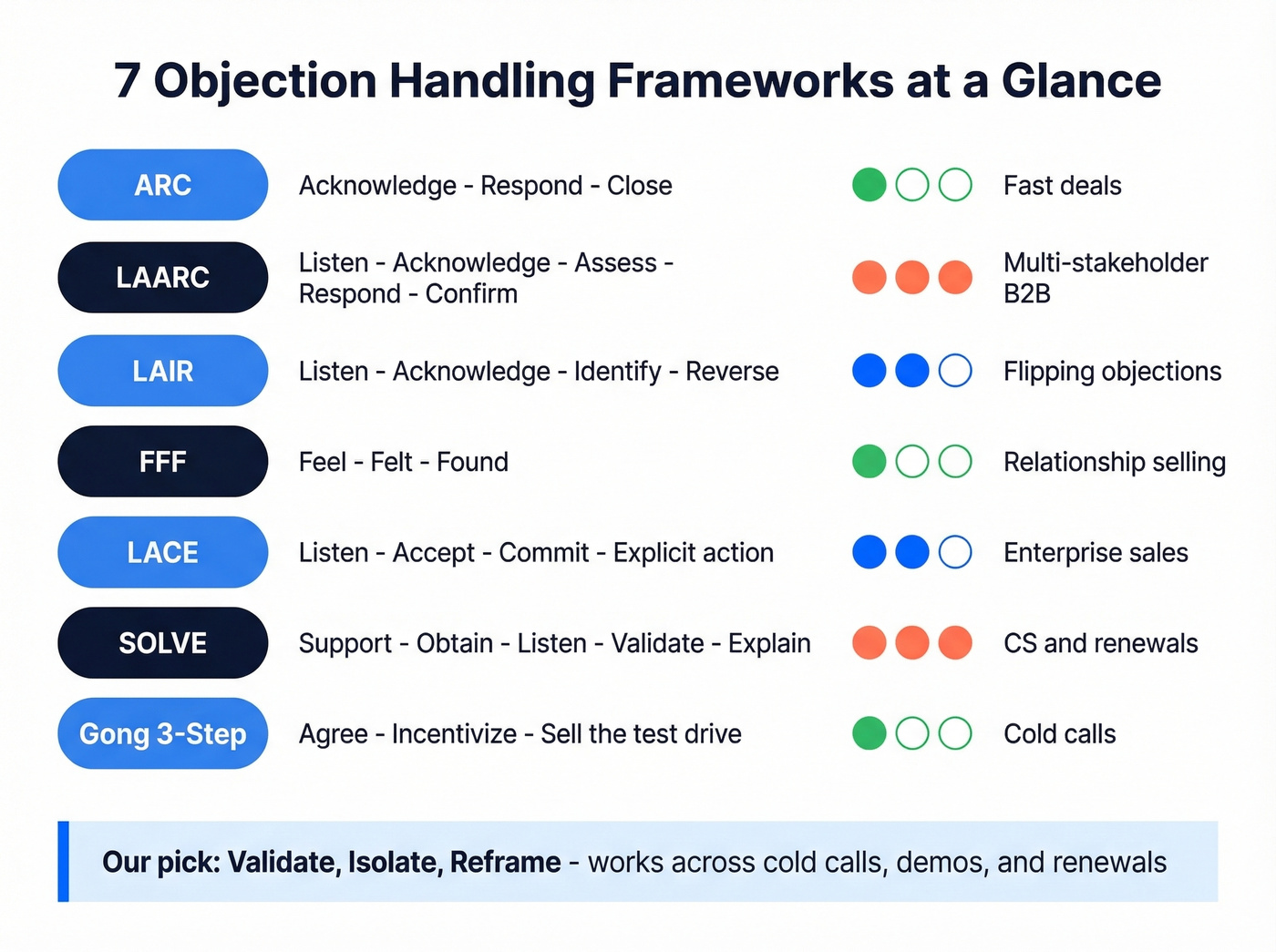
| Framework | Steps | Best For | Complexity |
|---|---|---|---|
| ARC | Acknowledge, Respond, Close | Fast transactional deals | Low |
| LAARC | Listen, Acknowledge, Assess, Respond, Confirm | Multi-stakeholder B2B | High |
| LAIR | Listen, Acknowledge, Identify, Reverse | Flipping objections into selling points | Medium |
| FFF | Feel, Felt, Found | Relationship selling | Low |
| LACE | Listen, Accept, Commit, Explicit action | Structured enterprise sales | Medium |
| SOLVE | Support, Obtain, Listen, Validate, Explain | CS and renewal conversations | High |
| Gong 3-Step | Agree, Incentivize, Sell the test drive | Cold calls specifically | Low |
Let's be honest: most reps who try to learn multiple frameworks end up using none. Our recommendation is Validate, Isolate, Reframe. It's the simplest structure that works across cold calls, demos, and renewals. Validate the concern ("That makes sense"), isolate the real issue ("Is it the price itself, or the timing of the spend?"), then reframe around the outcome they care about. The Gong 3-step cold call variant is essentially the same idea tuned for outbound - agree to lower defenses, give them a reason to keep talking, then sell the meeting, not the product.

Most objections start upstream - with bad data. When 35% of your emails bounce and calls hit dead numbers, you never get the chance to handle objections at all. Prospeo's 98% email accuracy and 30% mobile pickup rate mean your reps actually reach decision-makers who can say yes.
You can't overcome objections if your data never gets you on the phone.
Scripts That Actually Work
These scripts follow the Validate, Isolate, Reframe structure and cover the scenarios reps face most when they need to handle customer objections in real time. Adapt the language to your voice, but keep the bones.
Price and Budget
"It's too expensive."
"That's fair - budget matters. Quick question: if price weren't the issue, is this the solution you'd choose to solve [specific problem]?" If yes, you've isolated price as the only blocker and can walk an ROI model. If no, the real objection is something else entirely.
Here's a stat worth keeping in your back pocket: introducing pricing on the first call can increase win rates by 10%. Most reps avoid it. Lean in instead.
"We don't have budget right now."
"Totally get it. What's going to change between now and next quarter that makes this a better time?" This forces them to articulate whether the budget issue is real or a brush-off. Teams shift funds mid-cycle when they see clear ROI - Highspot's playbook recommends mapping impact to help them build the internal case.
Competitor and Status Quo
"We already use [competitor]."
Here's what a bad response looks like versus a good one:
❌ "Oh, we're way better than them. Let me tell you why."
✅ "Nice - [competitor] does [specific strength] well. Does their package include onboarding support, analytics, and ongoing account management, or are those separate?"
Don't trash the competitor. Validate their choice, then open a door to a gap - total value, not feature-by-feature sniping. The reframe around what's included versus what costs extra works because buyers rarely calculate the full cost of their current stack.
"We built it in-house."
"That's impressive. Who supports the internal tool when your dev team gets pulled onto a product launch?" The maintenance angle is the wedge. In-house solutions always have an ownership cost that's invisible until it isn't.
Timing and Authority
"Call me next quarter."
"Happy to. What specifically is happening next quarter that makes it better timing?" If they can't answer, the timing objection is a polite brush-off, and you should pivot to value. Short silence after this question tells you everything.
"I need to run this by my boss."
This one plays out as a dialogue:
Prospect: "I need to run this by my boss." You: "Of course. What questions do you think they'll throw at you that we haven't covered?" Prospect: "Probably the ROI and implementation timeline." You: "Let me build you a one-pager with both. Or I can join the call - sometimes it's easier than playing telephone."
Your job is to arm your champion, not hope they sell it for you.
Feature Gaps
"You don't have [feature]."
"You're right - we don't. What we do instead is [alternative approach]. For the teams using us, that's actually been a better fit because [reason]. But how critical is [feature] to your day-to-day workflow?" Sometimes the feature they're asking about is a nice-to-have they saw on a competitor's pricing page. Sometimes it's a dealbreaker. This question tells you which.
Brush-Offs and Ghosting
"Just send me an email."
"Sure - what one thing would you need to see in that email to make it worth reading?" This reframes a dismissal into a micro-commitment. If they give you an answer, you've got a hook.
"Not interested."
"Totally fair. Most [title] I talk to aren't - until they hear how [similar company] cut [specific metric] by [number]. Would 30 seconds on that be worth it?" You're not arguing. You're offering a reason to stay for half a minute.
Prospect goes silent.
"Hey [name], I know things get busy. I don't want to keep following up without adding value. If the timing's off, just say the word and I'll close this out." Giving them an easy out paradoxically increases response rates. Nobody wants to feel chased.
Responding by Deal Stage
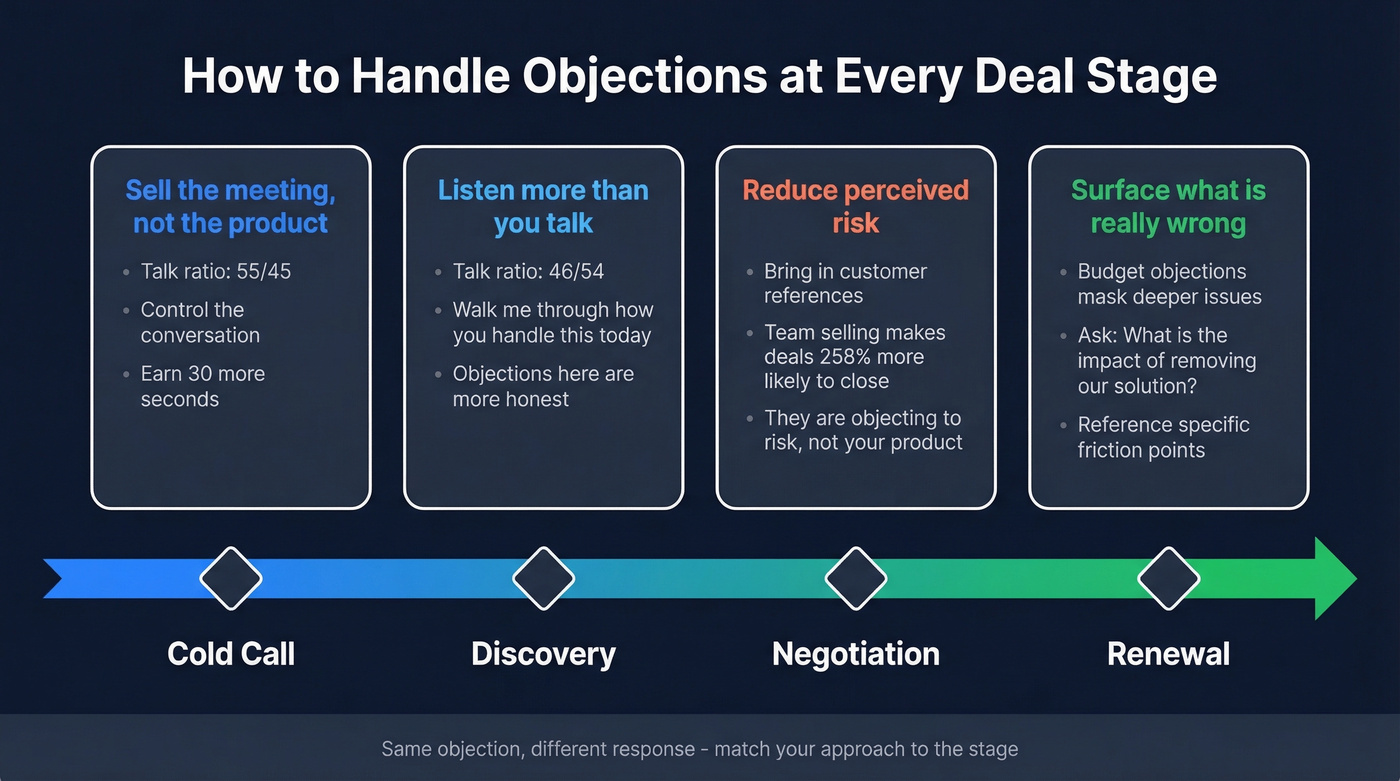
The same objection requires a completely different response depending on where you are in the sales cycle.
Cold Calls
On cold calls, you're selling the meeting, not the product. Call analysis shows successful cold calls have a 55/45 talk-to-listen ratio - higher than you'd expect. That's because cold calls aren't discovery. You need to control the conversation, state why you're calling (2.1x higher success rate), and earn 30 more seconds.
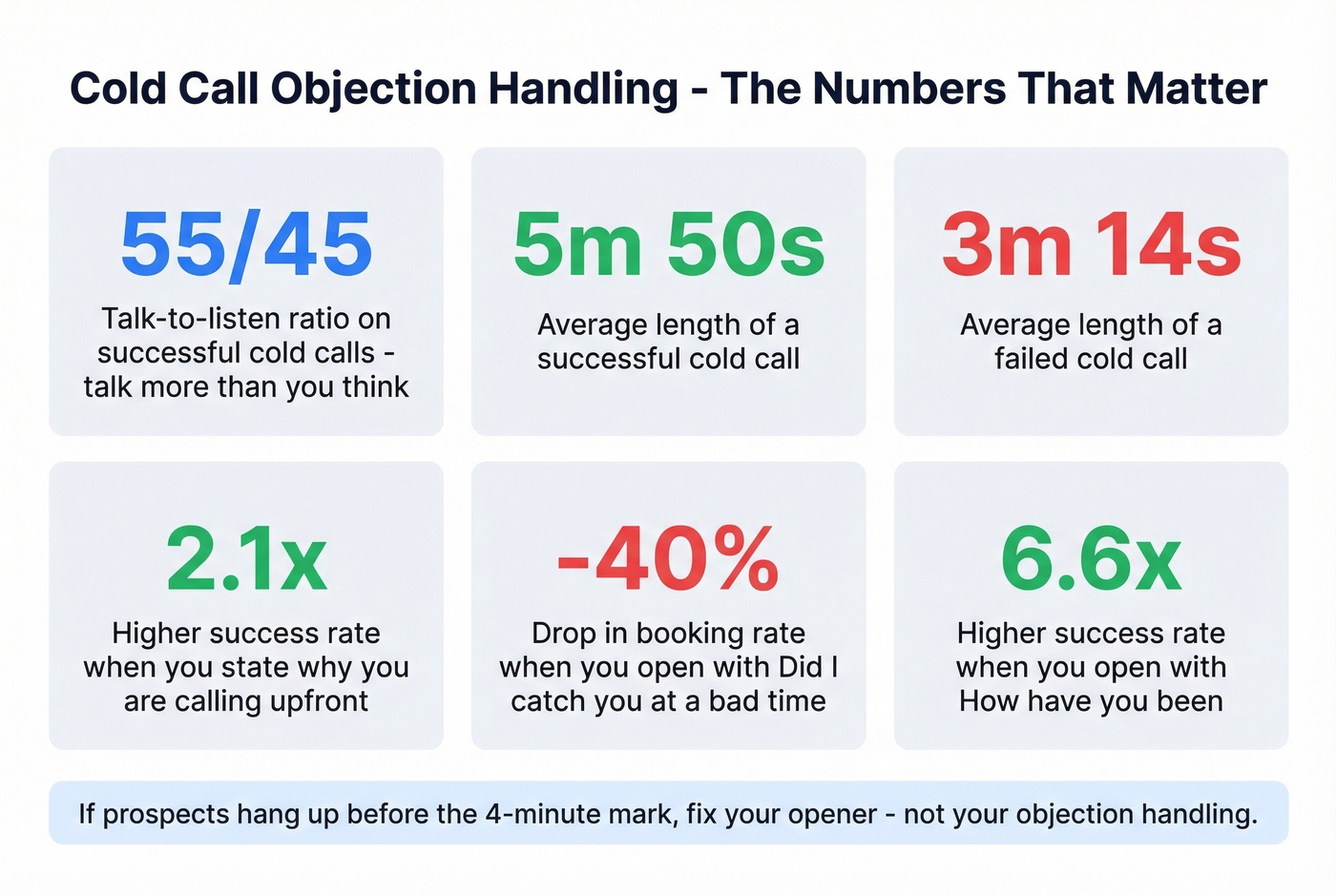
Successful cold calls average 5 minutes 50 seconds versus 3 minutes 14 seconds for failed ones. If you're getting hung up before the four-minute mark, your opener is the problem, not your objection handling.
What you say first swings your success rate by 40% or more. "Did I catch you at a bad time?" decreases meeting-booking chances by 40%. "How have you been?" produces a 6.6x higher success rate. And if a prospect snaps "Where'd you get my number?" - that's not really an objection. That's a data quality problem we'll address below.
Discovery and Demo
The ratio flips here. Top reps talk about 46% of the time during discovery - the rest is listening. "Walk me through how you're handling this today" beats "Don't you think our solution is better?" every single time.
When objections come up in demos, they're usually more specific and more honest than cold-call pushback. A prospect saying "I'm not sure this integrates with our stack" is giving you something real to work with.
Negotiation
Late-stage objections are about risk reduction, not information gathering. Social proof carries enormous weight - team selling makes deals 258% more likely to close. Bring in a customer reference, a technical resource, or an executive sponsor. The prospect isn't objecting to your product anymore. They're objecting to the risk of making a wrong decision.
Renewals
In CS conversations, budget objections almost always mask something else. ChurnZero recommends a direct prompt: "What else is bugging you?" Reference specific friction points - ticket volume, feature requests that haven't shipped, adoption gaps. Then use impact questions: "What's the impact of removing our solution?" These surface the real stakes and give you something concrete to act on.
The Upstream Fix Most Teams Miss
Look, here's the thing most sales content won't tell you: the best approach to customer objection handling is preventing the objection from ever happening. And most sales teams are hemorrhaging time on objections they created themselves through bad data.
Reps lose 27.3% of their time due to bad contact data. B2B data decays at 2.1% per month - that's 22.5% of your database going stale every year. The cost isn't abstract: poor data quality costs organizations an average of $12.9 million per year.
When a rep calls a dead number, reaches the wrong person, or triggers a "How did you get my info?" reaction, no framework saves that conversation. The objection was baked in before the dial.
We've seen the biggest gains come from objection prevention: reaching the right person with current contact details so the conversation can actually start. When Meritt switched to Prospeo for contact verification, their bounce rate dropped from 35% to under 4% and their connect rate tripled to 20-25%. That's not a rebuttal improvement - it's a list-quality improvement that eliminated an entire category of pushback before reps ever picked up the phone.
Before every call block, verify your list. Upload a CSV, flag invalid emails and disconnected numbers, and only dial contacts that are current. The "Where'd you get my number?" objection disappears when you're reaching the right person at a number they actually use.
Authority objections like 'I need to run this by my boss' happen when you're pitching the wrong person. Prospeo's 30+ search filters - including job title, department, and seniority - let you skip the gatekeeper and land directly on the decision-maker's line.
Stop handling authority objections. Start calling the authority.
How to Practice
Knowing frameworks and scripts is table stakes. Internalizing them so they fire automatically under pressure is the actual skill. Sellers who practiced role-playing before live calls saw 20-45% higher win rates than those who didn't, and 43% of sales enablement leaders now use AI-powered role play to scale coaching beyond what managers can cover.
Practice also teaches you when to walk away. If a prospect cycles through budget, timing, and authority objections with no new information surfacing, that's not an objection problem - it's a misalignment signal. Skip the fifth follow-up. The best reps recognize this and step back rather than burning cycles on a deal that was never real. Learning to overcome customer objections matters, but knowing when to disengage is equally valuable.
The reps who win aren't the ones with the best rebuttals. They're the ones who practiced five responses until they didn't have to think anymore.
FAQ
What are the most common customer objections?
Analysis of 300M+ calls shows 49.5% are dismissive ("not interested"), 42.6% are situational (budget, timing, fit), and 7.9% involve an existing solution. The top 5 specific objections account for 74% of all pushback reps encounter.
What's the best objection-handling framework?
Validate, Isolate, Reframe works across cold calls, demos, and renewals because it forces you to find the real issue before responding. It adapts to any deal stage with minimal modification - one framework instead of seven.
How many follow-ups before a prospect says yes?
60% of customers say no four times before saying yes, and 80% of sales need five or more follow-ups. Yet 48% of agents give up without attempting even one follow-up - persistence alone separates closers from the rest.
Can bad data cause more objections?
Absolutely. B2B data decays at 2.1% per month, and reps lose over a quarter of their time to bad contact info. Verifying your list before every call block eliminates "wrong number" and "who is this?" objections before they happen - the consensus on r/sales is that list quality matters more than any script.