

Data Intelligence Platform: What It Costs and Which Type You Need in 2026
Your CTO just told the data team to "build a data intelligence platform" after reading a Databricks blog post. Nobody in the room agrees on what that means. The VP of Engineering thinks it's a lakehouse. The head of governance thinks it's a catalog. The RevOps lead thinks it's about contact data accuracy. They're all partially right, which is the problem.
The term means whatever the vendor selling it needs it to mean. IDC estimates roughly 90% of enterprise data is unstructured, AI is eating every roadmap, and the tooling market spans everything from open-source metadata catalogs to $500k/year unified analytics platforms. The confusion isn't accidental - it's profitable for vendors.
What You Need (Quick Version)
| Your Pain Point | Platform Type | Price Range |
|---|---|---|
| Enterprise AI + lakehouse | Databricks | $50k-$500k+/yr |
| Governance-first | Collibra or Informatica | $100k-$200k+/yr |
| Fast catalog, mid-market | Secoda | ~$500/mo |
| B2B contact data accuracy | Prospeo | Free tier; ~$0.01/email |
| Budget + engineering team | DataHub / OpenMetadata | Free (self-hosted) |
If none of those match, keep reading - the taxonomy below will help you figure out which type you actually need.
What Does "Data Intelligence" Actually Mean?
Databricks popularized the term to describe a new generation of unified platforms that "deeply understand an organization's data" through GenAI. The idea is that AI analyzes not just your data, but your metadata, usage signals, queries, reports, and lineage to learn your enterprise's semantics. That learned understanding then powers natural language access, semantic cataloging, automated optimization, and enhanced governance.
The concept is sound - and increasingly necessary. But it's also a vendor-captured term, and that matters when you're evaluating tools.
How It Differs from BI
The distinction from business intelligence is real, even if it's overstated in marketing. BI tools visualize historical data for reporting. A data intelligence platform uses AI to understand data semantics, automate governance, and enable natural language access across an organization's entire data estate. BI sees a slice of workloads; a true intelligence layer sees lineage, usage patterns, and upstream context that BI tools never touch.
The Category Problem
Dozens of vendors now call themselves data intelligence solutions - from metadata catalogs to governance suites to contact data providers. BARC lists everything from Atlan to AWS Glue under this umbrella. When a category label applies to everything, it describes nothing.
Let's break it into types that actually help you buy.
Five Types You'll Encounter
The data catalog market alone is projected to grow from $2.47B (2025) to $9.77B by 2032 at 21.7% CAGR, according to Fortune Business Insights. The broader Data and Decision Intelligence market is even larger - valued at $12.5B and projected to reach $28.3B by 2034 at 9.7% CAGR. But "data intelligence" spans far more than catalogs. Here are the five types, mapped to the problem each one solves.
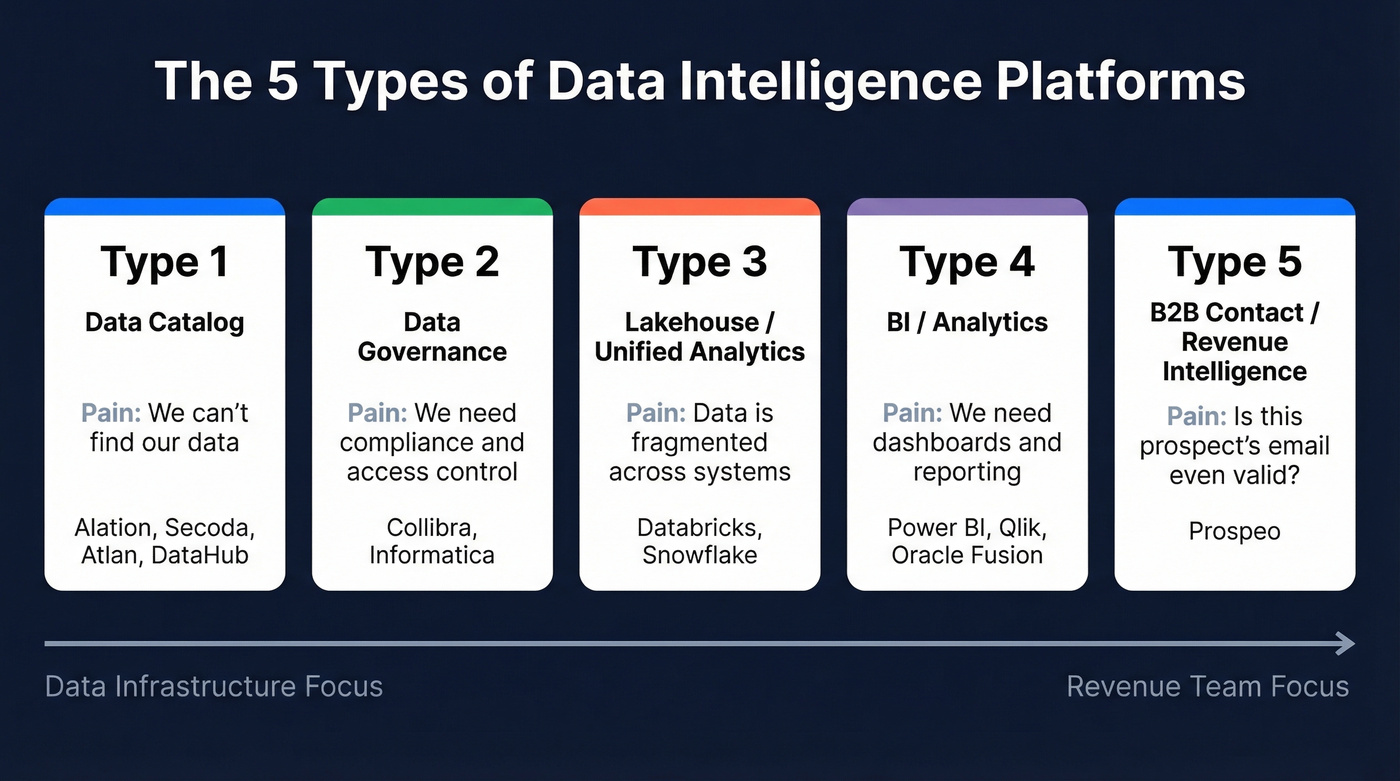
Type 1: Data Catalog. The pain is "we can't find our data." Catalogs create a searchable metadata repository so teams can discover, understand, and trust data assets. Think Alation, Secoda, Atlan, or open-source options like DataHub.
Type 2: Data Governance. The pain is "we need compliance, access control, and policy enforcement." Governance platforms manage quality, security, lineage, and responsible use across the data lifecycle. Collibra and Informatica IDMC dominate here.
Type 3: Lakehouse / Unified Analytics. The pain is "our data is fragmented across warehouses, lakes, and ML pipelines." A lakehouse unifies query, governance, and AI workloads on one platform. Databricks and Snowflake are the headliners.
Type 4: BI / Analytics Platform. The pain is "we need dashboards and reporting." You're looking at traditional BI with increasingly AI-powered features. Oracle Fusion, Power BI, and Qlik fit here - though calling them "data intelligence" is a stretch.
Type 5: B2B Contact / Revenue Intelligence. For revenue teams, "data intelligence" means knowing your prospect's email is valid before you hit send. A platform in this category delivers intent signals, verified mobiles, and enrichment that doesn't decay in a week.
Here's the thing: figure out which type matches your actual pain before you start evaluating vendors. We've seen teams spend six months evaluating governance platforms when their real problem was catalog discovery.
Top Platforms Compared
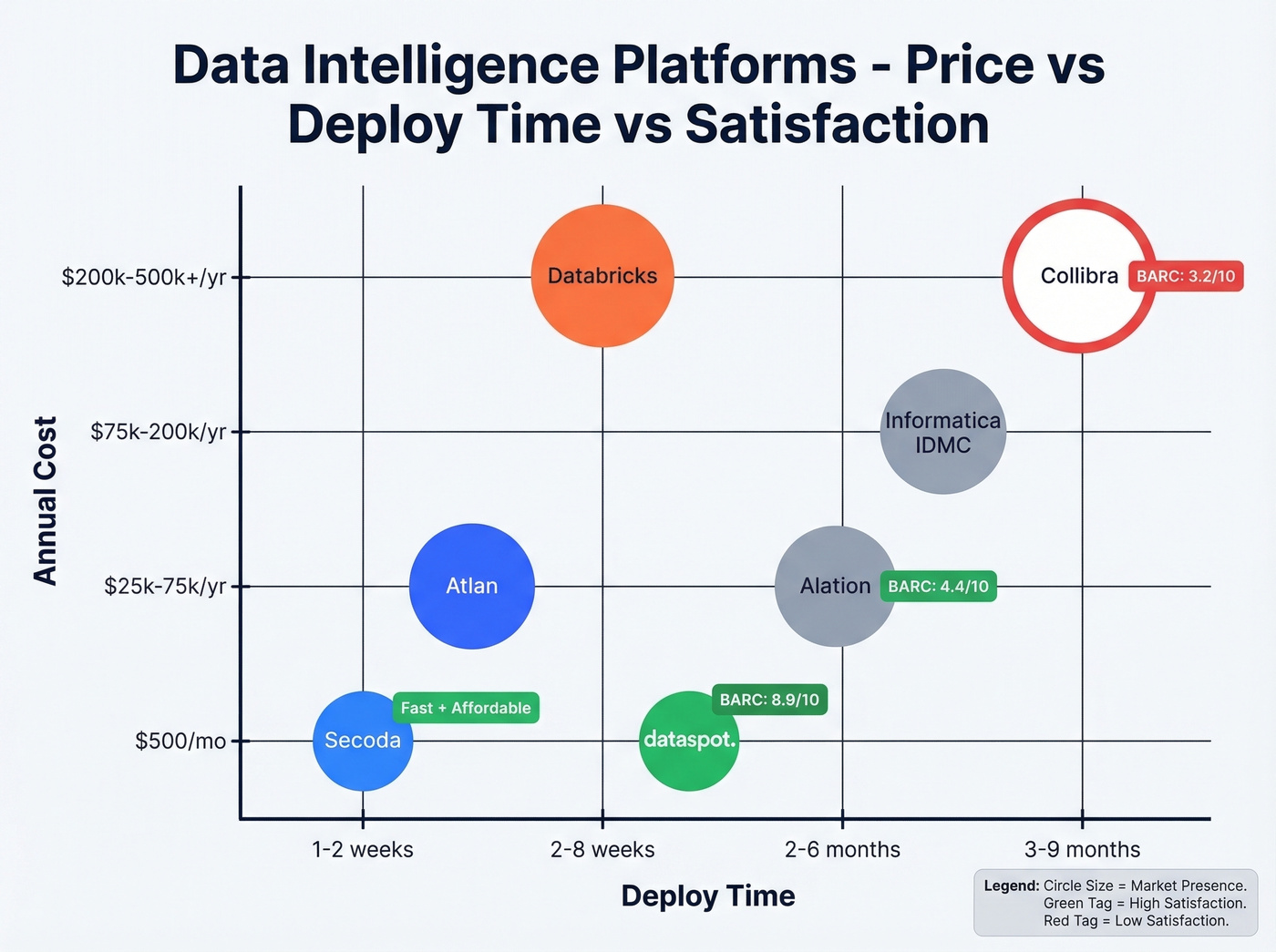
| Platform | Type / Best For | Price Range | BARC Score | Deploy Time |
|---|---|---|---|---|
| Databricks | Lakehouse / AI-first | $50k-$500k+/yr | N/A | Weeks-months |
| Collibra | Governance / regulated | $100k+/yr | 3.2/10 | 3-9 months |
| Secoda | Catalog / mid-market | ~$500/mo | N/A | 1-2 weeks |
| Alation | Catalog / enterprise | $75k-$200k/yr | 4.4/10 | 2-6 months |
| Atlan | Catalog / modern alt | $30k-$100k/yr | N/A | 2-8 weeks |
| Informatica IDMC | Integration + governance | $50k-$200k+/yr | N/A | 3-9 months |
| dataspot. | High satisfaction | $25k-$75k/yr (est.) | 8.9/10 | 2-8 weeks |
Databricks
Databricks coined the "lakehouse" concept, and their vision is the closest to the original idea - AI that learns your enterprise semantics from metadata, queries, and usage patterns. If you're already on Spark/Delta Lake and want a unified platform for analytics, ML, and governance with AI-native features baked in, this is the default choice.
Consumption-based pricing means you pay for what you use, but that flexibility cuts both ways. A mid-market deployment runs $50k-$150k/year; large enterprises with heavy compute easily hit $500k+. We've talked to teams that started at $80k and crept past $300k within 18 months as usage expanded across departments.
Skip this if your primary need is governance or cataloging without heavy analytics workloads. You'd be paying for a lakehouse you don't need. Teams that just want to find and govern their data are better served by a purpose-built catalog.
Collibra
Collibra is a market leader in governance, and its feature depth for compliance-heavy environments is genuinely deep. If you're in a regulated industry - financial services, healthcare, pharma - where governance isn't optional and you need policy enforcement, lineage, and stewardship workflows, Collibra belongs on the shortlist.
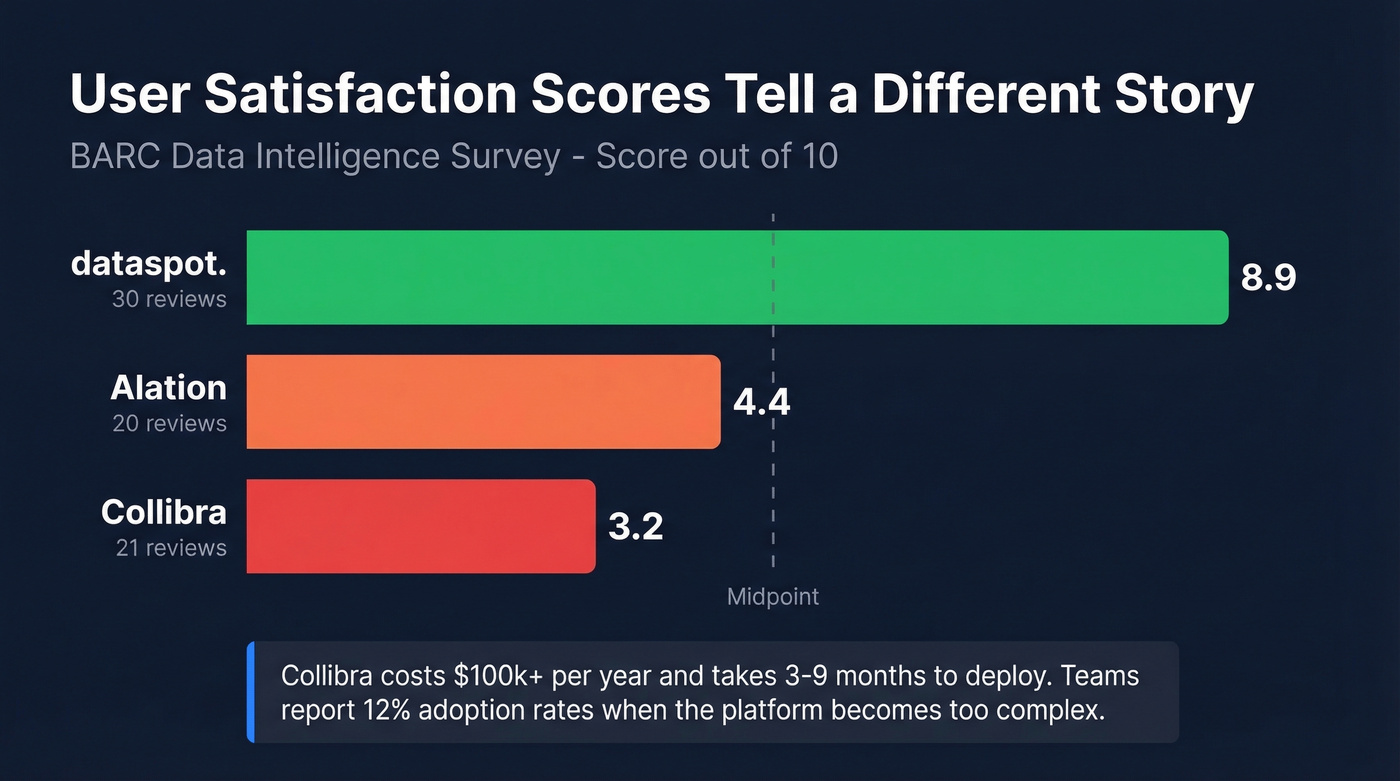
But here's the problem: Collibra's BARC satisfaction score is 3.2 out of 10 across 21 reviews. That's alarming for a platform that typically runs $100k+/year and takes 3-9 months to deploy. In real deployments, complexity and learning curve are the adoption killers. We've watched teams spend $150k and end up with 12% adoption because the platform became an expensive filing cabinet nobody wanted to open. For contrast, dataspot. scores 8.9/10 across 30 reviews - a staggering gap.
Collibra is the Salesforce of data governance. It can do everything, but most teams will only use 20% of it, and they'll resent the other 80%.
Secoda: Two Weeks to Production
Secoda deploys in 1-2 weeks. For small and mid-market data teams, this speed advantage matters more than any feature comparison. It costs roughly $500/month, has a modern UI that doesn't require a dedicated data steward, and is the obvious choice for teams under 50 people who need discovery and documentation without enterprise governance overhead.
Where it falls short: deep governance workflows, complex policy enforcement, and regulatory compliance features. Secoda isn't trying to be Collibra. That's a feature, not a bug - until your compliance team says otherwise.
Other Notable Platforms
Alation is the enterprise catalog incumbent with strong metadata management and solid search. Pricing typically lands in the $75k-$200k/year range, and its BARC satisfaction score of 4.4/10 (20 reviews) suggests the same adoption challenges that plague most enterprise governance tools.
Atlan positions itself as a modern alternative - faster to deploy (2-8 weeks), more intuitive UI, and typically priced at $30k-$100k/year. Worth evaluating if Collibra's complexity gives you pause.
Informatica IDMC is a strong option for organizations with deep legacy integration needs. If you're connecting dozens of on-prem and cloud sources with complex transformation requirements, Informatica's integration engine is battle-tested. Typical spend lands in the $50k-$200k+/year range with 3-9 month deployments.
Oracle Fusion fits organizations already in the Oracle ecosystem. A Nucleus Research case study showed 641% ROI at a global investment bank - impressive, though single-vendor case studies always deserve context. Pricing typically runs $30k-$200k/year.
OvalEdge fills a gap between Secoda and enterprise tools at $25k-$100k/year. Mid-market teams that need more governance than Secoda offers but can't justify Collibra's price tag should look here.
BigID focuses on privacy and compliance - data discovery, classification, and rights management. If GDPR/CCPA compliance is your primary driver, BigID is purpose-built for it, typically in the $50k-$150k/year range.
Snowflake is a data cloud, not a catalog or governance tool, but its marketplace and sharing capabilities increasingly overlap with the intelligence label. Consumption-based pricing, typically $50k-$500k/yr for serious workloads.
DataHub and OpenMetadata are the open-source options. Free to self-host, but budget 0.5-1 FTE for setup and ongoing maintenance. They lack the AI-driven features of commercial platforms, but for teams with engineering capacity and tight budgets, they're genuinely viable.
dataspot. deserves a mention purely for its BARC satisfaction score: 8.9/10 across 30 reviews, the highest in the category by a wide margin. If you're evaluating platforms in this space and haven't looked at dataspot., it's worth investigating.

You don't need a $500K lakehouse to solve B2B contact data accuracy. Prospeo delivers 98% verified emails, 125M+ direct dials, and intent data across 15,000 topics - refreshed every 7 days, not every 6 weeks. Start free, no contracts.
Stop overpaying for data intelligence that can't even verify an email.
The Data Quality Layer Most Platforms Miss
Every platform in the section above assumes your data is reasonably clean. None of them fix it for you.
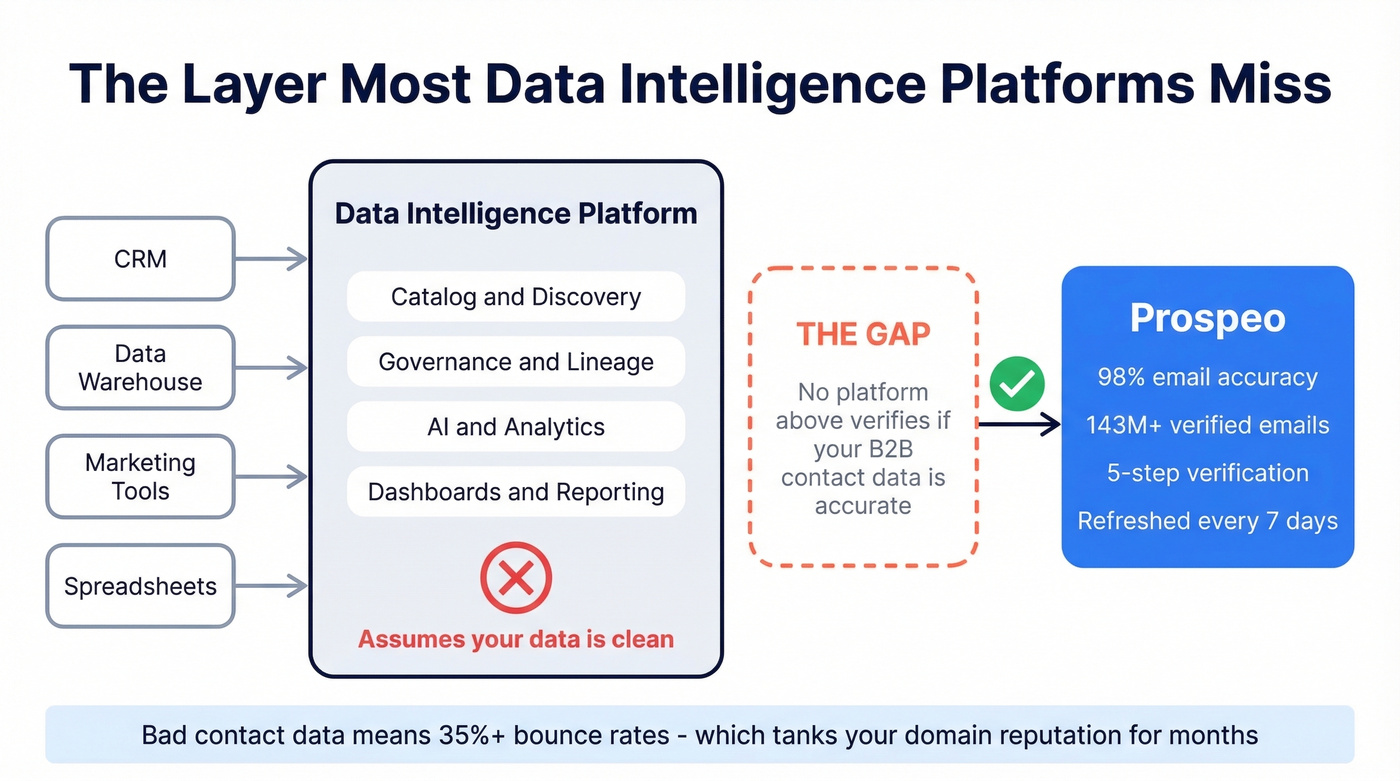
These tools are only as good as the data feeding them. For B2B revenue teams, the most critical intelligence question isn't "can we catalog our Snowflake tables?" - it's "is this prospect's email actually valid?" Teams running outbound with bad data see 35%+ bounce rates, which tanks domain reputation and kills deliverability for months.
Prospeo solves this specific problem. Its database covers 300M+ professional profiles with 143M+ verified emails and 125M+ verified mobile numbers, all running through a 5-step verification process and refreshed every 7 days - compared to the 6-week industry average. Email accuracy hits 98%, and mobile pickup rates run 30% across all regions. Intent data covers 15,000 topics via Bombora, so you're not just getting clean contact data - you're getting real-time signals about who's actively in-market right now.

The proof is in production results. Snyk's team of 50 AEs cut their bounce rate from 35-40% to under 5%, and AE-sourced pipeline jumped 180%. That's what happens when your contact data is actually accurate.
Most data intelligence platforms ignore the one thing revenue teams actually need: contacts that don't bounce. Prospeo's 5-step verification delivers 98% email accuracy at $0.01/lead - 90% cheaper than enterprise platforms with longer deploy times.
Build your revenue intelligence layer in minutes, not months.
What These Platforms Actually Cost
The fact that Collibra, Alation, and Informatica still won't publish pricing tells you everything about how enterprise software sales work. Here's what you'll actually pay.
| Platform | Pricing Model | Price Range | Deploy Time |
|---|---|---|---|
| Databricks | Consumption | $50k-$500k+/yr | Weeks-months |
| Collibra | Per-seat + modules | $100k+/yr | 3-9 months |
| Alation | Per-seat | $75k-$200k/yr | 2-6 months |
| Atlan | Subscription | $30k-$100k/yr | 2-8 weeks |
| Secoda | Subscription | ~$500/mo (~$6k/yr) | 1-2 weeks |
| OvalEdge | Per-seat | $25k-$100k/yr | 1-3 months |
| Informatica IDMC | Consumption | $50k-$200k+/yr | 3-9 months |
| Oracle Fusion | Per-seat + modules | $30k-$200k/yr | Months |
| BigID | Subscription | $50k-$150k/yr | 1-3 months |
| Snowflake | Consumption | $50k-$500k/yr | Weeks-months |
| dataspot. | Subscription (est.) | $25k-$75k/yr (est.) | 2-8 weeks |
| DataHub / OpenMetadata | Self-hosted | Free (0.5-1 FTE cost) | 2-8 weeks |
These numbers are license costs. Total cost of ownership is always higher - budget for customization, implementation consulting, integration development, and ongoing support. For enterprise governance tools, implementation often runs 30-50% of the first-year license cost. Training and data steward FTEs add another layer. Most organizations underestimate the human cost of making these platforms actually work, and it's the single biggest reason rollouts stall.
The gap between Secoda at ~$6k/year and Collibra at $100k+ isn't just about features. It's about organizational complexity, compliance requirements, and how many stakeholders need to touch the platform. Know which category you fall into before you start vendor conversations.
Five Mistakes That Kill Rollouts
1. Buying tech before defining outcomes. "We need Databricks" isn't a business case. Define what success looks like - time-to-insight reduction, compliance audit pass rates, data request volume - before you evaluate a single vendor. The tool should serve the outcome, not the other way around.
2. Ignoring adoption. You're six months into a Collibra deployment, adoption is at 12%, and the CFO is asking why you spent $150k. This happens constantly. If your data analysts and engineers don't find the platform easier than their current workflow (yes, including Excel), they won't use it. Invest in training and UX evaluation upfront, not as an afterthought.
3. Deferring governance to "phase two." Phase two never comes. Or it comes after the platform is already populated with ungoverned, untrusted data that nobody wants to clean up. Embed governance from day one, even if it's lightweight. Low trust equals low usage.
4. Boil-the-ocean scope. Teams plan to connect 2-3 data sources and discover they actually need 7-10. Projects planned as "2 weeks, 1 dev" become months-long efforts. Start with one high-value use case, prove it works, then expand.
5. Skipping AI readiness. Only about 36% of organizations say they have the data quality, governance, and security policies needed for AI. An estimated 95% of generative AI pilots fail to reach production. If your data foundations are messy, AI doesn't fix the mess - it amplifies it. Get the basics right first.
Does It Deliver ROI?
The most concrete ROI data comes from Oracle's Nucleus Research case study. A global investment bank deployed Oracle Fusion Data Intelligence Platform and reported 641% ROI, with $1.12M in annual cost savings, a 50% reduction in ServiceNow ticket volumes, and 5-10 minutes saved per user per day - which they valued at $1.5M+ annually.
Those are strong numbers, but they're from a single organization with a vendor-sponsored study. ROI from data intelligence investments depends heavily on your starting point. If your data team spends 40% of their time finding and validating data, the payoff from a good catalog is enormous. If your data is already well-organized and your team is small, the ROI math gets harder to justify for a $100k+ platform.
The measurement framework that actually works: define baseline metrics before deployment. Track time-to-insight, data request volume, compliance incident rates, and analyst productivity. If you can't measure the before state, you'll never prove the after.
If your average deal size is under $15k, you probably don't need a six-figure platform. A lightweight catalog like Secoda plus clean contact data from a tool like Prospeo will get you 80% of the value at 5% of the cost. Save the enterprise tooling for when your data complexity actually demands it.
FAQ
Data intelligence vs. business intelligence?
BI visualizes historical data through dashboards and charts. A data intelligence platform uses AI to understand data semantics, automate governance, and enable natural language access across metadata, lineage, and usage patterns that BI tools never see. BI reports on the past; intelligence platforms make the entire data estate discoverable and actionable.
Do small teams need one?
Teams under 50 people rarely need a full governance suite. A lightweight catalog like Secoda (~$500/mo) or open-source DataHub handles discovery and documentation without six-figure overhead. Match the tool to the problem, not the hype.
How long does implementation take?
Modern tools like Secoda deploy in 1-2 weeks. Enterprise governance platforms like Collibra or Informatica take 3-9 months to reach production. The difference is mostly about organizational complexity and integration scope, not the software itself.
Is open-source viable?
DataHub and OpenMetadata are free to self-host but require 0.5-1 FTE for setup and ongoing maintenance. They're solid for metadata cataloging but lack AI-driven semantic features found in commercial platforms like Databricks or Atlan. Budget engineering time, not license fees.
What about B2B sales intelligence?
If your primary need is prospect data accuracy and pipeline generation - not data cataloging - you need a revenue-focused tool. Look for verified contact data, intent signals, and CRM enrichment. Prospeo offers 98% email accuracy at roughly $0.01/lead with a free tier of 75 verified emails per month, while ZoomInfo and Cognism serve the enterprise end of this space at significantly higher price points.