


Datablist Pricing, Reviews, Pros and Cons: Is It Worth It?
You're staring at a messy CSV with 40,000 rows, half of them duplicates, and you need clean contact data by Friday. Datablist keeps popping up as the cheap fix - $0 to $50/mo for list cleanup, deduplication, and enrichment. But credit-based pricing is where the math gets fuzzy. B2B contact data decays at roughly 30% per year, and a cheap tool that feeds you stale data isn't saving you anything.
30-Second Verdict
Datablist is a solid budget tool for cleaning CSVs, deduplicating lead lists, and running enrichments from its enrichment store. At $25/mo for the Starter plan, it's a fraction of Clay's $149/mo. But the credit system takes a minute to understand, collaboration is limited, and enrichment quality depends on third-party sources you don't control.
If your primary need is verified contact data rather than list cleanup, skip the credit middleman and use a dedicated enrichment platform with transparent per-lead pricing.
Datablist Pricing Breakdown
Datablist runs three tiers. The free plan is free forever, but 500 credits per year is barely enough to test the enrichment features. Starter at $25/mo and Growth at $50/mo are where the real functionality lives.
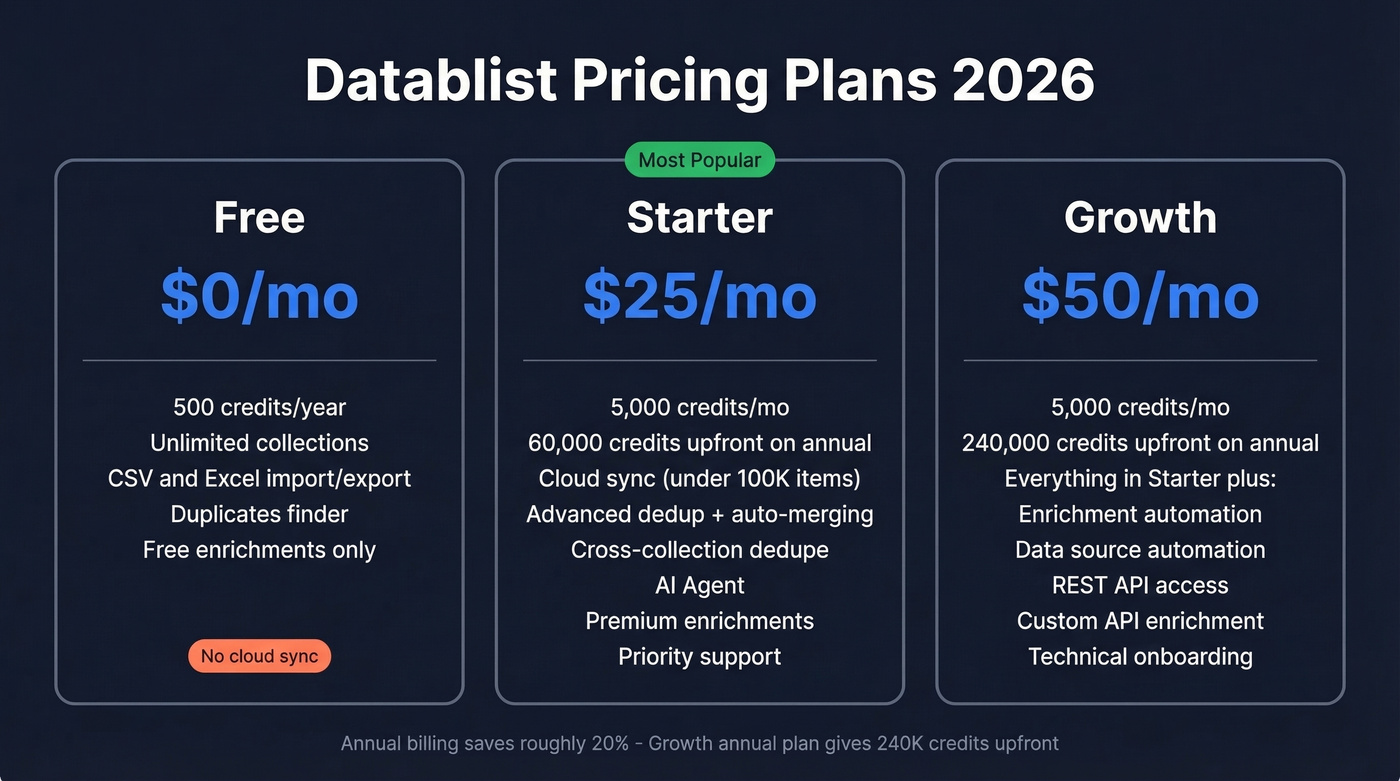
| Plan | Price/mo | Credits | Cloud Sync | Key Features |
|---|---|---|---|---|
| Free | $0 | 500/yr | No | Unlimited collections, CSV/Excel import/export, duplicates finder, free data enrichments |
| Starter | $25 | 5,000/mo (or 60,000 upfront on annual) | Yes, under 100K items | Advanced filtering, advanced dedup + auto-merging, cross-collection dedupe, AI Agent, premium enrichments, priority support |
| Growth | $50 | 5,000/mo (or 240,000 upfront on annual) | Yes, under 100K items | Everything in Starter + enrichment automation, data source automation, REST API, custom API enrichment, technical onboarding |
What you don't get until you pay: Cloud sync and premium enrichments are locked behind paid plans. Enrichment automation and the REST API both require Growth. There's no mobile app at any tier, and trigger-based automations aren't shipped yet.
Yearly billing saves around 20%. On annual plans, Growth gets 240,000 credits upfront versus the monthly drip - a meaningful difference if you're running large enrichment batches. Datablist integrates with tools like Pipedrive, Lemlist, Icypeas, and Findymail, though export integrations aren't included on Free or Starter.
One real risk worth knowing: Datablist stores data in a local browser database. Without cloud sync (paid plans only, capped at 100,000 items), clearing your browser storage can mean losing your collections entirely.
How Credits Actually Work
Here's where Datablist gets confusing. Each enrichment action costs a set number of credits, but the per-enrichment cost varies by action type and isn't published in a single table. You find out what each enrichment costs when you open it in the enrichments store.
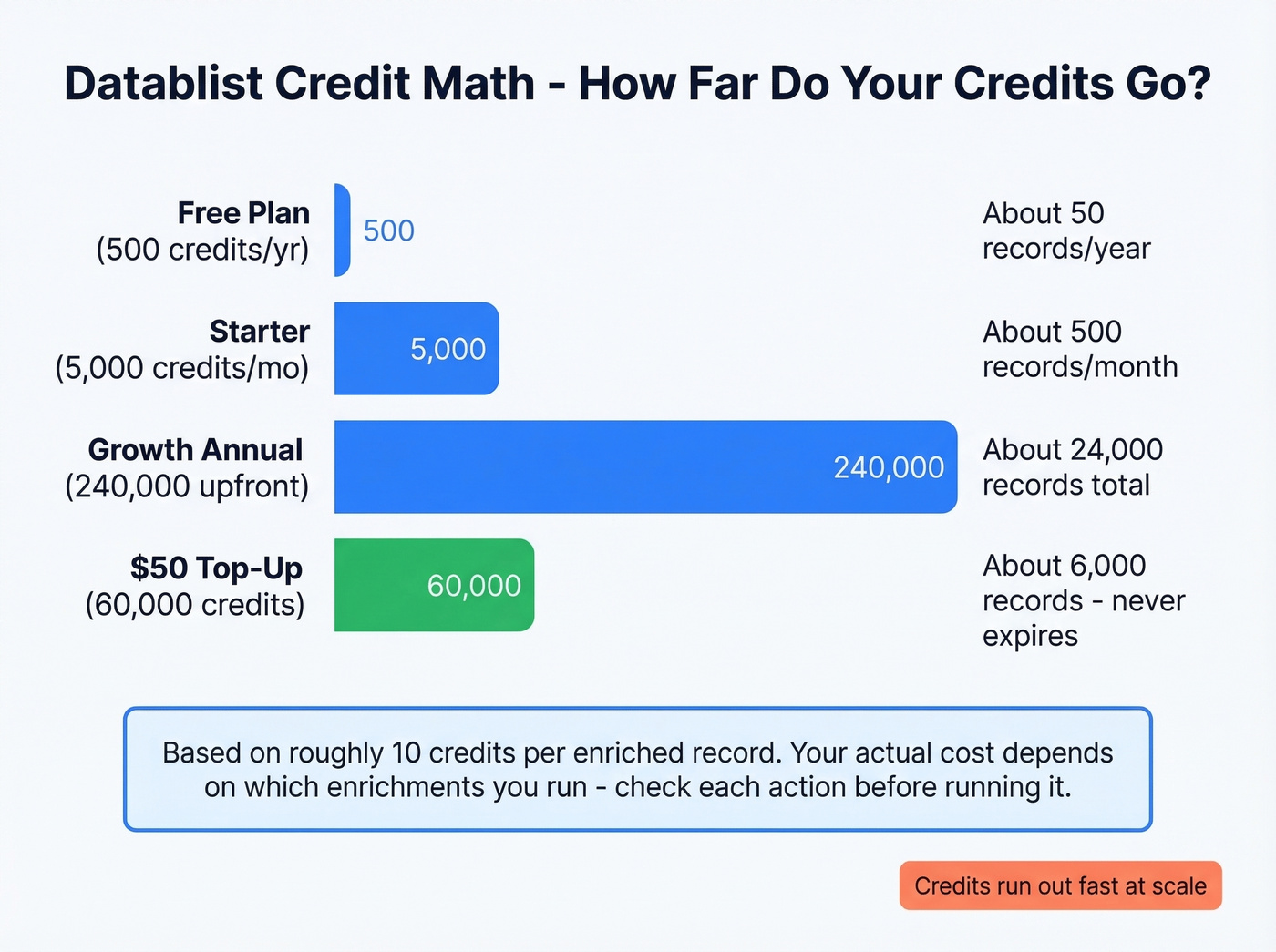
We ran the numbers on a few reference points. In Datablist's job-scraping workflow, 5,000 credits works out to about 500 job postings - roughly 10 credits per posting. A Trustpilot reviewer reported enriching about 3,000 contacts (names, addresses, phone numbers) for around EUR 30, which comes to EUR 0.01 per contact. That's competitive.
But do the math on your own use case. If you're spending ~10 credits per record, your monthly 5,000 credits cover roughly 500 records. A 10,000-contact enrichment job will blow through your allocation fast.
When monthly credits run dry, top-ups kick in:
| Top-Up | Credits | Cost per 1,000 | Per Credit |
|---|---|---|---|
| $20 | 20,000 | $1.00 | $0.001 |
| $50 | 60,000 | $0.83 | $0.00083 |
| $150 | 200,000 | $0.75 | $0.00075 |
| $650 | 1,000,000 | $0.65 | $0.00065 |
Top-ups never expire, which is a nice touch. But the gap between "5,000 credits included" and needing a $20 top-up comes fast for any serious enrichment work.
Datablist Pros
Dead simple for CSV work. Users praise the low learning curve. Import a messy spreadsheet, clean it, deduplicate it, export it. No onboarding call required.
Deduplication is genuinely strong. Fuzzy matching, phonetic matching, cross-collection dedup, and auto-merging. This is Datablist's best feature by a wide margin - most spreadsheet tools handle dedup poorly, and we've wasted hours doing it manually in Google Sheets before finding tools like this.
Handles scale on a budget. Datablist can manipulate up to 2 million items per collection locally. At $25/mo, that's remarkable compared to Clay's $149/mo entry point.
Customer support is responsive. Both G2 and Trustpilot reviewers call out helpful, fast support - unusual for a tool at this price point.
AI Agent adds research capability. The prompt-based research agent can browse pages, handle JavaScript rendering, and extract structured data. It's not a full scraping platform, but it's a useful bonus.

Datablist aggregates enrichments from third-party sources you can't verify. Prospeo runs proprietary 5-step email verification - no middlemen - delivering 98% accuracy with an 83% enrichment match rate across 300M+ profiles. At ~$0.01 per email, the math is simple.
Skip the credit guesswork. Get verified contact data directly.
Cons and Limitations
Credit system is opaque. A G2 reviewer put it plainly: "The token system for data enrichment was a bit hard to understand at first." There's no single table showing credits-per-enrichment across all actions, so budgeting requires trial and error.
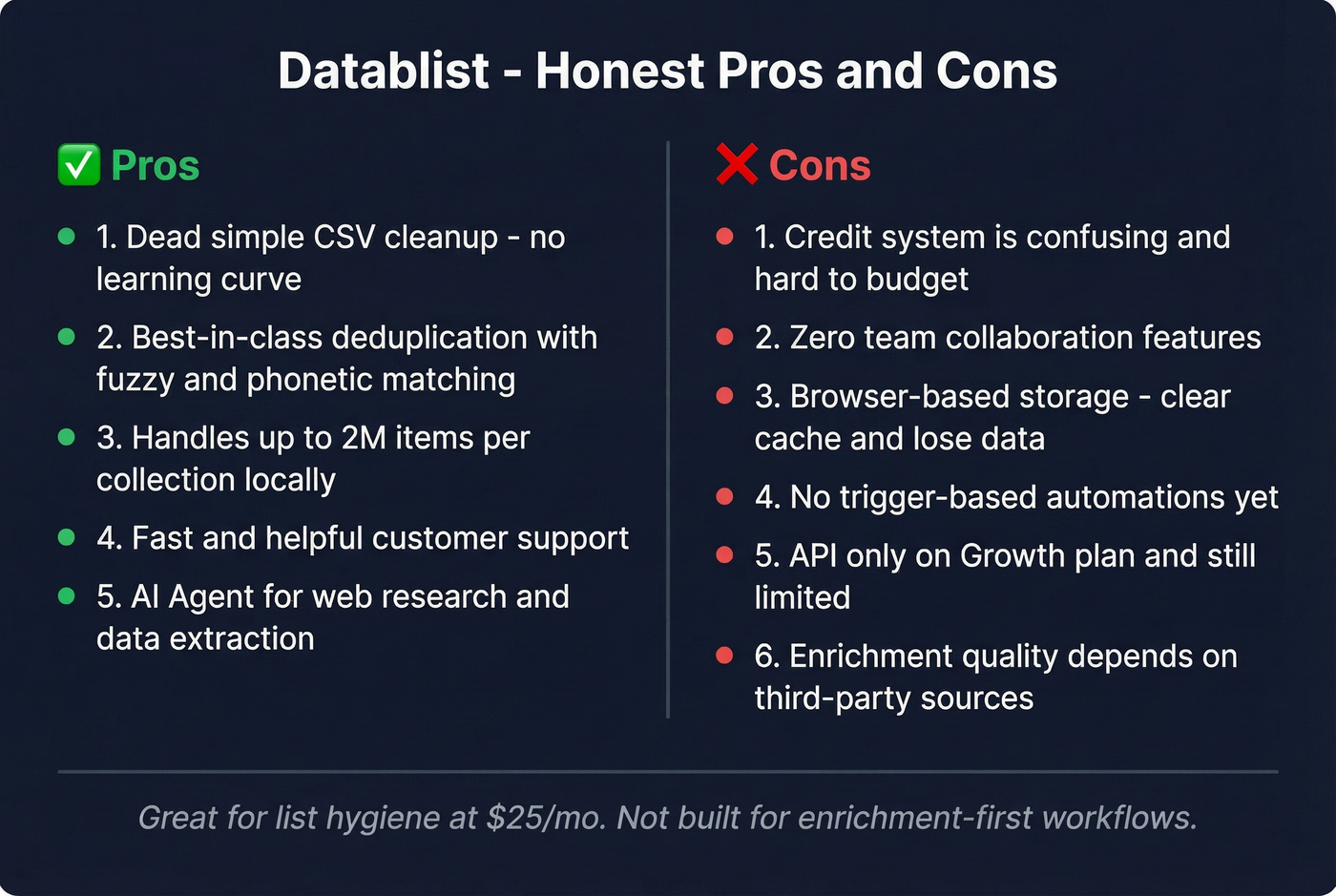
Collaboration is basically nonexistent. Another G2 reviewer flagged this directly: "I wish there was a team plan that could allow collaborative working on a dataset." If you're a team of three or more, this is a dealbreaker.
Browser-based storage is risky. Without cloud sync, your data lives in your browser's local database. Switch laptops or clear storage, and your collections vanish. That's a genuinely frustrating design choice for a data tool.
No trigger-based automations. Only scheduled automations exist today. Trigger-based workflows are on the roadmap but haven't shipped.
API is limited. The REST API (Growth plan only) covers the data management layer. APIs for sources and enrichments aren't available yet.
Enrichment quality is third-party dependent. Datablist aggregates enrichments from external sources. You're trusting their providers' accuracy, not a proprietary verification system.
What Users Actually Say
Datablist's review scores look stellar: 4.9/5 on G2 (4 reviews), 4.1/5 on Trustpilot (5 reviews), and 5.0/5 on Capterra (1 review).
Let's be honest - near-perfect scores based on 1-5 reviews aren't a consensus. They're a rounding error. We've tested tools with 4 glowing reviews that turned out to have serious gaps at scale.
The sentiment is consistent across the small sample, though. Users love the dedup capabilities and support quality. The recurring complaint is credit system confusion. Nobody's angry about Datablist - they just wish the pricing mechanics were more transparent.
Who Should Use Datablist
Use Datablist if you live in spreadsheets, your primary pain points are CSV cleanup and deduplication, and Clay's $149/mo feels excessive. It handles large lists without enterprise pricing, and the dedup tooling alone justifies the $25/mo for many users.
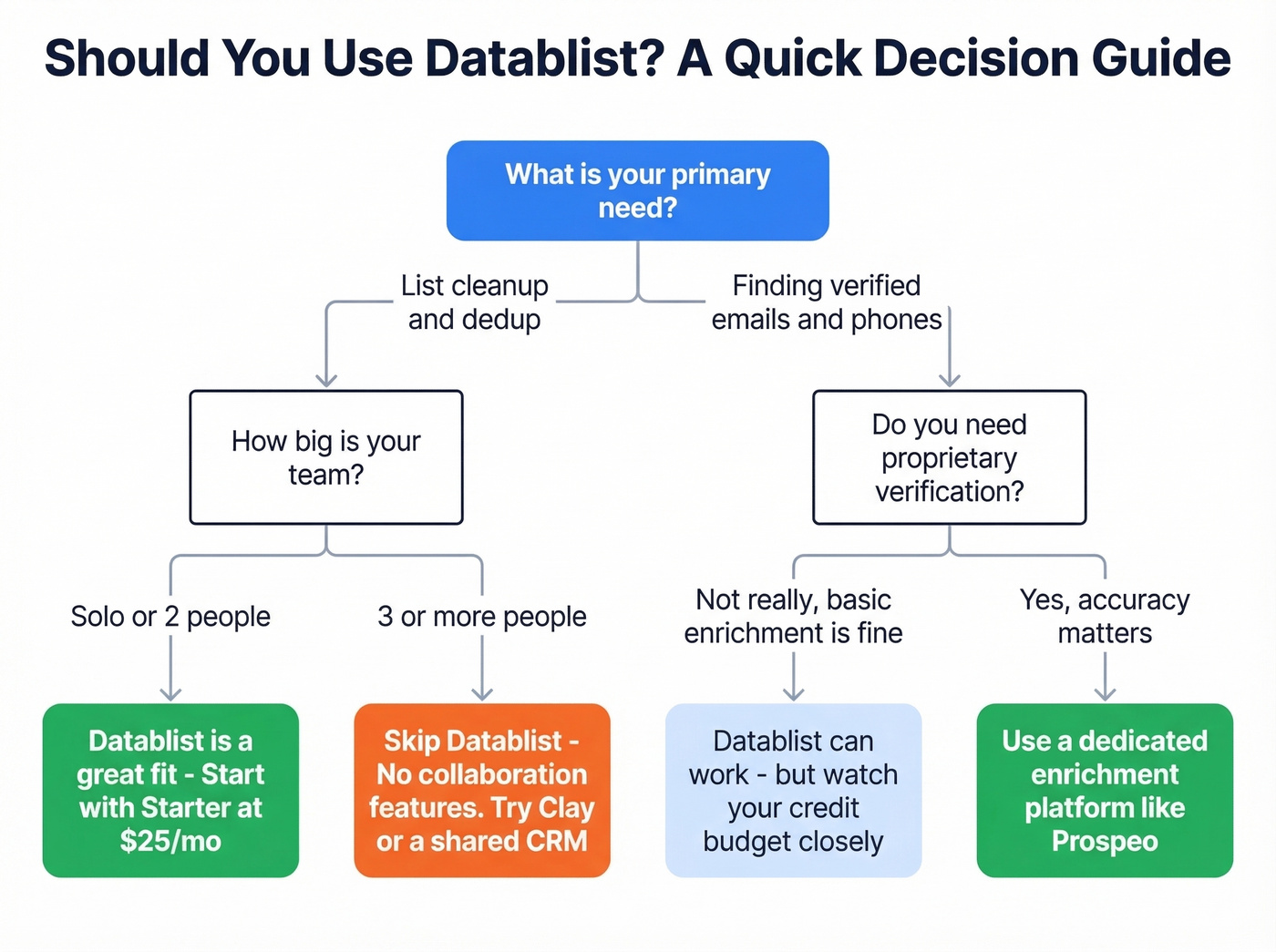
Skip Datablist if you need real collaboration on shared datasets, mobile access, or trigger-based automations. And if enrichment is your primary need - finding verified emails and phone numbers - Datablist is the wrong category of tool entirely. It's a list management platform that connects to third-party enrichment sources, not a dedicated data platform with proprietary verification.
Here's our hot take: Datablist is the best $25/mo you can spend on list hygiene. But most people searching for it actually need enrichment, not cleanup - and those are fundamentally different problems.
If You Need Enrichment Instead
Datablist is a list management tool that happens to offer enrichment through third-party sources. If verified emails and phone numbers are what you're actually after, that's a different problem requiring a different solution. With B2B contact data decaying at 30% annually, freshness matters as much as accuracy.
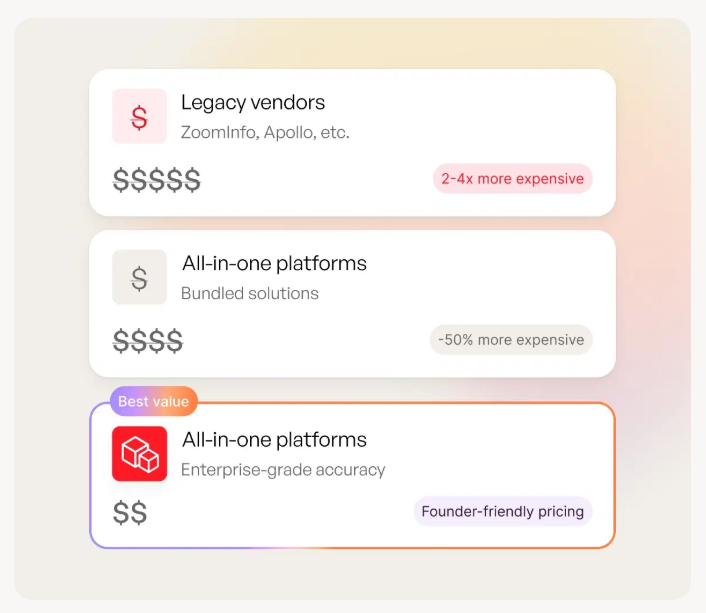
If enrichment is your primary need, a CSV cleanup tool with opaque credits isn't the answer. Prospeo returns 50+ data points per contact at a 92% API match rate, with data refreshed every 7 days - not weeks. Built-in CRM enrichment, no Growth plan upgrade required.
Get enterprise-grade enrichment without enterprise pricing or credit confusion.
FAQ
Does Datablist have a free plan?
Yes. The free plan includes 500 credits per year, unlimited collections, CSV/Excel import/export, a duplicates finder, and access to free data enrichments. Cloud sync and premium enrichments require a paid plan starting at $25/mo.
How do Datablist credits work?
Each enrichment action costs a set number of credits visible before you run it. Standard plans include 5,000 credits/month. Top-ups start at $20 for 20,000 credits and never expire. Expect roughly 10 credits per enriched record in typical workflows, meaning 5,000 credits covers about 500 records.
What's a good alternative for email enrichment?
For verified emails specifically, Prospeo offers 98% email accuracy across 300M+ profiles at ~$0.01 per email with a free tier of 75 emails/month. Other options include Hunter (25 free searches/mo) and Apollo (limited free credits). A dedicated enrichment platform with proprietary verification will consistently outperform Datablist's third-party approach for contact data.
Is Datablist worth it for large lists?
For list cleanup and deduplication, absolutely. Datablist handles up to 2 million items per collection locally at $25-$50/mo - far cheaper than Clay or similar platforms. For enrichment at scale, the 5,000 monthly credits run out quickly, and top-up costs add up. Budget $20-$50 in top-ups per month if you're enriching more than 500 records regularly.