

Demo Automation: What It Is, Where It Fits, and What It Costs (2026)
Automating a bad demo just scales failure faster. Most of what you'll find on this topic is vendor pages selling their own tool - this isn't one. Here's a neutral breakdown of what demo automation actually is, which type fits your funnel stage, what it costs in 2026, and the mistakes that quietly kill ROI.
The Short Version
- Start with a product tour if you've never automated a demo before - lowest lift, fastest to ship.
- These tools automate the creation of interactive product demonstrations, not recorded walkthroughs or slide decks.
- Before you personalize anything, fix your contact data. Garbage CRM records mean your "Hi {{first_name}}" tokens greet the wrong person at the wrong company.
- Budget for the tool and the data layer underneath it. Most teams underestimate the second part.
What It Is (and Isn't)
Demo automation is tooling that creates, personalizes, and distributes product demos without a live human on every call. The category spans interactive product tours, guided demos, sandbox environments, and mobile app flows with in-app gestures.
It's not a recorded Loom video. It's not a PowerPoint deck your AE clicks through on Zoom, or a static screenshot carousel. The whole point is interactivity - prospects click, explore, and self-qualify so your sales team spends live time on buyers who already understand the product.
Why It Matters Now
Sales cycles aren't getting shorter on their own. Outreach's data analysis found that opportunities closed within 50 days carry a 47% win rate - that drops to 20% or lower past that threshold. Meanwhile, 34% of revenue teams report average cycles of one to two quarters.
Automated demos compress the early funnel. Instead of waiting two weeks for an SE to run a live walkthrough, a prospect watches an interactive tour the same day they hit your site. Your SEs get hours back. Hours they'd otherwise burn on unqualified calls.
Three Core Demo Types
Product Tours
The fastest to ship. Capture screens (HTML clone or screenshots), add annotations and hotspots, embed on your website or share via link. Most teams go from zero to published in a single afternoon. Best for marketing-led demand gen and top-of-funnel qualification.
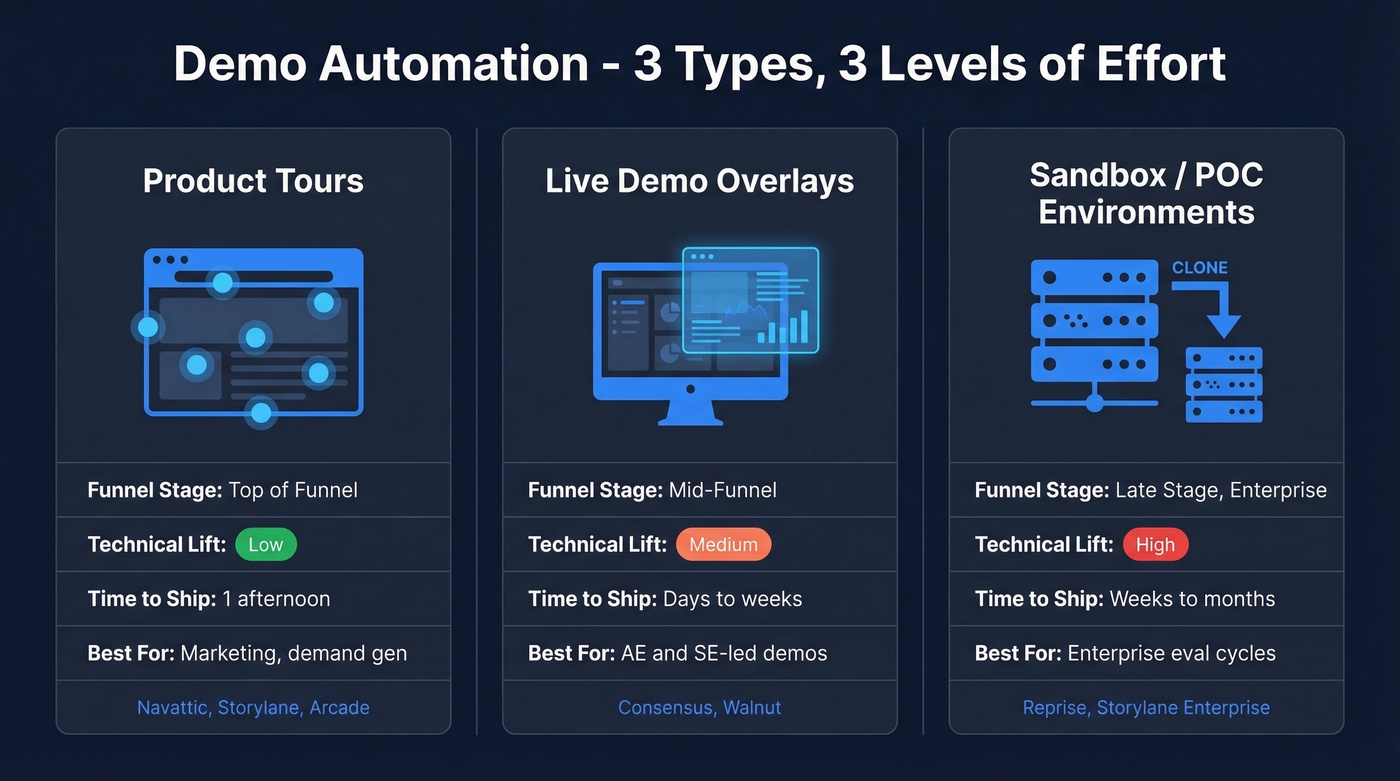
Live Demo Overlays
Best for mid-funnel AE/SE-led demos where narrative matters. These tools overlay synthetic data onto your live product so SEs can tell a compelling story without exposing real customer information. The lift is medium - you configure data injection rules and maintain them as your product evolves.
Sandbox/POC Environments
Full cloned environments where prospects click around a realistic copy of your product. Technical overhead is the highest: environment provisioning, data isolation, security reviews, ongoing maintenance. Reserve these for enterprise evaluation cycles where buyers need hands-on proof.
| Type | Best for | Technical lift | Common tools |
|---|---|---|---|
| Product tours | Top-of-funnel, marketing | Low | Navattic, Storylane, Arcade |
| Live demo overlays | Mid-funnel, SE-led | Medium | Consensus, Walnut |
| Sandbox/POC | Enterprise eval, POC | High | Reprise, Storylane Enterprise |

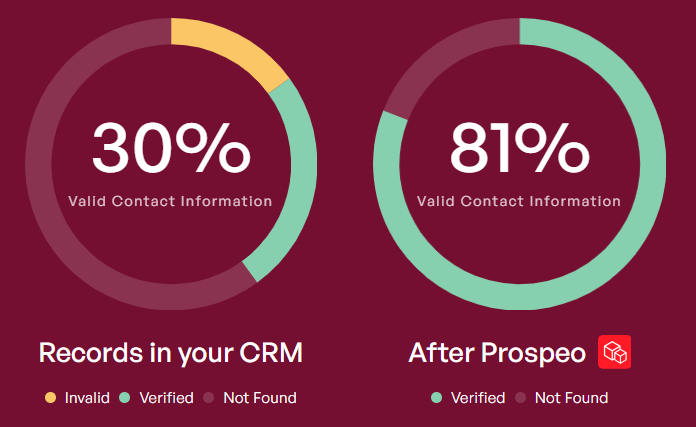
Personalized demos fail when your CRM is full of stale data. Prospeo enriches every contact with 50+ data points at a 92% match rate - so your "Hi {{first_name}}" tokens actually work and your leave-behind demos land with the right buyer at the right company.
Fix your data layer before you automate a single demo.
Where Automated Demos Fit the Funnel
Automated demos don't replace live demos - they co-exist with them. The Howdygo framework gets this right: automate the stages where human time is wasted, keep live interaction where it matters.
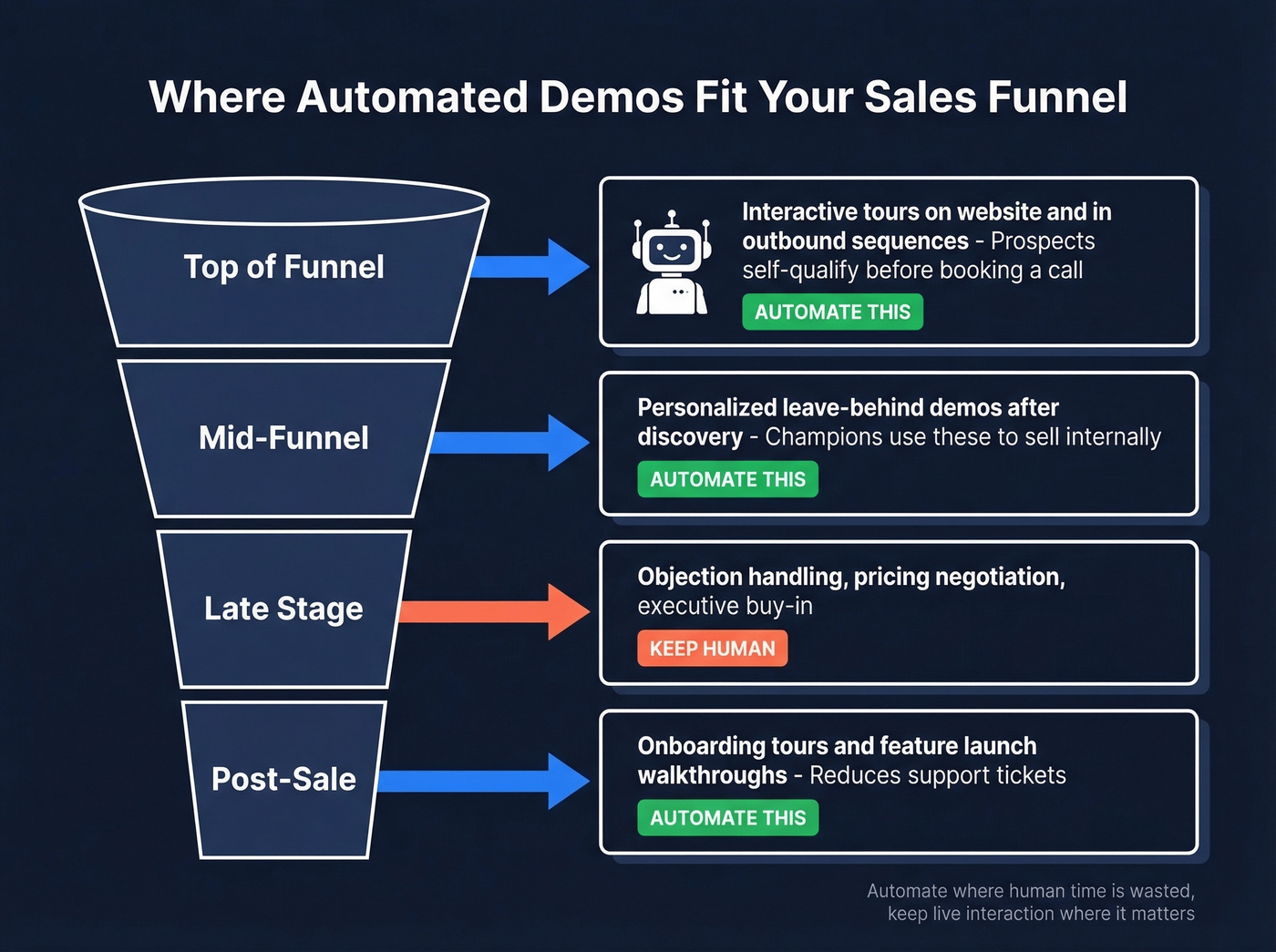
At the top of the funnel, embed interactive tours on your website and in outbound sequences so prospects self-qualify before booking a call. Mid-funnel, send personalized leave-behind demos after discovery calls - champions use these to sell internally. These leave-behinds work especially well as part of a broader sales engagement strategy, where every touchpoint reinforces the product story.
Late-stage, keep live demos for objection handling, technical deep dives, and executive buy-in. I've watched teams try to automate pricing negotiation and executive alignment. It backfires every time. Post-sale, onboarding tours and feature launch walkthroughs reduce support tickets.
How to Choose the Right Tool
G2's inclusion criteria double as a solid buyer checklist. We score tools on six dimensions before shortlisting:
- CRM/marketing integrations - Does it push engagement data into Salesforce, HubSpot, or your MAP? If not, attribution dies.
- Demo capture method - HTML cloning vs. screenshot-based vs. live overlay, each with tradeoffs in fidelity and maintenance.
- Personalization depth - Can you swap logos, names, and data dynamically? This is where CRM data quality becomes critical. If your records are stale, enrich them first with a tool like Prospeo, which returns 50+ data points per contact at a 92% API match rate.
- Overlays and data modification - Synthetic data injection for storytelling without exposing PII.
- Sharing and embedding - Link sharing, website embeds, email embeds, gated vs. ungated options.
- Engagement analytics - Views, clicks, completion rates, shares, and time-per-step.
2026 Pricing Breakdown
Here's the thing most articles skip: actual numbers.
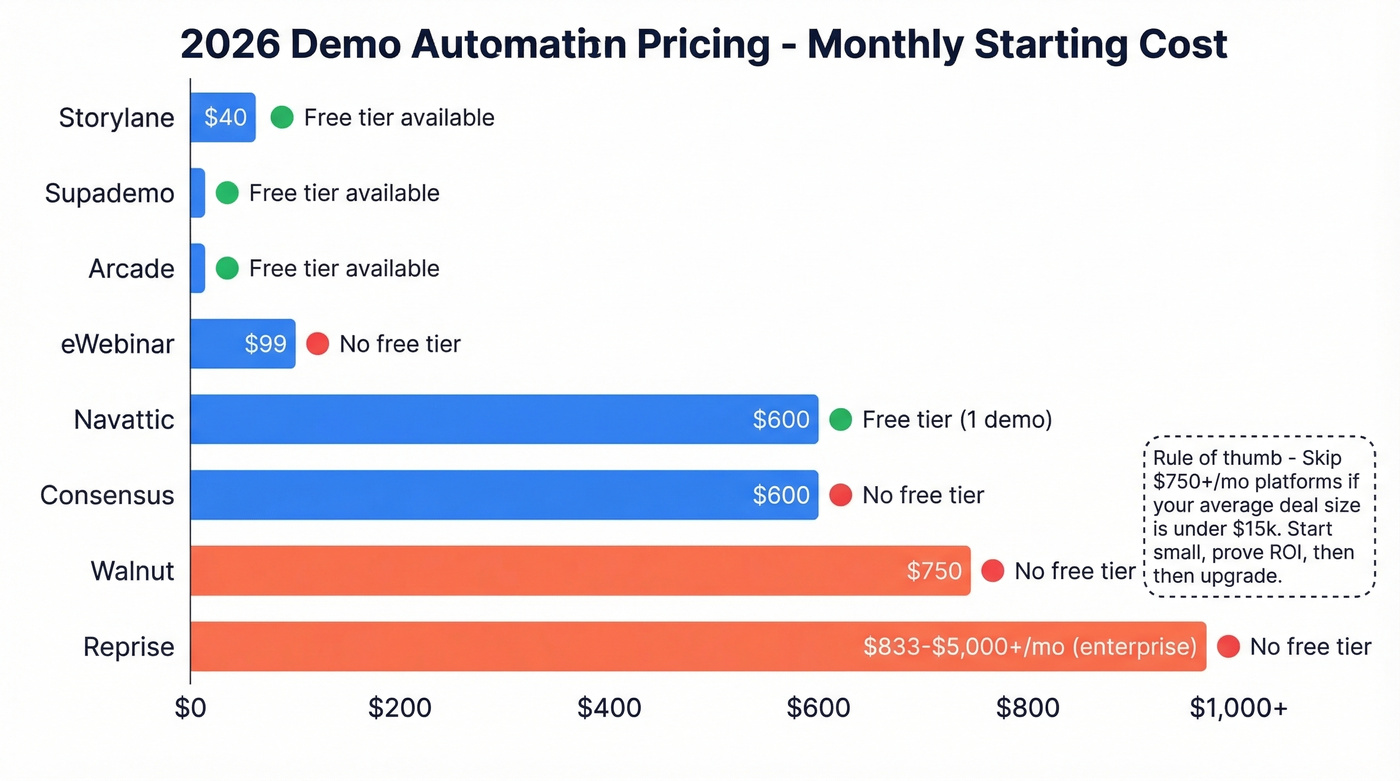
| Tool | Starting price | Free tier? | Best for | Notes |
|---|---|---|---|---|
| Storylane | $40/mo (annual) | Yes (1 demo) | SMB product tours | Growth $500/mo; Premium $1,200/mo |
| Navattic | $600/mo (annual) | Yes (1 demo) | Mid-market tours | Growth $1,200/mo (annual) |
| Arcade | Free tier available | Yes | Quick screen demos | Paid plans available |
| Supademo | Free tier available | Yes | Lightweight tours | Paid plans available |
| eWebinar | $99/mo | No | Webinar-style demos | $199/$299 upper tiers |
| Consensus | $600/mo (annual) | No | Video + tours | Pro $1,250/mo for 10 users |
| Walnut | $750/mo (annual) | No | SE-led demos | Accelerate $1,550/mo; Deal Rooms $70/user/mo ($35 bundled) |
| Reprise | ~$10k-$60k+/yr | No | Enterprise sandbox | SOC 2 Type II & ISO 27001 |
The spread is enormous - a Storylane Starter plan costs less per year than a single month of Walnut Accelerate. Match the tool to your actual use case, not your aspirations.
G2 reviewers praise Consensus for engagement tracking but flag demo library organization as a weak spot.
Skip the $750+/mo platforms if your average deal size is under $15k. Start with Storylane or Arcade, prove the ROI, then upgrade. The teams that overspend on demo tooling are the same ones that skip data enrichment and wonder why personalization falls flat.
Mistakes That Kill ROI
We've seen teams buy these tools and get zero lift. The pattern is almost always one of these failures.
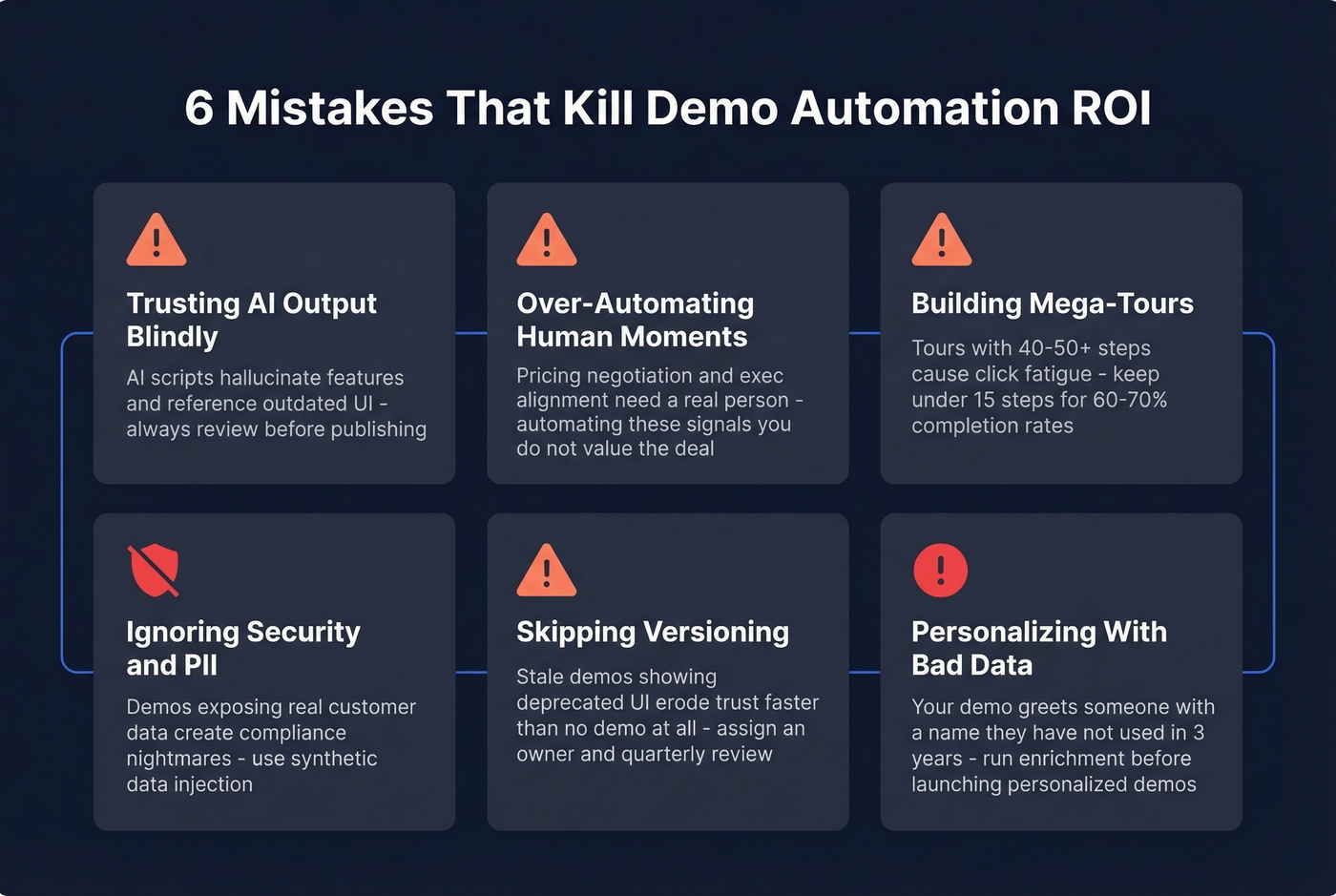
Don't treat AI features as plug-and-play. AI-generated demo scripts hallucinate product capabilities and reference outdated UI. Curate a knowledge base and review every AI output before publishing. The DemoDazzle pitfalls list nails this one.
Don't over-automate human touchpoints. Late-stage objection handling, pricing negotiation, and executive alignment need a real person. Automating these signals that you don't value the deal.
Don't build mega-tours. Tourial's data shows best-performing demos hit 60-70% completion rates - but tours with 40-50+ steps cause click fatigue and tank those numbers. Keep tours under 15 steps.
Don't ignore security and PII. Demos that expose real customer data create compliance nightmares. Use synthetic data injection, enforce role-based access controls, and run a security review before any demo goes public.
Don't skip versioning and maintenance. Your product ships updates monthly; your demos should too. Stale demos that show deprecated UI or removed features erode trust faster than no demo at all. Assign an owner and a quarterly review cadence.
Don't personalize with bad data. This is the silent killer. Your demo greets "{{first_name}}" with a name the prospect hasn't used in three years, or references a company they left six months ago. Run enrichment before you launch personalized demos - a 7-day data refresh cycle and 98% email accuracy from a tool like Prospeo prevent exactly this kind of embarrassment.
How to Measure Success
Three metrics matter more than everything else combined.
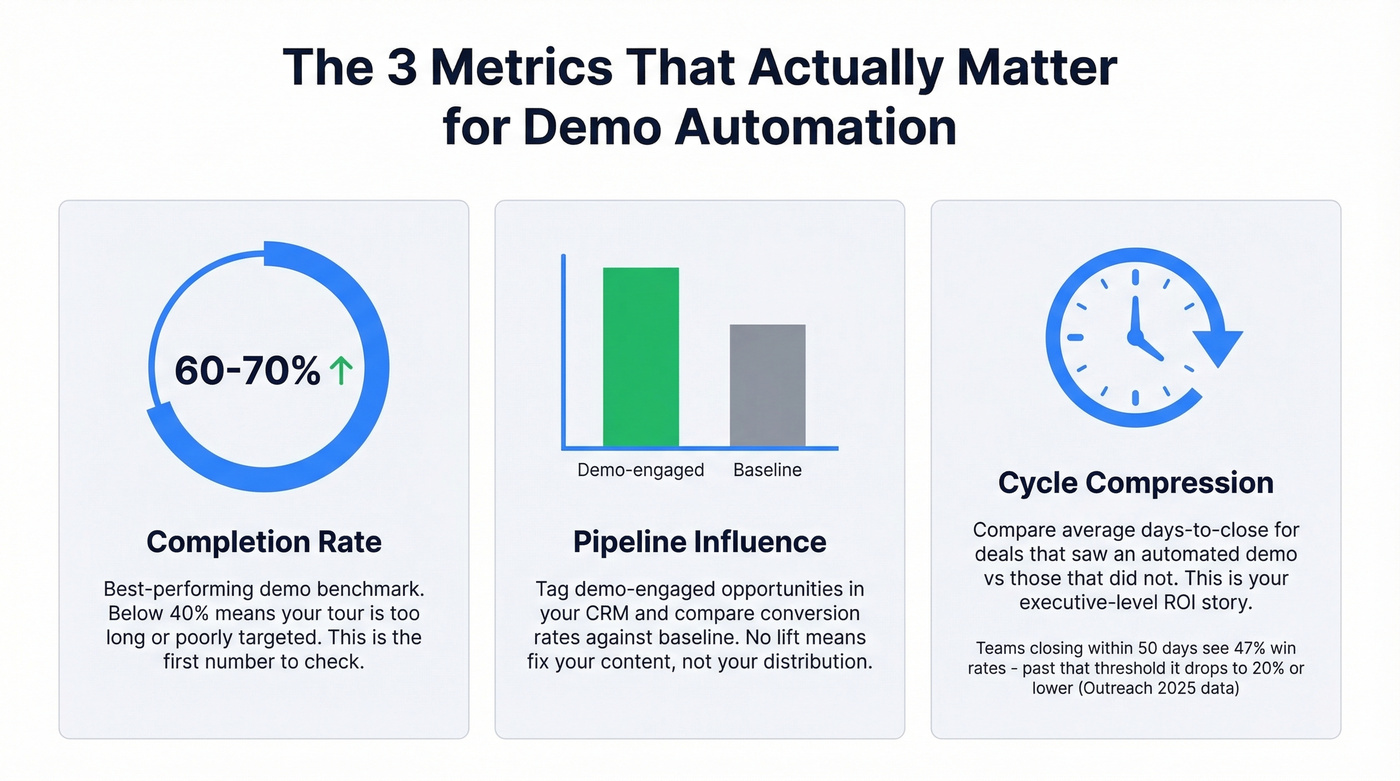
Completion rate tells you if your tour is the right length and targeting. Tourial benchmarks best-performing demos at 60-70%, so anything below 40% means your tour is too long or poorly targeted. This is the first number to check.
Pipeline influence reveals whether demos actually move deals forward. Tag demo-engaged opportunities in your CRM and compare conversion rates against the baseline - if there's no meaningful lift, your demo content needs work, not more distribution.
Cycle compression - comparing average days-to-close for deals that engaged with an automated demo vs. those that didn't - is your executive-level ROI story. Teams that pair demo automation with proposal and document workflows across the deal cycle often see the largest compression, because buyers never stall waiting for collateral between touchpoints.
FAQ
How much does it cost?
Product tour tools start at $40/mo with Storylane. Mid-market platforms run $600-$1,550/mo (Navattic, Walnut). Enterprise sandbox tools like Reprise hit $60k+/year. Budget separately for data enrichment underneath - expect ~$0.01/lead with self-serve platforms or $1+/lead with legacy providers.
Can automated demos replace live demos?
No. They handle top-of-funnel qualification and champion enablement, freeing SEs for high-value conversations. Late-stage deals with complex objections and executive stakeholders still need a human in the room.
How long does setup take?
Faster than you'd expect. Howdygo's framework: capture your flow in 30 minutes, publish with CTAs in 15, wire CRM signals in 15. Most teams ship a polished first tour in one afternoon.
What should I look for in demo automation software?
Prioritize CRM integration depth, the capture method that matches your product complexity, and engagement analytics that feed pipeline reporting. The pricing table above gives you a starting point, but always run a proof-of-concept with your actual product before committing annually.
You just budgeted $500+/mo for demo automation tooling. Don't let bad contact data undercut every personalized demo you ship. Prospeo delivers 98% email accuracy on a 7-day refresh cycle for ~$0.01 per email - no contracts, no sales calls.
Spend less on data than on your demo tool and get better results.