


Demoboost Pricing, Reviews, Pros and Cons: An Honest Breakdown
You're trying to figure out what Demoboost actually costs, and the pricing page just asks you to fill out a form. Meanwhile, every "review" you find is a directory template with the same recycled bullet points and zero editorial opinion. This breakdown covers real pricing estimates, 103 G2 reviews synthesized into actual patterns, and every meaningful pro and con - so you can make a decision without sitting through a sales call first.
30-Second Verdict
Demoboost is a strong demo automation platform for enterprise presales teams. But its opaque pricing (~$50-$150/user/month), no free trial listed on Capterra, and separate module pricing make it a tough sell for mid-market teams. Interactive content outperforms video by 7.2x, so the category matters. If you need transparent pricing and a free tier to test first, start with Navattic or Storylane instead.
What Is Demoboost?
Demoboost is a demo automation platform built for B2B software companies with complex products. It covers interactive tours, sandbox environments, live demo overlays, mobile demos, digital sales rooms, and demo analytics. It also supports non-linear demo navigation - playlists, choose-your-own-journey flows, demo menus - plus speaker notes for live demos and lead capture forms inside demos.
On the integration side, you'll find connections to Salesforce, Pipedrive, Slack, Google Analytics, and Hotjar.
What You'll Actually Pay
Demoboost doesn't publish pricing. The pricing page asks you to answer a few questions and promises a "personalised pricing quote instantly." No plan names, no seat minimums, no dollar amounts.
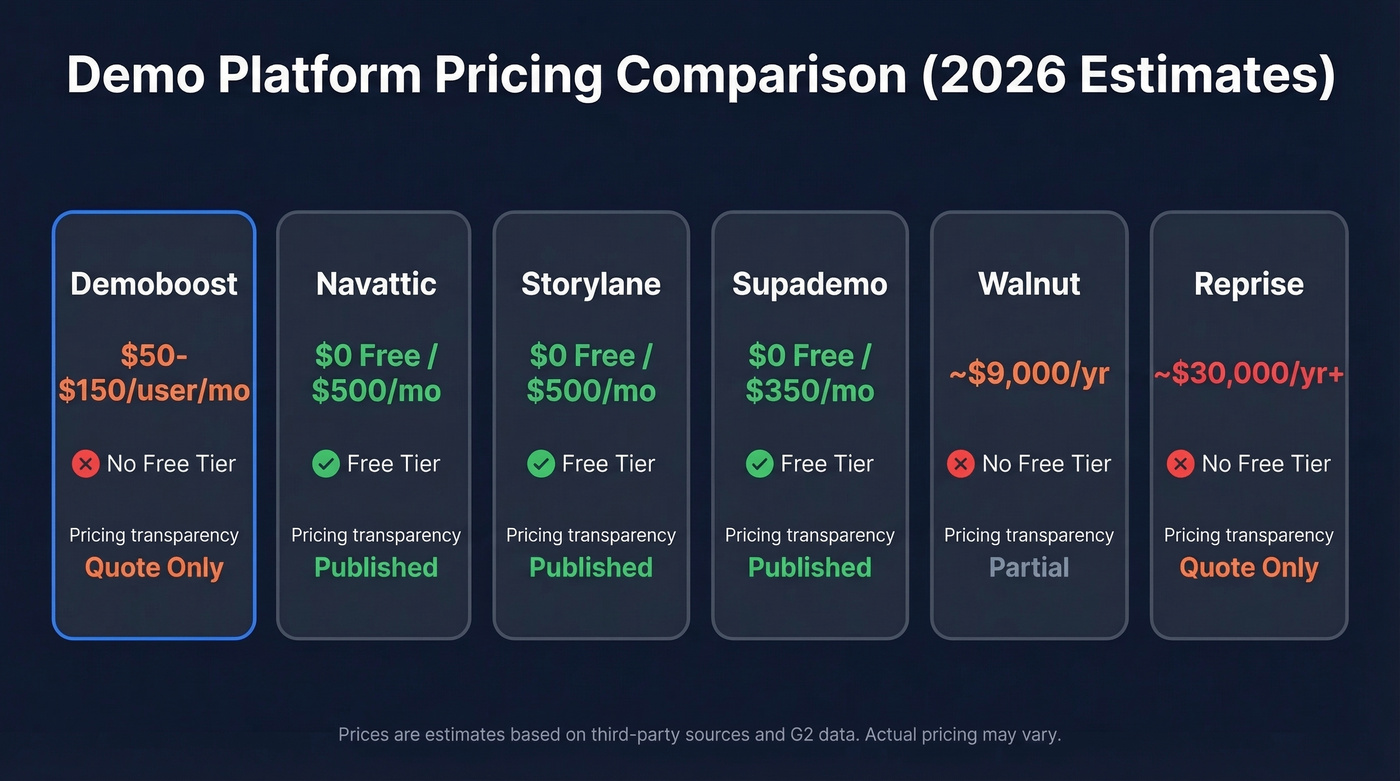
Here's what we pieced together from third-party estimates: expect $50-$150/user/month.
Do the math on that. A 5-person team comes out to roughly $3,000-$9,000/year on a pure per-seat basis. In practice, third-party comparisons place Demoboost deals around $10,000-$20,000+ per year once you factor in packaging, modules, and enterprise-style minimums. Two tiers appear to exist - Growth (up to 10 seats, with A/B testing and sandbox demos) and Enterprise (offline demos, audit logs, priority support) - though Demoboost doesn't confirm this publicly.
Two things can push the real cost higher than the headline seat price:
- Tours and Overlays are sold as separate modules. If you need both, you're effectively paying for two products.
- Free trial availability is unclear. Capterra lists "Free trial not available."
One bright spot: G2 reports an average 14% discount on Demoboost deals. If you engage their sales team, push for it - that knocks meaningful budget off an annual contract.
Here's how Demoboost stacks up against competitors on price:
| Tool | Starting Price | Free Tier? | Pricing Transparency |
|---|---|---|---|
| Demoboost | ~$50-$150/user/mo (est.) | No | Custom quote only |
| Navattic | $0 (Free) / $500/mo (Base) | Yes | Published tiers |
| Storylane | $0 (Free) / $500/mo (Growth) | Yes | Published tiers |
| Supademo | $0 (Starter) / $350/mo (Growth, 5 creators) | Yes | Published tiers |
| Walnut | ~$9,000/yr (up to 3 users) | No | Partially published |
| Reprise | ~$30,000/yr+ | No | Custom quote only |
Look, the fact that Demoboost doesn't publish pricing in 2026 - when most mid-market competitors do - is a competitive disadvantage they're choosing to accept. Buyers expect transparency, and "talk to sales" is a friction tax that smaller teams shouldn't have to pay.
What 103 G2 Users Say
Demoboost holds a 4.9/5 rating on G2 from 103 reviews. The distribution is striking: 94% five-star, 5% four-star, and nothing below four stars. G2 reports a 1-month implementation timeline and a 9-month ROI window.
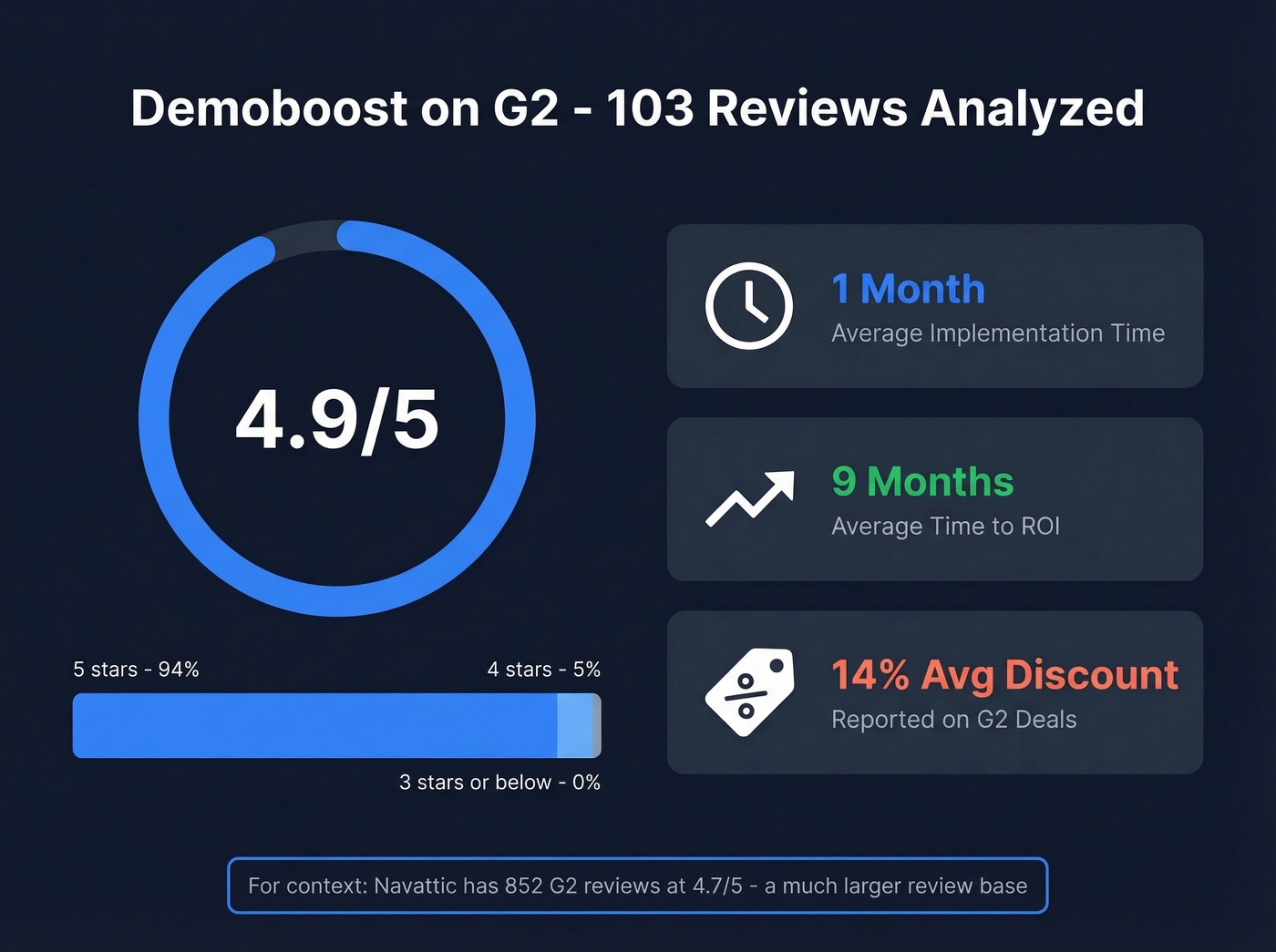
That 4.9 rating comes from a small sample, though. For comparison, Navattic has 852 G2 reviews with a 4.7/5 - a much larger base that inspires more statistical confidence. Capterra has zero Demoboost reviews. When a product's entire review ecosystem lives on a single platform with a near-perfect score, it's worth pausing on. It doesn't mean the reviews are fake - Demoboost almost certainly drives happy customers to G2 and simply doesn't have the broader market footprint that generates organic reviews elsewhere.
We also didn't find high-signal Reddit threads about Demoboost. Most demo platform discussions tend to center on bigger, more frequently mentioned tools like Navattic and Walnut.

Evaluating demo tools means you're scaling outbound. But the best demo in the world won't close deals if your prospect emails bounce. Prospeo delivers 98% email accuracy with a 7-day refresh cycle - 90% cheaper than ZoomInfo, with zero contracts and transparent pricing from day one.
Stop paying a friction tax for bad data. Start with 75 free emails.
Pros
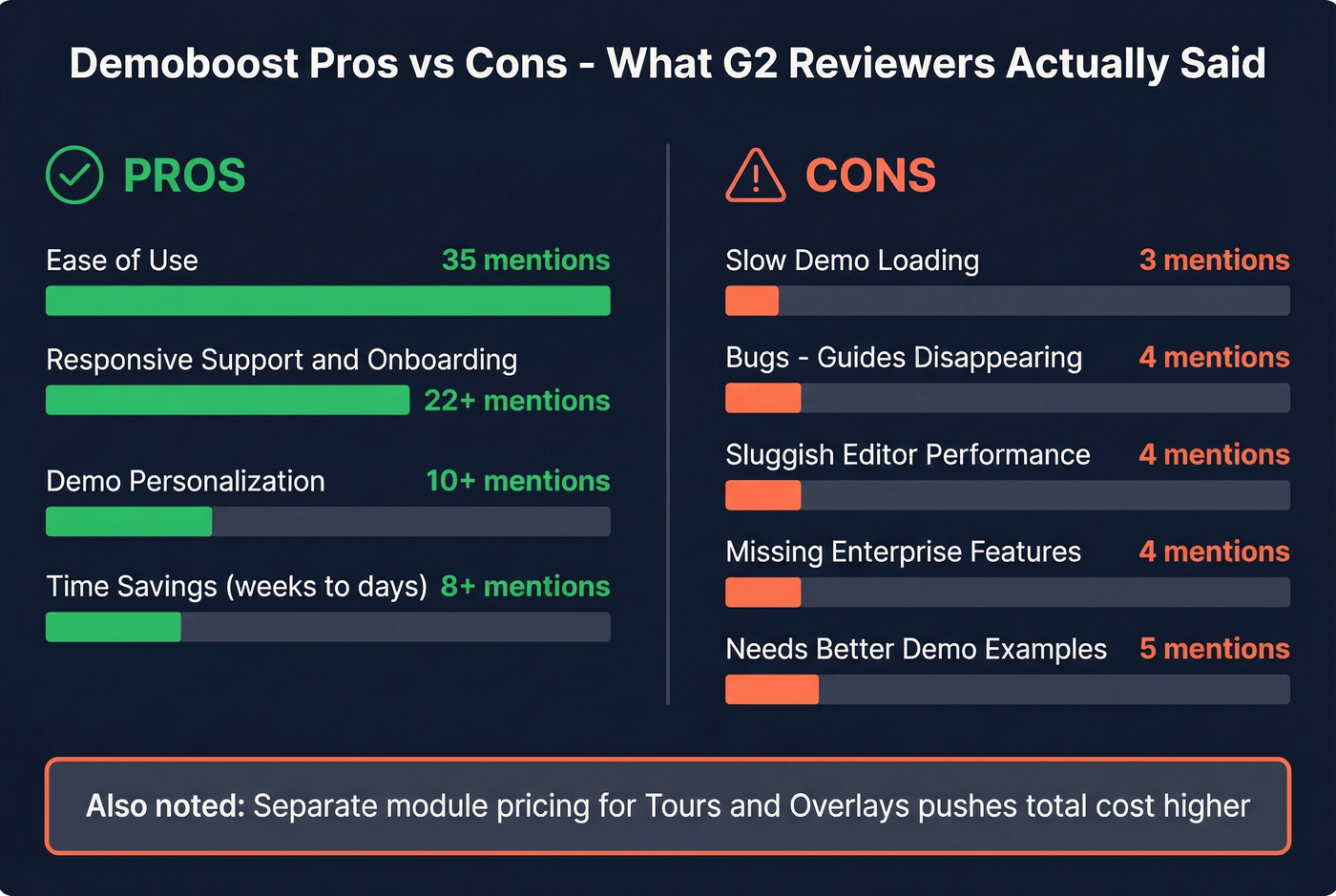
Ease of use is the most-cited positive across G2 reviews, with 35 mentions. Users consistently describe the demo builder as intuitive, even for non-technical team members. That matters when you're trying to get adoption across an entire presales org, not just the one person who "owns" the tool.
Responsive support and onboarding earned 22+ G2 mentions. For a tool that takes about a month to implement, strong onboarding isn't a nice-to-have - it's the difference between a successful rollout and shelfware.
Demo personalization stands out too. Reviewer Elyssa F. highlighted the ability to "customize demos for different campaigns" as a key win. The non-linear journey builder gives presales teams real flexibility to tailor flows by persona, industry, or deal stage.
Time savings round out the positives. Multiple reviewers report cutting demo build time from weeks to days, which directly frees up solution consultants for higher-value work.
Cons
Slow demo loading is the most visible complaint. Three G2 users flagged it, and Elyssa F. put it bluntly: "Demonstrations can sometimes take too long to load, which could deter customers." For a tool whose entire job is delivering demos, that's a problem worth taking seriously.
Then there are the bugs. Four reviewers mentioned guides disappearing or customers getting stuck mid-demo. When your prospect can't progress past a section, you've lost the moment - and possibly the deal.
On the editor side, four users report sluggish performance when editing, sometimes requiring page refreshes to keep moving. A Verified User in a late-2025 review described "minor editing flows" that disrupted their workflow. Small friction, but it compounds fast when you're building demos daily.
The feature gaps feel surprising at this price point. Bulk actions, granular access control, and sensitive information blurring all appear as missing across four G2 reviews. These are table-stakes features for enterprise presales teams spending $15K+ a year.
Five reviewers also asked for better demo examples and guidance. As Andy S. put it: "What does 'a great' example of an automated demo using DemoBoost look like?" The platform could do more to show best practices upfront, especially given the month-long implementation timeline.
And the elephant in the room: separate module pricing. You can end up budgeting for both Tours and Overlays, which pushes the total cost up fast compared to competitors offering free tiers and published pricing.
Who Should (and Shouldn't) Use Demoboost
Use Demoboost if:
- You're an enterprise presales team with complex, multi-persona products
- You've got $15K+ annual budget for demo tooling and don't mind custom pricing
- You need live demo overlays on production environments - a genuine differentiator
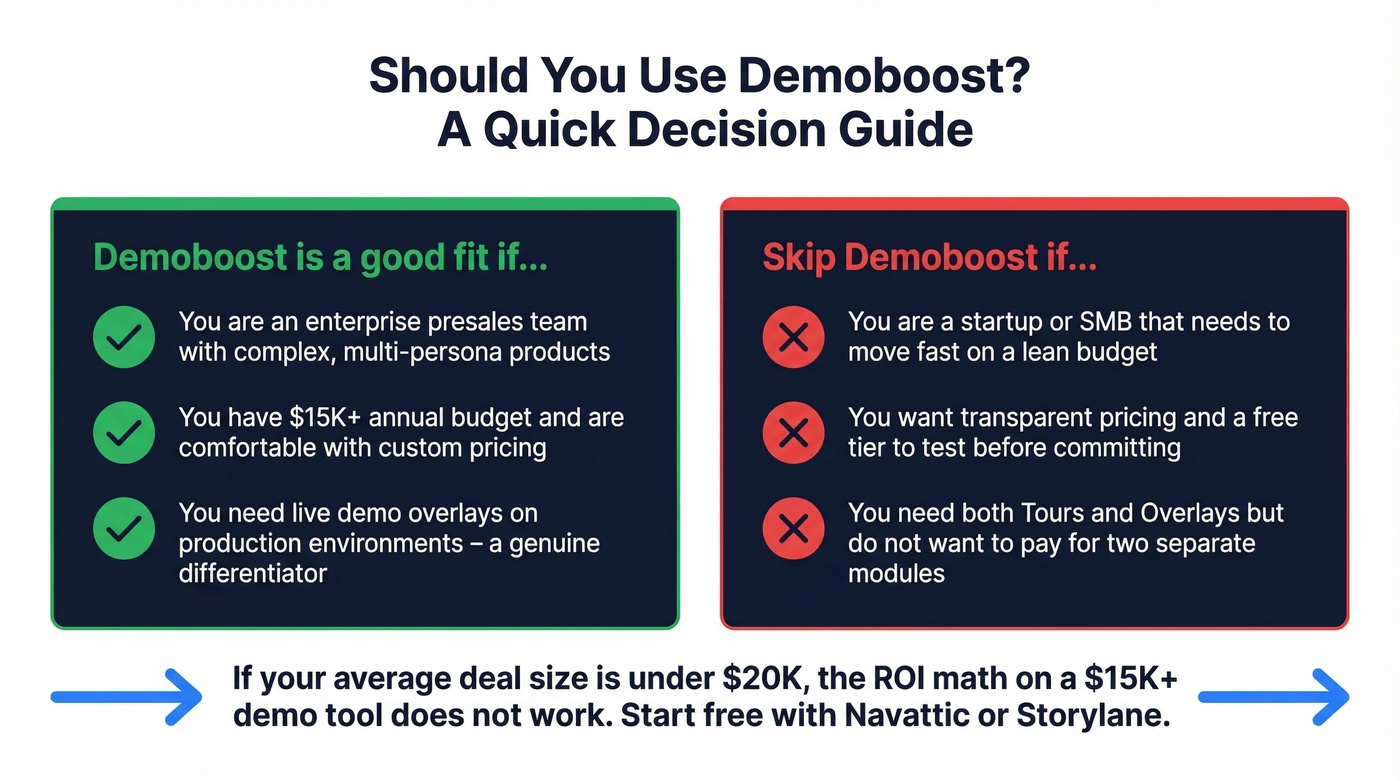
Skip Demoboost if:
- You're a startup or SMB that needs to move fast on a lean budget
- You want transparent pricing and a free tier to test first
- You need both Tours and Overlays and don't want to pay for two separate modules
Here's our honest take: Demoboost's feature set is genuinely impressive, but the pricing model actively punishes the mid-market buyers who'd benefit from it most. If your average deal size is under $20K, the ROI math on a $15K+ demo platform just doesn't work. Start with Navattic's free tier, prove the category, then upgrade when the budget justifies it.
Whatever demo platform you choose, your demos only work if they reach real inboxes. We've seen teams invest $15K+ in demo tooling only to send those polished interactive demos to email addresses that bounce. Prospeo verifies emails with 98% accuracy on a 7-day refresh cycle - and it starts free, which is more than Demoboost offers for its own trial.

You just read about a tool that hides pricing and sells modules separately. Prospeo is the opposite: self-serve, $0.01/email, published pricing, and 300M+ verified profiles you can search with 30+ filters - including buyer intent and technographics.
Transparent pricing, enterprise-grade data. No sales call needed.
Verdict
Demoboost is a capable enterprise demo platform with genuinely strong reviews from the users who've adopted it. The live overlay feature and non-linear demo journeys set it apart from simpler tools. But the pricing opacity and separate module costs make it hard to recommend for mid-market teams when Navattic, Storylane, and Supademo offer free tiers and published pricing.
Let's be honest: in 2026, "request a quote" pricing is a competitive disadvantage. If Demoboost published tiers and offered even a limited free plan, it'd be a much easier recommendation. Until then, test the transparent alternatives first.
FAQ
How much does Demoboost cost per year?
Expect $10,000-$20,000+ annually for a mid-size team, based on estimated per-seat pricing of $50-$150/user/month plus module add-ons. Demoboost doesn't publish pricing, so you'll need to request a custom quote. G2 data suggests you can negotiate roughly 14% off the initial offer.
Does Demoboost offer a free trial?
No free trial is listed on Capterra as of 2026, and the Demoboost website routes all pricing inquiries through a sales form. Competitors like Navattic, Storylane, and Supademo all offer free tiers you can test immediately without a sales conversation.
What are the biggest complaints about Demoboost?
Slow demo loading, intermittent bugs (guides disappearing mid-demo), and sluggish editor performance are the top three complaints across G2 reviews. Four reviewers also flagged missing enterprise features like bulk actions and granular access controls - surprising gaps at this price point.
Is there a good free alternative to Demoboost for sending demo links?
Navattic and Supademo both offer free tiers for creating interactive demos. For the email delivery side - making sure your demo links actually land in inboxes - Prospeo offers 75 free email verifications per month with 98% accuracy, so you're not wasting polished demos on bad addresses.