

Digital Sales Rooms: What They Are & How to Use Them in 2026
You built a deal room last quarter. Loaded it with case studies, a pricing deck, a mutual action plan, and a personalized Loom walkthrough. Nobody opened it. Not once.
That's not a you problem - roughly 48% of deal rooms created never get any engagement at all. The software matters far less than the data and strategy you put into it.
The Short Version
A digital sales room is a private microsite where you and your buyer collaborate throughout a deal. Point solutions like Trumpet, Aligned, and Dock are priced for SMB teams - Aligned runs $26-$54/month, Dock starts at $49/month, and Trumpet starts at £29/month (~$37). Enterprise suites like Seismic, Highspot, and Allego typically run $15,000-50,000+/year and bundle DSRs into broader enablement platforms.
The real differentiator isn't the tool. It's whether you've got the right contacts, the right content, and a reason for the buyer to come back. Nearly half of all deal rooms go completely untouched, so picking the fanciest platform won't save a lazy implementation.
What Is a Digital Sales Room?
Gartner defines a DSR as a private, persistent microsite that connects buying and selling teams throughout the customer journey, combining content, commerce, and planning tools to support both self-serve and seller-led interactions.
In plain English: it's a branded webpage - unique to each deal - where your buyer can find everything they need without digging through email threads. Proposals, contracts, case studies, mutual action plan, pricing, and recorded demos all live in one place. Think of it as a shared workspace that replaces the chaos of 47 email attachments and a Google Drive link nobody bookmarked.
What separates a DSR from a regular shared folder is engagement analytics. You can see what content gets viewed, who's looking at it, and how buyers interact with each piece - visibility that turns it from a file cabinet into a sales tool.
Why DSRs Matter in 2026
The shift isn't subtle. Gartner predicted that 30% of B2B sales cycles would be managed through digital sales rooms by 2026, and we're watching that play out in real time. The same research projected that 80% of B2B sales interactions would occur in digital channels - a number that felt aggressive in 2022 but looks conservative now. Gartner also found 43% of B2B buyers prefer a seller-free experience entirely, rising to 54% among millennials.
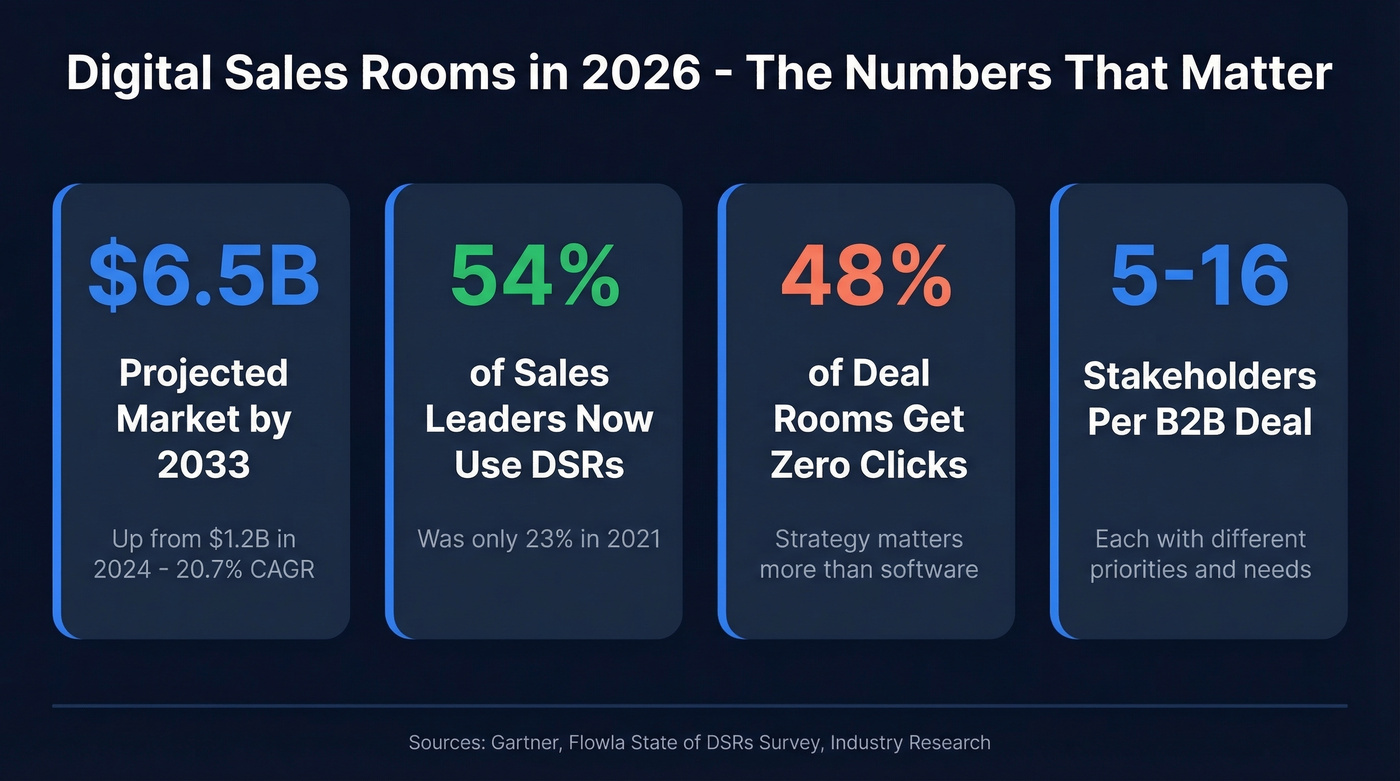
The market reflects this momentum. The global DSR market hit $1.2B in 2024 and is projected to reach $6.5B by 2033, growing at a 20.7% CAGR. North America accounts for 38% of that spend, with APAC growing fastest at 24.3%. In 2021, only 23% of sales leaders budgeted for DSRs. Today, 54% use them across all deals. That's not a trend - it's a structural shift.
Three forces are driving adoption:
Buying committees keep expanding. Gartner research puts deals at 5 to 16 stakeholders across different functions, each with different priorities and information needs. A single PDF deck can't serve all of them.
Buyers expect self-serve. McKinsey's research shows 70% of decision-makers are open to fully self-serve or remote purchases over $50K. They don't want to wait for a meeting to review your proposal.
The pandemic permanently rewired expectations. The sellers who adapted to digital-first kept their pipeline velocity. The ones still emailing attachments are losing deals to competitors who make it easier to buy.
DSR vs. Virtual Data Room
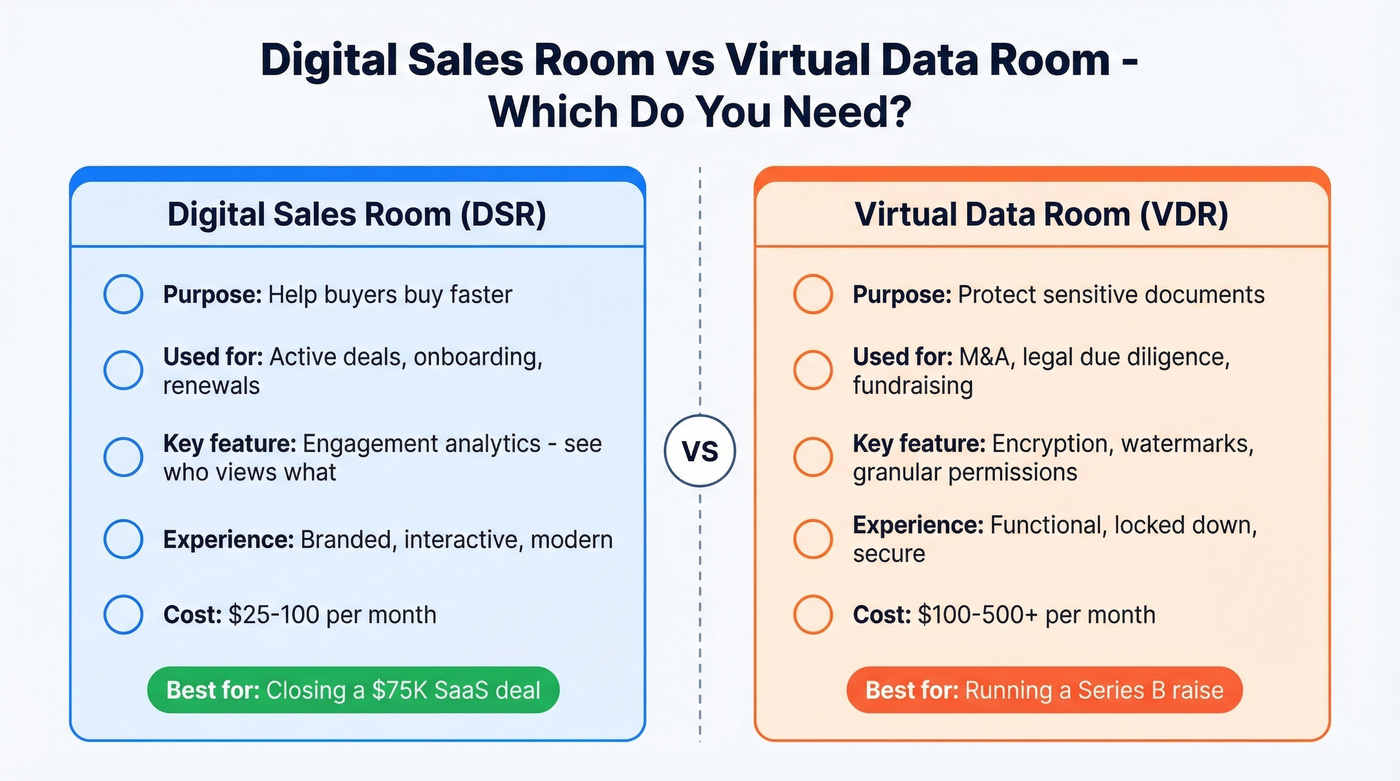
These get confused constantly. They're fundamentally different tools.
| Digital Sales Room | Virtual Data Room | |
|---|---|---|
| Purpose | Buyer enablement for active sales | Security-first document vault |
| Used for | Deals, onboarding, renewals | M&A, legal due diligence, fundraising |
| Key feature | Engagement analytics | Encryption, watermarking, granular permissions |
| Buyer experience | Branded, interactive | Functional, locked down |
| Typical cost | $25-100/mo | $100-500+/mo |
A DSR helps you sell. A VDR protects sensitive documents during high-stakes transactions like mergers and fundraising. Running a Series B? You need a VDR. Trying to close a $75K SaaS deal with a seven-person buying committee? You need a DSR.

A digital sales room is only as good as the contacts inside it. With 5-16 stakeholders per deal, you need verified emails for every decision-maker - not just the one who took your first call. Prospeo gives you 98% accurate emails across 300M+ profiles so your DSR lands with the full buying committee.
Stop building deal rooms for contacts who never see them.
Types of DSR Software
Not all deal room platforms are built the same way. Dock's taxonomy breaks the category into six types, and it's a useful framework.
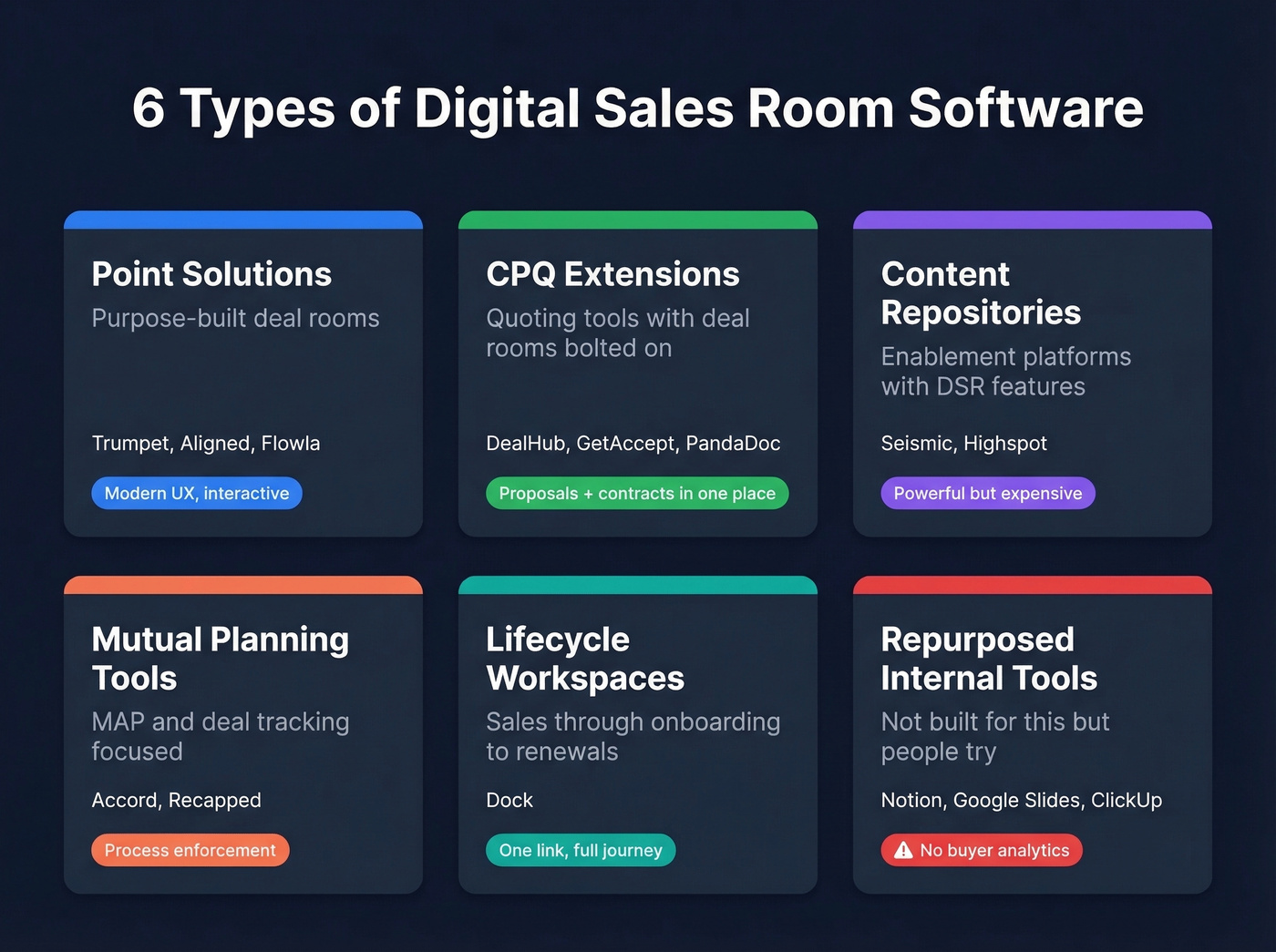
Point solutions like Trumpet, Aligned, and Flowla are purpose-built deal rooms with modern UX and interactive elements. These are what most people mean when they say "DSR."
CPQ extensions like DealHub, GetAccept, and PandaDoc started as quoting or e-signature tools and bolted on deal room functionality. Strong if you need proposals and contracts in the same place.
Content repositories like Seismic and Highspot are enablement platforms where the DSR is one feature among many. Powerful but expensive and complex.
Mutual planning tools like Accord and Recapped focus on mutual action plans and project-management-style deal tracking.
End-to-end lifecycle workspaces like Dock aim to carry the same link from sales through onboarding and into renewals.
Then there are repurposed internal tools - Notion, Google Slides, ClickUp. Sharing a Notion page can work for collaboration, but you won't get buyer engagement analytics or deal-room UX from a tool that wasn't built for it.
Best DSR Tools Compared
| Tool | Best For | Rating | Starting Price | Free Tier? |
|---|---|---|---|---|
| ⭐ Dock | Sales-to-renewal lifecycle | 4.9/5 | $49/mo | Yes |
| Trumpet | Interactive deal rooms | 4.8/5 | ~$37/mo (£29) | Free trial |
| Aligned | Fast setup, small teams | 4.8/5 | $26/mo | Yes |
| GetAccept | Proposals + e-signatures | 4.6/5 | $39/mo per user | Free trial |
| DealHub | Complex quoting workflows | ~4.5/5 | ~$25-100/mo | No |
| Accord | Mutual action plans | 4.8/5 | From $99/mo | No |
| Seismic/Highspot | Enterprise enablement | Varies | ~$15K-50K+/yr | No |
Dock (Editor's Pick)
Dock earns its 4.9/5 rating by solving a problem most DSRs ignore: what happens after the deal closes? The same workspace carries from sales through onboarding and into customer renewals, so your CS team doesn't rebuild everything from scratch. At $49/month with a freemium tier, it's the most complete option for teams that want one link from first meeting to renewal.
In our experience, the rooms that actually get opened are the ones built for three stakeholders, not thirty - and Dock's template system makes that kind of curation easy. We've seen teams cut room creation time to under 10 minutes once they've dialed in their templates, which is the difference between reps building rooms for every deal and reps building rooms for none.
Trumpet
Trumpet is the tool that makes buyers actually want to open the link. The UI is genuinely modern - interactive elements, embedded videos, personalized content blocks - and it shows. At £29/month (~$37), it's priced for SMB and mid-market teams that want a polished buyer experience without enterprise overhead.
Users rate it 4.8/5, and the praise consistently centers on design quality and ease of setup. Free trial available, so you can build a room before committing. The tradeoff: Trumpet is laser-focused on the deal room itself. For teams that need lifecycle continuity into onboarding or renewals, you'll outgrow it.
Aligned
Use this if you're a small team that needs a DSR running by Friday. Aligned's freemium plan is a strong no-cost entry point - you get a functional deal room without pulling out a credit card. Paid plans run $26-54/month, and the 4.8/5 rating reflects how little friction there is in getting started.
Skip this if you need deep CRM integrations or complex workflow automation. Aligned is built for speed and simplicity, not for RevOps teams managing 200+ concurrent deal rooms with custom routing rules.
GetAccept
GetAccept started as a proposal and e-signature tool, and that DNA shows. The deal room functionality is solid, but the real strength is combining content sharing with contract execution in one flow. Pricing runs $39/month per user for deal rooms, $49/month per user for contract rooms. At 4.6/5, it sits a step below the pure-play DSRs on user satisfaction, but if your bottleneck is getting signatures rather than sharing content, GetAccept collapses two tools into one.
DealHub
DealHub is for teams where the proposal itself is the hard part - multiple SKUs, usage-based pricing, approval workflows. It handles the full quote-to-revenue cycle with a deal room bolted on. Pricing ranges from ~$25-100/month depending on which modules you activate. Not the right tool if you just need a clean content-sharing experience.
Accord
Accord lives in the mutual action plan niche. Starting at $99/month, it's pricier than the point solutions, and the feature set is narrower - MAP tracking, stakeholder alignment, deal milestones. Best for teams that have already standardized on MEDDIC or a similar methodology and want the DSR to enforce the process.
Enterprise Suites: Seismic, Highspot, Allego
Here's the thing: these aren't DSR tools. They're enterprise enablement platforms that happen to include a deal room feature. Seismic and Highspot typically run $15,000-50,000+/year on custom contracts, and the DSR is a slice of what you're paying for. Seismic touts a 197% buyer engagement increase, but that's a self-reported metric from their own platform - not an independent benchmark.
The fact that none of them publish pricing is genuinely frustrating. You can't even ballpark the cost without sitting through a demo and a "discovery call" that's really a qualification screen.
If you've got 100+ reps and you're already paying for content management, training, and coaching in one of these platforms, the built-in DSR makes sense. For everyone else, it's overkill. A $49/month Dock account will outperform a $30K/year Seismic deployment that nobody on your team actually uses. The best DSR is the one your reps will build rooms in every single day.
Why Most Deal Rooms Fail
The Flowla State of Digital Sales Rooms survey found that roughly 48% of deal rooms created never get a single click. Nearly half.
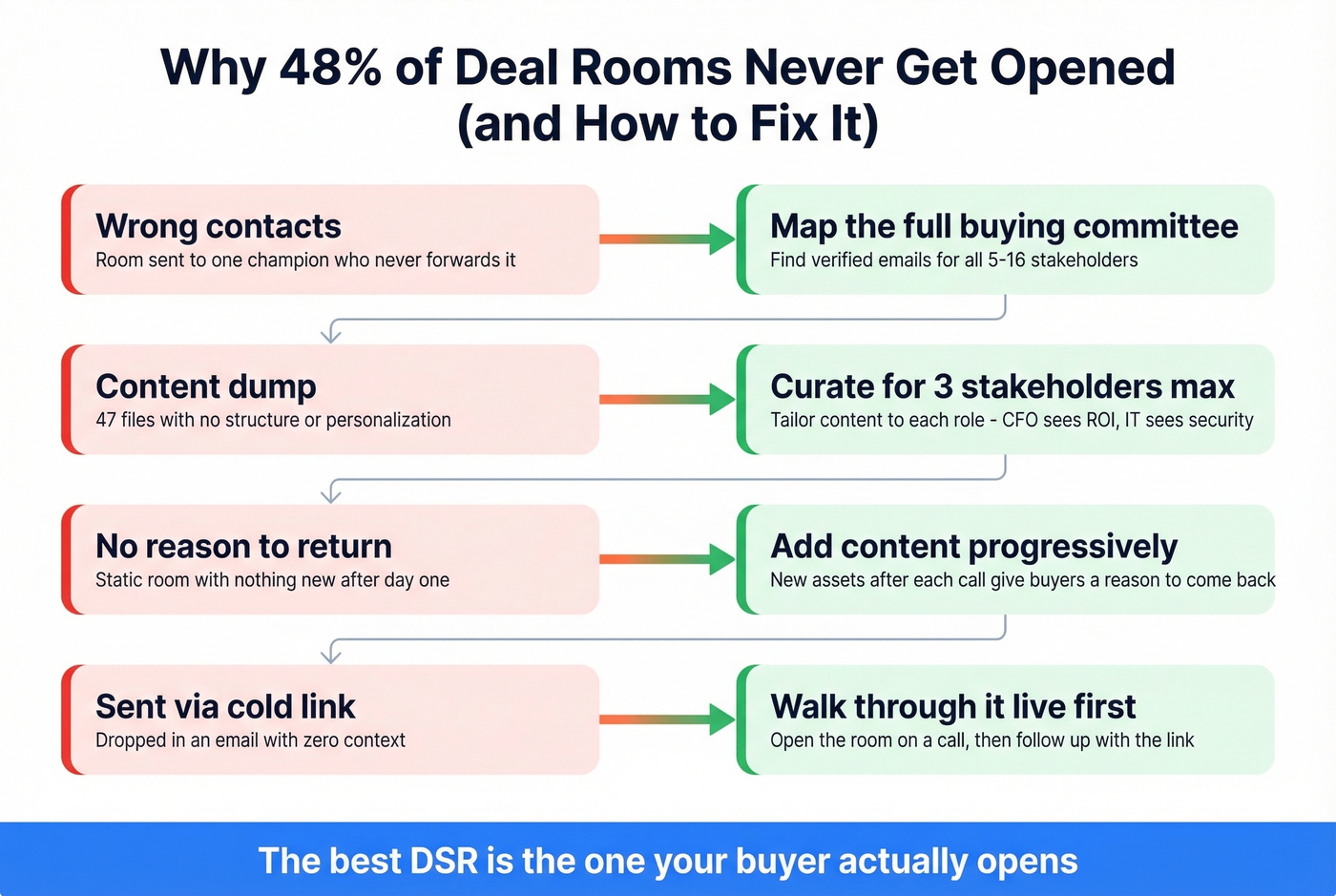
The skepticism is real. Reddit threads about DSRs often boil down to "what's the point of another platform when we already have email and video calls?" Given the 48% failure rate, the concern isn't crazy. But the problem isn't the category - it's how teams implement it. The failure modes are predictable.
The data dump. Reps throw every piece of content into the room - 14 PDFs, 3 case studies, a 40-slide deck, and a pricing calculator. The room becomes a static repository that buyers won't wade through. More content doesn't mean more engagement. It means more noise.
The surveillance backlash. Buyers aren't stupid. When they realize every click is being tracked, some disengage entirely. The Flowla survey flagged "surveillance concern" as a real friction point, particularly with technical buyers and privacy-conscious prospects.
The "just another tool" problem. Your buyer already has a Slack channel, an email thread, a shared Google Doc, and a project board for this evaluation. Asking them to check yet another platform is a hard sell unless the room delivers clear, immediate value they can't get elsewhere.
The missing stakeholder problem. This one kills more deals than bad content does. Your DSR analytics show the link was forwarded to seven new viewers. But you can't follow up because you don't have their emails. You built a room for nine people on the buying committee and only have contact info for two. The room is working - your data isn't.
The adoption numbers tell the same story from a different angle: 54% of practitioners use DSRs across all deals, but roughly 30% have never used one at all. The gap between "we bought the tool" and "we actually use it well" is enormous.
Getting Buyers to Actually Use Your DSR
Five tactics that separate the 52% of rooms that get engagement from the 48% that don't.
1. Curate, don't dump. Treat your deal room like a museum exhibit, not a filing cabinet. Three to five pieces of content, max, at any stage. Add materials progressively as the deal advances. The buyer should open the room and immediately see what's relevant to them right now - not everything you've ever produced about your product.
2. Present the room live first. Don't just send a link cold. Walk through the room on a call, show the buyer where things are, and then send the link as a follow-up. Adoption rates spike when the buyer has already seen the room in action. Even 15 minutes prevents the "poor usage, poor feedback" cycle that kills engagement before it starts.
3. Never call it a "digital sales room." That's vendor jargon. Frame it as "a dedicated space for us to collaborate" or "your project hub for this evaluation." The language matters more than you'd think.
4. Personalize by stakeholder role. The CTO cares about implementation timelines and security architecture. The CFO cares about ROI and contract terms. The end-user cares about ease of adoption. Build sections tailored to each persona on the buying committee, not a one-size-fits-all content dump.
5. Fix your data first. Your DSR analytics show the link was forwarded to seven unknown viewers - but you can't follow up because you don't have their emails or direct dials. Nine people on the buying committee, contact info for two. That's not a DSR problem; it's a data problem. Prospeo handles this upstream: search by company and department across 300M+ profiles, pull verified emails at 98% accuracy with a 7-day refresh cycle, and use the Chrome extension to enrich contacts in one click. The room is the plate. The data is the food.

The #1 reason deal rooms go unopened isn't the platform - it's sending them to the wrong person. Prospeo's 30+ search filters let you identify every stakeholder by job title, department, and seniority, then deliver verified emails and direct dials at $0.01/email. Build your DSR for the people who actually sign off.
Reach all 16 stakeholders, not just your champion.
Key Features to Evaluate
Not every DSR needs every feature. But here's what separates a real buyer engagement platform from a glorified shared folder.
Engagement analytics are non-negotiable. You need to know who opened the room, which documents they viewed, how long they spent on each page, and whether they forwarded the link. Without this, you're flying blind.
Content management should be drag-and-drop simple. If reps need training to upload a PDF, adoption will crater. The best tools support video embeds, interactive proposals, and dynamic content blocks - not just static file hosting.
E-signatures built into the room eliminate the handoff to DocuSign or PandaDoc. GetAccept handles proposals and e-signatures in the same flow. If signing is a bottleneck in your process, make sure your platform supports it natively or through a tight integration.
CRM integration with Salesforce or HubSpot keeps your deal data in sync. The room should auto-log engagement events to the opportunity record so your manager doesn't ask why there's no activity in the CRM.
Mutual action plans give the deal structure - shared timelines, assigned tasks, milestone tracking that keeps both sides accountable. Dock and Accord are strongest here.
Security and compliance matter more than most teams realize. SOC 2 certification, GDPR compliance, SSO, and granular permission controls are standard requirements in enterprise deals. If your buyer's security team can't approve the tool, the room is dead on arrival.
Mobile-responsive design is easy to overlook and painful to discover you're missing. Executives review deal materials on their phones. If your room looks broken on mobile, you've lost the CFO before they read a word.
FAQ
How much does a digital sales room cost?
Point solutions run $26-$54/month for Aligned, $49/month for Dock, and £29/month (~$37) for Trumpet. Enterprise enablement suites with built-in DSR features typically cost $15,000-50,000+/year on custom contracts. Both Aligned and Dock offer free tiers that work for small teams testing the category.
Do small sales teams need a DSR?
If you're running multi-stakeholder deals with three or more buyers involved, a DSR pays for itself in deal visibility alone. For transactional products sold to a single decision-maker on a two-week cycle, email and a good proposal tool will do the job.
Can I use Notion or Google Drive instead?
You can share documents, but you won't get buyer-friendly structure, purpose-built engagement analytics, or workflow features like mutual action plans and e-signatures. A Notion page is a shared workspace with a nice URL - not a deal room that tells you who viewed what and when.
How do I identify all stakeholders for my deal room?
Use a B2B data platform like Prospeo to map the full buying committee - search by company, department, and seniority to find verified emails and direct dials for every decision-maker. That way your room reaches all nine stakeholders, not just the two you already know.
What's the difference between a DSR and a virtual data room?
Digital sales rooms are buyer engagement tools for active sales cycles - they help you sell with analytics, personalized content, and mutual action plans. Virtual data rooms are security-first document vaults built for M&A, legal due diligence, and fundraising, with encryption, watermarking, and granular access controls.