

How to Build a Digital Transformation Sales Pitch That Doesn't Get Ignored
The last "transformation" at your company was probably a CRM rollout that sales refused to use because nobody asked them what they needed. A CEO mandated a uniform platform, the team saw it as a control tool rather than an enabler, and adoption cratered. If you're now tasked with building a digital transformation sales pitch for the next wave of change, you're fighting that memory - and the widespread practitioner consensus that "digital transformation" is corporate rhetoric with little real action.
A quick clarification: this article is about pitching digital transformation internally - to your board, your C-suite, your budget holders. If you're looking for advice on selling DT services to external clients, that's a different playbook entirely. This one is for the person who knows the company needs to change and has to convince leadership to fund it.
Here's the short version. Stop calling it "digital transformation." Frame it as an operational business case with technology as the enabler. Use the 8-slide deck structure below - boards fund phases, not visions. And lead with the Gartner stat: only 48% of enterprise-wide digital initiatives meet or exceed their business outcome targets, but the "Digital Vanguard" cohort hits 71%. The differentiator is CIO + CxO co-ownership. Governance is your pitch's backbone.
Why Most DT Pitches Fail
The data is brutal: per McKinsey research cited by IT Convergence, 70%+ of digital transformations fail to deliver intended outcomes. Most of those failures aren't technical - they're political and structural. We've watched these five pitch killers sink more proposals than bad slides ever will:
- No cross-functional buy-in. You pitched IT and finance but never looped in the ops leaders who'll actually change their workflows.
- Framing it as a tech upgrade. Boards don't fund platform migrations. They fund revenue growth, cost reduction, and risk mitigation.
- Skipping the financials. If your deck doesn't have an ROI slide with real numbers, it's dead before Q&A.
- Boiling the ocean. An all-or-nothing, 18-month roadmap with no interim milestones terrifies budget holders. Break it into phases or watch it die in committee.
- No urgency. Without a clear "cost of inaction" number, leadership defaults to "we're not ready yet."
These five come directly from Verndale's analysis of stalled proposals, and they match every failed pitch we've seen unfold.
Know Your Audience First
Before you build a single slide, map who's in the room and what they care about. A board member and a VP of Operations need completely different arguments.
| Audience | What They Care About | Your Angle |
|---|---|---|
| Board / C-suite | Budget, ROI, timelines | Financial model with phased risk - show payback period by quarter |
| VP / Director | Profitability, time-to-market | Show 90-day Phase 1 win + FTE hours saved |
| Cross-functional | Customer experience, workflow | Include their workflow in the pilot design - make them co-authors |
Here's the thing: the biggest risk isn't a bad deck. It's being seen as presumptuous. On r/askmanagers, a mid-level leader with solid data and a plan hesitated to pitch because it felt "too far-reaching" without senior sponsorship. The fix is pre-wiring. Share an overview with one or two senior allies before the formal pitch. Gauge interest, get feedback, and walk into the room with implicit backing already in place.
The 8-Slide Deck Structure
Investors spend about two minutes on a pitch deck. Build for that attention span: every slide earns its place or gets cut.
Adapted from LivePlan's fundraising deck framework and condensed for executive brevity:
- The Problem - Quantify the cost of the status quo. Revenue leakage, manual hours, customer churn.
- The Opportunity - Market context. What competitors are doing. What's at stake.
- The Solution - Your proposed approach in one sentence. Not a feature list.
- Phased Roadmap - Three phases with milestones. Phase 1 delivers a quick win in 90 days.
- ROI Model - Conservative, mid, and aggressive scenarios. Show payback period.
- Governance Structure - Who co-owns this. CIO + business leader. This is the slide that wins.
- Risk Mitigation - What could go wrong and how you'll handle it.
- The Ask - Budget, timeline, and the specific decision you need today.
The goal of this deck isn't to close. It's to get the next meeting. Keep it tight. Push your technical architecture, vendor comparison matrix, and detailed implementation timeline into an appendix - available if asked, invisible if not.

Your digital transformation pitch needs a Phase 1 win that proves the model. Start with sales data: Prospeo's 300M+ verified profiles and 98% email accuracy let teams book 26% more meetings - the kind of measurable result that turns a 90-day pilot into full board funding.
Give your pitch real numbers. Build your first list in minutes.
Stats That Win the Room
Drop these into your slides where they fit. Each one is sourced and defensible.
| Stat | Source | How to Use It |
|---|---|---|
| 48% of digital initiatives hit targets | Gartner survey of 3,186 CIOs/tech execs + 1,126 CxOs | Opens with urgency |
| Digital Vanguard cohort hits 71% | Gartner, same survey | Justifies governance slide |
| 2.5x budget increase in 2 years | Deloitte CTrO Study | Proves peers are investing |
| 80%+ programs on track | Deloitte CTrO Study | Counters "always fails" objection |
| 74% investing in AI/GenAI | Deloitte Tech Value | Frames AI as table stakes |
| Tech budgets: 8% to 14% of revenue | Deloitte Tech Value | Normalizes your budget ask |
Five Objections and Rebuttals
"We're not ready yet."
Readiness is a governance problem, not a maturity problem. Nobody feels "ready" - that's the point. Propose a 90-day pilot that proves the model without requiring full commitment. Once the pilot delivers a measurable result, readiness stops being a question.
"Show me quick wins first."
This one is a trap. Quick wins without a strategy create tech debt that the next team inherits. Your rebuttal: Phase 1 delivers a measurable win inside the larger roadmap. You're not asking them to skip quick wins - you're asking them to make quick wins count toward something bigger.
On r/ITManagers, practitioners describe leadership demanding tiny incremental wins before granting any mandate - which guarantees the transformation never gets strategic altitude. I've seen this play out at three different companies, and the pattern is always the same: the pilot succeeds, nobody funds the next phase, and the pilot becomes a permanent workaround that everyone resents.
"We tried this before and it failed."
Of course it did - 52% of initiatives miss their business outcome targets, usually because of siloed ownership. Your governance model mirrors the cohort that hits 71%. The difference isn't the technology. It's the co-ownership structure. Name the specific governance gap that killed the last attempt and show how your model closes it.
"IT should own this."
Gartner's data is clear: CIO + CxO co-ownership is a key differentiator between average outcomes and Digital Vanguard outcomes. This needs joint sponsorship. IT owns the implementation; the business owns the outcomes. Split it any other way and you're back in the 48%.
"If it's working, why touch it?"
It's working now. Technology budgets are rising from 8% to 14% of revenue across the industry. The cost of inaction compounds quarterly. Frame this as a competitive risk: your competitors are seeing up to a 2.5x increase in transformation budgets versus two years ago. Standing still is falling behind.
The Data Foundation Most Pitches Ignore
Every transformation pitch talks about automation, AI, and workflow optimization. Almost none address the data those systems run on.
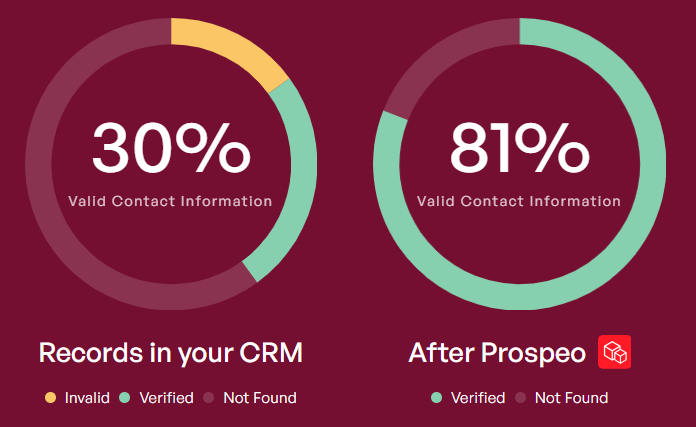
If your CRM is full of stale contacts - bounced emails, disconnected numbers, people who changed jobs two quarters ago - then every automated workflow you build is firing into the void. This is the blind spot that kills otherwise solid proposals. When your pitch promises "AI-driven outreach" or "automated lead routing," the first question should be: what's the data quality underneath?
We've seen teams at companies like Snyk go from 35-40% bounce rates to under 5% just by running their CRM through Prospeo's enrichment, which returns 50+ data points per contact on a 7-day refresh cycle with 98% email accuracy. That's the kind of foundation that turns a digital transformation sales pitch from theory into something measurable on day one.
Presentation Tips That Matter
Three things that separate pitches that get funded from pitches that get a polite "let's revisit next quarter."
Tell a story, not a feature list. "Our support team spends 14 hours a week on manual ticket routing" hits harder than "we'll implement AI-powered ticket classification." Start with the pain, not the solution. Every number in your deck should make someone in the room uncomfortable about the status quo.
Respect the two-minute window. Your deck has about 120 seconds of genuine attention. Front-load the problem and the ROI. Save the technical architecture for the appendix.
Reframe the language. Look, stop calling it "digital transformation." Call it what it is: an operational business case for change that happens to involve technology. The word "transformation" triggers cynicism in every room that's heard it before. In our experience, the pitches that get funded fastest are the ones that never use the T-word until someone else brings it up.
Let's be honest about something: most pitches for digital change fail not because the idea is wrong, but because the pitcher treats it like a technology proposal. It's not. It's a change management proposal with a technology component. The moment you internalize that distinction, your pitch gets dramatically better.
Slide 5 says show ROI. Here's one: teams using Prospeo cut bounce rates from 35% to under 4% and triple pipeline output - without adding headcount. At $0.01 per verified email with a 7-day data refresh cycle, that's the cost-reduction and revenue-growth story boards actually fund.
Stop pitching transformation. Start showing results.
FAQ
How long should a transformation pitch deck be?
Eight slides or fewer. Executives spend about two minutes on a deck, so every slide must earn its place. Focus on problem, solution, phased roadmap, ROI, and governance - push technical details and vendor comparisons into an appendix.
What's the top reason these pitches get rejected?
Framing it as a technology upgrade instead of a business outcome. Boards fund revenue growth, cost reduction, and risk mitigation - not platform migrations. Lead with financial impact and payback period, not the tech stack.
How do you prove ROI before implementation starts?
Use phased milestones with measurable 90-day checkpoints. Cite Gartner's finding that the Digital Vanguard cohort hits targets 71% of the time, and propose a CIO + CxO co-ownership governance model. Clean, verified data ensures your baseline metrics are accurate from day one - if your pilot numbers are built on stale records, your ROI model falls apart before it starts.
What data quality issues should I address in my pitch?
Stale CRM records undermine every automation promise. If 30-40% of your contact data bounces, AI-driven workflows waste budget and damage sender reputation. Include a data hygiene slide showing current bounce rates versus post-enrichment targets - teams that invest in data quality routinely drop bounce rates from 35%+ to under 4%, which makes the entire ROI model credible.