

The Data-Backed Discovery Call Script for 2026
You blocked 90 minutes for discovery calls this morning. Six booked. Two no-showed. One turned out to be a marketing coordinator who can't sign a napkin, let alone a contract. The three that showed up? You talked too much, asked too many questions, and ended with "let me think about it."
That's not a bad week - it's the default experience for most B2B reps. The fix isn't motivation. It's a discovery call script backed by data, specifically Gong's analysis of 326,000 sales calls.
If You Take Nothing Else Away
Nail these three things:
- Open every call with a 60-second "up-front contract." Set the agenda, relieve pressure, and define next steps before a single discovery question leaves your mouth.
- Aim for the 43/57 golden ratio and ask 15-16 questions - not 20. Won deals average 15-16 questions. Hit ~20 and you're running an interrogation, not a conversation.
- Verify your prospect data before the call. A third of outbound meetings are no-shows. Dead numbers and stale emails mean you're burning discovery slots on ghosts.
Discovery Call Benchmarks
Before the script, let's anchor on what "good" actually looks like. The talk/listen and question-count benchmarks come from Gong's 326K-call dataset, duration benchmarks from broader sales-call reporting, and segment-level timing from Clari.
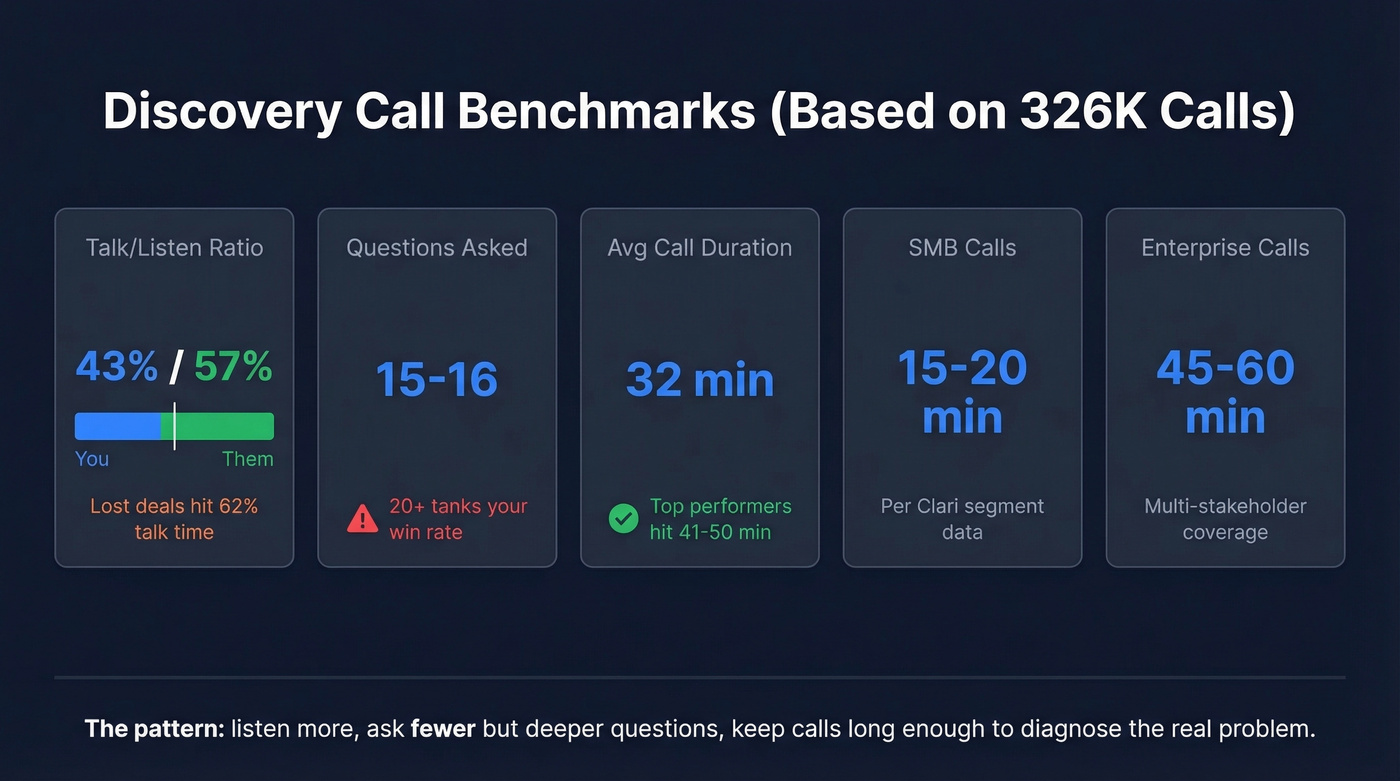
| Metric | Target | When You Miss |
|---|---|---|
| Talk/listen ratio | 43% talk / 57% listen | Lost deals hit 62% talk time |
| Questions asked | 15-16 | 20+ tanks win rate |
| Call duration | 32 min avg; top performers 41-50 min | Under 20 min = 42% less likely to advance |
| SMB calls | 15-20 min | Per Clari's segment guidance |
| Enterprise calls | 45-60 min | Multi-stakeholder = more ground to cover |
The pattern is clear: top performers listen more, ask fewer but deeper questions, and keep calls long enough to actually diagnose the problem. Reps who struggle talk 65-72% of the time and rush through a checklist. The script below is designed to hit these benchmarks naturally.
The Script (SaaS / B2B)
This script assumes a 30-40 minute call with a mid-market prospect. Adjust timing for SMB (compress) or enterprise (expand). Every section includes the actual words - no "[insert your value prop here]" placeholders.
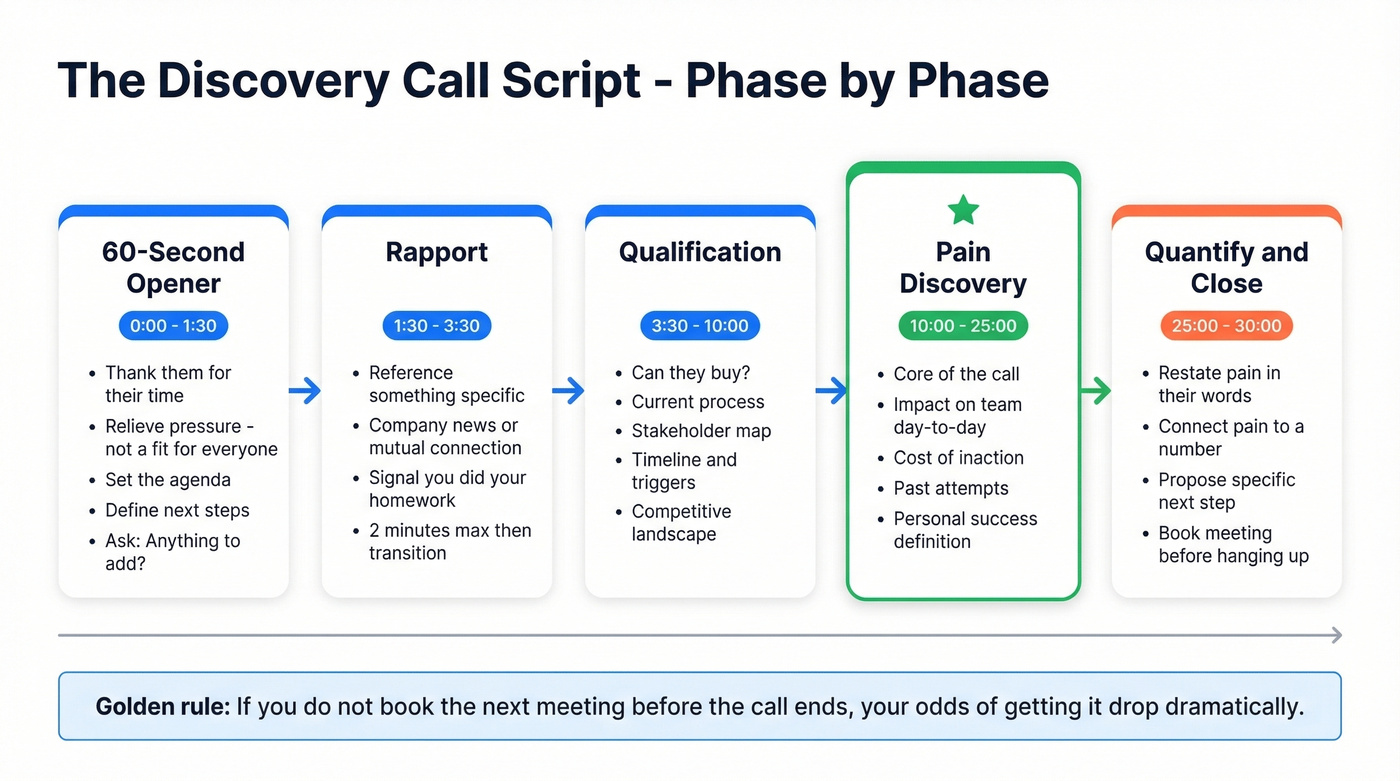
The 60-Second Opener
This is the single highest-leverage moment of the call. The up-front contract concept - popularized in Sandler training and discussed constantly on r/salestechniques - sets expectations before discovery begins. It has four components: thanks, pressure relief, agenda, and next steps.
"Hey [Name], thanks for making time today. Before we jump in - I want to be upfront. My goal for the next 30 minutes is to ask you a bunch of questions about [their challenge area] and figure out if there's actually a fit here. We're not a fit for everyone, and if it's not a match, I'll tell you that directly - please do the same. No hard feelings either way. If it does make sense, the next step would be scheduling a deeper dive with [relevant stakeholder/demo/technical review]. Sound fair? Anything you'd like to add to that agenda?"
That last question - "anything you'd like to add?" - is critical. It gives the prospect ownership of the call and surfaces hidden priorities you'd otherwise miss entirely.
Coaching note: This opener should take 60-90 seconds. If you're past 90 seconds and still talking, you've already started losing the ratio.
Rapport Phase (2 Minutes)
Don't jump straight from the up-front contract into qualification. You've earned two minutes of human connection. Reference something specific - a recent company announcement, a mutual connection, a detail from their profile. The goal isn't small talk for its own sake. It's signaling that you did your homework and see them as a person, not a pipeline number.
Two minutes, then transition: "So, let me start with what brought you here..."
Qualification Questions
Spend 5-7 minutes here. You're determining whether this person can buy, not whether they should. Weave these in conversationally - don't fire them sequentially like a census form.
"What prompted you to take this call? Was there a specific trigger, or has this been on your radar for a while?"
"Walk me through how you're handling [problem area] today. What does the current process look like?"
"Who else is involved in evaluating something like this? I'm not asking to go around you - I just want to make sure we include the right people early so this doesn't stall later."
"What's your timeline look like? Is there a date or event driving this?"
"Have you looked at other solutions? What did you like or not like?"
At this point, you should be listening more than you're talking. If you catch yourself explaining your product, stop. You're not there yet.
Pain Discovery Questions
This is the core of the call - 10-15 minutes of genuine diagnosis. The goal isn't to check boxes. It's to get the prospect to articulate their pain in their own words, because those words become your ammunition for every follow-up conversation. We've seen reps close deals months later by quoting the exact phrase a prospect used on this call.
"You mentioned [specific thing from qualification]. What's the actual impact of that on your team day-to-day?"
"If nothing changes in the next 6-12 months, what happens? What does that cost you - in revenue, time, headcount, whatever the metric is?"
"What have you tried before? What worked, what didn't?"
"If you could wave a magic wand and fix one thing about [problem area], what would it be?"
"What does success look like for you personally on this project? Not the company KPI - what makes you look good?"
That last question is underrated. People buy for personal reasons wrapped in business justification. Give them space to say it.
Quantify Impact & Close
Spend the final 3-5 minutes connecting their pain to a number and locking in next steps. Never end a discovery call without a calendar invite for the next meeting.
"So if I'm hearing you right, [restate pain in their words] is costing you roughly [their estimate or your calculation]. And the priority is [their stated priority]. Did I get that right?"
"Based on what you've shared, I think there's a strong fit - specifically around [1-2 areas]. Here's what I'd suggest as a next step: [specific next step]. I'll send a calendar invite before we hang up. Does [day/time] work?"
Here's the thing: if you don't book the next meeting before the call ends, your odds of getting it drop dramatically. "I'll send you some times" is where deals go to die.
Script Variations by Segment
Agencies & Consultants
Agency discovery calls are softer by nature. You're selling a relationship, not a platform. Replace the qualification block with vision-based questions drawn from Dubsado's discovery framework:
"What made you reach out now? What changed?"
"How did this business get started? What's the origin story?"
"What's felt hard or frustrating about this in the past?"
"If this goes better than expected, how would it impact your business - or honestly, your life?"
These feel less "salesy" because they are. Agency buyers aren't evaluating feature matrices. They're evaluating whether they trust you with their brand. A 45-minute structure works well: 5 minutes for intros, 10 for background, 15 for creative/strategic assessment, and 10 for goals and next steps.
Enterprise (Multi-Stakeholder)
Enterprise discovery runs 45-60 minutes and serves a different purpose: mapping the buying committee. You won't close on this call. You probably won't close on the next three either. Here's what you need to walk away with:
- The org chart - Who owns the budget? Who has veto power? Who's the internal champion?
- The decision process - Is there a procurement review? Legal sign-off? Security questionnaire?
- The competitive landscape - Have they bought in this category before? What went right or wrong?
- The metrics that matter - Not your metrics. Their internal KPIs that justify the spend.
Ask directly: "What does the approval process look like?" and "Who else needs to be in the room for this to move forward?" This is MEDDIC territory - Metrics, Economic Buyer, Decision Criteria, Decision Process, Identify Pain, Champion - even if you never use those labels on the call. Enterprise deals with 5+ stakeholders and 6-9 month cycles need this rigor.
Inbound vs. Outbound Openers
One distinction most scripts miss:
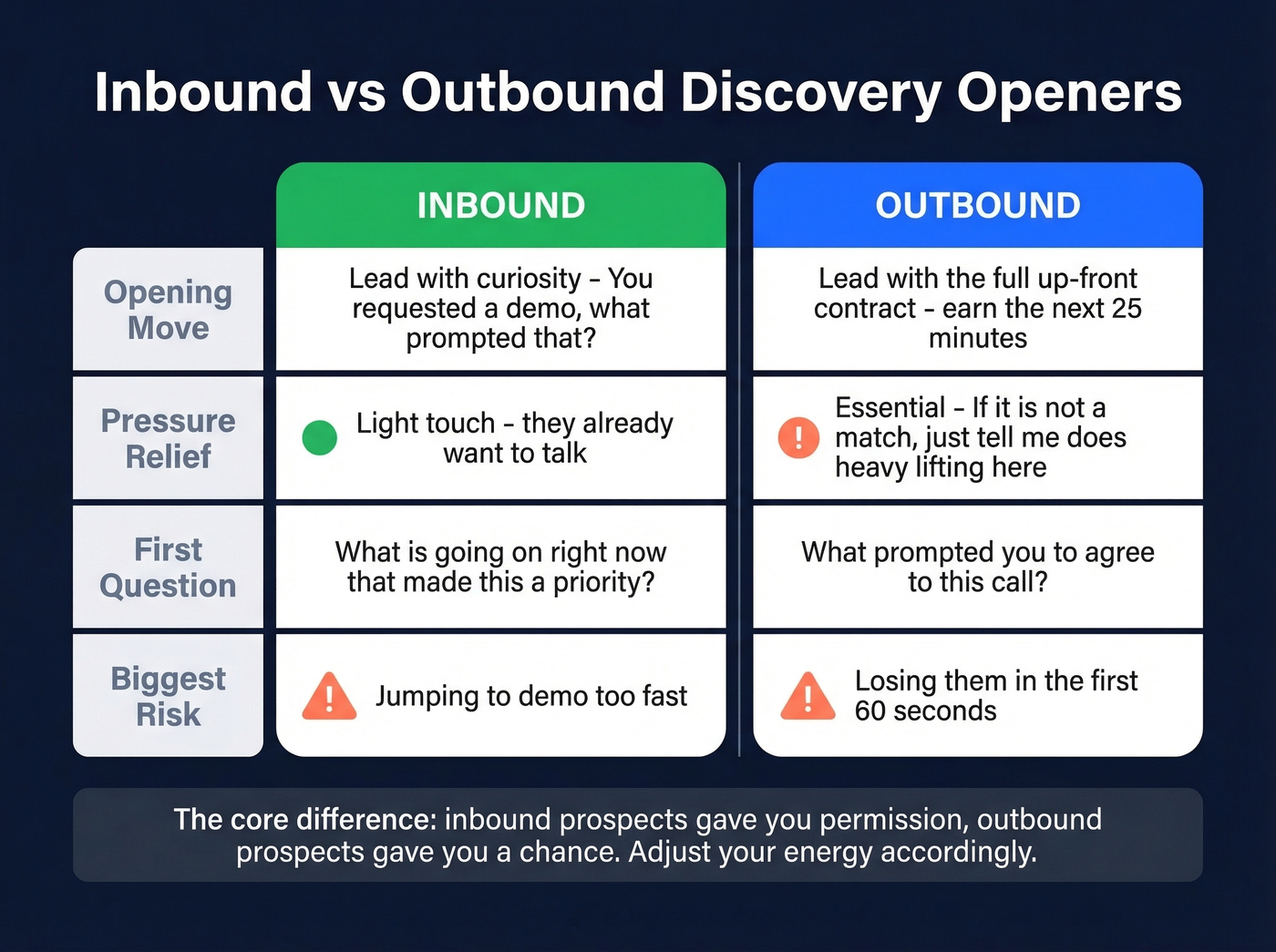
| Inbound | Outbound | |
|---|---|---|
| Opening move | Lead with curiosity: "You requested a demo - what prompted that?" | Lead with the full up-front contract. You need to earn the next 25 minutes. |
| Pressure relief | Light touch - they already want to talk | Essential. "If it's not a match, just tell me" does more work here than anywhere else. |
| First question | "What's going on right now that made this a priority?" | "What prompted you to agree to this call?" |
| Biggest risk | Jumping to demo too fast | Losing them in the first 60 seconds |

A third of outbound meetings are no-shows - mostly because reps dial dead numbers and email stale addresses. Prospeo's 300M+ profiles are refreshed every 7 days with 98% email accuracy, so every discovery slot connects to a real buyer.
Stop prepping scripts for prospects who will never pick up.
Which Framework Fits Your Deal?
Five major frameworks exist, and the right one depends on deal size, cycle length, and stakeholder count.
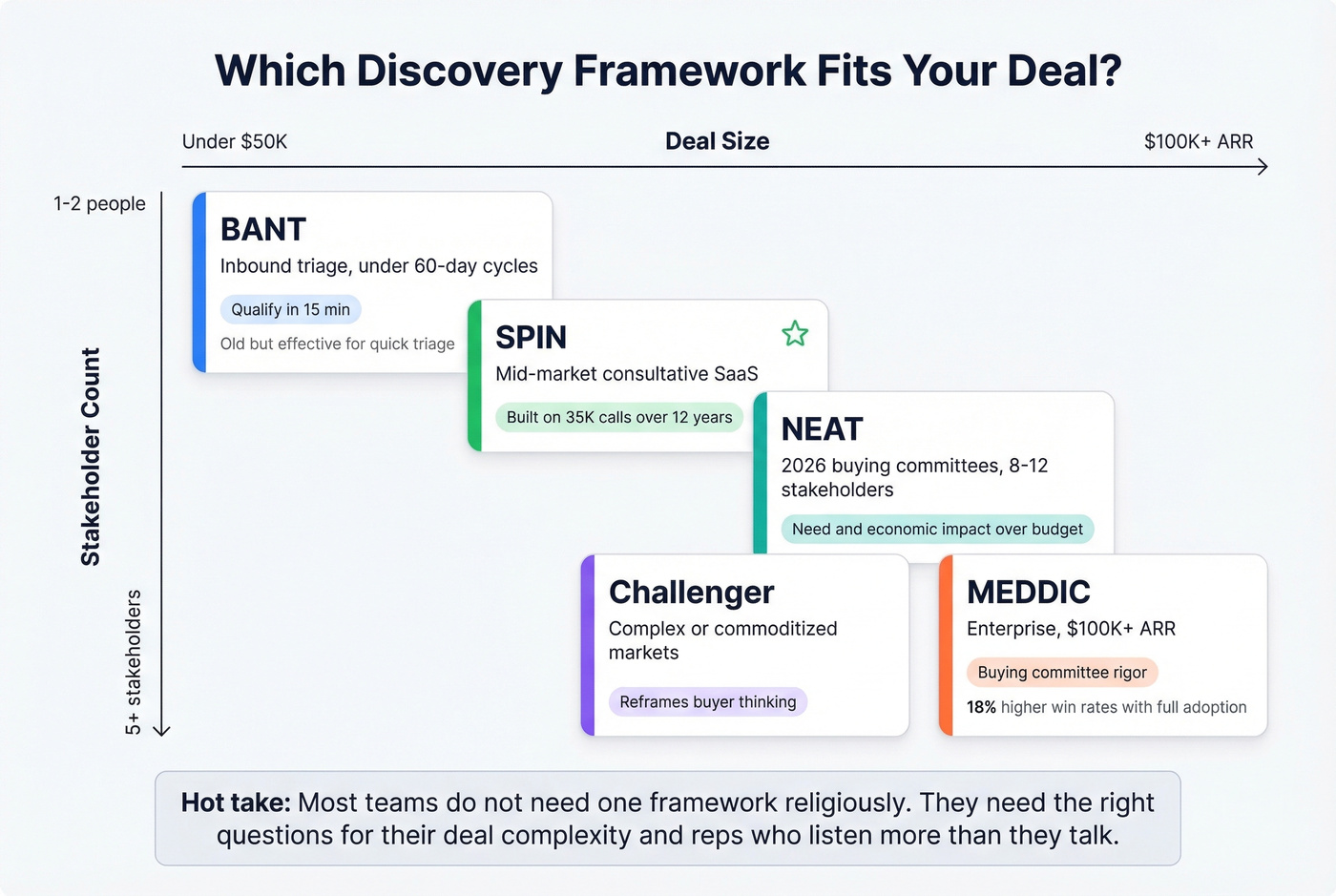
| Framework | Best For | Key Strength |
|---|---|---|
| BANT | Inbound triage, <60-day cycles | Qualify in 15 min |
| SPIN | Mid-market, consultative SaaS | Built on 35K calls across 20+ countries over 12 years |
| MEDDIC | Enterprise, $100K+ ARR | Buying-committee rigor |
| Challenger | Complex/commoditized markets | Reframes buyer thinking |
| NEAT | 2026 buying committees with distributed authority | Prioritizes need and economic impact over budget |
Here's my hot take: if your average deal is under $50K, you don't need MEDDIC-level rigor. Use SPIN. The research behind it - 35,000 sales calls across 20+ countries over 12 years - is one of the deepest datasets in the industry, and it's built for the consultative mid-market conversations where most SaaS deals live.
Over $100K with 5+ stakeholders? MEDDIC. Teams that fully adopt MEDDPICC see 18% higher win rates and 24% larger deal sizes. For SDRs qualifying inbound leads, BANT is fine. It's old and seller-centric, but for quick triage on a 15-minute call, it does the job.
NEAT deserves attention in 2026 because buying committees have ballooned to 8-12 stakeholders. It replaces "budget" with "economic impact" and "authority" with "access to authority" - a better fit when no single person holds the checkbook. Challenger works when you're selling into a commoditized market and need to reframe the buyer's thinking entirely. Xerox reported $65M in contract value after implementing it.
Most teams don't need to pick one framework religiously. They need the right questions for their deal complexity and reps who listen more than they talk.
Data Quality Decides Outcomes
The best script in the world doesn't help if the prospect never picks up. 20-40% of B2B contact data decays annually. Outbound no-show rates run around 33%, compared to just 6.5% for inbound. That means one in three of your outbound discovery slots is wasted before you say a word.
Buyers complete nearly 80% of their research before they ever talk to you, and 87% expect reps to act as trusted advisors. You can't be a trusted advisor if you're calling a disconnected number.
Fix this before your discovery block starts. Run your prospect list through Prospeo's email verification - 98% accuracy on 143M+ verified emails, plus 125M+ verified mobile numbers with a 30% pickup rate. The free tier gives you 75 email verifications and 100 Chrome extension credits per month, enough to clean a week's worth of outbound meetings.

Your discovery script is dialed in - but it's useless if you can't reach the decision-maker. Prospeo gives you 125M+ verified mobile numbers with a 30% pickup rate and direct emails for $0.01 each. No more marketing coordinators who can't sign a napkin.
Reach the people who can actually say yes.
Five Mistakes That Kill Discovery Calls
1. Talking too much. Reps on lost deals talk 62% of the time. Won deals? 43%. That gap is the difference between diagnosing and lecturing. If you catch yourself monologuing for more than 90 seconds, pause and ask a question.
2. Asking too many questions. This one surprises people. Won deals average 15-16 questions. Lost deals hit around 20. More questions doesn't mean more insight - it means the prospect feels interrogated. Go deeper on fewer questions instead of wider on more.
3. Skipping the up-front contract. No agenda means no structure, which means the prospect controls the call - and they'll control it right into "let me think about it." In our experience, the up-front contract alone cuts "let me think about it" responses by half.
4. Feature-dumping. Buyers have done their research before they talk to you. They don't need a walkthrough of your features page. They need you to diagnose their specific problem and connect it to a specific outcome. Save the demo for the demo.
5. No defined next step. Every discovery call should end with a calendar invite - not a promise to "circle back." If you can't get the next meeting booked before you hang up, something went wrong in the first 25 minutes.
How to Actually Get Better at This
Running great discovery calls consistently comes down to deliberate practice, not just reading a script. Record every call (with permission), review the talk/listen ratio, and count your questions. Compare your numbers against the benchmarks above.
The reps who master this aren't the ones with the best natural charisma - they're the ones who review their calls weekly and adjust. We've watched teams go from a 25% advance rate to 40%+ in a single quarter just by tracking talk ratio and question count.
A successful discovery call leaves the prospect feeling heard, not sold to. If they hang up thinking "that person actually understood my problem," you've done the job. Everything else - the framework, the question count, the timing - serves that single outcome.
Post-Call Follow-Up
The call ended well. Don't let momentum die.
Send a recap email within one hour. Not 24 hours. One hour. While the conversation is fresh for both of you. Restate their pain in their own words - don't paraphrase into your marketing language. Use the exact phrases they used. "You mentioned your team spends 6 hours a week manually enriching lists" hits harder than "you have a data quality challenge."
Confirm the next step with a calendar link, include the agenda and any stakeholders who should attend, and add one piece of value: a relevant case study, a benchmark, a short video - something that reinforces you were listening.
Here's a template you can steal:
Subject: [Name] - recap from today + next steps
Hey [Name], thanks for the conversation today. Here's what I took away:
- [Pain point in their exact words]
- [Priority they stated]
- [Timeline they mentioned]
Next step: [specific meeting type] on [date/time]. Calendar invite attached.
I also pulled [relevant resource] - thought it'd be useful given what you shared about [specific detail from the call].
Talk soon, [Your name]
The key is mirroring their language, not yours. If they said "our pipeline is a mess," write "our pipeline is a mess" - not "pipeline optimization challenges."
FAQ
How long should a discovery call be?
Top performers consistently land in the 41-50 minute range, while the average runs 32 minutes. SMB deals need 15-20 minutes; enterprise calls with multiple stakeholders should run 45-60 minutes. Calls under 20 minutes are 42% less likely to advance.
How many questions should I ask?
Fifteen to sixteen questions correlate with won deals across 326K analyzed calls. More than 20 and you're interrogating, not conversing. Ask fewer questions but follow up on each answer with "tell me more" or "what's the impact?" - those follow-ups are where the real insights live.
What's the difference between discovery and a demo?
Discovery is about listening - aim for the 43/57 ratio and avoid drifting into 60%+ talk time. A demo is about showing, where you'll talk 60-70%. Never turn discovery into a demo; earn the demo by diagnosing the problem first.
How do I reduce no-shows on outbound calls?
Verify contact data before your call block. A third of outbound meetings are no-shows, often due to stale numbers or bounced emails. Skip this step and you're spending discovery slots on voicemails instead of real conversations.