

The Discovery Objections Cheat Sheet You'll Actually Keep Open While Drafting
A California judge estimates granting ~90%+ of motions to compel further responses to requests for production - not because the discovery objections lacked merit, but because they weren't code-compliant. You've got 47 RFPs, 30 days, and you're staring at the same boilerplate block your firm has recycled since 2018. That's how sanctions happen.
At least three federal courts imposed sanctions for boilerplate objections in recent terms. The December 1, 2025 FRCP amendments changed how you plan privilege logs. And the "reasonably calculated to lead to admissible evidence" language? Dead in federal court since 2015, yet we still see it in responses every week. This discovery objections cheat sheet accounts for all of it.
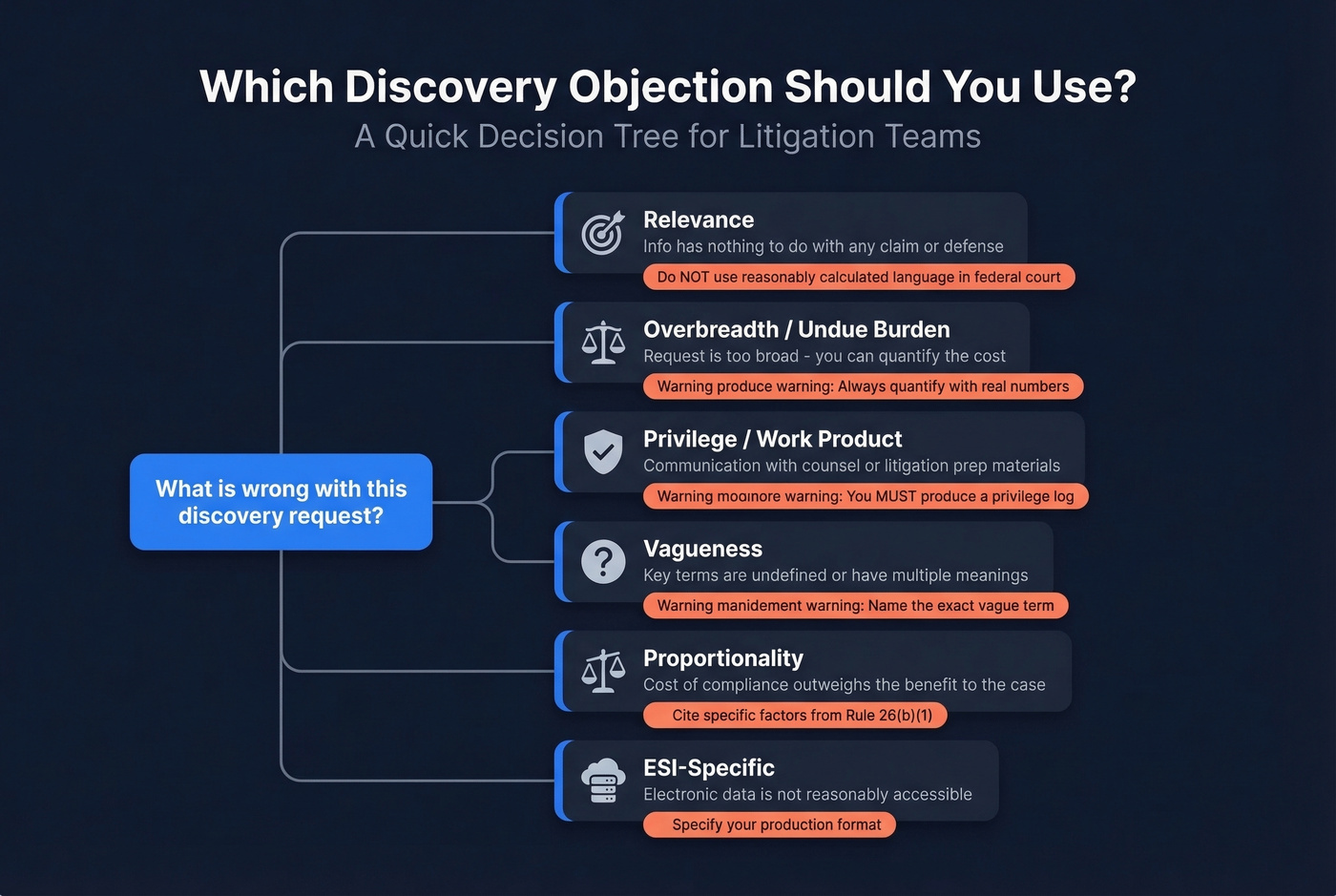
The Master Objections Table
This is the section you bookmark. Each row gives you an objection type, when it's appropriate, sample language you can drop directly into a response, the governing rule, and the mistake that gets you sanctioned. Whether you're handling objections in discovery calls with opposing counsel or drafting written responses, the same specificity principles apply.
| Objection Type | When to Use | Sample Language | Key Rule | Common Mistake |
|---|---|---|---|---|
| Relevance | Request seeks info unrelated to any claim or defense | "Objection. This request seeks information that is neither relevant to any party's claim or defense nor proportional to the needs of this case because [specific reason]." | FRCP 26(b)(1) | Using "not reasonably calculated" - that language was removed from federal rules in 2015. |
| Overbreadth / Undue Burden | Request is so broad the cost of compliance outweighs the benefit | "Objection. This request is overbroad in that it seeks [all documents since inception / every communication mentioning X] without temporal or subject-matter limitation. The burden of reviewing [estimated volume] documents outweighs the likely benefit given [specific proportionality factor]." | FRCP 26(b)(1); 26(c) | Saying "unduly burdensome" without quantifying the burden. Courts want numbers. |
| Attorney-Client Privilege | Communication between client and counsel for legal advice | "Objection. This request seeks information protected by the attorney-client privilege. A privilege log identifying withheld materials will be provided per Rule 26(b)(5)(A)." | FRCP 26(b)(5)(A) | Failing to produce a privilege log - the objection alone doesn't satisfy your obligation. |
| Work Product | Materials prepared in anticipation of litigation | "Objection. The documents sought constitute attorney work product prepared in anticipation of litigation. Respondent will provide a privilege log per Rule 26(b)(5)(A)." | FRCP 26(b)(3) | Forgetting that fact work product can be overcome by showing substantial need. |
| Vagueness / Ambiguity | Key terms in the request are undefined or unclear | "Objection. This request is vague and ambiguous as to the term '[specific term],' which could reasonably refer to [interpretation A] or [interpretation B]. Subject to this objection, responding party interprets '[term]' to mean [chosen interpretation] and responds as follows." | FRCP 33(b)(4); 34(b)(2)(B) | Saying "vague" without identifying which term is vague - that's itself boilerplate. |
| Compound | Single interrogatory contains multiple discrete subparts | "Objection. This interrogatory is compound in that it contains [number] discrete subparts, each requiring a separate answer, and therefore exceeds the limit under Rule 33(a)(1)." | FRCP 33(a)(1) | Objecting to compound questions without counting subparts - courts will check. |
| Calls for Legal Conclusion | Interrogatory asks the party to state a legal position | "Objection. This interrogatory improperly calls for a legal conclusion by asking respondent to characterize [specific legal issue]." | FRCP 33(a)(2) | Overusing this - Rule 33(a)(2) explicitly allows contention interrogatories. Pick your battles. |
| Speculation | Request asks for information the party doesn't possess | "Objection. This interrogatory calls for speculation, as respondent lacks personal knowledge of [specific subject] and cannot provide a factual response." | FRCP 33(b)(1) | Confusing "I don't know" with "I object." If you don't have the info, say so - don't just object. |
| Confidentiality / Trade Secrets | Request targets proprietary business information | "Objection. This request seeks confidential trade secret and proprietary business information. Respondent requests entry of a protective order under Rule 26(c)(1)(G) before production." | FRCP 26(c)(1)(G) | Refusing to produce without seeking a protective order. The objection alone doesn't shield you. |
| Duplicative | Request seeks the same info already requested elsewhere | "Objection. This request is duplicative of Request No. [X] and imposes an undue burden by requiring respondent to compile the same information twice." | FRCP 26(b)(2)(C) | Not identifying which prior request it duplicates - be specific. |
| Equally Available / Public Records | Information is equally accessible to the requesting party | "Objection. The information sought is equally available to the requesting party through [specific public source], and this request imposes an undue burden under Rule 26(b)(2)(C)." | FRCP 26(b)(2)(C) | This objection is weaker than most lawyers think. Courts often say "produce it anyway." |
| Exceeds Interrogatory Limits | Party has exceeded 25 interrogatories (or court-set limit) | "Objection. This interrogatory exceeds the 25-interrogatory limit set by Rule 33(a)(1) without leave of court. Respondent declines to answer interrogatories beyond the permitted number." | FRCP 33(a)(1) | Not counting subparts. Courts count discrete subparts as separate interrogatories. |
| Fifth Amendment | Response would tend to incriminate the responding party | "Objection. Respondent invokes the Fifth Amendment privilege against self-incrimination and declines to respond to this [interrogatory/request]." | U.S. Const. Amend. V | Using the Fifth Amendment in a corporate deposition - corporations can't invoke it. Only individuals. |
| Premature / Contention | Contention interrogatory served before adequate discovery | "Objection. This contention interrogatory is premature, as discovery is ongoing and respondent has not yet had a reasonable opportunity to investigate the facts underlying [specific claim/defense]." | FRCP 33(a)(2) | Objecting to all contention interrogatories reflexively. Courts allow them - just argue timing. |
| ESI-Specific | Request for ESI is unduly burdensome or format-specific | "Objection. The ESI sought is not reasonably accessible because of undue burden and cost under Rule 26(b)(2)(B). Respondent will produce ESI from reasonably accessible sources in [specified format] per Rule 34(b)(2)(E)." | FRCP 26(b)(2)(B); 34(b)(2)(E) | Not specifying the production format. If you don't, the requesting party gets to choose. |
For California, replace "relevant to any party's claim or defense" with "reasonably calculated to lead to the discovery of relevant, admissible evidence" - that framing is still active under California's discovery standard. Texas follows its own Rules of Civil Procedure with similar objection categories but different procedural mechanics. The jurisdiction comparison table below covers the key differences.
The Six Proportionality Factors
Standalone "not proportional to the needs of the case" is itself boilerplate. The Advisory Committee made clear that parties must tie proportionality objections to specific factors. Here are the six from FRCP 26(b)(1) - cite them by number in your objections:
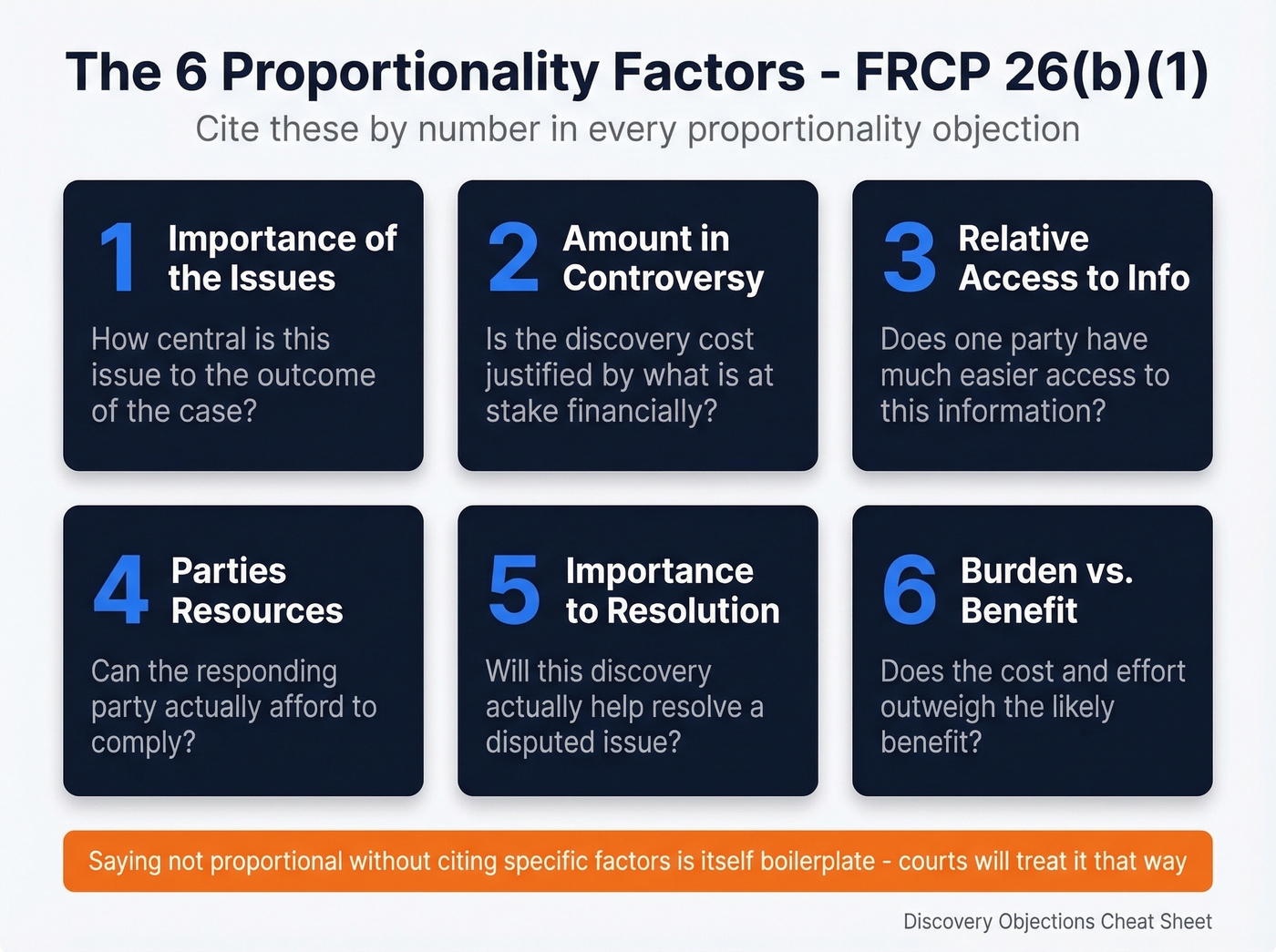
- Importance of the issues at stake in the action
- Amount in controversy
- Parties' relative access to relevant information
- Parties' resources
- Importance of the discovery in resolving the issues
- Whether the burden or expense outweighs the likely benefit
Here's what a proportionality objection should actually look like: "This request is not proportional to the needs of this case. The amount in controversy is approximately $150,000, yet compliance would require review of an estimated 40,000 documents at a cost exceeding $75,000. The burden substantially outweighs the likely benefit under Rule 26(b)(1)."
That's specific. That's defensible. "Not proportional" standing alone is not.
Why Courts Sanction Boilerplate
Boilerplate objections are professional malpractice waiting to happen. We've seen judges strike entire response sets for exactly this.
In Wilson v. Wavestream Corp., 2025 WL 1358360 (C.D. Cal. Apr. 17, 2025), the court imposed sanctions where the defendant relied on boilerplate "overbroad" objections without any specificity. In Continental General Insurance Co. v. Gardina, 2025 WL 278013 (M.D. Fla. Jan. 23, 2025), the court deemed boilerplate objections waived - even though opposing counsel hadn't moved to compel. And in Open Cheer & Dance Championship Series, LLC v. Varsity Spirit, LLC, 2025 WL 1811758 (N.D. Tex. July 1, 2025), the court wrote that unsupported stock objections:
"do not preserve... anything other than waiver and subjecting the responding party to sanctions."
These aren't outliers. The landmark Mancia v. Mayflower Textile Services Co., 253 F.R.D. 354 (D. Md. 2008) established that boilerplate objections are a prima facie Rule 26(g) violation. Courts sometimes still evaluate the merits even when objections are boilerplate - Jacobs v. Journal Publishing (D.N.M. 2024) went that route - but that's not a reason to be lazy.
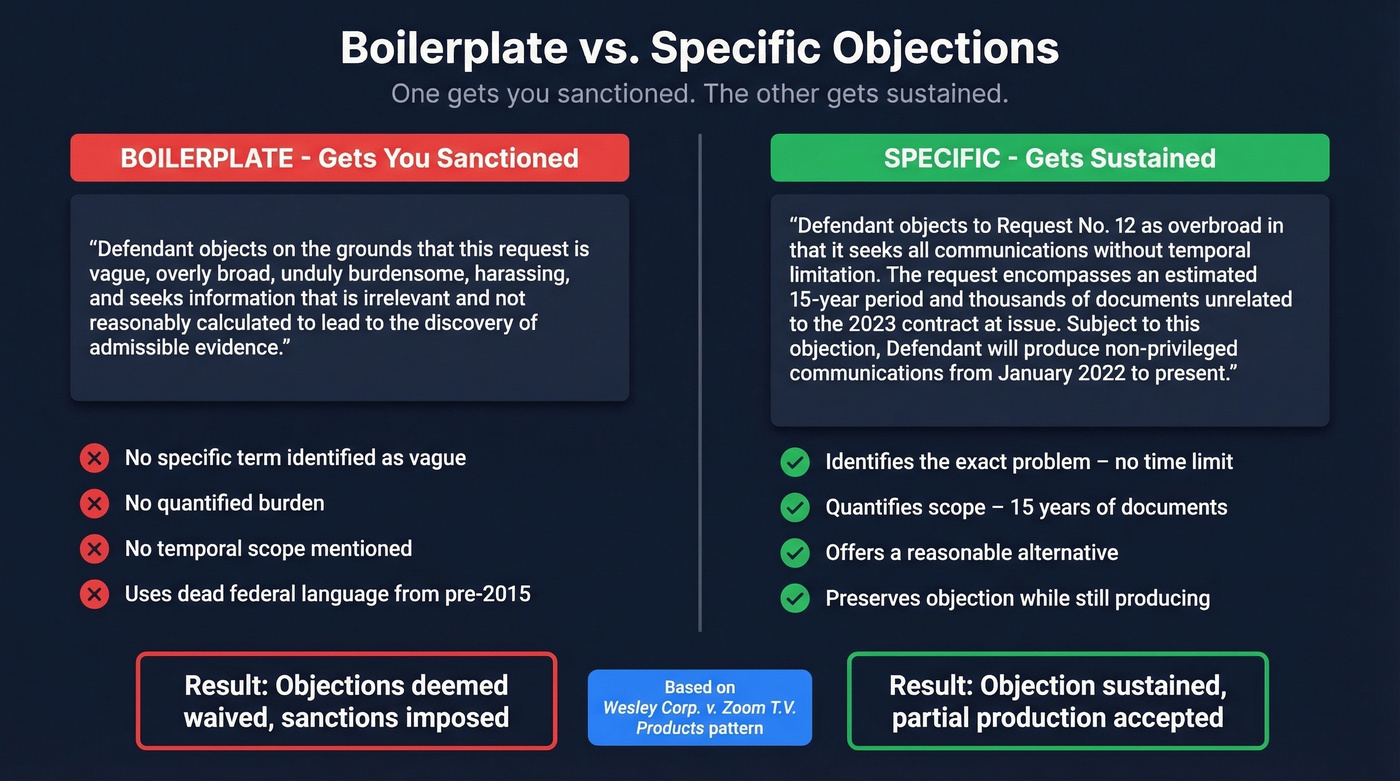
What boilerplate looks like (from Wesley Corp. v. Zoom T.V. Products): "Defendant objects on the grounds that this request is vague, overly broad, unduly burdensome, harassing, and/or seeks information that is irrelevant and/or not reasonably calculated to lead to the discovery of admissible evidence."
Now compare it to a specific objection for the same request: "Defendant objects to Request No. 12 as overbroad in that it seeks 'all communications' without temporal limitation. The request encompasses an estimated 15-year period and thousands of documents unrelated to the 2023 contract at issue. Subject to this objection, Defendant will produce non-privileged communications from January 2022 to present relating to [specific subject]."
If your responses look like the first example, you're at risk.
Deadlines and Waiver Rules
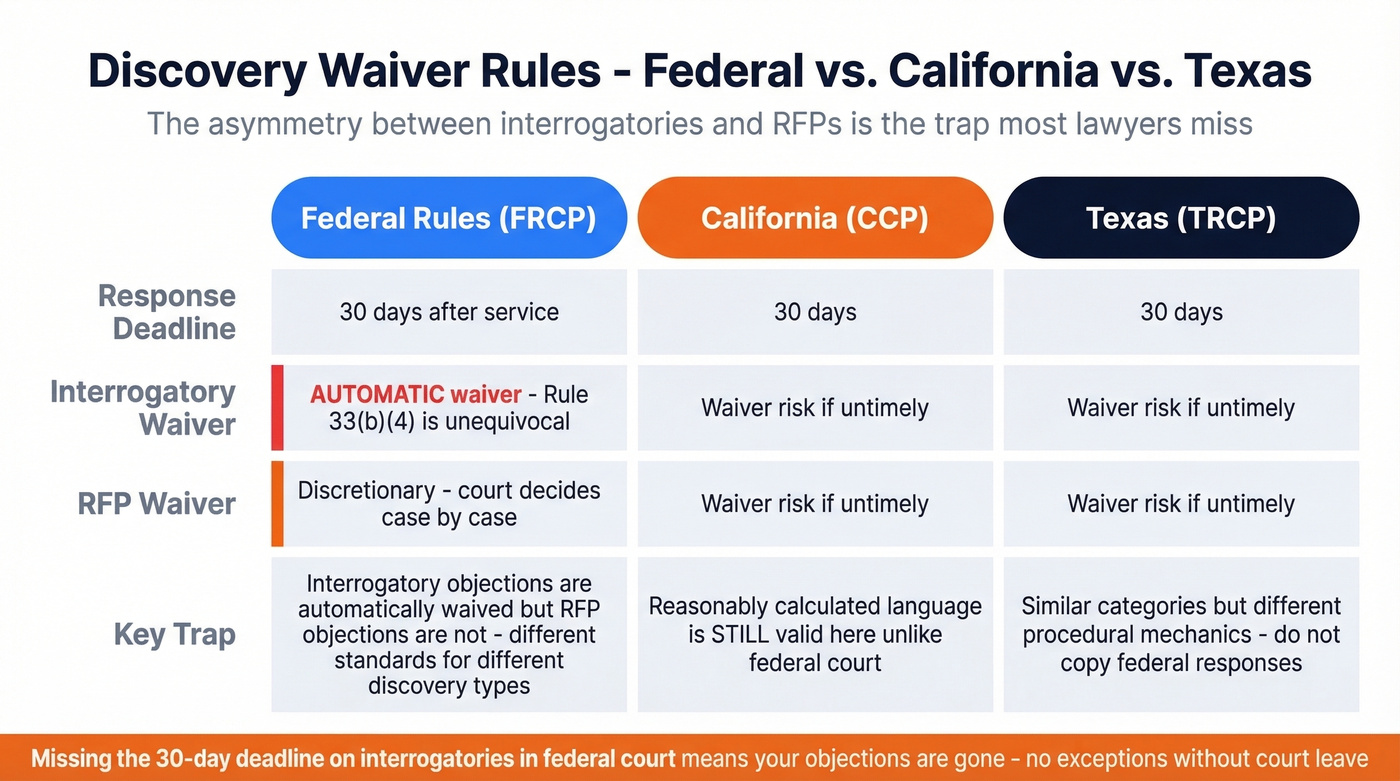
Most lawyers assume the waiver rules are the same for interrogatories and RFPs. They're not - and this asymmetry is the trap.
| Federal Interrogatories | Federal RFPs | California | Texas | |
|---|---|---|---|---|
| Deadline | 30 days after service | 30 days after service | 30 days | 30 days |
| Waiver Rule | Automatic (Rule 33(b)(4)) | Discretionary sanction | Waiver risk if untimely | Waiver risk if untimely |
| Key Rule | FRCP 33(b)(4) | FRCP 34(b)(2)(A) | Cal. Code Civ. Proc. | Tex. R. Civ. P. |
Rule 33(b)(4) is unequivocal: any ground not stated in a timely objection to an interrogatory is waived unless the court excuses the failure for good cause. Rule 34 contains no equivalent automatic waiver provision. In CT Install America, LLC v. Boryszewski, 2025 WL 257127 (E.D. Pa. Jan. 21, 2025), the court emphasized this distinction, declining blanket waiver for late RFP objections while noting that interrogatory objections would have been automatically waived under the same timeline.
Here's the thing: don't rely on Rule 34's softer waiver standard as a safety net. Calendar your deadlines. Serve objections on time. Every time.

You wouldn't send a boilerplate objection to a federal judge. So why send outreach to unverified contacts? Prospeo's 5-step email verification delivers 98% accuracy - the same specificity standard courts demand, applied to your prospect data.
Stop bouncing emails like courts bounce boilerplate objections.
Deposition Objections vs. Written Discovery
Your opposing counsel just told you to limit objections to "form." Are they right? Depends on where you are.
The "form" vs. specific objections debate is one of the most common fights in deposition practice. One California practitioner in that thread described opposing counsel insisting all deposition objections be limited to "form" - and accusing specific objections like "calls for speculation" of coaching the witness. Some jurisdictions and local rules require exactly that. Others expect you to state the specific ground so the examining attorney can cure the defect.
| Written Discovery | Depositions | |
|---|---|---|
| Specificity Required | Yes - must state grounds with particularity | Varies by jurisdiction |
| "Form" Sufficient | No | Often yes |
| Speaking Objections | N/A | Sanctionable - keep it concise |
| Coaching Risk | N/A | High if objection suggests answer |
Safe deposition objection language in most jurisdictions: "Objection, form." If your jurisdiction permits or requires more specificity: "Objection, form - compound." or "Objection, form - assumes facts not in evidence." Keep it to one phrase. The moment your objection becomes a sentence, you're in speaking-objection territory.
Privilege Logs - December 2025 Amendments
If you haven't updated your objection templates for the December 2025 privilege-log amendments, you're already behind.
Effective December 1, 2025, amendments to FRCP 26(f)(3)(D) and FRCP 16(b)(3)(B)(iv) now require parties to address privilege and protection issues early - at the Rule 26(f) conference, not after production is underway. Here's your updated checklist-about-new-privilege-log-rules):
- Discuss privilege-log format and timing at the Rule 26(f) conference - now mandatory under Rule 26(f)(3)(D)
- Propose a FRE 502 clawback/non-waiver order for post-production privilege assertions
- Negotiate practical log formats: categorical logs, metadata-only logs, or carve-outs for clearly privileged categories
- Agree on common metadata fields: date, author, recipients, document type, title/subject, and privilege coding
- Include privilege-log provisions in the scheduling order under Rule 16(b)(3)(B)(iv)
Let's be honest - the old approach of "we'll figure out the privilege log later" doesn't fly anymore. These amendments front-load the work, but they also reduce the fights that used to blow up three months into production.
How to Attack Boilerplate Objections
When you're on the receiving end of boilerplate, here's the offensive playbook. Paralegals and associates on legal forums consistently ask for this exact framework, and the consensus on r/Lawyertalk is that most people don't push back hard enough. So here it is.
1. Demand withdrawal in the meet-and-confer. Cite Liguria Foods, Inc. v. Griffith Labs., Inc., 320 F.R.D. 168, 190-91 (N.D. Iowa 2017), which provides a "road map" for attacking boilerplate: demand withdrawal of general objections and warn that you'll seek significant sanctions if they're not withdrawn.
2. File a motion to compel with fee-shifting. Under FRCP 37(a)(5), the losing party on a motion to compel presumptively pays the winner's fees. If their objections are boilerplate, you're likely to win - and get paid for the effort.
3. Stack the multi-jurisdiction authority. Fischer v. Forrest, 286 F.R.D. 177 (S.D.N.Y. 2012) and Heller v. City of Dallas, 303 F.R.D. 466 (N.D. Tex. 2014) both hold that general objections are meaningless and should be stricken. Stack these citations in your brief.
4. Move to compel identification of withheld documents. Under Rule 34(b)(2)(C), the responding party must state whether responsive materials are being withheld on the basis of an objection. If they haven't, that's a separate basis for your motion. And when discovery responses reference individuals whose contact information isn't provided, tools like Prospeo can surface verified emails to help you locate and serve them quickly.
Federal vs. California vs. Texas
| Federal | California | Texas | |
|---|---|---|---|
| Relevance Standard | Relevant to claim or defense + proportional | Reasonably calculated to lead to admissible evidence | Relevant to subject matter |
| Response Deadline | 30 days | 30 days | 30 days |
| Waiver Rule | Auto (interrog.); discretionary (RFPs) | Waiver risk if untimely | Waiver risk if untimely |
| Key Rule/Statute | FRCP 26, 33, 34 | Cal. Code Civ. Proc. | Tex. R. Civ. P. |
| "Reasonably Calculated" | Removed in 2015 | Still in use | Not standard phrasing |
| Privilege Log Required | De facto yes (Rule 26(b)(5)(A)) | Yes | Yes |
The biggest malpractice risk in discovery isn't missing a deadline - it's practicing in both federal and California courts and never updating your templates. California still uses the "reasonably calculated to lead to the discovery of relevant, admissible evidence" language. Federal courts removed it in 2015 because the Advisory Committee found it was being misused to overexpand discovery scope. If you're drafting federal objections using California templates, you're citing a standard that doesn't exist anymore. Stop.
Discovery disputes eat hours. So does chasing bad contact data. Prospeo gives you 300M+ verified profiles with 30+ filters - find opposing counsel, expert witnesses, or decision-makers at $0.01 per email. No contracts, no boilerplate.
Build your contact list with the precision you bring to your privilege log.
FAQ
Can I object and still answer?
Yes - state your objection with specificity, then respond "subject to and without waiving" the objection. Under Rule 34(b)(2)(C), you must also identify what responsive material you're withholding and why. Omitting that disclosure is a separate sanctionable deficiency.
What happens if I miss the objection deadline?
For federal interrogatories, Rule 33(b)(4) imposes automatic waiver - your objections are gone unless you show good cause. For RFPs under Rule 34, waiver is discretionary but increasingly enforced. Calendar every deadline the day you receive the request.
Do I need a privilege log for every privilege objection?
Under FRCP 26(b)(5)(A), yes - a bare privilege assertion without a log is insufficient. The December 2025 amendments now require discussing privilege-log format at the Rule 26(f) conference. Negotiate categorical or metadata-only logs to reduce cost.
Is "not proportional" a valid standalone objection?
No. You must tie it to specific FRCP 26(b)(1) factors - amount in controversy, relative access to information, burden vs. benefit - and quantify why they weigh against production. Naked proportionality objections are treated as boilerplate.
Are general objections at the top of my responses preserving anything?
Not a thing. Multiple federal courts have called them meaningless - they don't preserve anything and can invite sanctions. Drop them and make each objection request-specific. This discovery objections cheat sheet exists precisely because generic, copy-paste blocks invite sanctions rather than protect your client.