

DNC Checker: The Complete Guide to Staying Compliant in 2026
One phone call to the wrong number can cost you $53,088. That's not a scare tactic - it's the FTC's current maximum civil penalty for certain Do Not Call violations. And with over 1,500 TCPA lawsuits filed last year - up 44% year over year - the litigation machine isn't slowing down. It's accelerating.
A DNC checker scrubs your call lists before anyone dials. But most teams either skip it, do it wrong, or only scrub against the federal registry and call it a day. That last mistake is the one that actually gets people sued.
On r/insurance and r/realestateinvesting, agents share horror stories about getting hit with $25,000 lawsuits from a single call. Real estate wholesalers constantly ask about cheap bulk scrubbing because they know one wrong dial can wipe out a month's profit. The fear is justified - and the fix is straightforward.
What You Need (Quick Version)
What it costs: Free for single-number lookups, $24.99-$119/mo for bulk scrubbing, $200-$450/mo for enterprise platforms with advanced compliance workflows and API access.
What most people get wrong: They scrub against the federal registry only. That misses state-level DNC lists, DMA suppression files, and - critically - known TCPA litigators who file lawsuits for a living. Federal-only scrubbing is like locking the front door and leaving the garage wide open.
Quick recommendation by volume:
- Under 25 numbers/month: ScrubLite's free tier or FreeDNCList.com
- 1K-25K/month: ScrubLite ($24.99-$59.99/mo) or RealValidito credits
- 25K+/month: RealValidito bulk credits or PossibleNOW DNCSolution
What Is a DNC Checker?
A DNC checker compares phone numbers on your outbound call list against one or more Do Not Call registries. Numbers that appear on those registries get flagged or removed before your reps ever pick up the phone. Simple goal: don't call people who've told the government they don't want to be called.
Any business making outbound sales calls needs one. SDR teams, real estate wholesalers, insurance agents, home services companies, anyone running cold call campaigns - if you're dialing consumers or even business contacts on personal cell phones, you're in scope.
To access the National Do Not Call Registry, you need a Subscription Account Number (SAN). You register at telemarketing.donotcall.gov, and it's tied to your organization. Without a SAN, you can't legally pull registry data, and many checking tools require you to enter yours before processing a batch.
The registry is managed by the FTC and enforced by the FTC, FCC, and state attorneys general. It covers telemarketing calls - defined as "any plan, program, or campaign to sell goods or services through interstate phone calls." Political organizations, charities, and telephone surveyors are exempt. Everyone else needs to scrub.
TCPA vs. DNC vs. TSR
These three acronyms get thrown around interchangeably, and they shouldn't be. They're different laws with different enforcement mechanisms and different penalties.
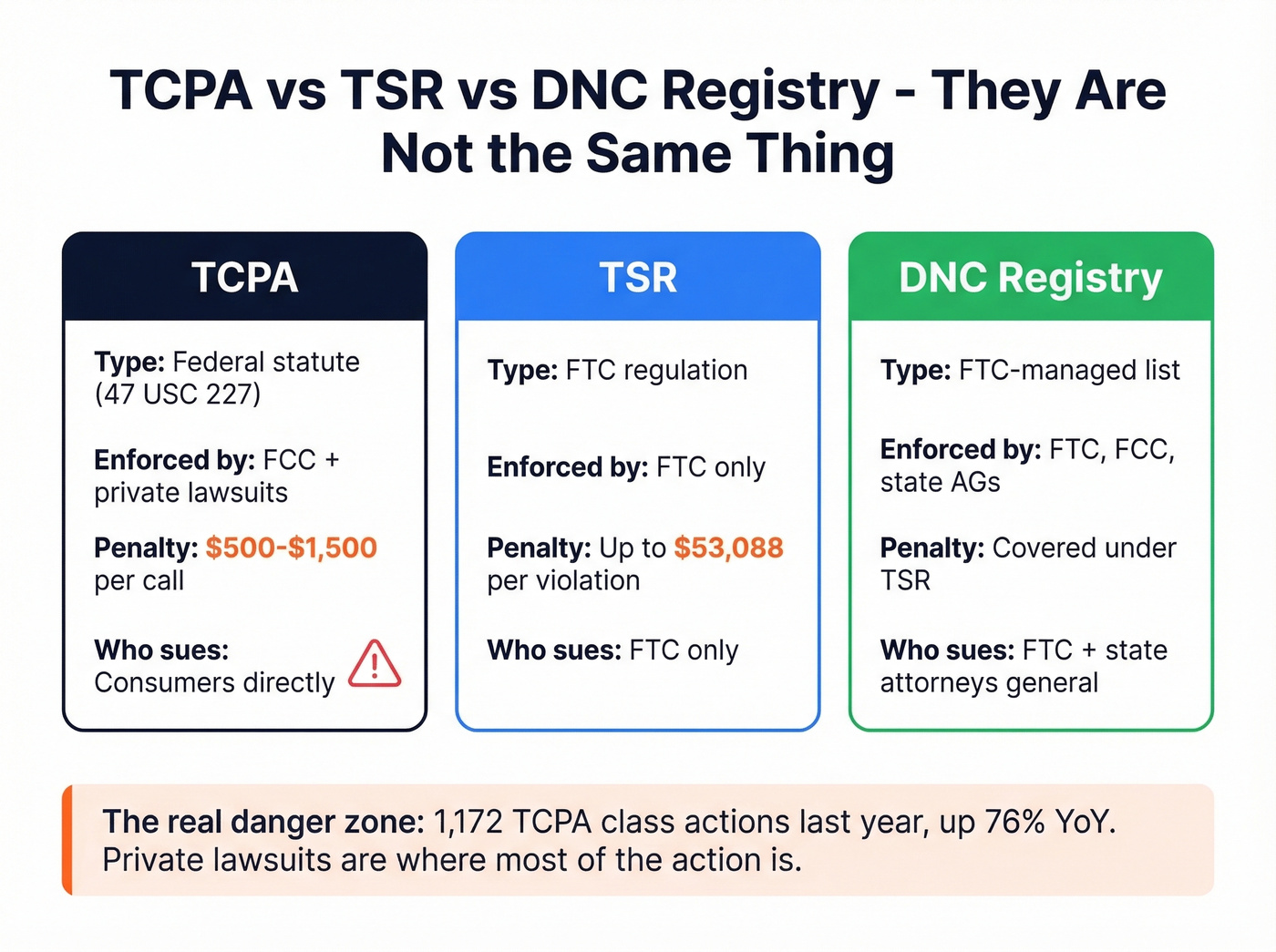
| TCPA | TSR | DNC Registry | |
|---|---|---|---|
| What it is | Federal statute (47 USC SS227) | FTC regulation | FTC-managed list |
| Enforced by | FCC + private lawsuits | FTC | FTC, FCC, states |
| Penalty | $500-$1,500/call (private) | Up to $53,088/violation | Covered by TSR |
| Who can sue | Consumers directly | FTC only | FTC + state AGs |
The TCPA breaks into two buckets. Section 227(b) covers regulated technology - autodialers, prerecorded messages, AI-generated voice. Using these to call cell phones without prior express written consent is where the big lawsuits come from. Section 227(c) covers the Do Not Call Registry provisions specifically.
The TSR is the FTC's enforcement mechanism for telemarketing rules, including DNC compliance. It's what gives the FTC the authority to levy that $53,088 penalty.
Private TCPA lawsuits are where most of the action is. A consumer can sue you for $500 per violation, tripled to $1,500 if the court finds it was willful. Class actions multiply that across thousands of calls. The 1,172 TCPA class actions last year - a 76% year-over-year jump - tell you everything about where the legal industry sees opportunity.
Here's the thing: if your average deal size is under $5K, a single TCPA class action can bankrupt your entire outbound operation. The math doesn't work without compliance scrubbing. It's not a nice-to-have - it's existential risk management.
What Does a DNC Checker Actually Check?
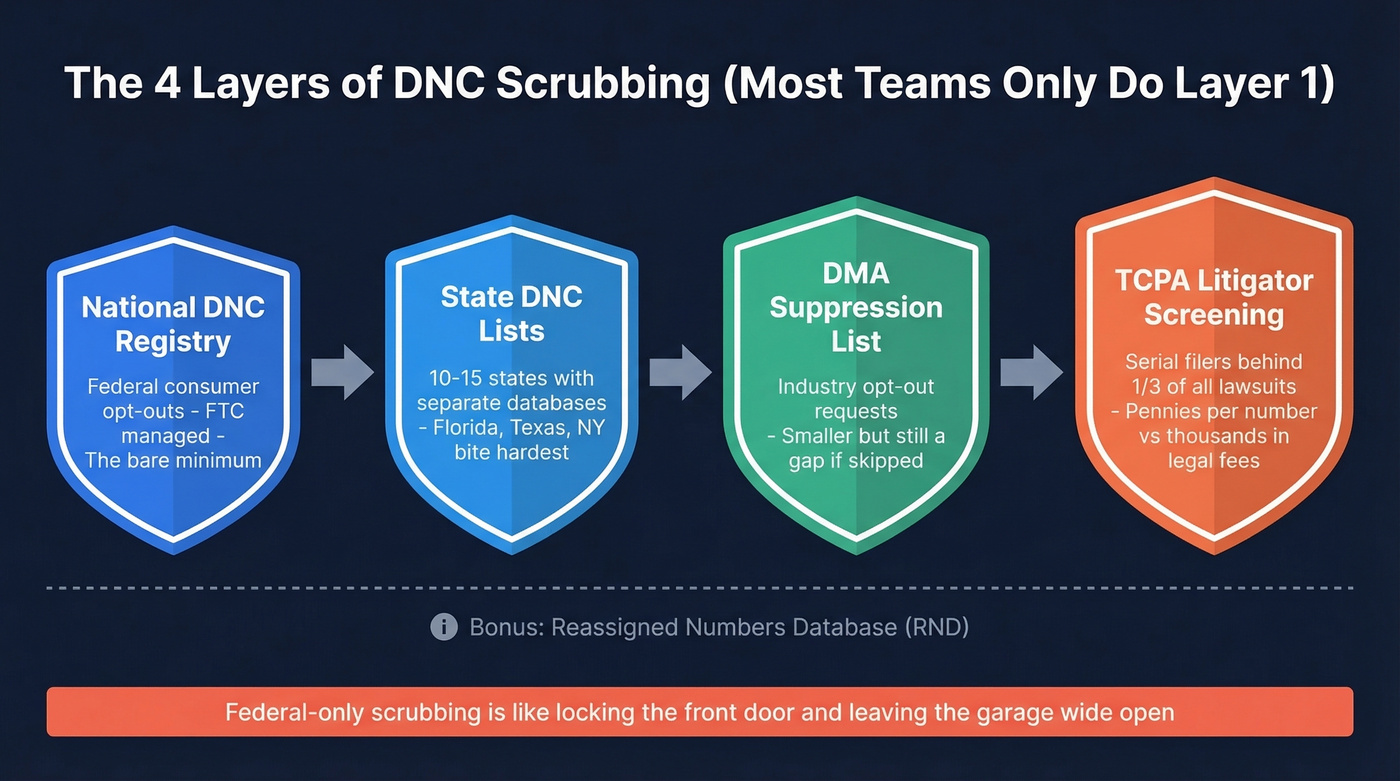
Not all scrubbing tools are equal. The difference between a basic tool and a serious one comes down to how many layers they scrub against.
The Four Layers
| Layer | What It Catches | Who Maintains It |
|---|---|---|
| National DNC Registry | Consumer opt-outs (federal) | FTC |
| State DNC Lists | State-specific opt-outs | ~10-15 state agencies |
| DMA Suppression List | Industry opt-out requests | Data & Marketing Assoc. |
| TCPA Litigator Screening | Known serial filers | Private vendors |
The National DNC Registry is the baseline - the list most people think of when they hear "Do Not Call." But it's only the first layer.
State DNC lists are maintained independently by roughly 10-15 states. Some mirror the federal list; others are entirely separate databases with their own registration requirements. Florida, Texas, Pennsylvania, Indiana, and New York are the ones that bite hardest.
The DMA Suppression List captures consumers who've opted out through the Data & Marketing Association's preference service. Smaller list, but skipping it leaves a gap.
Known TCPA litigator screening is where things get interesting. These serial filers are responsible for roughly one-third of all TCPA lawsuits. Screening for them is cheap insurance - pennies per number versus thousands in legal fees.
Some tools add a fifth layer: the Reassigned Numbers Database (RND). Phone numbers get recycled. The person who consented to your calls two years ago may no longer own that number, and the new owner didn't consent to anything. They might also be a litigator.
EBR Exemptions - When You CAN Call
An Existing Business Relationship gives you a limited exemption from DNC restrictions. But the windows are narrow and the consumer's override is absolute.
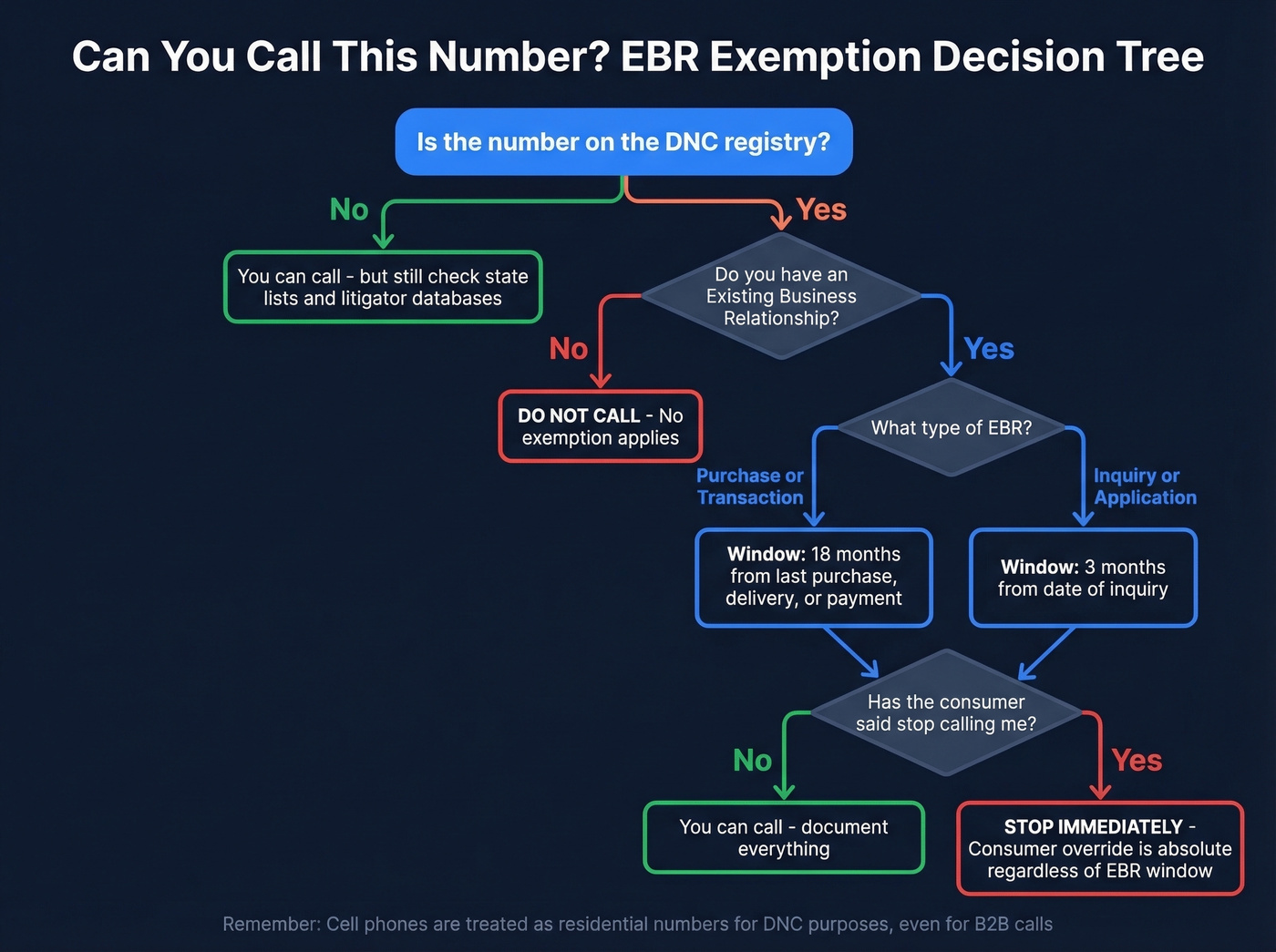
| EBR Type | Window | Starts From |
|---|---|---|
| Purchase/transaction | 18 months | Last purchase, delivery, or payment |
| Inquiry/application | 3 months | Date of inquiry or application |
If a customer bought from you 16 months ago, you can still call them - even if they're on the DNC registry. But if they say "stop calling me," you must honor that immediately, regardless of the EBR window.
A nuance that trips up B2B teams: cell phones are treated as residential numbers for DNC purposes. Calling a VP's personal cell for a sales pitch? That cell is protected by the DNC registry just like any consumer line. The "it's a business call" defense doesn't hold if the number is registered to an individual.
Use the EBR exemption if: you have documented proof of the transaction or inquiry date and the consumer hasn't asked you to stop. Skip it if: you're not 100% sure the relationship falls within the window. The burden of proof is on you.

DNC scrubbing keeps you out of court, but it doesn't solve the real problem: bad phone data. Prospeo's 125M+ verified mobile numbers deliver a 30% pickup rate because every number passes a 5-step verification process before you ever see it. Stop scrubbing garbage lists. Start with clean data.
Pay $0 for numbers that don't verify. Only pay when we find a match.
State DNC Rules - Why Federal-Only Fails
Scrubbing against the federal registry and stopping there is the most common compliance gap we see. States don't just mirror federal rules - several impose stricter penalties, tighter calling windows, and separate registration requirements.
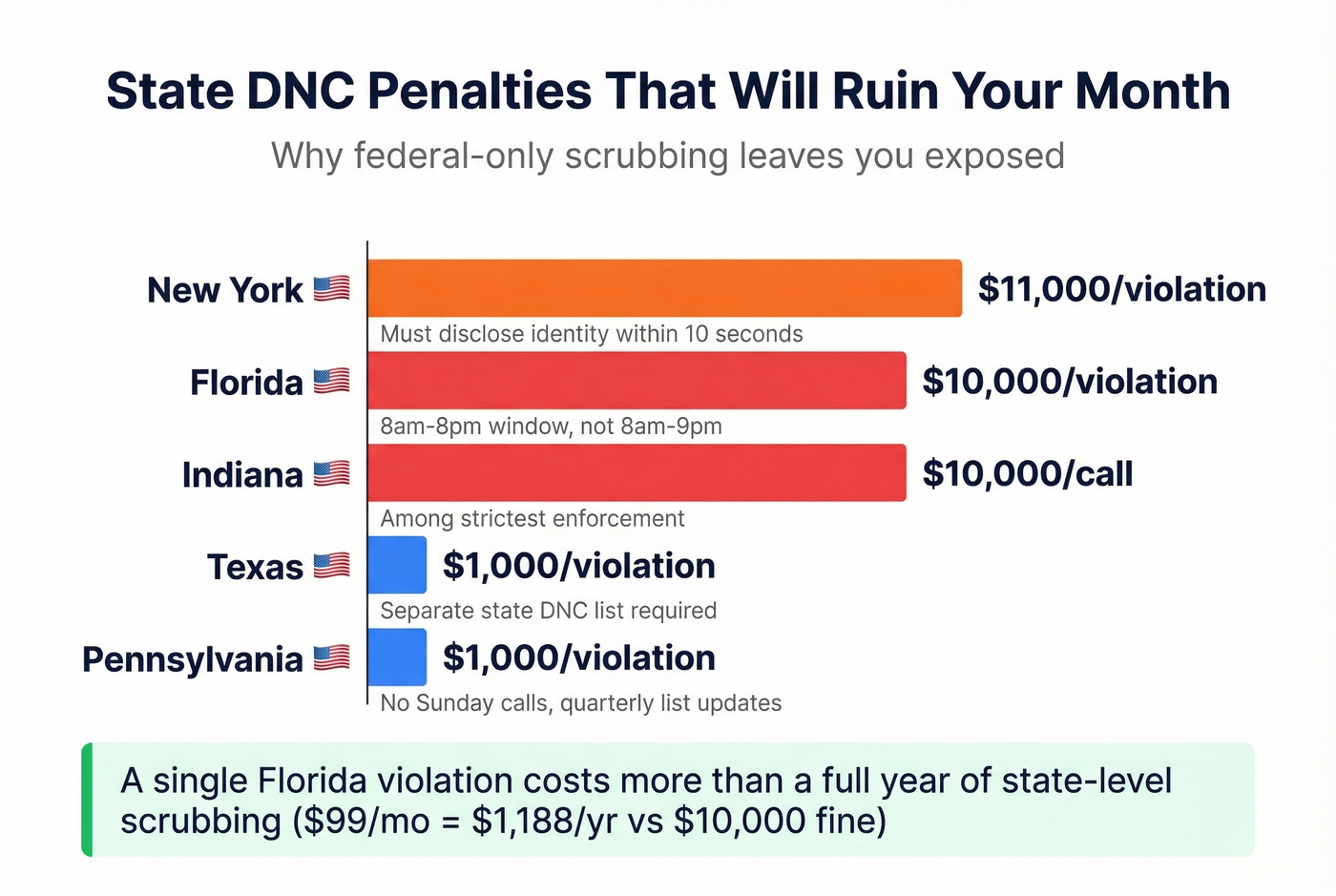
| State | Max Penalty | Notable Restriction |
|---|---|---|
| Florida | $10,000/violation | 8am-8pm window (vs. federal 8am-9pm) |
| Indiana | $10,000/call | Among strictest enforcement |
| New York | $11,000/violation | Must disclose identity within 10 seconds |
| Texas | $1,000/violation | Separate state DNC list required |
| Pennsylvania | $1,000/violation | No Sunday calls; quarterly list updates |
Florida's $10,000-per-violation penalty with a narrower calling window catches teams who assume federal hours apply everywhere. New York's 10-second disclosure rule means your reps need to identify themselves and state the purpose of the call almost immediately - before the prospect even says hello.
Let's be honest: if you're calling into multiple states, you need state-level scrubbing. ScrubLite's state DNC add-on runs $99/mo on top of their base plans. RealPhoneValidation and PossibleNOW include state coverage as part of their DNC lookup workflows. Either way, budget for it. A single Florida violation costs more than a year of state-level scrubbing.
National registry access fees alone can run around $22K/year for full coverage, before you add any scrubbing tool on top.
Best DNC Checkers Compared
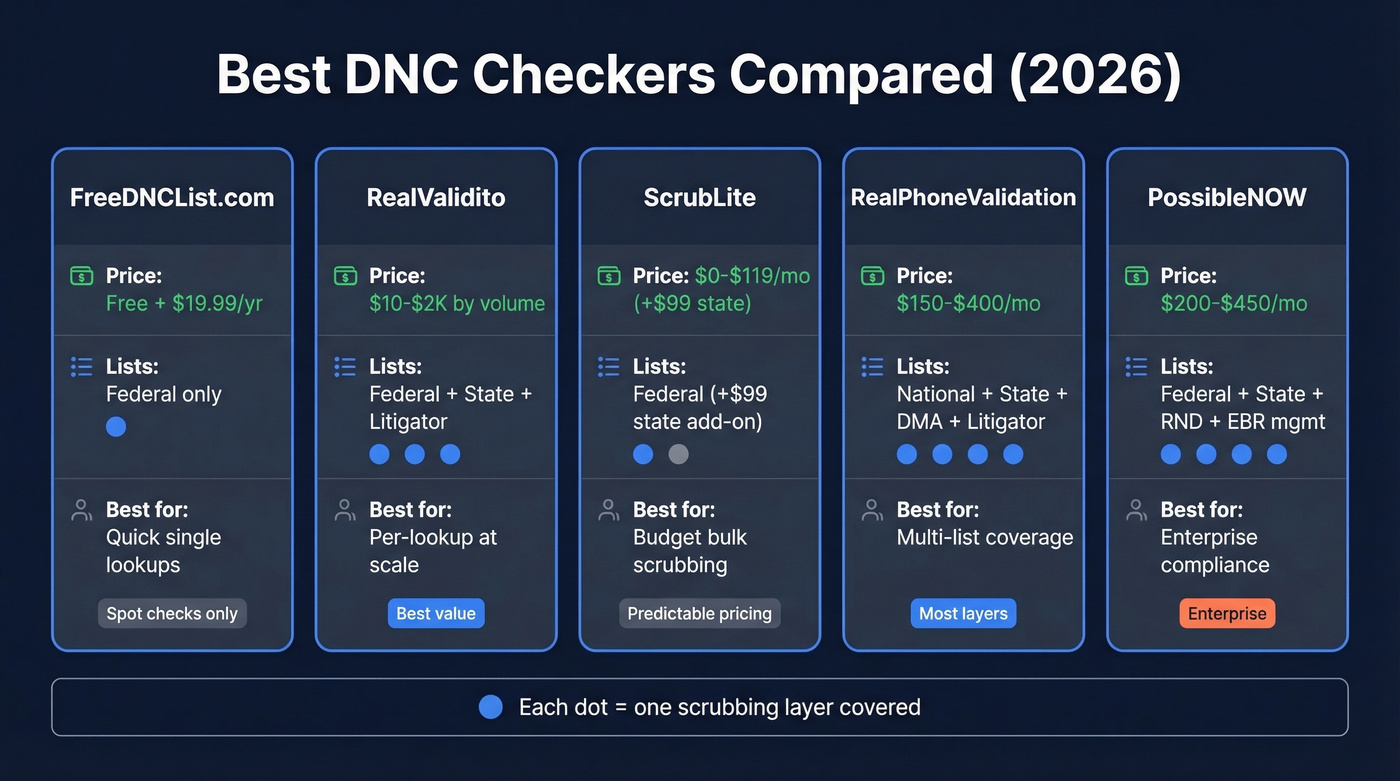
| Tool | Pricing | Lists Checked | Best For |
|---|---|---|---|
| FreeDNCList.com | Free + $19.99/yr registration | Federal only | Quick single lookups |
| RealValidito | Free trial credits; $10-$2K by volume | Federal + state + litigator signals | Per-lookup at scale |
| ScrubLite | $0-$119/mo (+$99/mo state add-on) | Federal (+$99 state) | Budget bulk scrubbing |
| RealPhoneValidation | ~$150-$400/mo (sales-gated) | National/state/DMA + litigator | Multi-list coverage |
| PossibleNOW | $200-$450/mo | Federal/state + RND + EBR mgmt | Enterprise compliance |
FreeDNCList.com - Quick and Free
Use this if you need to check DNC status on a handful of numbers before a call and don't want to pay anything. Skip this if you're scrubbing lists of any meaningful size. It's for spot-checks, not compliance at scale.
RealValidito - Best Per-Lookup Value
RealValidito's credit model is some of the most transparent pricing in the space. You buy credits in bulk, and the per-lookup cost drops aggressively with volume:
| Credits | Price | Per Lookup |
|---|---|---|
| 1,000 | $10 | $0.01 |
| 5,000 | $30 | $0.006 |
| 10,000 | $40 | $0.004 |
| 25,000 | $50 | $0.002 |
| 100,000 | $200 | $0.002 |
| 500,000 | $500 | $0.001 |
| 1,000,000 | $950 | ~$0.001 |
| 2,500,000 | $2,000 | ~$0.0008 |
Free trial credits let you test without commitment. At the 25K tier, you're paying $0.002 per lookup - two-tenths of a penny. That's rounding error compared to the cost of a single TCPA lawsuit.
RealValidito covers federal and state registries and incorporates litigator-related screening signals. If serial filers are a concern - and they should be - make sure your workflow includes litigator screening, whether that's inside your checker or as a dedicated step.
ScrubLite - Predictable Monthly Costs
ScrubLite is the go-to for teams that want predictable monthly pricing instead of a credit system:
| Tier | Price | Records/Month |
|---|---|---|
| Free | $0 | 25 |
| Tier 1 | $24.99/mo | 1,000 |
| Tier 2 | $39.99/mo | 5,000 |
| Tier 3 | $59.99/mo | 25,000 |
| Tier 4 | $119/mo | 60,000 |
The catch: state DNC database access is a $99/mo add-on. A team scrubbing 5,000 numbers against both federal and state lists pays $139/mo total. Still reasonable, but the state add-on effectively doubles the cost of the lower tiers. Mississippi, Louisiana, and Oklahoma state lists aren't included in the add-on - if you're calling heavily into those states, verify coverage separately.
For most SMB outbound teams doing 1K-5K calls per month, ScrubLite's Tier 1 or Tier 2 with the state add-on hits the sweet spot between cost and coverage.
RealPhoneValidation - Deepest Scrub
RealPhoneValidation checks three DNC databases (National, State, and DMA) plus a known litigator list in a single lookup. That four-layer approach is its main selling point. Results include phone type identification alongside DNC status, which helps with TCPA compliance beyond just registry scrubbing.
The tool offers both batch processing and a real-time API for point-of-entry scrubbing - meaning you can screen numbers the moment a lead enters your system, not just before a campaign. Pricing isn't publicly listed; based on the feature set and sales-gated model, expect $150-$400/mo for mid-volume teams. A free trial with 100 lookups lets you test the output format before committing.
PossibleNOW DNCSolution - Enterprise Grade
PossibleNOW starts at $200-$450/mo and earns that price tag with features smaller tools don't touch: EBR policy management customizable by state and time period, Reassigned Numbers Database integration, SOC 2 compliance, and an API-first architecture built for contact center workflows.
If you're scrubbing fewer than 5,000 numbers a month, skip this one. But for high-volume outbound operations in insurance, financial services, or home improvement, the EBR management alone prevents the kind of "we thought we had a relationship" mistakes that generate lawsuits. Support runs 8:30am-11pm ET on weekdays, which matters when you're troubleshooting a scrub at 9pm before a morning campaign.
Already Using a Contact Center Platform?
If you're running Five9, Gryphon ONE, or Phonexa, check whether DNC scrubbing is bundled into your existing contract. Many contact center suites include compliance features - real-time scrubbing, opt-out management, audit trails - that eliminate the need for a standalone checker.
How to Check DNC Status by Volume
The right tool depends almost entirely on how many numbers you're scrubbing per month.
Under 25 numbers/month: Use ScrubLite's free tier or FreeDNCList.com. Don't pay for something you barely use.
1,000-5,000/month: ScrubLite Tier 1 or Tier 2 with the state add-on gives you predictable costs at ~$125-$140/mo for full federal + state coverage.
5,000-25,000/month: RealValidito's credit model starts winning here. A 25,000-credit pack costs $50 - less than ScrubLite's Tier 3. Make sure your workflow includes litigator screening.
25,000+/month: RealValidito bulk credits at $200 for 100K lookups, or PossibleNOW at $200-$450/mo for teams that need EBR management, RND integration, and audit trails.
Point-of-capture scrubbing is worth considering regardless of volume. Instead of scrubbing in bulk before a campaign, you screen every number the moment it enters your CRM or web form. RealPhoneValidation's API and PossibleNOW both support this. It's more expensive per-lookup but eliminates the window between lead capture and scrub where a rep might accidentally dial a flagged number.
Clean Your Data Before You Scrub
DNC compliance is a data quality problem, not just a scrubbing problem. If 20% of the phone numbers on your list are disconnected, wrong, or reassigned to someone else, you're burning scrubbing credits on garbage data - and you're still exposed to reassigned-number lawsuits.
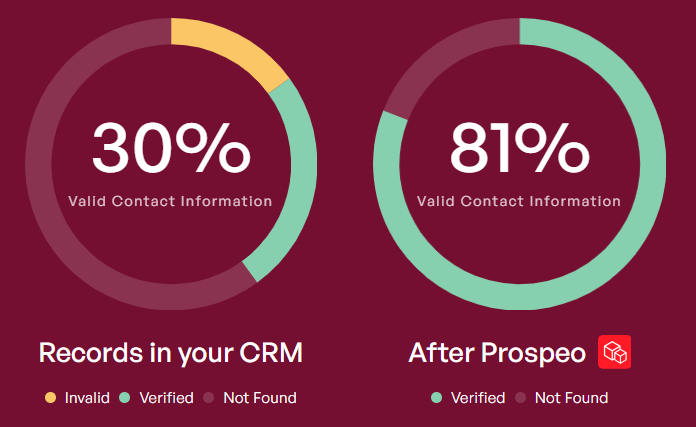
Think of it as step zero. Before you run a single Do Not Call lookup, make sure the numbers you're checking are real, current, and belong to the people you think they belong to. We've seen teams waste thousands of dollars a year scrubbing stale lists full of dead numbers. Prospeo's database of 125M+ verified mobile numbers runs on a 7-day refresh cycle, so the numbers you pull are current - not six weeks stale like most data providers. That freshness directly reduces reassigned-number exposure, and the 30% pickup rate confirms these numbers reach real people at active lines.
DNC Compliance Checklist
Register for a SAN at telemarketing.donotcall.gov. You can't legally access the registry without one.
Scrub against the National DNC Registry within 31 days of calling. This is the minimum for safe harbor protection.
Check state DNC lists for every state you're calling into. Federal scrubbing alone won't protect you from state-level enforcement.
Screen for known TCPA litigators. Serial filers account for a disproportionate share of lawsuits. A litigator scrub costs pennies per number.
Maintain a written DNC policy. Document your scrubbing procedures, calling hours, and opt-out handling. You'll need this if you're ever audited or sued.
Train your staff. Every rep making outbound calls should understand DNC rules, EBR windows, and how to handle opt-out requests. If you're building a repeatable outbound motion, pair compliance training with a documented cold calling system.
Keep records for at least two years. The TSR requires documentation of your compliance efforts, including scrub dates and results.
Respect calling hours. Federal rules allow 8am-9pm local time, but states like Florida restrict to 8am-8pm. Always default to the stricter window.
Honor opt-out requests immediately. If someone says "don't call me," that overrides any EBR exemption. Add them to your internal suppression list on the spot.
Re-scrub monthly or before each campaign - whichever comes first. Numbers get added to registries constantly.
Before all of this, verify your contact data is current. Stale numbers waste scrubbing credits and increase reassigned-number risk.
Serial TCPA litigators cost teams thousands per dial. The best defense isn't just scrubbing - it's starting with accurate, verified direct dials tied to real professionals. Prospeo refreshes 300M+ profiles every 7 days, so you're never calling reassigned or outdated numbers.
Clean data at the source beats scrubbing dirty lists after the fact.
FAQ
Is it illegal to call a number on the Do Not Call list?
Yes - calling a registered DNC number without an existing business relationship or prior written consent violates the TSR and can trigger fines up to $53,088 per call from the FTC, or $500-$1,500 per call in a private TCPA lawsuit. The only exceptions are EBR windows and certain exempt organizations like charities.
How often should I scrub my call list?
At minimum, every 31 days before calling. The FTC's safe harbor provision protects you if you can demonstrate the number was scrubbed within that window. High-volume teams often scrub before every campaign regardless of timing.
Do I need to check state-level DNC lists too?
Yes. Florida, Indiana, and New York impose penalties up to $10,000-$11,000 per violation - exceeding federal fines in many cases. Federal-only scrubbing leaves you exposed to state enforcement actions that are entirely separate from FTC proceedings.
What's the difference between a DNC checker and a TCPA compliance platform?
A DNC checker scrubs phone numbers against registries and flags matches. A TCPA compliance platform is broader - it includes consent management, calling-hour enforcement, reassigned number detection, EBR tracking, and audit trails. Standalone checkers run $24.99-$119/mo; full platforms start at $200-$450/mo.
How can I reduce the cost of DNC scrubbing?
Verify your phone data before scrubbing. If 20% of numbers are disconnected or reassigned, you're wasting credits checking dead lines. Starting with fresh, verified mobile data - refreshed weekly rather than monthly - means fewer wasted credits and less reassigned-number risk downstream.