

How to Convert a Domain to a Company Name (Free & Paid Methods)
You've got 200 domains sitting in a Google Analytics export and zero company names attached. Manually Googling each one isn't a workflow - it's a punishment.
Here's what actually works to resolve a domain to a company name in 2026, from free one-offs to bulk API enrichment.
Match Your Method to Your Volume
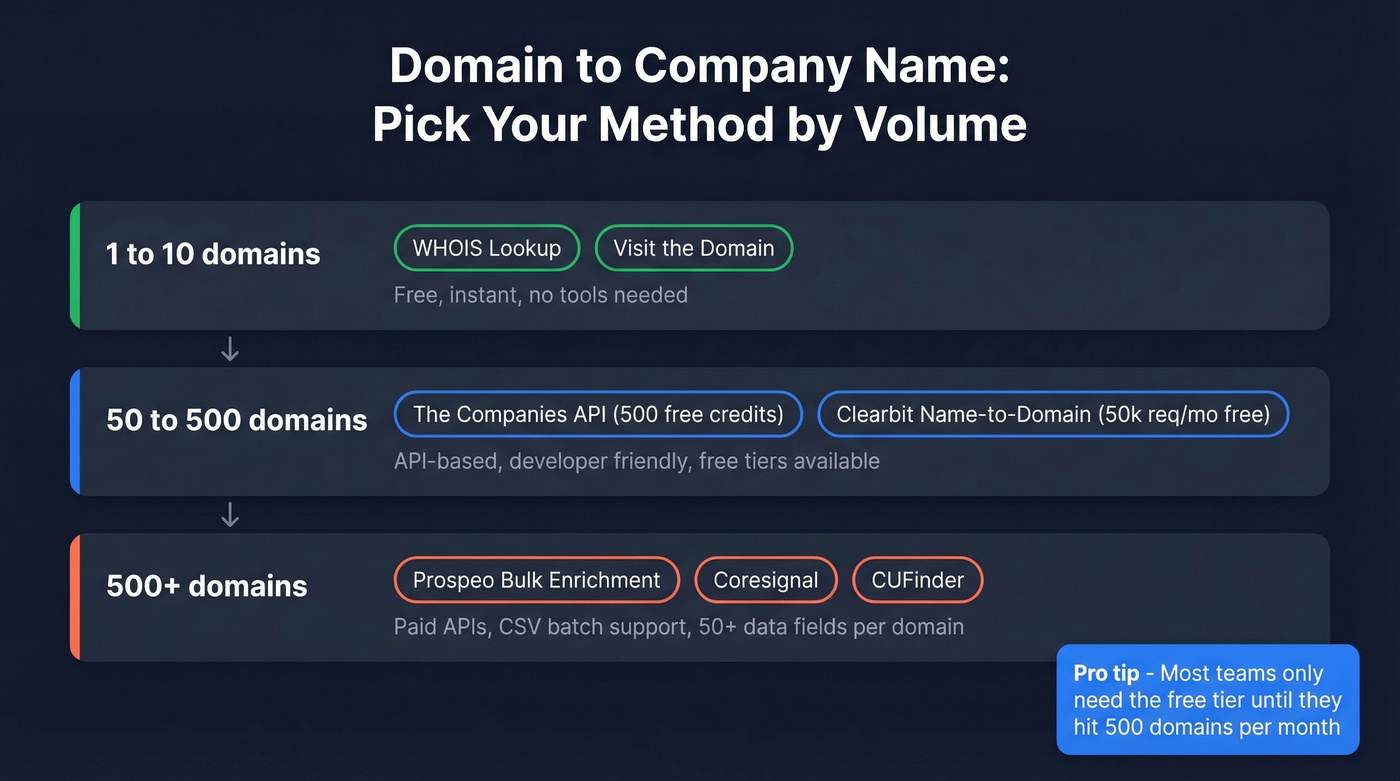
- 1-10 lookups: WHOIS or just visit the domain. Free, instant, no tools needed.
- 50-500 domains: The Companies API (500 free credits) or Clearbit's Name-to-Domain API (up to 50k requests/month on the free tier).
Why Domain-to-Company Lookups Matter for B2B
Resolving a domain to its parent company is the foundation of most B2B identification workflows. Sales and marketing teams use it to de-anonymize website traffic, qualify inbound leads, and enrich CRM records. It's closely related to IP-to-company identification - where you resolve a visitor's IP address to the company behind it - but domain-based lookups tend to be more accurate because you're starting with a known identifier rather than inferring one from network data.
If you're already running IP-to-company tracking on your site, pairing that data with domain-level enrichment gives you a much more complete picture of who's visiting and what accounts they belong to.
Free Methods (and Their Limits)
WHOIS lookup - Use it for one or two quick answers. Skip it for anything at scale. Many domains use privacy services, so you'll often see a proxy instead of an actual company name.
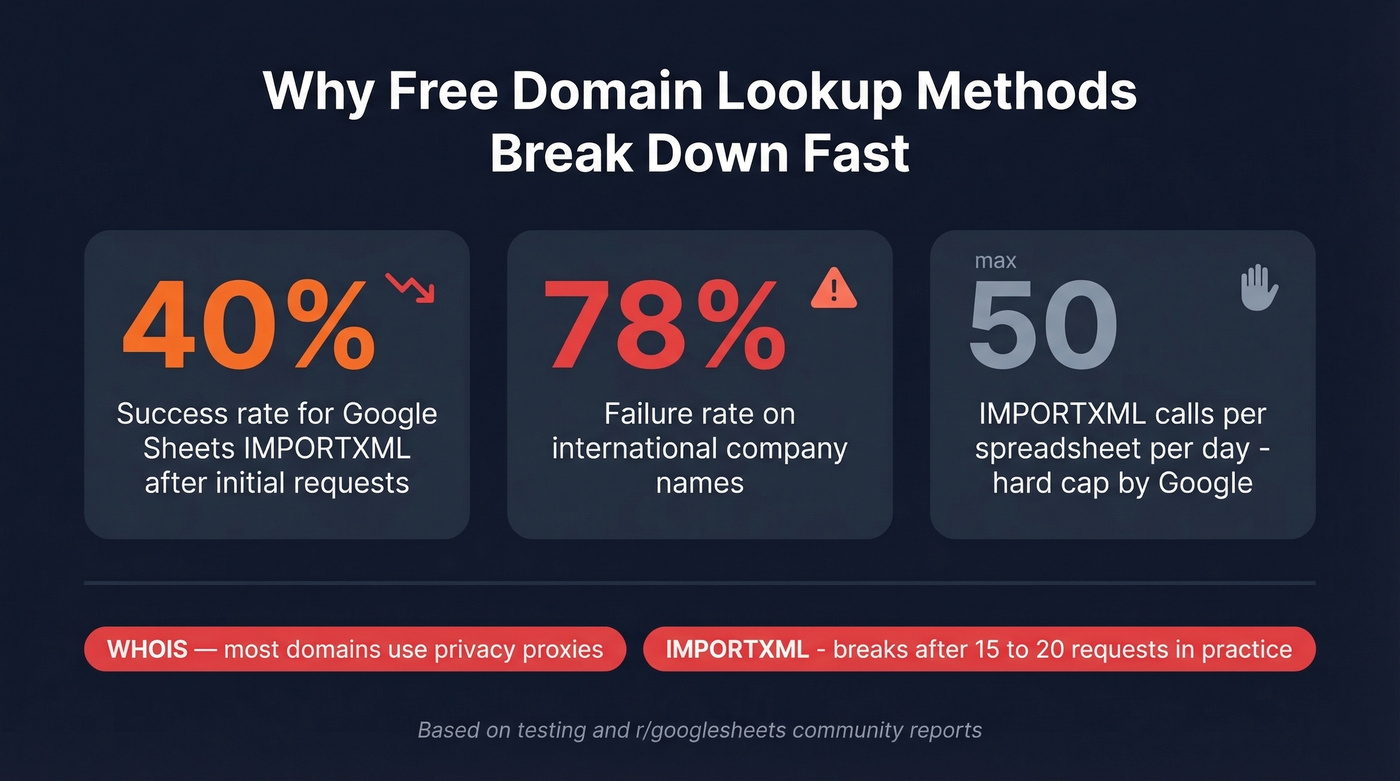
Google Sheets IMPORTXML - The classic hack: =IMPORTXML("https://www.google.com/search?q=" & A2, "//cite"). It works for about 15-20 requests before Google blocks you. After that, success rates drop to roughly 40%, international company names fail around 78% of the time, and Sheets caps IMPORTXML at 50 calls per spreadsheet per day. Reddit threads on r/googlesheets are full of people hitting this exact wall. In our testing, it broke even faster than the 15-20 threshold suggests.
It's a toy, not a tool.
Apps Script + JSON API - A better Sheets pattern. Call an enrichment API endpoint from a custom Apps Script function, parse the JSON response, and populate columns automatically. This actually scales inside Sheets, though you'll need API credits from somewhere.
One note for anyone following older tutorials: Clearbit's free Logo API was sunset on December 1, 2025. That endpoint is dead.

Most domain-to-company tools return a name and stop. Prospeo's API returns the company name, industry, headcount, verified emails, and direct dials - 50+ data points from a single domain lookup at a 92% match rate. Data refreshes every 7 days, not every 6 weeks.
Enrich 1,000 domains for about $10. Start with 75 free lookups.
Best APIs for Domain-to-Company Lookups
Prospeo
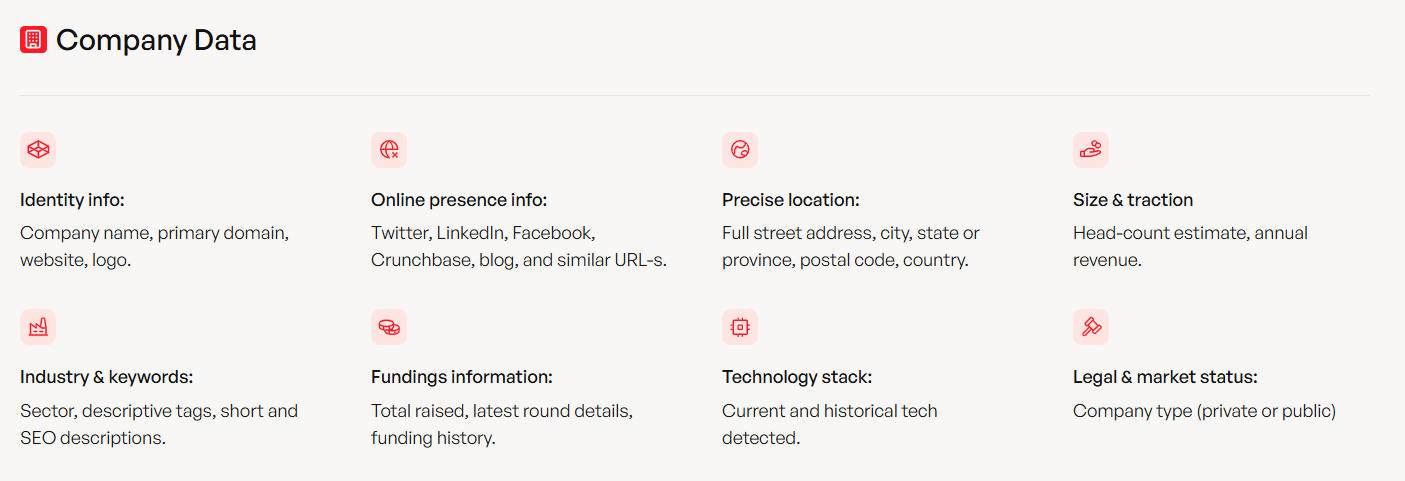
Most domain-to-company tools stop at the company name. Feed Prospeo a domain and you get the company name, industry, headcount, location, verified emails for key contacts, direct dial numbers, and 50+ data points - all from a single API call.
Use this if you're doing enrichment at scale and need actionable contact data, not just a label. The 92% API match rate means you aren't wasting credits on empty responses, and the 7-day data refresh cycle keeps records current. Pulling 1,000 verified emails costs about $10. The free tier gives you 75 email lookups and 100 Chrome extension credits per month to test before committing.
We've run bulk enrichment jobs through Prospeo where over 80% of domains came back with both the company name and at least one verified contact - that's a different league from tools that just return a label and a logo.
The Companies API
A solid, developer-friendly option for pure company data. Hit the domain enrichment endpoint and you get 80+ data points per company profile. One credit per request, no charge if nothing's found, and 500 free credits with no credit card required. The simplified=true parameter returns basic data at zero credit cost.
Skip this if you need verified emails or phone numbers alongside the company name. It's a company data API, not a contact data platform.
Clearbit / Breeze Intelligence
Now Breeze Intelligence under HubSpot. The free Name-to-Domain API handles up to 50k requests/month, but Clearbit themselves acknowledge that company names aren't unique, so there's inherent inaccuracy in name-based matching. The paid enrichment product runs $45/mo for 100 credits - that's $0.45 per lookup. If you're deep in HubSpot's ecosystem, the native integration is convenient. Otherwise, the cost-per-record is hard to justify against alternatives charging a fraction of that.
Coresignal & CUFinder
Coresignal starts at $49/month with a 14-day free trial (200 Collect + 400 Search credits). It's built for data science teams pulling company enrichment at scale. CUFinder also starts at $49/mo for 1,000 credits, claims 94%+ accuracy across 85M+ companies, and offers 50 free credits to test.
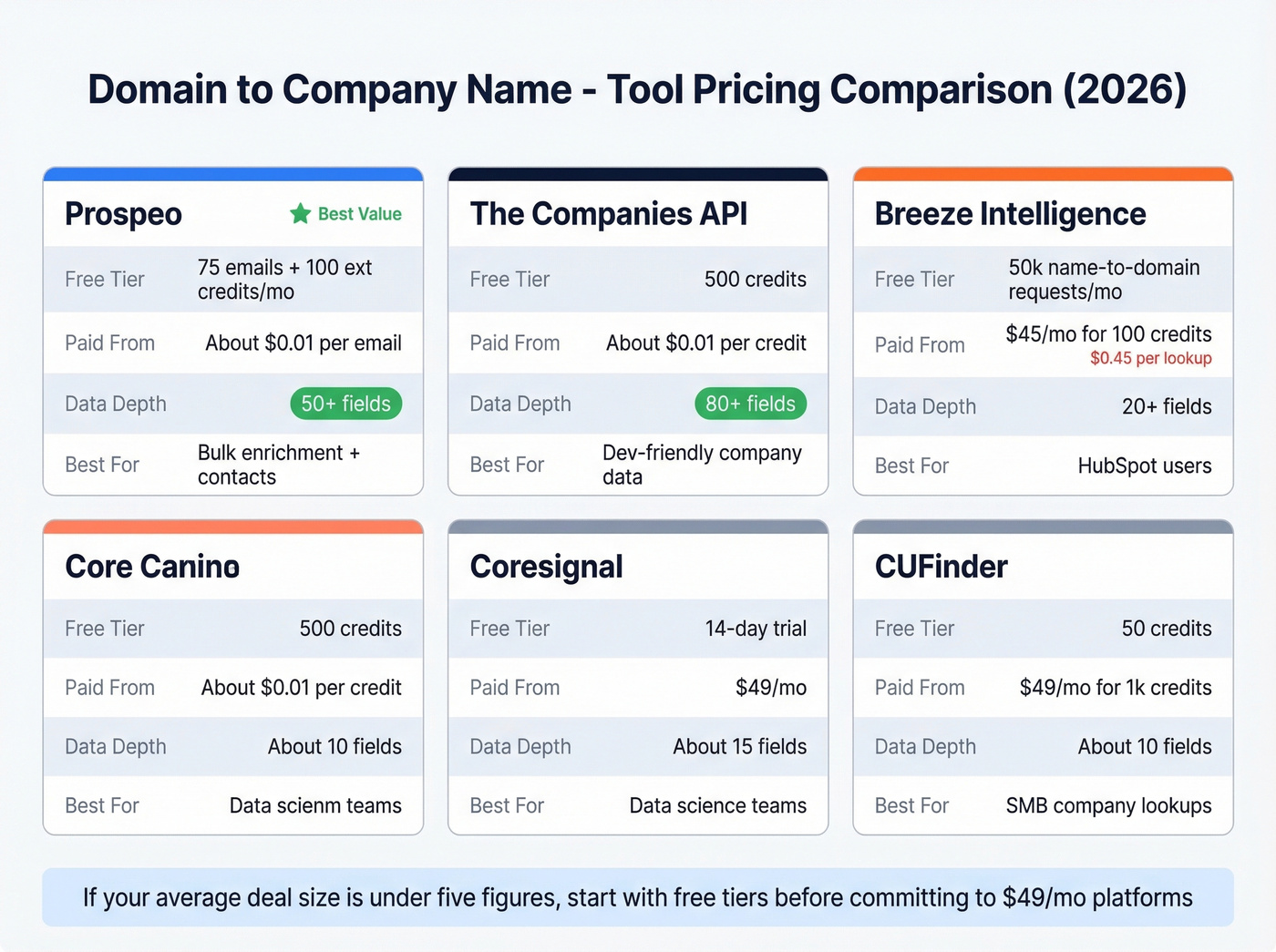
Here's the thing: if your average deal size is under five figures, you probably don't need anything beyond The Companies API's free tier or Prospeo's enrichment. The $49/mo platforms only make sense at serious volume or for very specific data science use cases.
How Domain Enrichment Fits Into IP-Based Identification
Converting a domain to a company name is one piece of a larger puzzle. Many B2B teams combine it with IP-to-company matching to identify anonymous website visitors. The two workflows typically connect like this:
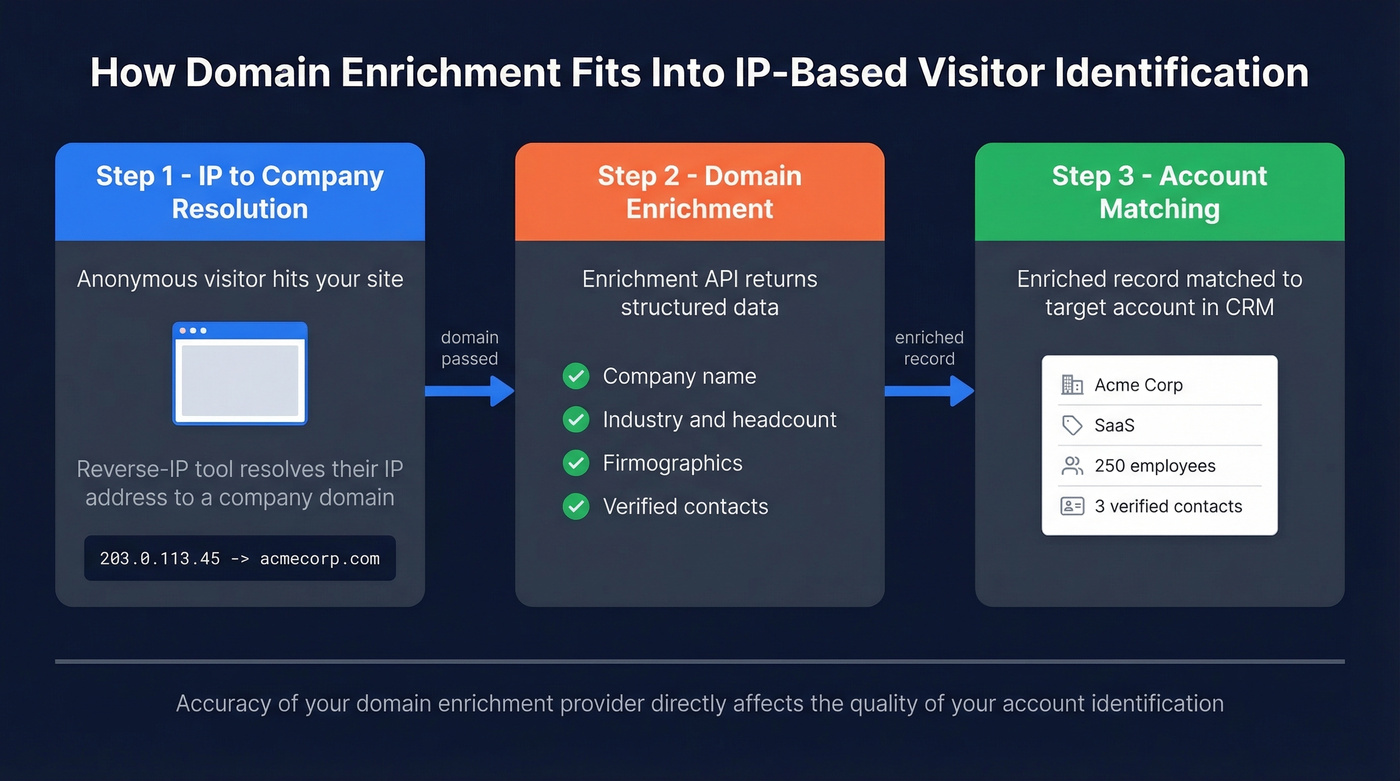
- IP-to-company resolution - A visitor hits your site, and a reverse-IP tool resolves their IP to a company domain.
- Domain enrichment - That domain gets passed to an enrichment API, which returns the company name, firmographics, and optionally contact data.
- Account matching - The enriched record is matched to a target account in your CRM, completing the identification loop.
This combination is what powers most account-based marketing platforms. Tools that handle IP-to-account matching often rely on the same underlying company databases, so the accuracy of your domain enrichment provider directly affects the quality of your lead-to-account matching. For teams running identity resolution at scale, the key metric isn't just match rate - it's whether the company name returned is the actual entity behind the domain, not a parent company or ISP. That's where dedicated enrichment APIs outperform generic WHOIS lookups by a wide margin.
Pricing Comparison
| Tool | Free Tier | Paid From | Data Depth | Best For |
|---|---|---|---|---|
| Prospeo | 75 emails + 100 ext./month | ~$0.01/email | 50+ fields | Bulk enrichment + contacts |
| The Companies API | 500 credits | ~$0.01/credit | 80+ fields | Dev-friendly company data |
| Breeze Intelligence | 50k name-to-domain | $45/mo (100 cr.) | 20+ fields | HubSpot users |
| Coresignal | 14-day trial | $49/mo | ~15 fields | Data science teams |
| CUFinder | 50 credits | $49/mo (1k cr.) | ~10 fields | SMB company lookups |
You're not resolving domains just to collect company names - you need to reach the people behind them. Prospeo turns your domain list into verified contacts with 98% email accuracy and 125M+ direct dials, so enrichment actually leads to booked meetings.
Stop at the company name and you stop short of pipeline.
FAQ
What if the domain is parked or redirects?
The Companies API returns an empty object when nothing's found and doesn't charge credits for the miss. WHOIS might show a registrant, but privacy services often mask it on parked domains. No tool reliably resolves inactive domains.
Can I convert domains to company names in bulk via CSV?
Yes. Prospeo and The Companies API both support bulk workflows including CSV uploads and batch API calls. Free methods like WHOIS and IMPORTXML don't realistically scale past 20 lookups before breaking.
Does WHOIS still show the company name?
Rarely. Most domains use WHOIS privacy services that mask registrant details. It still works for some large corporate domains registered under their legal entity, but expect it to fail for the majority of lookups.
How is domain enrichment different from IP address lookup?
IP-based lookup starts with a visitor's IP and tries to resolve it to a company - useful for de-anonymizing website traffic. Domain-to-company enrichment starts with a known domain and returns structured company data. They solve different problems but are often used together: IP resolution surfaces the domain, then an enrichment API fills in the company name, firmographics, and contacts.