

How to Build an Education Sales Pitch That Actually Closes in 2026
You ran a successful pilot. Teachers love the product. Then the curriculum director asks "Which funding stream covers this?" and the room goes silent.
That's the moment most edtech deals die - not because the product failed, but because the pitch wasn't built for how schools actually buy. Procurement cycles are longer than typical SaaS, funding is restricted to specific line items, and the person who loves your product never signs the check. We've watched reps nail a demo and then lose the deal six months later because nobody prepped a funding alignment memo for the grants team.
This is for people who've actually sat across from a superintendent and need a framework that accounts for the messy reality of K-12 procurement.
The Budget Reality in 2026
ESSER's nearly $190B in relief funding is gone. The liquidation deadline passed in early 2025, and roughly 1 in 4 districts report having no replacement funding for expenses previously covered by that relief aid.
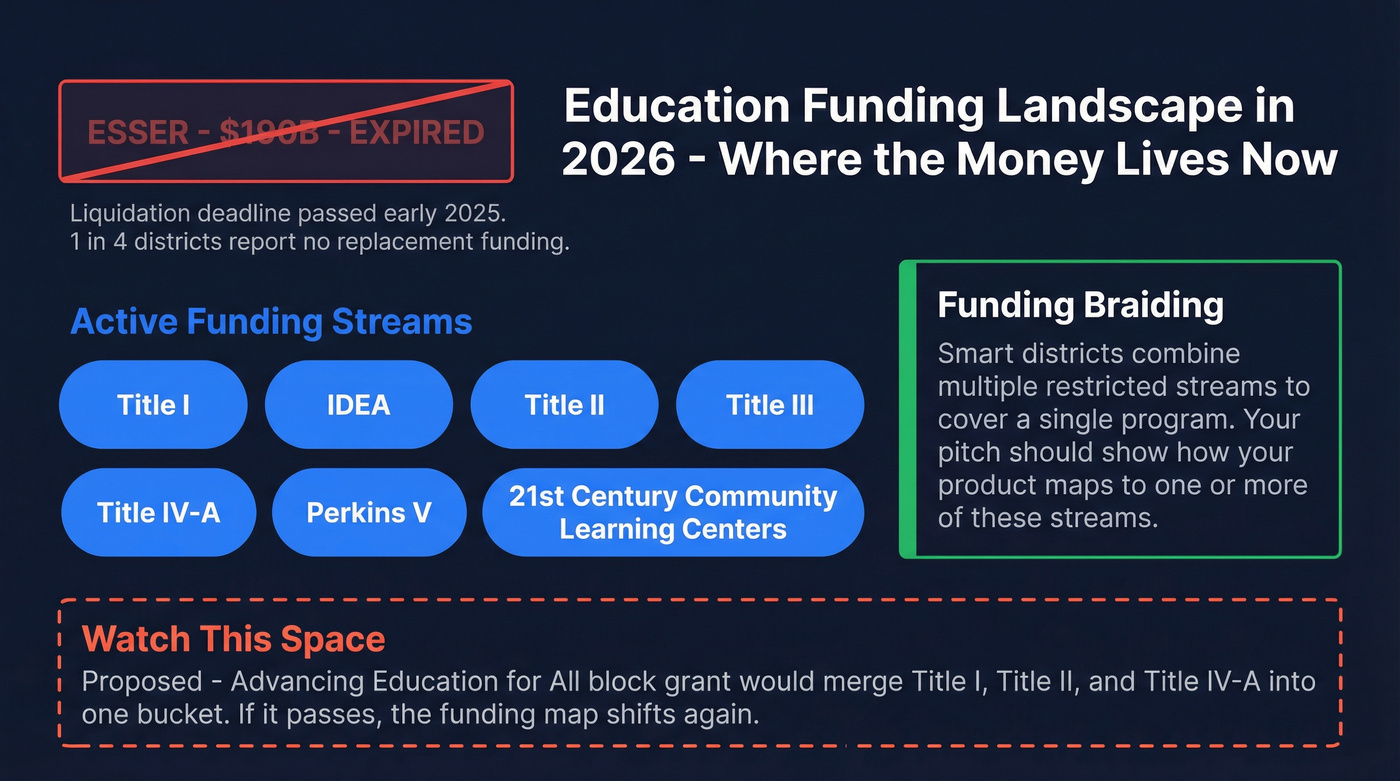
That doesn't mean there's no money. It means you need to know where it lives.
The streams that still work: Title I, IDEA, Title II, Title III, Title IV-A, Perkins V, and 21st Century Community Learning Centers. Smart districts use "funding braiding" - combining multiple restricted streams to cover a single program. There's also a proposed federal consolidation of 100+ programs into a single block grant called "Advancing Education for All," which would merge Title I, Title II, and Title IV-A into one bucket. If it passes, the funding map shifts again. If you can't speak this language fluently, your pitch is dead on arrival.
How Long Education Sales Actually Take
An EdWeek Research Center survey of 223 district and school leaders found that for district-wide investments, 37% said the process from identified need to signed contract takes 6-11 months. Another 22% reported 12-17 months. Only 7% closed in under three months. Add a pilot program and your real timeline stretches to 18-24 months.
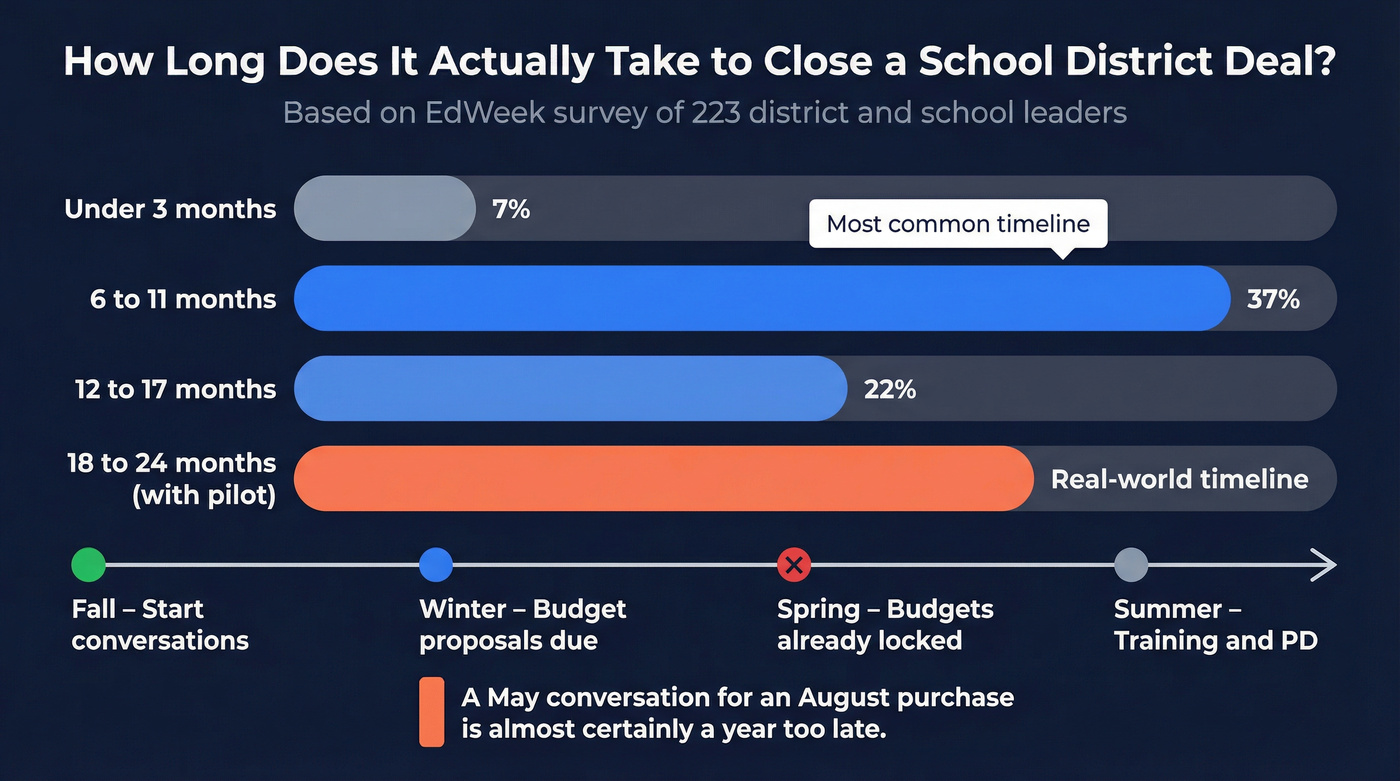
Timing matters enormously. Start conversations in fall or early winter to land in next year's budget proposals. Spring budgets are already set - a May conversation for an August purchase is almost certainly a year too late.
Know Your Stakeholders
The Harvard i-lab framework nails the split that trips up most sellers: users aren't buyers.
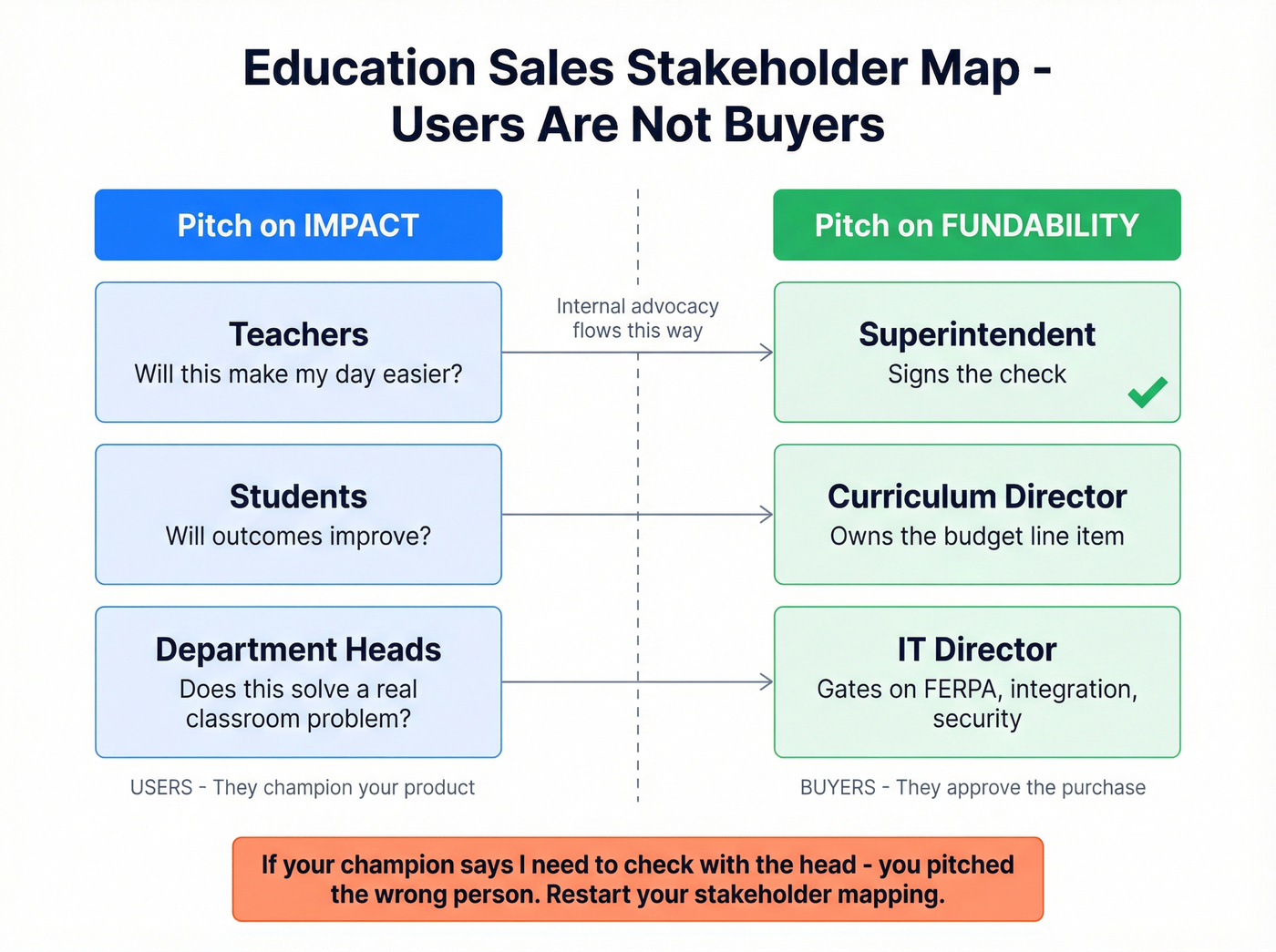
Pitch the user on impact. Teachers care about usability and student outcomes - will this make their day easier and their students better off? That's the conversation that builds internal champions.
Pitch the buyer on fundability. Principals have approved purchases specifically because a tool reduced teacher burdens. Superintendents sign the check. IT directors will gate your deal on integration compatibility, FERPA requirements, and data security architecture - and they can kill it silently if you don't engage them early.
Never pitch only the teacher. If your champion says "I'll need to check with the head," you pitched the wrong person. Identify the budget holder before you book the first meeting.

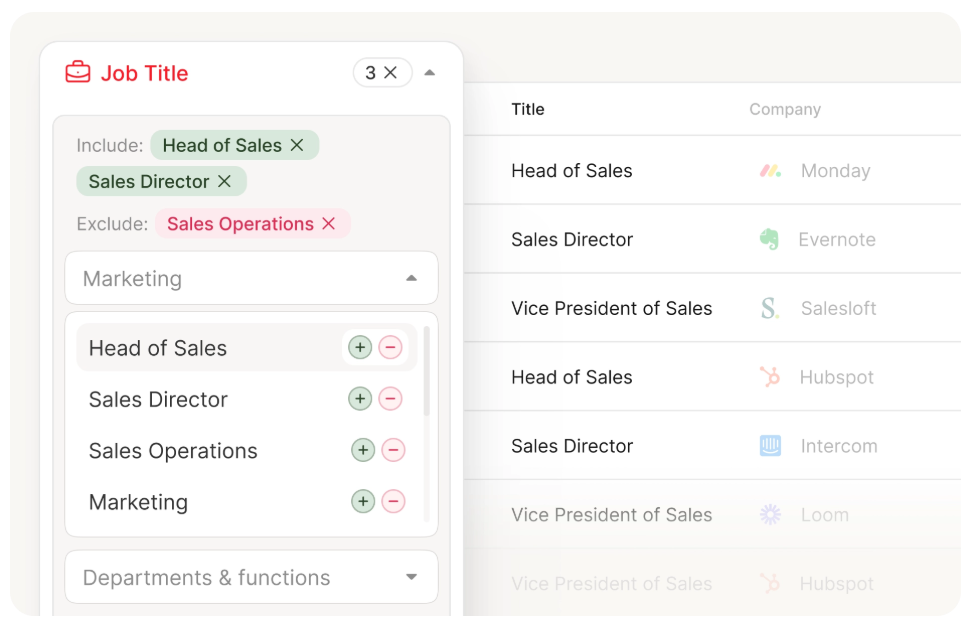
Your education pitch is only as good as the person who hears it. Prospeo lets you filter 300M+ profiles by job title and department - find superintendents, curriculum directors, and budget holders with 98% verified email accuracy. No more pitching teachers who can't sign the check.
Find the budget holder before you book the first meeting.
Anatomy of a Pitch That Closes
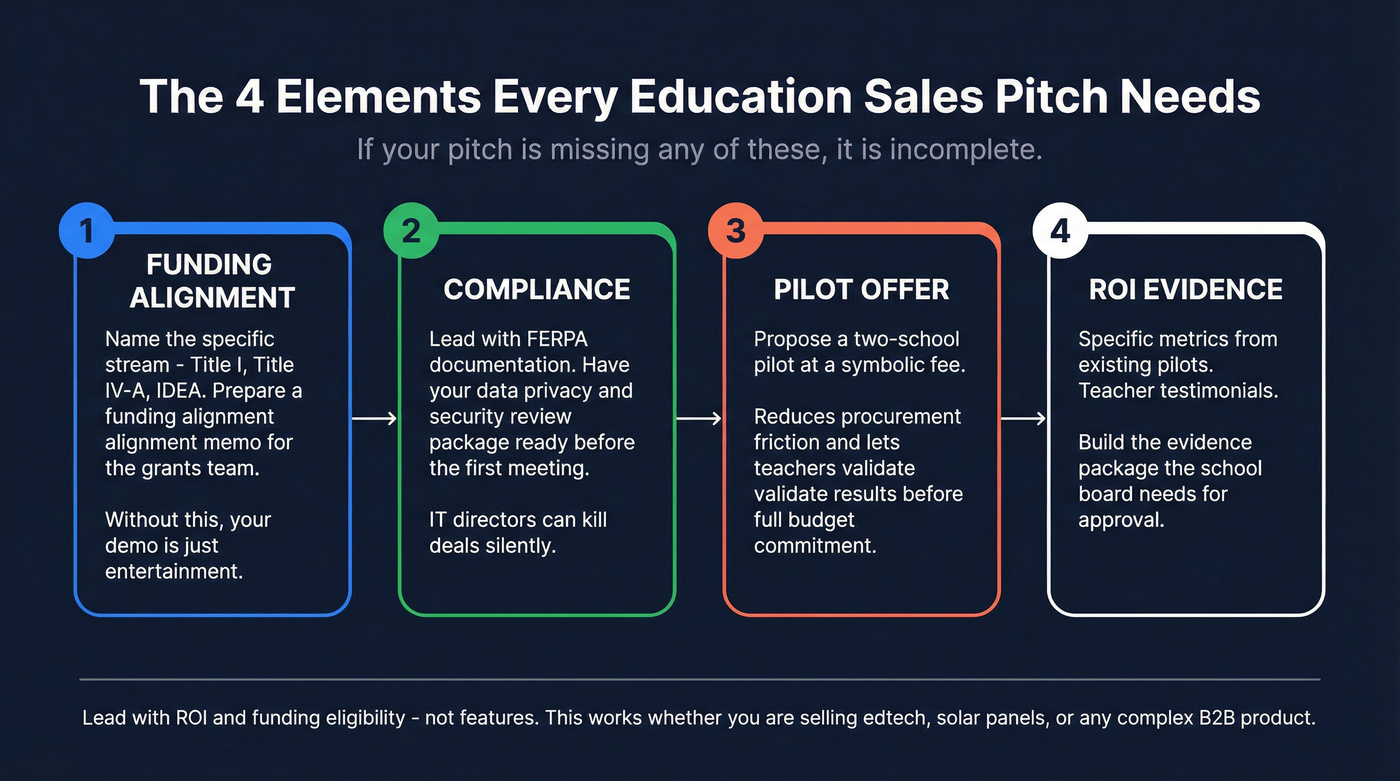
Here's a rule we use internally: if your pitch doesn't mention a specific funding source, it's incomplete. In many districts, dollars are tied to specific funding streams with hard restrictions on how they're spent, so a great product demo without a funding path is just entertainment.
A script framework for a K-12 district pitch targeting a superintendent and curriculum director:
"We help [grade band] students improve [outcome] by [mechanism]. The program is eligible under Title I / Title IV-A funding, and we've prepared a funding alignment memo for your grants team. We're fully FERPA compliant and ready for your district's privacy and security review - here's our data privacy documentation. We'd love to start with a two-school pilot this spring at a symbolic fee, so your teachers can validate the results before you commit budget. Districts running our pilot have seen [specific metric] - and we'll provide the evidence package your board needs for approval."
Adapt the specifics, but keep all four elements: funding, compliance, pilot, and ROI. A lot of edtech pitch templates focus on product features and leave out funding alignment entirely. And benchmark competitor pricing through public procurement documents - they're often publicly available. The same principle applies across verticals: whether you're crafting a solar panel pitch or selling classroom software, leading with ROI and funding eligibility outperforms leading with features every time.
Handling Common Objections
"We don't have the budget." Map your product to a specific funding stream. Offer a pilot with a symbolic fee so they can test without a full budget commitment. Districts that "don't have budget" often have unallocated Title IV-A funds sitting in a spreadsheet somewhere.
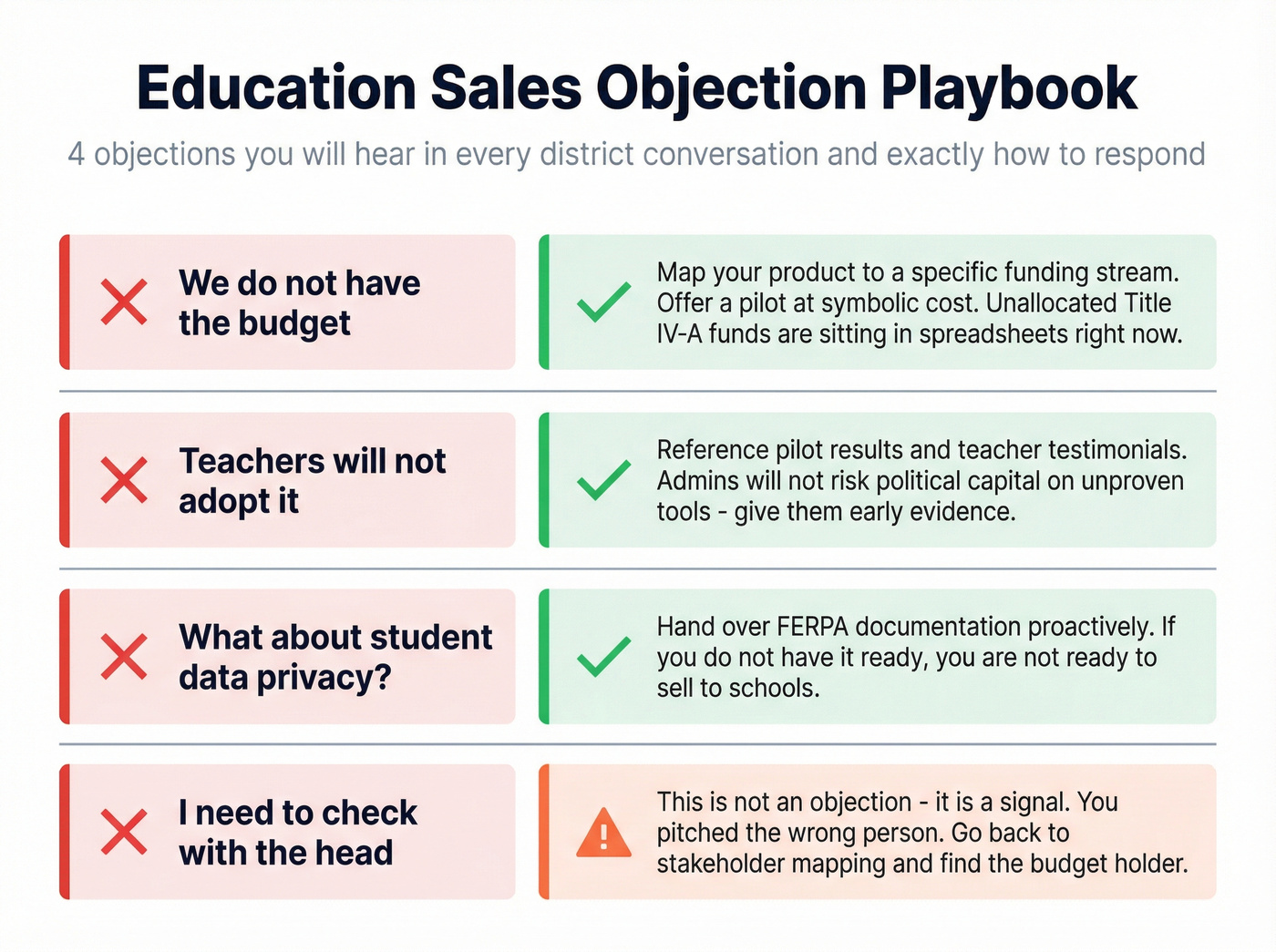
"Teachers won't adopt it." Reference pilot results and teacher testimonials. Early evidence is everything in education - administrators won't risk political capital on an unproven tool.
"What about student data privacy?" Hand over FERPA documentation proactively. If you don't have it ready, you're not ready to sell to schools. Full stop.
"I need to check with the head." You pitched the wrong person. This isn't really an objection - it's a signal to restart your stakeholder mapping.
Sharpen Your Pitch with Better Data
Look, a rep with a mediocre pitch and a perfect list will outsell a rep with a perfect pitch and a bad list every time. We've seen it repeatedly. Treating prospect research as a business intelligence exercise - layering enrollment data, funding allocations, and technology adoption signals - lets you personalize every conversation instead of blasting generic decks at the wrong people.
One r/salesdevelopment user reported a 75% close rate once they got a demo. The bottleneck wasn't pitch quality - it was top-of-funnel access. Finding verified emails for superintendents and curriculum directors shouldn't mean manually combing school district websites for hours.
Prospeo lets you filter by job title and department across 300M+ profiles, export a verified list, and start outreach with 98% email accuracy. The free tier gives you 75 verified emails per month - enough to test your targeting before you scale.
Pre-Outreach Checklist
- Start conversations by fall or early winter
- Identify the budget holder, not just the end user
- Map your product to a specific funding stream (Title I, IDEA, Title IV-A)
- Address FERPA and data privacy proactively - bring documentation to the first meeting
- Verify contact data before outreach; stale emails waste your narrow budget window
- Offer a pilot with a symbolic fee to reduce procurement friction
- Collect early evidence: teacher testimonials, pilot results, impact stories
- Follow up during the budget window, not after it closes
- Prepare a funding alignment memo for the grants team
- Use summer for training and professional development to maintain momentum
Education sales cycles run 6-18 months. You can't afford to waste your fall outreach window on bounced emails and wrong contacts. Prospeo refreshes data every 7 days and verifies emails through a 5-step process - so your outreach lands during the narrow budget planning season, not in a spam folder.
75 free verified emails per month - enough to test your district targeting today.
FAQ
How long does it take to close a deal with a school district?
Most district-wide purchases take 6-11 months from identified need to signed contract, based on the EdWeek survey of 223 leaders. Add a pilot phase and expect 18-24 months total. Starting outreach in fall gives you the best shot at landing in next year's budget cycle.
What funding streams can schools use to buy edtech in 2026?
With ESSER expired, districts rely on Title I, IDEA, Title II, Title III, Title IV-A, Perkins V, and 21st Century Community Learning Centers. Many combine multiple restricted streams through funding braiding. Your pitch should name the specific stream that applies to your product - without it, you're asking a budget holder to do homework they don't have time for.
When should I start outreach to schools?
Begin conversations in fall or early winter to be included in next year's budget proposals. Spring budgets are already locked. Reaching out in May for an August purchase means you're a full year too late.
How do I find verified contact info for school decision-makers?
School district websites are notoriously outdated, and generic info@ addresses rarely reach the right person. A B2B database with job title and department filters - like Prospeo's leads database - lets you build targeted lists of superintendents, curriculum directors, and principals with verified emails, so you're not burning your domain reputation on bounced messages during a narrow outreach window.