

Free Email Address Verifier: The Honest Comparison Nobody Else Will Write
Every free email address verifier tells you to use theirs. None of them compare honestly. So let's do that.
Global inbox placement sits at roughly 83.5% - meaning about 1 in 6 marketing emails never reaches the inbox. That's not a deliverability problem you can fix with better subject lines. It's a data quality problem, and it starts with unverified addresses.
This is for SDRs burning through prospect lists, marketers cleaning up neglected databases, and founders who can't afford to torch their domain reputation on bad data. We've tested these tools, dug into the only real benchmark anyone's published, and compared every free tier side by side so you can pick the right tool for your actual situation.
Our Picks (TL;DR)
- Quickest single check, no signup: Hunter - paste an email, get a result, no account needed
- Best for B2B prospecting: Prospeo - finds AND verifies emails in one step, 98% accuracy, 75 free emails/month
- Best pay-as-you-go value: Bouncer - credits never expire, no charge for unknowns, $8/1,000
- Most free trial credits: NeverBounce - 1,000 one-time credits to start
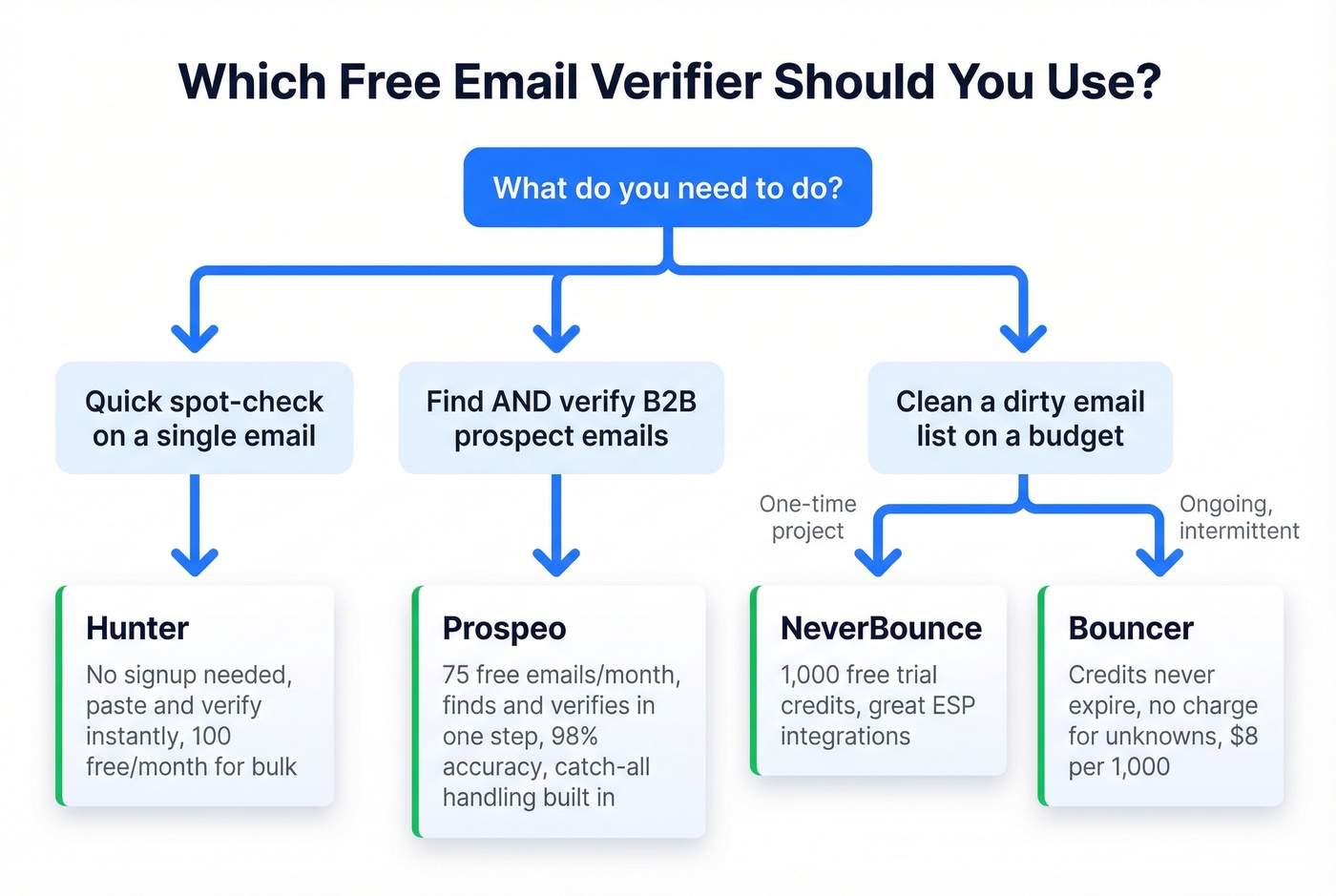
If you just need to spot-check a handful of addresses, Hunter's free checker is the fastest path. For building prospect lists where you want verified data from the start, Prospeo eliminates the "find emails, then verify them in a separate tool" dance entirely. And if you've got a dirty list that needs cleaning on a budget, Bouncer's credit policy is the friendliest in the space.
How Email Verification Works
Every verifier - free or paid - runs the same basic pipeline. The difference is how aggressively each tool handles ambiguous cases.
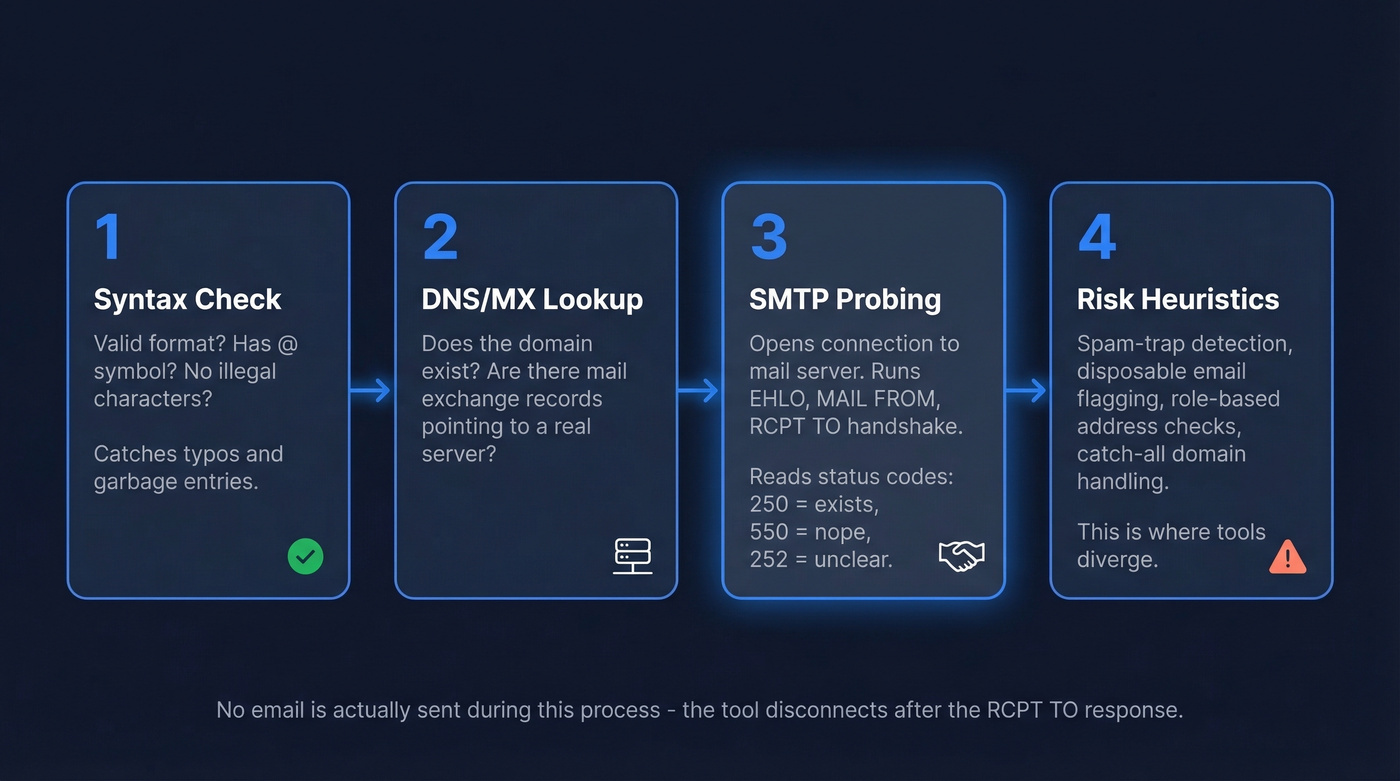
Layer 1: Syntax check. Is the format valid? Does it have an @, a domain, no illegal characters? This catches typos and garbage entries. Trivial. Every tool nails it.
Layer 2: DNS/MX lookup. Does the domain exist? Does it have mail exchange records pointing to a real mail server? No MX record means the address can't receive mail. Dead end.
Layer 3: SMTP probing. Here's where the real verification happens. The tool opens a connection to the mail server and runs a handshake sequence: EHLO to identify itself, MAIL FROM to declare a sender, then RCPT TO to ask if the recipient mailbox exists. The server responds with status codes - 250 typically means the mailbox exists, 550 means it doesn't, 450 or 421 signals a temporary issue like greylisting, and 252 is the frustrating one: "I can't verify right now, but I'll accept the message anyway." No email is actually sent during this process; the tool disconnects after the RCPT TO response.
Layer 4: Risk heuristics. This is where tools diverge. Good verifiers layer on spam-trap detection, disposable email identification, role-based address flagging for addresses like info@ and support@, and catch-all domain handling. A catch-all domain accepts mail for any address, even ones that don't exist - the server returns 250 for everything, so SMTP probing alone can't tell you if fake.person@catchall-company.com is real.
Different retry logic, different heuristic models, different approaches to catch-all domains. It's not a bug. It's the fundamental challenge of the technology.
The Accuracy Problem Nobody Talks About
Every email verifier markets "98-99% accuracy." Hunter ran an actual benchmark - 15 verifiers, 3,000 real business emails, standardized testing through Clay integrations. The top accuracy score? 70%. Hunter came first at 70.00%, Clearout hit 68.37%, Kickbox landed at 67.53%. That's a long way from 99%.
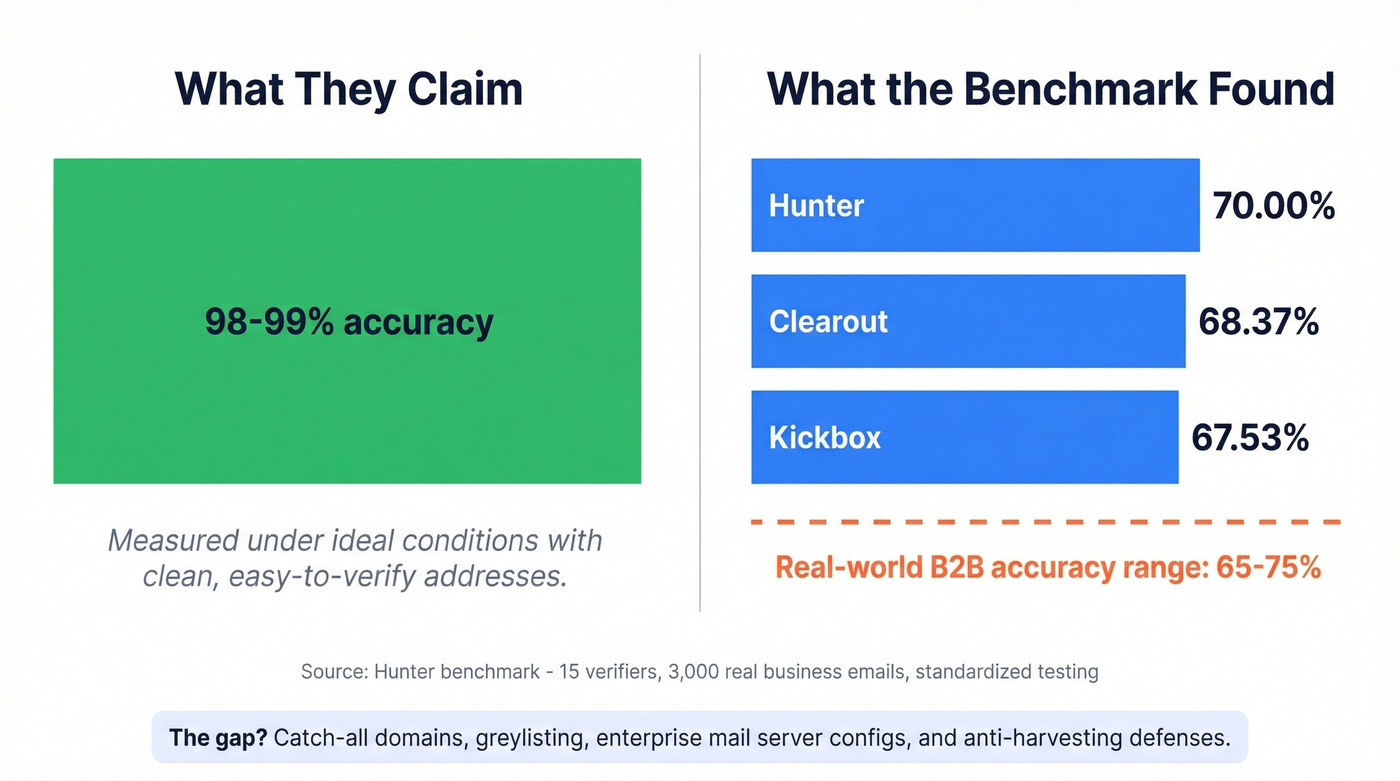
Why the gap? Vendor accuracy claims typically measure performance on clean, easy-to-verify addresses. The benchmark tested real-world B2B emails across small, medium, and large companies, where enterprise domains with strict mail server configs, greylisting, and anti-harvesting defenses dragged every tool's accuracy down. The "unknown" results that catch-all domains generate count against accuracy in any honest measurement.
Hunter disclosed that their dataset labeling used email activity recorded in their own system, which likely gave their tool an edge. Fair disclosure, and still the most transparent benchmark anyone's published.
Here's the thing: those 98-99% claims aren't lies - they're measured under ideal conditions that don't reflect your actual list. We've run mixed B2B lists through multiple tools, and real-world accuracy consistently hovers closer to 65-75%. Knowing this changes how you should think about verification. It's not about finding the "perfect" tool. It's about layering strategies and handling ambiguous results intelligently. If you're running deals under $15k, a single good free verification tool plus smart catch-all handling will get you 90% of the way there.

Most free verifiers check addresses you already have. Prospeo finds verified emails you don't - from 300M+ profiles, 5-step verification, catch-all handling, and spam-trap removal built in. 98% accuracy. 75 free emails/month.
Stop splitting find and verify into two steps. Do both at once.
Free Email Verifier Tools Compared
| Tool | Free Credits | Expiry | Signup? | Watch Out |
|---|---|---|---|---|
| Hunter | 100/mo + single check | Monthly | No for singles | Monthly cap for bulk |
| ZeroBounce | 100/mo | Monthly | Biz email only | No Gmail/Yahoo signup |
| MillionVerifier | 500 | One-time | Yes | One-time only |
| Bouncer | 100 one-time | Never | Yes, no CC | One-time only |
| NeverBounce | 1,000 trial | One-time | Yes | Not recurring |
| Emailable | 250 | One-time | Yes | One-time only |
| Verifalia | 25/day | Daily reset | No for singles | Low daily cap |
| Mailmeteor | Unlimited singles | Fair use | No | Sheets add-on: 50/mo |
| EmailListVerify | 3 | One-time | Yes | Basically a demo |
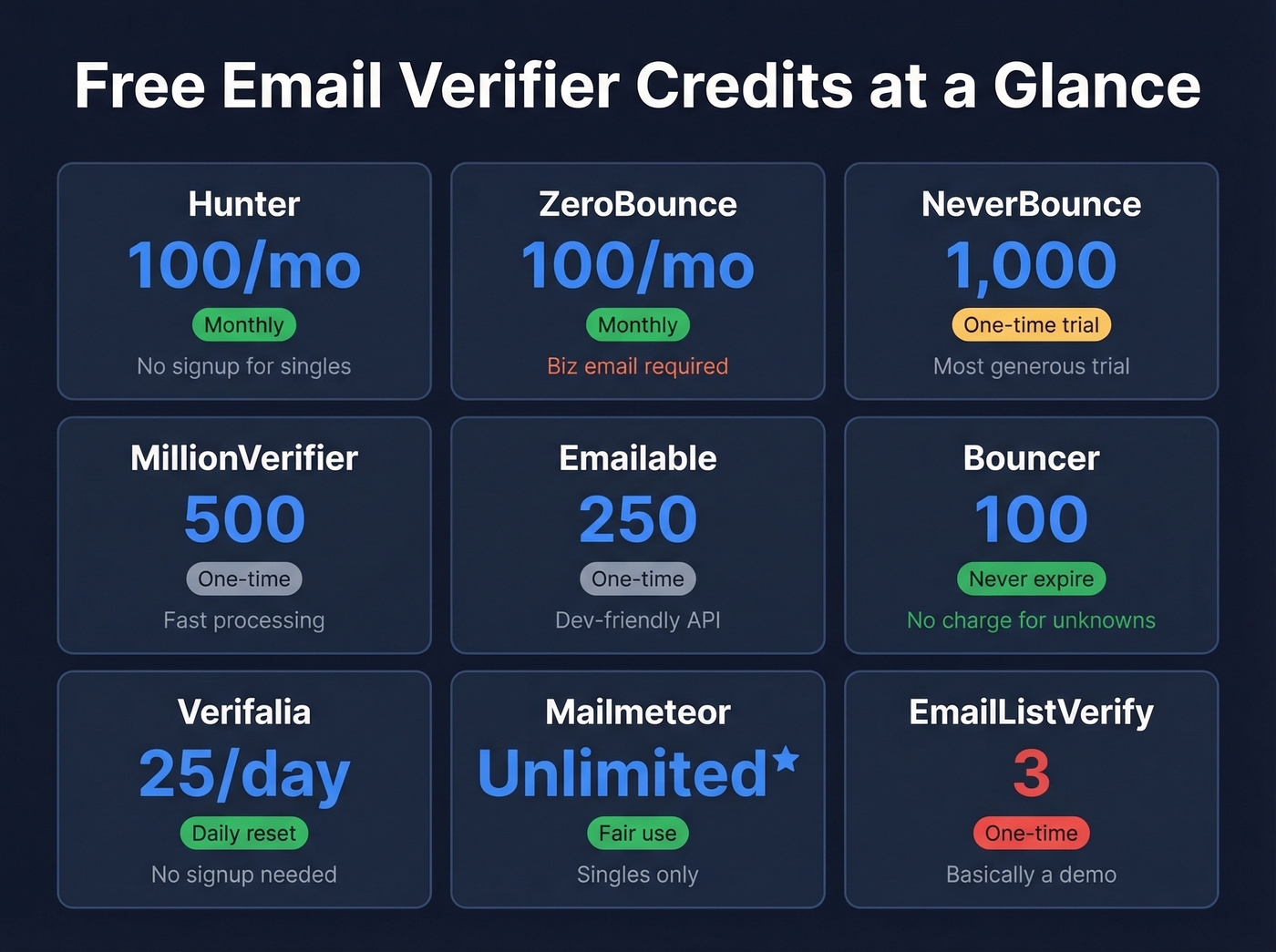
ZeroBounce's 100 free monthly verifications sound generous until you realize you need a business email to sign up - Gmail and Yahoo addresses are locked out. NeverBounce's 1,000 credits look like the best deal, but they're a one-time trial, not a recurring monthly allowance. Once they're gone, you're on paid plans. Bouncer's 100 credits never expire, which is a small but meaningful distinction if you're testing intermittently.
Best Free Email Verifiers Reviewed
Hunter - Instant Single-Email Checks
Hunter's single-email checker is the fastest way to verify an address without creating an account. Go to hunter.io/email-verifier, paste an email, get a result. No signup, no credit card, no friction. For quick spot-checks - "is this VP's email still valid before I send this cold email?" - nothing beats it.

Free accounts get up to 100 verifications per month. Hunter runs syntax, domain, and server response checks, plus a lookup against their own B2B database. They also offer proprietary catch-all verification for several major email providers, which is a genuine differentiator. The tool has 6M+ users and solid ratings across review platforms (4.6 on Capterra, 4.4 on G2).
The most common complaint? Paid verification pricing feels steep once you've been spoiled by the free single-check experience - $149 for 10K is roughly 2-6x what competitors charge.
Use this if: You need instant, no-friction single-email checks.
Skip this if: You're verifying lists at scale. There are much cheaper options for bulk work.
Bouncer - Best Pay-As-You-Go
Bouncer's pricing is refreshingly straightforward. Credits never expire. You don't get charged for unknown results. You don't get charged for duplicates. That alone sets it apart.

You get 100 free credits to start, no credit card required. Pay-as-you-go runs $8 per 1,000, scaling down to $6 per 1,000 at the 10K tier. Upload a CSV, get results, download. The interface is clean and fast, though the integration ecosystem is thinner than Hunter or NeverBounce. It's verification only - no email finding. If you want a free verification tool that won't pressure you into a subscription, Bouncer is hard to beat.
ZeroBounce - Monthly Free Allowance
ZeroBounce offers 100 free monthly verifications and claims 99.6% accuracy across 500,000+ customers. The real question is whether you can even sign up - you need a business or premium domain email. If you're running verification from a personal Gmail, you're locked out.
For established teams with company domains, it's a solid monthly free allowance with email scoring and activity data available as paid add-ons. Paid pricing runs around $64-99 for 10K credits depending on the plan.
Best for: Teams with company email domains who want a reliable monthly free allowance.
Dealbreaker for: Anyone working from a personal email address.
NeverBounce - Largest Trial Credits
NeverBounce hands you 1,000 free credits when you sign up - the most generous trial in this roundup. But those are one-time trial credits, not a recurring monthly allowance. Once they're gone, pay-as-you-go runs $8 per 1,000 with credits expiring after 12 months. The Growth plan is $49/month for up to 10,000 verifications.
Where NeverBounce shines is ESP integrations - it plugs directly into Mailchimp, HubSpot, and other platforms, making it easy to verify within existing email workflows rather than exporting and re-importing CSVs.
Use this if: You have a one-time list cleaning project and want to test before committing.
Skip this if: You need ongoing verification. Those credits expire, and the recurring plans aren't the cheapest.
Emailable - Developer-Friendly API
Emailable gives you 250 free verifications as a one-time credit. The interface is fast and clean, processing is quick, and there's a real-time API for developers who want to build verification into signup forms or lead capture flows. Paid pricing lands around $50 for 10K - middle of the pack. A solid, no-drama option that doesn't try to be more than what it is.
Use this if: You need a quick, small-batch verification with a clean UX or developer-friendly API.
Verifalia - Conservative and Precise
25 free verifications per day, no signup required for single checks. Verifalia takes a conservative approach, which means fewer false positives but more unknowns. If you'd rather have a cautious tool that says "I'm not sure" instead of guessing wrong, this philosophy will appeal to you.
MillionVerifier
500 free credits on signup - one of the larger one-time allowances. Straightforward interface, fast processing. It doesn't have the brand recognition of Hunter or NeverBounce, but the value proposition is clear: cheap, fast, and good enough for most list-cleaning jobs.
Mailmeteor - Built for Sheets
Unlimited single-email checks under a fair-use policy, plus a Sheets add-on that handles 50 free bulk verifications per month. If you live in spreadsheets and don't want another tool in your stack, this is your answer.
EmailListVerify - Cheapest at Scale
Only 3 free checks. Barely a demo. But paid pricing is the cheapest in the space at roughly $24 for 10K verifications. If you know you'll pay and want the lowest per-unit cost, start here. Don't bother with the free tier.
Real-world accuracy drops to 65-75% because most verifiers choke on catch-all domains and enterprise mail servers. Prospeo's proprietary infrastructure handles catch-all verification, honeypot filtering, and triple spam-trap removal - refreshed every 7 days, not 6 weeks.
Your domain reputation is worth more than free credits from a tool that guesses.
Pricing When You Outgrow Free
| Tool | Per 1K | Per 10K | Credits Expire? |
|---|---|---|---|
| Bouncer | $8 (drops to $6 at 10K) | $60 | Never |
| NeverBounce | $8 | $80 | 12 months |
| ZeroBounce | ~$6-10 | $64-99 | Varies by plan |
| MillionVerifier | ~$3 | ~$29 | Varies |
| EmailListVerify | ~$2.40 | $24 | Varies |
| Hunter | ~$15 | $149 | Monthly plan |
| Emailable | ~$5 | $50 | Varies |
Handling Unknown and Catch-All Results
Catch-all domains are the bane of email verification. When a mail server accepts all incoming mail regardless of whether the specific mailbox exists, every address at that domain returns a 250 status code. Your verifier can't distinguish real addresses from fabricated ones, so it marks them "unknown" or "risky."
Email lists decay by roughly 28% per year. That's about 7% per quarter going stale. Combined with catch-all ambiguity, you need a strategy beyond "verify once and forget."

We've run the same list through three different tools and gotten three different results - that's normal. Here's what actually works in practice.
Multi-provider verification. Run your list through your primary tool. Send the unknowns and risky results through a second verifier. Tools with proprietary catch-all handling reduce unknown results before they reach your list, and using a second free tool to cross-check keeps costs low while improving accuracy.
Re-verify every 60-90 days. Quarterly re-verification catches natural decay before it tanks your sender reputation. Set a calendar reminder. Treat it like changing your oil - boring but non-negotiable.
Know your thresholds. Top-performing campaigns keep bounce rates under 2%. Treat 2% as your ceiling, not your target. At 5%, you're in the danger zone.
Segment unknowns. Don't delete catch-all results. Send them in smaller batches, monitor bounce rates per batch, and pull the plug if bounces spike. This lets you salvage valid addresses hiding in catch-all domains without risking your entire sender reputation.
FAQ
Is free email verification accurate enough for business use?
Free tools use the same core technology as paid ones - syntax, DNS, and SMTP checks. The limitation is volume, not accuracy. For batches under 100 emails, free tiers from Hunter, Bouncer, or Prospeo work fine. For larger lists, you'll hit credit limits and need to upgrade or combine multiple free tiers.
How do I verify an email address for free?
Use a free email address verifier like Hunter's single-check tool - no signup required. Paste the address, and the tool runs syntax, DNS, and SMTP checks in seconds. For bulk lists, sign up for a free tier from Bouncer, ZeroBounce, or Prospeo and upload your CSV. Running unknowns through a second tool cross-checks results at no extra cost.
How often should I re-verify my email list?
Every 60-90 days. Email lists decay by roughly 28% per year, which works out to about 7% per quarter going stale. If your bounce rate spikes above 2%, re-verify immediately regardless of schedule.
Why do different verifiers give different results?
Catch-all domains, greylisting, rate limiting, and different retry logic all cause tools to disagree. This is normal. For critical sends, run the same address through two separate tools and trust the consensus result. Hunter's benchmark showed even top tools only agree on about 70% of real-world B2B addresses.