


7 Best EmailGuard Alternatives for Email Deliverability in 2026
You're running inbox placement tests, and GlockApps says 100% of your Outlook emails are hitting spam while EmailGuard says they're all landing in the inbox. Same domain. Same day. Opposite results. That's the moment you start shopping for EmailGuard alternatives.
To be clear: we're talking about EmailGuard.io, the deliverability monitoring platform - not email security software. EmailGuard bundles inbox placement tests, SPF/DKIM/DMARC checks, blacklist monitoring, contact verification credits, and domain masking proxies. It's a solid stack. But you don't need 15 tools to fix deliverability - you need a testing tool, a DMARC monitor, and clean data. Three tools, max.
Our Picks (TL;DR)
| Pick | Best For | Starting Price |
|---|---|---|
| GlockApps | Overall EmailGuard replacement | $59/mo |
| Prospeo | Contact verification & list hygiene | Free (75 emails/mo) |
| EasyDMARC | DMARC monitoring on a budget | Free |
Why People Switch from EmailGuard
The biggest trigger is trust erosion. A Reddit thread in r/coldemail captures this perfectly: one user reported GlockApps showing 100% spam on Outlook while EmailGuard showed 100% inbox. Same sending setup, opposite verdicts. When your monitoring tool can't agree with itself - let alone another tool - what are you even measuring?
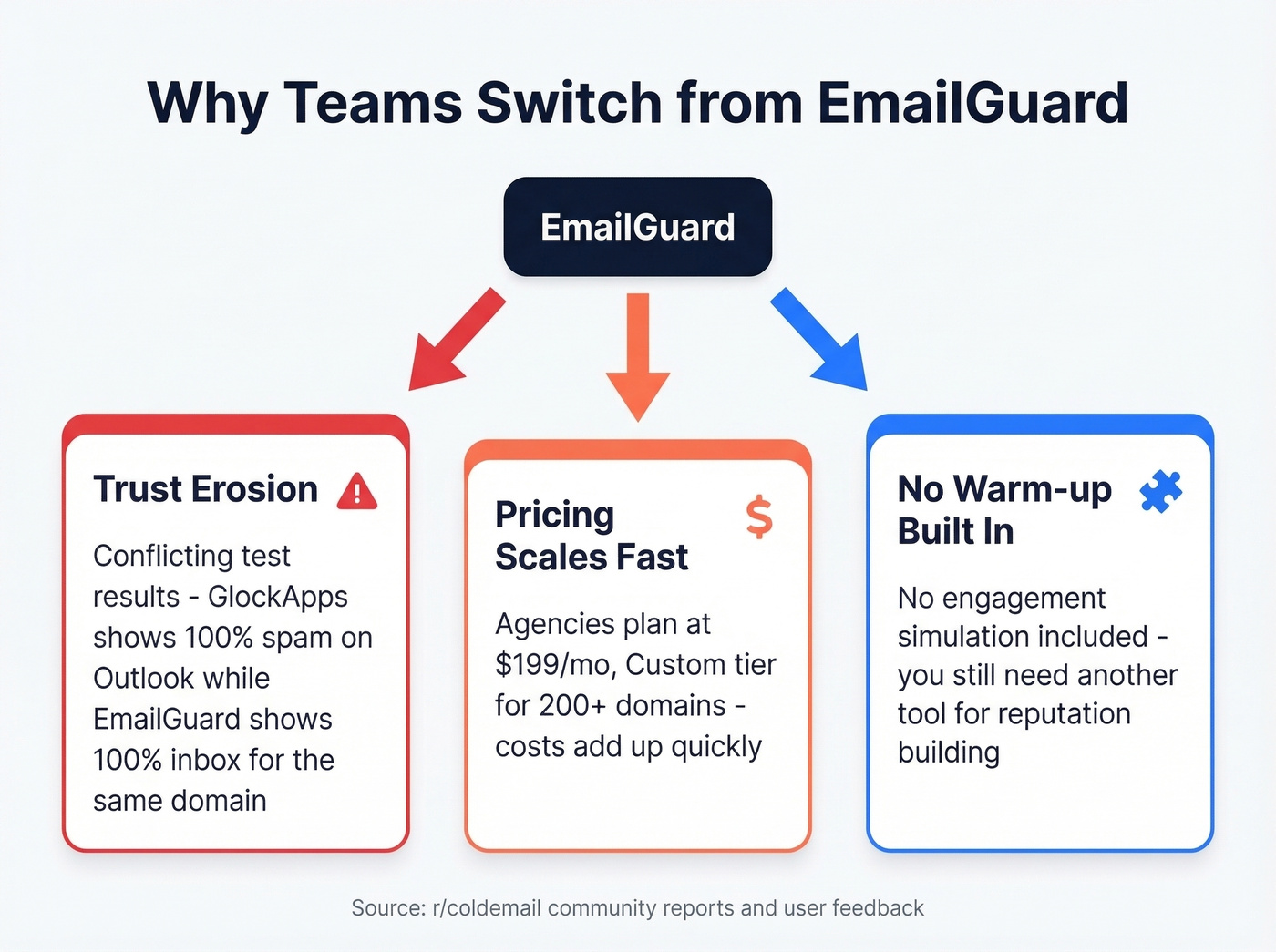
Beyond test reliability, agencies managing 200+ domains find EmailGuard's pricing scales fast. The Agencies plan runs $199/mo, and there's a Custom tier available via live chat. Teams also hit gaps around warm-up: EmailGuard doesn't include engagement simulation, so you're bolting on another tool anyway.

Conflicting inbox placement results mean nothing if your list is full of bounces, spam traps, and honeypots. Prospeo's 5-step verification removes them before you hit send - 98% email accuracy, 7-day data refresh, and zero domain flags for customers like Stack Optimize.
Fix deliverability at the source - not in the testing dashboard.
Best EmailGuard Alternatives Compared
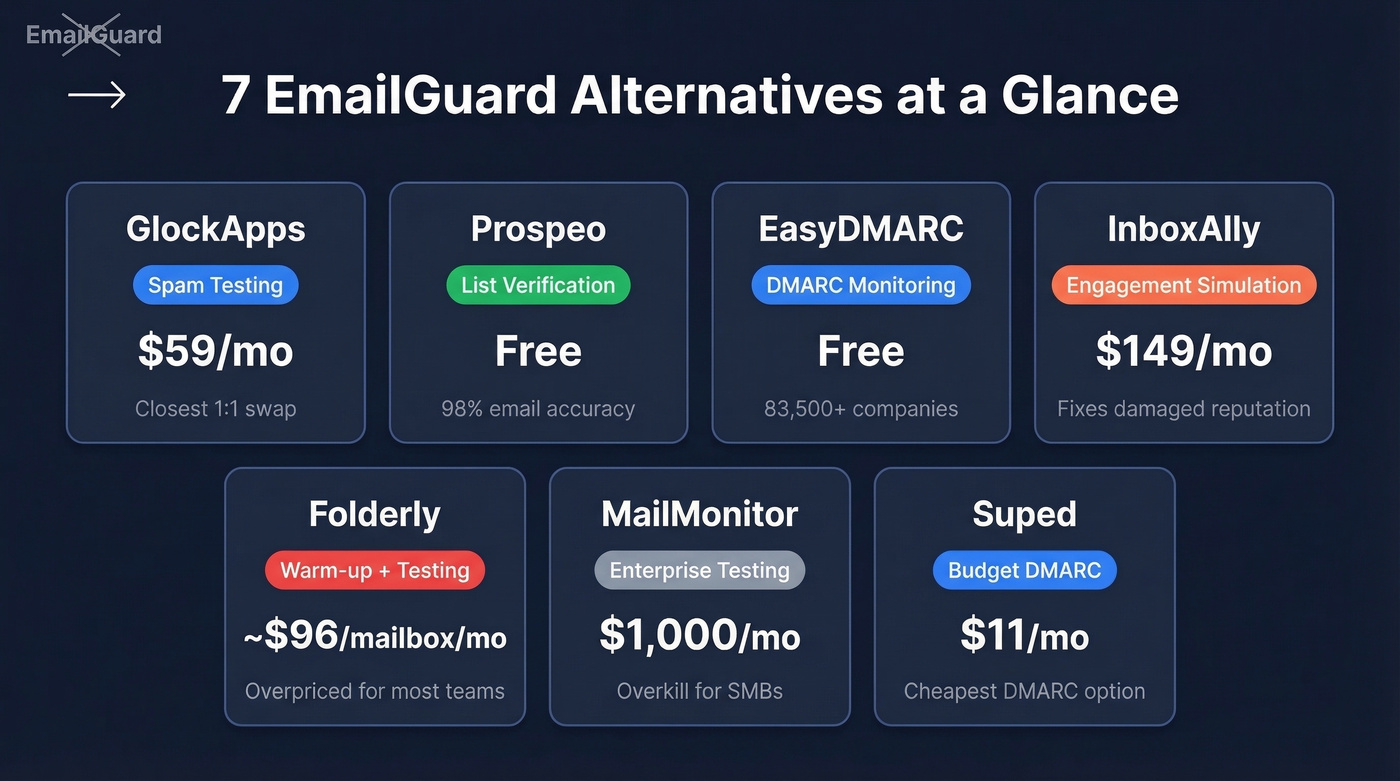
| Tool | Best For | Starting Price | Key Strength | Key Limitation |
|---|---|---|---|---|
| GlockApps | 1:1 EmailGuard swap | $59/mo | Deep spam testing + DMARC | ~100 seed mailboxes |
| Prospeo | List verification | Free | 98% email accuracy | Not a placement tester |
| EasyDMARC | DMARC compliance | Free | 83,500+ companies trust it | Slow interface |
| InboxAlly | Engagement simulation | $149/mo | Warms sender reputation | Expensive at scale |
| Folderly | Warm-up + testing | ~$96/mailbox/mo | All-in-one pitch | Overpriced for results |
| MailMonitor | Enterprise deliverability | $1,000/mo | 400+ real inboxes | Overkill for SMBs |
| Suped | Budget DMARC | $11/mo | Cheapest DMARC option | Limited feature set |
GlockApps
Use this if you want the closest 1:1 replacement for EmailGuard's core testing features. GlockApps' pricing runs $0 (2 test credits), $59/mo (360 credits), $99/mo (1,080 credits), and $129/mo (1,800 credits). It includes DMARC analytics and IP reputation monitoring, and it checks sending IPs and domains against 50+ major email blacklists. The spam test results break down Gmail Primary vs. Promotions vs. Spam - genuinely useful for cold email tuning.
We've found GlockApps to be the most reliable starting point for SMB and mid-market teams who just need to know where their emails are landing. The seed list is around 100 mailboxes, so don't over-interpret small percentage swings - a 5% shift on 100 seeds isn't statistically meaningful.
Skip this if you need contact verification or domain masking. GlockApps doesn't do either.

Prospeo
Use this if your deliverability problem starts upstream - with bad data. Inbox placement tests measure symptoms. Bounces, spam traps, and honeypots hits are the disease.
Most verification tools hover around 85-90% accuracy. Prospeo hits 98% across 143M+ verified emails using a proprietary 5-step verification process with catch-all handling, spam-trap removal, and honeypot filtering. Data refreshes every 7 days - the industry average is 6 weeks - so you're not sending to addresses that went stale last quarter. One customer, Stack Optimize, maintains 94%+ deliverability and under 3% bounce rates across all their clients using Prospeo for upstream verification, with zero domain flags.
The free tier gives you 75 email verifications per month, and paid plans work out to roughly $0.01/email with no contracts. If you're running sequences through Instantly, Lemlist, or Smartlead, Prospeo plugs in natively.
Skip this if you only need inbox placement testing - Prospeo doesn't test where emails land, it ensures they get there.
You're comparing $59-$199/mo deliverability tools, but bad data is costing you more than any monitoring subscription. At ~$0.01/email with 143M+ verified addresses and native integrations with Instantly, Lemlist, and Smartlead, Prospeo eliminates bounces before they tank your sender reputation.
Stop diagnosing deliverability problems you could prevent entirely.
EasyDMARC
EasyDMARC's free tier covers 1 domain and 1,000 emails/month - enough to get started. Paid plans are reasonable at $35.99/mo (Plus) and $71.99/mo (Premium) on annual billing. Over 83,500 companies use it, and it holds a 4.8/5 on G2 with 162 reviews. Reviewers consistently praise setup speed - DMARC records configured in minutes.
The downsides are real, though. The interface is slow, and multiple G2 reviewers flag this. One reviewer specifically warned that "exported output data cannot be trusted." If DMARC compliance is your primary need and you don't want to pay GlockApps prices for features you won't use, EasyDMARC is the right call. Just don't rely on its exports for reporting.
InboxAlly
InboxAlly takes a fundamentally different approach: instead of seed testing, it sends your emails to addresses that actively open, click, and move messages to inbox - training mailbox providers to trust your domain. Plans start at $149/mo for 100 seed emails/day (fits teams sending up to 2,000 emails/day), jumping to $645/mo for 500/day and $1,190/mo for 1,000/day.
Here's the thing: InboxAlly is the most underrated tool on this list. If your domain reputation is already damaged, no amount of testing will fix it - you need engagement signals. But at $149/mo minimum with no free tier, it's a real commitment for a tool that complements your testing stack rather than replacing it.
Folderly
Let's be honest - we'd skip this one. Folderly runs roughly $96/mailbox/month for warm-up on yearly billing, and their testing product costs $79/mo for 100 tests. Scale that to 10 mailboxes and you're looking at $960/month for warm-up plus $79/month for testing. That's over $1,000/month total. The seed list covers only four ESPs, users report warm-up emails firing on weekends with no timing control (causing Monday deliverability drops), and implementation takes 7+ days minimum.
MailMonitor
MailMonitor is the enterprise play - $1,000/mo minimum, billed annually, with 400+ real inboxes across 90 ISPs. They claim clients see a 15-25% boost in campaign revenue for every 10% improvement in inbox placement. But they explicitly state they're "not for 100% cold outbound without a warm-up or opt-in strategy," so most cold email teams should look elsewhere.
Suped
Suped starts at $11/mo and focuses on DMARC monitoring for small teams. If you just need basic authentication oversight without the testing and verification stack, it's the cheapest way in. Not much else to say.
Why Inbox Placement Tests Disagree
GlockApps publishes a stat that on average 51% of emails never reach the inbox, with 26% going to spam and 25% never delivered at all. That number sounds alarming, but the bigger point is that seed-based placement tests can be misleading if you treat them as gospel.
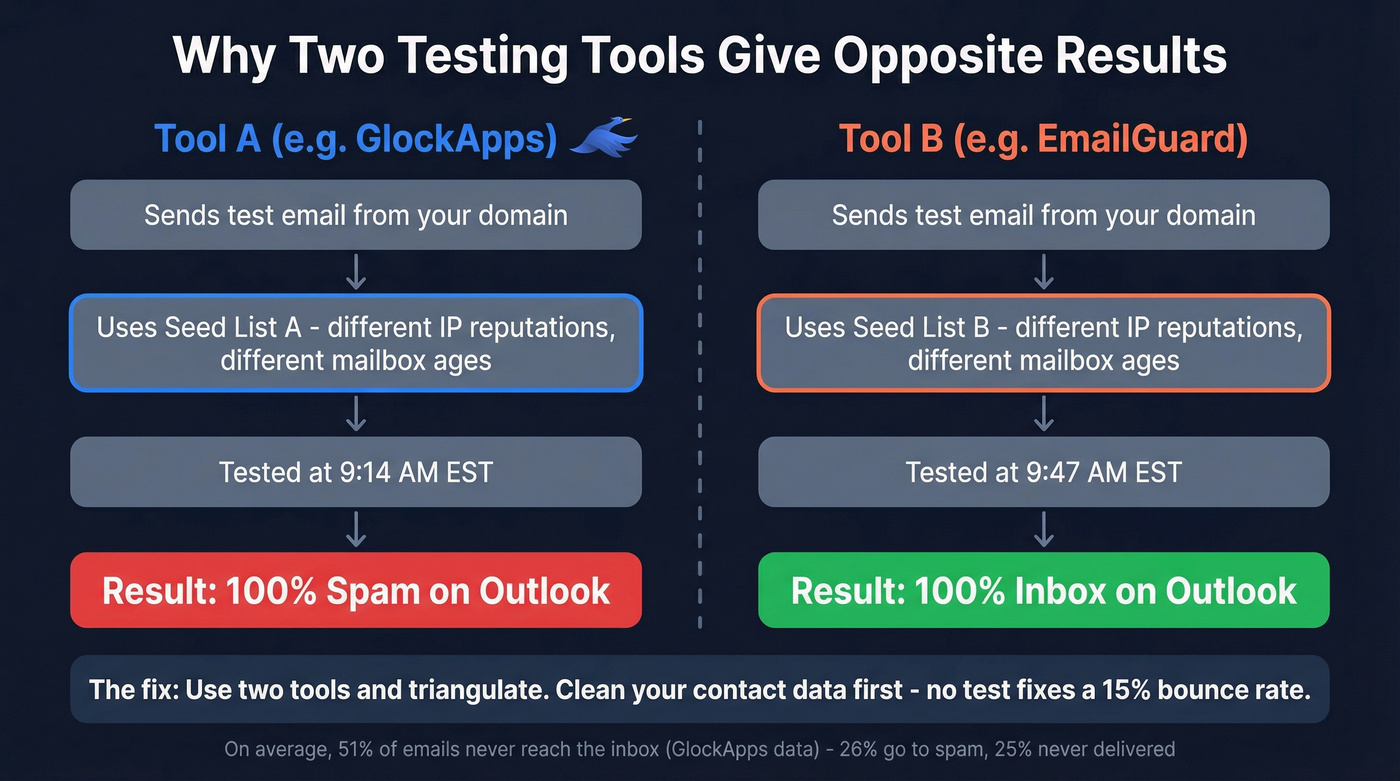
Every seed-based test sends a cold email to an address with zero engagement history - no opens, no clicks, no replies. Results skew pessimistic compared to your actual deliverability to real prospects who've interacted with your domain before.
This is exactly why that Reddit user saw opposite Outlook results from two tools. Different seed addresses, different IP reputations on the receiving end, different timing. The fix isn't finding the "right" tool - it's using two tools and triangulating. And it's making sure your contact data is clean before you send, because no amount of testing fixes a 15% bounce rate. In our experience, upstream verification matters more than which testing tool you pick.

Free Tools Worth Adding
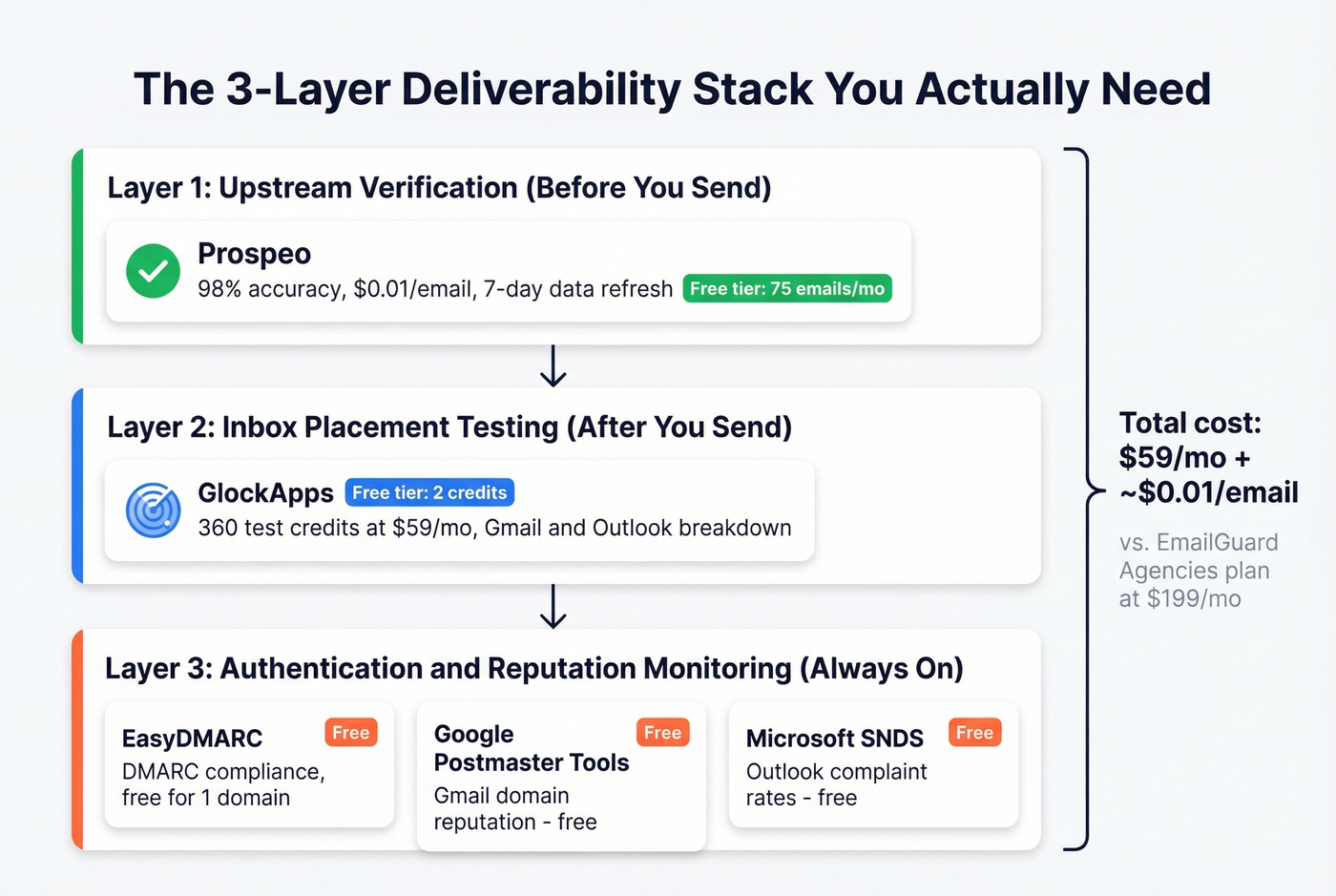
Don't overlook the free monitoring layer from major mailbox providers: Google Postmaster Tools for domain reputation and spam rates on Gmail, Microsoft SNDS for complaint rates on Outlook/Hotmail, and Yahoo Sender Hub for Yahoo Mail metrics. These aren't replacements for testing tools, but they're the ground truth that seed tests approximate.
If you want a deeper breakdown of what to monitor beyond seed tests, start with an email deliverability guide and then add a dedicated email reputation workflow.
FAQ
Is EmailGuard free?
EmailGuard offers a free tier limited to 1 domain, 3 email accounts, and 10 spam-filter tests per month. Paid plans range from roughly $49-$199/mo depending on tier. Most teams outgrow the free plan within weeks.
What's the best free alternative to EmailGuard?
GlockApps offers a free plan with 2 spam test credits and basic DMARC analytics. EasyDMARC's free tier covers 1 domain and 1,000 emails/month. For list verification, Prospeo's free plan includes 75 email verifications with full 5-step verification - the strongest option if bad data is your root cause.
Do I need both testing and verification?
Yes. Testing tools check where emails land after sending. Verification tools prevent the bounces and spam-trap hits that damage sender reputation in the first place. Skipping either leaves a gap - run both for reliable deliverability.